
Key takeaways
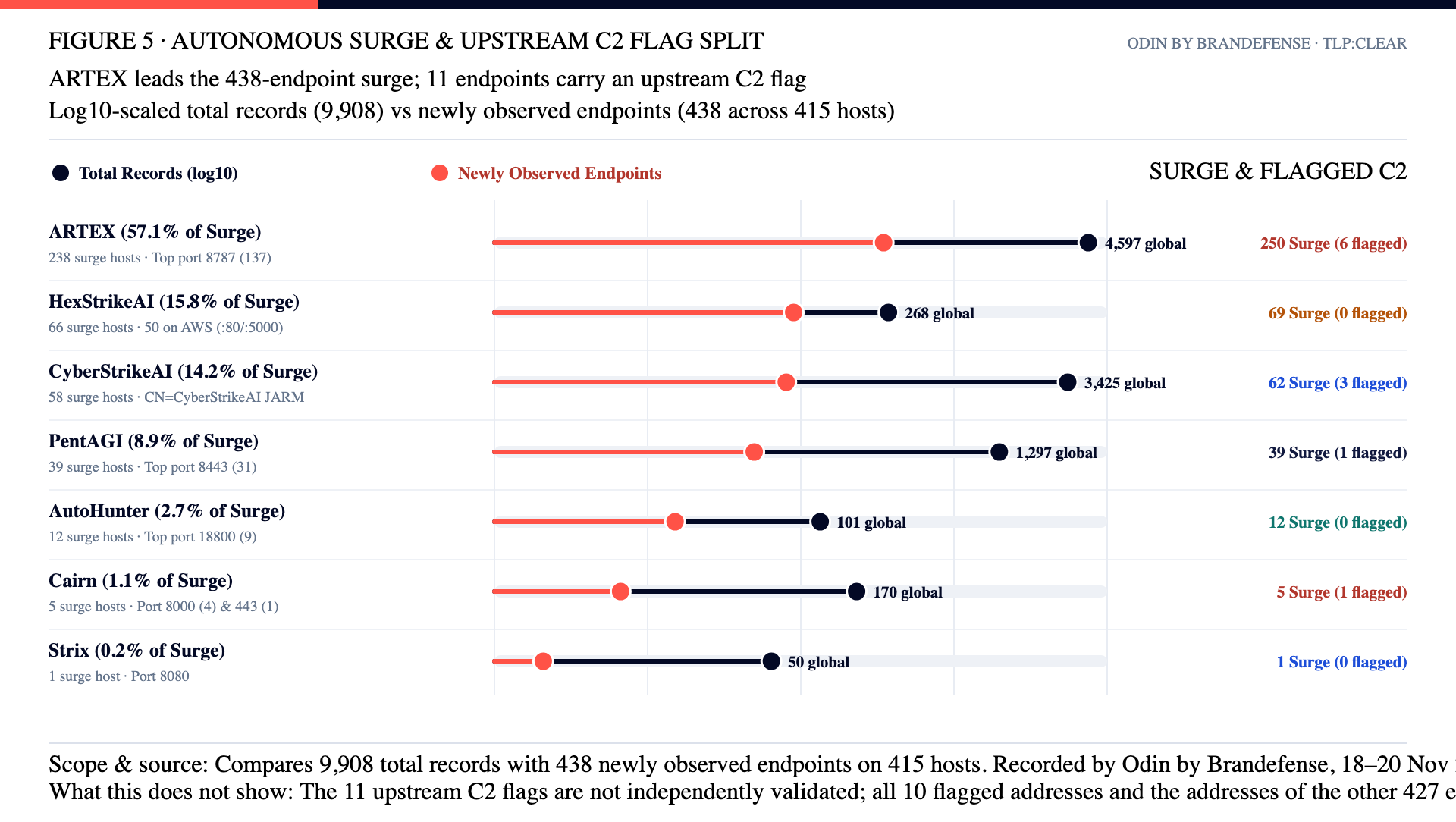
- Eleven of 438 new autonomous-offense endpoints on 10 dedicated addresses carry an upstream C2 flag without independent per-address validation; all 10 addresses are withheld.
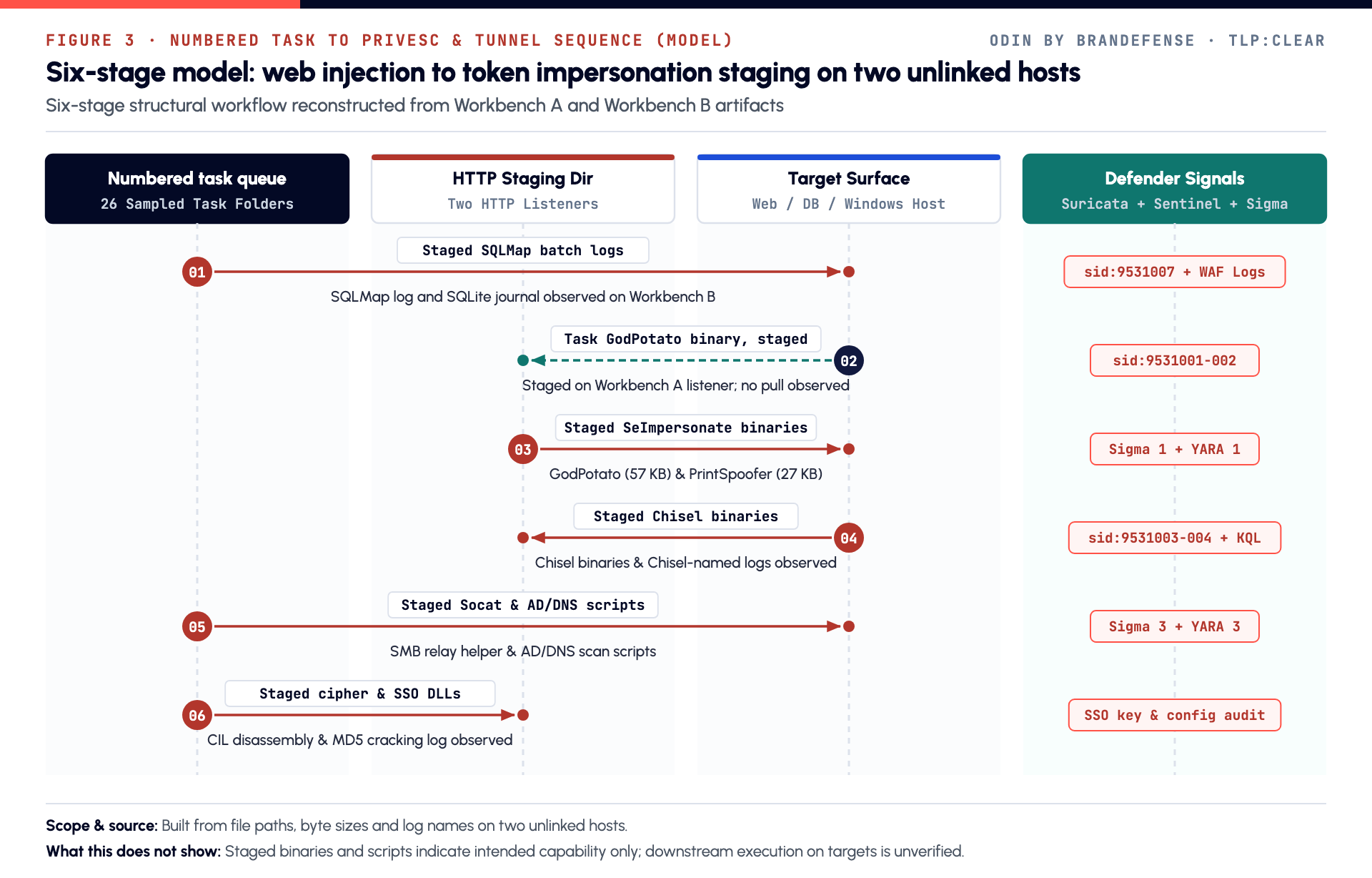
- One of 26 sampled numbered task folders holds GodPotato and PrintSpoofer binaries that match files at the root.
- Chisel tunnels, Socat SMB relays and an MS17-010 script prepare a path into internal Windows networks.
- A .NET single-sign-on cipher kit and MD5 cracking logs point at hard-coded application keys.
- Limit the impersonation right, retire SMBv1 and inspect outbound chisel-v3 WebSocket upgrades.
A 270-entry sample from one exposed web directory included 26 numbered task folders with Windows elevation tools, tunnels and application cipher files. From 18 to 20 November 2026, Odin by Brandefense also recorded 438 newly observed servers of seven autonomous-offense frameworks. The folder layout fits subagent staging, but neither workbench is linked to those servers. Defenders should review service-account rights, SMBv1, outbound tunnels and static SSO keys.
What are autonomous-offense frameworks, and how many did we see?
Frameworks such as ARTEX, CyberStrikeAI, HexStrikeAI and PentAGI let an operator hand a target to an AI-driven swarm. The swarm splits the job into many small tasks and runs each one with a separate worker, or subagent.
Of the 438 new endpoints, ARTEX accounts for 250 (57.1%). HexStrikeAI follows with 69 and CyberStrikeAI with 62. The servers sit mostly in the United States, Hong Kong and China, on large cloud and hosting networks.
Four hosts run two of these frameworks side by side, which shows how cheap it has become to deploy such a server.
A family label in threat intelligence tells you what software runs on a server, not who runs it. Developers, consultants and intruders all use these tools; cyber threat intelligence can help defenders assess the context. So we separate endpoints with an upstream C2 flag from the rest.
Eleven endpoints, on 10 dedicated addresses, carry an upstream command-and-control (C2) flag, though the study records do not independently validate that classification. Those 10 addresses and the addresses of the other 427 suspected or candidate endpoints are withheld.
What do the exposed task folders hold?
The first workbench serves 6,203 files, the kind of open web root external attack surface management flags on internet-facing hosts. The sampled tree includes files at the web root and in 26 numbered task folders.
Several task-folder files are byte for byte the same as files at the root, though the listing does not show which copy came first. Nothing in the listing names an agent framework; reading the folders as subagent tasks is our model.
Four groups of files stand out.
- Windows elevation tools. GodPotato and PrintSpoofer turn a low-privilege service account into full SYSTEM control. They need the "impersonate a client" right, which IIS web servers and SQL Server often hold.
- Tunnels and relays. Two builds of Chisel, a public tunnelling tool, can open a hidden SOCKS proxy from inside a network through a normal-looking WebSocket connection. Socat-named log files and an SMB helper script point to planned Windows file-sharing (SMB) relays on port 445.
- An old SMB exploit. A public MS17-010 script targets Windows servers that still run SMBv1 and miss a 2017 update for CVE-2017-0144.
- Single-sign-on cipher analysis. A .NET cipher library, seven third-party SSO modules, a disassembly of their code and MD5 cracking logs suggest an effort to recover hard-coded keys and passwords.
Each group maps to a control most Windows shops already own: account rights, SMB settings, egress inspection and secret storage. That is why the defensive steps below are short.
Other sampled folders hold OAuth and Microsoft Graph token files and short scripts for directory discovery. These are staged files. Nothing we saw confirms that any of them worked against a target.
What does the second workbench add?
The second workbench serves 1,970 files across three HTTP listeners. It holds a copy of sqlmap, the public SQL injection tool, and five sqlmap-named logs (3.49 MB).
Next to them sit two HTTP-named listener logs of 34.94 MB in total, though the listing does not include their contents. A listener like this can let a target database pull a second-stage file or call back to confirm an injection. Nothing ties this host to the first workbench. Together they illustrate both halves of a common pattern, on unrelated hosts: break in through the web, then climb and tunnel inside.
Are all these findings real threats?
Not all of them. Two kinds of noise matter for anyone who collects data from exposed servers.
First, nine files named like environment or Git configuration secrets turned out to be copies of two blank web-app pages. Many modern web apps return the same start page for any path. A worker that only checks for a "200 OK" saves that page under a secret-sounding name. Comparing file hashes catches this at once.
Second, none of the 438 new framework servers has independent per-address C2 validation in the study records. Blocking the addresses of all 438 endpoints would hit cloud customers who happen to reuse an address, or who run these tools for legitimate testing.
A contracted red team could also have left these folders open. Even so, serving SSO libraries and token files through unauthenticated services puts third parties at risk. We withhold both workbench addresses.
What to do now
- Deploy the YARA and behavioral rules in the full report's Detection rules tab, and treat banner or JARM hits as hunting leads until a certificate, URI or endpoint process corroborates them.
- Limit the impersonation right. Review which accounts hold
SeImpersonatePrivilege, run IIS and SQL Server as low-privilege managed accounts, and turn off Print Spooler on servers that do not print. - Retire SMBv1 and confirm the MS17-010 update is in place everywhere.
- Inspect outbound WebSocket traffic for the
chisel-v3header, and stop database and web servers from fetching files from raw IP addresses. - Remove hard-coded keys from custom single-sign-on components, use parameterized SQL, and block the
sqlmapuser agent at the WAF.
The 10 flagged C2 addresses and all workbench file hashes are withheld. The full report lists 4 text-only hunting selectors, and the full report's Detection rules tab has Suricata, Sentinel KQL, Sigma and YARA rules. The full report explains the sampled task folders, the tunnel chain and the rule logic in detail.
What is…?
Short explanations of the tools and families named in this study.
What is PrintSpoofer?
PrintSpoofer is a public Windows privilege escalation tool that abuses impersonation privileges to gain SYSTEM.
More about PrintSpooferAI offensive toolWhat is CyberStrikeAI?
CyberStrikeAI is a public AI-driven offensive security platform. It spreads its operator interface, API and agent listener across several ports on one host and exposes tools through MCP.
More about CyberStrikeAIAI offensive toolWhat is ARTEX?
ARTEX is an autonomous red-team console that chains AI agents and security tools. Operators fork and rebrand it; its default listener port is 8787.
More about ARTEXTechniqueWhat is JARM?
JARM is an open TLS server fingerprinting method from Salesforce. It hashes how a server answers a set of crafted TLS handshakes.
More about JARMAI offensive toolWhat is HexStrike AI?
HexStrikeAI is a public project that exposes many security tools to AI agents through the Model Context Protocol (MCP).
More about HexStrike AIAI offensive toolWhat is PentAGI?
PentAGI is an open-source autonomous penetration testing system that coordinates AI agents and security tools in containers.
More about PentAGIFrequently asked questions
What are autonomous-offense frameworks, and how many did we see?
Frameworks such as ARTEX, CyberStrikeAI, HexStrikeAI and PentAGI let an operator hand a target to an AI-driven swarm. The swarm splits the job into many small tasks and runs each one with a separate worker, or subagent.
What do the exposed task folders hold?
The first workbench serves 6,203 files, the kind of open web root external attack surface management flags on internet-facing hosts. The sampled tree includes files at the web root and in 26 numbered task folders.
What does the second workbench add?
The second workbench serves 1,970 files across three HTTP listeners. It holds a copy of sqlmap, the public SQL injection tool, and five sqlmap-named logs (3.49 MB). Next to them sit two HTTP-named listener logs of 34.94 MB in total, though the listing does not include their contents. A listener like this can let a target database pull a second-stage file or call back to confirm an injection.
Are all these findings real threats?
Not all of them. Two kinds of noise matter for anyone who collects data from exposed servers. First, nine files named like environment or Git configuration secrets turned out to be copies of two blank web-app pages. Many modern web apps return the same start page for any path. A worker that only checks for a "200 OK" saves that page under a secret-sounding name. Comparing file hashes catches this at once.