
1. Executive Summary
In short
An exposed Netherlands workbench held four differently sized copies of a GPU marketplace bidding script. It was catalogued separately from the two-week relay observation window ending 18 November 2026. The same directory stages AmneziaWG, WireGuard, X-UI and FRP tunnel tooling. Separately, we reviewed 624 tunnel, redirector and C2 endpoints on 263 hosts. Only 65 are confirmed C2 or SOCKS5 relays. Hunt obfuscated tunnel tools outside approved bastions, and block only corroborated relays.
Tools built to slip past deep packet inspection (DPI) or network address translation now serve three kinds of user. Privacy users, grey-market compute traders and intrusion operators all run the same AmneziaWG, X-UI, FRP and GOST stacks. This report looks at both ends.
One exposed workbench holds these tools together; its owner's activity is unconfirmed. Defenders can use cyber threat intelligence to review the wider set of 624 relay endpoints and decide which ones belong on a block list.
A GPU bidding bot shares one directory with four tunnel tools.
An open web directory in the Netherlands holds 45 entries. Four similarly named Python files appear designed to bid on spot GPU rentals on a legitimate marketplace. Next to them sit AmneziaWG and WireGuard installers, client profiles, an X-UI panel archive and Fast Reverse Proxy (FRP) binaries.
Default certificates and shared ports explain most relay noise.
Of 624 endpoints, 510 carry the HypeAgent feed label. Of those, 158 serve only the default Kubernetes ingress certificate and 297 sit on 19 multi-port reverse-proxy hosts, 278 of them on three hubs. Only nine present the default certificate of the GOST tunnel tool.
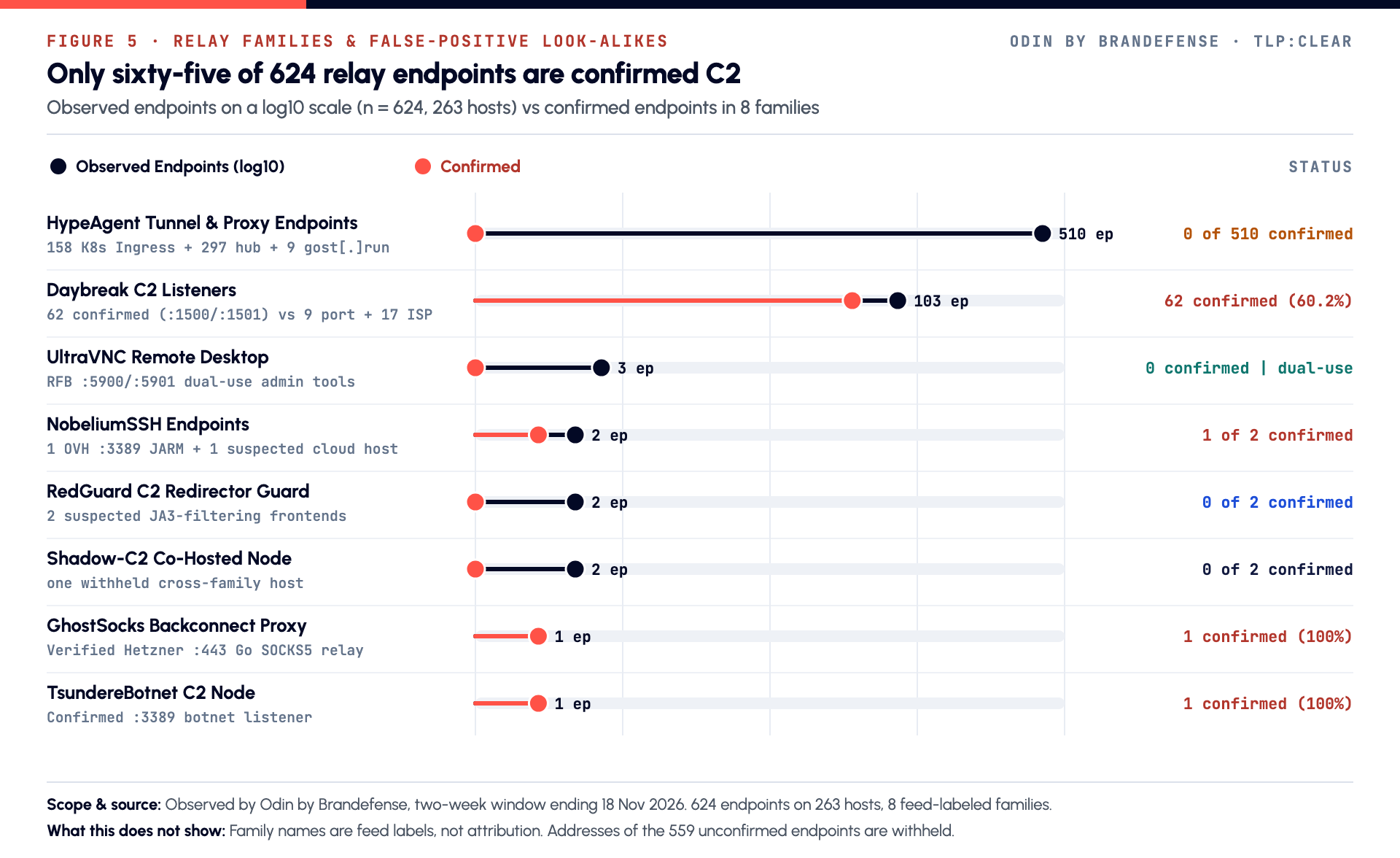
Only 65 of 624 endpoints are confirmed C2 or SOCKS5 relays.
They sit on 49 commercial hosting addresses. Paired Daybreak listeners on ports 1500 and 1501 lead the group, with one GhostSocks relay. A feed marks 29 more endpoints as confirmed, but they sit on mail ports, carrier networks or remote-desktop servers.
Three Decisions for Leaders
- Govern egress to GPU marketplaces and obfuscated VPNs. Unapproved Python polling of GPU rental APIs and UDP or TLS tunnels that hide WireGuard headers should only run from named bastions.
- Keep look-alikes off automated block lists. Default Kubernetes certificates, mail and database ports, dynamic carrier networks and dual-use VNC servers cause outages when blocked on a feed label alone.
- Hunt fingerprints, not port numbers. Pair tunnel binaries on hosts with the certificate subjects and JARM values in this report.
The Study in Numbers
| Number | What it is |
|---|---|
| 45 | Entries in one exposed workbench directory (108.88 MB, 37 unique SHA-256 digests) |
| 4 | Differently sized copies of the GPU marketplace bidding script, from 9,417 to 11,438 bytes |
| 4 | Tunnel tools staged together: AmneziaWG, WireGuard, X-UI and FRP |
| 624 | Tunnel, redirector and C2 endpoints on 263 hosts, in eight feed-labeled families |
| 158 | Endpoints that serve only the default Kubernetes ingress certificate |
| 65 | Confirmed C2 and SOCKS5 endpoints on 49 addresses (10.4% of 624) |
| 29 | Endpoints a feed marks confirmed that sit on mail ports, carrier networks or VNC servers |
How to use this report.
Security leaders can read Chapters 1, 6 and 7. Cloud, network and ML platform teams should read Chapters 3 and 4. SOC and detection engineers should start with Chapters 8 and 9. CTI analysts will find the relay families in Chapters 5 and 6.
2. What Was Found: One Workbench and 624 Relay Endpoints
In short
Two separate sets of evidence sit side by side in this report. No address, certificate or file hash links the workbench to the 624 relay endpoints, so the combined picture is an analytical model.
Censorship-evasion protocols and reverse proxies blur the line between privacy tools, compute automation and C2 relays. AmneziaWG and X-UI defeat state DPI. FRP and GOST cross NAT boundaries. All four turn up on personal VPS nodes, GPU rental bots and multi-tier C2 redirectors alike (T1572, T1090.002).
We looked at two sets of evidence. The first is one exposed workbench directory. The second is 624 endpoints on 263 hosts that public feeds label as tunnel, redirector or C2 infrastructure.
No shared address, certificate or file digest connects the two. Inside the relay set, only one Hong Kong host spans two feed families.
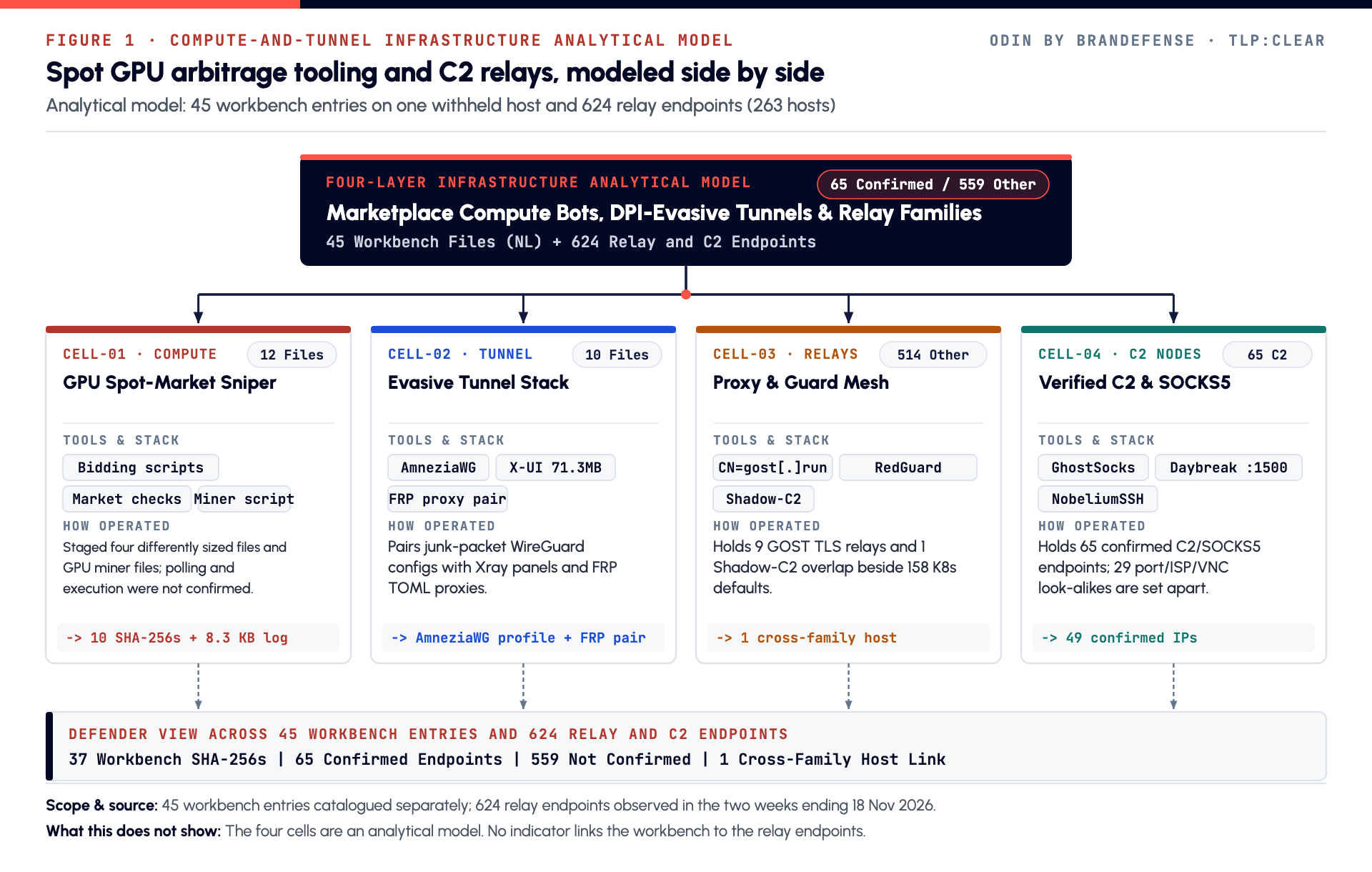
The workbench in five layers
Defenders can use external attack surface management to find open directories like the one on a Netherlands host that exposed 45 entries over plain HTTP. Forty entries list a size, adding up to 108,883,402 bytes (108.88 MB). Five lock, marker and helper entries list no size.
Thirty-nine entries carry SHA-256 digests, 37 of them unique. Files on the server carry timestamps from as early as 2 August 2026. The host address is withheld.
| Layer | Entries | Hashed / unique | Bytes | Main contents |
|---|---|---|---|---|
| GPU marketplace sniper | 8 | 8 / 7 | 64,889 | Bidding files, a market-check helper and an output log (names and paths withheld) |
| GPU workload provisioning | 4 | 3 / 3 | 99,817 | Runtime install script, miner launcher, node-layout file and screen helper (names and paths withheld) |
| DPI-evasive tunnel stack | 10 | 9 / 9 | 108,653,689 | X-UI panel archive, AmneziaWG and WireGuard installers, FRP binaries and TOML configs (names and paths withheld) |
| Shell and SSH state | 9 | 9 / 9 | 54,147 | Shell history, SSH key material, SSH host-key list (names and paths withheld) |
| Container and shell metadata | 14 | 10 / 9 | 10,860 | Docker Buildx files, shell profiles, caches, lock files (names and paths withheld) |
The relay set in eight families
The 624 endpoints come from eight families. The family names are the feeds' own labels. They describe matching network patterns, not attributed threat groups.
| Feed family label | Endpoints | Hosts | Confirmed | Share of 624 |
|---|---|---|---|---|
| HypeAgent | 510 | 171 | 0 | 81.7% |
| Daybreak | 103 | 83 | 62 | 16.5% |
| UltraVNC | 3 | 3 | 0 | 0.5% |
| NobeliumSSH | 2 | 2 | 1 | 0.3% |
| RedGuard | 2 | 2 | 0 | 0.3% |
| Shadow-C2 | 2 | 1 | 0 | 0.3% |
| GhostSocks | 1 | 1 | 1 | 0.2% |
| TsundereBotnet | 1 | 1 | 1 | 0.2% |
3. The GPU Marketplace Sniper and Its Workload Scripts
In short
Four similarly named Python files and two helper scripts sit in the exposed directory alongside a log file. Shell scripts beside them are named to prepare GPU machines for compute or mining jobs.
Decentralized compute marketplaces let hardware owners rent out idle GPUs for machine learning, rendering and other jobs. Clore[.]ai is one of them, and it is a legitimate service. Spot prices move as machines come online. So "sniper" scripts poll the order book fast and grab cheap GPUs before other bidders do.
Compute arbitrage can serve a business or a mining operation. Inside an enterprise, a bidding bot on stolen credentials or a rogue cloud workload brings shadow billing and policy risk (T1583.003).
We worked only from file names, sizes, extensions and hashes. We did not run any script and did not touch any marketplace account. Nothing here shows whether a GPU lease was won.
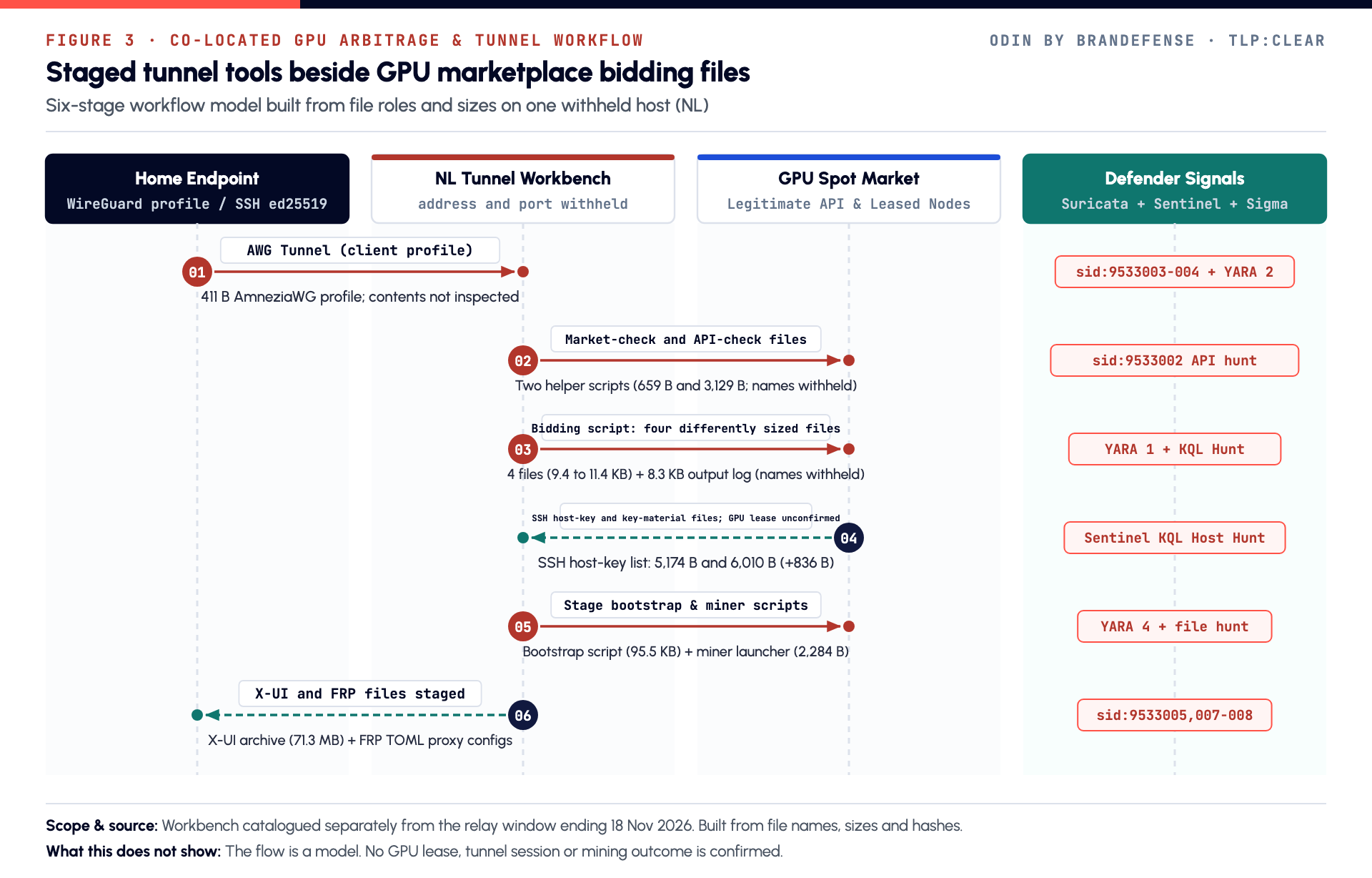
Four differently sized sniper files
The directory contains an editor search history and an editor choice file. Four similarly named Python files differ in size; their editing order and changes were not established.
| File label | File | Size (bytes) | Notes |
|---|---|---|---|
| File A (order unknown) | Name withheld | 9,417 | Contents and changes uninspected |
| File B (order unknown) | Name withheld | 10,626 | Contents and changes uninspected |
| Files C and D (order unknown) | Names withheld (two identical copies) | 10,659 each | Contents and changes uninspected |
| File E (order unknown) | Name withheld | 11,438 | Contents and changes uninspected |
Two smaller Python helper scripts (659 bytes and 3,129 bytes, names withheld) are named for market and API checks. An output log (8,302 bytes, name withheld) sits beside them; their contents and use were not established.
Workload scripts and SSH footprint
A cheap GPU lease only pays off if the job starts before a higher bidder takes the machine. Four provisioning files sit next to the sniper.
| File | Size (bytes) | Role |
|---|---|---|
| Bootstrap script (name withheld) | 95,521 | Runtime and driver bootstrap script |
| Miner launcher (name withheld) | 2,284 | GPU compute or mining launcher |
| Layout file (name withheld) | 2,012 | Node and service layout JSON file |
| Screen helper (name withheld) | no listed size | Screen helper for the miner |
The SSH host-key list file (path withheld) grew from 5,174 bytes in its older copy to 6,010 bytes, an increase of 836 bytes. The entries were not inspected, so the added bytes do not establish which hosts were contacted or whether a GPU lease occurred. The directory also exposes an Ed25519 private key and an authorized-keys file (paths withheld). We publish no key material and no hashes of these files.
4. Four Tunnel Tools on One Host: AmneziaWG, WireGuard, X-UI and FRP
In short
Ten tunnel files make up 99.8% of the workbench bytes. Together they cover UDP header obfuscation, TLS proxy panels and NAT reverse proxies, so no single-protocol control catches them all.
Plain VPN handshakes and cleartext SSH flows are throttled or blocked by many ISPs, enterprise perimeters and national DPI firewalls. The workbench owner staged four tunnel technologies in one root directory, next to a 42,084-byte shell history.
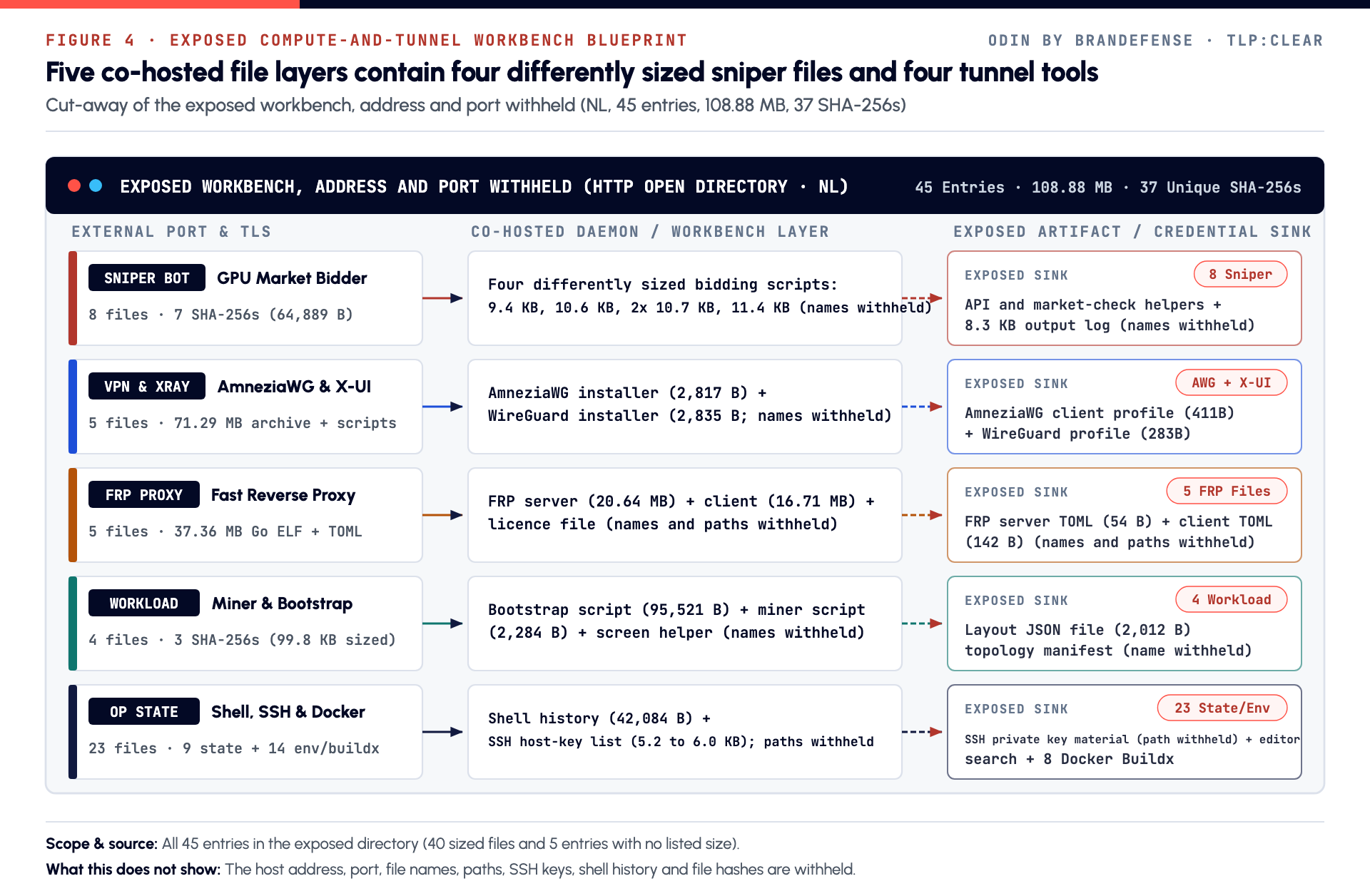
WireGuard and AmneziaWG staged together
Standard WireGuard uses fixed message type values (1 to 4) and fixed-length handshake messages. Per the AmneziaWG documentation (Source 2), these are 148 bytes to start, 92 bytes to reply and 64 bytes for a cookie. Source 1 gives the field layouts. DPI engines fingerprint and drop those predictable packets easily.
The workbench holds both a WireGuard installer script (2,835 bytes, name withheld) and an AmneziaWG installer script (2,817 bytes, name withheld). That pairing shows both installers were staged; their order of use is unknown. AmneziaWG keeps WireGuard's cryptography and adds settings that change what the packets look like on the wire.
| AmneziaWG setting | What it does |
|---|---|
Jc, Jmin, Jmax | Sends a number of random junk packets of random length before the handshake |
S1, S2 | Adds random padding in front of handshake messages |
H1 to H4 | Replaces the fixed message type values 1 to 4 |
Two client profiles fit this picture. A plain WireGuard profile is 283 bytes. An AmneziaWG profile in a client-profile subfolder (path withheld) is 411 bytes.
The 128-byte difference is consistent with additional settings, but the catalogue does not establish the profiles' contents. Both profile names point to the owner's own home machine, so we do not publish them.
X-UI, FRP and the shell trail
When UDP is blocked outright, users fall back to TLS tunnels and reverse port forwarding. Six more tunnel files cover that path.
| File | Size (bytes) | What it is |
|---|---|---|
| X-UI panel archive (name withheld) | 71,288,093 | X-UI web panel archive for multi-user Xray-core tunnels (VLESS, VMess, Trojan, Shadowsocks) |
| FRP server binary (name and path withheld) | 20,639,928 | FRP server, Go ELF binary |
| FRP client binary (name and path withheld) | 16,707,768 | FRP client, Go ELF binary |
| Licence file (name and path withheld) | 11,358 | Apache-2.0 licence shipped with FRP |
| FRP client config (name and path withheld) | 142 | 142-byte client TOML config |
| FRP server config (name and path withheld) | 54 | 54-byte minimal server TOML config |
FRP introduced TOML configuration in version 0.52.0; the directory metadata does not establish the staged binaries' version. A reverse proxy of this kind exposes a GPU or management port that sits behind NAT.
Eight Docker Buildx and token-seed files and the shell history show container builds and interactive administration on the host. All of it was readable over plain HTTP.
5. Relay and C2 Families: GOST, Daybreak, GhostSocks and RedGuard
In short
Intrusion operators use the same kinds of Go tunnels, filtering redirectors and paired listeners to shield their controllers. Certificate subjects and JARM pairs separate real relays from cloud noise better than port numbers.
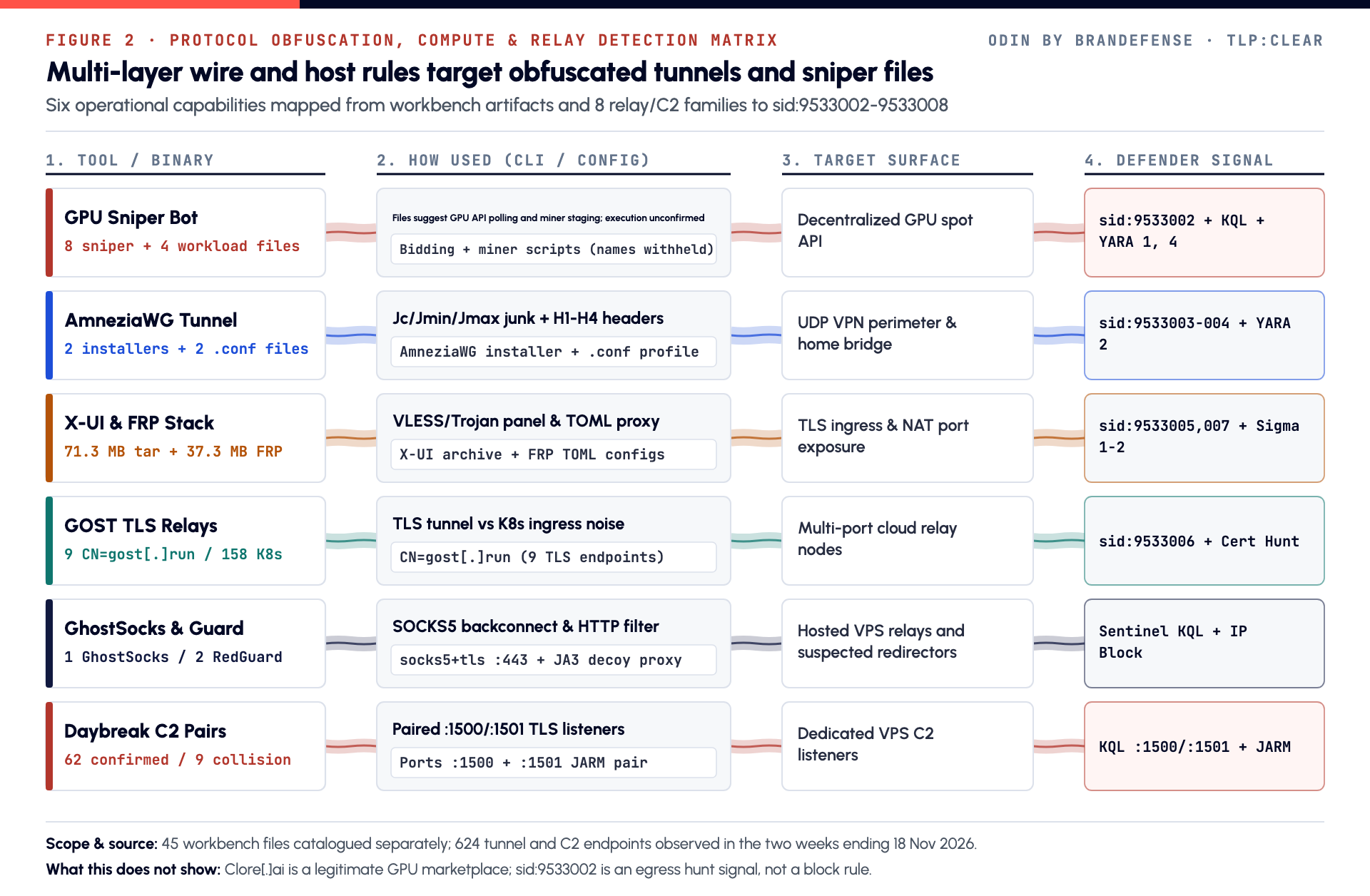
Operators hide their back-end controllers behind Go tunnels (GOST and GhostSocks), traffic-filtering HTTP redirectors (RedGuard) and dual-port C2 listeners (Daybreak). Figure 2 maps each capability in this report to the detection rules in Chapter 8.
HypeAgent: three populations, nine GOST relays
HypeAgent makes up 81.7% of the relay set: 510 endpoints on 171 hosts. The feed marks every one of them as suspected, and none is confirmed. Three distinct groups explain 464 of the 510 endpoints (91.0%).
| HypeAgent group | Endpoints | Hosts | What it is |
|---|---|---|---|
| Multi-port reverse-proxy hubs | 297 | 19 | Per-port certificates on cloud proxy hubs. Three Tencent Cloud hubs with 161, 91 and 26 ports produce 278 rows (54.5% of HypeAgent). |
| Default Kubernetes ingress | 158 | 109 | CN=Kubernetes_Ingress_Controller_Cert on major cloud providers. 71 share the default ingress-nginx JARM. |
| GOST TLS relays | 9 | 6 | CN=gost[.]run, the default self-signed certificate of the GOST tunnel tool (Source 10) |
The 109 Kubernetes hosts are 63.7% of the 171 HypeAgent hosts. Their 158 endpoints run ordinary ingress controllers that happen to match a broad Go and TLS pattern.
The nine GOST endpoints sit on six suspected hosts across nine distinct service ports (ports withheld). One withheld Hong Kong host spans the GOST and Shadow-C2 feed families. Its address and service ports are withheld.
Daybreak: paired listeners on ports 1500 and 1501
Daybreak accounts for 62 of the 65 confirmed endpoints, on 46 commercial VPS addresses. Of these, 43 (69.4%) listen on port 1500 (27 rows) or port 1501 (16 rows). Each port has its own stable JARM value, listed in Chapter 9.
The other 19 confirmed Daybreak endpoints sit on 17 hosts. They use HTTPS and proxy ports such as 443, 80 and 10003. Their certificates carry names such as rsproxy, allproxy, ldlr-redirect and litescrape-executor.
GhostSocks, NobeliumSSH, TsundereBotnet and RedGuard
| Family | Confirmed | What we saw |
|---|---|---|
| GhostSocks | 1 | A Go reverse SOCKS5 relay over TLS on a Hetzner server, port 443 |
| NobeliumSSH | 1 of 2 | One OVH server on port 3389 with certificate CN=server33916; one suspected cloud host (address and port withheld) |
| TsundereBotnet | 1 | One listener on port 3389 |
| RedGuard | 0 of 2 | Two suspected redirectors in China and the United States (addresses and ports withheld) |
GhostSocks gives an operator a reverse SOCKS5 tunnel (RFC 1928) wrapped in TLS. RedGuard is a C2 front-end guard.
It checks the JA3 fingerprint and HTTP Host header of each visitor, and sends unwanted visitors to a harmless decoy site (Source 11). The NobeliumSSH name is a feed label only. Nothing here ties these hosts to any named state group.
6. Look-Alikes That Should Not Be Blocked, and Other Explanations
In short
Blocking every endpoint a feed calls confirmed would hit mail servers, carrier customers and IT admin tools. Keep 559 of the 624 endpoints on review lists, and block only the 65 confirmed relays.
Raw feeds mix up shared reverse-proxy certificates, mail and database services on reused VPS addresses, and normal admin tools with real C2 servers. Of the 624 endpoints, 65 (10.4%) are confirmed. The other 559 (89.6%) stay unpublished.
Why 29 feed-confirmed endpoints are not on the block list
The feeds mark 94 endpoints as confirmed. Of these, 29 (30.9%) belong to one of three look-alike groups. Blocking them would cause outages without stopping an operator.
| Look-alike group | Endpoints | Why it is not blocked |
|---|---|---|
| Daybreak label on mail, database and FTP ports | 9 | Ports 587 (2), 465 (2), 5432 (2), 21, 143 and 993 host normal services |
| Daybreak label on dynamic carrier networks | 17 | Addresses on subscriber networks are reassigned to new customers |
| UltraVNC servers on ports 5900 and 5901 | 3 | UltraVNC is a common remote-desktop tool for IT staff |
Across the whole set, 27 endpoints sit on dynamic carrier networks: 17 Daybreak and 10 HypeAgent. Six more Daybreak endpoints are candidates only. Five of them carry breach-and-attack-simulation listener certificates, and one is a home NAS.
| Group | Endpoints | Addresses | Status |
|---|---|---|---|
| Confirmed C2 and SOCKS5 relays | 65 | 49 | Block |
| Suspected | 514 | 183 | Review, address withheld |
| Dynamic carrier networks | 27 | 23 | Review, address withheld |
| Mail, database and FTP ports | 9 | 8 | Review, address withheld |
| Candidates | 6 | 6 | Review, address withheld |
| Dual-use VNC | 3 | 3 | Review, address withheld |
Four ways to read the evidence
- A compute trader, not an intruder. The sniper, miner script and tunnel stack may belong to an independent GPU trader working around regional DPI. Nothing links this host to any intrusion. We treat its owner as a user, not an operator, and withhold its address, port, file names and file hashes.
- Normal services on shared ports. Nine Daybreak-labeled endpoints run on SMTP, IMAP, PostgreSQL and FTP ports. Blocking them risks mail and database outages.
- Kubernetes and simulation tools. Default ingress certificates and breach-and-attack-simulation listeners match broad Go and TLS patterns. They are not C2 servers.
- Carrier churn and dual-use VNC. Carrier addresses move between customers, and UltraVNC supports normal IT work. Both stay on time-limited review lists instead of block lists.
7. What Defenders Should Do
Network and SOC
- Alert on AmneziaWG (
amneziawg-go,awg-quick), X-UI, FRP (frpc,frps), GOST and GhostSocks processes outside named bastions with Sigma rules 1 and 2. Use Suricata SIDs 9533003 to 9533007 for network retrievals and the GOST certificate. - Hunt
CN=gost[.]runcertificates and the paired Daybreak JARM values on ports 1500 and 1501.
Cloud and ML platform
- Audit outbound traffic from corporate and cloud networks to GPU rental APIs such as
api.clore[.]ai(SID 9533002). Require job approval on GPU clusters. - Hunt GPU bidding and miner launch scripts on compute nodes with the YARA rules and Linux process logs.
Threat intelligence
- Before any feed reaches an automated block list, strip default Kubernetes ingress certificates and mail, database and FTP ports (21, 143, 465, 587, 993, 3306, 5432). Strip dynamic carrier networks and UltraVNC on ports 5900 and 5901 as well.
- Require an independent second signal before blocking any feed-labelled relay address at the perimeter for 30 days. Recheck the hosting lease before extending a block.
Attack surface and endpoints
- Find open HTTP directory listings on your own address space. SID 9533008 fires when a server on your network returns a Python
http.server("Directory listing for /") or Nginxautoindex on("Index of /") listing that names these tunnel tools. Look for exposed SSH keys, shell history and.tomlor.conftunnel files. - Scan Linux developer workstations, jump hosts and container build caches with the YARA rules for AmneziaWG profiles and FRP TOML files.
8. Detection Rules
The full rules are in the Detection rules tab. Suricata, YARA and Sigma engines were not available to us, so the rules were not loaded on live engines. The Suricata file passes a syntax lint with 0 problems. Test every rule in your own environment before production use.
| Rule file | What it catches |
|---|---|
odin_gpu_sniper_amneziawg_xui_and_ghostsocks.rules | Suricata 7: seven signatures for Python polling of the GPU marketplace API, AmneziaWG, X-UI and FRP downloads, the GOST certificate and open tunnel-tool directory listings |
sentinel_gpu_sniper_amneziawg_xui_and_socks_hunt.kql | Microsoft Sentinel and Defender XDR: tunnel, marketplace-API and miner processes joined with connections to corroborated relays, ports 1500 and 1501, or the marketplace API |
sigma_amneziawg_xui_frp_and_gpu_miner_staging.yml | Sigma (2 rules): AmneziaWG and X-UI processes, and FRP, GOST and GhostSocks processes on Linux |
odin_gpu_sniper_amneziawg_xui_and_frp_stack.yar | YARA (4 rules): GPU marketplace bidding scripts, AmneziaWG profiles, FRP TOML configs and GPU miner launch scripts |
How the Suricata signatures work
| SID | Looks for | Why |
|---|---|---|
| 9533002 | Host api.clore[.]ai with a python-requests user agent | Hunt only: flags scripted polling of a legitimate marketplace (needs TLS inspection) |
| 9533003 | Outbound GET for an AmneziaWG .sh, .tar.gz, .deb or .rpm file | Catches download of an AmneziaWG installer or package |
| 9533004 | Outbound GET for an AmneziaWG .conf client profile | Catches download of an AmneziaWG client profile |
| 9533005 | Outbound GET for an x-ui archive whose URI ends .tar.gz | Catches download of the X-UI panel |
| 9533006 | Server certificate subject CN=gost[.]run | Flags a GOST tunnel using its default certificate |
| 9533007 | Outbound GET for frpc or frps, with or without .toml | Catches download of FRP binaries or configs |
| 9533008 | A 200 Python http.server or Nginx autoindex listing served from your network that names AmneziaWG, X-UI, FRP or GhostSocks | Flags an open directory exposing tunnel tooling on your own hosts |
Keep SID 9533002 in alert-only mode, because the marketplace is legitimate. Add pass rules for approved ML sandboxes and for any authorized GOST test relays (SID 9533006).
How the other rules work
The KQL query looks back 7 days. Its process side finds amneziawg-go, awg-quick, x-ui, frpc, frps, gost or ghostsocks, or command lines naming the marketplace API, mining pool URLs or tunnel config files. Its network side finds connections to a defender-supplied list of corroborated relay addresses, to the marketplace API or gost[.]run, or non-browser traffic to ports 1500 and 1501. All of these network matches are kept after the join, including those with no matching process.
A full outer join on the device ties the two sides together. Each match gets one of four labels. Defenders can isolate corroborated relay contact, hunt command lines combining marketplace or miner and tunnel markers, or review port-pair and marketplace traffic.
Two named lists hold exact hostnames of approved GPU schedulers and network bastions. There are no wildcards. Exclude internal ERP traffic on ports 1500 and 1501 when tuning.
The two Sigma rules read Linux process creation logs. Rule 1 flags AmneziaWG and X-UI binaries and install paths. Rule 2 flags FRP, GOST and GhostSocks binaries, FRP TOML config names and socks5+tls:// or socks5+wss:// arguments.
Each rule excludes two exact hostnames in a Computer field; map it to your backend's hostname field. For GPU bidding or miner launch scripts on Linux hosts, defenders should also hunt command lines that call marketplace APIs or stratum+ pools outside approved schedulers (T1583.003).
| YARA rule | Fires when |
|---|---|
ODIN_Clore_GPU_Marketplace_Sniper_Script | The marketplace API host appears with two order, spot, marketplace or auth markers, in files under 128 KB |
ODIN_AmneziaWG_Obfuscated_Tunnel_Config_or_Installer | An [Interface] block or AmneziaWG name appears with Jc, Jmin, Jmax and H1 or S1, in files under 64 KB |
ODIN_FRP_TOML_Reverse_Proxy_Config_Artifact | serverAddr and serverPort appear with one of [[proxies]], remotePort or auth.token, or bindPort appears with auth.token, in files under 64 KB. A server config with bindPort only does not match |
ODIN_Compute_Tunnel_Workbench_Manifest_or_Miner_Script | A stratum+ pool URL appears with nvidia-smi or --algo, in files under 256 KB |
MITRE ATT&CK mapping
| Tactic | Technique | How it shows up | Detection |
|---|---|---|---|
| Command and Control | T1572 Protocol Tunneling | AmneziaWG, X-UI, FRP and GOST tunnels | SIDs 9533003 to 9533007; Sigma rules 1 and 2; KQL |
| Command and Control | T1090.002 Proxy: External Proxy | GhostSocks SOCKS5 relays, RedGuard redirectors and Daybreak listeners | SID 9533006; KQL |
| Resource Development | T1583.003 Acquire Infrastructure: Virtual Private Server | Rented VPS relays and leased GPU nodes | SID 9533002; YARA rules 1 and 4; KQL |
9. Indicators
The Indicators tab holds 2 published indicators: 2 JARM fingerprints. No network addresses, workbench file names or file hashes are published. The certificate names below stay in this report only.
| Type | Count | Where to use it |
|---|---|---|
| Network addresses (withheld) | 0 | Withheld pending an independent second signal; do not block |
| JARM fingerprints | 2 | TLS hunting on ports 1500 and 1501 |
| Certificate subjects | 6 | TLS inspection and certificate search (text only) |
| Workbench file names and hashes (withheld) | 0 | Withheld because the workbench owner is not confirmed as an adversary |
Confirmed relay addresses
Eight feed-labelled relay addresses are withheld pending an independent second signal for each exact address. Do not block them.
Fingerprints and certificate subjects
| Indicator | Type | Use |
|---|---|---|
21d14d00021d21d21c42d43d00041d0eea9d6a7e6a07bccd28e28ed272ad91 | JARM, Daybreak port 1500 | Hunt with the port and certificate, do not block alone |
3fd3fd0003fd3fd00042d42d00000000f78d2dc0ce6e5bbc5b8149a4872356 | JARM, Daybreak port 1501 | Hunt with the port and certificate, do not block alone |
CN=gost[.]run | Certificate subject, GOST default | Hunt; seen on 9 endpoints on 6 hosts |
rsproxy, allproxy, ldlr-redirect, litescrape-executor | Certificate names, Daybreak HTTPS servers | Hunt in TLS logs |
server33916 | Certificate name, NobeliumSSH server | Hunt in TLS logs |
29d29d00029d29d00042d42d00000023f2ae7180b8a0816654f2296c007d93 | JARM, default ingress-nginx | Benign default; suppress, never block |
Withheld: the workbench address, port, file names, paths and all 37 unique file hashes from the workbench. Also withheld: the eight feed-labelled relay addresses, the other relay addresses, the Hong Kong cross-family host and its ports, and the reverse-proxy hubs. The two client profile names are withheld because they describe the owner's home machine.
10. Scope and Limits
- Window. The relay findings cover a two-week observation window ending 18 November 2026. The workbench was catalogued separately; older dates are timestamps on its files.
- Files, not outcomes. We worked from file names, sizes and hashes. We did not run any script, use any key or contact the marketplace. Nothing confirms a GPU lease, a tunnel session or a mining job.
- Owner, not operator. The workbench may belong to an independent compute trader. Nothing links it to an intrusion.
- One model, two data sets. No address, certificate or hash links the workbench to the relay endpoints. The combined view is an analytical model.
- Feed labels are not attribution. HypeAgent, Daybreak, NobeliumSSH, RedGuard and the other family names come from feeds. They do not name a threat group.
- Rule testing. Suricata, YARA and Sigma engines were not available, so the rules were not loaded on live engines. The Suricata file passes a syntax lint. Test and tune all rules in your own environment.
11. Sources
- WireGuard. Protocol and Cryptography. https://www.wireguard.com/protocol/ (verified 20 November 2026)
- Amnezia. AmneziaWG documentation. https://docs.amnezia.org/documentation/amnezia-wg/ (verified 20 November 2026)
- IETF. RFC 1928: SOCKS Protocol Version 5. https://datatracker.ietf.org/doc/html/rfc1928 (verified 20 November 2026)
- Kubernetes ingress-nginx. TLS/HTTPS user guide (default self-signed certificate). https://kubernetes.github.io/ingress-nginx/user-guide/tls/ (verified 20 November 2026)
- MITRE ATT&CK. T1583.003 Acquire Infrastructure: Virtual Private Server. https://attack.mitre.org/techniques/T1583/003/ (verified 20 November 2026)
- MITRE ATT&CK. T1572 Protocol Tunneling. https://attack.mitre.org/techniques/T1572/ (verified 20 November 2026)
- MITRE ATT&CK. T1090.002 Proxy: External Proxy. https://attack.mitre.org/techniques/T1090/002/ (verified 20 November 2026)
- Salesforce. JARM active TLS server fingerprinting. https://github.com/salesforce/jarm (verified 20 November 2026)
- fatedier/frp. FRP README, TOML configuration since v0.52.0. https://github.com/fatedier/frp (verified 20 November 2026)
- GOST. TLS tutorial. https://gost.run/en/tutorials/tls/ (verified 20 November 2026)
- wikiZ/RedGuard. README. https://github.com/wikiZ/RedGuard (verified 20 November 2026)
What is…?
Short explanations of the tools and families named in this study.
What is FRP?
Fast Reverse Proxy (FRP) is an open-source tool that exposes services behind NAT through a public relay server.
More about FRPDetection heuristicWhat is Daybreak?
Daybreak is a public JA4X-based C2 heuristic. On port 3306 it also matches ordinary MySQL servers, which makes it a well-known source of false positives.
More about DaybreakTechniqueWhat is JARM?
JARM is an open TLS server fingerprinting method from Salesforce. It hashes how a server answers a set of crafted TLS handshakes.
More about JARMFeed labelWhat is HypeAgent?
HypeAgent is a C2 family label used in threat feeds. Many endpoints with this label present a default Kubernetes ingress certificate.
More about HypeAgentFrequently asked questions
What was on the exposed server?
Defenders can use external attack surface management to find directories like the one on a Netherlands server that listed 45 entries, about 108.88 MB in total. We read the file names, sizes and hashes. We did not run anything. The server address is withheld.
Why do these tunnel tools matter to defenders?
Each tool solves a different blocking problem. A 283-byte WireGuard profile sits next to a 411-byte AmneziaWG profile. Their order of use and contents are unknown; the 128-byte difference alone does not establish the added settings.
Which relay endpoints are real C2?
Separately, we looked at 624 endpoints on 263 hosts that public feeds label as tunnel, redirector or C2 infrastructure. The family names are the feeds' own labels, not attribution. Most of the set is noise. One family, HypeAgent, makes up 510 endpoints, and none of them is confirmed.
What does this mean for security leaders?
Two separate risks share the same tools. Inside the enterprise, a GPU bidding bot or an obfuscated tunnel on a developer machine can hide shadow compute spending and an unapproved way out of the network. On the threat intelligence side, raw feeds about tunnels and relays mix real C2 with ordinary cloud services. Treating the feeds as block lists causes outages and gives a false sense of coverage.