
Key takeaways
- An exposed workbench pairs a GPU marketplace bidding bot with AmneziaWG, WireGuard, X-UI and FRP tunnel tools.
- AmneziaWG hides WireGuard handshakes with junk packets, padding and changed headers, so plain WireGuard signatures miss it.
- Only 65 of 624 tunnel, redirector and C2 endpoints are confirmed relays; 559 are not.
- Default Kubernetes certificates, mail ports, carrier networks and VNC servers cause most false alarms.
- Hunt tunnel tools outside approved bastions and block only the confirmed relay addresses.
An exposed server held files for a GPU rental bidding bot beside AmneziaWG, WireGuard, X-UI and FRP tools. The workbench was catalogued separately from the two-week relay observation window ending 18 November 2026. We also reviewed 624 tunnel, redirector and C2 endpoints on 263 hosts. Only 65 of them are confirmed attacker relays.
For defenders, the lesson is twofold. Tunnel tools need their own detection, and defenders can use cyber threat intelligence to review feed alerts before they reach a block list.
What was on the exposed server?
Defenders can use external attack surface management to find directories like the one on a Netherlands server that listed 45 entries, about 108.88 MB in total. We read the file names, sizes and hashes. We did not run anything. The server address is withheld.
The directory holds five kinds of file:
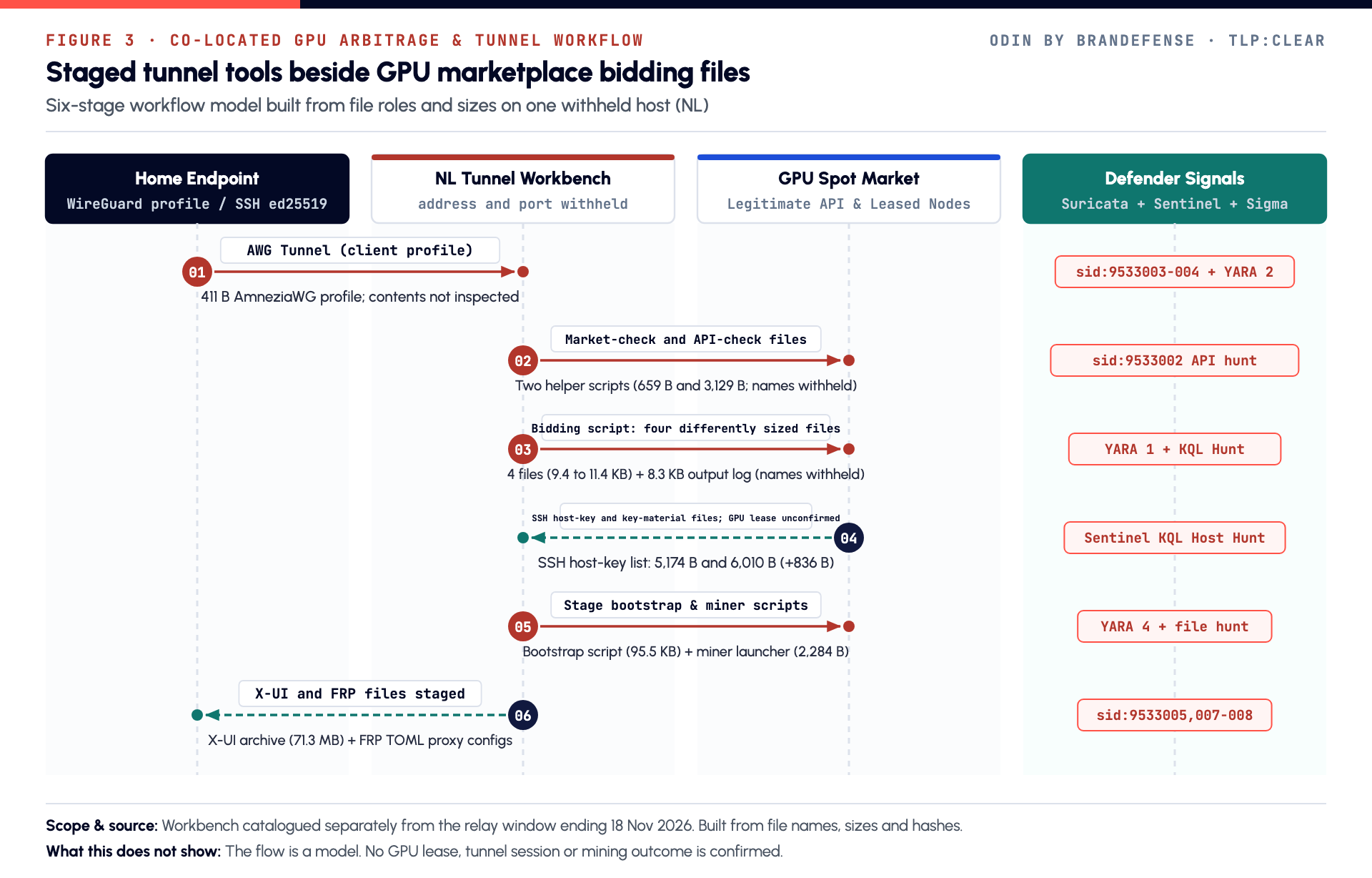
- A GPU bidding bot. Four similarly named Python files range from 9,417 to 11,438 bytes. Two smaller files are named for market and API checks, and a log is 8,302 bytes. Their contents, editing order and use were not established.
- Workload scripts. A 95,521-byte install script and a small miner launcher prepare rented GPU machines for compute or mining jobs.
- Tunnel tools. AmneziaWG and WireGuard installers, client profiles, an X-UI panel archive and Fast Reverse Proxy (FRP) binaries make up 99.8% of the bytes.
- Shell and SSH state. A shell history, SSH key material and an SSH host-key list (paths withheld).
- Container metadata. Docker build files, shell profiles and caches.
The marketplace itself, Clore[.]ai, is a legitimate GPU rental service. Bidding bots are common there. What makes this server interesting is the tunnel stack sitting next to the bot.
Why do these tunnel tools matter to defenders?
Each tool solves a different blocking problem.
- AmneziaWG is a WireGuard variant. Plain WireGuard uses fixed message types and fixed handshake sizes, which DPI firewalls spot easily. AmneziaWG sends random junk packets before the handshake, pads messages and swaps the header values. Signatures for plain WireGuard miss it.
- X-UI is a web panel for Xray tunnels (VLESS, VMess, Trojan and Shadowsocks). It hides traffic inside TLS or WebSocket sessions that look like normal web traffic.
- FRP is a reverse proxy that exposes a port behind NAT to the internet. The TOML configuration files show FRP configuration was staged; the binary version is unknown.
A 283-byte WireGuard profile sits next to a 411-byte AmneziaWG profile. Their order of use and contents are unknown; the 128-byte difference alone does not establish the added settings.
The owner may simply be a compute trader working around regional network filters. Nothing links this server to an intrusion, so we treat the owner as a user, not an attacker. The same tools, though, serve intrusion operators well. That is why they deserve their own alerts on enterprise hosts.
Which relay endpoints are real C2?
Separately, we looked at 624 endpoints on 263 hosts that public feeds label as tunnel, redirector or C2 infrastructure. The family names are the feeds' own labels, not attribution.
Most of the set is noise. One family, HypeAgent, makes up 510 endpoints, and none of them is confirmed.
Of those, 158 serve only the default certificate of a Kubernetes ingress controller. Another 297 sit on 19 multi-port reverse-proxy hosts, 278 of them on three hubs. Only nine show the default certificate of GOST, a real tunnel tool.
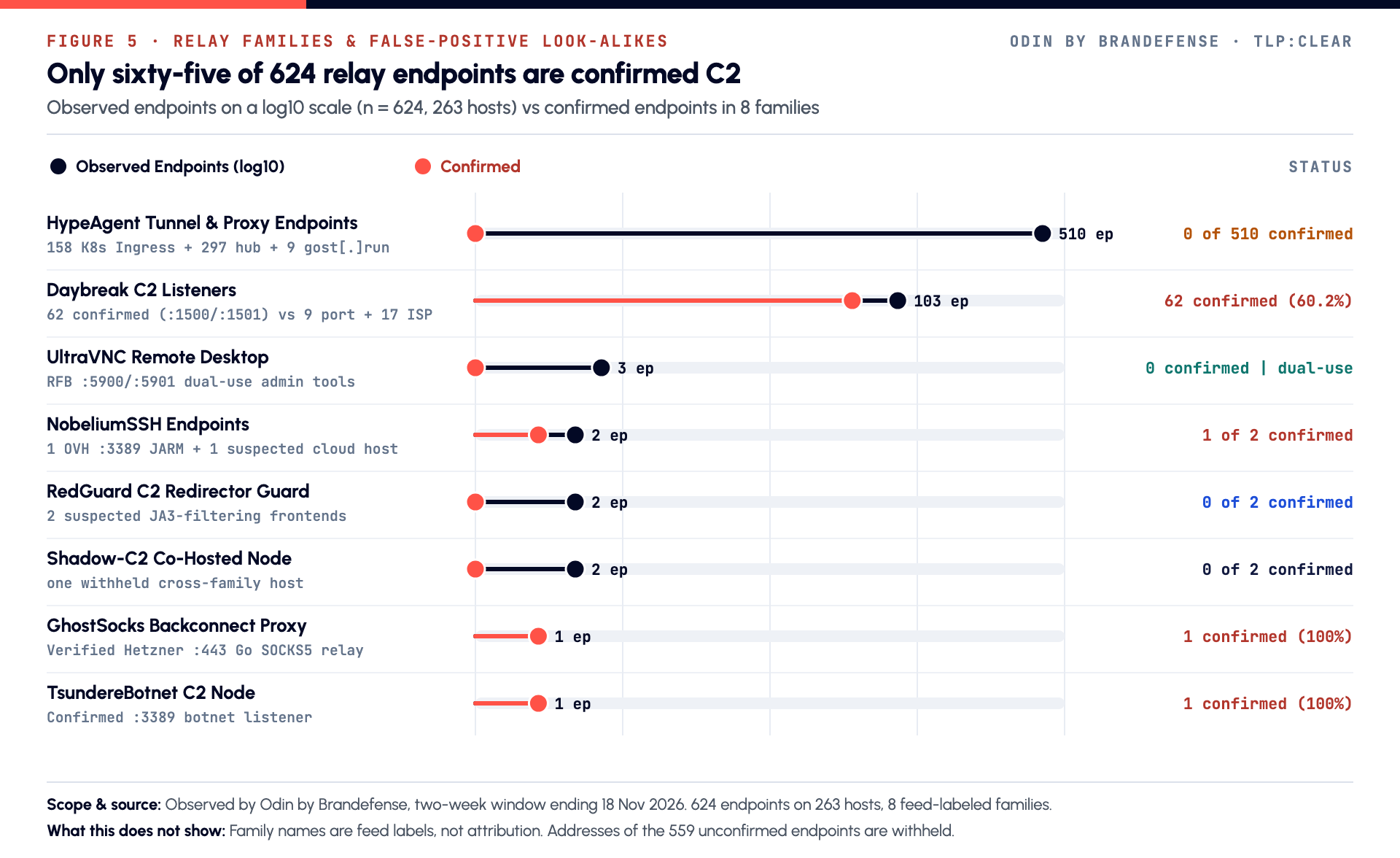
The 65 confirmed endpoints sit on 49 commercial hosting addresses. Most carry the Daybreak label and listen on paired ports 1500 and 1501, each with a stable TLS fingerprint. One GhostSocks server offers a reverse SOCKS5 tunnel over TLS. Eight feed-labelled relay addresses are withheld pending an independent second signal, and the full report's Indicators tab lists the two Daybreak fingerprints.
Feeds also mark 29 more endpoints as confirmed that should not be blocked:
- 9 sit on mail, database and FTP ports, where blocking breaks normal services.
- 17 sit on dynamic carrier networks, where addresses move to new customers.
- 3 are UltraVNC servers, a common IT remote-desktop tool.
Blocking on a feed label alone would hit all of these. It would also hit every Kubernetes cluster that still uses the default certificate.
What does this mean for security leaders?
Two separate risks share the same tools. Inside the enterprise, a GPU bidding bot or an obfuscated tunnel on a developer machine can hide shadow compute spending and an unapproved way out of the network. On the threat intelligence side, raw feeds about tunnels and relays mix real C2 with ordinary cloud services. Treating the feeds as block lists causes outages and gives a false sense of coverage.
The answer is to hunt the tools by behaviour and fingerprint, and to block only confirmed relays.
What to do now
- Alert on tunnel tools outside named bastions. Watch for
amneziawg-go,awg-quick,x-ui,frpc,frps,gostandghostsocksprocesses on servers and workstations. - Govern GPU marketplace traffic. Review scripted calls to GPU rental APIs from corporate and cloud networks, and require approval for jobs on GPU clusters.
- Clean feeds before they reach a block list. Remove default Kubernetes certificates, mail and database ports, dynamic carrier networks and VNC servers.
- Corroborate relays before blocking and hunt their fingerprints. Use the two JARM values on the full report's Indicators tab, hunt the GOST default certificate in TLS logs, and require an independent second signal before blocking relay addresses.
- Close your own open directories. Search your address space for listings that expose SSH keys, shell history or tunnel configs.
The full report's Indicators tab holds 2 JARM fingerprints; eight feed-labelled relay addresses are withheld pending an independent second signal. The full report's Detection rules tab has Suricata, Sentinel KQL, Sigma and YARA rules. The full report covers the workbench, the relay families and the rule logic in detail.
What is…?
Short explanations of the tools and families named in this study.
What is FRP?
Fast Reverse Proxy (FRP) is an open-source tool that exposes services behind NAT through a public relay server.
More about FRPDetection heuristicWhat is Daybreak?
Daybreak is a public JA4X-based C2 heuristic. On port 3306 it also matches ordinary MySQL servers, which makes it a well-known source of false positives.
More about DaybreakTechniqueWhat is JARM?
JARM is an open TLS server fingerprinting method from Salesforce. It hashes how a server answers a set of crafted TLS handshakes.
More about JARMFeed labelWhat is HypeAgent?
HypeAgent is a C2 family label used in threat feeds. Many endpoints with this label present a default Kubernetes ingress certificate.
More about HypeAgentFrequently asked questions
What was on the exposed server?
Defenders can use external attack surface management to find directories like the one on a Netherlands server that listed 45 entries, about 108.88 MB in total. We read the file names, sizes and hashes. We did not run anything. The server address is withheld.
Why do these tunnel tools matter to defenders?
Each tool solves a different blocking problem. A 283-byte WireGuard profile sits next to a 411-byte AmneziaWG profile. Their order of use and contents are unknown; the 128-byte difference alone does not establish the added settings.
Which relay endpoints are real C2?
Separately, we looked at 624 endpoints on 263 hosts that public feeds label as tunnel, redirector or C2 infrastructure. The family names are the feeds' own labels, not attribution. Most of the set is noise. One family, HypeAgent, makes up 510 endpoints, and none of them is confirmed.
What does this mean for security leaders?
Two separate risks share the same tools. Inside the enterprise, a GPU bidding bot or an obfuscated tunnel on a developer machine can hide shadow compute spending and an unapproved way out of the network. On the threat intelligence side, raw feeds about tunnels and relays mix real C2 with ordinary cloud services. Treating the feeds as block lists causes outages and gives a false sense of coverage.