

1. Executive Summary
In short
Across evidence dated 3 February and 16–20 November 2026, Odin by Brandefense examined ten Nginx reverse proxies in Hong Kong cloned from one server image. It also examined an exposed US workbench holding staged Apktool files for four Android CPU types, and seven feed-labeled mobile endpoints. No shared address, certificate or hash links the three groups, and all 18 host addresses are withheld pending corroboration. Turn off unmanaged APK installs on Android fleets, alert on external APK downloads, and require multi-signal corroboration before blocking cloud hosts.
Mobile trojan campaigns rarely use one server for everything. Regional traffic filtering, app repackaging and command-and-control (C2) often sit with different cloud providers, so a takedown at one layer leaves the others standing. This report looks at one example of each layer, examined from evidence dated 3 February and 16–20 November 2026, and is careful about what links them.
Ten Hong Kong reverse proxies share byte-identical files from one server image.
Ten open web directories on Microsoft cloud space in Hong Kong exposed 5,035 files. Every node holds the same custom 14.38 MB Nginx binary, the same GeoIP module and the same 15.44 MB error log. They also share paired certificate bundles; one node also held a mobile download configuration file (path withheld).
An exposed workbench holds staged IPTV app files for four Android CPU types.
A US open directory held 5,399 unpacked Apktool files consistent with a streaming lure. Two of the four build trees stage a 12 MiB native library for 32-bit and 64-bit ARM and x86, next to a commercial packer and inline hooking libraries. A staged 65.15 MB APK and two control-panel archives sit at the web root.
Seven feed-labeled mobile endpoints remain withheld pending independent behavioral corroboration.
The source totals 138 global sightings across four feed labels: PixPirate, LightSpy, GobRAT and KTLVBackdoor. Seven feed-labeled endpoints appear in the sampled inventory. Two Huawei Cloud endpoints carry a PixPirate feed label and share a certificate name; their C2 role needs independent corroboration. All seven endpoint addresses are withheld.
Three Decisions for Leaders
- Stop browser and unmanaged APK installs on Android fleets. Turn off installs from unknown sources on managed Android devices through your MDM. Keep Google Play Protect active and restrict Accessibility Service grants.
- Watch for external APK downloads and packed multi-ABI artifacts. Alert on APK files fetched from outside your app store or MDM, and hunt the multi-ABI packer and hooking combinations in Chapter 8.
- Keep uncorroborated cloud addresses off block lists. Cloud addresses change owners quickly. Pair the published JARM fingerprints and certificate leads with an independent certificate or endpoint process signal before blocking any host.
The Study in Numbers
| Number | What it is |
|---|---|
| 10 | Cloned Nginx reverse-proxy nodes on Microsoft cloud in Hong Kong (5,035 exposed files) |
| 14.38 MB | Custom Nginx binary, byte-identical on all 10 nodes, with an 89,976-byte GeoIP module |
| 5,399 | Unpacked Apktool files on a US Android repackaging workbench |
| 12 MiB | Size of a staged native library (name withheld), the same for all four Android CPU types |
| 65.15 MB | Staged multi-ABI IPTV APK on the workbench |
| 2 | Huawei Cloud endpoints with a PixPirate feed label and shared certificate name (addresses withheld) |
| 5 | Other suspected or candidate feed-labeled mobile endpoints (addresses withheld) |
How to use this report.
Security leaders can read Chapters 1, 6 and 7. Mobile, network and cloud engineers should read Chapters 3 to 5. SOC analysts and detection engineers should start with Chapters 8 and 9.
2. What Was Found: Three Groups, No Shared Links
In short
The study covers 18 hosts and 10,434 exposed files in three groups. All 18 host addresses are withheld pending ownership or behavioral corroboration; use structural and TLS hunts instead.
The three groups are a cloned edge fleet, an APK workbench and seven feed-labeled mobile endpoints, which defenders can evaluate using cyber threat intelligence. Together they look like the layers of a mobile trojan delivery chain. But no shared IP address, TLS certificate or file hash links them. Figure 1 therefore shows them as an analytical model, not as one proven operation.
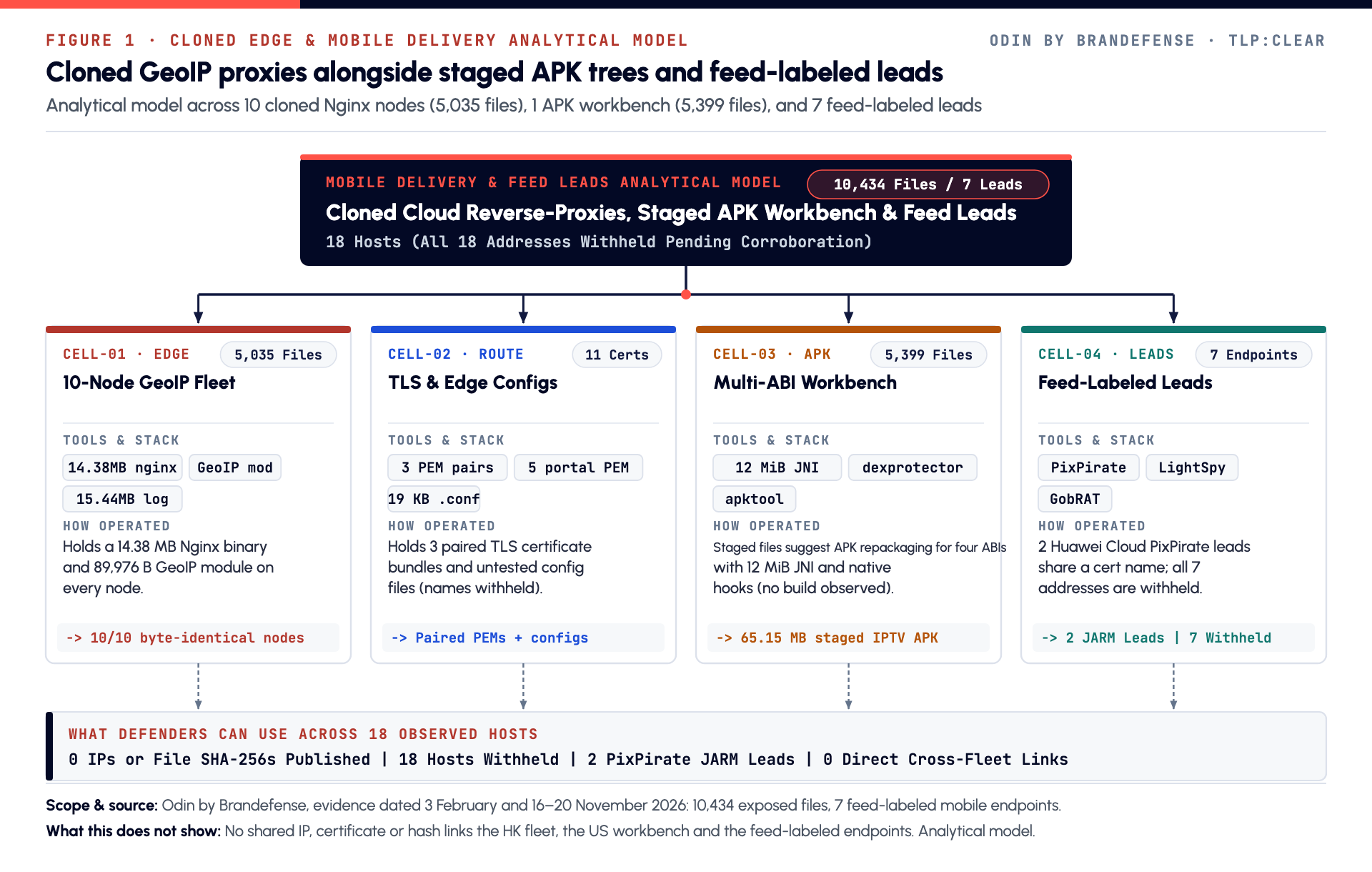
| Group | Sampled hosts | Published addresses | Exposed files or global feed sightings | Hosting | Status |
|---|---|---|---|---|---|
| Cloned GeoIP Nginx edge fleet | 10 | 0 | 5,035 exposed files | Microsoft Corp, Hong Kong | Owner not established, withheld |
| Multi-ABI Android APK workbench | 1 | 0 | 5,399 exposed files | Unattributed US hosting | Owner not established, address and hashes withheld |
| PixPirate feed-labeled endpoints | 2 | 0 | 18 global PixPirate sightings | Huawei Cloud, China | Needs independent corroboration, addresses withheld |
| Other feed-labeled mobile endpoints | 5 | 0 | 120 global sightings (GobRAT, LightSpy, KTLVBackdoor) | AWS Germany, Alibaba, Huawei, UCloud | Suspected or candidate, addresses withheld |
Open directories like these can belong to badly configured staging servers or to cloud machines that change tenants. Publishing their addresses, distinctive paths or file hashes could identify an unconfirmed third party, so this report withholds them and focuses on structural detection rules.
3. The Cloned Ten-Node GeoIP Nginx Fleet
In short
All ten Hong Kong nodes share the same binary, module, error-log size and paired certificate bundles. That level of sameness points to one disk image copied ten times; disable directory listing and clear logs before cloning server images.
Many open directories run ordinary distribution Nginx packages and look alike for that reason. These ten are different. They share non-standard file sizes and identical SHA-256 digests across executables, logs, TLS bundles and configuration includes. In total they share 14 file hashes.
The nodes exposed between 99 and 694 files each, 5,035 in all; defenders can use external attack surface management to find similar open directories. The mean is 503.5 files and the median 553.5.
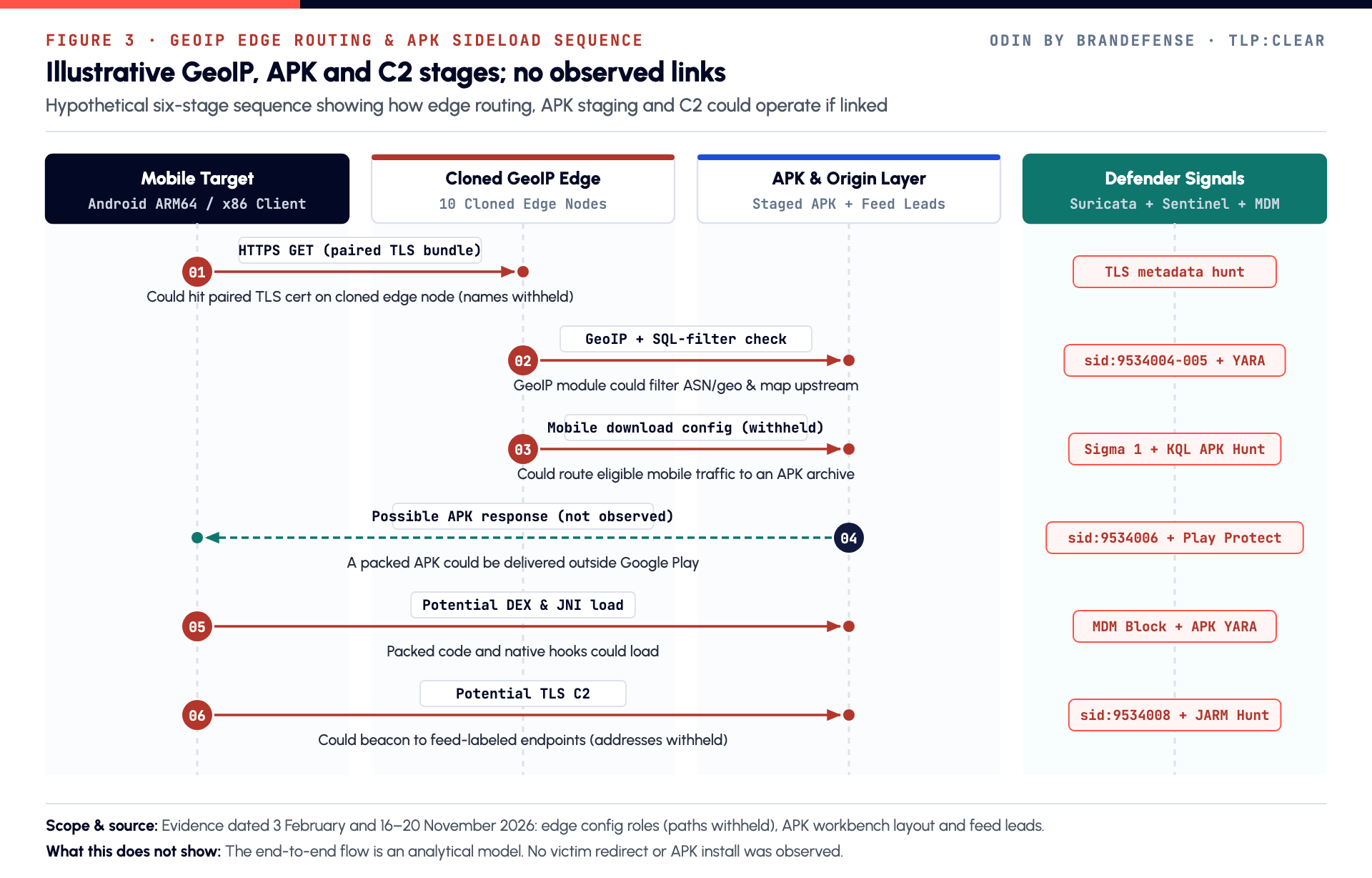
Figure 3 is a model. It shows how GeoIP checks, SQL-injection filtering, paired certificates and a download configuration could work together in a mobile delivery chain. We did not observe a victim being redirected or an APK being installed.
One image, three tell-tale files
| File (path withheld) | Nodes | Size (bytes) | What it is |
|---|---|---|---|
| Custom Nginx binary (path withheld) | 10 of 10 | 14,379,936 | Custom Nginx binary, about ten times larger than a stripped distribution build |
| Dynamic GeoIP module (path withheld) | 10 of 10 | 89,976 | Dynamic GeoIP module (ngx_http_geoip_module) that reads country and network variables such as $geoip_country_code and $geoip_org |
| Pre-filled Nginx error log (path withheld) | 10 of 10 | 15,440,912 | Pre-filled Nginx error log, identical on the nine nodes where it was hashed |
The error log is the strongest clue. Live proxies write different log lines from the first request. The same 15.44 MB log, hash-identical on the nine nodes where it was hashed, indicates that the machines came from one captured disk snapshot that already held old logs. For defenders, the open directory puts that history on the owner's attack surface.
Paired certificates and configuration files
Every node holds 11 certificate bundles in an SSL folder (path and filenames withheld). Five are portal certificates. The other six form three paired bundles: a base bundle (7,120 to 8,847 bytes) and a companion bundle (7,137 to 9,471 bytes). The real certificate domains and filenames are withheld.
The paired certificate filenames could support domain rotation; no certificate switch or domain suspension was observed. This is a common pattern for grey-market app portals and for malware delivery alike.
| Shared file (name and path withheld) | Nodes | Size (bytes) | Role |
|---|---|---|---|
| Upstream proxy configuration (path withheld) | 1 of 10 | 19,834 | File name suggests upstream proxy mapping; contents and behavior were not verified |
| Mobile download configuration (path withheld) | 1 of 10 | 19,123 | File name suggests app-download routing; contents and behavior were not verified |
| Companion TLS bundle B (name and path withheld) | 10 of 10 | 9,471 | Companion TLS bundle; rotation not verified |
| Companion TLS bundle A (name and path withheld) | 10 of 10 | 7,142 | Companion TLS bundle; rotation not verified |
| SQL-injection filter include (path withheld) | 7 of 10 | 6,701 | Query-string SQL-injection filter include; effect on scanners was not tested |
| Generated traffic-control config (path withheld) | 4 of 10 | 5,730 | Upstream routing settings; behavior not verified |
| Web routing script template (path withheld) | 1 of 10 | 5,487 | Edge routing template; behavior not verified |
The two 19 KB .conf files surfaced on one node, where they were among the 15 largest files. On the other nodes, larger certificate chains pushed smaller .conf files out of the largest-file listing. So "1 of 10" means seen on one node, not missing from nine.
Together, GeoIP checks, an anti-SQL-injection include and a mobile download configuration suggest an edge layer built for traffic filtering and routing. Its effect on automated scanners was not tested. Whether this configuration steered mobile browsers toward a download was not tested.
4. The Multi-ABI Android APK Repackaging Workbench
In short
A US open directory exposes staged Apktool files consistent with IPTV app repackaging across four Android CPU types, alongside a commercial packer and inline hooking libraries. Block unmanaged APK installs on Android fleets.
Sideloaded Android trojans often pose as free streaming or IPTV players, an app impersonation problem that brand protection teams track. Users then install them outside Google Play and grant extra permissions. This workbench shows the server side of that kind of lure: 5,399 files in total. Our review covers the 90 largest files.
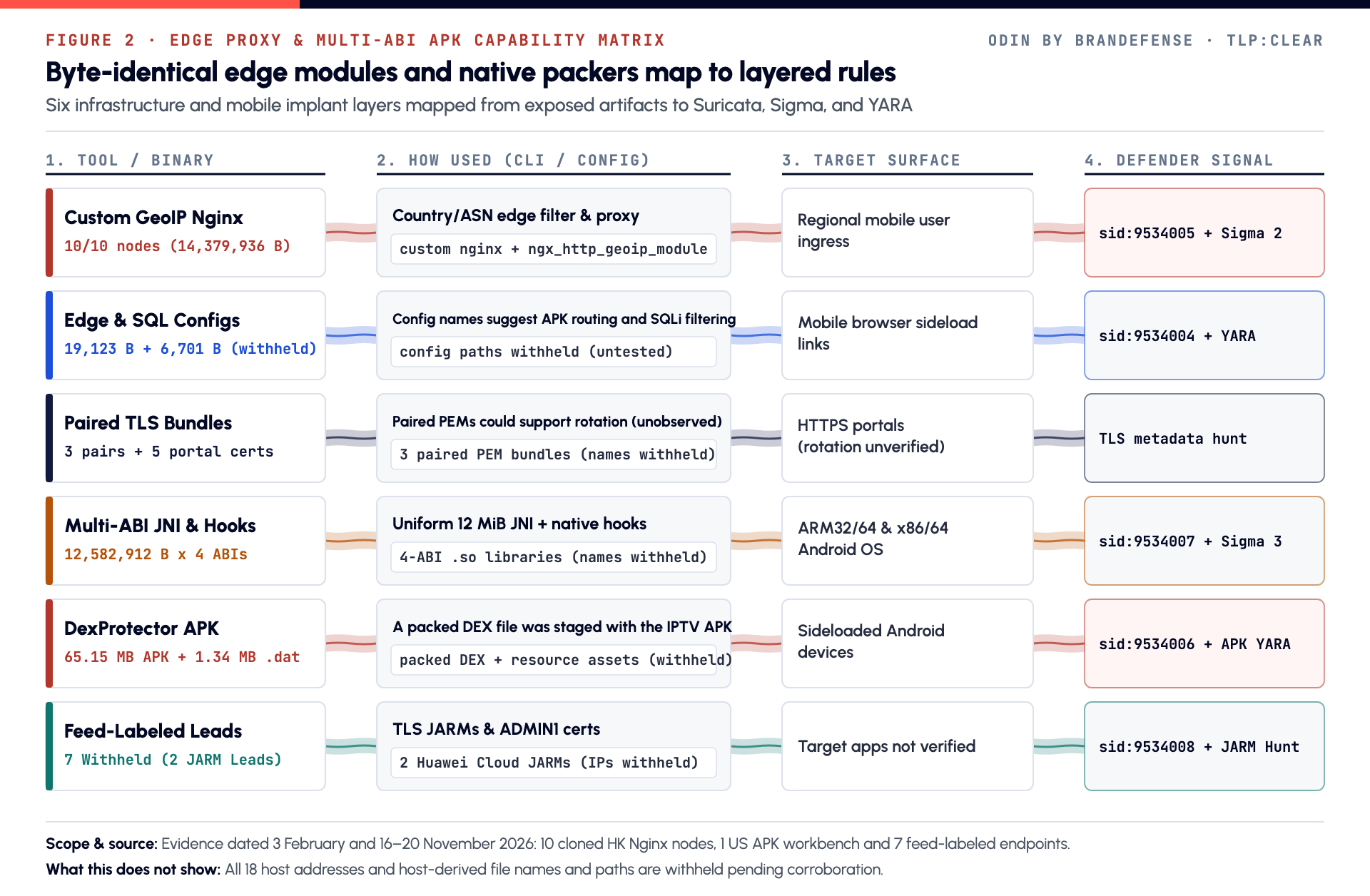
Four Apktool trees
The workbench holds four parallel Apktool build trees; their paths are withheld because the host owner is unconfirmed. Four Apktool trees contain files consistent with app repackaging, including branding assets, native libraries and a staged APK; no build was observed.
Three file types point to this unpacking and editing layout. There is an original RSA signing certificate (1,050 bytes), a saved backup of the Android manifest (20,480 bytes), and Apktool duplicate-resource stubs (names and paths withheld).
Staged archives and installer at the web root
| Artifact (path withheld) | Size (bytes) | What it is |
|---|---|---|
Packaged IPTV archive A (.zip) | 76,546,048 | Packaged IPTV distribution bundle |
Packaged IPTV archive B (.zip) | 76,546,048 | Second bundle of the same size |
Signed multi-ABI installer (.apk) | 65,149,417 | Staged multi-ABI Android installer (65.15 MB) |
Control-panel deployment archive (.zip) | 2,228,822 | Back-end web control panel archive |
Panel rebranding patch archive (.zip) | 819,308 | Panel rebranding patch archive |
Four CPU types, one packer, two hooking engines
Of the 90 largest files, 63 (70.0%) are native .so libraries. The staged folders cover all four Android NDK ABIs: arm64-v8a, armeabi-v7a, x86 and x86_64. That spans phones, TV boxes and emulators.
- A fixed 12 MiB native container. In two of the four build trees, one native library (name and path withheld) is exactly 12,582,912 bytes for all four ABIs. The same size on ARM and x86 suggests fixed padding or an appended encrypted container.
- A DexProtector loader. Each ABI folder stages a DexProtector native loader alongside an encrypted secondary DEX asset (1,339,955 bytes) and an encrypted resource asset (68,720 bytes) in all four trees (names and paths withheld). DexProtector is a commercial app-protection packer.
- Inline hooking. Next to FFmpeg streaming libraries sit four native hooking libraries, including an older backup copy and a 79,872-byte hook library (names and paths withheld). These libraries are designed to intercept native functions at runtime inside the Android app sandbox.
| Workbench file (tree paths withheld) | Copies | Size (bytes) | Role |
|---|---|---|---|
| Multi-ABI native container library (name and path withheld) | 8 | 12,582,912 | Native core container, same size for all four ABIs |
| Primary Dalvik bytecode file (name and path withheld) | 2 | 6,252,104 | Main compiled Dalvik bytecode |
| Encrypted secondary DEX asset (name and path withheld) | 4 | 1,339,955 | Encrypted secondary DEX for DexProtector |
| Older x86 native hook library (name and path withheld) | 2 | 1,121,444 | Older x86 native hook binary |
| Packer unpacking stub, 64-bit ARM (name and path withheld) | 1 | 349,632 | Packer unpacking stub, 64-bit ARM |
| Packer unpacking stub, 32-bit ARM (name and path withheld) | 1 | 312,296 | Packer unpacking stub, 32-bit ARM |
| Native app library (name and path withheld) | 1 | 282,120 | 64-bit ARM library; behavior unverified |
| Native inline hook library, 64-bit ARM (name and path withheld) | 1 | 228,176 | Native inline hook engine, 64-bit ARM |
The file names, file hashes and build-tree paths for these artifacts are withheld because the host owner is unconfirmed. We read the directory listing and file metadata. We did not install or run the APK.
5. Feed-Labeled Mobile Leads: Seven Sampled Endpoints
In short
Seven sampled feed-labeled mobile endpoints appear alongside 138 global feed sightings across four family labels. All seven endpoint addresses are withheld pending independent behavioral corroboration; use the JARM and certificate leads to hunt.
The ten clones show clear internal links. Nothing of that kind ties them to the workbench or to the feed-labeled endpoints below. Figure 4 lays the three groups side by side as a model of how such layers fit together.
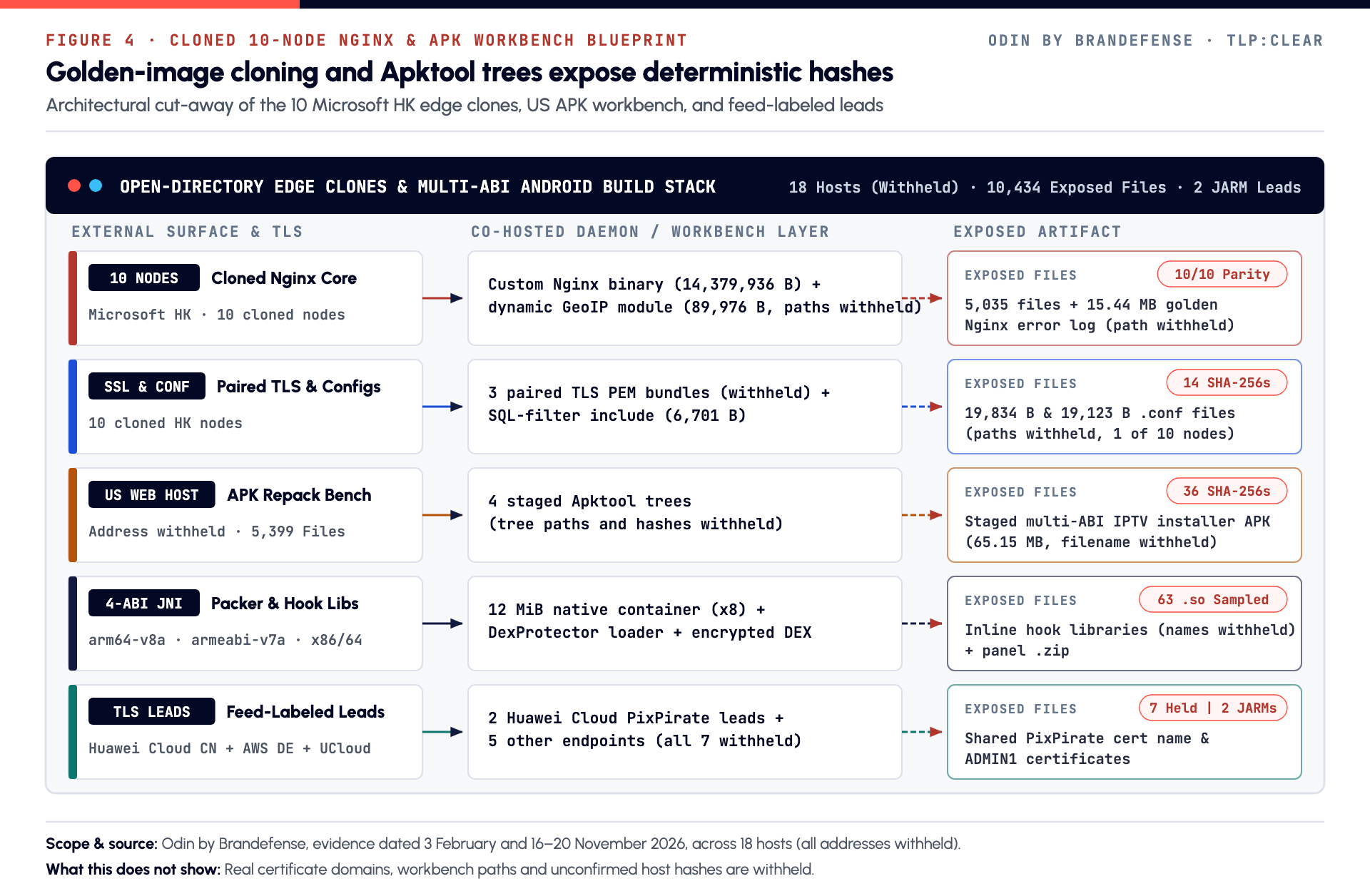
The source totals 138 global sightings across four feed labels; seven endpoints appear in the sampled inventory. The family names are the feeds' own labels, not our attribution to a named actor.
Two Huawei Cloud endpoints with a PixPirate feed label
Two Huawei Cloud endpoints carry a PixPirate feed label and share a certificate name; their C2 role needs independent corroboration. PixPirate is an Android banking trojan. Three traits appear on the pair.
- Same provider. Both sit in a Huawei Cloud data center in China; the two addresses are withheld pending a second qualifying signal.
- Same certificate name. The two listeners present the same TLS certificate common name. The name itself is withheld.
- Two TLS fingerprints. Each listener has its own JARM fingerprint, shown in the table below. Pair the JARM value with certificate or mobile process signals before blocking.
| Endpoint | Hosting | JARM fingerprint (hunt only) |
|---|---|---|
| Huawei Cloud PixPirate-labeled endpoint A (withheld) | Huawei Cloud, China | 29d29d00029d29d22c29d29d29d29dc2ddcfd203d071c45b4b0ffe3d7b4b89 |
| Huawei Cloud PixPirate-labeled endpoint B (withheld) | Huawei Cloud, China | 21d19d00021d21d21c21d19d21d21d3b0d229d76f2fd7cb8e23bb87da38a20 |
Five other withheld endpoints
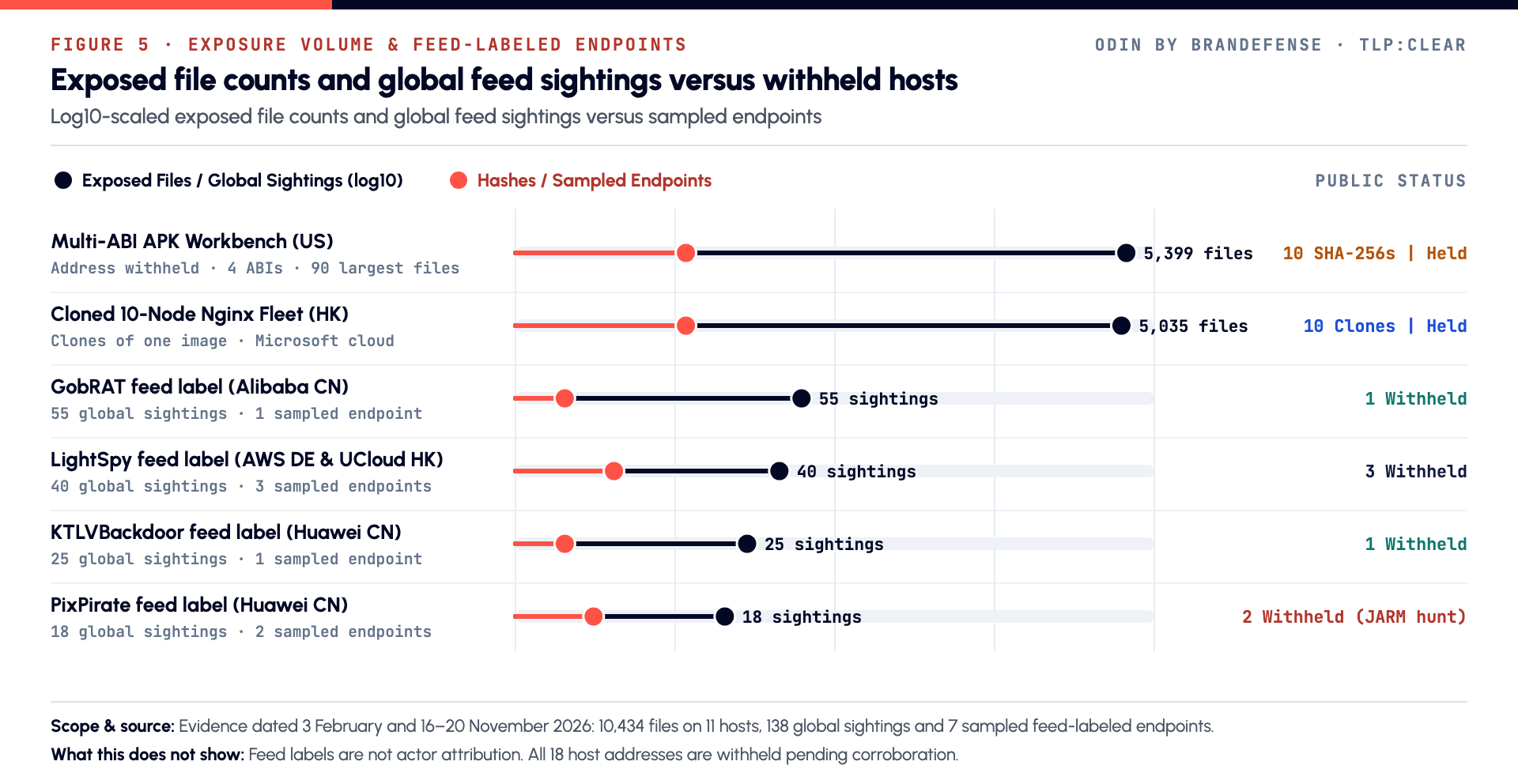
The other three feed labels total 120 global sightings: 55 under GobRAT, 40 under LightSpy and 25 under KTLVBackdoor, alongside 18 under PixPirate. Five endpoints under those three labels appear in the sampled inventory. Each is suspected or candidate only, so its address is withheld.
| Feed label | Endpoints | Hosting | Status | Shared trait |
|---|---|---|---|---|
| LightSpy | 2 | AWS, Germany | Suspected | Self-signed certificate CN=ADMIN1 and one shared JARM (withheld) |
| LightSpy | 1 | UCloud, Hong Kong | Candidate | Single signal only |
| GobRAT | 1 | Alibaba Cloud, China | Suspected | Single host on shared cloud space |
| KTLVBackdoor | 1 | Huawei Cloud, China | Suspected | Single host on shared cloud space |
CN=ADMIN1 is a default-looking certificate name and turns up on harmless servers too. Treat it as a hunting lead only.
6. Other Explanations and False-Positive Traps
In short
10,434 exposed files and 138 global feed sightings yield hunting leads rather than immediate IP block lists. Pair TLS and file leads with endpoint context before blocking.
Large open directories and single-signal TLS matches are easy to over-read. Figure 5 compares the size of each surface with what this report publishes from it.
Four other readings of the evidence remain open.
- A grey-market app-portal CDN. Cloned proxies with GeoIP modules, anti-SQL includes, paired certificates and mobile download configurations also front offshore gaming and streaming portals. These portals hand out apps outside the stores. No APK behind the download configuration was retrieved, so the ten Hong Kong addresses and their configuration paths stay withheld.
- A commercial IPTV white-label builder. The four build trees and panel archives could belong to an illicit IPTV rebranding service that uses DexProtector to protect pirated streams. Whatever the motive, unmanaged APKs with multi-ABI inline hooks bypass Google Play protection. The workbench artifacts need behavioral confirmation before any hash-based block.
- Cloud address churn. All 18 hosts sit with large cloud providers: Microsoft, AWS, Huawei, Alibaba and UCloud. Addresses there move between customers quickly. Require an independent behavioral or certificate signal before blocking any cloud address, and review temporary blocks after 30 days.
- Default certificates and stock TLS stacks.
CN=ADMIN1and common JARM values recur on benign servers. Suricata SID 9534008 treatsCN=ADMIN1as a hunting signal only.
| Surface | Easy mistake | Safer approach |
|---|---|---|
| 10 cloned Hong Kong Nginx nodes | Blocking cloud addresses or any ngx_http_geoip_module build | Keep the addresses off block lists; hunt the GeoIP module paired with multi-PEM TLS configs |
| APK workbench | Flagging legitimate CI apktool or FFmpeg builds | Require multi-ABI native libraries, packer assets and hooking libraries together |
CN=ADMIN1 certificate and JARM | Matching default appliance certificates or stock TLS stacks | Hunt only, and confirm with mobile endpoint process data |
| PixPirate-labeled Huawei Cloud pair | Blocking on a feed label and JARM without a second signal | Withhold from block lists; pair JARM with certificate or mobile process telemetry |
7. What Defenders Should Do
Mobile and endpoint
- Turn on the Android Enterprise policies that block installs from unknown sources through your MDM. Keep Google Play Protect on, and limit Accessibility Service rights for apps from outside the store.
- Test the three unvalidated YARA structural hunts from Chapter 8 on configuration text, certificate manifests and multi-ABI build specifications before adding them to sandbox pipelines.
Network security
- Use the two PixPirate-labeled JARM fingerprints and the
CN=ADMIN1certificate subject as TLS hunting leads on firewalls and mobile ZTNA gateways. Require certificate or endpoint process corroboration before blocking. - Alert on APK files (
application/vnd.android.package-archive) delivered from outside approved stores and MDM hosts.
Cloud and platform
- Check your own Nginx reverse proxies. Turn directory listing off (
autoindex off) and block public access to binary, module, certificate, log and configuration directories, as well as*.confand*.incfiles. - Clear old logs from golden VM images before you clone them.
Detection engineering
- Deploy the Suricata, Sigma and KQL rules in Chapter 8. Fill the MDM and Android CI allowlists with exact hostnames first, so authorized builds do not flood the queue.
8. Detection Rules
The full rules are in the Detection rules tab. The Suricata file passes a syntax lint. The YARA, Sigma and KQL files were checked by reading, not loaded in live engines for this edition. None of the rules was replayed against live traffic, so test them in your own environment first.
| Rule file | What it catches |
|---|---|
odin_cloned_geoip_nginx_apk_delivery_and_pixpirate.rules | Suricata 7: five signatures for exposed SQL-filter regexes, GeoIP module downloads, external APK deliveries, unpacked multi-ABI .so requests and CN=ADMIN1 certificates |
sentinel_geoip_apk_delivery_and_mobile_c2_hunt.kql | Microsoft Sentinel and Defender XDR: explicit .apk URL downloads outside approved MDM hosts, plus nginx, apktool, java or adb commands that name the GeoIP module or multi-ABI repackaging markers |
sigma_exposed_nginx_conf_geoip_and_apk_sideload.yml | Sigma (3 rules): proxy requests for external APKs or unpacked multi-ABI .so paths; unmanaged nginx launches with the GeoIP module; and Linux repackaging tool command lines referencing Android NDK ABI names |
odin_cloned_nginx_apk_conf_and_jni_library.yar | YARA (3 unvalidated structural hunts): Nginx configuration text, certificate manifests and multi-ABI build specifications. |
How the Suricata signatures work
| SID | Looks for | Why |
|---|---|---|
| 9534004 | An HTTP 200 response body holding select|union and $query_string | Catches an exposed SQL-injection filter include file |
| 9534005 | A GET for ngx_http_geoip_module.so | Catches retrieval of the GeoIP module from outside |
| 9534006 | An external response with content type application/vnd.android.package-archive and a ZIP header | Hunt only: flags APK deliveries outside approved channels |
| 9534007 | A GET for any .so library under /lib/<abi>/ across the four Android NDK ABIs | Hunt only: flags retrieval of unpacked multi-ABI Android native libraries |
| 9534008 | A TLS server certificate with CN=ADMIN1 | Hunt only: default-looking certificate seen on hosts with a LightSpy feed label |
Keep SIDs 9534004 through 9534008 in alert mode, with pass rules for approved MDM and build hosts.
How the other rules work
The KQL query looks back 7 days. Because the unconfirmed hosts' paths and uncorroborated C2 addresses are withheld, the network branch matches the generic .apk URL pattern explicitly ((?i).apk(?:?|$)). The query skips remote hosts in an exact MDM hostname list and devices in an exact build-host list.
The process side looks for nginx, apktool, java or adb with the GeoIP module or Android NDK ABI and repackaging markers on the command line. Each match gets one hunting label: hunt a multi-ABI APK workbench, hunt a cloned GeoIP edge config, or hunt an unmanaged APK transfer.
The first Sigma rule reads web proxy logs and flags requests for .apk URLs or unpacked .so libraries under /lib/<abi>/. Three exact MDM hostnames and one internal scanner address are excluded. The second flags nginx launches whose command line names ngx_http_geoip_module.so. The third pairs an unvalidated selection_repack_tool executable list with the Android NDK ABI names arm64-v8a, armeabi-v7a or x86_64. The third rule flags Linux command lines mentioning these ABI names under repackaging tools; analysts must verify that a repackaging process ran.
| YARA rule | Fires when |
|---|---|
ODIN_Cloned_Nginx_GeoIP_APK_Delivery_Config | ngx_http_geoip_module.so and proxy_pass appear with $geoip_country_code, $geoip_org or the select|union and $query_string filter terms |
ODIN_Cloned_Nginx_Multi_PEM_TLS_Manifest | Multiple ssl_certificate and ssl_certificate_key directives appear with .pem |
ODIN_MultiABI_APK_Repack_Build_Spec | apktool or AndroidManifest.xml appears with all four Android NDK ABI names (arm64-v8a, armeabi-v7a, x86 and x86_64) |
The two MITRE ATT&CK for Mobile tactics in play are Initial Access (TA0027), through sideloaded and repackaged apps, and Command and Control (TA0037), through encrypted channels.
9. Indicators
The Indicators tab holds 0 published block indicators: all 18 host addresses and all 18 file hashes are withheld pending independent behavioral corroboration or host ownership checks. Three hunting indicators appear in this report only: the two PixPirate-labeled JARM fingerprints and the CN=ADMIN1 certificate subject.
| Type | Count | Where to use it |
|---|---|---|
| Network addresses | 0 (18 withheld) | Withheld pending independent behavioral corroboration and host ownership checks |
| File hashes (SHA-256) | 0 (18 withheld) | Withheld pending host ownership and behavioral confirmation |
| JARM fingerprints | 2 (1 withheld) | TLS hunting only, pair with certificate or mobile process signals (Chapter 5) |
| Nginx configuration paths | 0 (withheld) | Owner-specific configuration paths withheld pending host ownership confirmation |
| Certificate subject | 1 | TLS hunting only: CN=ADMIN1 |
Withheld: all 18 host addresses, covering the ten Hong Kong nodes and the US workbench. This also includes the two Huawei Cloud PixPirate-labeled endpoints and the five other suspected or candidate feed-labeled hosts. Also withheld are all 18 file hashes from the unconfirmed open-directory hosts (eight from the Hong Kong fleet and ten from the US workbench). The owner-specific Nginx configuration paths, the distinctive workbench paths and file names, the real certificate domains and filenames, the shared PixPirate certificate name and the LightSpy JARM are withheld as well.
10. Scope and Limits
- Evidence dates. The findings draw on evidence dated 3 February and 16–20 November 2026, with a research cutoff of 20 November 2026.
- Files, not outcomes. We read directory listings and file metadata. We did not run any binary or install the APK, and we saw no victim device.
- No proven chain. No shared address, certificate or hash links the Hong Kong fleet, the US workbench and the feed-labeled endpoints. The end-to-end delivery picture is an analytical model.
- Owners not established. The Hong Kong fleet could serve a grey-market app portal, and the workbench could serve an IPTV piracy business. Their addresses, configuration paths and host-derived file names are withheld for that reason.
- Feed labels are not attribution. PixPirate, LightSpy, GobRAT and KTLVBackdoor are the feeds' own family labels.
- Partial view. The workbench figures describe its 90 largest files out of 5,399. The Hong Kong figures rely on each node's largest files, so a file missing from a node's list may still exist there.
- Rule testing. The Suricata file passes a syntax lint. The other rule files were not loaded in live engines for this edition, and no rule was replayed against live traffic. Test and tune them before production use.
11. Sources
- NGINX documentation. Module ngx_http_geoip_module. https://nginx.org/en/docs/http/ngx_http_geoip_module.html (verified 20 November 2026)
- NGINX documentation. Module ngx_http_proxy_module. https://nginx.org/en/docs/http/ngx_http_proxy_module.html (verified 20 November 2026)
- Android Developers. Android ABIs. https://developer.android.com/ndk/guides/abis (verified 20 November 2026)
- Android Open Source Project. Application Sandbox. https://source.android.com/docs/security/app-sandbox (verified 20 November 2026)
- OWASP Mobile Application Security. Mobile Application Security Testing Guide (MASTG). https://mas.owasp.org/MASTG/ (verified 20 November 2026)
- MITRE ATT&CK for Mobile. TA0027 Initial Access. https://attack.mitre.org/tactics/TA0027/ (verified 20 November 2026)
- MITRE ATT&CK for Mobile. TA0037 Command and Control. https://attack.mitre.org/tactics/TA0037/ (verified 20 November 2026)
- Suricata documentation. HTTP Keywords. https://docs.suricata.io/en/latest/rules/http-keywords.html (verified 20 November 2026)
What is…?
Short explanations of the tools and families named in this study.
Frequently asked questions
What did we find?
The study covers 18 hosts and 10,434 exposed files in three groups. All 18 host addresses are withheld pending ownership or behavioral corroboration. A live proxy writes its own log from the first request. The log was hash-identical on nine nodes where hashes were available, pointing to one disk image copied across the fleet.
How do the cloned proxies work?
The nodes pair Nginx's GeoIP module with an anti-SQL-injection filter include (seen on seven of ten) and, on one node, a mobile download configuration file (path withheld). The GeoIP module lets the server decide what to show based on the visitor's country and network. The include appears designed to filter SQL-injection requests; we did not test whether it blocked scanners. Whether this configuration steered mobile browsers toward a download was not tested.
What does the workbench hold?
The workbench holds staged files for one streaming lure. Four Apktool trees contain files consistent with app repackaging, including branding assets, native libraries and a staged APK; no build was observed. Their build-tree paths are withheld because the host owner is unconfirmed.
Why are all 18 host addresses withheld?
Large cloud providers move addresses between customers quickly. A block on an uncorroborated address can hit an innocent tenant a week later. Two Huawei Cloud endpoints carry a PixPirate feed label and share a certificate name, but their C2 role needs independent corroboration. We therefore withhold both addresses and publish their JARM fingerprints as hunting leads only.