
Key takeaways
- Ten Nginx reverse proxies in Hong Kong are copies of one server image with a GeoIP module; one node also held a mobile download configuration file.
- An exposed US workbench holds staged Apktool trees for four Android CPU types with a commercial packer and hooking libraries.
- Two Huawei Cloud endpoints carry a PixPirate feed label and share a certificate name; all 18 host addresses are withheld pending corroboration.
- No shared address, certificate or hash links the three groups, so the delivery chain is a model, not a proven operation.
- Turn off unmanaged APK installs on Android fleets and alert on APK downloads from outside approved app stores.
Ten cloned Nginx proxies in Hong Kong, an exposed US Android repackaging workbench and seven feed-labeled mobile endpoints are three distinct findings. Odin by Brandefense examined them in evidence dated 3 February and 16–20 November 2026. No shared address, certificate or file hash links the groups. The proxy and workbench owners remain unknown, so their role in malware delivery has not been established.
What did we find?
The study covers 18 hosts and 10,434 exposed files in three groups. All 18 host addresses are withheld pending ownership or behavioral corroboration.
A cloned edge fleet.
Ten open web directories on Microsoft cloud space in Hong Kong exposed 5,035 files, an exposure defenders can check with external attack surface management. Every node holds the same custom 14.38 MB Nginx binary, the same GeoIP module and the same 15.44 MB error log.
A live proxy writes its own log from the first request. The log was hash-identical on nine nodes where hashes were available, pointing to one disk image copied across the fleet.
An APK workbench. A US open directory held 5,399 unpacked Android files consistent with IPTV app repackaging. Repackaged copies of real apps are a brand protection problem as much as a malware one. A staged 65.15 MB APK sits at the web root next to a control-panel archive.
Feed-labeled mobile endpoints. The source totals 138 global sightings across four threat-feed labels: PixPirate, LightSpy, GobRAT and KTLVBackdoor, which defenders can review with cyber threat intelligence. Seven endpoints appear in the sampled inventory. Two Huawei Cloud endpoints carry a PixPirate feed label and share a certificate name; their C2 role needs independent corroboration. PixPirate is an Android banking trojan.
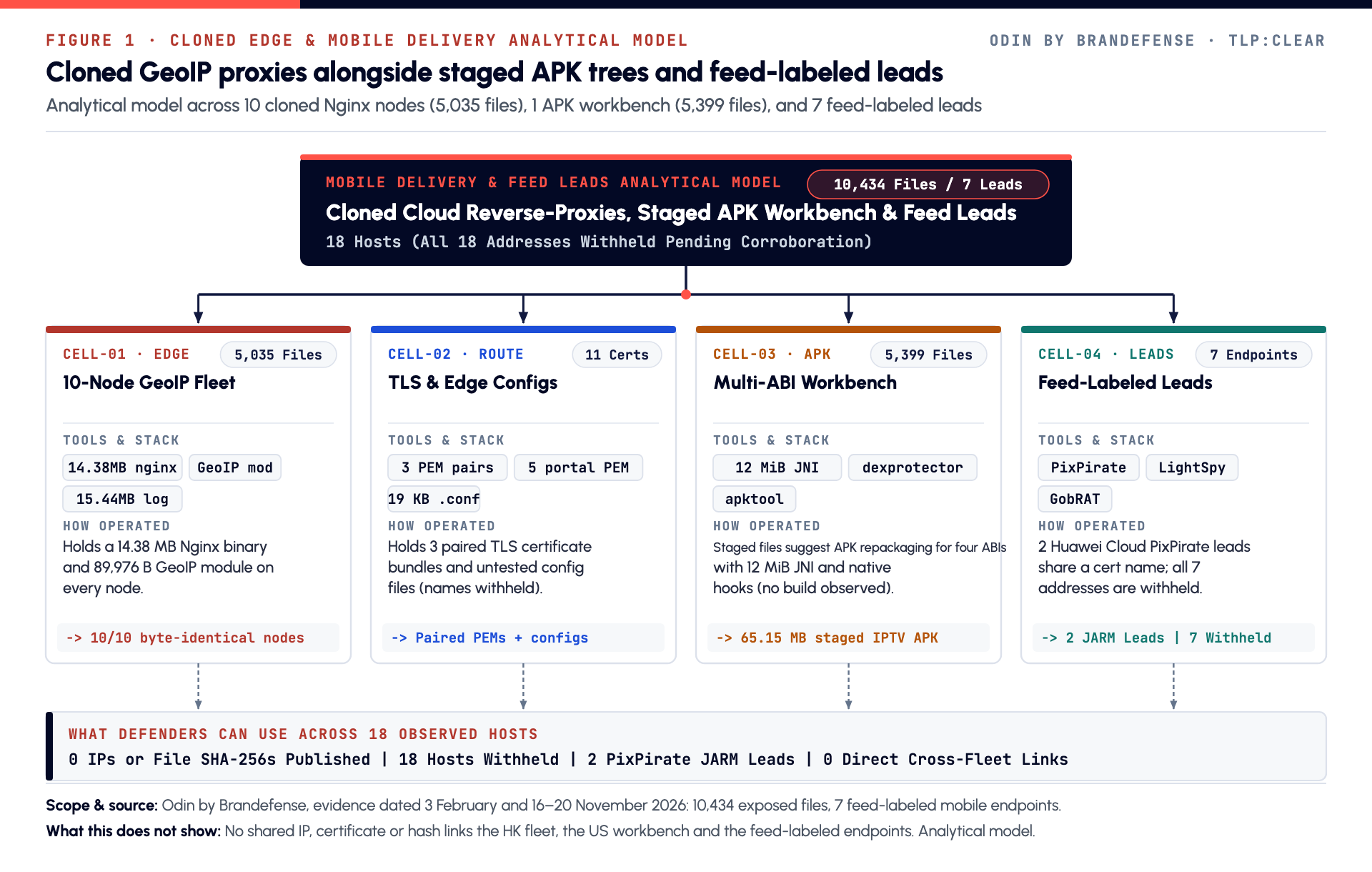
One caution matters here. No shared IP address, certificate or file hash links the three groups. They look like the layers of one delivery chain, but that picture is an analytical model, not a proven operation.
How do the cloned proxies work?
The nodes pair Nginx's GeoIP module with an anti-SQL-injection filter include (seen on seven of ten) and, on one node, a mobile download configuration file (path withheld). The GeoIP module lets the server decide what to show based on the visitor's country and network. The include appears designed to filter SQL-injection requests; we did not test whether it blocked scanners. Whether this configuration steered mobile browsers toward a download was not tested.
The nodes also carry paired certificates. Each node holds three paired TLS certificate bundles (names and paths withheld). The paired certificate filenames could support domain rotation; no certificate switch or domain suspension was observed.
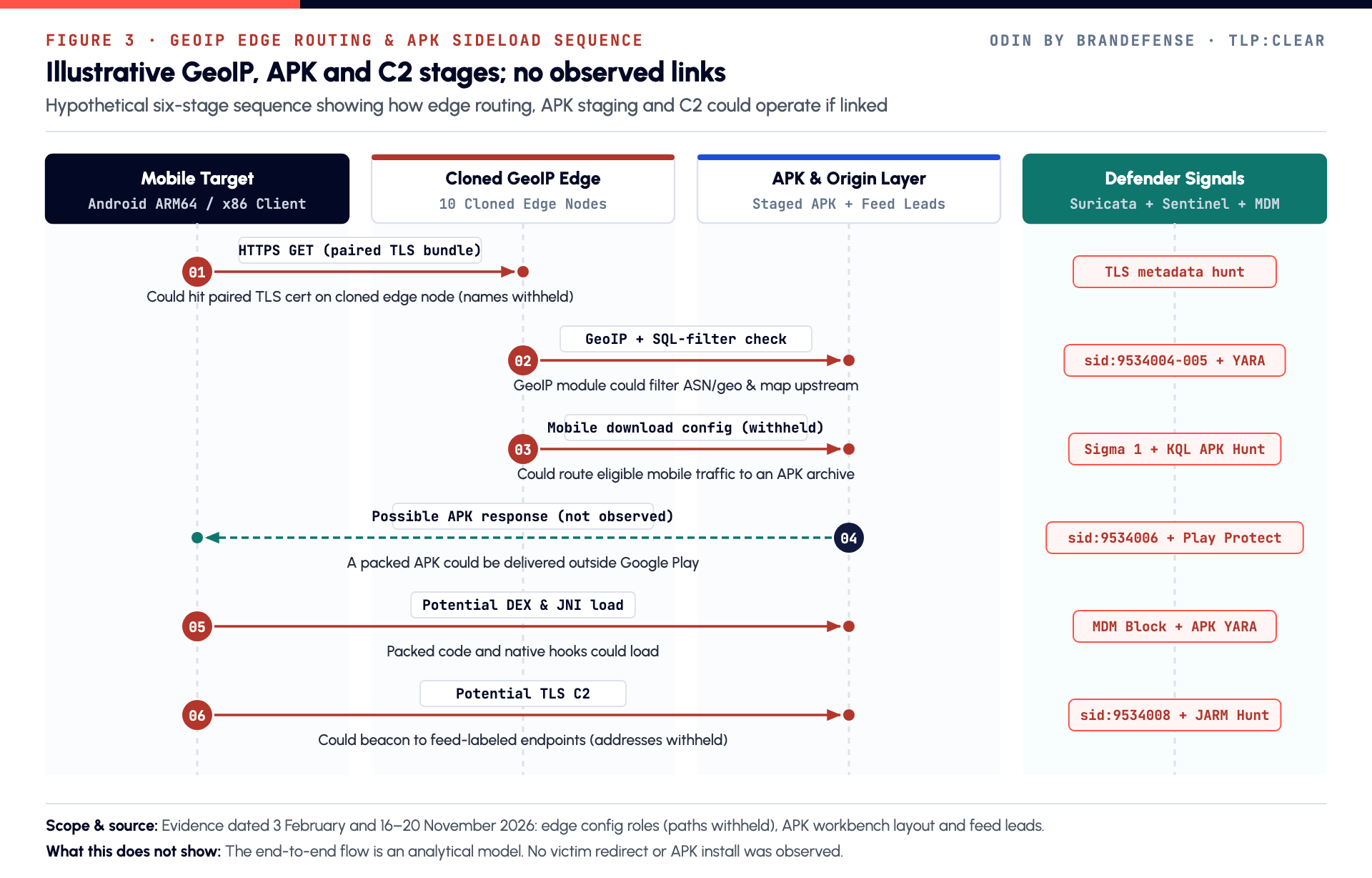
The cloning itself carries a lesson for any team that builds servers from images. The shared 15.44 MB error log means whatever the original server logged was copied to all ten clones. An open directory exposes that history on the owner's attack surface. The same risk applies to your own golden images: clear logs, keys and old configs before you clone, and never leave directory listing on.
This design is not unique to malware. Grey-market gaming and streaming portals use the same tricks to hand out apps outside the official stores. We did not retrieve any APK from the proxy nodes, so we treat the owner as unknown and withhold all ten addresses and their configuration paths.
What does the workbench hold?
The workbench holds staged files for one streaming lure. Four Apktool trees contain files consistent with app repackaging, including branding assets, native libraries and a staged APK; no build was observed. Their build-tree paths are withheld because the host owner is unconfirmed.
Three details stand out:
- Four CPU types. The staged folders cover 32-bit and 64-bit ARM and x86, so a built app could run on phones, TV boxes and emulators. One staged native library (name and path withheld) is exactly 12 MiB for all four.
- A commercial packer. DexProtector encrypts part of the app's code, which makes static analysis harder.
- Hooking engines. Staged native hooking libraries (names and paths withheld) are designed to intercept native functions while an app runs.
The workbench might belong to an illicit IPTV rebranding service rather than a trojan operator. Either way, an unmanaged APK with packed code and runtime hooks has no place on a managed device. Workbench file names and hashes are withheld pending ownership and behavioral checks. We read file listings and metadata only; we did not install or run the app.
Why are all 18 host addresses withheld?
Large cloud providers move addresses between customers quickly. A block on an uncorroborated address can hit an innocent tenant a week later. Two Huawei Cloud endpoints carry a PixPirate feed label and share a certificate name, but their C2 role needs independent corroboration. We therefore withhold both addresses and publish their JARM fingerprints as hunting leads only.
The other five feed-labeled endpoints are suspected or candidate hosts on AWS, Alibaba, Huawei and UCloud. Two of them share a default-looking certificate, CN=ADMIN1, which also appears on harmless servers. Use that name and the JARM values as hunting leads, never as a block rule.
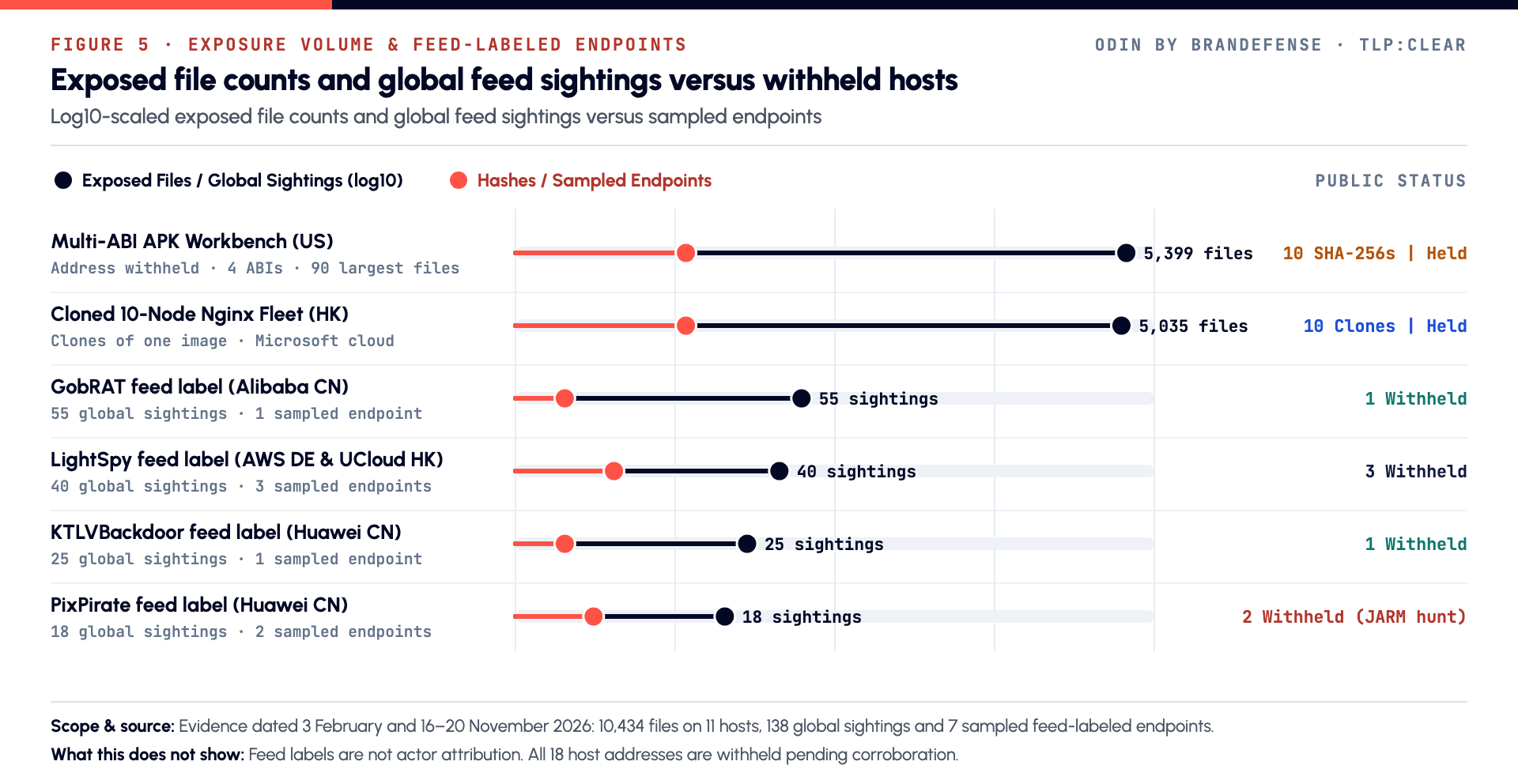
Pair any JARM or certificate match with mobile endpoint process telemetry before you block a cloud address, and review temporary blocks after 30 days.
What to do now
- Corroborate feed-labeled leads before blocking. Hunt with the two PixPirate-labeled JARM fingerprints and
CN=ADMIN1, and require a second certificate or process signal before blocking a cloud host. - Stop unmanaged APK installs. Use your MDM to block installs from unknown sources, keep Google Play Protect on, and limit Accessibility Service rights for apps from outside the store.
- Hunt the build and edge patterns. Test the three unvalidated YARA structural hunts on configuration text, certificate manifests and build specifications before sandbox use.
- Watch for external APK downloads. Alert on APK downloads from outside approved stores and MDM hosts.
- Check your own Nginx servers. Turn off directory listing and clear old logs from server images before you clone them.
The full report's Indicators tab lists 0 published block indicators because all 18 host addresses and all 18 file hashes are withheld pending ownership or behavioral corroboration. The full report's Detection rules tab has Suricata, Sentinel KQL, Sigma and YARA rules. The full report covers the fleet, the workbench, the feed-labeled leads and the rule logic in detail.
What is…?
Short explanations of the tools and families named in this study.
Frequently asked questions
What did we find?
The study covers 18 hosts and 10,434 exposed files in three groups. All 18 host addresses are withheld pending ownership or behavioral corroboration. A live proxy writes its own log from the first request. The log was hash-identical on nine nodes where hashes were available, pointing to one disk image copied across the fleet.
How do the cloned proxies work?
The nodes pair Nginx's GeoIP module with an anti-SQL-injection filter include (seen on seven of ten) and, on one node, a mobile download configuration file (path withheld). The GeoIP module lets the server decide what to show based on the visitor's country and network. The include appears designed to filter SQL-injection requests; we did not test whether it blocked scanners. Whether this configuration steered mobile browsers toward a download was not tested.
What does the workbench hold?
The workbench holds staged files for one streaming lure. Four Apktool trees contain files consistent with app repackaging, including branding assets, native libraries and a staged APK; no build was observed. Their build-tree paths are withheld because the host owner is unconfirmed.
Why are all 18 host addresses withheld?
Large cloud providers move addresses between customers quickly. A block on an uncorroborated address can hit an innocent tenant a week later. Two Huawei Cloud endpoints carry a PixPirate feed label and share a certificate name, but their C2 role needs independent corroboration. We therefore withhold both addresses and publish their JARM fingerprints as hunting leads only.