
1. Executive Summary
In short
In a two-week review ending 20 November 2026, Odin by Brandefense found 60 C2 and callback listeners on 44 hosts that also served open web directories. Separately, 35 hosts exposed 200 AI coding-agent and chat-connector records, including 49 commercial AI API keys. The feed held 7,648 records labelled with 11 stealer and loader families. None of the 24 endpoints examined had independent corroboration for blocking. Route feed matches to hunting, close ad-hoc HTTP servers on developer hosts, and rotate exposed agent keys.
Three kinds of infrastructure sit side by side in modern intrusions. Stealers and loaders harvest credentials. Developer and AI-agent workspaces store high-value keys.
Operators run C2 and out-of-band callback servers. This report looks at all three and asks one practical question for each: block, hunt or rotate.
Sixty C2 and callback listeners share a host with an open web directory.
On 44 servers, 15 offensive and callback frameworks listen next to an unauthenticated directory listing. Interactsh (14 endpoints), CyberStrikeAI (11), Sliver (7), Octopus (5) and Strix (5) make up 70.0% of them. The directories expose staging files, but many such hosts may be authorized test labs.
Exposed AI coding agents and chat bridges leak 200 session records.
On 35 hosts, open directories expose records from five agent tools. Hermes Agent accounts for 93; OpenClaw for 49; Claude Code for 31; Codex CLI for 20; and Cursor Server for 7.
The files hold 49 commercial AI API keys, 18 chat-bot tokens and 72 references to C2 or callback endpoints. We treat the owners as misconfigured users, not attackers.
None of the 24 examined stealer endpoints had independent corroboration for blocking.
The 7,648 feed records name 11 stealer, loader and RAT families. Six examined endpoints on five dedicated hosts carry feed status, hosting and TLS metadata for Rhadamanthys, Bofamet, IcedID, NebulaStealer and DarkComet, but lack independent corroboration. The other 18 sit on common service ports, share TLS fingerprints with unrelated servers or belong to residential telecom networks.
Three Decisions for Leaders
- Require independent corroboration before blocking feed endpoints. Because the 24 examined stealer and loader endpoints lack independent second-signal corroboration, withhold them from automatic egress block lists. Send those feed leads, the hybrid hosts and the ISP addresses to hunting, not blocking.
- Ban ad-hoc HTTP directory servers on developer, AI-agent and red-team hosts. A single
python3 -m http.serverin a home folder publishes every hidden agent folder and key file in it. - Audit chat bridges and rotate file-resident AI keys. List every DingTalk, Telegram and Discord bot connector. Move AI and chat keys out of
.envfiles into a vault with short-lived tokens.
The Study in Numbers
| Number | What it is |
|---|---|
| 60 / 44 | C2 and callback endpoints co-exposed with an open directory, on 44 hosts (15 frameworks) |
| 200 / 35 | Exposed AI coding-agent and chat-connector records, on 35 hosts |
| 49 | Commercial AI API keys in those records (DeepSeek, Stability, Anthropic, OpenAI, OpenRouter) |
| 7,648 / 24 | Feed records labelled with 11 stealer and loader families, and the 24 endpoints we examined on 22 hosts |
| 6 / 5 | Dedicated-host stealer, loader and RAT endpoints on five hosts without independent corroboration (addresses withheld) |
| 18 / 17 | Stealer and loader endpoints with port collisions, shared JARMs or telecom ISP hosts, on 17 hosts (addresses withheld) |
| 0 | Shared hosts or certificates between the stealer endpoints and the hybrid hosts |
How to use this report.
Security leaders can read Chapters 1, 6 and 7. Platform and developer-security teams should read Chapters 3 and 4. SOC and detection engineers should start with Chapters 5, 8 and 9. Teams using cyber threat intelligence will find the hosting detail in Chapters 2, 3 and 5.
2. Three Groups, One Analytical Model
In short
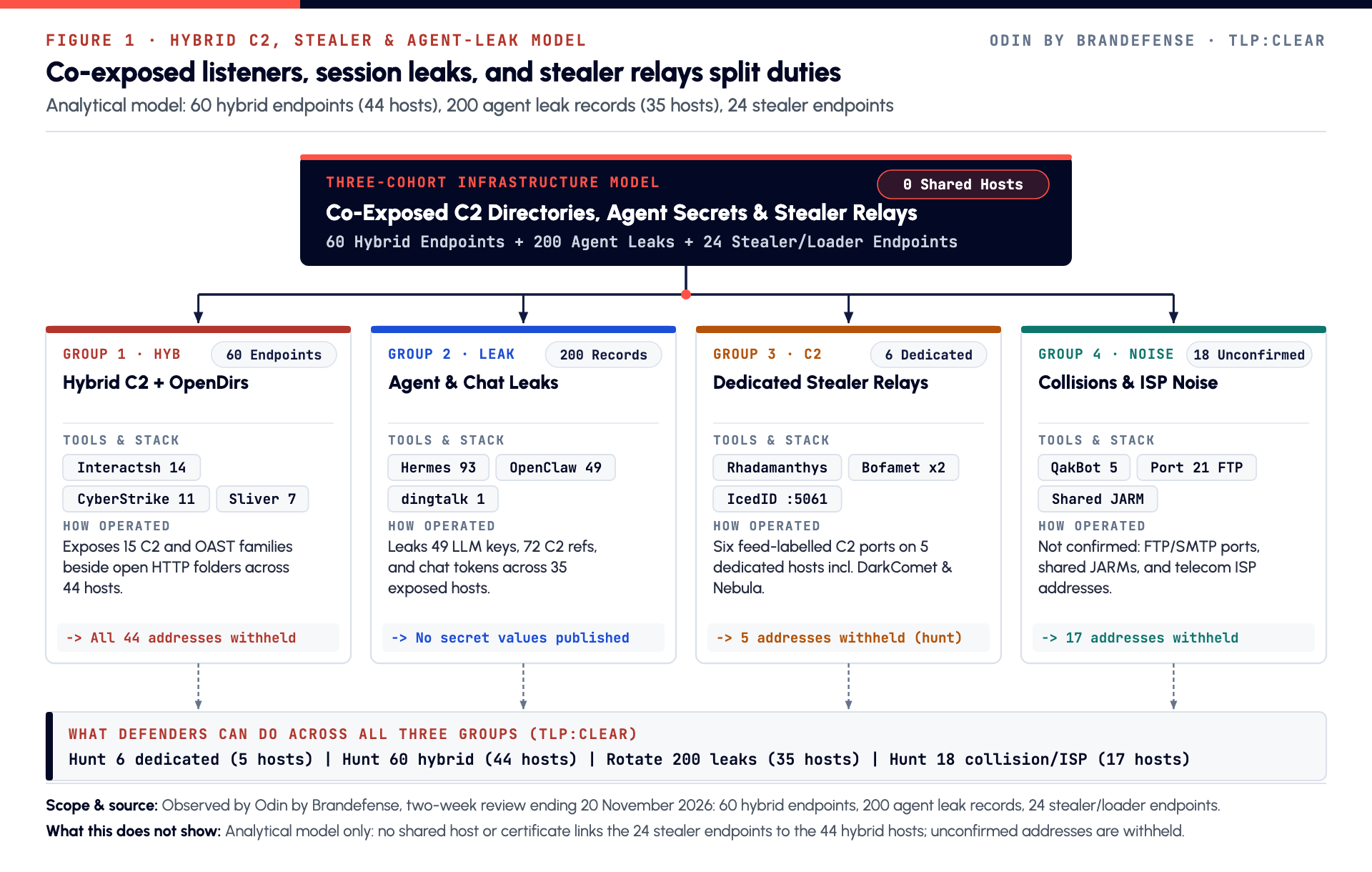
No shared host or certificate links the stealer endpoints to the hybrid hosts. We present the three groups together as an analytical model of how intrusion infrastructure divides work, not as one actor.
Stealers feed credentials into the ecosystem. Developer and AI-agent hosts hold the keys that make those credentials valuable. C2 and callback servers are where operators act on them. Treating every feed match across these layers as a block-list entry breaks production services and blames misconfigured developers.
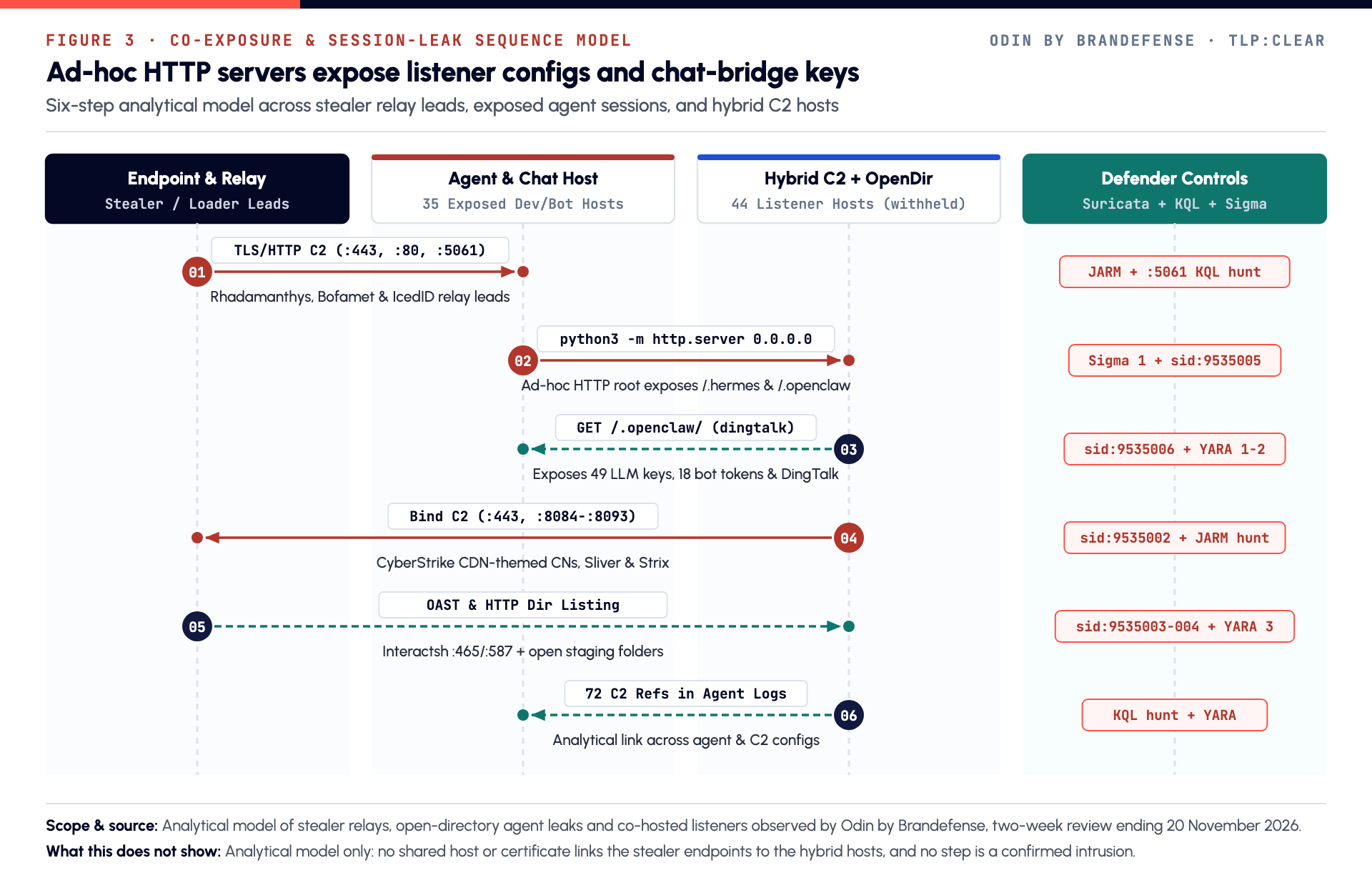
We compared hosts and TLS certificates between the stealer and hybrid groups. None of the 24 stealer endpoints shares a host or certificate with the 44 hybrid hosts. So the link between them is functional, not proven. Figure 1 shows the model and what defenders can do with each part.
| Group | Records | Hosts | Published addresses | What to do |
|---|---|---|---|---|
| Hybrid C2 and open directory | 60 endpoints | 44 | 0 | Hunt; check your own hosts |
| AI coding-agent and chat leaks | 200 records | 35 | 0 | Rotate keys; close directories |
| Stealer, loader and RAT endpoints | 24 endpoints (from 7,648 feed records) | 22 | 0 | Hunt JARM fingerprints and port 5061 |
Where the servers are hosted
The hybrid listeners sit mostly on commercial cloud and budget VPS networks. The United States (26 endpoints, 43.3%), Germany (11, 18.3%), Finland (6, 10.0%) and China (5, 8.3%) account for 80.0% of them.
| Hosting provider | Hybrid endpoints |
|---|---|
| Hetzner Online GmbH | 8 |
| CNServer LLC | 6 |
| IBM Cloud | 5 |
| IXROOT LTD | 5 |
| NetLab Global | 5 |
| Hangzhou Alibaba Advertising Co.,Ltd. | 4 |
Six dedicated-host stealer and loader endpoints sit on cloud and European hosting: Amazon.com, Inc., IONOS SE, Yedinyye Resheniya LLC, Brainoza OU and JSC "TIMEWEB". The QakBot-labelled candidate addresses sit on residential and mobile telecom networks in Saudi Arabia and Canada. Because none of the 24 stealer endpoints has independent corroboration and ISP addresses change hands often, none is placed on a block list here.
3. Sixty Listeners Next to Open Directories
In short
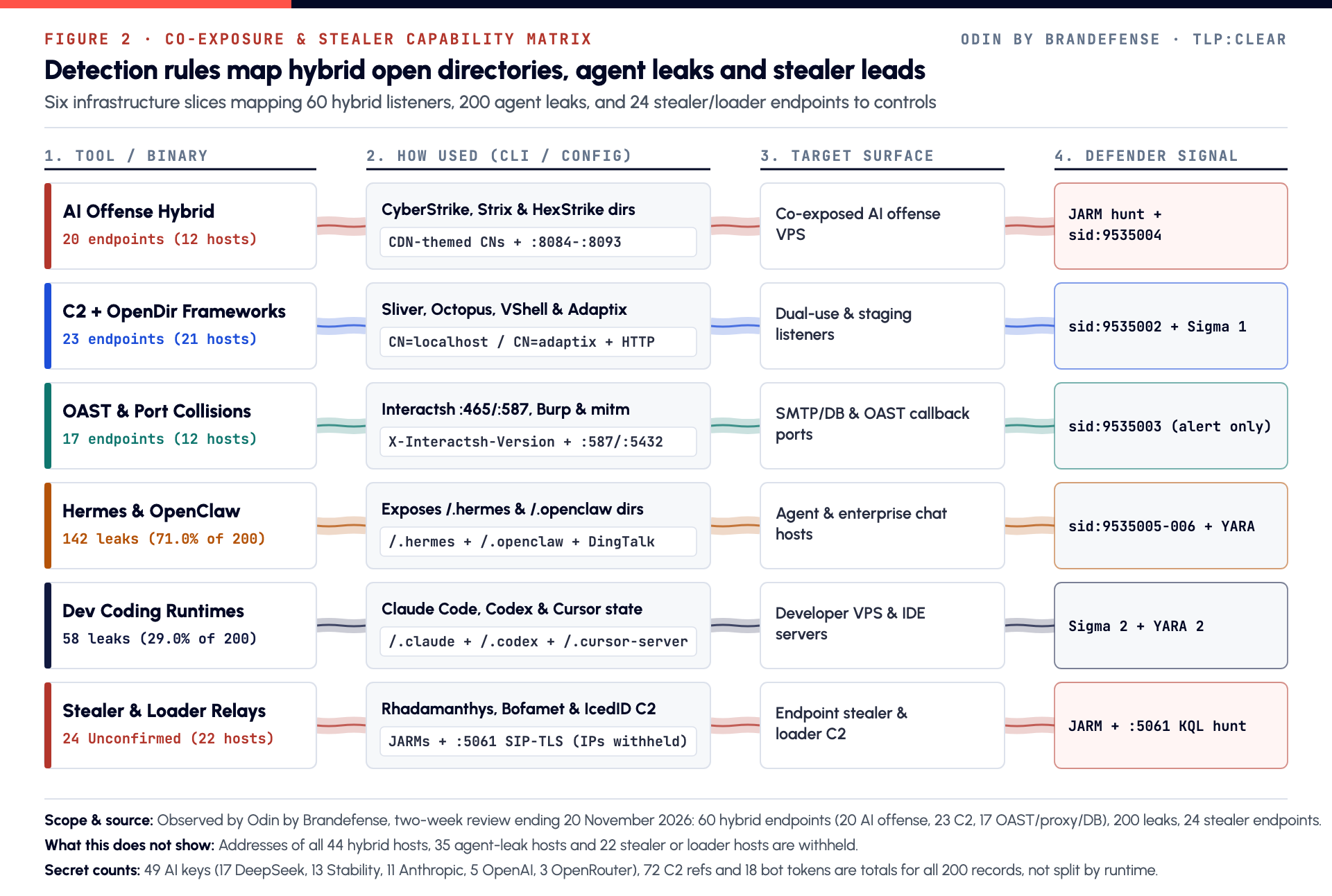
On 44 hosts, C2, callback and AI-offense listeners share an IPv4 address with an unauthenticated directory listing. AI-offense platforms, classic C2 frameworks and callback utilities make up three groups of 20, 23 and 17 endpoints.
Operators on a fresh VPS often start a quick file server, such as python3 -m http.server or SimpleHTTPServer, to move payloads, stagers or logs. They skip SCP or a reverse proxy. Bound to 0.0.0.0, the file server exposes the working folder; defenders can find that risk with external attack surface management (T1583.003).
Python's own documentation warns that http.server is not meant for production and has only basic security checks. Figure 2 maps each slice of this research to the target surface and the matching detection.
AI-offense platforms and masquerade certificates
AI-assisted offense platforms account for 20 of the 60 endpoints (33.3%) on 12 hosts. They are CyberStrikeAI (11 endpoints on 7 hosts), Strix (5 on 1 host) and HexStrikeAI (4 on 4 hosts).
CyberStrikeAI shows two TLS deployment clusters:
- Dual-port cluster. Three US hosts on CNServer LLC each listen on TCP 80 and 443 (six endpoints). All six share one certificate and one JARM fingerprint (
40d40d40d00040d…, full value in Chapter 9). - Masquerade cluster. Three hosts in Malaysia (port 443), the United States (8443) and Japan (8443) share a second JARM. Each presents a certificate name themed as a CDN or health-check service. The three names are withheld because each points to a single server whose owner is not established.
One US host carries all five Strix endpoints on five high ports. HexStrikeAI listens on TCP 5000 on three hosts and on 8888 on one host in Hong Kong.
Classic C2 frameworks
Post-exploitation C2 frameworks contribute 23 endpoints (38.3%). Six of the seven Sliver endpoints, on ports 443 and 8443, still use Sliver's default CN=localhost certificate. Three of them share one JARM fingerprint.
Five Octopus HTTP listeners sit on five separate German IBM Cloud hosts. AdaptixC2 presents its default CN=adaptix certificate on port 4321.
Callback utilities and port collisions
Callback, interception and database-port listeners make up the last 17 endpoints (28.3%). Thirteen of the 14 Interactsh endpoints sit on mail-submission ports 465 (5) and 587 (8), across eight hosts. One more Interactsh endpoint uses 8443. Another framework label, Daybreak, sits on PostgreSQL port 5432.
ProjectDiscovery's interactsh-server opens SMTP listeners by default on port 25, on 587 for SMTPS and on 465 for SMTP with automatic TLS. A port banner rule alone therefore cannot tell a self-hosted callback server from a real mail relay. Use the X-Interactsh-Version: HTTP header as a hunt signal instead.
Two US hosts stack more than one framework over an open directory:
| Host | Frameworks and ports |
|---|---|
| Multi-family host 1 | Interactsh on 465 and 587, Sliver on 443 |
| Multi-family host 2 | Sliver on 8443, Kaiten on 9080 |
All 15 frameworks
| Framework | Endpoints | Hosts | Ports | Notes |
|---|---|---|---|---|
| Interactsh | 14 | 9 | 587 (8), 465 (5), 8443 (1) | Mail-port collision on 13 endpoints |
| CyberStrikeAI | 11 | 7 | 443 (5), 80 (3), 8443 (2), 8899 (1) | Two TLS clusters |
| Sliver | 7 | 7 | 443 (5), 8443 (2) | Six with default CN=localhost |
| Octopus | 5 | 5 | 80 (5) | IBM Cloud, Germany |
| Strix | 5 | 1 | 8084, 8085, 8086, 8089, 8093 | One host |
| HexStrikeAI | 4 | 4 | 5000 (3), 8888 (1) | |
| VShell | 4 | 3 | 8082 (3), 8086 (1) | |
| AdaptixC2 | 2 | 2 | 4321 (CN=adaptix), 4444 | |
| Cobalt Strike | 2 | 2 | 443 (1), 9091 (1) | |
| Six others (one each) | 6 | 6 | 443, 5432, 8080, 8081, 9080 | Burp Collaborator, mitmproxy, Daybreak, Kaiten, Havoc, Hashtopolis |
All 44 host addresses are withheld. Many of these frameworks are standard red-team and testing tools, and an open directory can sit on a shared lab or a hijacked VPS.
4. AI Coding Agents and Chat Bridges in Open Directories
In short
Open directories on 35 hosts expose 200 AI coding-agent and chat-connector records. The owners are misconfigured users, and the fix is to close the directory and rotate every key it held.
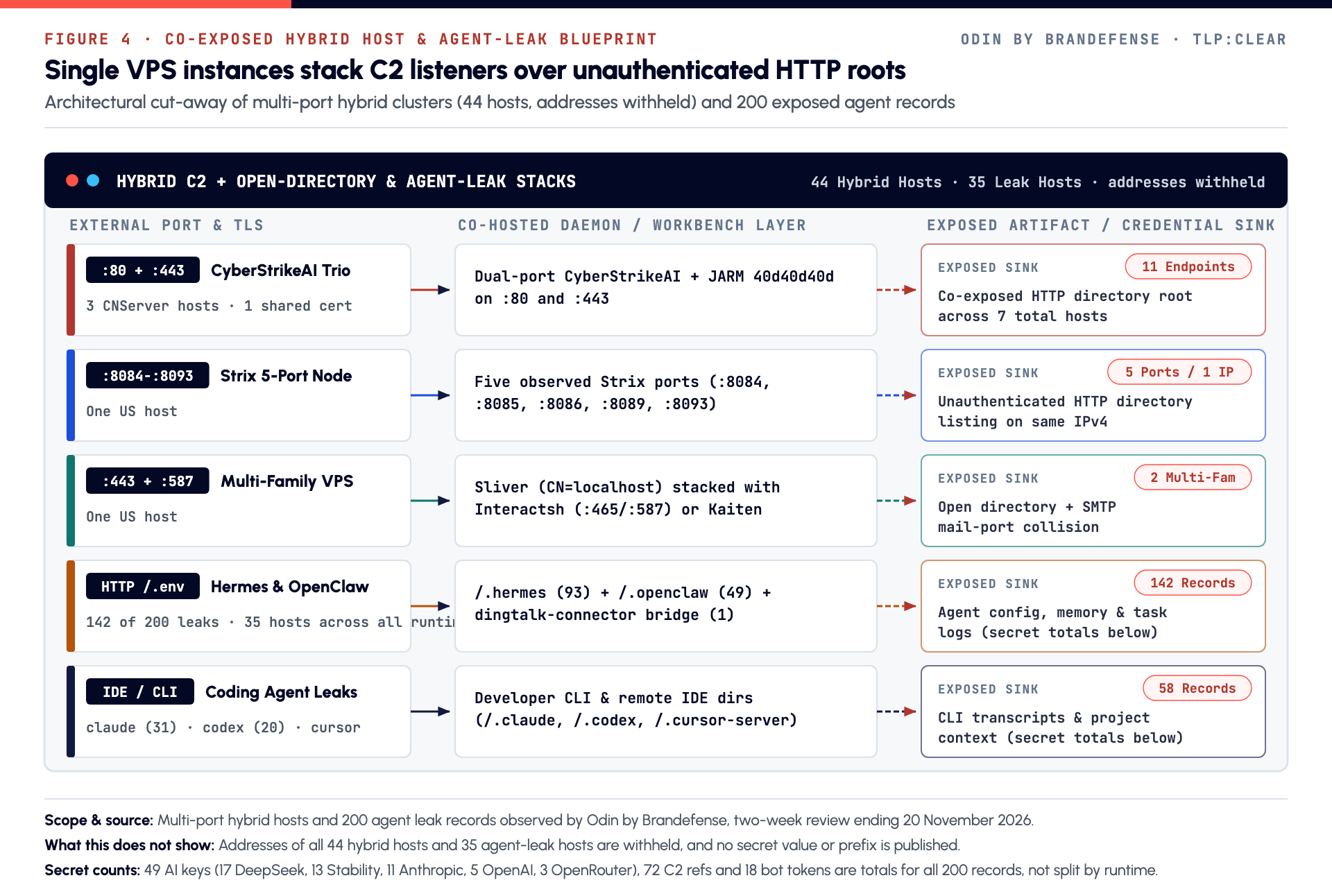
Autonomous coding assistants and chat-driven agents keep their state in hidden home folders: /.hermes/, /.openclaw/, /.claude/, /.codex/ and /.cursor-server/. Those folders collect API keys, bot tokens and transcripts. Starting a file server from the home folder publishes all of them at once (T1552.001).
Five runtimes
Autonomous task agents outnumber interactive coding tools by about two and a half to one. Hermes Agent and OpenClaw hold 142 records (71.0%). Coding assistants hold the remaining 58 (29.0%).
| Runtime | Folder | Records | Share | What leaks |
|---|---|---|---|---|
| Hermes Agent | /.hermes/ | 93 | 46.5% | Task state, scratch logs and API key files |
| OpenClaw | /.openclaw/ | 49 | 24.5% | Agent sessions, including one dingtalk-connector bridge |
| Claude Code | /.claude/ | 31 | 15.5% | CLI transcripts and project context |
| Codex CLI | /.codex/ | 20 | 10.0% | CLI configuration |
| Cursor Server | /.cursor-server/ | 7 | 3.5% | Remote IDE configuration |
What the records hold
| Content | Records | Share | Detail |
|---|---|---|---|
| C2 or callback endpoint references | 72 | 36.0% | URLs inside agent task logs and scan output |
| Commercial AI API keys | 49 | 24.5% | 17 DeepSeek, 13 Stability, 11 Anthropic, 5 OpenAI, 3 OpenRouter |
| Passwords, secrets and private keys | 39 | 19.5% | 21 passwords, 15 generic secrets, 3 PEM private keys |
| Chat bots, paste drops and other connectors | 40 | 20.0% | 12 Telegram, 6 Discord, 4 Pastebin, 18 other connector records including DingTalk |
The 72 endpoint references sit inside agent task logs and scan output. That fits people using Hermes Agent or OpenClaw for security testing on hosts with open directories. No secret value or partial secret appears in this report.
Why a chat bridge matters
A dingtalk-connector configuration inside an OpenClaw workspace creates risk in both directions. Anyone who copies a valid bridge credential can reach internal workspace notifications and bot command webhooks without corporate single sign-on. We classify owners of these exposed Claude Code, Codex CLI, Cursor Server, OpenClaw and Hermes Agent servers as misconfigured users. Nothing on them shows offensive intent.
5. Stealer, Loader and RAT Endpoints
In short
Feed records name 11 stealer, loader and RAT families across 24 examined endpoints, including six endpoints on five dedicated cloud and VPS hosts. Because the available evidence does not establish independent corroboration for any of the 24 endpoints, withhold them from block lists and hunt their JARM fingerprints and SIP-TLS port 5061 usage.
Information stealers (Rhadamanthys, NebulaStealer, js-tap) and loaders or RATs (QakBot, Bumblebee, IcedID, Bofamet, DarkComet, Ursnif, StadiaRAT, SilverRAT) harvest browser cookies, SSH keys and workstation .env tokens. Those are the same secrets that fuel cloud and agent abuse later. The family names come from upstream feeds and are not actor attribution.
Six dedicated-host endpoints without independent corroboration
The available evidence does not establish independent corroboration for these endpoints. The study records provide upstream feed status, dedicated hosting and TLS metadata for six endpoints across five hosts, so their five IPv4 addresses are withheld.
| Family | Host and port | Country and provider | TLS |
|---|---|---|---|
| Rhadamanthys | Dedicated host 1, port 443 (address withheld) | Germany, Amazon.com, Inc. | Certificate, JARM 3fd21b20d3fd… |
| Bofamet | Dedicated host 2, port 443 (address withheld) | Belarus, Yedinyye Resheniya LLC | Certificate, JARM 29d29d00029d… |
| Bofamet | Dedicated host 2, port 80 (address withheld) | Belarus, Yedinyye Resheniya LLC | Plain HTTP |
| IcedID | Dedicated host 3, port 5061 (address withheld) | Netherlands, Brainoza OU | Certificate, JARM 29d3fd00029d… |
| NebulaStealer | Dedicated host 4, port 80 (address withheld) | Germany, IONOS SE | Plain HTTP panel |
| DarkComet | Dedicated host 5, port 443 (address withheld) | Russia, JSC "TIMEWEB" | Certificate, JARM 27d40d40d000… |
Three points matter for defenders:
- Rhadamanthys on AWS. Cloud addresses are reassigned quickly, and an elastic IP without a corroborated beacon or response can move to a new tenant within days. Hunt the TLS JARM fingerprint instead of blocking the host.
- Bofamet on two ports. The same Belarus host pairs plain HTTP on port 80 with TLS on 443. Use the TLS JARM fingerprint for hunting until an independent second signal is recorded.
- IcedID on port 5061. TCP 5061 is normally reserved for encrypted SIP-TLS voice signalling. Non-voice traffic on this port can pass for VoIP traffic at a glance (T1571). Allow outbound 5061 only from known voice systems.
Eighteen endpoints with port collisions, shared JARMs or ISP churn
A feed's own "confirmed" label is not enough to block an address. Three Rhadamanthys-labelled endpoints carried that label, but two showed direct collisions. One sits on FTP port 21 at a large cloud provider. The other, on port 8443 at a cloud provider in Hong Kong, shares its TLS fingerprint with unrelated servers.
| Group | Endpoints | Families and ports |
|---|---|---|
| Rhadamanthys label, collision leads | 2 | FTP port 21; shared JARM on 8443 |
| Suspected C2 leads | 5 | Bumblebee on 443 (2), QakBot on 5000, DarkComet on 50001, js-tap on 443 sharing the DarkComet endpoint's JARM |
| Weak leads | 11 | QakBot on 443 on telecom ISPs (4), DarkComet on 1604 and 7777, Ursnif (2), StadiaRAT (2), SilverRAT on 3467 |
These 18 endpoints sit on 17 hosts. Together with the five dedicated hosts above, all 22 stealer and loader host addresses are withheld. Use the metadata and JARM fingerprints as hunting context, not as block-list entries.
6. Feed Labels Against Corroborated Evidence
In short
Pushing raw feed matches into a firewall would block ISP customers, mail relays and developer machines. None of the 24 endpoints examined from the 7,648-record feed had the independent second signal required for a block list here.
A block list is defined as much by what it leaves out as by what it holds. Figure 5 compares the size of each feed label or dataset with the examined endpoints and shows why all were routed to hunting or key rotation.
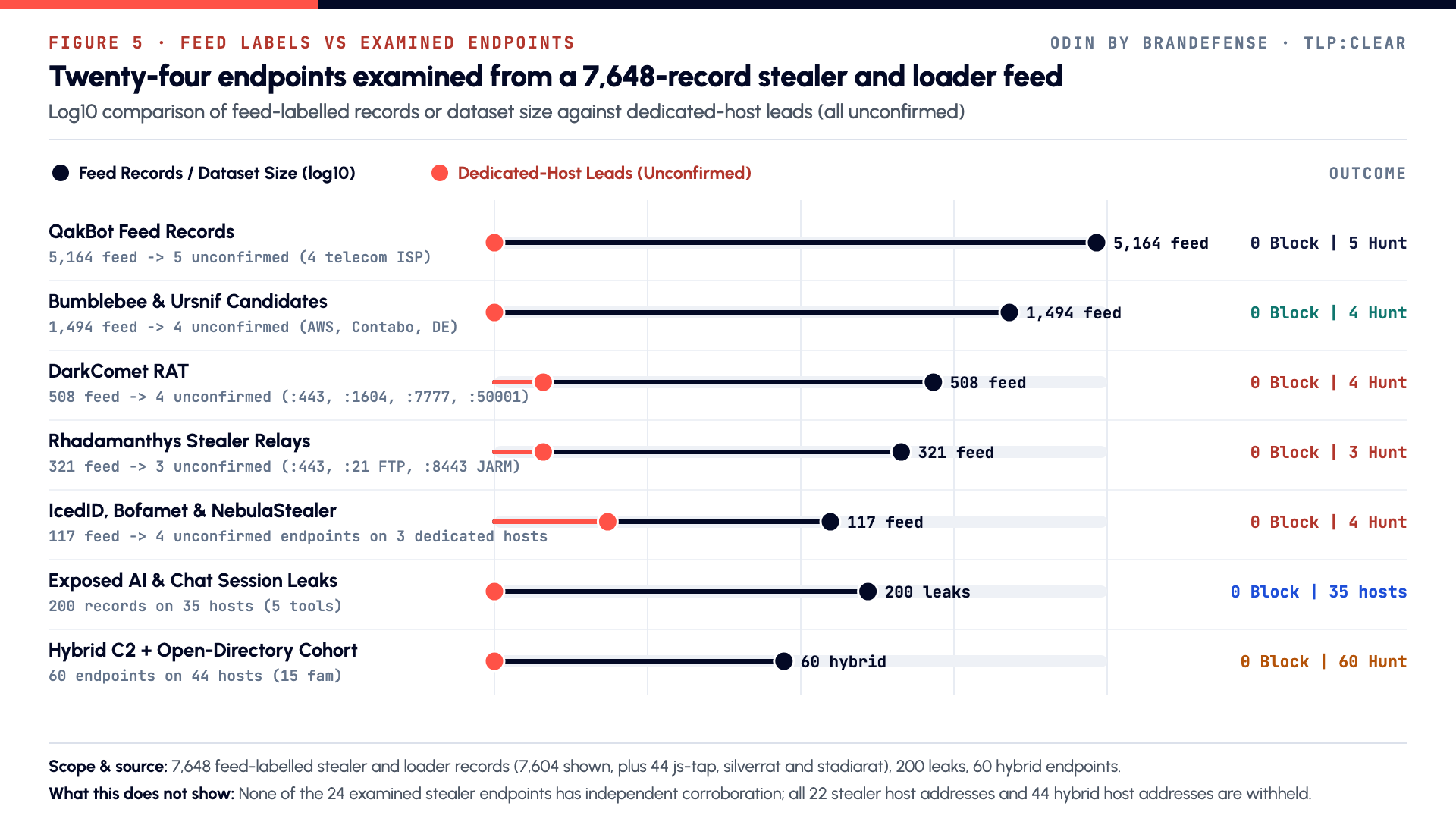
| Family | Feed-labelled records | Endpoints examined | Hosts | Dedicated-host leads (unconfirmed) | Collision or ISP leads (unconfirmed) |
|---|---|---|---|---|---|
| QakBot | 5,164 | 5 | 5 | 0 | 5 (4 telecom ISP, 1 port 5000) |
| Bumblebee | 1,164 | 2 | 2 | 0 | 2 (port 443) |
| DarkComet | 508 | 4 | 3 | 1 (port 443, address withheld) | 3 (ports 1604, 7777, 50001) |
| Ursnif | 330 | 2 | 2 | 0 | 2 (ports 443, 58089) |
| Rhadamanthys | 321 | 3 | 3 | 1 (port 443, address withheld) | 2 (FTP 21, shared JARM on 8443) |
| IcedID | 102 | 1 | 1 | 1 (port 5061, address withheld) | 0 |
| js-tap and SilverRAT | 39 | 2 | 2 | 0 | 2 (23 js-tap and 16 SilverRAT records) |
| Bofamet | 12 | 2 | 1 | 2 (ports 443 and 80, address withheld) | 0 |
| StadiaRAT | 5 | 2 | 2 | 0 | 2 (port 80, Germany and Netherlands) |
| NebulaStealer | 3 | 1 | 1 | 1 (port 80, address withheld) | 0 |
Four other ways to read the evidence
- Authorized testing. Sliver with
CN=localhost, Interactsh, Burp Collaborator, mitmproxy, AdaptixC2 and Hashtopolis are everyday tools for internal red teams and contracted testers. Even CyberStrikeAI's masquerade certificates can sit on a shared lab or a hijacked third-party VPS. That is why all 60 hybrid endpoints stay unpublished. - Developers, not operators. Engineers using Claude Code, Codex CLI, Cursor Server, OpenClaw or Hermes Agent often start a temporary HTTP server to copy files off a cloud devbox. The 35 hosts behind the 200 records are credential-exposure victims. They need key rotation, not blocking.
- Residential ISP churn. QakBot has a history of relaying through infected home computers on residential broadband networks. Of 5,164 QakBot-labelled records, none produced a block-list address. Blocking a subscriber address hurts the next customer who receives it.
- Port and fingerprint collisions. Thirteen Interactsh endpoints on ports 465 and 587, one Daybreak label on PostgreSQL 5432, and two Rhadamanthys labels (FTP 21 and a shared JARM) make 16 collision cases. A JARM or a port on its own should never trigger a block.
7. What Defenders Should Do
Network and firewall
- Require an independent second signal, such as a protocol response, beacon or workbench artifact, before adding upstream stealer or loader feed addresses to firewall or proxy block lists.
- Allow outbound TCP 5061 only from registered voice gateways and session border controllers. Alert on any other process that opens it.
Cloud and developer platforms
- Scan your own external and VPC address space for
Directory listing for /pages. Close any that expose/.hermes/,/.openclaw/,/.claude/,/.codex/or/.cursor-server/. - Block
http.serverand similar ad-hoc servers bound to0.0.0.0on hosts that hold agent folders.
Identity and AI platform security
- Inventory every chat bridge (
dingtalk-connector, Telegram, Discord) and every commercial AI key (DeepSeek, Anthropic, OpenAI, OpenRouter, Stability). Move plaintext.envsecrets into an OS keychain or a vault with short-lived tokens. - Rotate any key found in a folder that was reachable over HTTP, even briefly.
Detection and threat intelligence
- Deploy the rules in Chapter 8 on perimeter, TLS-inspection and Linux or Windows EDR tiers, with exact-name allowlists for red-team and sandbox hosts.
- Keep FTP (21), SMTP (465, 587), PostgreSQL (5432), shared-JARM and telecom ISP matches out of automatic firewall feeds. Route them to hunting.
8. Detection Rules
The full rules are in the Detection rules tab. The Suricata file passes a syntax lint. The rules were not loaded on live Suricata, YARA, Sigma or Kusto engines for this edition, so test and tune them in your own environment before production use.
| Rule file | What it catches |
|---|---|
odin_hybrid_c2_opendir_rhadamanthys_and_agent_leaks.rules | Suricata 7: five signatures for the AdaptixC2 default certificate, Interactsh headers, co-exposed C2 and agent-folder directory listings, and OpenClaw config fetches |
sentinel_hybrid_c2_opendir_stealer_and_agent_leak_hunt.kql | Microsoft Sentinel and Defender XDR: non-voice use of port 5061, HTTP requests to agent folders, and ad-hoc HTTP servers next to C2 or agent folders |
sigma_hybrid_c2_http_server_rhadamanthys_and_agent_env.yml | Sigma (2 rules): ad-hoc HTTP servers in agent or C2 folders, and archiving or copying of agent folders |
odin_rhadamanthys_bofamet_and_exposed_agent_sessions.yar | YARA (3 rules): exposed OpenClaw and DingTalk sessions, agent key bundles, and hybrid open-directory listings |
How the Suricata signatures work
| SID | Looks for | Why |
|---|---|---|
| 9535002 | Server certificate subject CN=adaptix | AdaptixC2's default self-signed certificate |
| 9535003 | X-Interactsh-Version: response header | Self-hosted Interactsh server (hunt only, authorized scanners use it too) |
| 9535004 | A 200 directory listing that names CyberStrike, HexStrike, Sliver, Adaptix, Strix, VShell or Octopus | C2 or AI-offense tooling in an open directory |
| 9535005 | A 200 directory listing with links to .hermes, .openclaw, .claude, .codex or .cursor-server folders | Agent home folders exposed over HTTP |
| 9535006 | GET requests under /.openclaw/ for dingtalk-connector, config, .env or session files | Someone fetching exposed agent or bridge secrets |
TLS 1.3 encrypts server certificates, so SID 9535002 fires on TLS 1.2 handshakes or behind a TLS-decrypting proxy. Keep SID 9535003 in alert-only mode where authorized scanners run.
How the other rules work
The KQL query looks back seven days. It first finds Python, PHP, Node, Caddy or nginx processes started as ad-hoc file servers, or command lines that name agent folders or C2 frameworks. It then finds network connections to port 5061 from non-voice hosts, or to URLs under agent folders. The two views are joined per device.
Each result gets one label: contain an exposed directory and rotate keys, hunt a DingTalk bridge, or hunt a listener or port 5061 anomaly. Red-team, AI-gateway and voice hosts are excluded by exact device name.
| Sigma rule | Level | Fires when |
|---|---|---|
| Ad-hoc HTTP server in a C2 or agent workspace | High | http.server, SimpleHTTPServer or similar starts from an agent or C2 folder on Linux |
| Archive or transfer of agent folders | High | tar, zip, curl, scp or rsync reads an agent or dingtalk-connector path on Linux |
| YARA rule | Fires when |
|---|---|
ODIN_Exposed_OpenClaw_DingTalk_Connector_Session | An OpenClaw marker appears with a DingTalk connector, or with a bot token and a key field |
ODIN_Exposed_Hermes_Claude_Codex_Agent_Secret_Bundle | An agent folder path appears with at least two AI API key names |
ODIN_Hybrid_C2_OpenDir_Workspace_Manifest | A directory listing names at least two C2, callback or AI-offense frameworks |
MITRE ATT&CK mapping
| Tactic | Technique | How it shows up | Detection |
|---|---|---|---|
| Resource Development | T1583.003 Acquire Infrastructure: Virtual Private Server | C2 and callback listeners on rented VPS hosts with open directories | SID 9535004; Sigma rule 1; YARA |
| Credential Access | T1552.001 Unsecured Credentials: Credentials In Files | AI and chat keys in exposed agent folders | SIDs 9535005 and 9535006; Sigma rule 2; YARA |
| Command and Control | T1071.001 Application Layer Protocol: Web Protocols | C2 and callback listeners over HTTP and HTTPS | SIDs 9535002 and 9535003; KQL |
| Command and Control | T1571 Non-Standard Port | IcedID-labelled endpoint on SIP-TLS port 5061 | KQL port 5061 hunt |
9. Indicators
The Indicators tab holds 7 published indicators: 7 JARM fingerprints for TLS hunting. There are no published IPv4 addresses or file hashes in this report. Eight more indicators appear in this report only: one default certificate name, one HTTP header, five agent folder paths and one chat-bridge name.
| Type | Count | Where to use it |
|---|---|---|
| JARM fingerprints | 7 | TLS hunting only, never block on a JARM alone |
| Certificate name and HTTP header | 2 | TLS and proxy hunting |
| Agent folder paths and chat-bridge name | 6 | External attack-surface scans, EDR and IAM reviews |
JARM fingerprints to hunt
| JARM | Family | Context |
|---|---|---|
3fd21b20d3fd3fd21c43d21b21b43d1ec49a4b64df0a9e9f328abd60285841 | Rhadamanthys | Dedicated-host endpoint; also seen on another server |
29d29d00029d29d00042d42d0000002059a3b916699461c5923779b77cf06b | Bofamet | Dedicated-host loader endpoint |
29d3fd00029d29d00042d43d000000ad9bf51cc3f5a1e29eecb81d0c7b06eb | IcedID | Dedicated-host port 5061 endpoint |
27d40d40d00040d00042d43d000000d2e61cae37a985f75ecafb81b33ca523 | DarkComet | Dedicated-host endpoint; shared with a suspected js-tap server |
40d40d40d00040d00043d43d00043d3bef2bf79cd6719851e8198c1e8f9a14 | CyberStrikeAI | Three dual-port hybrid hosts |
40d40d40d00000000043d43d00043d6aff5ab0f4fc31897186312c9e639319 | CyberStrikeAI | Three hosts with CDN-themed certificate names |
3fd3fd20d00000021c43d43d00043d204204071741c36579e355f830d285a5 | Sliver | Three hybrid Sliver listeners |
Other indicators
| Indicator | Type | Use |
|---|---|---|
CN=adaptix | Default certificate name (AdaptixC2, port 4321) | TLS hunting |
X-Interactsh-Version: | HTTP response header (14 endpoints on 9 hosts) | Proxy hunting, alert only |
/.hermes/ | Agent folder (93 records) | Attack-surface scans and EDR |
/.openclaw/ | Agent folder (49 records) | Attack-surface scans and EDR |
/.claude/ | Agent folder (31 records) | Developer host audit |
/.codex/ | Agent folder (20 records) | Developer host audit |
/.cursor-server/ | Agent folder (7 records) | Developer host audit |
dingtalk-connector | Chat-bridge configuration in OpenClaw | IAM and EDR review |
Withheld: all 44 hybrid host addresses and all 35 agent-leak host addresses. Also withheld: all 22 hosts behind the 24 stealer endpoints (the five dedicated hosts and the 17 collision or ISP hosts). The three CDN-themed certificate names and every secret value are withheld too.
10. Scope and Limits
- Window. The review ended 20 November 2026. The stealer comparison includes older feed records; their dates do not establish activity within a two-week window.
- Feed labels are not attribution. Family names such as Rhadamanthys or QakBot come from upstream feeds. Without an independent second signal, none of the 24 stealer endpoints is treated as confirmed adversary infrastructure.
- The model is a model. No host or certificate links the stealer endpoints to the hybrid hosts. Figures 1 and 3 show an analytical model of how the groups divide work, not one actor.
- Owners are not operators. The 35 agent-leak hosts belong to misconfigured users. Hybrid hosts may be authorized labs. Their addresses are withheld.
- No secrets used. We did not use any leaked key or token, and no secret value appears in this report.
- Cloud addresses move. One Rhadamanthys-labelled endpoint sits on AWS, where elastic addresses are reassigned often. All 22 stealer host addresses are withheld rather than placed on a block list.
- Rule testing. The rules were not loaded on live engines for this edition and were not replayed against live traffic. Test them in your own environment first.
11. Sources
- MITRE ATT&CK. T1583.003 Acquire Infrastructure: Virtual Private Server. https://attack.mitre.org/techniques/T1583/003/ (verified 20 November 2026)
- ProjectDiscovery. Interactsh: out-of-band interaction server and client. https://github.com/projectdiscovery/interactsh (verified 20 November 2026)
- MITRE ATT&CK. S0633 Sliver. https://attack.mitre.org/software/S0633/ (verified 20 November 2026)
- MITRE ATT&CK. T1552.001 Unsecured Credentials: Credentials In Files. https://attack.mitre.org/techniques/T1552/001/ (verified 20 November 2026)
- OWASP Cheat Sheet Series. Secrets Management Cheat Sheet. https://cheatsheetseries.owasp.org/cheatsheets/Secrets_Management_Cheat_Sheet.html (verified 20 November 2026)
- MITRE ATT&CK. S0650 QakBot. https://attack.mitre.org/software/S0650/ (verified 20 November 2026)
- MITRE ATT&CK. S0483 IcedID. https://attack.mitre.org/software/S0483/ (verified 20 November 2026)
- Salesforce. JARM: active TLS server fingerprinting. https://github.com/salesforce/jarm (verified 20 November 2026)
- MITRE ATT&CK. T1571 Non-Standard Port. https://attack.mitre.org/techniques/T1571/ (verified 20 November 2026)
- Python documentation. http.server: HTTP servers. https://docs.python.org/3/library/http.server.html (verified 20 November 2026)
What is…?
Short explanations of the tools and families named in this study.
What is JARM?
JARM is an open TLS server fingerprinting method from Salesforce. It hashes how a server answers a set of crafted TLS handshakes.
More about JARMAI agentWhat is OpenClaw?
OpenClaw is an open-source autonomous agent gateway that keeps trajectories, auth profiles and session logs on disk.
More about OpenClawC2 frameworkWhat is Sliver?
Sliver is an open-source command-and-control (C2) framework from Bishop Fox, written in Go. Red teams use it for adversary emulation, and criminal and state operators use it as a free alternative to Cobalt Strike.
More about SliverOAST serviceWhat is Interactsh?
Interactsh is ProjectDiscovery's open-source OAST server and client for catching DNS, HTTP and other callbacks.
More about InteractshAI offensive toolWhat is CyberStrikeAI?
CyberStrikeAI is a public AI-driven offensive security platform. It spreads its operator interface, API and agent listener across several ports on one host and exposes tools through MCP.
More about CyberStrikeAIC2 frameworkWhat is AdaptixC2?
AdaptixC2 is an open-source, extensible post-exploitation and adversary emulation framework with a multi-operator client.
More about AdaptixC2Frequently asked questions
What does a C2 server with an open directory look like?
On 44 servers we found 60 C2, callback and AI-offense listeners running next to an unauthenticated directory listing on the same address. They cover 15 frameworks. Five of them make up 70.0% of the total: Interactsh (14 endpoints), CyberStrikeAI (11), Sliver (7), Octopus (5) and Strix (5).
How do AI coding agents leak keys?
AI coding assistants and chat-driven agents keep their state in hidden home folders: /.hermes/, /.openclaw/, /.claude/, /.codex/ and /.cursor-server/. Those folders collect API keys, bot tokens and transcripts. Start a file server in the home folder and every one of them is published.
Why did none of the 24 stealer endpoints make the block list?
Stealers and loaders harvest browser cookies, SSH keys and .env files, the same secrets that later fuel cloud and agent abuse. So it is tempting to block everything a feed labels as Rhadamanthys or QakBot. That would be a mistake.
Are these three groups the same actor?
No evidence says so. None of the 24 stealer endpoints shares a host or certificate with the 44 hybrid hosts. We present the three groups as an analytical model of how intrusion infrastructure divides work.