
Key takeaways
- Sixty C2 and callback listeners on 44 hosts share an address with an open web directory.
- Open directories on 35 hosts leak 200 AI agent records, including 49 commercial AI API keys.
- None of the 24 stealer endpoints examined from a 7,648-record feed had independent corroboration for blocking.
- An IcedID-labelled endpoint uses SIP-TLS port 5061, where traffic can pass for voice signalling.
- Keep uncorroborated feed matches out of block lists, ban ad-hoc file servers and rotate exposed agent keys.
Odin found 60 C2 and callback listeners sharing addresses with open web directories. Someone types python3 -m http.server, copies what they need and forgets to stop it. In a two-week review ending 20 November 2026, Odin by Brandefense found that shortcut in two very different places.
One was next to live C2 and callback listeners. The other was inside the home folders of AI coding agents, full of API keys.
We also looked at a third layer that feeds both: commodity stealers and loaders. Here the lesson was about restraint. The feed held 7,648 records labelled with 11 stealer and loader families. Of 24 endpoints examined across 22 hosts, six sat on five dedicated hosts, yet none had independent corroboration as command-and-control (C2).
This short read explains what we found, what it means and what to do about it. The full report has the technical detail, indicators and detection rules defenders can use with a cyber threat intelligence platform.
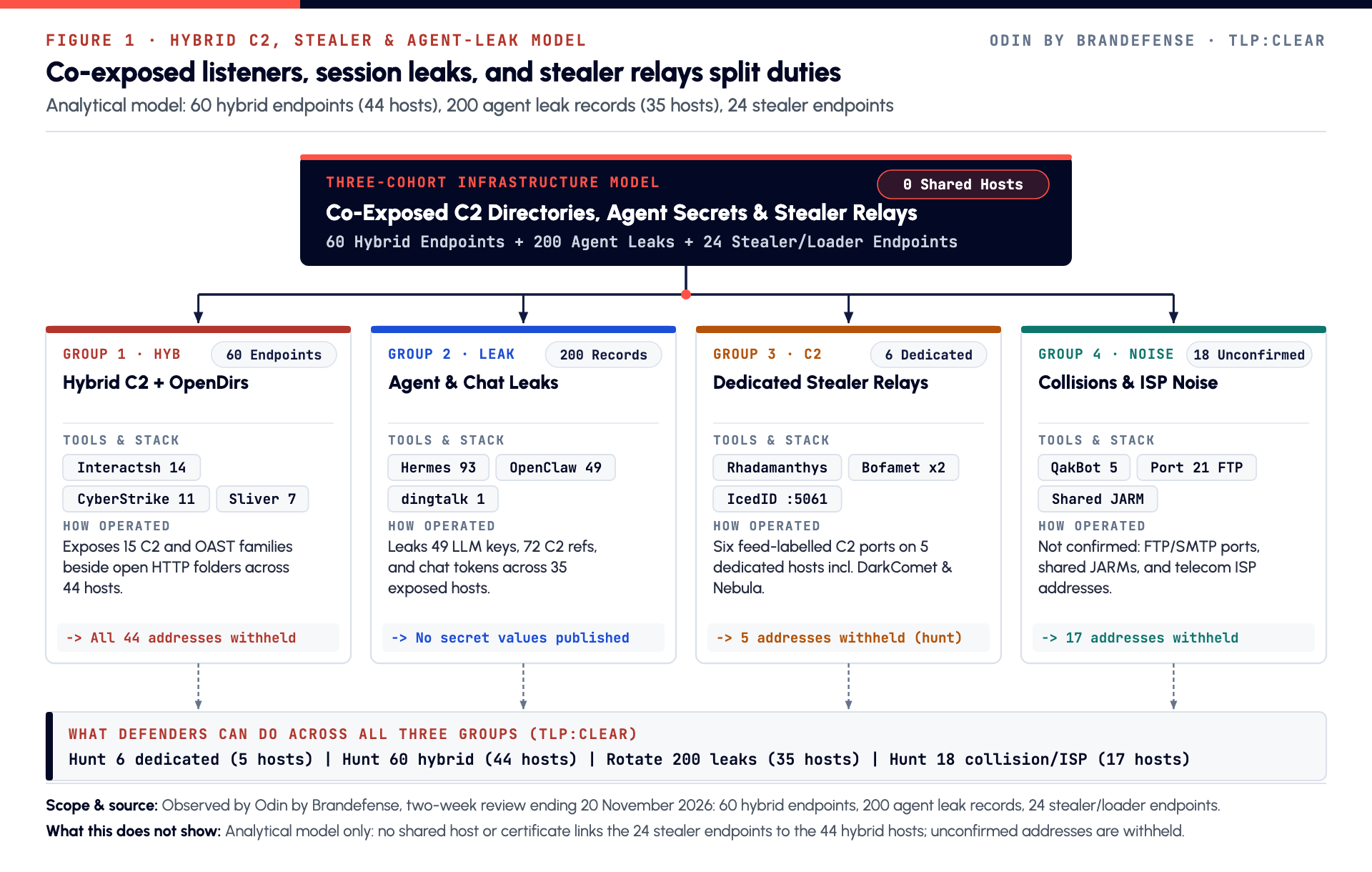
What does a C2 server with an open directory look like?
On 44 servers we found 60 C2, callback and AI-offense listeners running next to an unauthenticated directory listing on the same address. They cover 15 frameworks. Five of them make up 70.0% of the total: Interactsh (14 endpoints), CyberStrikeAI (11), Sliver (7), Octopus (5) and Strix (5).
A typical pattern: someone rents a VPS, starts a C2 listener, then starts a file server to move payloads or logs. The file server exposes the working folder to anyone who looks, an exposure defenders can find with external attack surface management.
Some details stand out:
- Masquerade certificates. Three CyberStrikeAI hosts present certificate names themed as CDN or health-check services. Three others on one US hosting provider each listen on both port 80 and 443 and share one certificate.
- Default certificates. Six of seven Sliver listeners still use Sliver's default
CN=localhost. AdaptixC2 presents its defaultCN=adaptix. - Mail-port collisions. Thirteen Interactsh servers sit on mail ports 465 and 587, because the tool opens SMTP listeners by default. A port rule alone cannot tell them from real mail relays.
We do not publish any of these 44 addresses. Many of these frameworks are everyday red-team tools, and an open directory can sit on a shared lab or a hijacked VPS. The value for defenders is in the patterns, which the detection rules turn into hunts.
How do AI coding agents leak keys?
AI coding assistants and chat-driven agents keep their state in hidden home folders: /.hermes/, /.openclaw/, /.claude/, /.codex/ and /.cursor-server/. Those folders collect API keys, bot tokens and transcripts. Start a file server in the home folder and every one of them is published.
On 35 hosts, open directories exposed 200 such records:
| Runtime | Records |
|---|---|
| Hermes Agent | 93 |
| OpenClaw | 49 |
| Claude Code | 31 |
| Codex CLI | 20 |
| Cursor Server | 7 |
The records hold 49 commercial AI API keys from DeepSeek, Stability, Anthropic, OpenAI and OpenRouter. They also hold 18 Telegram and Discord bot tokens. One OpenClaw workspace holds a DingTalk chat-bridge configuration. Anyone who copies that credential can reach internal notifications and bot webhooks without corporate single sign-on.
We treat the owners as misconfigured users, not attackers. The 72 C2 references in these files sit inside agent task logs and scan output, which fits people using AI agents for security testing. The right response is to close the directory and rotate every key it held.
Why did none of the 24 stealer endpoints make the block list?
Stealers and loaders harvest browser cookies, SSH keys and .env files, the same secrets that later fuel cloud and agent abuse. So it is tempting to block everything a feed labels as Rhadamanthys or QakBot. That would be a mistake.
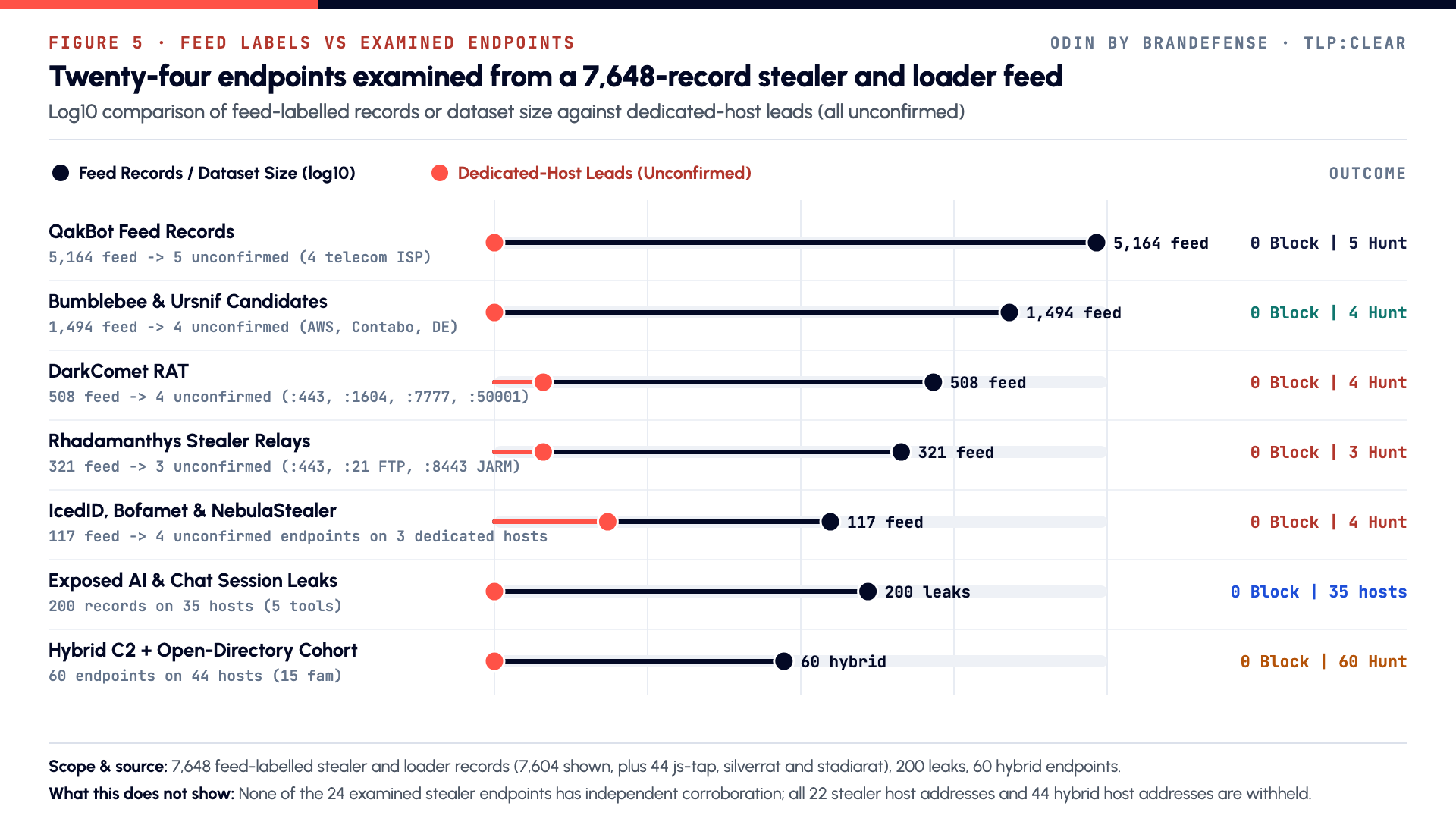
Of 7,648 feed-labelled records across 11 families, we examined 24 endpoints on 22 hosts. Six endpoints on five dedicated cloud and European hosts carried feed status, hosting and TLS metadata without port collisions or residential ISP churn. Even so, the available evidence does not establish independent corroboration for these endpoints, so all five addresses are withheld:
| Family | Port and protocol | Hosting |
|---|---|---|
| Rhadamanthys | TCP 443 (TLS, address withheld) | Amazon, Germany |
| Bofamet | TCP 443 (TLS) and TCP 80 (HTTP, address withheld) | Yedinyye Resheniya LLC, Belarus |
| IcedID | TCP 5061 (TLS, address withheld) | Brainoza OU, Netherlands |
| NebulaStealer | TCP 80 (HTTP, address withheld) | IONOS SE, Germany |
| DarkComet | TCP 443 (TLS, address withheld) | JSC "TIMEWEB", Russia |
The IcedID-labelled endpoint deserves attention. TCP 5061 is normally used for encrypted SIP-TLS voice signalling, so non-voice traffic on it can pass for VoIP at a glance.
The other 18 endpoints on 17 hosts showed clear collision or churn risks. Two Rhadamanthys-labelled servers carried a "confirmed" label in the feed. One sat on FTP port 21 at a large cloud provider, and the other shared its TLS fingerprint with unrelated servers.
QakBot alone accounted for 5,164 feed records but produced no block-list address. Four of its five candidates sit on residential telecom networks, where addresses pass from one customer to the next.
Blocking all of that would cut off ISP customers, mail relays and developer machines. A feed label is a lead, not a verdict.
Are these three groups the same actor?
No evidence says so. None of the 24 stealer endpoints shares a host or certificate with the 44 hybrid hosts. We present the three groups as an analytical model of how intrusion infrastructure divides work.
Stealers harvest secrets, exposed developer hosts hold more of them, and operators act through C2 servers. The model helps defenders plan controls. It does not name an actor.
What to do now
- Require independent corroboration before blocking feed addresses, and use the JARM fingerprints in the full report's Indicators tab as TLS hunting leads rather than firewall blocks.
- Allow outbound port 5061 only from voice systems, and alert on any other process that opens it.
- Ban ad-hoc HTTP servers such as
python3 -m http.serveron developer, AI-agent and red-team hosts, and scan your own address space for open directory listings. - Rotate AI and chat-bot keys found in any folder that was reachable over HTTP, and move them from
.envfiles into a vault with short-lived tokens. - Keep feed matches on common ports, shared JARMs and ISP networks out of automatic block lists. Route them to hunting with the rules in the full report's Detection rules tab.
What is…?
Short explanations of the tools and families named in this study.
What is JARM?
JARM is an open TLS server fingerprinting method from Salesforce. It hashes how a server answers a set of crafted TLS handshakes.
More about JARMAI agentWhat is OpenClaw?
OpenClaw is an open-source autonomous agent gateway that keeps trajectories, auth profiles and session logs on disk.
More about OpenClawC2 frameworkWhat is Sliver?
Sliver is an open-source command-and-control (C2) framework from Bishop Fox, written in Go. Red teams use it for adversary emulation, and criminal and state operators use it as a free alternative to Cobalt Strike.
More about SliverOAST serviceWhat is Interactsh?
Interactsh is ProjectDiscovery's open-source OAST server and client for catching DNS, HTTP and other callbacks.
More about InteractshAI offensive toolWhat is CyberStrikeAI?
CyberStrikeAI is a public AI-driven offensive security platform. It spreads its operator interface, API and agent listener across several ports on one host and exposes tools through MCP.
More about CyberStrikeAIC2 frameworkWhat is AdaptixC2?
AdaptixC2 is an open-source, extensible post-exploitation and adversary emulation framework with a multi-operator client.
More about AdaptixC2Frequently asked questions
What does a C2 server with an open directory look like?
On 44 servers we found 60 C2, callback and AI-offense listeners running next to an unauthenticated directory listing on the same address. They cover 15 frameworks. Five of them make up 70.0% of the total: Interactsh (14 endpoints), CyberStrikeAI (11), Sliver (7), Octopus (5) and Strix (5).
How do AI coding agents leak keys?
AI coding assistants and chat-driven agents keep their state in hidden home folders: /.hermes/, /.openclaw/, /.claude/, /.codex/ and /.cursor-server/. Those folders collect API keys, bot tokens and transcripts. Start a file server in the home folder and every one of them is published.
Why did none of the 24 stealer endpoints make the block list?
Stealers and loaders harvest browser cookies, SSH keys and .env files, the same secrets that later fuel cloud and agent abuse. So it is tempting to block everything a feed labels as Rhadamanthys or QakBot. That would be a mistake.
Are these three groups the same actor?
No evidence says so. None of the 24 stealer endpoints shares a host or certificate with the 44 hybrid hosts. We present the three groups as an analytical model of how intrusion infrastructure divides work.