
1. Executive Summary
In short
From 13 to 20 November 2026, Odin by Brandefense examined an open HTTP directory in China reporting 2,202 files. We also examined 220 newly observed endpoints (19 to 20 November 2026) across seven autonomous-offense frameworks from 9,928 feed-labelled records. A sample of 178 workbench files pairs a 171.2 MB agent runtime and 16 post-exploitation playbooks with Windows and Linux x64 implants. Three feed-labelled endpoints matched TLS and port checks, but all 220 remain unconfirmed. Close unauthenticated HTTP directories and hunt CyberStrikeAI TLS certificates.
Autonomous offense tools split work between two layers. On staging servers, command-line agents pair Markdown skill playbooks with local scan scripts and compiled implants. On external virtual private servers (VPS), web and GraphQL consoles accept operator tasks and callback traffic. Defenders can use cyber threat intelligence to examine both layers and separate what to block from what to hunt.
One open HTTP directory exposes 2,202 files across playbooks, implants and scans.
On one server in China, 178 sampled entries span five directory layers. A hidden agent runtime folder holds a 171.2 MB agent binary, unified JSONL event logs and 16 Markdown playbooks for Sliver C2, token impersonation, credential dumping and cloud persistence. Sibling folders hold Windows and Linux x64 implant binaries, 93 CMS check scripts and 49.8 MB of packet captures.
Per-target scope folders hold 19 secret and callback findings next to a Go cache.
Twenty chat-history logs sit across 18 numbered scope folders under a dated work folder on the server. Those logs hold 14 C2 endpoint references, two passwords, one reverse-shell string, one ElevenLabs API key and one BIP-39 mnemonic. Twenty-six Go build cache files are consistent with Go compilation, though the listing does not establish where it occurred.
All 220 newly observed autonomous-offense endpoints remain unconfirmed without behavioral evidence.
Across 9,928 feed records naming ARTEX, CyberStrikeAI, PentAGI, HexStrikeAI, Cairn, AutoHunter and Strix, we examined 220 endpoints on 211 hosts. Three feed-labelled endpoints (one CyberStrikeAI and two PentAGI) matched certificate, JARM, port and hosting checks, but lack protocol or beacon corroboration. The remaining 217 also stay unconfirmed due to cloud churn, single banners or telecom ISP networks.
Three Decisions for Leaders
- Keep uncorroborated C2 feed addresses off automatic block lists. Three feed-labelled CyberStrikeAI and PentAGI endpoints matched certificate, JARM, port and hosting checks, but lack behavioral or protocol confirmation. Treat those three endpoints, single-banner cloud matches and dynamic telecom addresses as hunting leads rather than firewall blocks.
- Ban unauthenticated HTTP file servers on red-team, build and AI-agent hosts. A quick HTTP directory server publishes hidden agent folders, Go build caches, engagement logs and implant archives to the internet.
- Audit exposed workspaces and harden CMS and Windows service accounts. Alert on unauthenticated HTTP directory listings and ad-hoc web servers, restrict Windows token impersonation rights, and patch internet-facing CMS deployments.
The Study in Numbers
| Number | What it is |
|---|---|
| 2,202 / 178 | Total reported files and sampled file entries on the exposed HTTP workbench in China |
| 44 + 34 | Sampled agent runtime, playbook and session files (44) plus implant staging and Go cache files (34) |
| 19 | Secret and callback findings in six sampled session scopes (14 C2 references, 2 passwords, 1 reverse shell, 2 keys) |
| 9,928 / 220 | Feed-labelled records across seven autonomous-offense frameworks, and the 220 newly observed endpoints examined |
| 211 | Distinct hosts in the 220-endpoint set, including nine dual-listener hosts and two dual-framework hosts |
| 3 / 217 | Feed-labelled endpoints with TLS, JARM and port matches (3) versus other unconfirmed endpoints (217), all withheld |
| 5 | Published indicators in the Indicators tab: 5 JARM fingerprints (0 IPv4 addresses and 0 file hashes) |
How to use this report.
Security leaders can start with the short read on autonomous hunting agents and cross-platform implants or read Chapters 1, 6 and 7. Cloud, platform and Windows teams should read Chapters 3, 4 and 7. SOC analysts, detection engineers and CTI analysts should start with Chapters 2, 5, 6, 8 and 9.
2. Two Populations, One Analytical Model
In short
No host or TLS certificate links the exposed workbench in China to the 211 hosts in the seven-framework cohort. Keep uncorroborated listener addresses off automatic block lists, and use the TLS certificate and JARM fingerprints for hunting only.
Agent-assisted offense relies on local workspaces to prepare tooling and remote listeners to coordinate tasks. Treating an open testing directory as proven hostile infrastructure, or blocking every cloud address that serves a default web banner, breaks legitimate services and clouds attribution.
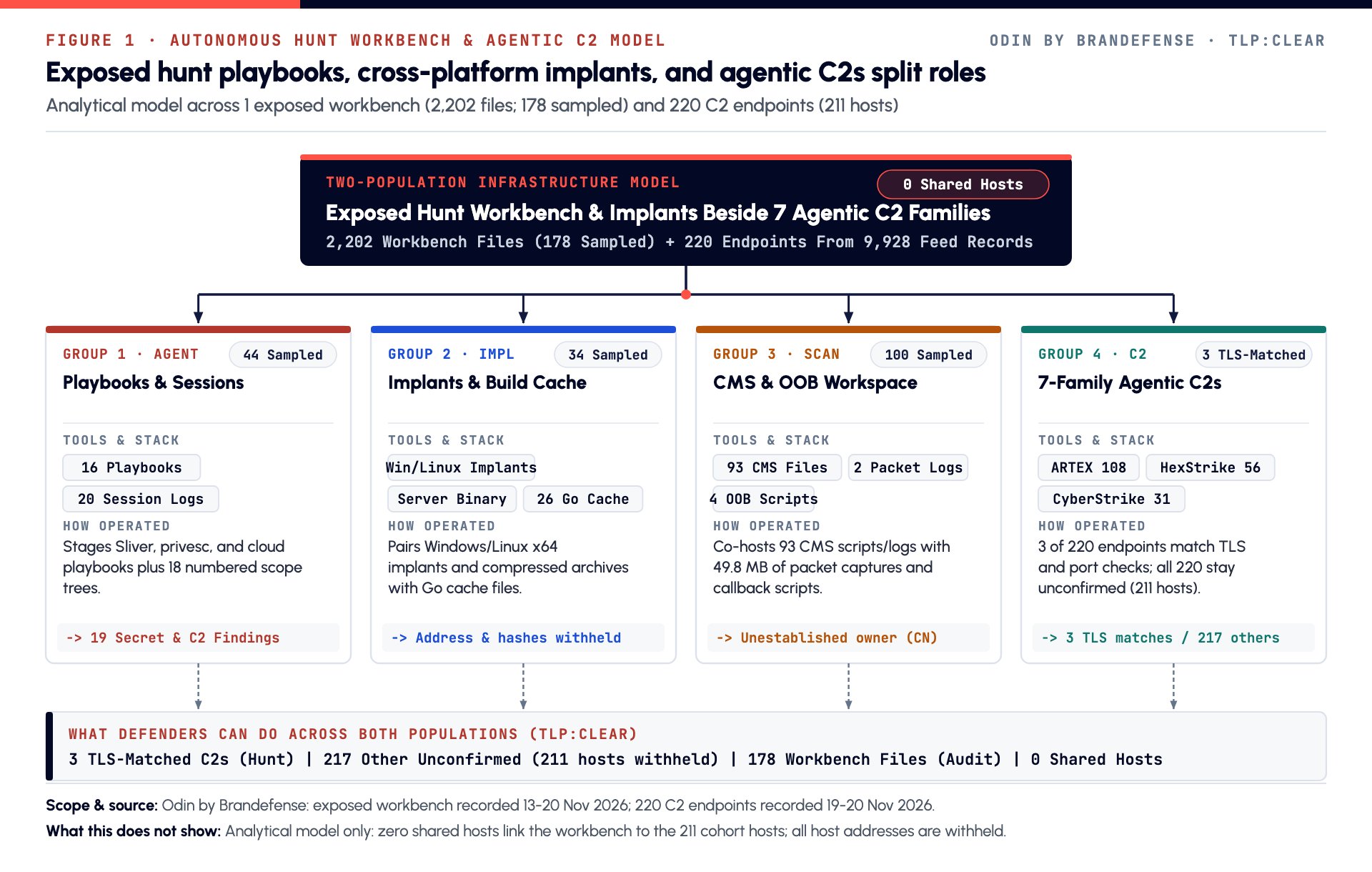
We compared hosts and TLS certificates across both populations in this study. Zero IPv4 addresses or certificates link the exposed server in China to the 211 hosts in the seven-framework listener set. We therefore present both populations as an analytical model of how local hunting workspaces and remote C2 consoles divide work, not as one actor. Figure 1 shows the four functional groups and what defenders can do with each.
| Population | Upstream count | Examined in this study | Distinct hosts | Published addresses | Defender action |
|---|---|---|---|---|---|
| Exposed hunt and implant workbench | 2,202 files | 178 file entries | 1 (withheld) | 0 | Audit ad-hoc HTTP servers; close open directories |
| Workbench session findings | 19 matches | 19 findings (6 scopes) | 1 (withheld) | 0 | Rotate exposed keys; audit agent logs |
| Seven-framework listener set | 9,928 feed records | 220 endpoints | 211 (all withheld) | 0 | Hunt TLS certificates and JARM fingerprints |
Where the servers sit
The exposed workbench sits in China on an unattributed network, illustrating what defenders can find on their own assets with external attack surface management. The folder tree includes agent playbooks and a report-generation script. External directory listings cannot establish whether the owner is a contracted red team or an intruder reusing red-team skill templates. The server address, service port, directory paths, file names and all file hashes from that host are withheld in this edition.
By contrast, the 220 newly observed autonomous-offense endpoints span 25 countries and 72 hosting networks. Five jurisdictions hold 154 of the 220 endpoints (70.0%), followed by Sweden (8), Germany (8), India (7), Australia (7) and Italy (6).
| Country | Endpoints | Share |
|---|---|---|
| United States | 62 | 28.2% |
| Hong Kong | 48 | 21.8% |
| China | 21 | 9.5% |
| Singapore | 13 | 5.9% |
| Japan | 10 | 4.5% |
Hyperscale cloud providers and low-cost VPS networks host most of the 220 endpoints. Seven candidate endpoints (six ARTEX and one PentAGI) sit on dynamic Chinese telecom networks (CHINANET BACKBONE, CHINA UNICOM China169 Backbone, China Mobile and China Telecom). Because broadband and mobile addresses change hands across subscribers, those seven addresses never belong on a firewall block list.
| Hosting provider | Endpoints | Main frameworks on provider |
|---|---|---|
| Amazon.com, Inc. | 39 | HexStrikeAI (36), CyberStrikeAI (1), PentAGI (1), Cairn (1) |
| PEG TECH INC | 19 | ARTEX (17), PentAGI (2) |
| Microsoft Corporation | 17 | HexStrikeAI (15), PentAGI (1), ARTEX (1) |
| CTG Server Limited | 10 | CyberStrikeAI (7), ARTEX (3) |
| NetLab Global | 9 | ARTEX (7), CyberStrikeAI (2) |
| cognetcloud INC | 8 | ARTEX (6), CyberStrikeAI (2) |
| Shenzhen Tencent Computer Systems | 7 | ARTEX (3), AutoHunter (3), PentAGI (1) |
3. Inside the Exposed Autonomous Hunting Workbench
In short
The exposed server in China reports 2,202 files, with 178 sampled across five directory layers. Inside the agent runtime folder, a 171.2 MB agent binary sits beside 16 post-exploitation Markdown playbooks and 20 chat-history transcripts. Scan your own cloud hosts for open HTTP directories that expose hidden agent folders.
Security practitioners and intruders alike now pair command-line LLM agents with plain-text "skill" files and local scan scripts. A quick file server such as python3 -m http.server can expose hidden folders, playbooks and logs. This happens when it serves the working directory on an unauthenticated public interface.
Python's standard library documentation explicitly warns that http.server lacks production security controls. Figure 2 maps each slice of the workbench and the listener set to its target surface and matching detection or audit control.
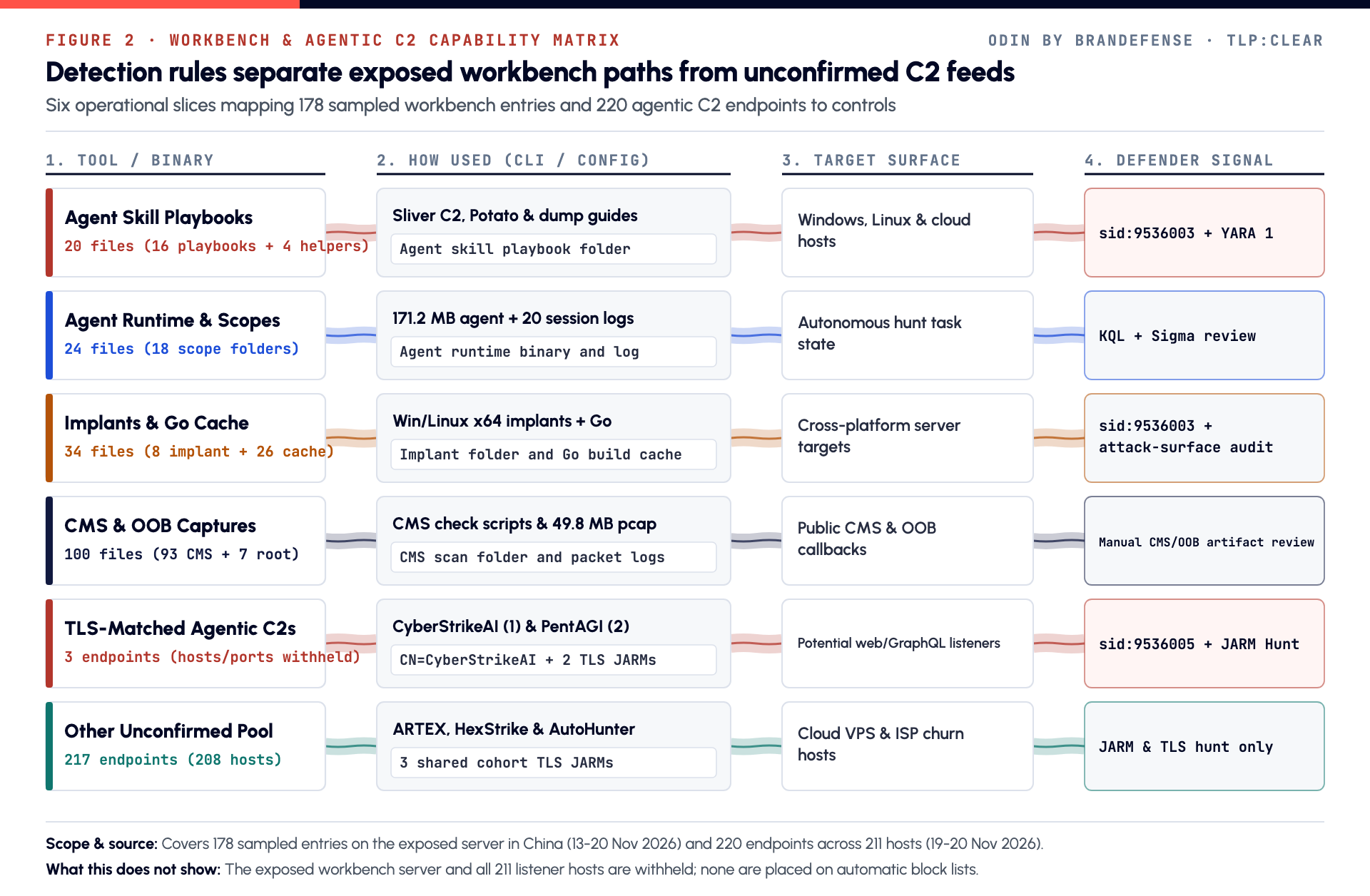
Across the 178 sampled entries on the workbench, scripts lead with 75 files (72 Python, two Unix shell and one batch file). The sample also holds 70 text files, 26 Go cache objects, four executables, two compressed archives and one SQLite database.
| Directory layer | Sampled files | Share | Key contents and byte sizes |
|---|---|---|---|
| CMS scanning workspace | 93 | 52.2% | Python CMS check scripts, URL lists and a CMS scan log (3.75 MB) |
| Agent runtime folder | 44 | 24.7% | Agent binary (171.2 MB), 20 skill playbook files, 21 session files and a unified event log |
| Go compiler cache | 26 | 14.6% | 17 build action files and 9 compiled output objects |
| Implant staging folder | 8 | 4.5% | Controller binary (17.9 MB), Windows and Linux x64 implant binaries and compressed archives |
| Root captures and callbacks | 7 | 3.9% | Two packet capture logs (39.0 MB and 10.8 MB), OOB Python scripts and an 85-byte netcat loop script |
The agent runtime and post-exploitation playbooks
Forty-four sampled files (24.7%) sit inside the hidden agent runtime folder. A single agent executable measures 171,207,616 bytes (163.3 MB). Beside it sit a unified JSONL event log and a 283,192-byte Bash completion script.
Inside the agent skill subtree, 20 files turn the runtime into a guided post-exploitation assistant. Sixteen are Markdown playbooks grouped across three topic subfolders (12, 3 and 1 files; paths and file names withheld):
| Playbook group | Count | Covered workflows (file names withheld) |
|---|---|---|
| Sliver C2 operations | 5 | Sliver operator setup, implant generation, C2 protocols, pivoting proxies and post-exploitation |
| Credential access and privilege escalation | 4 | Lateral credential extraction, Windows credential dumping, Windows token Potato privilege escalation and Linux kernel exploit checks |
| Cloud post-exploitation | 3 | Cloud post-exploitation workflows, persistence backdoors and cloud data exfiltration |
| Mobile and exploit research | 4 | iOS exploitation, iOS mitigation analysis, iOS kernel heap techniques and exploit development |
Four supporting files complete the skill folder: a Python wrapper for the public TruffleHog secret-checking tool, a DOCX report-generation script, a 3,881-byte Python memory utility and a 417-byte sample environment file.
Per-scope session trees and dated work folders
Under the agent session folder, an SQLite session index sits next to 20 JSONL chat-history transcripts (118,712 to 593,712 bytes). Those 20 transcripts span 18 numbered scope folders; one holds three sessions and the other 17 hold one each.
The session paths include a dated work folder beneath the session root. Its date is a server folder name, not Odin's observation period. Numbered scope folders and the DOCX report-generation script fit either a consultancy producing client reports or an intruder reusing a red-team harness.
Co-hosted CMS checks and packet captures
Outside the agent runtime folder, 93 sampled entries (52.2%) sit under a Mandarin-named CMS scanning workspace folder. Sixty-six sit in a subfolder with 23 Python check scripts targeting regional CMS and office platforms. Sibling folders hold deduplicated domain and URL lists, backup outputs and scan result text files.
Those file labels reflect staged artifacts on the server, and a directory listing does not show that any remote CMS target was affected. At the web root, two packet capture logs (38,959,964 bytes and 10,807,210 bytes) total 49.77 MB. Three small Python callback scripts (948 to 1,094 bytes) and an 85-byte netcat loop script sit beside them.
4. Cross-Platform Implants, Go Build Cache, and Session Findings
In short
The implant staging folder holds Windows and Linux x64 implant binaries, pre-compressed archives and a Linux controller binary next to 26 Go compiler cache files. Six sampled session scopes also hold 19 secret and callback findings. Audit ad-hoc HTTP servers and keep build caches and agent logs off web-accessible folders.
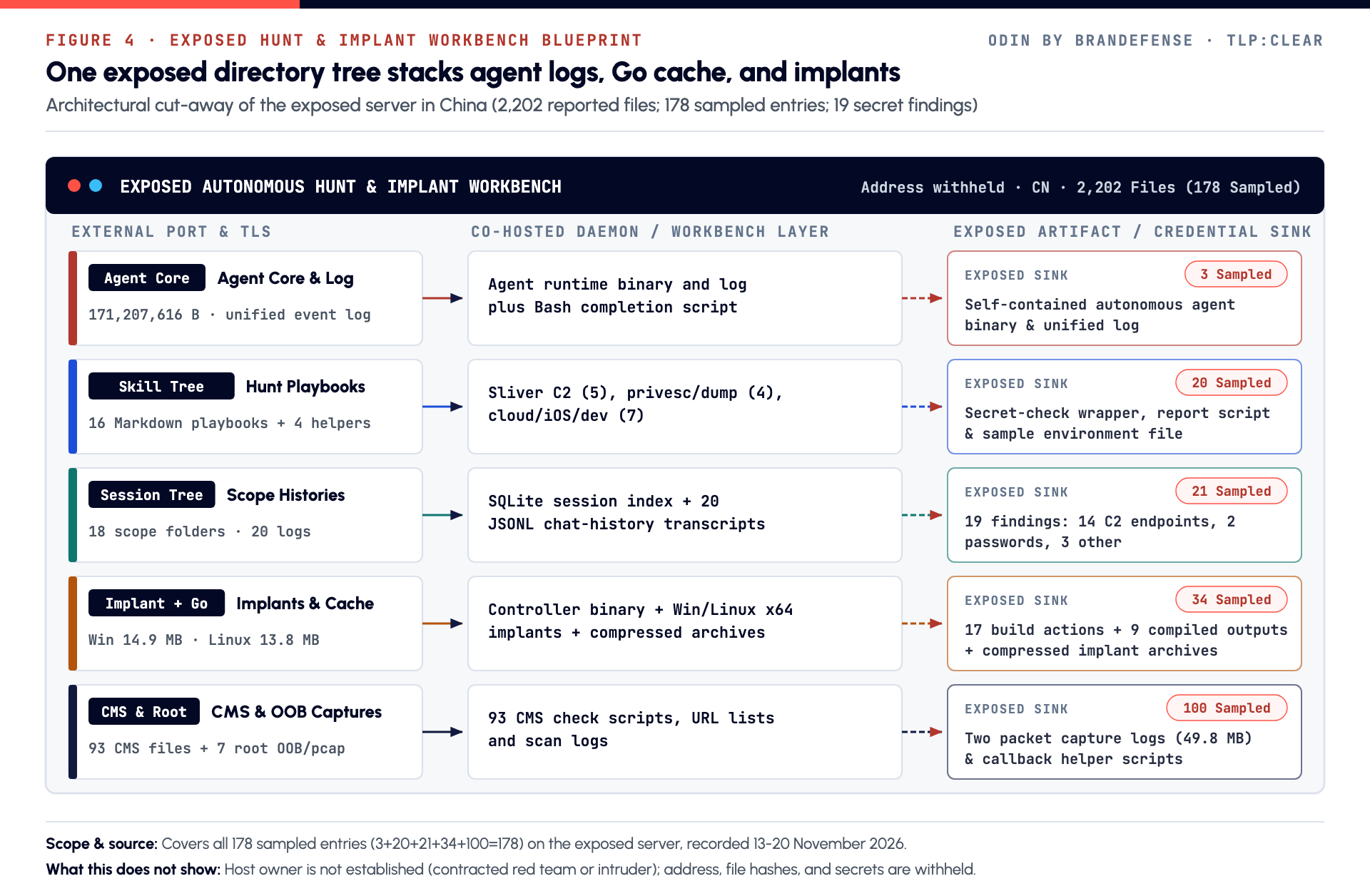
The implant staging folder has eight sampled entries, and the Go compiler build cache folder has 26. Both sit beside the agent runtime and CMS scanning folders on the exposed server. Figure 4 shows all five layers of the directory tree.
Cross-platform implant binaries and Go build cache objects
Five files inside the implant staging folder are compiled executables and gzip archives whose multi-megabyte sizes match statically linked Go binaries (paths and file names withheld):
| Artifact role (path withheld) | Kind | Size (bytes) | Role on workbench |
|---|---|---|---|
| Controller binary | Linux binary | 17,883,296 | Controller binary staged beside the two platform agents |
| Windows x64 implant binary | Windows x64 PE | 14,937,600 | Uncompressed Windows x64 implant binary |
| Linux x64 implant binary | Linux x64 ELF | 13,815,968 | Uncompressed Linux x64 implant binary |
| Compressed Windows implant | Gzip archive | 5,891,003 | Compressed Windows implant (39.4% of raw binary size) |
| Compressed Linux implant | Gzip archive | 5,410,760 | Compressed Linux implant (39.2% of raw binary size) |
Three text and script files also sit in the implant folder, while a 3,751,583-byte CMS scan log sits in the nearby CMS scanning workspace. One 5,630-byte Python script in the implant folder has byte-identical copies in four CMS workspace subfolders, linking both trees on the host. Two root callback scripts (1,094 bytes) and two CMS scripts (29,873 and 12,141 bytes) also repeat across folders.
Meanwhile, the Go compiler cache folder exposes 26 sampled files: 17 build action records and nine compiled outputs. Under Go's GOCACHE layout, those files are consistent with Go compilation, but the listing does not establish where it occurred. Because we did not detonate or reverse-engineer the binaries, co-location with the implant folder is structural context rather than proof of the exact build source.
Nineteen secret and callback findings in agent sessions
Across six sampled scope session trees on the server, 19 secret and callback matches were recorded (T1552.001). Callback and command infrastructure strings make up nearly four fifths of the total, while four entries hold passwords or API and wallet credentials. No secret value or partial prefix appears in this report.
| Finding type | Count | Share | What it shows |
|---|---|---|---|
| C2 or callback endpoint reference | 14 | 73.7% | Callback URLs or listener addresses logged inside agent session transcripts |
| Generic password | 2 | 10.5% | Plaintext password strings stored in session files |
| Reverse-shell command string | 1 | 5.3% | Shell callback one-liner recorded in a session transcript |
| ElevenLabs API key | 1 | 5.3% | Commercial voice/AI service key exposed in agent state |
| BIP-39 mnemonic | 1 | 5.3% | Cryptocurrency seed phrase exposed in agent state |
5. Seven Autonomous Offense Families and TLS Fingerprints
In short
Out of 220 newly observed endpoints across seven autonomous-offense frameworks, three feed-labelled endpoints matched certificate, JARM, port and hosting checks. All 220 remain unconfirmed without behavioral or protocol evidence. Keep all 211 host addresses off automatic block lists, and use CN=CyberStrikeAI and the five JARM fingerprints as hunting selectors.
While the exposed server in China shows a file-based hunting workspace, public and commercial autonomous-offense suites expose web, GraphQL and Model Context Protocol (MCP) listener ports across cloud VPS fleets. Upstream feed labels (artex, hexstrikeai, cyberstrikeai, pentagi, autohunter, cairn and strix) describe banner, certificate or API fingerprints; they are not actor attribution. Figure 3 maps the non-directional evidence layers across target surfaces, the exposed workbench, staged cross-platform implant binaries and the unlinked listener fleet.
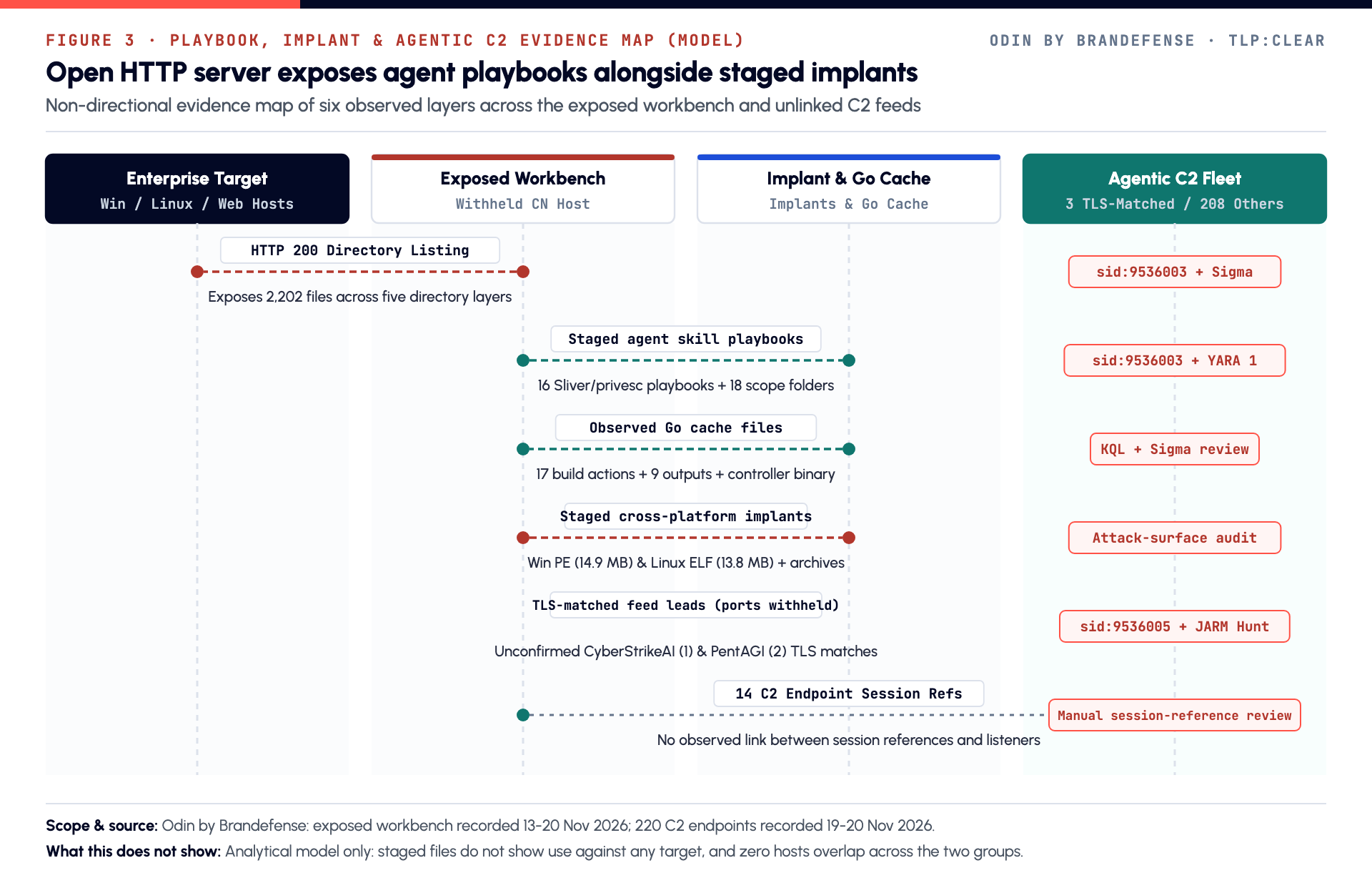
Three feed-labelled endpoints with certificate, JARM and port matches
Across the 220 endpoints on 211 hosts, three feed-labelled endpoints (1.36%) had certificate, JARM, port and hosting matches (T1071.001). Because the records include no protocol response, beacon, behavioral match or workbench link, all three remain unconfirmed and their IPv4 addresses, ports and hosting details are withheld:
| Framework | Unconfirmed feed leads | Hosting | TLS certificate and JARM | Review advice |
|---|---|---|---|---|
| CyberStrikeAI | One unconfirmed feed lead (host and port withheld) | Withheld | CN=CyberStrikeAI, JARM 40d40d40d000…9319 | Hunt TLS and JARM; do not block without behavioral evidence |
| PentAGI | Two unconfirmed feed leads (hosts and ports withheld) | Withheld | CN=localhost, JARM 3fd3fd000000…99fb | Hunt JARM; do not block without behavioral evidence |
Full 62-character JARM values are listed in Chapter 9. Two details matter for operations:
- CyberStrikeAI TLS match. The CyberStrikeAI feed lead (host, port and hosting withheld) serves TLS with
CN=CyberStrikeAI. Its JARM is listed in Chapter 9. - Two PentAGI endpoints sharing one TLS stack. Both PentAGI feed leads (hosts, ports and hosting withheld) present
CN=localhost. Their shared JARM is listed in Chapter 9.
Multi-listener hosts, dual-framework servers and port patterns
Summing distinct hosts per framework gives 213 rather than 211 because two servers expose two frameworks at the same time (hosts, ports and hosting withheld):
| Multi-framework pairing | Host count | Frameworks observed |
|---|---|---|
| CyberStrikeAI and ARTEX | 1 (host, ports and hosting withheld) | CyberStrikeAI and ARTEX on two listeners |
| ARTEX and AutoHunter | 1 (host, ports and hosting withheld) | ARTEX and AutoHunter on two listeners |
Seven other withheld hosts expose two listeners of one framework (four CyberStrikeAI, two HexStrikeAI and one ARTEX; hosts and ports withheld). Together, those nine dual-listener hosts explain the gap between 220 endpoints and 211 unique hosts.
Each framework clusters on recognizable ports across the 220 endpoints. ARTEX uses 8787 (42 of 108 endpoints, 38.9%), 8790 (17), 443 (10) and 80 (9). HexStrikeAI uses 80 (34 of 56), 5000 (7), 8080 (5) and 443 (5). CyberStrikeAI uses 8080 (17 of 31) and 443 (4).
PentAGI uses 8443 (12 of 17) and 8666 (2), while AutoHunter puts four of its five Chinese cloud endpoints on 18800. Three additional TLS JARM values each repeat across four other endpoints in the set (listed in Chapter 9 as hunt-only fingerprints).
6. Feed Labels, TLS Matches, and Other Explanations
In short
Auto-blocking all 9,928 feed-labelled records or all 220 newly observed endpoints would cut off cloud tenants, broadband customers and authorized testers. Three endpoints (1.36% of the 220 examined) matched certificate, JARM, port and hosting checks, but all 220 require behavioral corroboration before blocking.
An external block list is only as trustworthy as the false positives it refuses to include. Figure 5 compares the total feed-labelled records (9,928 across seven frameworks) and the 2,202 workbench files against the three endpoints that matched certificate, JARM, port and hosting checks.
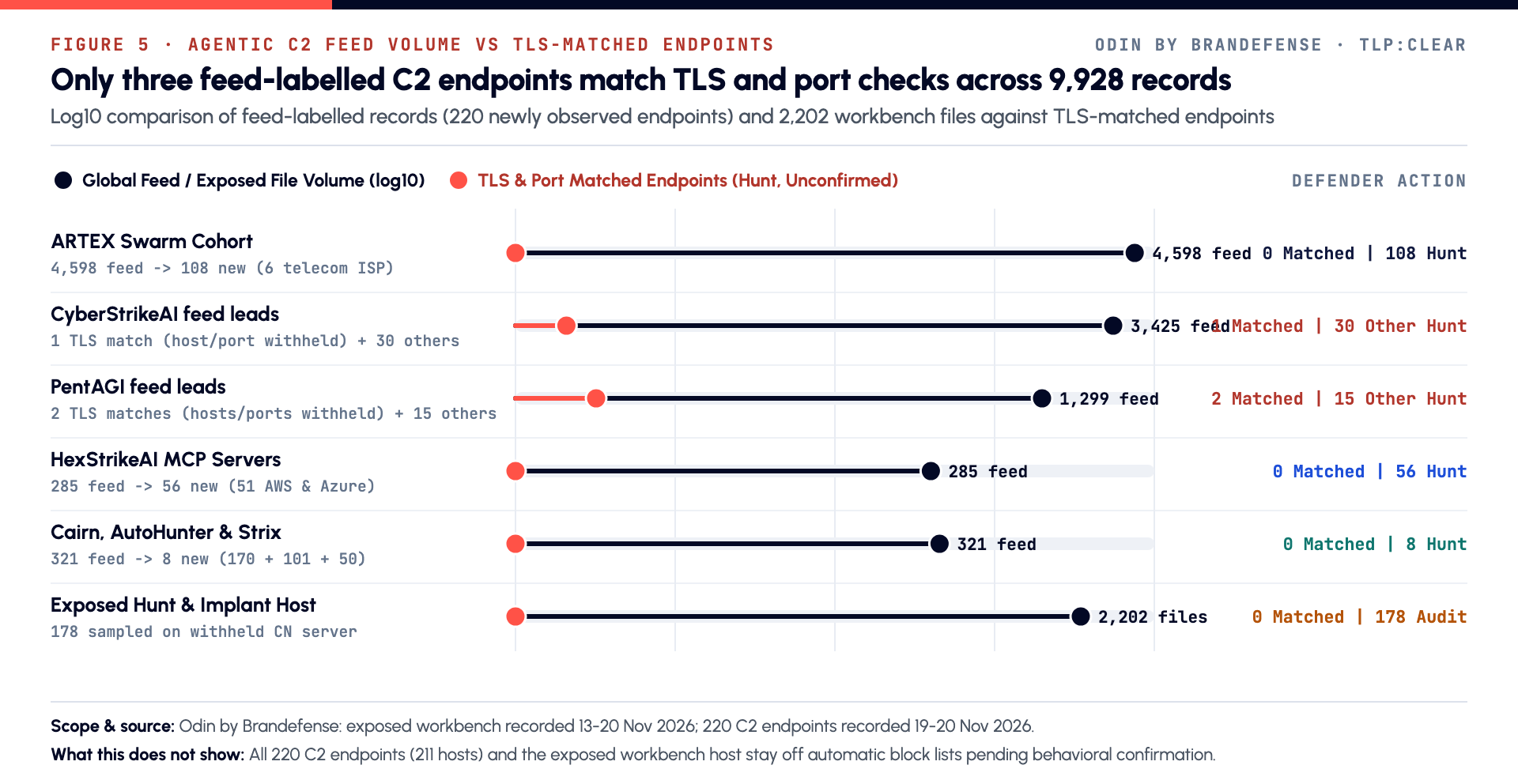
| Framework | All feed records | Historical verified in feed | Newly observed endpoints | Distinct hosts | TLS & port matches (hunt, withheld) | Other unconfirmed (hunt, withheld) |
|---|---|---|---|---|---|---|
| ARTEX | 4,598 | 83 | 108 (49.1%) | 107 | 0 | 108 (6 telecom ISP, 1 open directory) |
| HexStrikeAI | 285 | 0 | 56 (25.5%) | 54 | 0 | 56 (54 suspected, 2 candidate; 51 AWS/Azure) |
| CyberStrikeAI | 3,425 | 15 | 31 (14.1%) | 27 | 1 (host, port and hosting withheld; CN=CyberStrikeAI) | 30 candidates |
| PentAGI | 1,299 | 23 | 17 (7.7%) | 17 | 2 (hosts, ports and hosting withheld; CN=localhost) | 15 (1 suspected, 13 candidate, 1 telecom ISP) |
| AutoHunter | 101 | 1 | 5 (2.3%) | 5 | 0 | 5 candidates (hosts and ports withheld) |
| Cairn | 170 | 1 | 2 (0.9%) | 2 | 0 | 2 (1 suspected, 1 candidate; hosts and ports withheld) |
| Strix | 50 | 3 | 1 (0.5%) | 1 | 0 | 1 candidate (host and port withheld) |
Four other ways to read the evidence
- Contracted red team versus template reuse. Including post-exploitation skill playbooks, keeping numbered scope folders and bundling a DOCX report-generation script fit a consultancy writing client reports. Co-hosting 93 CMS check scripts, cross-platform implant binaries and 49.8 MB of packet captures on an unattributed Chinese host also fits template reuse by an intruder. Because a directory listing cannot settle ownership, we withhold the address, service port, directory paths, file names and all 48 unique file hashes from that host.
- AWS and Azure container churn. Fifty-one of 56 HexStrikeAI endpoints (91.1%) sit on Amazon AWS (36) and Microsoft Azure (15). Most return only generic FastAPI pages on ports 80, 5000 or 8080 (0 of 285 historical records verified), and cloud addresses move rapidly.
- Dynamic telecom ISP addresses. Six ARTEX candidates and one PentAGI candidate sit on Chinese broadband and mobile networks. Blocking carrier addresses hurts unrelated subscribers after lease reassignment.
- Default certificates and co-hosted directories. One ARTEX candidate uses a default Kubernetes
CN=k3scertificate, and another shares its host with an open directory (hosts, ports and hosting withheld). Never block onCN=localhostor a JARM fingerprint alone.
7. What Defenders Should Do
Network and firewall
- Require independent protocol or beacon telemetry before blocking feed-labelled CyberStrikeAI or PentAGI addresses at the egress firewall, especially on high-churn cloud ranges.
- Inspect outbound HTTP requests for unauthenticated directory transfers of compiled Go binaries or gzip archives, and alert on TLS handshakes carrying
CN=CyberStrikeAI.
Cloud, build and red-team platforms
- Scan your own cloud subnets, CI build runners and red-team hosts for
Directory listing for /responses on high ports. Close any directory that exposes hidden agent dot-folders, staged binaries or compiler build caches. - Block
python3 -m http.serverand similar ad-hoc HTTP listeners bound to0.0.0.0on hosts holding agent session logs,.envfiles or compiled offensive binaries.
Endpoint, Windows and application security
- Deploy the process and directory-listing review rules in Chapter 8 to catch ad-hoc HTTP servers on hosts holding agent workspaces or build caches.
- Audit Windows service accounts that hold
SeImpersonatePrivilege(targeted by Potato-style playbooks) and patch internet-facing CMS installations. Move API keys and wallet secrets out of agent folders into a managed vault.
Threat intelligence
- Keep single-banner AWS/Azure candidates, Kubernetes
CN=k3scollisions and dynamic telecom ISP matches out of automatic firewall block lists. Use the five JARM fingerprints in Chapter 9 for TLS hunting only.
8. Detection Rules
The full rules are in the Detection rules tab. The Suricata file passes a syntax lint. Suricata, YARA, Sigma and Kusto engines were not available to load the files for this edition, and the rules were not replayed against live traffic. Test and tune them in your own environment before production use.
| Rule file | What it catches |
|---|---|
odin_hunt_workbench_and_agentic_c2.rules | Suricata 7: two signatures for unauthenticated HTTP Directory listing for / responses (review) and CN=CyberStrikeAI server TLS certificates (hunt) |
sentinel_hunt_workbench_and_agentic_c2_hunt.kql | Microsoft Sentinel and Defender XDR: ad-hoc HTTP directory server processes (http.server, SimpleHTTPServer, -S 0.0.0.0, --bind 0.0.0.0) on non-allowlisted hosts for review |
sigma_hunt_workbench_http_server_exposure.yml | Sigma (1 rule): ad-hoc Linux HTTP directory server launches via Python, PHP or Node on non-allowlisted hosts for review |
odin_exposed_http_directory_listing.yar | YARA (1 rule): captured HTML directory listing snapshots from unauthenticated HTTP servers exposing hidden dot-folders |
How the Suricata signatures work
| SID | Looks for | Why |
|---|---|---|
| 9536003 | An HTTP 200 response body containing <title>Directory listing for / and Directory listing for / | Review alert for an unauthenticated ad-hoc HTTP directory server |
| 9536005 | A server TLS certificate subject containing CN=CyberStrikeAI | Hunt only: CyberStrikeAI's default self-signed certificate |
TLS 1.3 encrypts server certificates on the wire, so SID 9536005 fires on TLS 1.2 handshakes or behind a TLS-decrypting proxy. Keep SID 9536005 in alert-only mode where authorized red teams test CyberStrikeAI.
How the other rules work
The KQL query looks back seven days across DeviceProcessEvents and flags ad-hoc HTTP directory server processes (http.server, SimpleHTTPServer, -S 0.0.0.0 or --bind 0.0.0.0) launched via Python, PHP, Node, Caddy or Nginx. Approved red-team and Go CI build hosts are excluded by exact device name only. Defenders should also audit their own agent dot-folders, session logs and Go compiler caches to ensure they are never served over HTTP.
| Sigma rule | Level | Fires when |
|---|---|---|
| Ad-hoc Linux HTTP directory server exposure for review | High | A Python, PHP or Node process starts with http.server, SimpleHTTPServer, -S 0.0.0.0 or --bind 0.0.0.0 (review alert, exact lab hostname filter) |
| YARA rule | Fires when |
|---|---|
ODIN_Exposed_HTTP_Directory_Listing_Snapshot | A captured file under 512 KB contains <title>Directory listing for / and <h1>Directory listing for / alongside a hidden dot-folder link (href=".) |
MITRE ATT&CK mapping
| Tactic | Technique | How it shows up | Detection |
|---|---|---|---|
| Credential Access | T1552.001 Unsecured Credentials: Credentials In Files | Keys, passwords and C2 endpoints in exposed agent session files on an unauthenticated HTTP directory | SID 9536003; KQL; Sigma; YARA |
| Command and Control | T1071.001 Application Layer Protocol: Web Protocols | Cross-platform HTTP implant staging and CyberStrikeAI or PentAGI HTTPS/GraphQL listeners | SID 9536005; JARM hunting |
9. Indicators
The Indicators tab holds 5 published indicators: 5 JARM fingerprints. All 211 listener host addresses, the exposed workbench address and port, all workbench paths and file names, and all 48 workbench file hashes are withheld. One additional text-only hunting selector appears in the table below: CyberStrikeAI's default TLS certificate subject.
| Type | Count | Where to use it |
|---|---|---|
| JARM fingerprints | 5 | TLS hunting only, never block on a JARM alone |
| Default TLS certificate subject | 1 | TLS and proxy hunting (CN=CyberStrikeAI) |
JARM fingerprints to hunt
| JARM | Framework | Context |
|---|---|---|
40d40d40d00000000043d43d00043d6aff5ab0f4fc31897186312c9e639319 | CyberStrikeAI | One unconfirmed feed lead (host, port and hosting withheld) |
3fd3fd00000000000043d43d00043dc3b2afa8a5ec09b510a8559aff7899fb | PentAGI | Shared by two unconfirmed feed leads and two other TLS listeners (hosts and ports withheld) |
29d29d00029d29d00041d41d00041dcb3f8752a2d70d1dbf446fc46ab5df96 | HexStrikeAI | Shared by four suspected TLS endpoints (hosts and ports withheld) |
29d29d00029d29d21c42d42d000000c1fc3d47ef34532079f4922fcb05ef65 | CyberStrikeAI | Shared by four candidate TLS endpoints (hosts and ports withheld) |
3fd3fd0003fd3fd00042d42d0000002059a3b916699461c5923779b77cf06b | ARTEX and CyberStrikeAI | Shared across four candidate TLS endpoints (hosts and ports withheld) |
Text-only hunting selectors
| Selector | Type | Use |
|---|---|---|
CN=CyberStrikeAI | Default server TLS certificate subject | TLS hunting (SID 9536005, alert only) |
Withheld: the exposed workbench IPv4 address, its service port, its directory paths and file names, and all 48 unique SHA-256 file hashes recorded on that unestablished host. We also withhold all 211 listener host addresses and individual host ports, including the three feed-labelled endpoints that lack independent behavioral confirmation. Unverified server certificate names and every secret value are withheld as well.
10. Scope and Limits
- Window. Workbench records were recorded from 13 to 20 November 2026, and the 220 autonomous-offense listener endpoints were recorded on 19 and 20 November 2026. The dated work folder beneath the agent session directory is a server folder name, not our observation period.
- Feed labels are not attribution. Names such as ARTEX, CyberStrikeAI or PentAGI come from upstream feeds. Even the three endpoints with certificate, JARM and port matches remain unconfirmed without behavioral or protocol evidence.
- The model is a model. Zero shared IPv4 addresses or certificates link the exposed workbench to the 211 listener hosts. Figures 1 and 3 show an analytical model, not one operator.
- Workbench owner not established. The post-exploitation playbooks and DOCX report-generation script fit either a contracted red team or template reuse. The server's IPv4 address, service port, directory paths, file names and all 48 unique hashes on that host are therefore withheld.
- Staged files are not target outcomes. Staged CMS scan results, cross-platform implant binaries and packet capture logs show staged files only, and no binary or key was tested.
- Cloud addresses move. Many unconfirmed feed leads, including 51 of 56 HexStrikeAI endpoints, sit on hyperscale cloud ranges where IPv4 leases move rapidly.
- Rule testing. Rules were not loaded on live engines or replayed against live traffic for this edition; test them locally first.
11. Sources
- MITRE ATT&CK. S0633 Sliver. https://attack.mitre.org/software/S0633/ (verified on 21 November 2026)
- MITRE ATT&CK. T1552.001 Unsecured Credentials: Credentials In Files. https://attack.mitre.org/techniques/T1552/001/ (verified on 21 November 2026)
- MITRE ATT&CK. T1071.001 Application Layer Protocol: Web Protocols. https://attack.mitre.org/techniques/T1071/001/ (verified on 21 November 2026)
- OWASP Cheat Sheet Series. Secrets Management Cheat Sheet. https://cheatsheetseries.owasp.org/cheatsheets/Secrets_Management_Cheat_Sheet.html (verified on 21 November 2026)
- Go Documentation. Command go: Build and Test Caching. https://pkg.go.dev/cmd/go (verified on 21 November 2026)
- Python Documentation. http.server: HTTP servers. https://docs.python.org/3/library/http.server.html (verified on 21 November 2026)
- Salesforce Engineering. JARM: An Active Transport Layer Security (TLS) Server Fingerprinting Specification. https://github.com/salesforce/jarm (verified on 21 November 2026)
What is…?
Short explanations of the tools and families named in this study.
What is CyberStrikeAI?
CyberStrikeAI is a public AI-driven offensive security platform. It spreads its operator interface, API and agent listener across several ports on one host and exposes tools through MCP.
More about CyberStrikeAITechniqueWhat is JARM?
JARM is an open TLS server fingerprinting method from Salesforce. It hashes how a server answers a set of crafted TLS handshakes.
More about JARMAI offensive toolWhat is ARTEX?
ARTEX is an autonomous red-team console that chains AI agents and security tools. Operators fork and rebrand it; its default listener port is 8787.
More about ARTEXAI offensive toolWhat is PentAGI?
PentAGI is an open-source autonomous penetration testing system that coordinates AI agents and security tools in containers.
More about PentAGIAI offensive toolWhat is HexStrike AI?
HexStrikeAI is a public project that exposes many security tools to AI agents through the Model Context Protocol (MCP).
More about HexStrike AIAI security toolWhat is AutoHunter?
AutoHunter automates headless bug-bounty reconnaissance of subdomains, API routes and query parameters.
More about AutoHunterFrequently asked questions
What sits inside an exposed autonomous hunting workbench?
Across 178 sampled entries from the 2,202 reported files on the server, five directory layers sit side by side: Three parts of this layout matter to defenders: The playbooks and report script could belong to a contracted red team or an intruder reusing its templates. We therefore withhold the server's IPv4 address, service port, directory paths, file names and all file hashes.
Why did all 220 autonomous-offense endpoints stay off the block list?
Frameworks such as ARTEX, CyberStrikeAI, PentAGI and HexStrikeAI wrap classic security tools behind web, GraphQL and Model Context Protocol (MCP) APIs. Feeds flag thousands of addresses with those names, but a banner label is a lead rather than proof of hostile C2.
Are the exposed workbench and the listener fleet linked?
No host or certificate connects them. Zero IPv4 addresses or TLS certificates overlap between the exposed workbench in China and the 211 hosts in the seven-framework listener set. We present them side by side as an analytical model of how agentic offense splits between local preparation workspaces and external C2 consoles.