
Key takeaways
- An open HTTP directory in China exposes 2,202 reported files, pairing a 171.2 MB agent runtime with 16 post-exploitation playbooks.
- The same directory stages Windows and Linux x64 implants (14.9 MB and 13.8 MB), compressed archives and 26 Go compiler cache files.
- Six sampled session scopes hold 19 secret and callback findings, including 14 C2 endpoint references, an ElevenLabs key and a BIP-39 phrase.
- Out of 220 newly observed endpoints across seven autonomous-offense frameworks (from 9,928 feed records), three matched TLS and port checks but remain unconfirmed.
- Keep uncorroborated feed addresses off automatic block lists, close ad-hoc HTTP directory servers and hunt CyberStrikeAI TLS certificates and JARM fingerprints.
Odin found an exposed workbench in China reporting 2,202 files. Its directory listing placed hidden agent folders, build caches, scan scripts and compiled implants within public reach. Odin recorded the workbench batches from 13 to 20 November 2026.
On 19 and 20 November 2026, we also examined 220 newly observed endpoints across seven autonomous-offense frameworks drawn from 9,928 feed-labelled records. Here the main lesson was restraint. Only three endpoints matched expected certificates, JARMs, ports and hosting, and even those remain unconfirmed leads for cyber threat intelligence teams rather than automatic firewall blocks.
This short read covers what sat on the exposed workbench, why the framework feed did not become a blanket block list, and what defenders should do next. The full report on autonomous hunting agents and cross-platform implants carries the complete tables, detection rules and indicators.
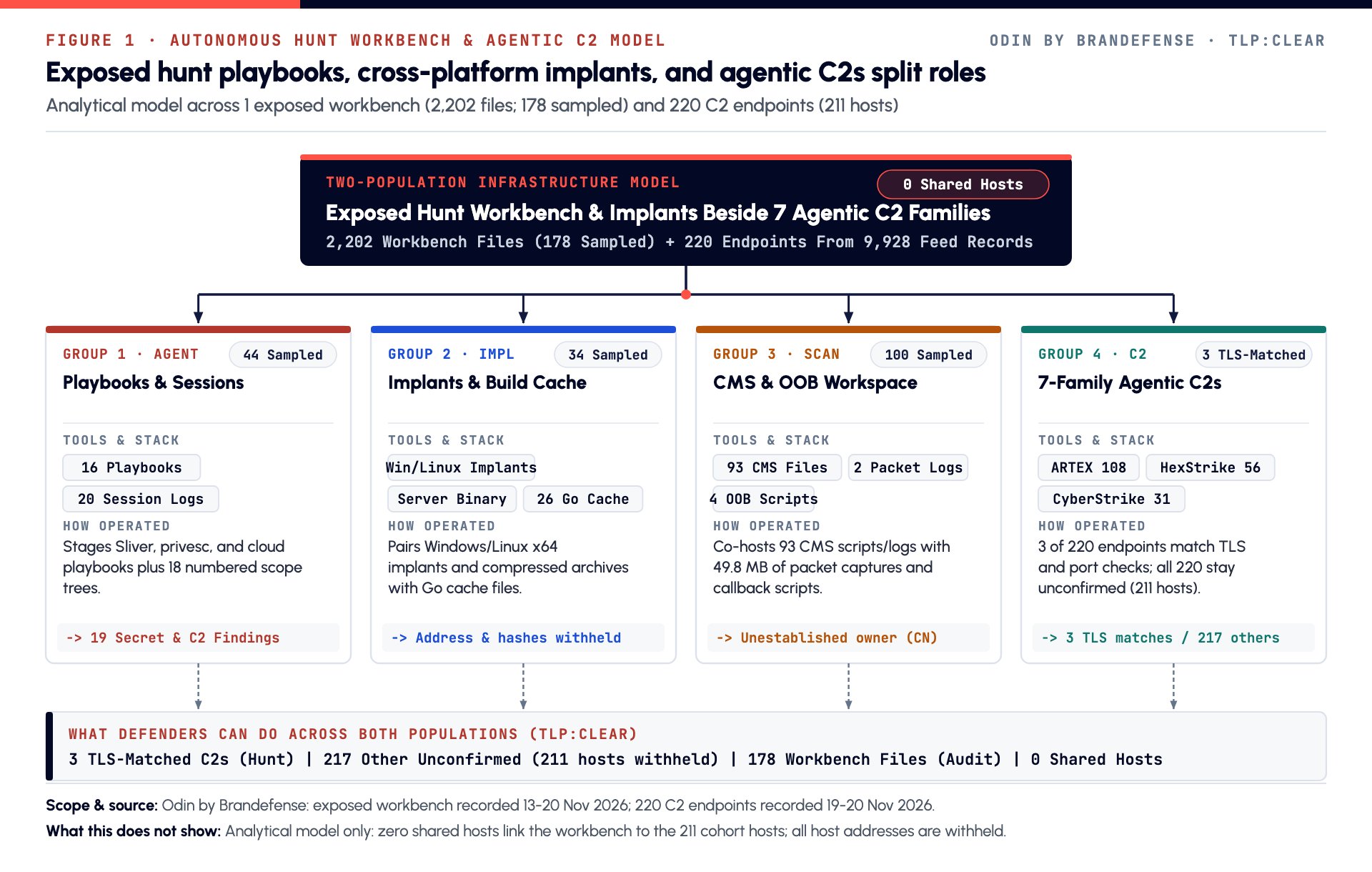
What sits inside an exposed autonomous hunting workbench?
Across 178 sampled entries from the 2,202 reported files on the server, five directory layers sit side by side:
| Directory layer | Sampled files | What it holds |
|---|---|---|
| CMS scanning workspace | 93 | Python CMS check scripts, URL lists and a 3.75 MB CMS scan log |
| Agent runtime folder | 44 | A 171.2 MB agent binary, 20 skill playbook files and 21 session files |
| Go compiler cache | 26 | 17 build action files and 9 compiled Go output objects |
| Implant staging folder | 8 | A 17.9 MB controller binary plus Windows and Linux x64 implant binaries and compressed archives |
| Web root | 7 | Two packet capture logs (39.0 MB and 10.8 MB), callback scripts and an 85-byte netcat loop script |
Three parts of this layout matter to defenders:
- Guided post-exploitation playbooks. Inside the agent skill folder, 16 Markdown playbooks give the agent step-by-step guidance for Sliver C2 (five files) and Windows token impersonation or credential dumping (four). They also cover cloud persistence and exfiltration (three) and iOS or exploit workflows (four). Supporting scripts wrap TruffleHog secret checks and DOCX report rendering.
- Cross-platform implants and a Go build cache. Inside the implant staging folder, uncompressed and gzip-compressed x64 implants sit ready for both Windows (14.94 MB) and Linux (13.82 MB), next to a Linux controller binary (17.88 MB). Beside them, a Go build cache folder exposes 26 files consistent with Go compilation (build location unestablished), an exposure defenders can find with external attack surface management.
- Per-target session logs. Under the agent session folder, 20 JSONL chat-history logs sit across 18 numbered scope folders inside a dated work folder recorded on the server. Six sampled scopes hold 19 findings: 14 C2 endpoint references, two passwords, one reverse-shell string, one ElevenLabs key and one BIP-39 seed phrase.
The playbooks and report script could belong to a contracted red team or an intruder reusing its templates. We therefore withhold the server's IPv4 address, service port, directory paths, file names and all file hashes. Defenders get durable value by auditing their own exposed agent workspaces and build caches.
Why did all 220 autonomous-offense endpoints stay off the block list?
Frameworks such as ARTEX, CyberStrikeAI, PentAGI and HexStrikeAI wrap classic security tools behind web, GraphQL and Model Context Protocol (MCP) APIs. Feeds flag thousands of addresses with those names, but a banner label is a lead rather than proof of hostile C2.
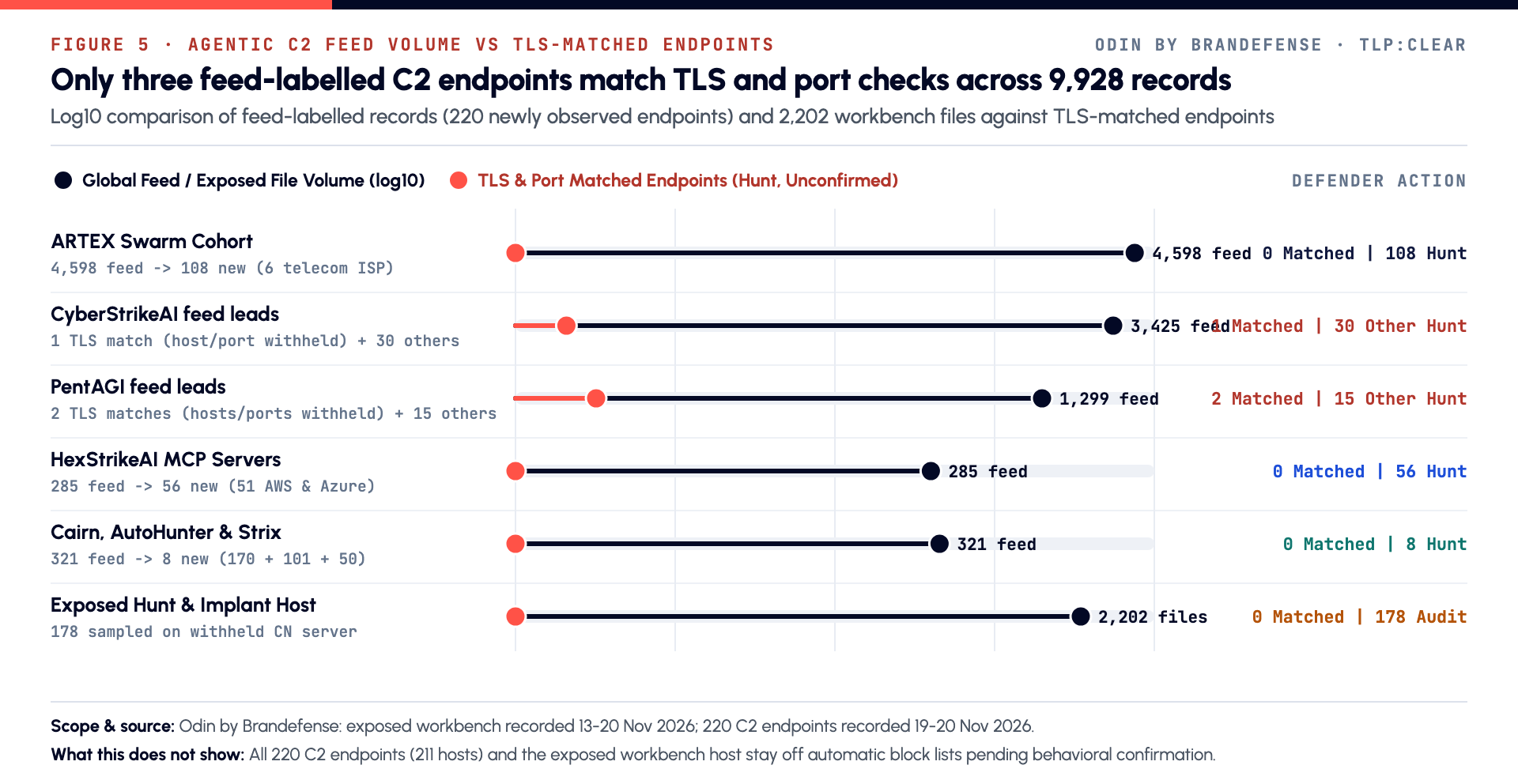
Out of 9,928 feed-labelled records across seven frameworks, we examined 220 newly observed endpoints on 211 hosts. ARTEX (108 endpoints), HexStrikeAI (56), CyberStrikeAI (31) and PentAGI (17) account for 96.4% of them, alongside AutoHunter (5), Cairn (2) and Strix (1). Two hosts run two frameworks at once (CyberStrikeAI with ARTEX, and ARTEX with AutoHunter; hosts and ports withheld).
Three feed-labelled endpoints had certificate, JARM, port and hosting matches, but remain unconfirmed without independent behavioral or protocol evidence.
| Framework | Endpoint and port | Hosting and TLS |
|---|---|---|
| CyberStrikeAI | One unconfirmed feed lead (host and port withheld) | TLS match; hosting withheld |
| PentAGI | Two unconfirmed feed leads (hosts and ports withheld) | TLS matches; hosting withheld |
The remaining 217 endpoints on 208 hosts were also left unconfirmed for clear operational reasons. Fifty-one of the 56 HexStrikeAI endpoints (91.1%) sit on Amazon AWS and Microsoft Azure, where generic FastAPI pages and fast IP reassignment make static firewall blocks risky. Seven ARTEX and PentAGI candidates sit on dynamic Chinese telecom networks, where blocking an address punishes the next broadband customer. One ARTEX candidate even serves a default Kubernetes CN=k3s certificate.
Are the exposed workbench and the listener fleet linked?
No host or certificate connects them. Zero IPv4 addresses or TLS certificates overlap between the exposed workbench in China and the 211 hosts in the seven-framework listener set. We present them side by side as an analytical model of how agentic offense splits between local preparation workspaces and external C2 consoles.
What to do now
- Require behavioral or protocol corroboration before blocking feed-labelled C2 addresses. Hunt TLS handshakes carrying
CN=CyberStrikeAIand the five JARM fingerprints in the full report's Indicators tab. - Alert on unauthenticated HTTP directory listings and ad-hoc web servers across proxies and Windows or Linux endpoints using the Suricata, KQL, Sigma and YARA rules in the full report's Detection rules tab.
- Scan your own cloud, build and red-team hosts for open HTTP directories on high ports, and shut down any
http.serverexposing hidden agent folders, staged binaries or compiler build caches. - Move API keys and secrets out of agent dot-folders into a managed vault, audit
SeImpersonatePrivilegeon Windows servers, and patch internet-facing CMS platforms. - Keep single-banner cloud matches and telecom ISP addresses out of automatic block lists. Pair the five JARM fingerprints and
CN=CyberStrikeAIwith endpoint or protocol evidence when hunting.
What is…?
Short explanations of the tools and families named in this study.
What is CyberStrikeAI?
CyberStrikeAI is a public AI-driven offensive security platform. It spreads its operator interface, API and agent listener across several ports on one host and exposes tools through MCP.
More about CyberStrikeAITechniqueWhat is JARM?
JARM is an open TLS server fingerprinting method from Salesforce. It hashes how a server answers a set of crafted TLS handshakes.
More about JARMAI offensive toolWhat is ARTEX?
ARTEX is an autonomous red-team console that chains AI agents and security tools. Operators fork and rebrand it; its default listener port is 8787.
More about ARTEXAI offensive toolWhat is PentAGI?
PentAGI is an open-source autonomous penetration testing system that coordinates AI agents and security tools in containers.
More about PentAGIAI offensive toolWhat is HexStrike AI?
HexStrikeAI is a public project that exposes many security tools to AI agents through the Model Context Protocol (MCP).
More about HexStrike AIAI security toolWhat is AutoHunter?
AutoHunter automates headless bug-bounty reconnaissance of subdomains, API routes and query parameters.
More about AutoHunterFrequently asked questions
What sits inside an exposed autonomous hunting workbench?
Across 178 sampled entries from the 2,202 reported files on the server, five directory layers sit side by side: Three parts of this layout matter to defenders: The playbooks and report script could belong to a contracted red team or an intruder reusing its templates. We therefore withhold the server's IPv4 address, service port, directory paths, file names and all file hashes.
Why did all 220 autonomous-offense endpoints stay off the block list?
Frameworks such as ARTEX, CyberStrikeAI, PentAGI and HexStrikeAI wrap classic security tools behind web, GraphQL and Model Context Protocol (MCP) APIs. Feeds flag thousands of addresses with those names, but a banner label is a lead rather than proof of hostile C2.
Are the exposed workbench and the listener fleet linked?
No host or certificate connects them. Zero IPv4 addresses or TLS certificates overlap between the exposed workbench in China and the 211 hosts in the seven-framework listener set. We present them side by side as an analytical model of how agentic offense splits between local preparation workspaces and external C2 consoles.