


Key takeaways
- Odin observed 1,874 endpoints running AI offense frameworks; CyberStrikeAI and ARTEX hold 95.6% of them.
- One exposed server runs both tools, wired to a DeepSeek model, search-engine keys and Telegram alerts.
- Public servers leak 1,731 AI coding-agent session files and 1,779 numbered script backups.
- Staged scripts target LiteLLM key tables, MCP servers and apps that accept a custom model base URL.
- Upgrade LiteLLM to 1.83.7, keep its database private, and lock SDK base URLs to approved providers.
In a two-week observation window ending 18 November 2026, Odin by Brandefense observed 1,874 internet-facing endpoints running autonomous AI offense frameworks. These tools let a language model plan an attack and drive scanners and exploit scripts. In the same period, staged scripts showed attackers turning to the AI systems companies run themselves: LLM gateways such as LiteLLM and Model Context Protocol (MCP) servers. Both hold provider keys and both can run actions, so both deserve the same care as any internet-facing admin system.
Where do these AI attack consoles run?
Two frameworks dominate. CyberStrikeAI accounts for 1,290 records and ARTEX for 501, together 95.6% of the total. PentAGI (26), HexStrikeAI (56) and DeepAudit (1) make up the rest. The 1,874 records sit on 1,106 hosts in 36 countries.
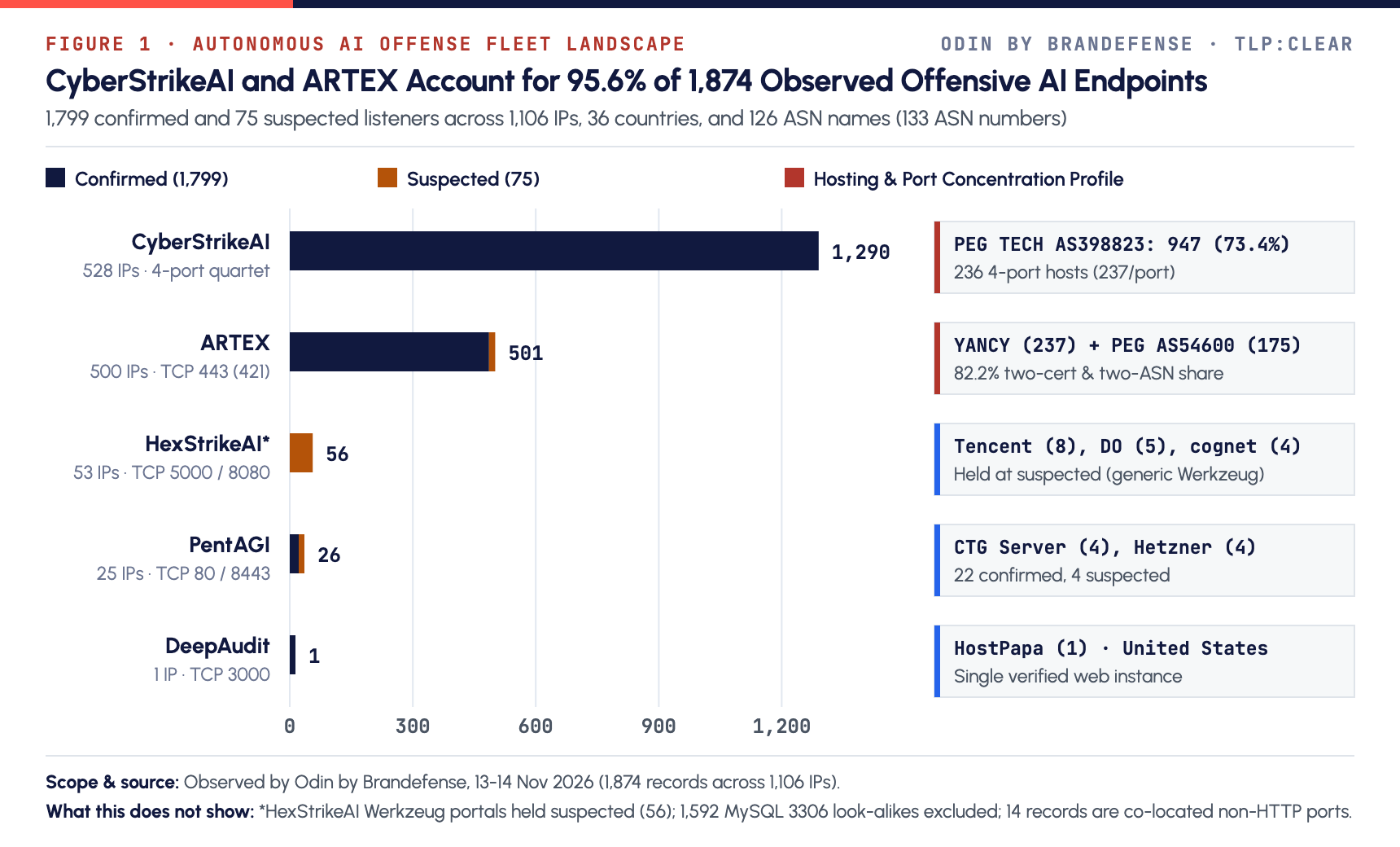
The fleet is concentrated and predictable. One hosting provider, PEG TECH INC, carries 947 CyberStrikeAI records. Of its hosts, 236 open the same four ports at once: 5001, 5002, 5003 and 8082. ARTEX is just as uniform: 412 of its 501 endpoints sit behind only two TLS certificates, one per hosting cluster.
That uniformity helps defenders. A device that talks to all four CyberStrikeAI ports on one address within an hour is worth a look. A server presenting one of the two ARTEX certificates is a strong lead.
Not everything that looks like an AI attack tool is one. An upstream detection signature also matched 1,592 ordinary MySQL servers on port 3306, because MySQL creates its own certificate. Another 99 hosts showed a default Ubiquiti UniFi certificate, which is normal for home and office network controllers. HexStrikeAI runs on the same Python web server as many student and developer projects, so its 56 records stay suspected. None of these belong on an automatic block list.
What does an operator's server look like inside?
One server in Japan, at 177.3.90[.]1, left an open directory of 363 files. It runs CyberStrikeAI and ARTEX side by side, and the files show how the operator joined them up.
Both tools send their reasoning to a DeepSeek model through a local proxy. CyberStrikeAI holds keys for FOFA and ZoomEye, two search engines that index internet-facing devices. ARTEX sends each finding to Telegram, up to 20 messages a minute, and to a webhook.
The server also held a small script that restores the admin password and its timestamp in CyberStrikeAI's database. That could be an operator tidying up after a session or a test rig resetting itself. Either way, the file hashes are useful for hunting, and the server is on the block list.
Why are developer machines part of the story?
Many people now pair an AI coding assistant with automatic command execution. A common shortcut is to start a quick web server in a home folder to move files. That also publishes the assistant's hidden folders.
Odin found 1,731 such files readable on public servers. Claude Code made up 85.2%, Cursor 10.3% and Codex 4.4%. Session logs can hold prompts, shell output and sometimes API credentials. Odin also found 1,779 numbered script backups across 336 hosts, a sign of edit-and-retry loops.
Exposure alone does not make an owner an attacker. Developers, red teams and threat actors all make this mistake. A few hosts did stage clearly offensive work, such as numbered webshell revisions and a C2 loader, and those appear as hunt leads in the full report.
How are LLM gateways and MCP servers being targeted?
Odin observed 349 AI-stack records on 104 hosts. Once 16 disclosure archives are set aside, 333 records remain. They show three attack paths.
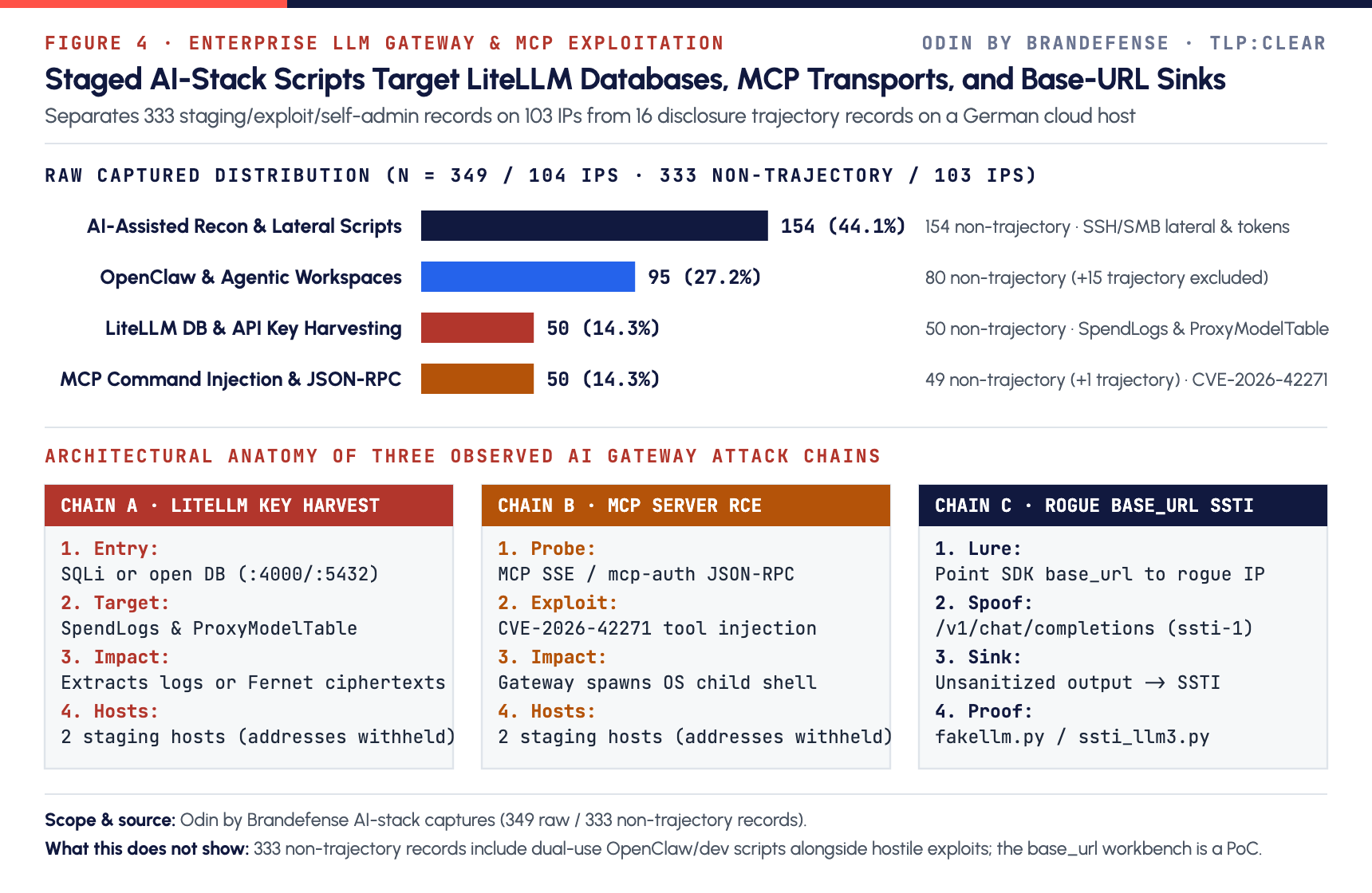
Key theft from LiteLLM databases.
LiteLLM stores model credentials and request logs in PostgreSQL. Staged scripts are written to reach those tables through SQL injection, including through the HTTP Authorization header. Stored provider keys are encrypted with a salt key. A dump yields plaintext keys only if payloads were logged unmasked or the salt key sits next to the database.
Command execution through MCP.
One workspace reproduces CVE-2026-42271, a published LiteLLM flaw. It lets an authenticated user run commands through MCP test endpoints in LiteLLM 1.74.2 through 1.83.6, and is fixed in 1.83.7. Other staging hosts held scripts that probe MCP streams and replay OAuth tokens.
Rogue model servers. Many apps let a user or an imported agent config change the SDK base URL. Two staged fake OpenAI servers answer with template code instead of text. An app that drops model output into a template without escaping can end up running that code.
These are staged files. Nothing here shows a successful attack on a specific company, but the paths are realistic and easy to close.
What to do now
- Patch and isolate LiteLLM. Upgrade to 1.83.7 or later, keep its PostgreSQL database on a private network, and store the salt key in a secret manager.
- Lock down MCP. Require mutual TLS or scoped OAuth tokens on every MCP endpoint.
- Control model endpoints. Allow AI SDKs to reach only approved provider domains, and escape model output before any template renders it.
- Block and hunt with care. Block the five confirmed controller addresses for 30 days and alert on the four-port pattern. Keep MySQL, UniFi and generic Python hosts off automatic block lists. The full report's Indicators tab has the full list.
- Close the coding-agent leak. Ban ad-hoc web servers in folders holding
.claude,.cursoror.codexdata, and rotate any key that was stored there.
The full report covers the fleet infrastructure, the operator server, the attack paths and the logic of each detection rule. The rules themselves are in the full report's Detection rules tab.
What is…?
Short explanations of the tools and families named in this study.
What is LiteLLM?
LiteLLM is an open-source gateway that gives one API in front of many large language model providers and holds their keys.
More about LiteLLMAI offensive toolWhat is CyberStrikeAI?
CyberStrikeAI is a public AI-driven offensive security platform. It spreads its operator interface, API and agent listener across several ports on one host and exposes tools through MCP.
More about CyberStrikeAIAI offensive toolWhat is ARTEX?
ARTEX is an autonomous red-team console that chains AI agents and security tools. Operators fork and rebrand it; its default listener port is 8787.
More about ARTEXAI offensive toolWhat is HexStrike AI?
HexStrikeAI is a public project that exposes many security tools to AI agents through the Model Context Protocol (MCP).
More about HexStrike AIAI agentWhat is OpenClaw?
OpenClaw is an open-source autonomous agent gateway that keeps trajectories, auth profiles and session logs on disk.
More about OpenClawAI offensive toolWhat is PentAGI?
PentAGI is an open-source autonomous penetration testing system that coordinates AI agents and security tools in containers.
More about PentAGIFrequently asked questions
Where do these AI attack consoles run?
Two frameworks dominate. CyberStrikeAI accounts for 1,290 records and ARTEX for 501, together 95.6% of the total. PentAGI (26), HexStrikeAI (56) and DeepAudit (1) make up the rest. The 1,874 records sit on 1,106 hosts in 36 countries.
What does an operator's server look like inside?
One server in Japan, at 177.3.90[.]1, left an open directory of 363 files. It runs CyberStrikeAI and ARTEX side by side, and the files show how the operator joined them up.
Why are developer machines part of the story?
Many people now pair an AI coding assistant with automatic command execution. A common shortcut is to start a quick web server in a home folder to move files. That also publishes the assistant's hidden folders.
How are LLM gateways and MCP servers being targeted?
Odin observed 349 AI-stack records on 104 hosts. Once 16 disclosure archives are set aside, 333 records remain. They show three attack paths. These are staged files. Nothing here shows a successful attack on a specific company, but the paths are realistic and easy to close.