


1. Executive Summary
In short
In a two-week observation window ending 18 November 2026, Odin by Brandefense observed 1,874 endpoints running autonomous AI offense frameworks. CyberStrikeAI and ARTEX hold 95.6% of them, packed into a few budget hosting networks. One exposed server shows both frameworks wired to a DeepSeek model and Telegram alerts. Staged scripts aim at LiteLLM databases, MCP servers and rogue model endpoints. Upgrade LiteLLM to 1.83.7, keep its database private, and alert on the CyberStrikeAI four-port pattern.
Autonomous offense frameworks put a large language model (LLM) in charge of scanners and exploit tools. At the same time, companies now route their own AI traffic through LLM gateways such as LiteLLM and through Model Context Protocol (MCP) servers. This report covers both sides: where the offensive consoles run, what one operator server holds, and how staged scripts target the gateways.
Two frameworks make up 95.6% of 1,874 AI offense endpoints.
CyberStrikeAI (1,290 records on 528 IPs) and ARTEX (501 endpoints) dominate. CyberStrikeAI puts 947 records (73.4%) on PEG TECH INC. ARTEX places 412 endpoints (82.2%) behind just two TLS certificates.
Exposed coding-agent folders and revision backups show iterative script work.
Odin found 1,731 readable coding-agent session files on public servers, led by Claude Code (85.2%). It also found 1,779 numbered revision backups across 336 hosts. Owners include developers, red teams and threat actors, so exposure alone does not show intent.
Staged scripts target LiteLLM databases, MCP servers and SDK base URLs.
Of 349 AI-stack records on 104 hosts, 333 sit outside disclosure archives. Scripts are written to pull API keys from LiteLLM tables and to probe MCP endpoints. One workspace reproduces CVE-2026-42271, a LiteLLM command-execution flaw.
Three Decisions for Leaders
- Isolate LLM proxy databases, salt keys and MCP transports. Take LiteLLM PostgreSQL stores off public networks and keep the encryption salt key away from the database host. Upgrade LiteLLM to 1.83.7 or later, and require mutual TLS or OAuth on MCP endpoints.
- Restrict SDK base URLs and watch the four-port pattern. Allow AI SDKs to reach only approved provider domains. Block the confirmed controller IPs for 30 days, and alert when one device reaches ports 5001, 5002, 5003 and 8082 on one IP within 60 minutes.
- Keep block lists apart from watchlists. Do not block a MySQL server on port 3306 or a bare Python Werkzeug banner on that signal alone. Check Ubiquiti default certificates before blocking, and feed block and hunt indicators into separate lists.
The Study in Numbers
| Number | What it is |
|---|---|
| 1,874 | AI offense framework records on 1,106 IPv4 hosts in 36 countries and 126 hosting providers (133 ASNs) |
| 95.6% | Share held by CyberStrikeAI (1,290 records) and ARTEX (501 endpoints) |
| 363 | Files exposed on one server that co-hosts CyberStrikeAI and ARTEX, 177.3.90[.]1 |
| 1,731 | Coding-agent session and config files readable on public servers (Claude Code, Cursor, Codex, Aider) |
| 1,779 | Numbered revision backup files across 336 hosts |
| 349 / 333 | AI-stack records on 104 hosts; 333 of them on 103 hosts once disclosure archives are set aside |
| 25 | Indicators in Chapter 8: 11 to block and 14 to hunt |
How to use this report.
Security leaders can read Chapter 1 and Chapter 9. Cloud and AI platform teams should read Chapter 5 and run the Chapter 9 checklist. SOC and detection engineers should start with Chapters 6 to 8.
2. The AI Offense Fleet
In short
Five frameworks account for 1,874 records on 1,106 hosts, seen on 13 and 14 November 2026. Almost all sit in a few budget VPS networks with fixed port and certificate habits, which makes them easy to fingerprint.
The 1,874 records were seen on 13 and 14 November 2026. Of these, 1,799 are confirmed (96.0%) and 75 are suspected (4.0%). CyberStrikeAI, ARTEX, PentAGI and HexStrikeAI are public projects. A confirmed record shows the software is running. It does not show who runs it or whether they are authorized.
These consoles live on rented VPS hosting in 36 countries. They differ from the hijacked-router relay networks described in Microsoft's Storm-0940 reporting.
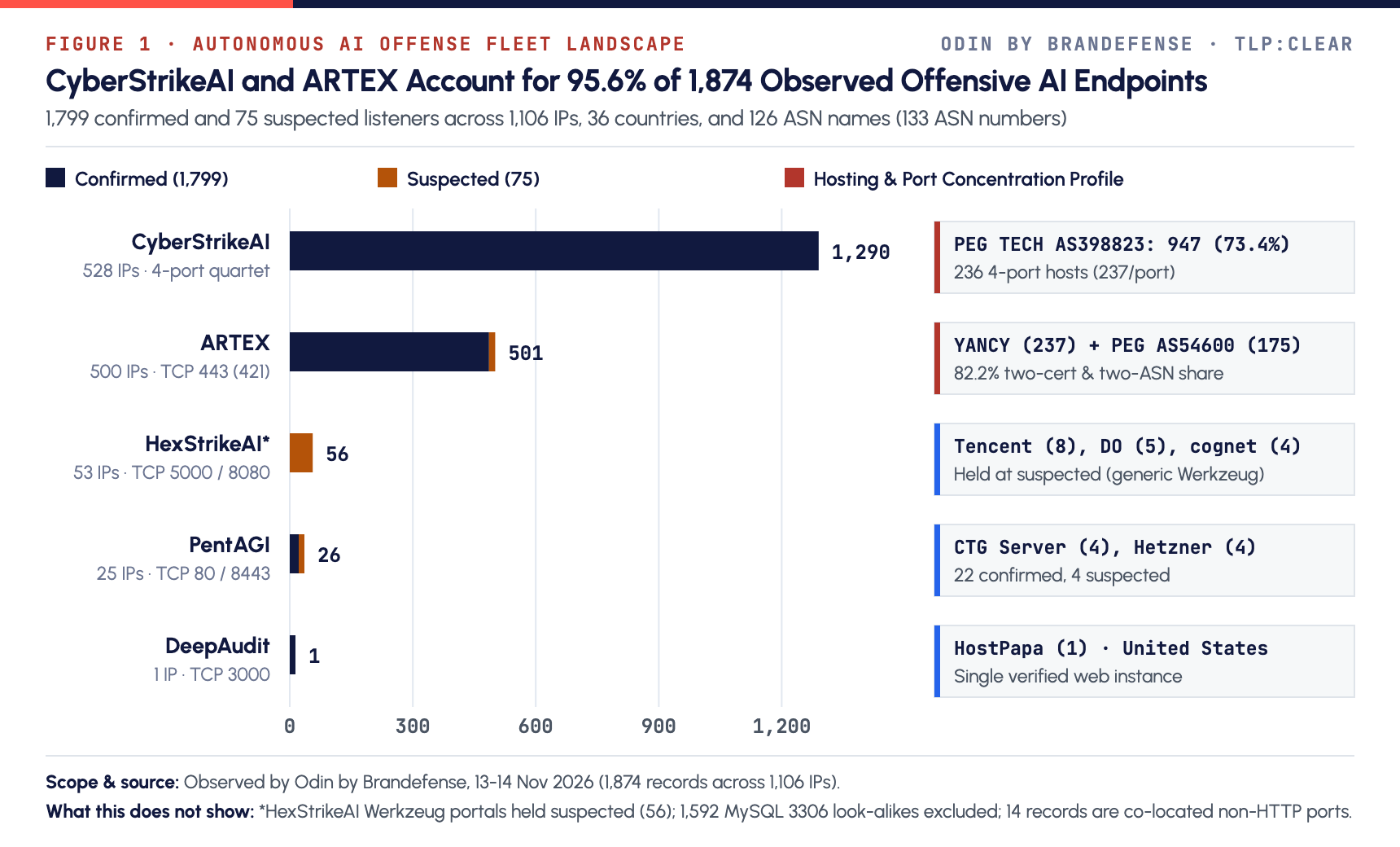
Counts by framework
| Framework | Records (IPs) | Confirmed / suspected | Main ports | Main hosting networks |
|---|---|---|---|---|
| CyberStrikeAI | 1,290 (528) | 1,290 / 0 (1,277 HTTP or TLS, 13 other services) | 5001, 5002, 5003, 8082 (237 each), 443 (156), 80 (83) | PEG TECH INC AS398823 (947, 73.4%), DigitalOcean (94), AROSSCLOUD (90) |
| ARTEX | 501 (500) | 486 / 15 | 443 (421, 84.0%), 80 (64), 8443 (4), 3000 (3) | YANCY LIMITED (237, 47.3%), PEG TECH INC AS54600 (175, 34.9%) |
| HexStrikeAI | 56 (53) | 0 / 56 | 5000 (15), 8080 (12), 8000 (4), 8888 (4) | Shenzhen Tencent (8), DigitalOcean (5), cognetcloud (4) |
| PentAGI | 26 (25) | 22 / 4 | 80 (10), 8443 (5), 443 (4), 3001 (4) | CTG Server Limited (4), Hetzner Online (4), DigitalOcean (2) |
| DeepAudit | 1 (1) | 1 / 0 | 3000 (1) | HostPapa (1), United States |
PentAGI and DeepAudit are dual-use pentest tools. Their addresses are not published, and they stay in hunt review until hostile use is shown. HexStrikeAI addresses are also withheld (see Chapter 6).
CyberStrikeAI: the four-port pattern
CyberStrikeAI listens on four orchestration ports: 5001, 5002, 5003 and 8082. Each port has 237 listeners across 238 hosts. Together they make up 948 records, or 73.5% of CyberStrikeAI.
Of those hosts, 236 on PEG TECH INC (AS398823) bind all four ports at once. That is 944 records, or 73.2%. One more host binds only the first three ports, and one Tencent Cloud host binds 8082 alone.
The pattern is unusually uniform. Of the 236 four-port hosts, 231 sit in 38.6.0.0/16 and present no TLS certificate or JARM value. One cognetcloud host answers on 10 ports, including 5666. Cloned provider images or responders that answer on any port may explain part of this, alongside separate operator instances.
CyberStrikeAI certificates and workspaces
On TLS, 88 CyberStrikeAI nodes on AROSSCLOUD INC. reuse one certificate name, withheld because it may belong to a third party. One example is 186.241.69[.]175:443.
Another 99 records present Ubiquiti's default CN=unifi.local subject. Of these, 92 sit on DigitalOcean and 7 on telecom ISPs, on ports 443, 7443 and 8443. A default UniFi certificate is normal for a self-hosted UniFi controller, so these hosts are not on the block list.
Two hosts expose CyberStrikeAI working folders over HTTP. One serves /CyberStrikeAI/tmp/workspace/projects/ on one host. The other serves /opt/cyberstrike-ai/w5_tokens.json on another. Both addresses are withheld.
ARTEX: two server templates
ARTEX runs almost one listener per IP: 501 endpoints on 500 IPs. It puts 84.0% (421) on port 443, and 80 on 12 other ports such as 80, 8443, 3000, 8083 and 9000.
Operators deploy two server templates, each with its own certificate.
| Cluster | Hosting | Certificate | Endpoints | Example |
|---|---|---|---|---|
| A | YANCY LIMITED | certificate name A (withheld) | 237 | 103.48.132[.]2:443 |
| B | PEG TECH INC (AS54600) | certificate name B (withheld) | 175 | 38.12.72[.]83:443 |
PEG TECH INC splits cleanly by ASN. AS398823 carries 947 CyberStrikeAI records, while AS54600 carries the 175 ARTEX endpoints.
Per-framework IP counts add up to 1,107, one more than the 1,106 unique hosts. The extra host is 144.172.68[.]197 (AS30823), which runs ARTEX on 80 and CyberStrikeAI on 8443.
3. Inside a Co-Hosted CyberStrikeAI and ARTEX Server
In short
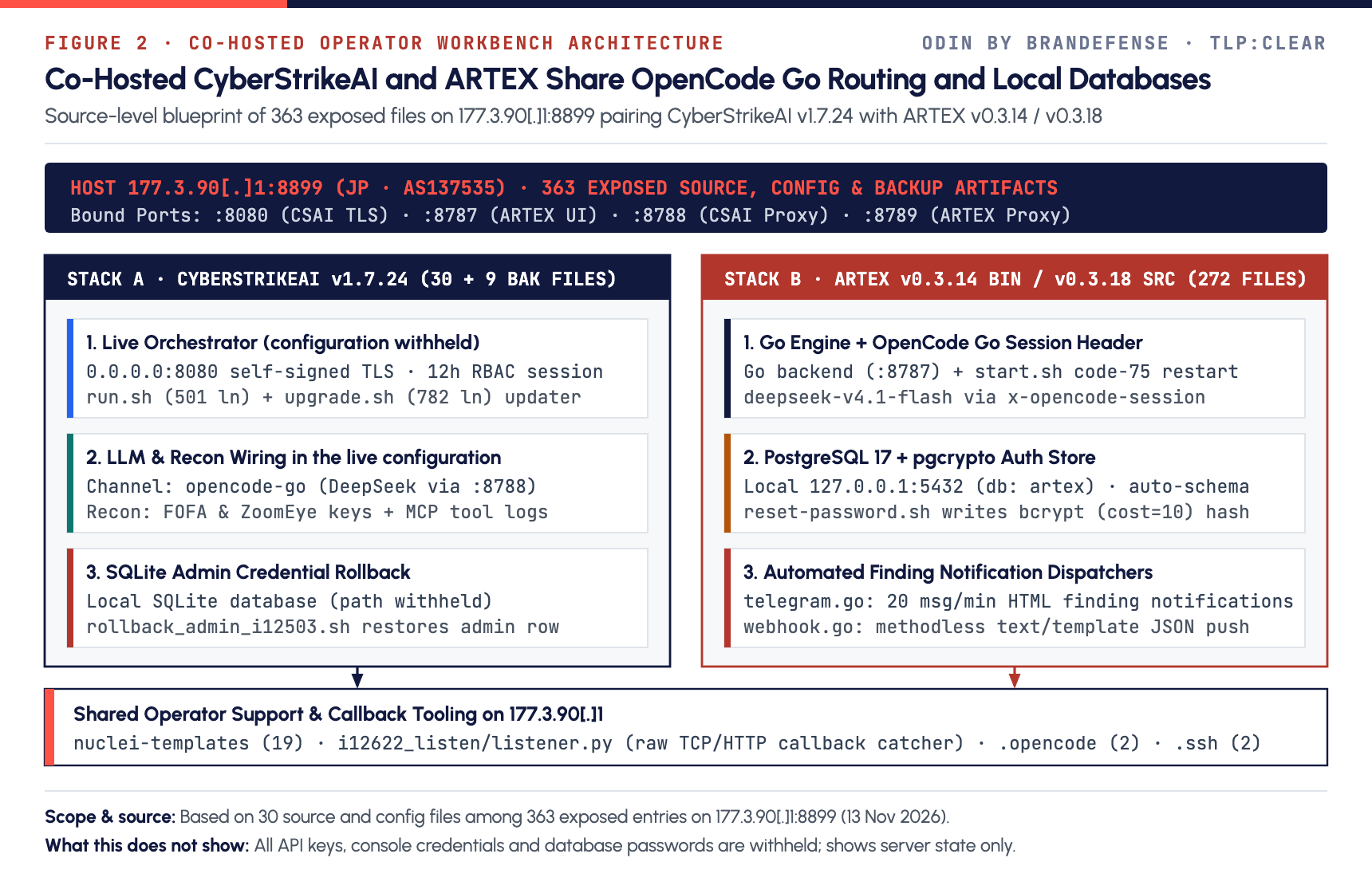
An open directory on 177.3.90[.]1:8899 exposed 363 files from a server running CyberStrikeAI v1.7.24 next to ARTEX v0.3.14 and v0.3.18. It shows how one operator wires both tools to a DeepSeek model, search-engine keys, local databases and Telegram alerts.
On 13 November 2026, Odin by Brandefense found an open Python SimpleHTTP directory on 177.3.90[.]1:8899. The host sits on JT TELECOM INTERNATIONAL PTE.LTD. (AS137535) in Japan. The same host runs CyberStrikeAI over TLS on 8080 and an ARTEX console on 8787.
The listing held 363 files in 14 top-level folders. Thirty configuration, source and maintenance files were kept for analysis. The figure below maps the setup, and the table lists the folders.
| Folder | Files | Share | What it holds |
|---|---|---|---|
ARTEX-src | 265 | 73.0% | ARTEX Go and Next.js source tree, changelog up to 0.3.18 |
CyberStrikeAI | 30 | 8.3% | A live v1.7.24 configuration, the example template, run.sh, upgrade.sh |
nuclei-templates | 19 | 5.2% | Custom vulnerability templates shared by both tools |
| (root) | 10 | 2.8% | Deployment notes, including ARTEX_SETUP.md |
csai_bak_i12482 | 9 | 2.5% | User-table export and an admin rollback script |
artex-0.3.14-linux-amd64 | 7 | 1.9% | Compiled v0.3.14 binary, config.json, start.sh |
.config and 7 support folders | 23 | 6.3% | .config (7), .cache (3), i10004_tmp (4), .ssh (2), .x (2), CyberStrikeAI-proxy (2), .opencode (2), i12622_listen (1) |
CyberStrikeAI v1.7.24 setup
The live configuration file is about 40 KB. Its name, path, hash and all live API keys are withheld. It runs the console on 0.0.0.0:8080 with a self-signed certificate generated in memory.
Other settings show how the operator uses the tool:
- 12-hour role-based sessions and 15-day audit retention
- an iteration cap of 299,999 and an MCP
tool_executionsmonitor - an LLM channel named
opencode-go, sendingdeepseek-v4.1-flashrequests to a local proxy on127.0.0.1:8788 - filled-in FOFA and ZoomEye key blocks for internet asset search
The example config also lists optional Alibaba DashScope (Qwen) and OpenAI-compatible connectors. Two scripts manage the install. run.sh (501 lines) pulls Python packages through the Tsinghua PyPI mirror and Go modules through goproxy[.]cn. upgrade.sh (782 lines) tracks the AIPentest/CyberStrikeAI project and keeps data/, roles/, skills/ and agents/ across updates.
Admin credential rollback
The csai_bak_i12482 folder holds rollback_admin_i12503.sh, a 15-line bash and Python script of 578 bytes. It is written to read an exported user backup and restore two fields for the admin user in CyberStrikeAI's local SQLite database: the password hash and the last-updated time.
Restoring both fields reverts a temporary password change without leaving a fresh timestamp. This fits post-session credential cleanup by an operator, which resembles indicator removal (MITRE ATT&CK T1070). It also fits a test setup that resets state between runs.
ARTEX setup
ARTEX_SETUP.md shows the co-hosting was deliberate. Its console and database passwords are withheld. The v0.3.14 binary runs its console on 8787. Its traffic-recording proxy moved to 127.0.0.1:8789, because CyberStrikeAI's proxy already held 8788.
ARTEX sends OpenAI-compatible requests to opencode[.]ai with deepseek-v4.1-flash and a 128K context window. A Go wrapper called quotaAwareTransport adds a per-conversation x-opencode-session header. start.sh watches for exit code 75 and swaps in a new binary after a web UI update.
ARTEX keeps its state in a local PostgreSQL 17 database named artex on 127.0.0.1:5432. reset-password.sh (9,663 bytes) sets an admin password by computing a bcrypt hash (cost 10) inside PostgreSQL with pgcrypto. The secret passes through environment variables, not the command line.
Findings go out automatically. notify/telegram.go sends up to 20 HTML messages per minute. notify/webhook.go posts JSON and masks bot tokens in error logs.
Key files from 177.3.90[.]1:8899
All hashes below were recorded at acquisition from the complete files.
| Path | Size (lines) | SHA-256 | Role |
|---|---|---|---|
/CyberStrikeAI/run.sh | 16,334 B (501) | 1fe555c690ac70b1d58cc6b0b29dac99749f996d4f0edb13eb82fa25e59cd574 | Launcher using Tsinghua PyPI and goproxy[.]cn mirrors |
/CyberStrikeAI/upgrade.sh | 28,356 B (782) | 754d0ac640dd35718b845fcf1ea5510499267de97806cfb74a6a35f7f593f329 | Self-updater that keeps data, skills and agents |
/csai_bak_i12482/rollback_admin_i12503.sh | 578 B (15) | e8521a024f6ea910390e99e56eba8a91dd23c99f29162252d5287d71994e7cb4 | Restores the admin password hash and timestamp |
/ARTEX-src/reset-password.sh | 9,663 B (235) | b17d1932eeea6d77e946f65620c29ae6e9826fcc6cced7eee5d85aba19515ae5 | pgcrypto bcrypt admin reset |
/ARTEX-src/notify/telegram.go | 7,160 B (191) | 3729020bfffe04f4fc0f384a81a2ec2293bb525844a74ef93851d1e1cb01a38b | Telegram finding alerts, 20 per minute |
/ARTEX-src/notify/webhook.go | 7,634 B (224) | 4fe3ba0c6e064005ec96a0e0692864ffb73bcaac34a4c65af3c9c63cf3fe346d | JSON webhook finding alerts with secret masking |
/i12622_listen/listener.py | 1,365 B (32) | 02261c0065f07d88dce553d191623141990c9126335c1643eb8d8c80c35dc464 | Out-of-band TCP and HTTP callback listener writing headers to raw.log |
4. Exposed Coding-Agent Folders and Revision Backups
In short
People who run quick HTTP file servers from home folders often publish their AI coding-agent state by mistake. Odin found 1,731 such session files and 1,779 numbered script backups across 336 servers.
Many offensive and testing workflows now pair an AI coding assistant with automatic command execution. A common mistake is starting python3 -m http.server in /root or a home folder to move files. That publishes hidden folders such as .claude, .cursor and .codex to the internet.
Directory exposure alone does not show bad intent. These counts mix threat-actor staging boxes, red-team jump hosts and ordinary developer machines. Their owners are users, not operators, unless the files show offensive work.
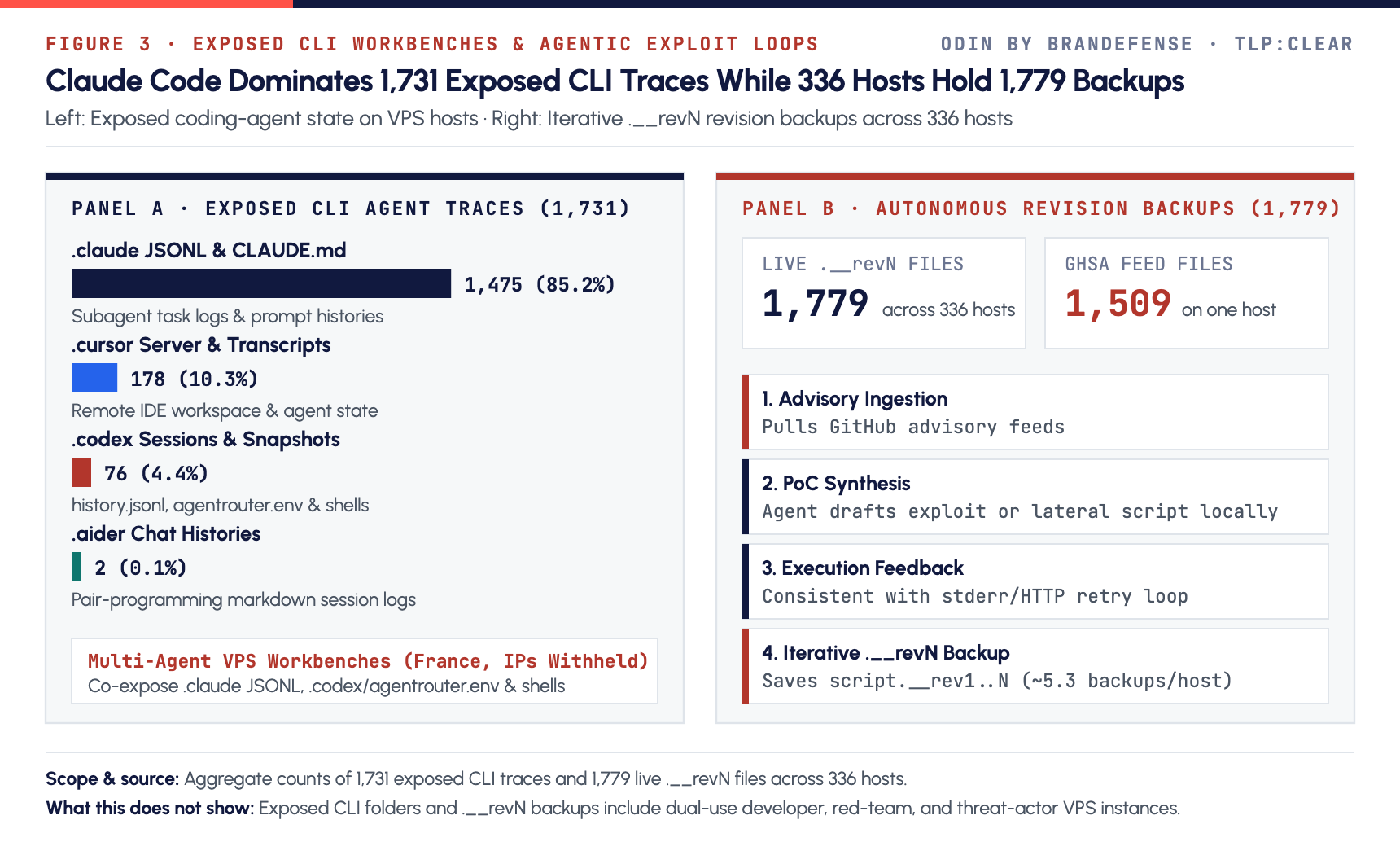
1,731 coding-agent files
| Tool | Files | Share | What was exposed |
|---|---|---|---|
| Claude Code | 1,475 | 85.2% | .claude subagent JSONL conversation logs (1,473) and CLAUDE.md instruction files (2) |
| Cursor Server | 178 | 10.3% | Remote .cursor server folders and cached agent transcripts on cloud VMs |
| Codex CLI | 76 | 4.4% | .codex/history.jsonl and shell_snapshots/*.sh (75), plus one agentrouter.env proxy credential file |
| Aider | 2 | 0.1% | Plain-text .aider.chat.history.md transcripts |
Some servers mix several tools. One VPS in France exposed 513 files, with .claude transcripts and .codex session logs side by side. A second French VPS exposed .codex/agentrouter.env, .codex/history.jsonl, .openclaw/openclaw.json and .codex/shell_snapshots/ on one listener. Neither showed offensive tooling, so both addresses are withheld.
1,779 revision backups
Open directories also held 1,779 numbered revision backups, named like script.__rev1, script.__rev2 and onward. They sit on 336 hosts, about 5.3 per host.
Some hosts clearly staged offensive work:
| Host | Files of interest |
|---|---|
| Withheld | /shell.php.__rev28 and /enc_shell.jsp (webshell and XXE staging) |
| Withheld | /gen_loader.py.__rev2 (Sliver C2 loader) |
| Withheld | MCP probing scripts with revision backups |
A directory listing shows files, not running processes. Still, numbered revisions of payloads and MCP helpers fit an edit-and-retry loop driven by an agent (T1059).
Advisory ingestion
One research host held a workbench of 1,509 files. It pulls structured GitHub Security Advisory feeds next to login-page templates. The evidence does not make this host adversary infrastructure, so its address is withheld and it is not an indicator. Workflows like this shorten the gap between an advisory and a working proof of concept.
5. Attacks on LiteLLM Gateways, MCP Servers and Base URLs
In short
Company AI middleware has become a target. Staged scripts aim at LiteLLM databases, MCP endpoints vulnerable to CVE-2026-42271, and apps that let users change the model base URL.
An LLM gateway such as LiteLLM routes a company's calls to OpenAI, Anthropic, Google and Azure through one internal proxy. An MCP server lets a model call internal databases and command tools. Both hold keys and both can run actions, which makes them attractive.
Odin observed 349 AI-stack records on 104 hosts. Sixteen of them are disclosure archives on one German cloud host, described in Chapter 6. Setting those aside leaves 333 records on 103 hosts. That set mixes staged offensive scripts with dual-use admin and developer test scripts.
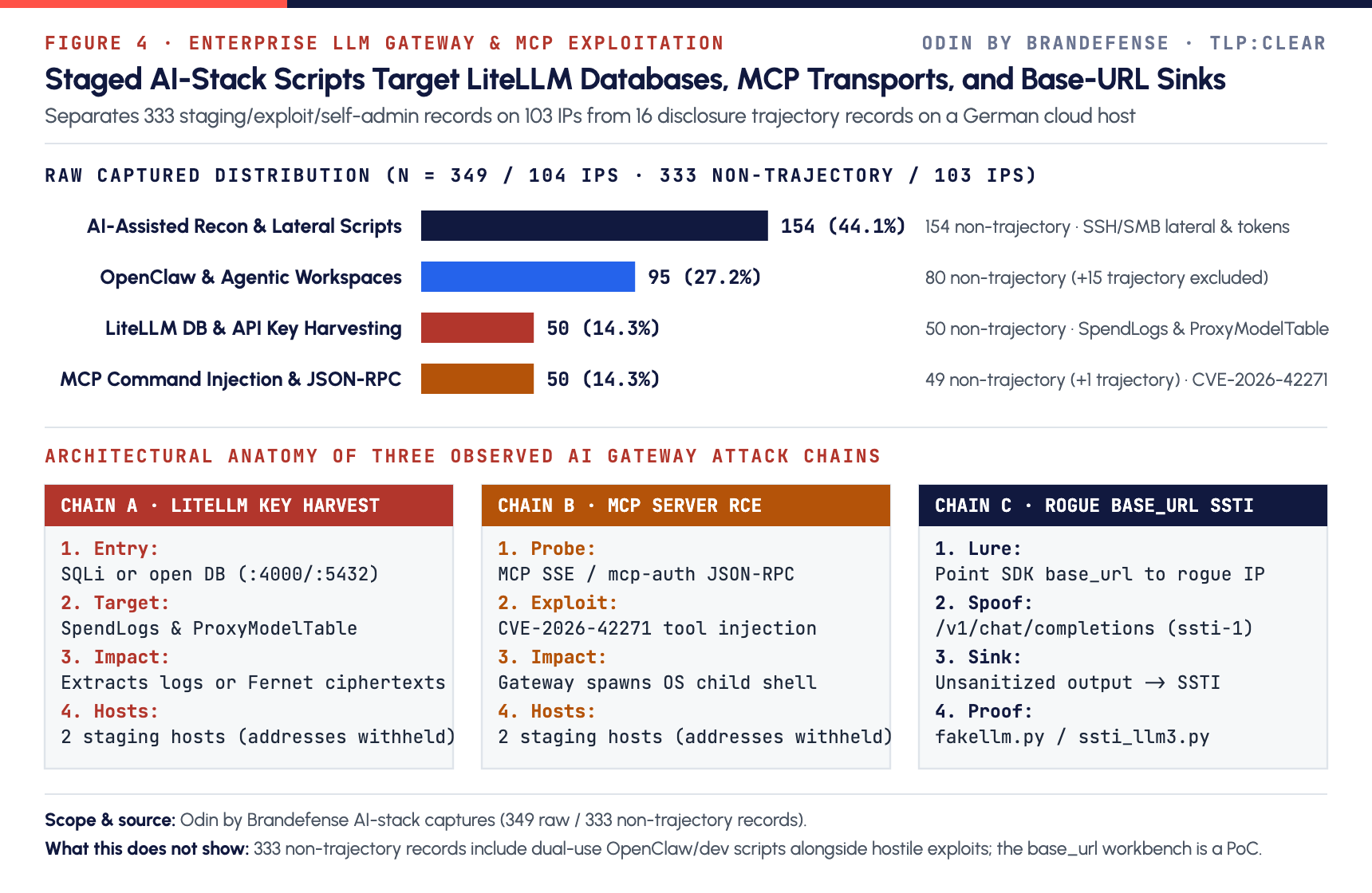
What the 349 records contain
| Category | Records (share) | Outside disclosure archives | Example hosts | What was staged |
|---|---|---|---|---|
| AI-assisted recon and lateral movement | 154 (44.1%) | 154 | 3 hosts (addresses withheld) | SSH, SOCKS5, SMB and token-store scripts, next to dual-use REST helpers |
| OpenClaw and agent workspaces | 95 (27.2%) | 80 (15 set aside) | 3 hosts (addresses withheld) | Key-scraping scripts for openclaw.json via FOFA, plus dual-use OpenClaw test scripts |
| LiteLLM database and key harvesting | 50 (14.3%) | 50 | 2 hosts (addresses withheld) | SQL injection and PostgreSQL queries aimed at LiteLLM spend and model tables (OWASP LLM02) |
| MCP command injection and JSON-RPC | 50 (14.3%) | 49 (1 set aside) | 3 hosts (addresses withheld) | mcp-auth OAuth and SSE probing, and a CVE-2026-42271 reproduction workspace |
The hosts above are older staging hosts, first seen before this window, so treat them as hunt leads, not block entries.
Path 1: Harvesting keys from LiteLLM databases
LiteLLM Proxy with PostgreSQL writes request metadata to LiteLLM_SpendLogs and model credentials to LiteLLM_ProxyModelTable. Virtual key hashes appear in LiteLLM_VerificationTokenView.
In production, LiteLLM encrypts provider keys at rest with LITELLM_SALT_KEY (Fernet). It also hashes virtual proxy tokens. A table dump therefore gives plaintext keys only in two cases: unmasked payloads were logged to the spend logs, or the salt key is also exposed in config.yaml.
Three hosts staged scripts for this path. Two target LiteLLM directly; the third tests the keys found:
| Host | Scripts | SHA-256 | Written to |
|---|---|---|---|
| Withheld | mine.py, creds3.py | Withheld | Query spend logs and the token view through SQL injection |
| Withheld | fast_litellm_scan.py, phase8c_extract.py | Withheld | Inject SQL through the HTTP Authorization header to reach sk-ant-* keys in the model table |
| Withheld | call_all.py, test_keys.py | Not listed | Find exposed openclaw.json files through FOFA and test keys against OpenAI, Anthropic and Google |
These are staged files. We did not verify any result on a target.
Path 2: MCP command injection and SSE probing
MCP servers run local tools over JSON-RPC and Server-Sent Events (SSE). Missing authentication or unchecked tool arguments can expose the host's interpreter.
One withheld staging host held mcp_eat_xtests.py and mcp_eat_capture.py. They are written to capture and replay OAuth PKCE tokens against mcp-auth endpoints. Another withheld host held mcp_sse_session.py and mcp_config_dl.py. These are designed to open MCP SSE sessions and download mcp_config.json.
A third host, withheld because it may be legitimate, exposes a container workspace reproducing CVE-2026-42271. We did not test the workspace.
CVE-2026-42271 is a published BerriAI LiteLLM flaw. It allows authenticated command execution through the MCP stdio test endpoints POST /mcp-rest/test/connection and POST /mcp-rest/test/tools/list. NVD lists LiteLLM 1.74.2 through 1.83.6 as affected, fixed in 1.83.7.
Path 3: Rogue base URL servers and template injection
Many AI apps use OpenAI-compatible SDKs with a configurable base_url. If users or imported agent configs can change it, the SDK can be pointed at a rogue server.
An open directory on a withheld workbench host held two such servers. fakellm.py is 2,013 bytes. ssti_llm3.py binds port 8083. Their hashes are withheld with the host. A log, fakellm_run.log, shows a third copy failing to bind 8082 (Errno 98).
The rogue server answers /v1/models with the model id ssti-1 and fakes /v1/chat/completions. It returns template expressions inside choices[0].message.content with wildcard CORS headers. An app that drops model output into Jinja2 or dashboard templates without escaping can suffer server-side template injection (OWASP LLM05). That can lead to code execution.
The host also held .dockerenv and /flag files, which point to a container or capture-the-flag lab. Treat it as a proof of concept, not a production breach.
6. Look-Alikes and What Not to Block
In short
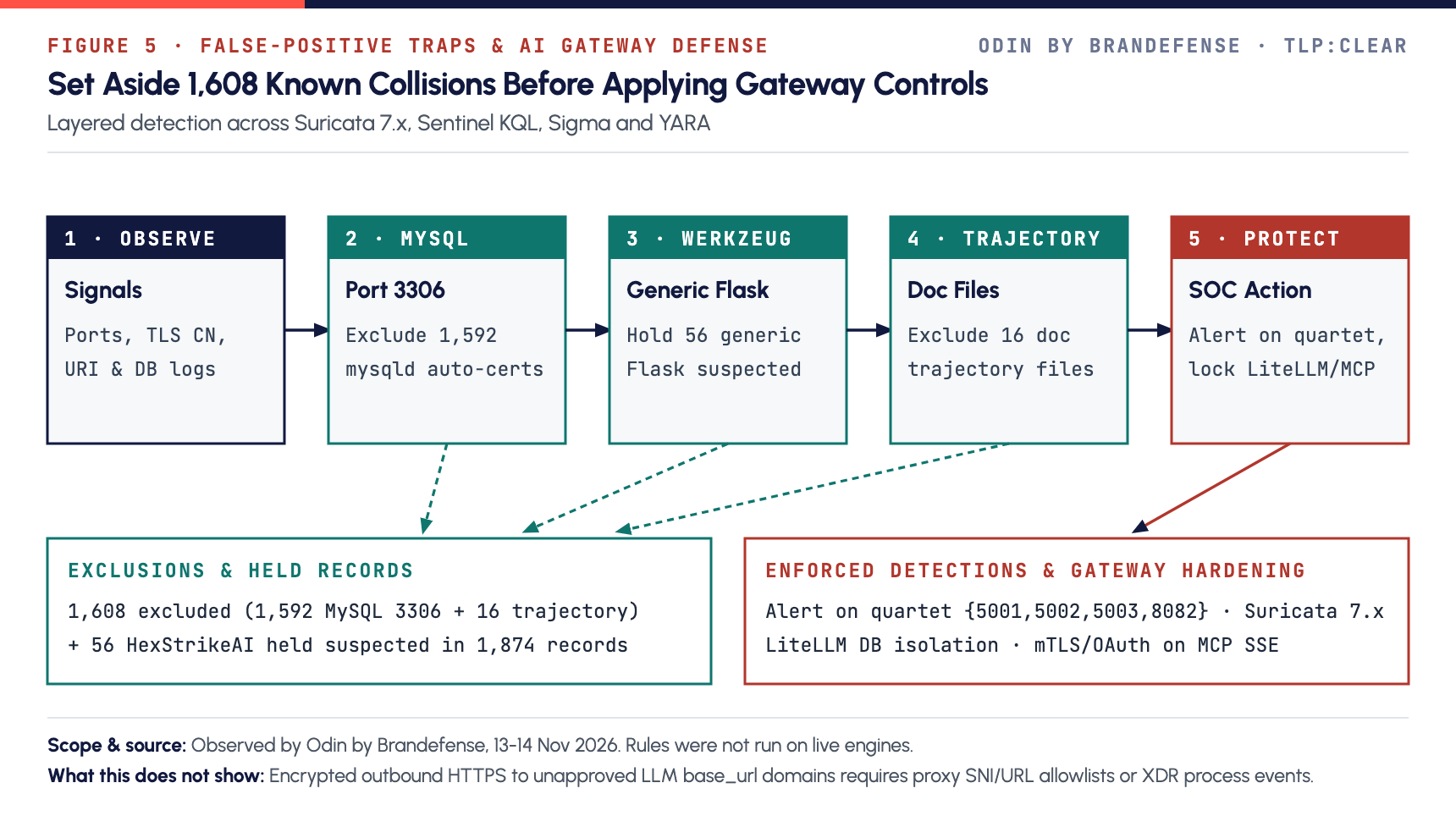
Generic banners, default certificates and disclosure archives look like AI offense tooling but are not. Odin set aside 1,608 such records and held 56 HexStrikeAI records as suspected; defenders should do the same before automating blocks.
Treating every Python banner, Ubiquiti certificate or agent folder as hostile would flood a SOC and break legitimate services. Five kinds of look-alike are left out of the counts and indicators in this report.
| Look-alike | Records | Why it is not counted as hostile | What to do |
|---|---|---|---|
| MySQL on port 3306 | 1,592 excluded | MySQL creates its own server certificate (MySQL_Server_*_Auto_Generated_Server_Certificate), which matches a public AI offense signature by accident | Never block on this certificate alone |
| HexStrikeAI on Werkzeug | 56 records on 53 IPs, held as suspected | HexStrikeAI runs on Flask and Python Werkzeug on 5000 and 8080, like many developer sandboxes and university labs | Block only with a task route or MCP signal |
| Disclosure archives | 16 excluded | Session archives on one German cloud host contain structured disclosure reports (FULL-REPORT.md), not crimeware staging | Keep out of threat counts |
| Rogue base URL workbench | Hashes only | Container and /flag files point to a lab or CTF proof of concept | Hunt the two file hashes, do not block a host |
Ubiquiti CN=unifi.local | 99 | Default certificate on self-hosted UniFi controllers | Check against UniFi inventory or JARM first |
The 16 disclosure records are 15 OpenClaw files and 1 MCP markdown file. The 1,592 and 16 together make the 1,608 records set aside.
Four older Linux sudo exploit scripts for CVE-2021-3156 sat on an unrelated host. They are not AI-related and are left out.
Fourteen records bind non-HTTP service ports: 3389, 993, 995, 465, 143, 53, 5060, 5432 and 5666. Thirteen are CyberStrikeAI and one is HexStrikeAI. None of these, and no unifi.local or standalone PentAGI host, enters the indicator list.
7. Detection Rules
In short
Four rule files cover the network, the endpoint and the file system. Deploy them together, and act only on multi-signal hits or concrete exploit evidence.
The full rules are in the Detection rules tab. Every rule file loads without errors in its engine (Suricata 7.0.12, YARA-X, pySigma, Kusto.Language); the rules were not replayed against live traffic. Test them in your own environment before production use.
| Rule file | What it catches |
|---|---|
suricata_ai_c2_and_mcp_gateway.rules | Suricata 7: 9 signatures for CyberStrikeAI and OpenClaw workspaces, LiteLLM SQL injection and external MCP access |
sentinel_llm_gateway_and_agent_hunt.kql | Microsoft Sentinel and Defender XDR: the four-port pattern, unexpected LiteLLM database clients and SDK base URL overrides |
sigma_autonomous_agent_and_mcp_abuse.yml | Sigma (3 rules): gateways spawning shells, archiving of coding-agent folders, and runs of .__rev scripts |
yara_ai_offense_workbenches.yar | YARA (4 rules): CyberStrikeAI configs, ARTEX reset and notifier modules, rogue base URL servers and LiteLLM key harvesters |
How the Suricata signatures work
| SID | Looks for | Why |
|---|---|---|
| 9402601 | /CyberStrikeAI/ in an HTTP URI | Exposed CyberStrikeAI workspace or config |
| 9402608 | TLS subject CN=unifi.local from an external host, one alert per source per hour | Policy hint only; check UniFi inventory first |
| 9402604 | LiteLLM_SpendLogs plus an SQL injection operator in the URI | Spend-log harvesting |
| 9402611 | Same, in the request body | Spend-log harvesting |
| 9402605 | LiteLLM_ProxyModelTable plus an SQL injection operator in a header | Key theft through the Authorization header |
| 9402612 | Same, in the request body | Key theft from the model table |
| 9402606 | External access to /mcp-auth, /mcp/sse, /mcp/messages, /v1/mcp or /mcp-rest/, rate-limited | MCP reconnaissance or exposure |
| 9402607 | /.openclaw/workspace/ in a URI | OpenClaw exploit workspace retrieval |
| 9402609 | w5_tokens.json in a URI | CyberStrikeAI token-store retrieval |
The four LiteLLM rules need a real SQL injection operator, such as UNION SELECT, pg_sleep, ' OR or ; SELECT. A bare -- comment does not fire them, so routine Grafana or FinOps queries stay quiet.
TLS 1.3 encrypts the server certificate. The certificate rules therefore work only on TLS 1.2 or on decrypted traffic. Pair them with JA4S or JARM fingerprints and destination-IP controls.
How the KQL hunt works
The query reads DeviceNetworkEvents over a 14-day lookback. It has three branches.
- Four-port pattern. It flags a device that reaches all of 5001, 5002, 5003 and 8082 on one public IP within 60 minutes. The window slides from each connection, so sequences that cross a clock boundary still match.
- Unexpected LiteLLM database client. It flags connections to PostgreSQL on 5432 or 5433 from anything other than your approved gateway hosts running LiteLLM.
- Base URL override. It flags processes whose command line sets
--base-url,OPENAI_BASE_URLor a similar option toward a host outside your approved provider list.
Fill in your own gateway hostnames, database IPs and approved Azure OpenAI hostnames before use. Add SNI allowlisting on the web gateway to catch base URL overrides set only in environment variables.
How the Sigma and YARA rules work
The first Sigma rule flags a LiteLLM or MCP server process that spawns a shell or interpreter. Normal prisma generate and prisma db push start-up steps are excluded.
The second flags tar, zip, scp, curl or nc when the command line names .claude/, .cursor/, .codex/ or agentrouter.env. The third flags an interpreter running a .__rev script.
Sigma sees process launches, not file reads inside a running program. Add auditd read watches on /root/.claude/, /root/.codex/ and /root/.cursor/ to catch those.
Each YARA rule is limited to files under 256 KB and carries explicit exclusions.
| YARA rule | Fires on | Excludes |
|---|---|---|
ODIN_CyberStrikeAI_Workbench_Config_And_Rollback | Live CyberStrikeAI configs and the admin rollback script | config.example.yaml |
ODIN_ARTEX_Finding_Notifier_And_Reset | ARTEX pgcrypto reset and finding notifier modules | None listed |
ODIN_Rogue_OpenAI_BaseURL_SSTI_Server | Fake OpenAI servers returning template payloads (ssti-1) | Benign mock OpenAI test fixtures |
ODIN_LiteLLM_Database_Key_Harvester | SQL injection scripts aimed at LiteLLM tables | Upstream LiteLLM source and FinOps spend queries |
How to sort an observation
| What the observation shows | Action |
|---|---|
| A disclosure or documentation archive | Low-signal review (checked first, before any CVE file name match) |
| A real SQL injection operator, shell injection marker or template gadget, plus a matching rendered-sink event for the same completion | Critical: gateway exploitation |
| A harmless completion, or one that only discusses sink APIs | Low-signal review |
| A standalone PentAGI or DeepAudit install | Low-signal review |
| A confirmed multi-signal C2 node | Block |
8. Indicators
The Indicators tab holds the 11 block entries. The 14 hunt entries in this chapter are described by file and port only; their addresses and hashes are withheld.
| Type | Block | Hunt | Total |
|---|---|---|---|
| IPv4 | 5 | 12 | 17 |
| SHA-256 | 6 | 2 | 8 |
| Total | 11 | 14 | 25 |
Block entries are confirmed multi-port or shared-certificate C2 nodes and the co-hosted workbench hashes. Hunt entries are older offensive staging hosts and proof-of-concept hashes; their addresses are withheld, because older staging hosts may be dual-use or reassigned. Cloud and VPS addresses change hands often, so block IPs for 30 days and then review.
Withheld: the two French coding-agent hosts, the advisory workbench, the CVE-2026-42271 reproduction host, the base URL workbench host, the disclosure archive host, and all PentAGI, DeepAudit, HexStrikeAI and unifi.local addresses.
Block
| Indicator | Port | Last seen | What it is |
|---|---|---|---|
| 177.3.90[.]1 | 8899 | 13 Nov 2026 | Co-hosted CyberStrikeAI v1.7.24 and ARTEX v0.3.14 / v0.3.18; 363 files; C2 on 8080 and 8787 |
| 38.6.108[.]121 | 5001 | 14 Nov 2026 | PEG TECH INC (AS398823) four-port node on 5001, 5002, 5003, 8082 |
| 186.241.69[.]175 | 443 | 14 Nov 2026 | AROSSCLOUD INC. CyberStrikeAI node with a CyberStrikeAI certificate name (withheld) |
| 103.48.132[.]2 | 443 | 14 Nov 2026 | YANCY LIMITED ARTEX Cluster A node with certificate name A (withheld) (237 endpoints share it) |
| 38.12.72[.]83 | 443 | 14 Nov 2026 | PEG TECH INC (AS54600) ARTEX Cluster B node with certificate name B (withheld) (175 endpoints share it) |
The six block hashes are the workbench files from 177.3.90[.]1:8899 in Chapter 3: run.sh, upgrade.sh, telegram.go, webhook.go, reset-password.sh and rollback_admin_i12503.sh.
Hunt
These hosts staged offensive scripts. The dates are the file or snapshot dates recorded on each server, not how long Odin watched it.
| Indicator | Port | What it held |
|---|---|---|
| Withheld | 8000 | mine.py, creds3.py, written to query LiteLLM spend logs |
| Withheld | 9999 | fast_litellm_scan.py, phase8c_extract.py |
| Withheld | 8765 | MCP OAuth scripts mcp_eat_xtests.py, mcp_eat_capture.py |
| Withheld | 8099 | MCP SSE scripts and .__revN backups |
| Withheld | 8000 | Exposed /CyberStrikeAI/tmp/workspace/projects/ |
| Withheld | 80 | w5_verify.py loading /opt/cyberstrike-ai/w5_tokens.json |
| Withheld | 8000 | SSH and NAS lateral payloads /nas_deliver.ps1, /fix_authkey.ps1 |
| Withheld | 8080 | OpenClaw FOFA key scraper call_all.py, test_keys.py |
| Withheld | 8888 | Webshell and XXE staging, /shell.php.__rev28 |
| Withheld | 8080 | Sliver C2 loader /gen_loader.py.__rev2 |
| Withheld | 8080 | OpenClaw GL.iNet OpenVPN exploit staging |
| Withheld | 39002 | OpenClaw ARP, DNS and SMB lateral module /openclaw_lan_hunter_v18.py |
The two hunt hashes belong to the base URL server files from Chapter 5, ssti_llm3.py and fakellm.py. Their values are withheld with the host.
MITRE ATT&CK mapping
| Technique | How it shows up | Detection |
|---|---|---|
| T1190 Exploit Public-Facing Application | SQL injection against LiteLLM tables; CVE-2026-42271 on MCP test endpoints | Suricata 9402604, 9402605, 9402611, 9402612, 9402606; YARA LiteLLM rule |
| T1059 Command and Scripting Interpreter | Agent-driven edit-and-retry scripts; gateways spawning shells | Sigma rules 1 and 3 |
| T1070 Indicator Removal | Admin password hash and timestamp rollback on the CyberStrikeAI database | YARA CyberStrikeAI rule; file hash |
MITRE ATLAS covers the AI-specific steps: LLM-driven tool chaining and automated advisory analysis. OWASP LLM02 (sensitive information disclosure) and LLM05 (improper output handling) cover the gateway key theft and the base URL template injection.
9. What Defenders Should Do
These steps turn the rules in Chapter 7 and the indicators in Chapter 8 into controls for AI gateways, MCP servers and agent hosts, ordered by urgency.
Within 24 hours
- Block the five block-tier IPs for 30 days, and load the six workbench hashes into EDR and file scanning.
- Hunt for the staging file names and URI paths in Chapter 8; the 12 hunt addresses and their 2 script hashes are withheld.
- Check every LiteLLM version. Upgrade to 1.83.7 or later to fix CVE-2026-42271 on
/mcp-rest/test/*.
Within 72 hours
- Bind LiteLLM PostgreSQL (5432 and 5433) to loopback or a private subnet only.
- Move
LITELLM_SALT_KEYinto a secret manager, away from the database host, and mask bearer keys in spend logs. - Require mutual TLS or scoped OAuth 2.1 tokens on all MCP endpoints:
/mcp/sse,/mcp-auth,/v1/mcpand/mcp-rest/.
Within 7 to 30 days
- Lock SDK base URLs to approved provider domains with web gateway SNI or URL allowlists.
- Escape all model output before it reaches a template engine (OWASP LLM05).
- Alert on the four-port pattern (5001, 5002, 5003, 8082) within 60 minutes, and deploy the Suricata rules.
- Ban ad-hoc HTTP file servers in folders that hold
.claude,.cursor,.codexor.aiderdata, and watch reads of those folders withauditd. - Keep HexStrikeAI Werkzeug servers, standalone PentAGI listeners, unconfirmed
unifi.localhits and the non-HTTP ports listed in Chapter 6 off automatic block lists.
10. Scope and Limits
- Window. The findings cover a two-week observation window ending 18 November 2026. The 1,874 fleet records were seen on 13 and 14 November 2026. Earlier dates in this report are file or snapshot dates on the servers, not a tracking start.
- Running is not hostile. A confirmed record shows the framework is running. Authorized red teams, labs and threat actors use the same public packages.
- Exposure is not breach. Coding-agent folders, AI-stack records and staged scripts show what sat on a server. They do not show that any attack worked on a target.
- Aggregate counts. The 1,731, 1,779 and 349 figures are counts. Per-host detail is withheld to protect the owners of exposed machines.
- Proofs of concept. The CVE-2026-42271 workspace and the base URL servers were not tested live.
- Rule testing. Every published rule file loads without errors in its engine (Suricata 7.0.12, YARA-X, pySigma and Microsoft's Kusto.Language analyzer, checked on 20 November 2026). The rules were not replayed against live traffic, so test and tune them in your own environment before production use.
11. Sources
- OWASP Top 10 for Large Language Model Applications (2025), LLM02 and LLM05. https://genai.owasp.org/llm-top-10/ (verified 18 November 2026)
- Model Context Protocol. Authorization specification. https://modelcontextprotocol.io/specification/2025-03-26/basic/authorization (verified 18 November 2026)
- LiteLLM. Proxy production deployment documentation. https://docs.litellm.ai/docs/proxy/prod (verified 18 November 2026)
- MITRE ATLAS data repository. https://github.com/mitre-atlas/atlas-data/blob/main/dist/ATLAS.yaml (verified 18 November 2026)
- Microsoft Threat Intelligence. Chinese threat actor Storm-0940 uses credentials from password spray attacks from a covert network. https://www.microsoft.com/en-us/security/blog/2024/10/31/chinese-threat-actor-storm-0940-uses-credentials-from-password-spray-attacks-from-a-covert-network/ (verified 18 November 2026)
- MITRE ATT&CK. T1190 Exploit Public-Facing Application. https://attack.mitre.org/techniques/T1190/ (verified 18 November 2026)
- MITRE ATT&CK. T1059 Command and Scripting Interpreter. https://attack.mitre.org/techniques/T1059/ (verified 18 November 2026)
- MITRE ATT&CK. T1070 Indicator Removal. https://attack.mitre.org/techniques/T1070/ (verified 18 November 2026)
- NVD. CVE-2026-42271, BerriAI LiteLLM command execution via MCP stdio test endpoints (affected 1.74.2 to before 1.83.7, fixed in 1.83.7). https://nvd.nist.gov/vuln/detail/CVE-2026-42271 (verified 18 November 2026)
What is…?
Short explanations of the tools and families named in this study.
What is LiteLLM?
LiteLLM is an open-source gateway that gives one API in front of many large language model providers and holds their keys.
More about LiteLLMAI offensive toolWhat is CyberStrikeAI?
CyberStrikeAI is a public AI-driven offensive security platform. It spreads its operator interface, API and agent listener across several ports on one host and exposes tools through MCP.
More about CyberStrikeAIAI offensive toolWhat is ARTEX?
ARTEX is an autonomous red-team console that chains AI agents and security tools. Operators fork and rebrand it; its default listener port is 8787.
More about ARTEXAI offensive toolWhat is HexStrike AI?
HexStrikeAI is a public project that exposes many security tools to AI agents through the Model Context Protocol (MCP).
More about HexStrike AIAI agentWhat is OpenClaw?
OpenClaw is an open-source autonomous agent gateway that keeps trajectories, auth profiles and session logs on disk.
More about OpenClawAI offensive toolWhat is PentAGI?
PentAGI is an open-source autonomous penetration testing system that coordinates AI agents and security tools in containers.
More about PentAGIFrequently asked questions
Where do these AI attack consoles run?
Two frameworks dominate. CyberStrikeAI accounts for 1,290 records and ARTEX for 501, together 95.6% of the total. PentAGI (26), HexStrikeAI (56) and DeepAudit (1) make up the rest. The 1,874 records sit on 1,106 hosts in 36 countries.
What does an operator's server look like inside?
One server in Japan, at 177.3.90[.]1, left an open directory of 363 files. It runs CyberStrikeAI and ARTEX side by side, and the files show how the operator joined them up.
Why are developer machines part of the story?
Many people now pair an AI coding assistant with automatic command execution. A common shortcut is to start a quick web server in a home folder to move files. That also publishes the assistant's hidden folders.
How are LLM gateways and MCP servers being targeted?
Odin observed 349 AI-stack records on 104 hosts. Once 16 disclosure archives are set aside, 333 records remain. They show three attack paths. These are staged files. Nothing here shows a successful attack on a specific company, but the paths are realistic and easy to close.