


1. Executive Summary
In short
Between 13 and 16 November 2026, Odin by Brandefense observed an exposed staging server, 38.60.227[.]210, holding 1,824 records across five open ports. The scripts combine memory-only Linux agents, Cloudflare R2 delivery, Oracle database-link pivots, Windows SMB tooling, rival-malware eviction and search-bot cloaking. They show intent and tooling, not confirmed activity on targets. Hunt executable memory regions paired with temporary file locks, audit Oracle database links, and block the listed staging hosts.
Most toolkits do one job. This one does several. The same server holds enterprise lateral-movement scripts for Oracle, Zimbra and Windows, and the tools that turn a breached server into income: cryptocurrency mining and search-engine spam. This report explains how each part works and what defenders should look for.
All findings come from scripts and configuration files on the attacker's own server. Victim domains, database schemas, internal addresses and secrets are withheld.
Memory-only agents and kernel file locks are designed to evade Linux process scans.
Comments in the root bootstrapper describe a GitHub-named agent that deletes its own file, blanks its command line and poses as the system init binary. Three persistence hooks check whether it is alive through a file lock, not a process name. A separate launcher serves unprivileged accounts from a Cloudflare R2 bucket.
Lateral scripts target Oracle database links, Zimbra servers and Windows SMB shares.
Thirty middleware scripts, 26 of them for Oracle Database, RAC and E-Business Suite, are written to run remote DDL over database links. Zimbra scripts keep or lock a configuration re-entry channel. Windows scripts copy files over SMB, add a hidden administrator and overwrite AnyDesk password hashes.
Rival eviction and cloaking scripts are designed to keep hosts quiet and profitable.
A watchdog is configured to kill 13 rival process patterns and quarantine 11 rival file names every two minutes. It never edits web server configuration, so sites stay up. Three PHP implants serve spam only to search bots and selected mobile visitors.
Three Decisions for Leaders
- Correlate Linux executable memory with kernel file locks. Process names are not enough. Alert when an anonymous executable memory region and a temporary advisory lock appear together, and exclude kernel workers, user service managers and non-executable shared memory.
- Audit Oracle database links and restrict middleware egress. Inventory privileged database links. Alert on remote directory or Java creation in Unified Audit logs, and block unapproved cloud-bucket downloads from database and middleware servers.
- Inspect PHP prepend hooks, backup JVMs and night-time Windows tasks. Replay web checks with search-bot headers. Hunt encoded PowerShell started by Java, hidden local accounts, and SYSTEM tasks running from a temporary folder.
The Study in Numbers
| Number | What it is |
|---|---|
| 1,824 | Records exposed across five staging ports (1,171 unique paths) |
| 99 / 94 | Script and JSON configuration instances retrieved (94 unique SHA-256 digests) |
| 3 | Linux persistence hooks (systemd, cron, profile) gated by one advisory file lock |
| 26 | Core Oracle Database, RAC and E-Business Suite lateral scripts (23 Bash, 3 PHP) |
| 11 / 13 | Rival file name patterns quarantined, and rival process patterns killed |
| 18:00 to 09:00 | Local-time window in which a Windows script kills Task Manager |
| 47 | Published indicators: 30 script digests and 17 network, cloud, binary and pool indicators |
As of 16 November 2026, none of six primary indicators appeared in five public threat-intelligence sources. Private commercial feeds and later indexing are outside that check.
How to use this report.
Security leaders can read Chapter 1, Chapter 6 and Chapter 9. Detection engineers should start with Chapters 7 and 8. CTI analysts and hunters will find the tooling detail in Chapters 2 to 5.
2. One Server, Five Ports, Many Jobs
In short
The operator put lateral-movement scripts, callback endpoints, cloaking modules and mining configurations on one Linux VPS. Five HTTP ports serve files, and the scripts reference four more callback ports, a second check-in host and two cloud buckets.
What the server held
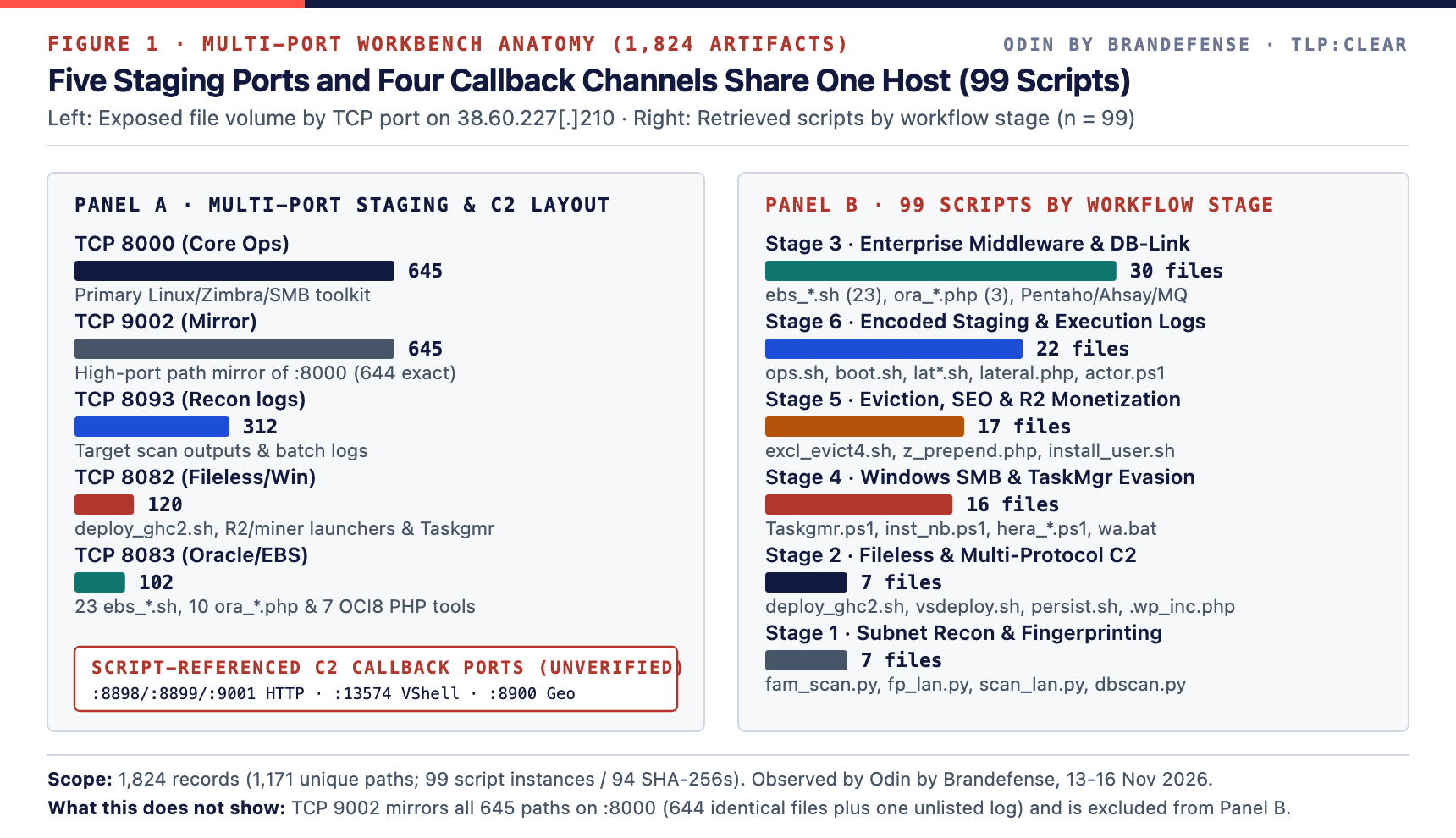
The workbench at 38.60.227[.]210 exposed 1,824 directory records across five open HTTP ports. Port 9002 mirrors port 8000, accounting for 645 paths. After removing that mirror and 8 cross-port overlaps, 1,171 unique paths remain.
From ports 8000, 8082 and 8083, 99 script and JSON configuration instances were retrieved. They map to 94 unique SHA-256 digests. By type, they break down as 47 .sh, 16 .php, 13 .json, 13 .ps1, 8 .py, 1 .bat and 1 .js.
Some files appear on more than one port. The table lists them.
| File | Copies | Ports | Notes |
|---|---|---|---|
/install_user.sh | 3 | 8000, 8082, 8083 | 425-line R2 variants on 8000 and 8082; 327-line variant on 8083 |
/config.json | 3 | 8000, 8082, 8083 | Port-specific pool and thread settings |
/javas | 3 | 8000, 8082, 8083 | ELF payload, listed but not retrieved |
/inst_nb.ps1 | 2 | 8000, 8082 | Differ only in max-threads-hint (50 vs. 60) |
/miner_restart_verify.sh | 2 | 8000, 8083 | Identical copies |
What each port does
Matching script download URLs against directory contents shows a clear layout. Some ports serve files. Others appear only inside scripts as callback endpoints. Whether those callback ports were listening was not verified.
| Port | Role | Files listed | What it holds |
|---|---|---|---|
| 8000 | Main staging root | 645 | Zimbra loaders (vsdeploy.sh, ops.sh), rival eviction (excl_evict4.sh), PHP cloakers (z_prepend.php, wbi_v10.php), Ahsay SMB pivot scripts |
| 9002 | Mirror of 8000 | 645 | 644 identical files plus one unlisted log; likely a fallback if port 8000 is blocked |
| 8093 | Recon and log store | 312 | Scan outputs, target liveness lists, encoded execution logs |
| 8082 | Fileless and Windows staging | 120 | deploy_ghc2.sh, R2 and /miner/ launchers, .wp_inc.php, tj.js, Windows SMB and AnyDesk tools (Taskgmr.ps1, hera_*.ps1) |
| 8083 | Oracle and PHP relays | 102 | 23 ebs_*.sh scripts, 10 ora_*.php files, 7 more OCI8 PHP tools, Pentaho loaders, HTTP PUT servers (put_srv*.py) |
| 8898, 8899, 9001, 13574 | Callbacks named in scripts | Not verified | 45-second HTTP polling (8898), eviction and recon uploads (8899), pull-test callbacks (9001), VShell sessions (13574) |
A second host, 38.60.252[.]110, receives /GEO_TOP_<host> check-ins on port 8900. Its reachability was also not verified.
Why this toolkit does not fit one label
Threat models often separate enterprise intrusion groups from opportunistic miners. This server holds both kinds of tooling. The scripts are written to reach high-CPU database and middleware servers through Oracle database links, Zimbra configuration changes, SMB and MSSQL execution, and lock-gated Linux persistence.
Companion modules are designed to earn money from the same hosts. They run mining at night and serve spam to search bots. The stage labels in Figure 1 reflect how files were grouped by port and campaign on the server.
Binaries listed but not retrieved
The directory listings also named 122 binary and archive files that were not retrieved. Their names show how the operator prepares privilege escalation and tunnelling.
| Port | Staged files | Platform | Purpose |
|---|---|---|---|
| 8082 | /github-c2-agent-dual, /vs.agent, /agent_l64 | Linux ELF | Main C2 and VShell agent binaries used by deploy_ghc2.sh, vsdeploy.sh and boot.sh |
| 8082 | /cve3156/pwnkit.tar.gz, pwnkit2.tar.gz, pwnkit3.tar.gz, hax.tar.gz, /dirtyfrag | Linux local root | Privilege-escalation archives for sudo and polkit, plus a kernel exploit binary |
| 8082 | /.nd/NtApiDotNet.dll, /win/edge.exe | Windows | .NET token and RPC library for the PrintSpoofer loaders, and a disguised Windows payload |
| 8000 | /chisel_linux, /chisel_orig.exe, /chisel_upx.exe, /plink.exe, /vagent_win.exe | Linux and Windows | Reverse SOCKS and port-forwarding tools to reach internal Oracle and SMB tiers |
The cve3156 folder name points at CVE-2021-3156 in sudo. The pwnkit archives point at CVE-2021-4034 in polkit. Both are long-patched, so unpatched hosts are the real risk.
3. Memory-Only Linux Agents and Cloudflare R2 Delivery
In short
The root bootstrapper deploy_ghc2.sh carries the author's own notes on how its agent hides. The agent deletes its file, blanks its command line and fakes its executable path, and three hooks restart it only when a kernel file lock is free.
The bootstrapper and its author's notes
The most carefully built Linux file is deploy_ghc2.sh on port 8082. It is 156 lines and 5,796 bytes, with SHA-256 549d39ceceb57866c0ade97fa02897d29f3141034ff6a02732118324c4ca1ce7. It runs as root, downloads a binary named github-c2-agent-dual, and guards it against process sweeps and broken downloads.
The binary itself was not retrieved. Its GitHub C2 channel rests on the deployment banner (GitHub-C2 agent) and the file name. No repository URL or token was found.
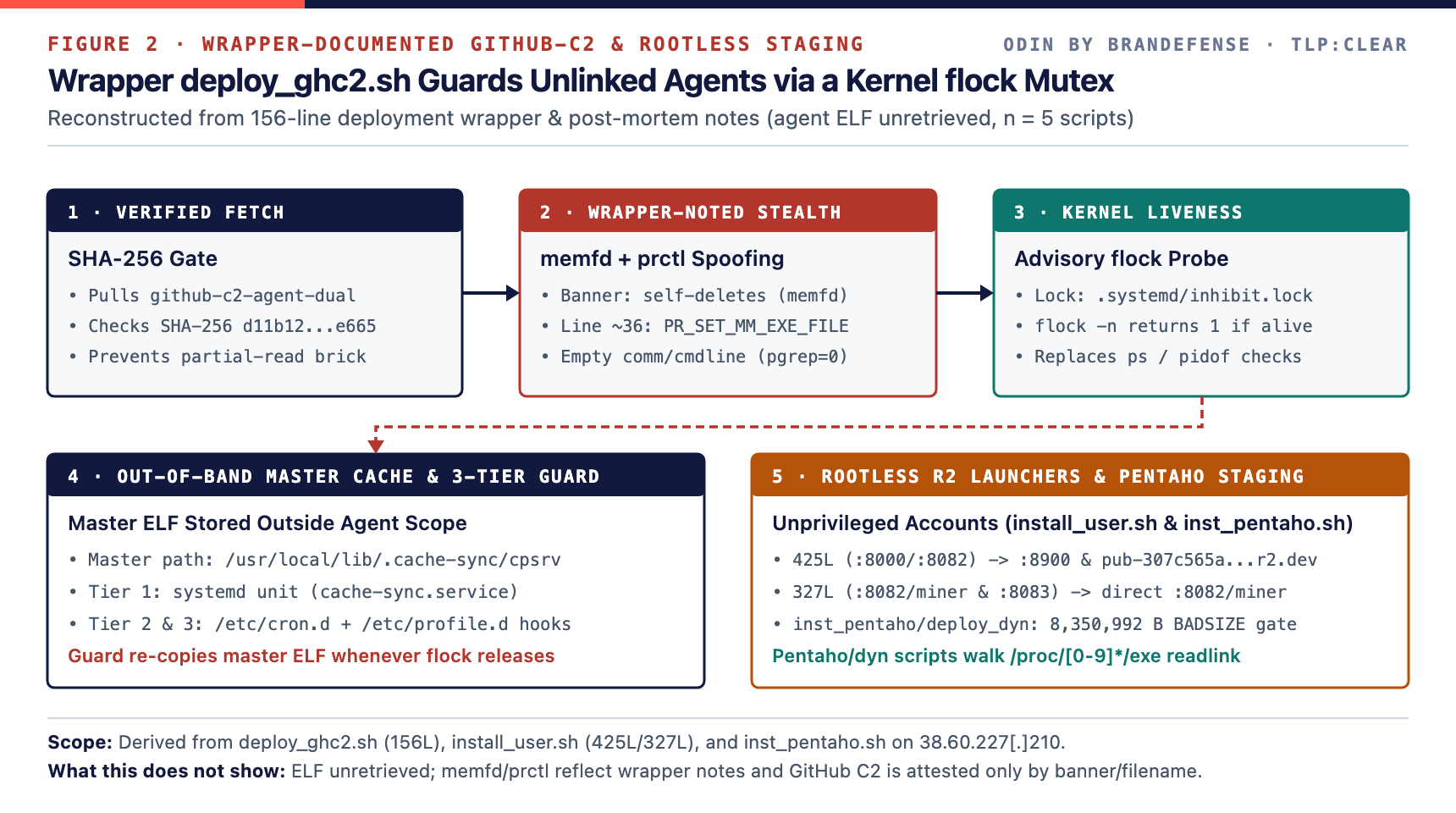
The author left four numbered lessons in Chinese at the top of the script, headed "pitfalls already stepped in, do not alter". A fifth note sits around line 36. Translated, they say the following.
| Note | What it says | Why it matters to defenders |
|---|---|---|
| 1. Self-deleting agent | The agent deletes its binary at startup (fileless/memfd). A master copy must sit outside its scope so the guard can restore it. | The running process has no file on disk, but a master copy does. |
2. Invisible to pgrep | The process has no comm name and an empty command line. The only reliable liveness check is flock -n on the lock file. | Process-name hunts miss it. Lock files do not. |
| 3. Checksum before install | Downloads must pass a SHA-256 check with retries. A partial download once left a CentOS 7 host "permanently dark". | The enforced hash identifies the agent binary. |
| 4. System-style names | All names pose as cache or system parts: cache-sync, cpsrv, Cache sync helper. | Search for these names in units, cron and profile scripts. |
| Line ~36 | The agent sets /proc/<pid>/exe to /usr/lib/systemd/systemd with PR_SET_MM_EXE_FILE, so the script skips system folders when finding its working directory. | A systemd process that is not PID 1 is a red flag. |
The script also records these defaults.
| Default | Value |
|---|---|
| Payload URL | http://38.60.227[.]210:8082/github-c2-agent-dual |
| Enforced SHA-256 of the agent | d11b12d628615d5eff982e3e312f4c406fde38373eee76bc056be780a9e2e665 |
| Master cache folder | /usr/local/lib/.cache-sync/ |
| Kernel lock file | /var/tmp/.systemd/inhibit.lock |
How the agent hides
According to the script, the agent removes its own ELF file and keeps running from an anonymous memory file (memfd). It clears its comm and cmdline strings, so pgrep finds nothing. It then calls prctl with PR_SET_MM_EXE_FILE to point /proc/<pid>/exe at /usr/lib/systemd/systemd.
The script's own filter skips /memfd:* and /usr/* paths when it works out the agent's folder. That confirms the author expected both tricks to be in place.
For hunters, this means /proc/<pid>/exe -> memfd: alone is not a reliable check. Correlate three signals instead:
- executable (
r-xp) anonymousmemfd:regions in/proc/<pid>/maps - a
systemdprocess that is not PID 1 and has no--userargument - a lock inode in
/proc/locksthat matches a file under/var/tmp
This maps to MITRE ATT&CK T1620 (Reflective Code Loading). The operator-claimed GitHub channel would map to T1102.002 (Web Service: Bidirectional Communication).
Three hooks gated by one file lock
The running agent holds an exclusive advisory lock on /var/tmp/.systemd/inhibit.lock. Three persistence hooks are written to test that lock with flock -n:
| Hook | Path |
|---|---|
| systemd unit | /etc/systemd/system/cache-sync.service |
| cron job | /etc/cron.d/cache-sync |
| login profile | /etc/profile.d/cache-sync.sh |
If a hook can take the lock, the agent is dead. The hook then checks the master copy in /usr/local/lib/.cache-sync/ against the hardcoded SHA-256 and restores it. This replaces ps and pidof checks, which the agent defeats.
Rootless launchers for service accounts
Initial access often lands in an unprivileged service account such as oracle, zimbra, pentaho or apache, with no sudo rights. For that case the toolkit ships rootless launchers that install a process named java_update.
| Port and path | Lines / bytes | Delivery and checks |
|---|---|---|
8000:/install_user.sh | 425 / 16,351 | Sends a check-in to 38.60.252[.]110:8900/GEO_TOP_<host>; pulls /javas and /config.json from the R2 bucket pub-307c565a487b43c5bee73d21edc4d83b.r2[.]dev/linux |
8082:/install_user.sh and /linux/install_user.sh | 425 / 16,351 | Port 8082 revision; same check-in; stages into $HOME/.cache/java_update with WALLET=krxYMRN97D |
8082:/miner/install_user.sh and 8083:/install_user.sh | 327 / 12,157 | Direct-IP variant; no :8900 check-in; pulls payloads from 38.60.227[.]210:8082/miner |
8083:/inst_pentaho.sh and 8083:/watch_pentaho.sh | 21 / 1,177 and 5 / 262 | Stages :8082/miner/javas into /opt/pentaho/.cache/java_update; enforces an 8,350,992-byte size check |
8083:/deploy_dyn.sh | 17 / 1,359 | Stages into /tmp/.cache/java_update; enforces the same size check plus ELF magic 7f454c46 |
The 425-line launchers download from Cloudflare R2 by default. That makes payload downloads look like ordinary Cloudflare TLS traffic. This maps to T1105 (Ingress Tool Transfer).
The Pentaho and dynamic stagers check that the payload is exactly 8,350,992 bytes (8.35 MB). They then walk /proc/[0-9]*/exe links with readlink to avoid starting a second java_update. They do this without calling ps.
4. Pivoting Through Oracle, Zimbra and Windows
In short
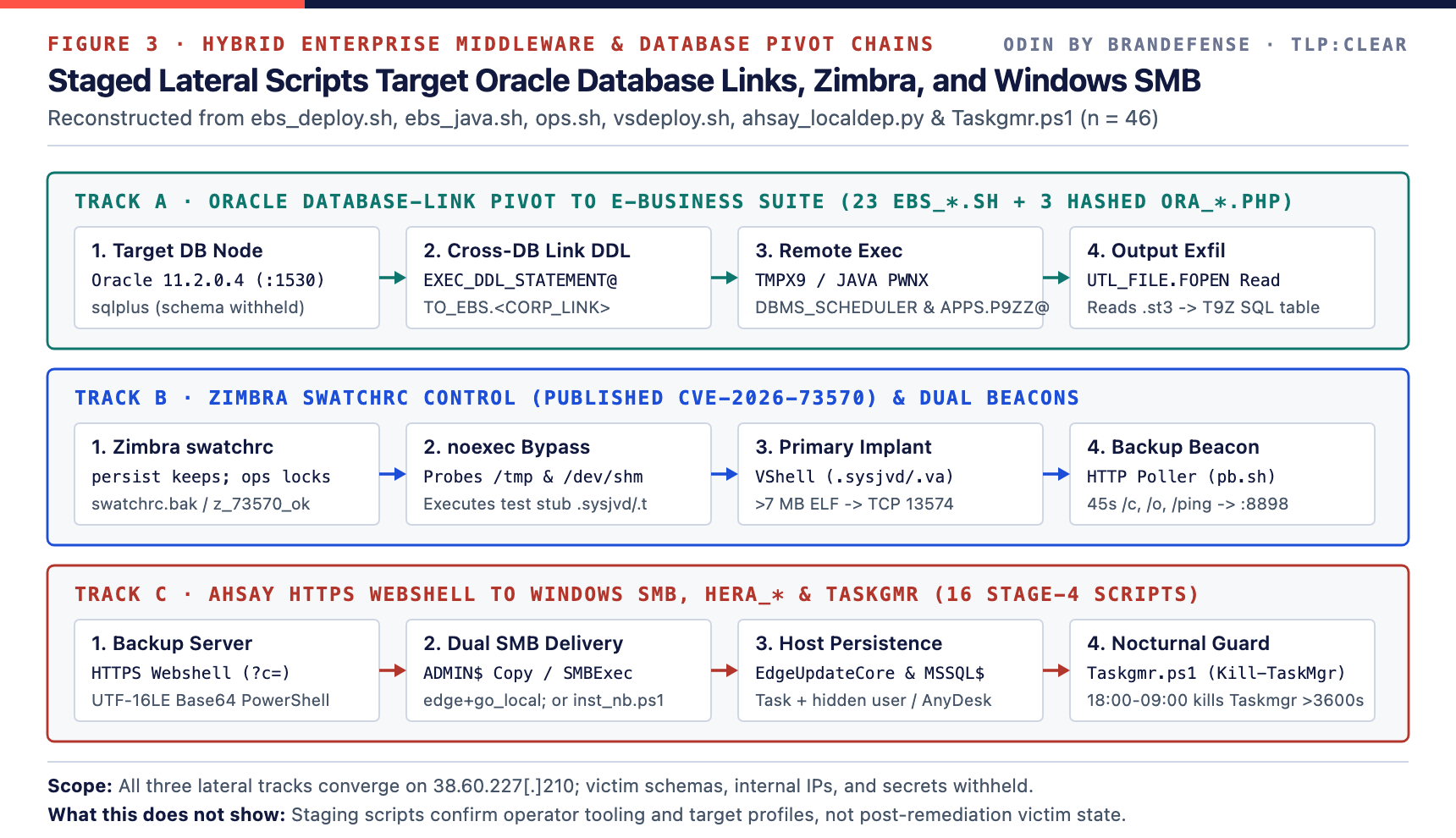
Thirty middleware scripts and companion Zimbra and Windows tools are written to move between Linux and Windows tiers. They target Oracle database links, Zimbra swatchrc files, Pentaho folders and Ahsay Backup web shells.
Oracle E-Business Suite over database links
Port 8083 holds 26 core Oracle lateral scripts and 7 supporting OCI8 PHP tools. They are written for Oracle Database 11.2.0.4, Real Application Clusters (ebs_rac.sh) and Oracle E-Business Suite (EBS).
| Script group | Listed / hashed | Key files | What they are written to do |
|---|---|---|---|
ebs_*.sh database-link wrappers | 23 / 23 | ebs_deploy.sh, ebs_rac.sh, ebs_java.sh, ebs_verify.sh, ebs_zz.sh | Connect with sqlplus to an internal database on port 1530, then call SYS.DBMS_UTILITY.EXEC_DDL_STATEMENT@ or APPS.P9ZZ@ across the TO_EBS link |
ora_*.php OCI8 deployers | 10 / 3 | ora_fleet.php, ora_deploy.php, ora_rce.php | Create directory TMPX9, schedule /bin/sh jobs with DBMS_SCHEDULER.CREATE_JOB, and read output with UTL_FILE |
| Supporting OCI8 and MySQL PHP tools | 7 / 7 | dl_probe.php, dl_fleet.php, dump2.php, dump_users.php, implant.php, jobchk.php, lateral.php | List database links and session_privs@, dump application user tables, schedule WPOLL command pollers, and pivot to internal web apps |
The script ebs_deploy.sh (63 lines, 4,199 bytes) lays out a four-step remote sequence.
| Step | Oracle call across @TO_EBS | Intended effect on the remote EBS database |
|---|---|---|
| 1. Map a folder | SYS.DBMS_UTILITY.EXEC_DDL_STATEMENT@TO_EBS | Create directory TMPX9 pointing at /tmp |
| 2. Output table | SYS.DBMS_UTILITY.EXEC_DDL_STATEMENT@TO_EBS | Drop and recreate table T9Z to hold command output (schema withheld) |
| 3. Read-back procedure | SYS.DBMS_UTILITY.EXEC_DDL_STATEMENT@TO_EBS | Compile procedure P9Z, which reads /tmp/.st3 with UTL_FILE.FOPEN into T9Z |
| 4. OS job | SYS.DBMS_SCHEDULER.CREATE_JOB@TO_EBS | Create /bin/sh job JZEBS1 to fetch :8082/miner/javas into /tmp/.cache/java_update and write output to /tmp/.st3 |
Why database links bypass network segmentation.
Firewalls often isolate EBS servers but still allow SQL*Net (TCP 1521/1530) from neighbouring databases over pre-configured links. A call to SYS.DBMS_UTILITY.EXEC_DDL_STATEMENT@<link> runs privileged DDL on the remote instance. No direct socket to the EBS host is needed.
Two more scripts, ebs_java.sh and ebs_zz.sh, are written to compile Java classes PWNX and PWNZ on the remote side. PL/SQL wrappers P9RUN and APPS.P9ZZ@ expose them for inline command execution. This maps to T1053 (Scheduled Task/Job).
Zimbra swatchrc handling and noexec probing
Seven Zimbra scripts on port 8000, including persist.sh, vsdeploy.sh and ops.sh, mention CVE-2026-73570 in comments or backup file names. NVD lists this as a Zimbra Collaboration Suite SNMP monitoring (swatchrc / dosnmp) command-injection flaw, published 13 August 2026 and fixed in Zimbra 10.1.20.
These are post-exploitation scripts, not exploit traffic. The CVE label alone does not show which initial access path was used on any target.
The scripts treat /opt/zimbra/conf/swatchrc in two opposite ways:
persist.shtells the operator to leaveswatchrcalone, so the CVE-2026-73570 re-entry channel stays open.ops.shis written to back up the file asswatchrc.bak_cve73570and rewrite thedosnmpentry with markerz_73570_ok, closing the channel to rival operators.
Testing for noexec mounts.
Hardened servers often mount /tmp with noexec. Before downloading anything, vsdeploy.sh loops through /tmp, $HOME/.cache, /dev/shm and $HOME. In each it creates a small test stub (.sysjvd/.t), marks it executable and tries to run it.
Once a folder passes, the script fetches a VShell binary of more than 7 MB (.sysjvd/.va), which calls back to 38.60.227[.]210:13574. The companion persist.sh installs a 45-second curl poller (pb.sh in .jvbd). It checks /c/, /o/ and /ping/ on 38.60.227[.]210:8898.
From backup servers to Windows: Ahsay, SMB, AnyDesk and Task Manager
To move from backup appliances into Windows subnets, the server stages 16 Windows scripts alongside Python and MSSQL wrappers. Four modules stand out.
| Module | Port | How it is delivered | What it is written to do on Windows |
|---|---|---|---|
ahsay_localdep.py and go_local.ps1 | 8000 | HTTPS requests with certificate checks off (ssl.CERT_NONE) to a JSP web shell on an Ahsay Backup server, passing ?c=powershell -nop -enc ... | Stage edge.exe, go_local.ps1 and config_template.json in C:WindowsTempmsedge, mount neighbouring IPC$ shares, and copy the files to \<ip>ADMIN$Tempmsedge |
inst_nb.ps1 | 8000, 8082 | Invoke-SMBExec sessions running as SYSTEM | Download :8082/win/edge.exe, write a plaintext Stratum config.json (tls: false) and register task MicrosoftEdgeUpdateCore |
actor.ps1, dec_hera*.ps1, hera_*.ps1 | 8082 | MSSQL xp_cmdshell into reflective .NET PrintSpoofer loaders (dec_hera2.ps1, dec_hera3.ps1) | hera_adduser.ps1 creates a hidden local administrator MSSQL$; hera_setpwd.ps1 overwrites ad.anynet.pwd_hash in C:ProgramDataAnyDeskservice.conf |
win/Taskgmr.ps1 and wa.bat | 8082, 8000 | Pulled from port 8082 or an Alibaba Cloud OSS bucket (imagefiles-backup.oss-ap-southeast-7.aliyuncs[.]com/javas/win/) | Watch Task Manager and hide the miner from it, as described below |
The hidden account works by setting WinlogonSpecialAccountsUserList to 0 for MSSQL$. That keeps it off the Windows logon screen. The AnyDesk change sets an operator-chosen password hash, which is withheld here. These map to T1136.001 (Create Local Account) and T1219 (Remote Access Software). The fake Edge update task maps to T1053.005 and T1036.005.
Task Manager watch (Taskgmr.ps1).
This 151-line script polls Taskmgr and TaskmgrApp every 3 seconds with Get-Process and CIM Win32_Process. During the day, it stops MicrosoftEdgeUpdateSvc whenever Task Manager opens. That hides the miner's CPU use from anyone who looks.
Between 18:00 and 09:00 local time, the script's "automatic Kill Window" applies. If Task Manager stays open longer than 3,600 seconds, a function named Kill-TaskManager closes it. The aim is long, quiet night-time mining runs.
5. Evicting Rivals and Cloaking for Search Bots
In short
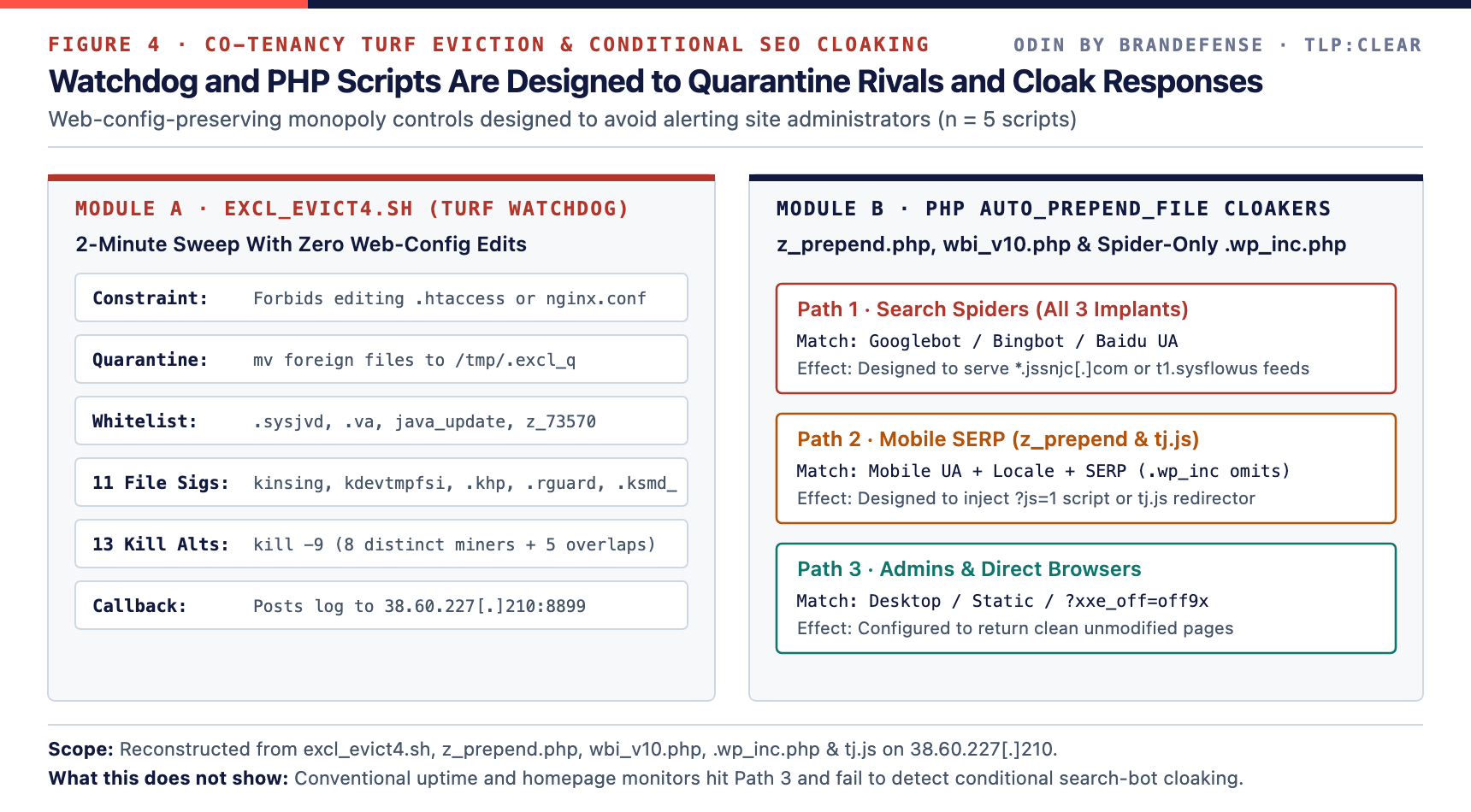
Internet-facing servers often host several competing intruders. A watchdog script is written to kill rival processes and quarantine their files every two minutes, while three PHP implants show spam only to search bots.
A watchdog that avoids breaking the site
Opportunistic botnets such as Kinsing (kdevtmpfsi) often overwrite crontabs and web configuration. The resulting outages bring in incident responders. The script excl_evict4.sh ("Exclusive Eviction v4", 7,153 bytes, 131 lines) takes the opposite approach. It is written around five rules.
| Rule | What the script does |
|---|---|
| 1. No web configuration edits | The header forbids writing to .htaccess or nginx.conf, so site routing keeps working |
| 2. Quarantine, not delete | Foreign binaries and web shells are moved with mv into /tmp/.excl_q, so a wrongly matched web file can be recovered |
| 3. Protect its own files | The sweep skips the operator's files by name (.sysjvd, .va, java_update, z_73570) and by content (38.60.227[.]210, :8899) |
| 4. Match rival names and processes | 11 file name patterns are quarantined; a 13-branch grep -iE sweep runs kill -9 on matching processes |
| 5. Repeat and report | Every 120 seconds it re-scans, checks its own implants are running (selfok) and posts a log to 38.60.227[.]210:8899 |
The match lists are below.
| Match type | Count | Patterns |
|---|---|---|
File quarantine (FOREIGNNAMES) | 11 | .khp, .rguard, .exectest, .java_cache, .app_args, .d, phpupdate, kinsing, kdevtmpfsi, .ksmd_, .UUID_NODEID |
Process kill (kill -9) | 13 | 5 shared with the file list (kinsing, kdevtmpfsi, .ksmd_, .khp, .rguard) plus 8 miner and daemon names (xmrig, minerd, kryptex, nicehash, xmr-stak, sysupdates, kworkerds, crond64) |
For defenders, a folder named /tmp/.excl_q full of other malware is a sign that a second intruder is on the host.
PHP prepend implants that cloak for search bots
On PHP servers, three implants hook the auto_prepend_file setting: z_prepend.php, wbi_v10.php and .wp_inc.php. A JavaScript redirector, tj.js, pairs with them. PHP runs the prepended file before the application on every dynamic request. No Nginx change is needed.
Each implant decides who sees spam. Administrators and direct visitors get the normal page.
| Implant and spam feed | Who triggers it | What it is written to serve |
|---|---|---|
z_prepend.php (th8.jssnjc[.]com/feed.php) | Search-bot user agents (googlebot, bingbot, yandex, baiduspider), or a mobile visitor with a target Accept-Language and a search-engine referrer | Spam HTML inline to bots (302 fallback); a feed.php?js=1 redirect script to mobile search visitors |
wbi_v10.php (th12.jssnjc[.]com/feed.php) | Bot user agents; debug switch ?xxe_debug=test123 | Checks an X-Mode header from the feed and renders the spam payload, skipping static files. It uses only anonymous closures and $GLOBALS['_XP']='V10', so no named functions show up in PHP-FPM function lists |
.wp_inc.php (t1.sysflowus[.]com, th10.jssnjc[.]com) | googlebot and bingbot only; the mobile and language branches were removed; kill switch ?xxe_off=off9x | When the feed returns HTTP 200 and X-Mode: inject, buffers the page with ob_start and inserts spam links before </body> |
Uptime monitors and homepage checks see the clean page. Only a request that looks like a search bot shows the spam. This maps to T1505.003 (Server Software Component).
6. What the Evidence Can and Cannot Show
In short
The server's own scripts show what the operator built and intended. They do not show which targets were reached, whether the agent binary works as described, or who runs the server.
Scripts versus binaries and victims
The memfd, blank command line and PR_SET_MM_EXE_FILE behaviour come from the bootstrapper's comments. The agent binary was not retrieved, so these were not confirmed by disassembly. The GitHub C2 channel rests only on the banner and file name.
Lateral scripts such as ebs_deploy.sh and ahsay_localdep.py describe intended workflows. They do not show that the steps ran on any target, or what state any victim is in now. The SHA-256 values in Chapter 9 were recorded when the files were acquired.
Four explanations for the server
Because the evidence comes from a staging host and not from victims, we weighed four explanations. Without target-side logs or client authorization records, none can be fully excluded. This is an analytical model, not attribution.
| Hypothesis | Fits | Does not fit | Cannot be excluded without target records |
|---|---|---|---|
| 1. Unauthorized intrusion and monetization workbench | Oracle, Zimbra and Ahsay pivots paired with live pool accounts (krxYMRN97D), spam feeds (*.jssnjc[.]com) and rival eviction | Nothing in the staging evidence | Whether specific scripts ran on targets or stayed drafts |
| 2. Authorized red-team exercise | Standard lateral tools (DBMS_UTILITY.EXEC_DDL_STATEMENT@, Invoke-SMBExec, PrintSpoofer, chisel, plink) and target-scoped scripts | Third-party spam feeds, rival quarantine, night-time mining configs, and a note about bricking a CentOS 7 host | Whether a tester copied real monetization scripts as realistic lures |
| 3. Research lab or honeypot | 1,824 records on five open directory listeners on one public VPS | Target-specific Oracle schema and link names, callback ports (8898, 8899, 13574) and custom checksum guards | Whether the server mirrors or sinkholes a captured toolkit |
| 4. Open-source test fixture | Known privilege-escalation archives (pwnkit, dirtyfrag, NtApiDotNet.dll) and standard SQL and PowerShell templates | Custom markers (z_73570_ok, TMPX9, P9ZZ, WALLET=krxYMRN97D) and two-server callback wiring | Whether sub-modules came from unpublished training or shared toolkits |
Hypothesis 1 fits all the staging evidence. The others each meet at least one conflict.
Shared mining pools are not operator infrastructure
The scripts name three bare IP addresses on port 8029, labelled # pool egress (Kryptex naked IPs) in diag.sh. They also name xmr.kryptex[.]network:8029 and gulf.moneroocean[.]stream:443. These are shared public mining-pool front ends used by many unrelated miners. Treat them as policy signals, not as C2.
The operator's own infrastructure is different. It is the workbench (38.60.227[.]210), the check-in host (38.60.252[.]110:8900) and a custom TLS pool proxy (wa.theshyc[.]xyz:5556, which resolves to 38.54.14[.]162).
Of the 24 files that reference krxYMRN97D, most use encrypted Stratum. 8083:/config_t31.json sets tls: true, and six Linux Oracle and Pentaho stagers use TLS Stratum on port 8029. Plaintext Stratum (tls: false) appears only in 8000:/config_template.json and the two inst_nb.ps1 copies. The other 14 files pass the account without a TLS flag.
Direct-IP TLS on port 8029 encrypts the login and sends no server name. Network rules alone will miss it, so pair them with a host-side search for krxYMRN97D. Likewise, blocking all *.r2[.]dev traffic would break developer tools. Tie R2 alerts to the process that made the request.
7. What Defenders Should Do
These steps cover the Linux agents, the Oracle, Zimbra and Windows pivots, and the rival-eviction scripts in Chapters 3 to 5, ordered by urgency.
Within 24 hours
- Block traffic to 38.60.227[.]210 (all listed ports), 38.60.252[.]110:8900 and
wa.theshyc[.]xyz:5556(38.54.14[.]162). - Block the R2 bucket
pub-307c565a487b43c5bee73d21edc4d83b.r2[.]dev, the OSS bucketimagefiles-backup.oss-ap-southeast-7.aliyuncs[.]com,*.jssnjc[.]com,t1.sysflowus[.]comandvjdghqegthea[.]cn[.]com. - Search Linux hosts for
/var/tmp/.systemd/inhibit.lock,/usr/local/lib/.cache-sync/,cache-sync.service,/tmp/.sysjvd/,/tmp/.jvbd/,/tmp/.excl_q/and anyjava_updatefolder.
Within 72 hours
- On Linux, correlate executable
memfd:mappings,/proc/<pid>/exe -> /memfd:*and non-PID-1systemdprocesses with lock inodes in/proc/locks. Excludekthreaddworkers,systemd --userand non-executable shared memory. - Turn on Oracle Unified Auditing of
SQL_TEXT. Alert onDBMS_UTILITY.EXEC_DDL_STATEMENT@,DBMS_SCHEDULER.CREATE_JOB@,TMPX9andCOMPILE JAVA SOURCE, and reviewDBA_DB_LINKS. - Update Zimbra to 10.1.20 or later (CVE-2026-73570) and watch
/opt/zimbra/conf/swatchrcfor thez_73570_okmarker. - Check
php.iniand.user.inifor unexpectedauto_prepend_fileentries. Replay key pages with a Googlebot user agent and with mobile search headers.
Within 7 to 30 days
- Patch
sudo(CVE-2021-3156) andpolkit(CVE-2021-4034), and limitSeImpersonatePrivilegeon Windows service accounts. - Hunt
chiselandplinkreverse tunnels (R:arguments), encoded PowerShell started by Java, files inC:WindowsTempmsedge, a hiddenMSSQL$account, AnyDeskservice.confedits andTaskgmr.ps1. - Limit egress from database and middleware servers to approved destinations. Pair port-8029 alerts with host searches for
krxYMRN97D. - Before keeping permanent IP blocks, re-check who owns the VPS addresses. Cloud addresses get reassigned.
8. Detection Rules
The full rules are in the Detection rules tab. Together they cover five layers: the Linux kernel, the Oracle database, the network perimeter, web and mail servers, and Windows endpoints.
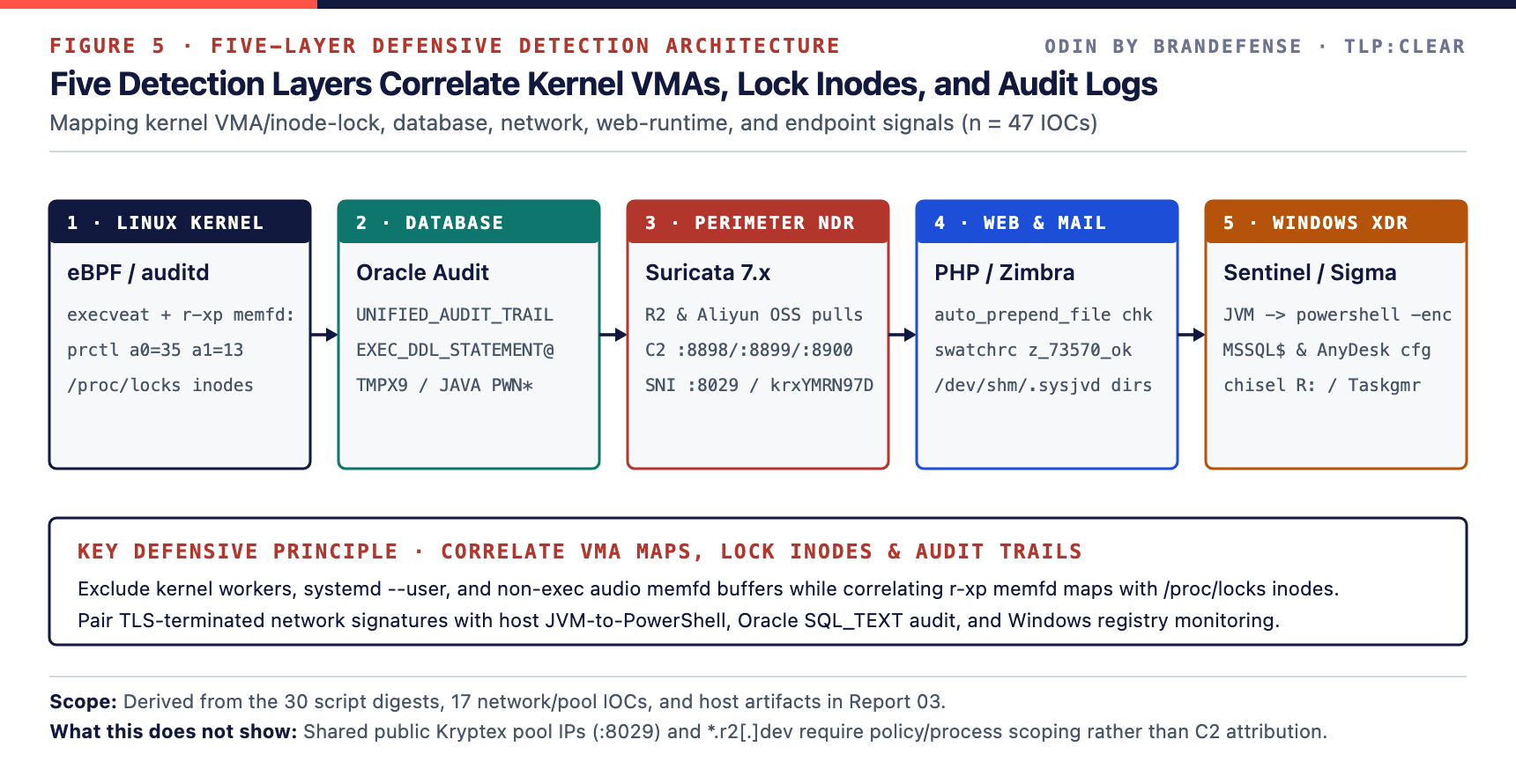
| Rule file | What it catches |
|---|---|
linux_auditd_memfd_and_flock.rules | Linux auditd: memfd_create with execveat, prctl executable spoofing, scoped flock calls, writes under /var/tmp and /dev/shm, and watches on the campaign's persistence paths |
suricata_r2_staging_and_c2_beacons.rules | Suricata 7: 17 signatures for staging downloads, R2 and OSS buckets, C2 polling, cloaking feeds, web-shell PowerShell and Stratum traffic |
sentinel_cross_platform_fileless_and_smb_hunt.kql | Microsoft Sentinel and Defender XDR: Linux and Windows process, registry, file and network hunt across the campaign's artifacts |
sigma_hybrid_fileless_dblink_and_taskgmr.yml | Sigma (6 rules): flock liveness checks, Oracle database-link DDL, Java-spawned encoded PowerShell, fake Edge tasks, hidden MSSQL$ and tunnels, AnyDesk and Task Manager script blocks |
yara_ghc2_eviction_and_prepend_implants.yar | YARA (5 rules): the bootstrapper, the eviction watchdog, the PHP cloakers, Oracle pivot scripts and mining configs |
Linux auditd
The auditd rules need kernel 3.17 or later, for memfd_create and execveat. They load paired 64-bit and 32-bit syscall rules before the file watches, and use -i so a missing optional folder does not stop loading.
| Rule key | Looks for | Notes |
|---|---|---|
odin_r3_execveat, odin_r3_memfd_create | Execution from an anonymous file descriptor | Correlate both on the same PID within 5 seconds; pulseaudio, pipewire and systemd-journald are excluded from memfd_create |
odin_r3_prctl_exe_masquerade | prctl with PR_SET_MM and PR_SET_MM_EXE_FILE | Catches the /proc/<pid>/exe spoof |
odin_r3_flock_syscall | flock calls outside systemd, cron, logrotate and dpkg | Scope alerts to lock files under /var/tmp, /tmp or /dev/shm |
odin_r3_vartmp_staging, odin_r3_shm_staging | File creation and renames under /var/tmp and /dev/shm | On ARM64, drop legacy creat and rename |
| Path watches | cache-sync.service, .cache-sync/, inhibit.lock, .sysjvd/, .jvbd/, .excl_q/, swatchrc, the Pentaho java_update path, /etc/cron.d/, /etc/profile.d/ | Deep paths arm only if the parent folder exists at load time |
The rules deliberately do not filter out unset login IDs. That keeps service daemons such as zimbra, oracle and tomcat in scope. Container runtimes such as runc and crun may need an allowlist if they call memfd_create.
Suricata
Run these at perimeter egress and DMZ boundaries with the HTTP and TLS parsers on. SID 9302607 needs TLS termination in front of backup or middleware web servers, because ahsay_localdep.py uses HTTPS.
| SIDs | Looks for |
|---|---|
| 9302601, 9302602 | Downloads of /deploy_ghc2.sh and /github-c2-agent-dual |
| 9302603 | TLS server name of the R2 payload bucket |
| 9302604, 9302612, 9302613 | pb.sh polling on port 8898: GET /ping/<host>, GET /c/<host>, POST /o/<host> |
| 9302605 | Any outbound connection to 38.60.227[.]210 on the nine workbench ports |
| 9302614 | /GEO_TOP_ check-ins to 38.60.252[.]110:8900 |
| 9302606, 9302608, 9302609 | TLS server names of the cloaking feeds and the tj.js redirector |
| 9302607 | Inbound c=powershell with -enc in a URL query (web-shell pivot) |
| 9302610 | Plain HTTP fetches of /javas/win/ from the Alibaba OSS bucket (wa.bat) |
| 9302611 | TLS to wa.theshyc[.]xyz on port 5556 |
| 9302615 | krxYMRN97D in plaintext Stratum on port 8029 |
| 9302616 | Any connection to the three shared Kryptex pool IPs on port 8029 (policy signal) |
| 9302617 | TLS server name ending kryptex[.]network on port 8029 (policy signal) |
Scope SIDs 9302616 and 9302617 to database, middleware and DMZ subnets. They fire on any Kryptex miner, so confirm with a host-side krxYMRN97D check before linking an alert to this operator.
Microsoft Sentinel KQL
The query looks back 14 days and joins DeviceInfo to label each host's platform. It has four branches.
| Branch | Looks for |
|---|---|
| Process and persistence | Command lines and paths with deploy_ghc2.sh, java_update, .cache-sync, .sysjvd, .jvbd, swatchrc.bak_cve73570, MicrosoftEdgeUpdateCore, Tempmsedge, krxYMRN97D, the wallet prefix, net user MSSQL$, and chisel or plink with R: |
| Hidden account registry | Writes under WinlogonSpecialAccountsUserList naming MSSQL$ or setting 0 |
| AnyDesk tampering | Writes to ProgramDataAnyDeskservice.conf by any process other than AnyDesk.exe |
| Network | Connections to the workbench IPs, the shared pool IPs on 8029, exact campaign host names, the jssnjc[.]com and vjdghqegthea[.]cn[.]com suffixes, kryptex[.]network, and *.r2[.]dev requests from shells, curl, Python or PowerShell |
Each network hit is labelled. Exact campaign hosts are direct hits. Related domain suffixes and R2 traffic from scripting tools are hunt leads, and pool traffic is a policy check. Allowlist approved developer R2 bucket names, not whole processes. If a management tool deploys AnyDesk configuration, allowlist that signed binary by path and hash.
Sigma
The six Sigma rules need Linux process logs, Oracle Unified Auditing with SQL_TEXT, Windows process creation (Security 4688 or Sysmon 1) and PowerShell Script Block Logging (4104).
| Sigma rule | Fires when |
|---|---|
| Linux flock liveness and master cache | A flock command, or any command line, names /var/tmp/.systemd/inhibit, .cache-sync, github-c2-agent-dual or deploy_ghc2.sh |
| Oracle database-link DDL and scheduler pivot | SQL_TEXT contains DBMS_UTILITY.EXEC_DDL_STATEMENT@, DBMS_SCHEDULER.CREATE_JOB@, CREATE OR REPLACE DIRECTORY TMPX9, COMPILE JAVA SOURCE NAMED "PWN, APPS.P9ZZ@ or P9RUN@ |
| Backup or Tomcat JVM spawning encoded PowerShell | java.exe, javaw.exe, bJW.exe, cbssvc.exe or a Tomcat service starts PowerShell with an encoded-command flag |
| Fake Edge update in Temp | schtasks /create with MicrosoftEdgeUpdateCore and WindowsTempmsedge, or edge.exe running from that folder |
Hidden MSSQL$ and reverse tunnels | net user MSSQL$ /add, a SpecialAccountsUserList change naming MSSQL$, or chisel in client mode with R: |
| AnyDesk hash or Task Manager loop in PowerShell | A script block writing ad.anynet.pwd_hash= to AnyDesk service.conf, or containing MicrosoftEdgeUpdateSvc, TaskMgrMaxOpenDuration and KillStartTime together |
Routine SELECT ... FROM dual@<link> queries are common in Oracle. Keep the database rule scoped to the DDL, scheduler, directory and Java calls listed above. On backup appliances, allowlist signed vendor scripts by full path.
YARA
The five YARA rules scan web roots, temporary folders, /usr/local/lib and service-account homes. Size limits keep them off large database files.
| YARA rule | Fires when |
|---|---|
ODIN_R3_Linux_Deploy_GitHubC2_Memfd_Guard | At least three bootstrapper strings appear in a file under 50 KB |
ODIN_R3_Linux_Exclusive_Turf_Eviction_Watchdog | At least three watchdog strings appear in a file under 60 KB |
PHP prepend cloaker rule (ODIN_R3_PHP_AutoPrepend_*) | At least two cloaker strings appear in a PHP file under 30 KB |
ODIN_R3_Oracle_DBLink_DDL_Lateral_Pivot | A high-confidence DDL or Java string appears, or enough supporting and staging strings appear together, in a file under 40 KB, so routine DBA checks do not fire |
ODIN_R3_Campaign_Monetization_Config_And_Stager | A mining config under 200 KB names krxYMRN97D, the Monero wallet or the custom pool proxy |
Hunting in /proc
Live checks need root or CAP_SYS_PTRACE. Link three signals per process: executable memfd mappings, PR_SET_MM_EXE_FILE spoofing and lock inodes in /proc/locks.
Treat as normal the known non-executable shared-memory users (pulseaudio, pipewire, wayland, php-fpm opcache) and post-upgrade daemons. Do not allowlist /proc/<pid>/exe -> /memfd:* by process name alone. An operator can pass a fake name such as pulseaudio to memfd_create.
MITRE ATT&CK mapping
| Tactic | Technique | How the toolkit uses it | Detection |
|---|---|---|---|
| Defense Evasion | T1620 Reflective Code Loading | Agent runs from memfd after deleting its file | auditd memfd_create and execveat; Sigma flock rule |
| Command and Control | T1102.002 Web Service: Bidirectional Communication | GitHub C2 channel, claimed by the banner and file name only | YARA bootstrapper rule; SIDs 9302601 and 9302602 |
| Command and Control | T1105 Ingress Tool Transfer | Payloads from Cloudflare R2, Alibaba OSS and the workbench | SIDs 9302603, 9302605, 9302610; KQL network branch |
| Execution | T1053 Scheduled Task/Job | DBMS_SCHEDULER.CREATE_JOB@ over database links | Sigma Oracle rule; YARA Oracle rule |
| Persistence | T1053.005 Scheduled Task | MicrosoftEdgeUpdateCore task from Tempmsedge | Sigma fake Edge rule; KQL process branch |
| Execution | T1059.001 PowerShell | Encoded PowerShell through the Ahsay web shell | SID 9302607; Sigma JVM rule |
| Persistence | T1505.003 Server Software Component | Ahsay JSP web shell and PHP prepend implants | Sigma JVM rule; YARA cloaker rule |
| Persistence | T1136.001 Create Account: Local Account | Hidden MSSQL$ administrator | Sigma hidden account rule; KQL registry branch |
| Persistence | T1219 Remote Access Software | AnyDesk password hash overwrite | Sigma script block rule; KQL AnyDesk branch |
| Command and Control | T1572 Protocol Tunneling | chisel and plink reverse tunnels | Sigma tunnel selection; KQL process branch |
| Defense Evasion | T1036.005 Match Legitimate Name or Location | MicrosoftEdgeUpdateCore, cache-sync, java_update, fake systemd exe | Sigma rules; auditd path watches |
9. Indicators
The report publishes 47 indicators. The Indicators tab holds the 34 that suit automated feeds: the three operator addresses, the agent binary digest and the 30 script digests. The shared pool addresses, domains, buckets, pool account and wallet appear only in the table below.
| Type | Count |
|---|---|
| Operator IPv4 addresses (workbench, check-in host, pool proxy) | 3 |
| Shared public mining-pool IPv4 addresses (policy signal, not C2) | 3 |
| Domains and cloud buckets | 8 |
| Agent binary SHA-256 | 1 |
| Mining pool account and wallet | 2 |
| Script SHA-256 digests | 30 |
Network, cloud and pool indicators
| Indicator | Ports | Role |
|---|---|---|
| 38.60.227[.]210 | 8000, 8082, 8083, 8093, 8898, 8899, 9001, 9002, 13574 | Main staging server and callback host |
| 38.60.252[.]110 | 8900 | /GEO_TOP_<host> check-in host for the 425-line launchers |
| 38.54.14[.]162 | 5556 | TLS mining pool proxy behind wa.theshyc[.]xyz |
| 135.125.145[.]1, 51.195.127[.]124, 40.160.29[.]14 | 8029 | Shared public Kryptex pool front ends; policy signal only |
pub-307c565a487b43c5bee73d21edc4d83b.r2[.]dev | 443 | Cloudflare R2 bucket serving Linux java_update payloads |
imagefiles-backup.oss-ap-southeast-7.aliyuncs[.]com | 80 | Alibaba OSS bucket serving Taskgmr.ps1, edge.exe and WinRing0x64.sys |
th8.jssnjc[.]com, th10.jssnjc[.]com, th12.jssnjc[.]com | 443 | Spam and cloaking feeds for the PHP implants |
t1.sysflowus[.]com | 443 | Link-injection feed for .wp_inc.php |
ifwetrtjyudfwtuytxdfarxtyt.vjdghqegthea[.]cn[.]com | 443 | JavaScript redirector in tj.js |
wa.theshyc[.]xyz | 5556 | TLS mining pool proxy host name |
d11b12d628615d5eff982e3e312f4c406fde38373eee76bc056be780a9e2e665 | n/a | SHA-256 enforced for github-c2-agent-dual |
krxYMRN97D | n/a | Kryptex pool account in launchers, ebs_*.sh and inst_nb.ps1 |
89v9DbfLx49f6kuziDnExs6BHGyVV2UanFvMhcAU386sDKtT8eBqAwfhsSmxPwYSJT1r5bQyRgbpGHY741w5gMnk4McHFL3.creativejs | n/a | Monero wallet and worker name in config.json and cfg511.json |
Key script hashes
The Indicators tab lists all 30 script digests with path, port, size and line count. The most useful for hunting on hosts are below.
| File | Port | Bytes / lines | SHA-256 |
|---|---|---|---|
/deploy_ghc2.sh | 8082 | 5,796 / 156 | 549d39ceceb57866c0ade97fa02897d29f3141034ff6a02732118324c4ca1ce7 |
/install_user.sh | 8082 | 16,351 / 425 | 73fe311d3323b6bbc9f97854e43eaf33ed45d3122b236675f68350b820640b01 |
/excl_evict4.sh | 8000 | 7,153 / 131 | 2a271c5cbf9bcc000b914c6f1f23cabc168fb98ed1628c555a4e4c416a456cde |
/vsdeploy.sh | 8000 | 1,756 / 46 | d441ac91d579ee400e188e36c678e7a543c24a69a7ce6a4aa290bb9c4098aeba |
/persist.sh | 8000 | 1,617 / 47 | c9269bd3c242a96a9bbe4c61df6d8f3473a343e9bbf3a5a91159f0f6baa9bc91 |
/z_prepend.php | 8000 | 3,148 / 58 | dbf856873b8142dac2d29118d60532f6d7bdafd8eb8763e9e149b9ef46ec832d |
/wbi_v10.php | 8000 | 3,655 / 74 | a7423702c637bd84d96d69d14b1bbefacebb3bfcbecac44b2990c5f59ab4f720 |
/.wp_inc.php | 8082 | 5,889 / 137 | dceb0d07a78ccecd98d7e3b3660a9aef82b580d9ffcbc44d5c0c40e45bdc0ca2 |
/win/Taskgmr.ps1 | 8082 | 5,443 / 151 | 481728a7c9c4c02be07051d9c1958d902ea6397ebb8952ab83944818e3d25d21 |
/ops.sh | 8000 | 3,308 / 72 | 525b7b194bede5a194204bdb78816b0db64b75ff9593e6d2ab3a736da79f44f6 |
Lateral orchestrators such as ebs_deploy.sh and ahsay_localdep.py run from the staging server or a foothold, not on the target. Hunt them through network traffic, database audit logs and the target artifacts below, rather than by file hash.
Artifacts on target hosts
| Artifact | Platform | Source script | Meaning |
|---|---|---|---|
/var/tmp/.systemd/inhibit.lock and /usr/local/lib/.cache-sync/ | Linux | deploy_ghc2.sh | Liveness lock and master ELF cache, guarded by cache-sync.service |
/opt/zimbra/conf/swatchrc.bak_cve73570 and z_73570_ok | Linux (Zimbra) | ops.sh | Backup and lockout marker written when swatchrc is changed |
Directory TMPX9, Java sources PWNX and PWNZ, function APPS.P9ZZ | Oracle DB / EBS | ebs_deploy.sh, ebs_zz.sh | Remote /tmp mapping and Java command wrappers |
C:WindowsTempmsedgeedge.exe and task MicrosoftEdgeUpdateCore | Windows | ahsay_localdep.py, inst_nb.ps1 | Disguised SYSTEM task and staging folder, watched by Taskgmr.ps1 |
MSSQL$ with SpecialAccountsUserList = 0 | Windows | hera_adduser.ps1 | Hidden local administrator |
ad.anynet.pwd_hash in C:ProgramDataAnyDeskservice.conf | Windows | hera_setpwd.ps1 | Operator password hash written before AnyDesk restarts (value withheld) |
Withheld: victim domains, database schema names, internal database addresses, application user names, the AnyDesk password hash and the agent's per-user install path.
10. Scope and Limits
- Window. The workbench was observed from 13 to 16 November 2026. The findings describe its contents in that window.
- Staging is not execution. The scripts show what the operator built and configured. We did not see any step run on a target system.
- The agent binary was not retrieved. Its hiding behaviour comes from the bootstrapper's comments. Its GitHub C2 channel rests on a banner and a file name.
- Callback ports are unverified. Ports 8898, 8899, 9001, 13574 and 8900 are named in scripts. Whether they were listening was not checked.
- Who runs it is open. An unauthorized intrusion workbench fits the evidence best, but a red team, a research mirror or a test fixture cannot be fully excluded.
- Shared pools are not C2. The three port-8029 pool addresses serve many unrelated miners.
- Public sources are a snapshot. The zero-hit result covers six indicators in five public sources as of 16 November 2026, not private feeds or later reports.
- Rule testing. Every published rule file loads without errors in its engine (Suricata 7.0.12, YARA-X, pySigma and Microsoft's Kusto.Language analyzer, checked on 20 November 2026). The rules were not replayed against live traffic, so test and tune them in your own environment before production use. The auditd rules were checked against auditctl syntax.
11. Sources
- Linux man-pages.
memfd_create(2). https://man7.org/linux/man-pages/man2/memfd_create.2.html (verified 18 November 2026) - Linux man-pages.
flock(2). https://man7.org/linux/man-pages/man2/flock.2.html (verified 18 November 2026) - Linux man-pages.
prctl(2),PR_SET_MM_EXE_FILE. https://man7.org/linux/man-pages/man2/prctl.2.html (verified 18 November 2026) - Oracle. Database PL/SQL Packages and Types Reference,
DBMS_UTILITY. https://docs.oracle.com/en/database/oracle/oracle-database/19/arpls/DBMS_UTILITY.html (verified 18 November 2026) - NIST NVD. CVE-2026-73570 Detail. https://nvd.nist.gov/vuln/detail/CVE-2026-73570 (verified 18 November 2026)
- Zimbra. Security Advisories (CVE-2026-73570, fixed in 10.1.20). https://wiki.zimbra.com/wiki/Zimbra_Security_Advisories (verified 18 November 2026)
- PHP Manual. Core
php.inidirectives,auto_prepend_file. https://www.php.net/manual/en/ini.core.php#ini.auto-prepend-file (verified 18 November 2026) - MITRE ATT&CK. T1620 Reflective Code Loading. https://attack.mitre.org/techniques/T1620/ (verified 18 November 2026)
- MITRE ATT&CK. T1102.002 Web Service: Bidirectional Communication. https://attack.mitre.org/techniques/T1102/002/ (verified 18 November 2026)
- MITRE ATT&CK. T1105 Ingress Tool Transfer. https://attack.mitre.org/techniques/T1105/ (verified 18 November 2026)
What is…?
Short explanations of the tools and families named in this study.
What is Zimbra?
Zimbra Collaboration is an email and collaboration suite. Its internet-facing servers are frequent targets of exploitation.
More about ZimbraMining serviceWhat is Kryptex?
Kryptex is a commercial cryptocurrency mining service and pool. Its miner and pool accounts appear in cryptojacking kits.
More about KryptexOffensive toolWhat is PrintSpoofer?
PrintSpoofer is a public Windows privilege escalation tool that abuses impersonation privileges to gain SYSTEM.
More about PrintSpooferRemote access implantWhat is VShell?
VShell is a remote access implant and C2 panel that talks over WebSocket and other transports. It is popular with Chinese-speaking operators.
More about VShellFrequently asked questions
What was on the server?
Each port had its own job. Port 8000 held the main toolkit, and port 9002 mirrored it, probably as a fallback if 8000 was blocked. Port 8082 held the Linux agent loader and the Windows tools. Port 8083 held the Oracle scripts, and port 8093 stored scan results and logs.
How does the Linux agent hide?
The most carefully built file is a root bootstrapper called deploy_ghc2.sh. It downloads an agent named github-c2-agent-dual, which was not retrieved. The author's own comments in the script explain how the agent hides:
How does it move inside a network?
Thirty middleware scripts target the systems that hold business data. Twenty-six are aimed at Oracle Database, RAC and E-Business Suite. The Oracle scripts use database links, the trusted connections that let one database query another. Through a link, a script can create folders, compile Java code and schedule operating-system jobs on a database the attacker cannot reach directly.
Why does it fight other malware?
Popular servers attract several intruders, and they compete for CPU. A watchdog script, excl_evict4.sh, is configured to run every two minutes. It is written to kill 13 rival process patterns, such as xmrig and kinsing, and moves files matching 11 rival names into a quarantine folder, /tmp/.excl_q.