


1. Executive Summary
In short
In a two-week window, with data up to 15 November 2026, Odin by Brandefense analysed 7,934 feed-labeled C2 endpoint records on 5,889 hosts. C2 fleets reuse a few TLS stacks, hosting providers and certificate names. One JARM covers 93.9% of Brute Ratel C4 records, and two certificate names cover 82.2% of ARTEX. Yet 1,876 records are benign collisions: MySQL auto-certificates, hosting panels and a vendor demo lab. Require two independent non-ASN signals before any automatic block.
Command-and-control (C2) servers try to look ordinary. They listen on web ports, present certificates that name trusted brands or default appliances, and sit on cheap hosting. Threat feeds that label these servers often catch harmless systems in the same net. This report shows both sides: the camouflage patterns that defenders can hunt, and the collisions that turn into false positives.
A few TLS stacks and hosting providers dominate several C2 fleets.
One Nginx reverse-proxy JARM covers 93.9% of feed-labeled Brute Ratel C4 records (506 of 539). Single hosting providers hold up to 98.8% of a family. The same reverse-proxy JARM also appears on commercial proxy nodes and a vendor simulation lab, so a JARM match alone is not enough to block.
ARTEX reuses two certificate names across 82.2% of its fleet.
Two repeated certificate names, withheld because they may belong to third parties, cover 412 of 501 ARTEX endpoints. Default appliance names are harder to read. Droplets presenting the Ubiquiti name unifi.local show no overlap with the hosts that run CyberStrikeAI's four-port layout, so that name is a lead for review.
Most port-3306 Daybreak hits are ordinary MySQL servers, not C2.
Of 1,701 Daybreak records, 1,592 sit on TCP 3306 and carry MySQL startup certificates. Across 59 Daybreak hosts we examined, candidate secondary C2 appeared on 26.7% of non-database candidates but only 8.0% of port-3306 hosts. Separately, 99.6% of MITRE Caldera records sit inside one security vendor's network.
Three Decisions for Leaders
- Require two independent non-ASN signals before an automatic block. Hold a lone certificate-name or reverse-proxy JARM match at analyst review. Block only when it is backed by a verified self-signed certificate, a framework-specific TLS stack, a C2 port or a multi-port layout.
- Treat appliance-certificate alerts as enrichment, and add TLS 1.3 coverage. Check the URI or endpoint context behind external Ubiquiti and non-VoIP Mumble certificate alerts over TLS 1.2. Pair TLS 1.3 rules on port 31337 with endpoint data.
- Restrict workstation egress to C2 implant, operator and database ports. Block direct outbound connections from user segments to TCP 1337, 3306, 4321, 5001 to 5003, 8001, 8082, 8888, 9999, 31337 and 43211 unless there is a business need.
The Study in Numbers
| Number | What it is |
|---|---|
| 7,934 | Feed-labeled C2 endpoint records on 5,889 IPv4 hosts, in 81 countries and 697 BGP autonomous systems (657 hosting organizations) |
| 93.9% | Brute Ratel C4 records (506 of 539) that share one Nginx reverse-proxy JARM |
| 82.2% | ARTEX endpoints (412 of 501) that present one of two repeated certificate names |
| 72.2% / 73.7% | DarkSword (174 of 241) and SuperShell (126 of 171) records that share one TLS stack |
| 26.7% / 8.0% | Examined Daybreak hosts with a candidate secondary C2: non-database candidates (4 of 15) versus port-3306 MySQL hosts (2 of 25) |
| 1,831 + 45 | Collision-prone records: 239 vendor lab records, 1,592 MySQL certificates on TCP 3306, and 45 hosting-panel records |
| 3 + 29 | High-signal patterns and review patterns in the indicator set, all published at network level |
How to use this report.
Security leaders can read Chapter 1, Chapter 7 and Chapter 10. Detection engineers should start with the JARM analysis in Chapter 3, the certificate taxonomy in Chapter 4 and the rules in Chapter 8. Network teams can use the checklist in Chapter 7.
2. How C2 Hides in Ports
In short
C2 frameworks either blend into web ports such as 443 and 8080 or bind their own listener and admin ports. The raw feed also mixes real C2 with databases, hosting panels, home routers and dual-use tools.
The data set
Odin by Brandefense analysed 7,934 endpoint records. Each record is an IP, a port and a family label from upstream threat feeds. The feeds label 5,256 records confirmed, 2,454 suspected and 224 as management-port candidates (21 Daybreak and 203 AdaptixC2). These are the feeds' labels, not our verdicts.
Most records are single snapshots. For 7,700 of the 7,934 records (97.1%), the first-seen and last-seen times are the same. Counts in this report are therefore counts of records, not of deployments or growth.
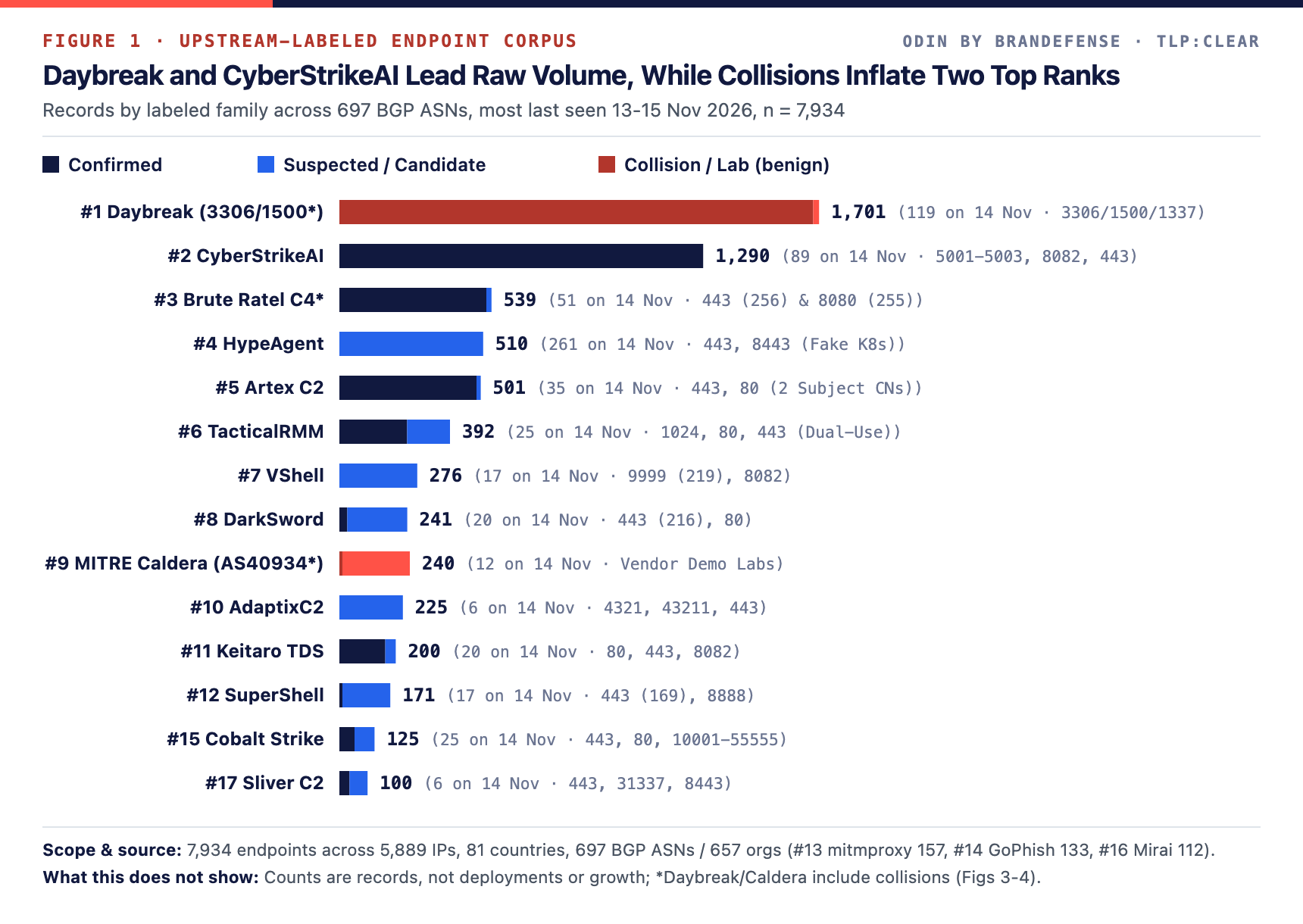
Daybreak tops the raw ranking with 1,701 records, and MITRE Caldera sits ninth with 240. Both ranks are inflated by benign collisions, which Chapter 5 takes apart.
Four port strategies
Frameworks fall into four port strategies. Using a port that does not match the protocol is MITRE ATT&CK T1571, Non-Standard Port.
| Port strategy | Ports | Frameworks and endpoint counts | What it means for defenders |
|---|---|---|---|
| Web and alt-web blending | TCP 443, 8080, 8443, 80 | Brute Ratel C4 (256 on 443, 255 on 8080, 3 with TLS on 80), ARTEX (421 on 443), DarkSword (216 on 443), SuperShell (169 on 443), HypeAgent (118 on 443) | Passes web proxies easily, but the TLS stack stays visible to internet-wide JARM fingerprinting |
| Four-port orchestration | TCP 5001, 5002, 5003, 8082 | CyberStrikeAI (237 endpoints on each port, 236 hosts with all four, plus 156 on 443) | Operator UI, API, WebSocket stream and agent listener on one host make a distinct four-port fingerprint |
| High-port implant and operator listeners | TCP 9999, 8888, 4321, 43211, 31337, 1337, 8001 | VShell (219 on 9999), AdaptixC2 (82 on 4321, 11 on 43211), Sliver (20 operator gRPC on 31337; default implant mTLS uses 8888), Daybreak (13 on 1337, 1 on 8001), Cobalt Strike (10001 to 55555) | Avoids conflict with a decoy site on 443, but stands out in endpoint socket logs |
| Admin, RMM, panel and database overlap | TCP 1024, 3306, 1500, 1501 | TacticalRMM (313 on 1024), Daybreak (28 on 1500, 17 on 1501, 1,592 raw hits on 3306) | Collides with RMM, hosting-panel and MySQL ports, so it causes false positives without application-layer checks |
Watch both web ports.
Brute Ratel C4 records span 283 hosts, split evenly between TCP 443 (256 endpoints) and TCP 8080 (255 endpoints). Both ports appear together on 252 hosts. A TLS inspection policy that covers only port 443 misses half of these channels.
What the raw feed contains
Not every record is C2. The table below splits the 7,934 records by function.
| Slice | Records | Share | What is inside |
|---|---|---|---|
| C2 and offensive tools | 7,337 | 92.5% | Teamservers, plus 1,316 open-source AI red-team records (CyberStrikeAI 1,290, PentAGI 26), 525 dual-use RMM and phishing records (TacticalRMM 392, GoPhish 133) and 448 scanner and OAST records |
| IoT botnets and home routers | 203 | 2.6% | Mirai (112), Hajime (49), Mozi (42); 18 records on one telecom network share a subscriber certificate name that likely reflects router defaults |
| Traffic distribution (TDS) | 200 | 2.5% | Keitaro redirectors, including 45 CN=SolidityGameServer records on 20 hosts |
| Malware panels, scanners and ASM | 194 | 2.4% | Malware panels (151, including Emotet 37 and AdaptixC2 22), OpenVAS (28), Daybreak candidates (14) and 1 attack-surface node |
The scanner and OAST group covers mitmproxy (157), ARL (99), Burp (72), Nessus (46), Interactsh (27), Acunetix (24) and reNgine (23). With the 28 OpenVAS records counted under scanners elsewhere, the feed holds 476. These are dual-use tools, not proof of hostile use.
Some records need extra care. 180 records sit on consumer ISP networks (136 IPs across 43 networks); their addresses and certificate names are withheld. Another 54 records (0.7%, including 22 of 125 Cobalt Strike records) are flagged as contested.
3. TLS Stack and Hosting Monocultures
In short
A single JARM fingerprint covers up to 93.9% of a C2 family, and a single hosting provider up to 98.8%. But generic reverse-proxy JARMs also appear on commercial proxies and labs, so pair every JARM match with a protocol or host signal.
What JARM measures
JARM sends ten crafted TLS ClientHello messages and hashes the server's replies into a 62-character fingerprint. Servers with the same TLS library and configuration produce the same JARM. That makes it good for clustering, but it describes the TLS stack, not the program behind it.
Hosting concentration
The records span 697 BGP autonomous systems and 657 hosting organizations. Three providers spread their records across sibling networks.
| Hosting organization | Records | Networks | Main families |
|---|---|---|---|
| PEG TECH INC | 1,144 (6 ASNs) | AS398823 (947), AS54600 (186), 4 others (11) | 947 CyberStrikeAI on AS398823; 175 ARTEX on AS54600 |
| Shenzhen Tencent | 832 (2 ASNs) | AS45090 (800), AS132203 (32) | 288 HypeAgent; 399 Daybreak |
| Datacamp Limited | 283 (2 ASNs) | AS212238 (275), AS60068 (8) | 277 Brute Ratel C4 (269 on AS212238, 8 on AS60068) |
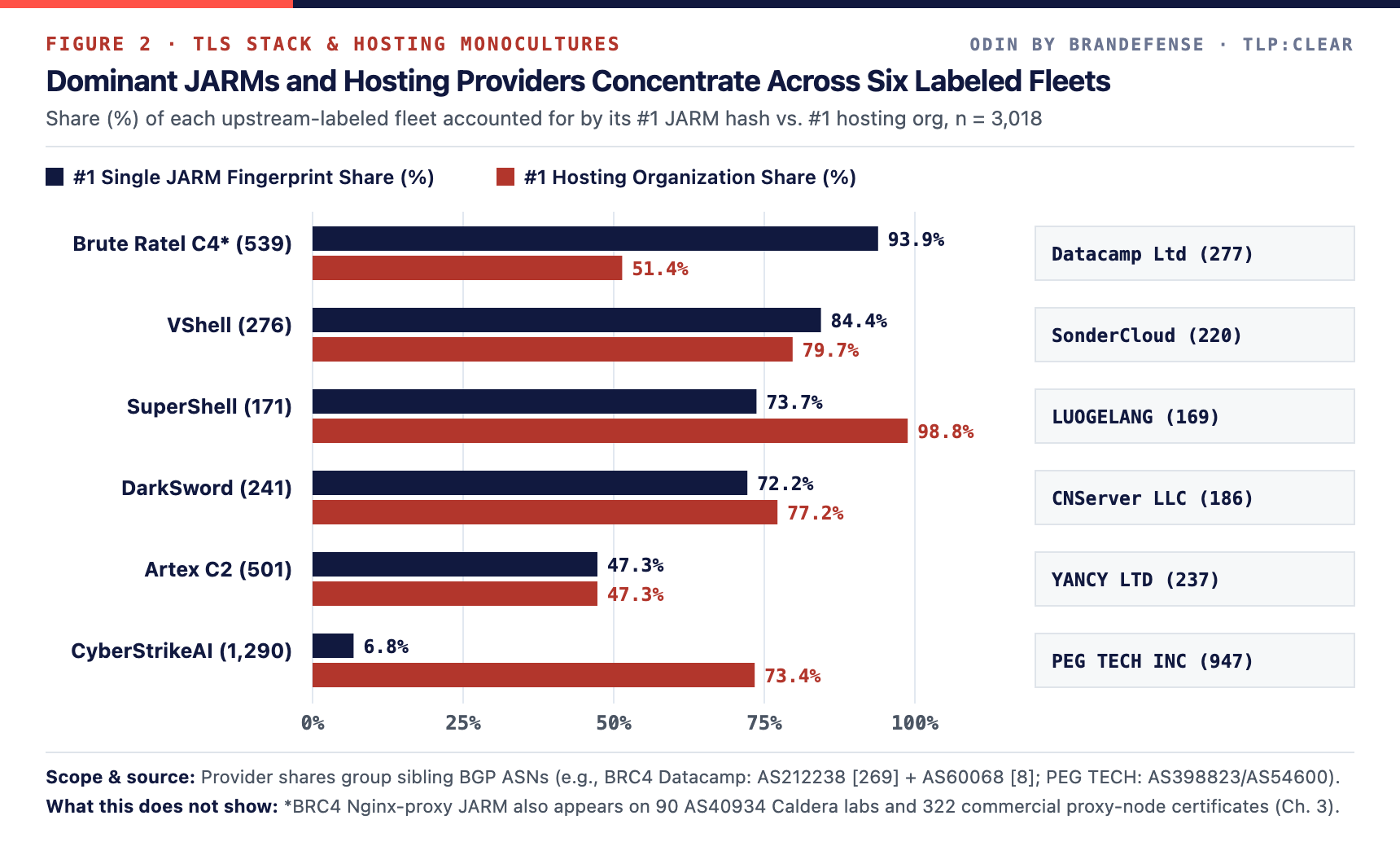
Six families compared
| Framework (records / IPs) | Top JARM share | Top hosting organization | Note |
|---|---|---|---|
| Brute Ratel C4 (539 / 283) | 93.9% (506) | Datacamp Limited (277, 51.4%) | Datacamp, M247 (95) and Cogent (75) host 82.9% (447). The JARM is a generic proxy profile; see below |
| VShell (276 / 270) | 84.4% (233) | SonderCloud Limited (220, 79.7%) | Go crypto/tls RSA listener on TCP 9999 for 219 of 276 endpoints (AS133199) |
| SuperShell (171 / 171) | 73.7% (126) | LUOGELANG FRANCE (169, 98.8%) | 170 of 171 suspected; almost all on AS135097, TCP 443 |
| DarkSword (241 / 225) | 72.2% (174) | CNServer LLC (186, 77.2%) | 213 suspected, 28 confirmed; same JARM as SuperShell, on AS7488 |
| ARTEX (501 / 500) | 47.3% (237) | YANCY LIMITED (237, 47.3%) | Two turnkey blocks, YANCY AS138415 (237) and PEG TECH AS54600 (175), hold 82.2% |
| CyberStrikeAI (1,290 / 528) | 6.8% (88) | PEG TECH INC (947, 73.4%) | Plain HTTP on the four-port layout dilutes the JARM share; 73.4% sit on PEG TECH AS398823 |
The full JARM values are below, for hunting.
| Cluster (matching records) | JARM |
|---|---|
| Brute Ratel C4 (506 of 539) | 2ad2ad0002ad2ad00042d42d00000000f78d2dc0ce6e5bbc5b8149a4872356 |
| VShell (233 of 276) | 3fd21b20d00000021c43d21b21b43de0a012c76cf078b8d06f4620c2286f5e |
| DarkSword and SuperShell | 21d14d00021d21d00042d43d00000091f9827a8676a9d9f27d421962a09b5d |
| ARTEX, certificate name A (withheld) (237 of 501) | 29d29d00029d29d00042d43d00041dd469afa8cfbe5e42c631eb3fc55d6787 |
| ARTEX, certificate name B (withheld) (173 of 501; 173 of its 175 records return a JARM) | 3fd3fd16d3fd3fd21c42d42d00000078e356c38fb85055d97a8bed930c8956 |
| CyberStrikeAI (88 of 1,290) | 3fd3fd0003fd3fd00042d42d0000002059a3b916699461c5923779b77cf06b |
The Brute Ratel C4 JARM is not unique
Within the 539 Brute Ratel C4 records, 322 (59.7%, on 162 IPs across 50 city names) carry certificates that name nodes of a commercial proxy service. The pattern is <city>-rack<NNN>.nodes.<proxy domain>, with the domain withheld. Most other named certificates follow <city><NNN> and expose both 443 and 8080 across Datacamp, M247 and Cogent.
The same 2ad2ad...a4872356 JARM also appears on 90 vendor-lab MITRE Caldera records across 85 hosts, 4 ARTEX records and 3 TacticalRMM records. A rule that keys on reverse-proxy behaviour can confuse a commercial VPN or proxy exit network with Brute Ratel redirectors. We treat this JARM as a generic proxy profile and hold these endpoints at review, with addresses withheld.
DarkSword and SuperShell share one stack
"DarkSword" is a family label that comes from an upstream threat feed. It covers 241 records, 88.4% of them suspected. Google Threat Intelligence Group (GTIG) has documented an iOS exploit kit of that name. We did not check these endpoints against GTIG's published indicators, so the label is not attribution.
One confirmed DarkSword panel on AS45102, port 443, presents a certificate name (withheld). Of the 241 DarkSword records, 174 (72.2%, all on CNServer AS7488) share JARM 21d14d...62a09b5d. On SuperShell, 126 of 171 records (73.7%, all on LUOGELANG AS135097) share the identical JARM, for 300 records in total.
Most of these records are suspected (213 of 241 DarkSword, 170 of 171 SuperShell), and they split cleanly by provider. The shared JARM fits either a shared C2 bundle or a provider's standard OS and Nginx image.
4. Certificate Camouflage
In short
A self-made TLS certificate can claim any name, and no authority checks it. Certificate names in the feed fall into three C2 patterns (portal lures and appliance defaults, framework defaults, and repeated campaign names) plus one collision group.
Under RFC 5280, an operator who builds a custom certificate can write any Common Name (CN) or Organization into it. The feed records the subject CN and the JARM. It does not record certificate hashes, serial numbers or issuers. Repeated CN counts therefore show naming and template reuse, not shared private keys or verified self-signatures. Creating such certificates is MITRE ATT&CK T1587.003, Develop Capabilities: Digital Certificates.
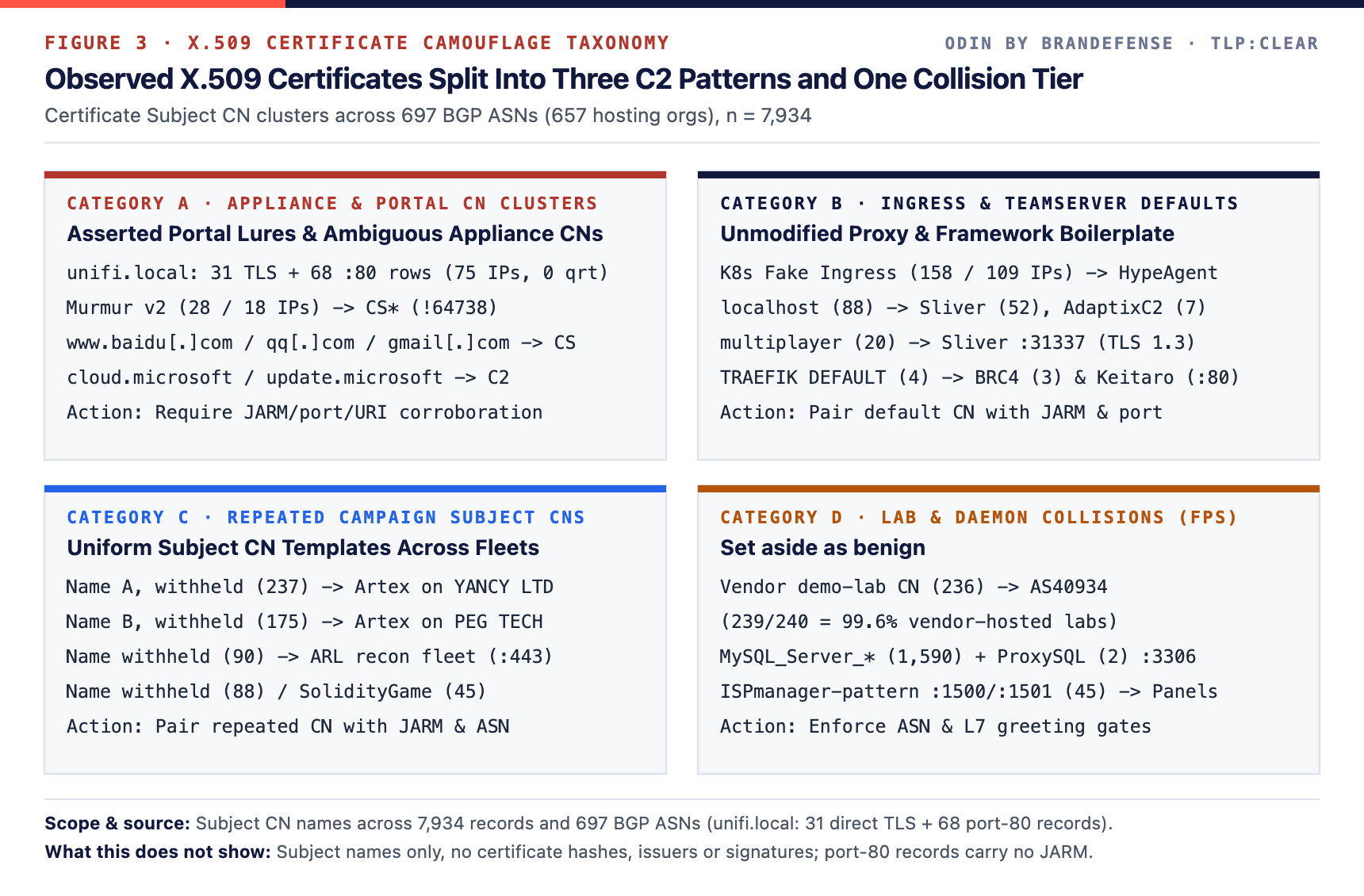
Category A: appliance, VoIP and portal names
The unifi.local cluster. 99 CyberStrikeAI-labeled records on 75 hosts carry CN=unifi.local, the default name of a Ubiquiti console. Of these, 92 (92.9%) sit on DigitalOcean (AS14061).
| Part of the cluster | Records | Detail |
|---|---|---|
| Direct TLS | 31 | 29 on TCP 443, 1 on 7443, 1 on 8443; generic Nginx or UniFi JARM 29d29d...6c007d93 |
| Port-80 records with no JARM | 68 | Across 23 dual-port droplets and 45 hosts without a matching TLS record |
| Non-DigitalOcean records | 7 | Including 5 consumer or telecom hosts; same JARM as genuine UniFi OS consoles |
None of the 75 hosts expose CyberStrikeAI's four-port layout (5001 to 5003 and 8082). DigitalOcean droplets also host real UniFi controllers. CN=unifi.local is therefore an enrichment signal for review, and these addresses are withheld.
The Murmur cluster. 28 Cobalt Strike-labeled records on 18 hosts present CN=Murmur Autogenerated Certificate v2, the default of the Mumble voice server. That is 22.4% of the Cobalt Strike slice (125 endpoints on 87 hosts). The records use 19 non-default ports, led by 10010 (7), 10002 (3) and 10004 (2), and none uses the Mumble default 64738.
Fifteen of the 28 records sit in one OVH /24 network (AS16276), across consecutive ports 10001 to 10025, with 9 ports on one IP. The 28 records also show 5 different JARMs. This layout fits multi-tenant game-voice hosting. We hold Murmur certificates at review unless a separate C2 signal appears.
Portal names. Endpoints in four families present the names of major web and update portals, outside the brand owner's network.
| Asserted CN | Family | Endpoints | Hosting |
|---|---|---|---|
www.baidu[.]com | Cobalt Strike | 5 | Shenzhen Tencent, CNServer, Alibaba |
qq[.]com | Cobalt Strike | 4 | Shenzhen Tencent |
gmail[.]com | Cobalt Strike | 1 | Privex Inc. (AS210083) |
baidu[.]com | HypeAgent | 2 | Shenzhen Tencent |
cloud.microsoft | CyberStrikeAI | 1 | Cloudie Limited (AS906) |
update.microsoft[.]com | AdaptixC2 | 1 | Alibaba (AS37963), TCP 4321 |
Category B: cloud ingress and framework defaults
Fake Kubernetes ingress certificates.
Across 510 suspected HypeAgent endpoints (171 hosts), 288 (56.5%) sit on Shenzhen Tencent Cloud. A sub-cluster of 158 endpoints (109 hosts, 31.0% of HypeAgent) presents CN=Kubernetes Ingress Controller Fake Certificate. It sits mainly on Microsoft Azure (AS8075, 48 endpoints, 30.4%), DigitalOcean (19, 12.0%) and Alibaba (19, 12.0%). Smaller shares are on AWS (11), Hetzner (7), FPT Telecom (3) and ALEXHOST (2).
Every unconfigured Kubernetes ingress-nginx deployment shows this exact name. On 443 or 8443 it is not enough on its own; it needs a C2 port or co-hosting signal.
Teamserver and proxy defaults.
| CN | Endpoints | Where it appears |
|---|---|---|
CN=localhost | 88 on 82 hosts | Sliver (52 of 100), PentAGI (8), AdaptixC2 (7), OpenVAS (5) |
CN=multiplayer | 20 | All Sliver operator gRPC listeners on TCP 31337; all 16 that answer JARM negotiate TLS 1.3 only, as Sliver's mTLS default does |
CN=TRAEFIK DEFAULT CERT | 4 | None on 8080 or 8443. Three Brute Ratel C4 records and 1 Keitaro record on DigitalOcean (AS14061) serve live TLS on TCP port 80 |
TLS on port 80 is a protocol mismatch worth hunting, because ordinary web servers speak plain HTTP there.
Category C: repeated campaign names
Industrial-scale deployments reuse fixed certificate names across whole provider blocks.
| CN | Family | Endpoints | Hosting |
|---|---|---|---|
| certificate name A (withheld) | ARTEX | 237 | YANCY LIMITED (AS138415) |
| certificate name B (withheld) | ARTEX | 175 | PEG TECH INC (AS54600) |
| an ARL certificate name (withheld) | ARL recon | 90 | TCP 443 |
| a CyberStrikeAI certificate name (withheld) | CyberStrikeAI | 88 | AROSSCLOUD INC. (AS400619) |
SolidityGameServer | Keitaro TDS | 45 on 20 hosts | Ports 8082, 8081 and 443 |
ARTEX has 501 endpoints on 500 hosts, and its two names cover 412 of them (82.2%). Confirming that these endpoints share a private key or a self-signature needs certificate thumbprints, which the feed does not carry.
5. Benign Collisions That Inflate the Feed
In short
Raw feed volume is not adversary volume. Most port-3306 Daybreak records are MySQL servers, ports 1500 and 1501 match a hosting panel, and 99.6% of Caldera records sit in a security vendor's network.
Two large clusters needed testing before any defensive advice: 1,701 Daybreak records and 240 MITRE Caldera records.
Daybreak and MySQL
Daybreak ranks first by raw count with 1,701 records. Of these, 1,592 (93.6%) sit on TCP 3306. They carry 1,590 auto-generated MySQL_Server_* certificates and 2 ProxySQL certificates. MySQL 5.7.44 (365) and 8.0.45 (148) lead the versions.
Modern MySQL servers (5.7.5 and later, 8.0 and 8.4) can create their own CA and server certificate at startup when the auto_generate_certs conditions are met. Any feed that labels "self-signed TLS on an unusual port" will catch them.
To test this, we compared the feed labels on other ports of 59 Daybreak hosts, drawn from three groups. A host counts as a candidate secondary C2 when another port carries a C2 family label. Every such label in this set is candidate-level.
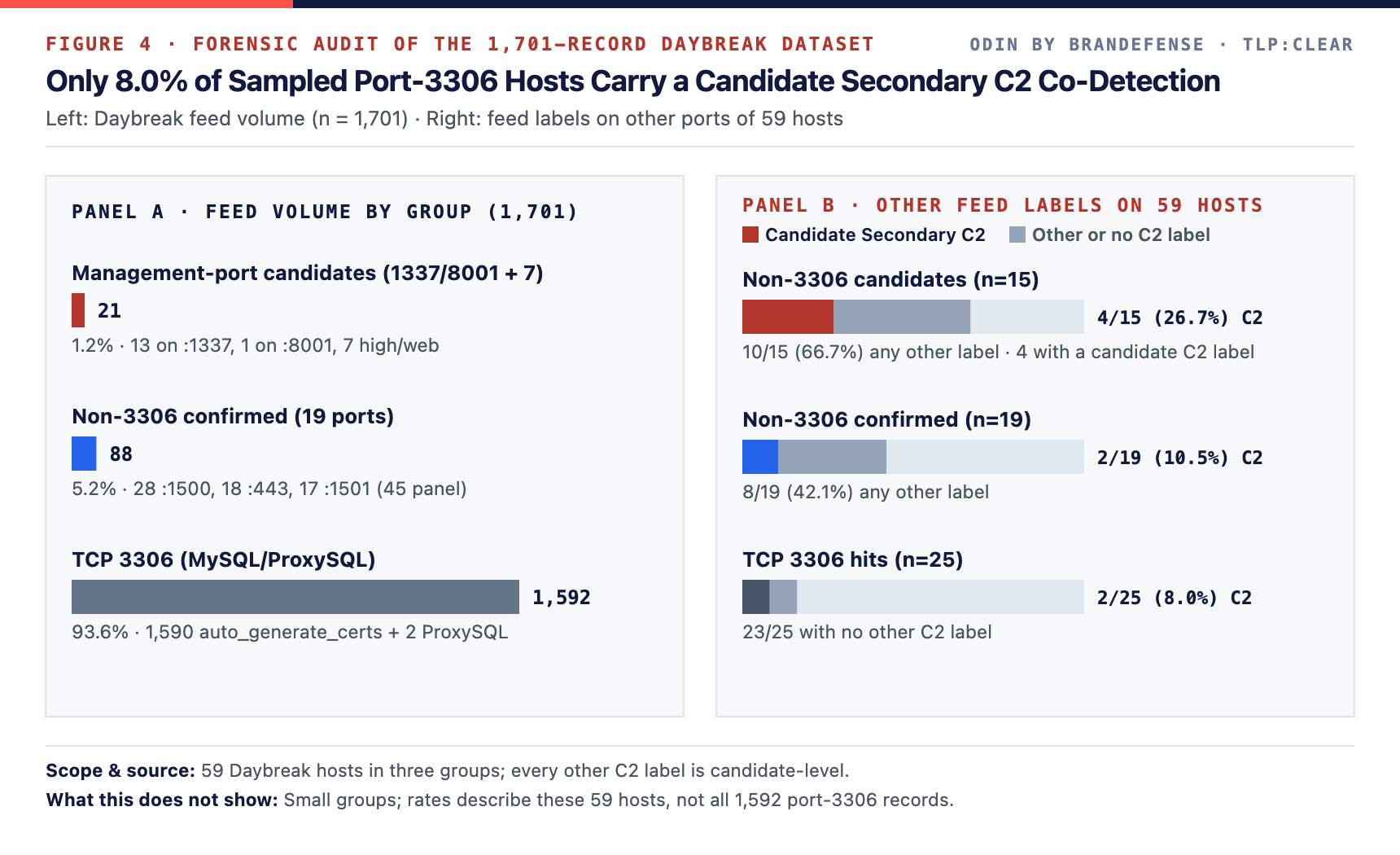
| Daybreak group | Records (port split) | Hosts examined | Candidate secondary C2 | Any other hit |
|---|---|---|---|---|
| Non-3306 candidates | 21 (13 on 1337, 1 on 8001, 7 on other ports) | 15 | 4 of 15 (26.7%) | 10 of 15 (66.7%) |
| Non-3306 confirmed | 88 (28 on 1500, 18 on 443, 17 on 1501, 25 on 16 other ports) | 19 | 2 of 19 (10.5%) | 8 of 19 (42.1%) |
| TCP 3306 | 1,592 (1,590 MySQL, 2 ProxySQL) | 25 | 2 of 25 (8.0%) | 4 of 25 (16.0%) |
What sat next to Daybreak in each group:
- Non-3306 candidates. Four hosts carried candidate VShell (8084 and 8887), Sliver (8080), Metasploit (33970, SSH banner only) or ARTEX and JavaChains (8787 and 8011). Three carried ARL or AutoHunter recon hits. Three showed only Daybreak itself.
- Non-3306 confirmed. Two hosts on 443 carried candidate Ramnit or ARTEX labels. Four of the 8 raw hits were Daybreak's own labels on ports 1500 and 1501.
- TCP 3306. Two hosts carried candidate VShell or Sliver next to open MySQL, along with GoWebSSH or GoPhish. Two matched only Acunetix or Nessus scanners. The other 21 (84.0%, typically MySQL 8.4) showed no other detection.
Ports 1500 and 1501: a hosting panel
All 8 examined hosts on ports 1500 and 1501 returned "Authorization" on 1500, and 4 of 8 exposed nginx on 1501. This matches the ISPsystem ISPmanager shared-hosting control panel, which binds web listeners to those ports and redirects to /ispmgr. The feed holds 45 such records. ISPConfig and FASTPANEL also appear.
MITRE Caldera in a vendor lab
The 240 MITRE Caldera records sit on ports 443 (118), 80 (114), 16018 (5) and 8080 (3). Of these, 236 present one vendor demo-lab certificate name (withheld), and 3 present 192.168.100.4. Routing data puts 239 of 240 (99.6%) inside one security vendor's network, AS40934, with one external DigitalOcean instance.
The pattern is consistent with a Fortinet demo lab, a benign collision. Exclude vendor-hosted demo labs like this from automatic WAN block lists, but keep internal callback monitoring.
6. What Passive Monitoring Misses
In short
Internet-wide TLS data describes server configuration, not victim compromise. TLS 1.3 hides the certificate, JARM hides the backend behind a proxy, and many C2 families are also normal security tools.
TLS 1.3 hides the certificate.
Under TLS 1.2, the ServerHello and Certificate messages travel in clear text. A passive Suricata deployment can read the certificate subject and issuer. Under TLS 1.3 (RFC 8446, NIST SP 800-52 Rev. 2), everything after ServerHello is encrypted, including the certificate.
Certificate rules therefore stay blind on TLS 1.3 flows. All 16 Sliver multiplayer listeners on 31337 that answer JARM return a TLS 1.3-only JARM (00000000000000000043d43d...), matching Sliver's default mutual TLS profile. The rule set covers this with a TLS 1.3 session rule on port 31337, paired with JA4S and endpoint process data.
JARM measures the TLS stack, not the program.
Reverse proxies such as Nginx, Caddy and Traefik hide the teamserver behind a generic profile. The 2ad2ad... JARM shared by Brute Ratel C4 and 90 vendor-lab Caldera records on 85 hosts shows this. A feed that exports only the subject CN, without issuer or signature, also cannot confirm self-signing. A JARM match alone should never trigger an automatic firewall block.
Dual-use tools. TacticalRMM (392), GoPhish (133), Sliver (100), CyberStrikeAI (1,290), PentAGI (26) and 476 scanner, proxy and OAST endpoints serve authorized security teams and MSPs as well as attackers. The study covers network handshakes and service banners only, with no malware samples, so file-based YARA rules are out of scope. C2 behind a CDN ends TLS at the Cloudflare or CloudFront edge and needs endpoint data instead.
7. What Defenders Should Do
Within 24 hours
- Configure SOAR so that no lone certificate name, JARM or ASN match triggers an automatic block. Require two independent non-ASN signals.
- Exclude the vendor demo-lab records (AS40934, 239 records) from automatic WAN block lists.
- Block direct workstation egress to implant ports (8888, 9999, 43211, 5001 to 5003, 8082), admin ports (1337, 4321, 8001, 31337) and 3306, unless there is a business need.
Within 72 hours
- Deploy the Suricata certificate rules for TLS 1.2, with the Mumble port 64738 excluded and consumer ISP ranges tuned out.
- Deploy the TLS 1.3 session rule for port 31337.
- Alert on non-MySQL certificates on inspectable TCP 3306 handshakes, and check
/ispmgrbanners on TCP 1500 and 1501.
Within 7 to 30 days
- Hunt endpoint network events for the full CyberStrikeAI four-port layout, TLS 1.3 callbacks to high ports, and port-3306 egress from processes that are not database clients.
- Add the JARM values in this report to external attack surface hunting, as leads for review.
- Inspect TLS on both 443 and 8080, since Brute Ratel C4 splits evenly across the two.
The table suggests an owner for each control. Record its status and the evidence that it works in production.
| Control | Owner |
|---|---|
| Two-signal gate before SOAR blocking, vendor lab excluded | CTI and SOAR engineering |
| Non-MySQL certificate on 3306, ISPmanager check on 1500 and 1501 | Network detection and SOC |
| Suricata TLS 1.2 rules and TLS 1.3 rule on 31337 | Perimeter NDR team |
| Workstation egress block on C2 and database ports | Firewall operations |
| Endpoint hunting for four-port layouts, TLS 1.3 high-port callbacks and non-database 3306 egress | Threat hunting and EDR |
8. Detection Rules
The full rules are in the Detection rules tab. Each file targets a signal that holds up after a C2 operator changes the surface details.
| Rule file | What it catches |
|---|---|
suricata_c2_tls_jarm_camouflage.rules | Suricata 7: six server-to-client TLS signatures for camouflage certificates, TLS on port 80, non-MySQL certificates on 3306 and TLS 1.3 on 31337 |
sentinel_wan_c2_certificate_and_port_hunt.kql | Microsoft Sentinel and Defender XDR: workstation egress to C2 and database ports, with the CyberStrikeAI four-port layout and database-client checks |
sigma_c2_nonstandard_port_egress.yml | Sigma (3 rules): outbound connections to public 3306, staging-folder binaries reaching C2 ports, and LOLBins reaching CyberStrikeAI or VShell ports |
How the Suricata signatures work
All six signatures inspect the server's side of the handshake (flow:established,to_client). SIDs 9202601 to 9202603, 9202606 and 9202607 read the certificate subject, so they work only on cleartext TLS 1.2 or decrypted traffic. Matching a subject and issuer name does not prove a cryptographic self-signature.
| SID | Looks for | Feed records it covers |
|---|---|---|
| 9202601 | CN=unifi.local in both subject and issuer, from an external IP | 25 non-consumer direct-TLS records (of 31) |
| 9202602 | CN=Murmur Autogenerated Certificate v2 on any port except 64738 | 28 |
| 9202603 | CN=multiplayer on TCP 31337, not issued by Let's Encrypt | TLS 1.2 downgrade only; pair with 9202608 |
| 9202606 | CN=TRAEFIK DEFAULT CERT served as live TLS on TCP 80 | 4 |
| 9202607 | A TLS certificate on TCP 3306 that is not MySQL_Server_ or ProxySQL_ | Pair with KQL and Sigma for TLS 1.3 |
| 9202608 | Any TLS 1.3 session from external TCP 31337 | 16 responsive Sliver records |
These counts are upper bounds. The feed holds the subject CN and port but no issuer, so it cannot show which records would also match the issuer condition.
How the KQL hunt works
The Sentinel query looks back 14 days at successful connections to public addresses. It ignores private IPv4 ranges and IPv6 link-local and unique-local addresses. It watches TCP 1337, 4321, 5001 to 5003, 8001, 8082, 8888, 9999, 31337, 43211 and 3306.
Each hit gets a plain label. A device that reaches all four CyberStrikeAI ports (5001, 5002, 5003, 8082) on one IP is always kept, even at low volume. Port 9999 is labelled VShell, 8888 Sliver implant mTLS, 4321 and 43211 AdaptixC2, and 1337, 8001 and 31337 operator consoles. Except for the full four-port layout, a destination needs 3 or more connections before it is reported.
For port 3306, a known database client name alone is not trusted. The query checks the process hash, or a trusted signer such as Oracle, MariaDB, DBeaver, JetBrains, PremiumSoft or Datadog. A known name without that check is flagged as an unverified database client, and any other process as a non-database process reaching public 3306.
How the Sigma rules work
The three Sigma rules use Sysmon Event ID 3 network events and exclude RFC 1918, CGNAT and private IPv6 ranges.
| Rule | Fires when | Note |
|---|---|---|
| 1 | Any process connects to public TCP 3306 | Event ID 3 has no hash or signer, so correlate with Event ID 1 by ProcessGuid |
| 2 | A binary in a staging folder (AppDataLocalTemp, UsersPublic, ProgramData, WindowsTemp, Downloads) reaches a high C2 port | Catches dropped implants |
| 3 | A Windows LOLBin reaches CyberStrikeAI ports (5001 to 5003, 8082) or VShell port 9999 | Catches living-off-the-land callbacks |
How to sort an endpoint
The triage logic never blocks on uncorroborated evidence. It treats self-signing as unknown until certificate evidence is checked.
| What the endpoint shows | Action |
|---|---|
| Inside the vendor lab network AS40934 | Benign vendor lab |
| A verified MySQL greeting or ISPmanager banner | Low signal |
| Dual-use labels (TacticalRMM, GoPhish, CyberStrikeAI, PentAGI) | No co-hosting credit without independent service checks |
Test every rule in your own environment before production use.
9. Indicators
No individual address is published for this study, so the Indicators tab is empty. The selected set has 32 records across 11 families. It contains no vendor-lab records, no 3306, 1500 or 1501 collisions, and no consumer-ISP or contested records.
| Type | Count |
|---|---|
| Network-level patterns (VShell on port 9999) | 3 |
| Other network-level patterns | 29 |
| Full JARM values for hunting | 6 (Chapter 3) |
| Default certificate names | See Chapters 4 and 8; campaign names are withheld |
All 32 are published at network level. Their individual IP addresses are withheld, because their feed label is suspected or because self-signing or hostile use is not verified. Cloud and VPS addresses change hands quickly, so check the live handshake before any permanent block.
VShell pattern
| Records | Framework | Network | Port | Certificate | JARM |
|---|---|---|---|---|---|
| 3 | VShell | AS133199 SonderCloud | 9999 | None | 3fd21b20d0000002...c2286f5e |
These three share TCP 9999 and the VShell Go TLS fingerprint.
Other patterns
| Records | Framework | Network | Port | Certificate | JARM | Needs |
|---|---|---|---|---|---|---|
| 2 | Brute Ratel C4 | AS14061 DigitalOcean | 80 | TRAEFIK DEFAULT CERT | 3fd3fd0000000000...ff7899fb | Self-signature check |
| 2 | Brute Ratel C4 | AS45671 Servers Australia (8080); AS212238 Datacamp (443) | 8080, 443 | <city><NNN>; proxy-node name | 2ad2ad0002ad2ad0...a4872356 | Second signal (generic proxy JARM) |
| 2 | CyberStrikeAI | AS14061 DigitalOcean | 443 | unifi.local | 29d29d00029d29d0...6c007d93 | Second signal |
| 1 | CyberStrikeAI | AS400619 AROSSCLOUD | 443 | a CyberStrikeAI certificate name (withheld) | 3fd3fd0003fd3fd0...b77cf06b | Self-signature check |
| 2 | CyberStrikeAI | AS398823 PEG TECH | 5001, 5002 | None | No TLS | Four-port check |
| 4 | ARTEX | AS138415 YANCY (2); AS54600 PEG TECH (2) | 443 | certificate name A (withheld); certificate name B (withheld) | 29d29d...c55d6787; 3fd3fd16...930c8956 | Self-signature check |
| 3 | HypeAgent | AS18403 FPT Telecom; AS200019 ALEXHOST; AS14061 DigitalOcean | 443 | Kubernetes Ingress Controller Fake Certificate | Several 29d29d... | Second signal |
| 2 | Cobalt Strike | AS16276 OVH | 10004, 10025 | Murmur Autogenerated Certificate v2 | 29d08d00029d0000...b2392e62 | Non-Mumble protocol |
| 2 | Cobalt Strike | AS45090 Shenzhen Tencent; AS7488 CNServer | 443 | www.baidu[.]com | 3fd3fd20...ddbaefa8; 3fd3fd00...ff7899fb | Second signal |
| 2 | Sliver | AS16509 Amazon; AS396982 Google | 31337 | multiplayer | TLS 1.3 only, or no JARM reply | Self-signature check (one record) |
| 3 | DarkSword | AS7488 CNServer (2); AS45102 Alibaba US (1) | 443 | None (2); a certificate name (withheld) (1) | 21d14d...62a09b5d; 40d40d40d00040d0...9311926e | Second signal; self-signature check for the panel |
| 1 | SuperShell | AS135097 LUOGELANG FRANCE | 443 | None | 21d14d00021d21d0...62a09b5d | Second signal |
| 1 | AdaptixC2 | AS57043 HOSTKEY | 4321 | None | No TLS | Hunt lead |
| 2 | Daybreak | AS139203 Guizhou GuiAn IDC; AS45090 Shenzhen Tencent | 1337 | None | No TLS | Candidate co-detection |
Withheld: every individual IP in the set, the campaign certificate names (they may belong to third parties), the commercial proxy domain, the vendor demo-lab certificate name, subscriber certificate names, and all 180 consumer-ISP records.
MITRE ATT&CK mapping
| Technique | How it shows up | Detection |
|---|---|---|
| T1571 Non-Standard Port | Four-port CyberStrikeAI layout, VShell on 9999, AdaptixC2 on 4321 and 43211, Sliver on 31337, TLS on 80 | KQL hunt; Sigma rules 2 and 3; SIDs 9202606 and 9202608 |
| T1587.003 Develop Capabilities: Digital Certificates | Portal-name certificates, appliance and framework defaults, repeated campaign names | SIDs 9202601 to 9202603 and 9202607 |
10. Scope and Limits
- Dates. Last-seen dates on the records run from 17 October to 15 November 2026, and most fall on 13 to 15 November. Some first-seen dates go back to 2024. Those are the earliest dates attached to records in source feeds, not the start of our observation. The research cutoff is 15 November 2026.
- Feed labels are not verdicts. Family names and confirmed, suspected and candidate labels come from upstream feeds. "DarkSword" in particular is a feed label, not a link to GTIG's reporting.
- Configuration, not compromise. The data describes how external servers are set up. It does not show any victim compromise.
- Names, not keys. The feed holds certificate subject names and JARMs, not certificate hashes, issuers or signatures. Repeated names show template reuse, not a shared private key.
- Small samples. The Daybreak rates come from 59 examined hosts in three groups. They describe those hosts, not the whole 1,592-record port-3306 set.
- No growth claims. Most records are single snapshots, so the data supports counts, not trends.
- Network only. No malware samples were analysed, so file-based detection is out of scope. C2 behind a CDN needs endpoint data.
- Rule testing. Each rule file loads without errors in its engine (Suricata 7.0.12, pySigma and Microsoft's Kusto.Language analyzer). The rules were not replayed against live traffic, so test them in your own environment before production use.
11. Sources
- Salesforce Engineering (Althouse, Smart, Nunnally and Brady). Easily Identify Malicious Servers on the Internet with JARM. https://engineering.salesforce.com/easily-identify-malicious-servers-on-the-internet-with-jarm-e095edac525a/ (verified 18 November 2026)
- Google Threat Intelligence Group. The Proliferation of DarkSword: iOS Exploit Chain Adopted by Multiple Threat Actors. https://cloud.google.com/blog/topics/threat-intelligence/darksword-ios-exploit-chain (verified 18 November 2026)
- MySQL 8.0 Reference Manual. Creating SSL and RSA Certificates and Keys using MySQL. https://dev.mysql.com/doc/refman/8.0/en/creating-ssl-rsa-files-using-mysql.html (verified 18 November 2026)
- MITRE ATT&CK. T1587.003 Develop Capabilities: Digital Certificates. https://attack.mitre.org/techniques/T1587/003/ (verified 18 November 2026)
- MITRE ATT&CK. T1571 Non-Standard Port. https://attack.mitre.org/techniques/T1571/ (verified 18 November 2026)
- NIST Special Publication 800-52 Rev. 2. Guidelines for the Selection, Configuration, and Use of TLS Implementations. https://csrc.nist.gov/pubs/sp/800/52/r2/final (verified 18 November 2026)
- IETF RFC 5280. Internet X.509 Public Key Infrastructure Certificate and CRL Profile. https://datatracker.ietf.org/doc/html/rfc5280 (verified 18 November 2026)
- IETF RFC 8446. The Transport Layer Security (TLS) Protocol Version 1.3. https://datatracker.ietf.org/doc/html/rfc8446 (verified 18 November 2026)
What is…?
Short explanations of the tools and families named in this study.
What is JARM?
JARM is an open TLS server fingerprinting method from Salesforce. It hashes how a server answers a set of crafted TLS handshakes.
More about JARMAI offensive toolWhat is CyberStrikeAI?
CyberStrikeAI is a public AI-driven offensive security platform. It spreads its operator interface, API and agent listener across several ports on one host and exposes tools through MCP.
More about CyberStrikeAIDetection heuristicWhat is Daybreak?
Daybreak is a public JA4X-based C2 heuristic. On port 3306 it also matches ordinary MySQL servers, which makes it a well-known source of false positives.
More about DaybreakC2 frameworkWhat is Brute Ratel C4?
Brute Ratel C4 is a commercial red-team C2 framework built to evade endpoint detection. Leaked copies have been used by criminal operators.
More about Brute Ratel C4AI offensive toolWhat is ARTEX?
ARTEX is an autonomous red-team console that chains AI agents and security tools. Operators fork and rebrand it; its default listener port is 8787.
More about ARTEXRemote access implantWhat is VShell?
VShell is a remote access implant and C2 panel that talks over WebSocket and other transports. It is popular with Chinese-speaking operators.
More about VShellFrequently asked questions
How do C2 servers blend in?
Most C2 frameworks choose one of four port strategies. Some listen on web ports such as 443 and 8080, so their traffic passes through web proxies. CyberStrikeAI spreads its operator UI, API and agent listener over four ports (5001, 5002, 5003 and 8082) on one host. VShell, AdaptixC2 and Sliver bind high ports such as 9999, 4321 and 31337. A fourth group overlaps with remote-management, hosting-panel and database ports.
Can defenders fingerprint them?
Yes, up to a point. C2 fleets reuse the same TLS setup and the same hosting providers. JARM is a fingerprint of how a server answers TLS handshakes. One JARM covers 93.9% of Brute Ratel C4 records, and single hosting providers hold up to 98.8% of a family.
Why do threat feeds flag harmless servers?
Raw volume is not attacker volume. The family called Daybreak tops the feed with 1,701 records. But 1,592 of them sit on port 3306 and carry the certificates that MySQL creates for itself at startup. These are ordinary database servers with self-signed TLS on an unusual port, which is exactly what a naive C2 rule looks for.
What can network monitoring not see?
Passive network monitoring has blind spots. Under TLS 1.3 the server certificate is encrypted, so certificate rules cannot read it. Sliver's operator listeners on port 31337 use TLS 1.3 only. Reverse proxies hide the C2 program behind a generic TLS profile. Many of these frameworks are also used by authorized red teams and managed service providers. Network rules need endpoint data next to them.