


Key takeaways
- C2 fleets reuse a few TLS stacks, hosting providers and certificate names.
- One JARM fingerprint covers 93.9% of Brute Ratel C4 records, but it also matches proxies and labs.
- Two certificate names cover 82.2% of the ARTEX C2 fleet.
- 1,876 feed records were benign collisions: MySQL servers, hosting panels and a vendor demo lab.
- Require two independent non-ASN signals before any automatic block.
In a two-week window, with data up to 15 November 2026, Odin by Brandefense analysed 7,934 command-and-control (C2) endpoint records from upstream threat feeds. They sit on 5,889 hosts in 81 countries. Two things stand out. Attackers make their servers look ordinary by reusing web ports, default certificates and cheap hosting. And the feeds that track them also flag thousands of harmless servers. A defender who blocks on raw feed hits will block the wrong things and still miss real C2.
How do C2 servers blend in?
Most C2 frameworks choose one of four port strategies. Some listen on web ports such as 443 and 8080, so their traffic passes through web proxies. CyberStrikeAI spreads its operator UI, API and agent listener over four ports (5001, 5002, 5003 and 8082) on one host. VShell, AdaptixC2 and Sliver bind high ports such as 9999, 4321 and 31337. A fourth group overlaps with remote-management, hosting-panel and database ports.
Brute Ratel C4 shows why port coverage matters. Its records split evenly between port 443 (256 endpoints) and port 8080 (255). A TLS inspection policy that covers only 443 misses half of them.
Can defenders fingerprint them?
Yes, up to a point. C2 fleets reuse the same TLS setup and the same hosting providers. JARM is a fingerprint of how a server answers TLS handshakes. One JARM covers 93.9% of Brute Ratel C4 records, and single hosting providers hold up to 98.8% of a family.
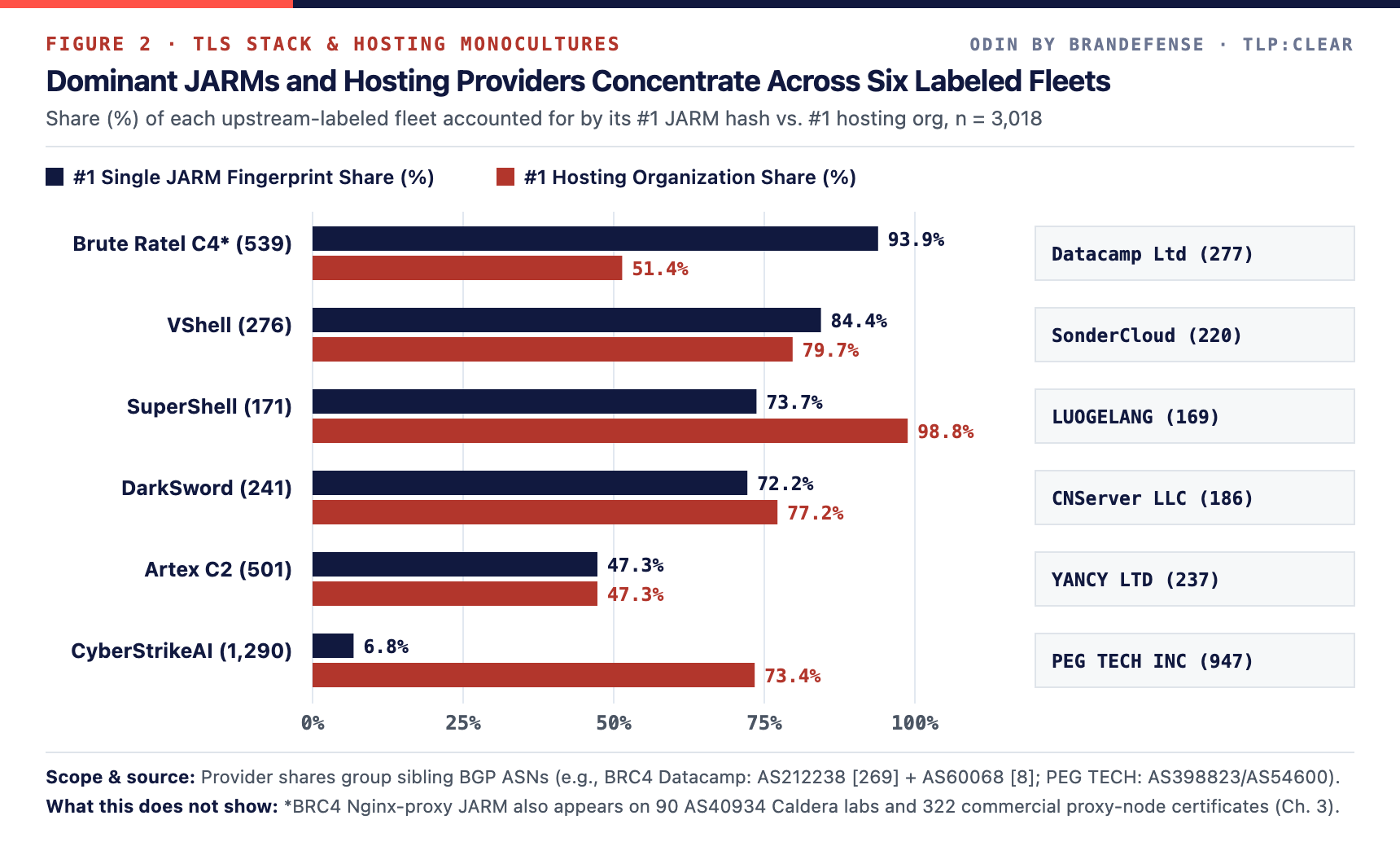
Certificate names are reused too. Two names cover 82.2% of the ARTEX C2 fleet (412 of 501 endpoints). Other servers claim the names of big portals such as www.baidu[.]com, gmail[.]com or update.microsoft[.]com. A self-made certificate can claim any name, and nobody checks it.
The catch is that many of these fingerprints are not unique. The Brute Ratel C4 JARM is a generic Nginx reverse-proxy profile. It also shows up on a commercial proxy service and on a security vendor's demo lab. The Ubiquiti name unifi.local appears on 99 CyberStrikeAI-labeled records, but none of those hosts runs CyberStrikeAI's four-port layout, and real UniFi consoles use the same name. A Kubernetes ingress default certificate covers 158 HypeAgent endpoints, yet every unconfigured ingress shows that same name.
Shared fingerprints can also cross family lines. The feed families DarkSword and SuperShell share one identical JARM across 300 records, but each sits almost entirely on its own hosting provider. That pattern fits a shared C2 bundle just as well as a provider's standard server image. "DarkSword" is also only a feed label here. We did not tie these servers to the iOS exploit kit of that name that Google researchers have described.
So a fingerprint is a lead, not a verdict. Pair it with a second, independent signal before acting. VShell listeners on port 9999 that also present VShell's own TLS fingerprint are a good example of two signals that agree.
Why do threat feeds flag harmless servers?
Raw volume is not attacker volume. The family called Daybreak tops the feed with 1,701 records. But 1,592 of them sit on port 3306 and carry the certificates that MySQL creates for itself at startup. These are ordinary database servers with self-signed TLS on an unusual port, which is exactly what a naive C2 rule looks for.
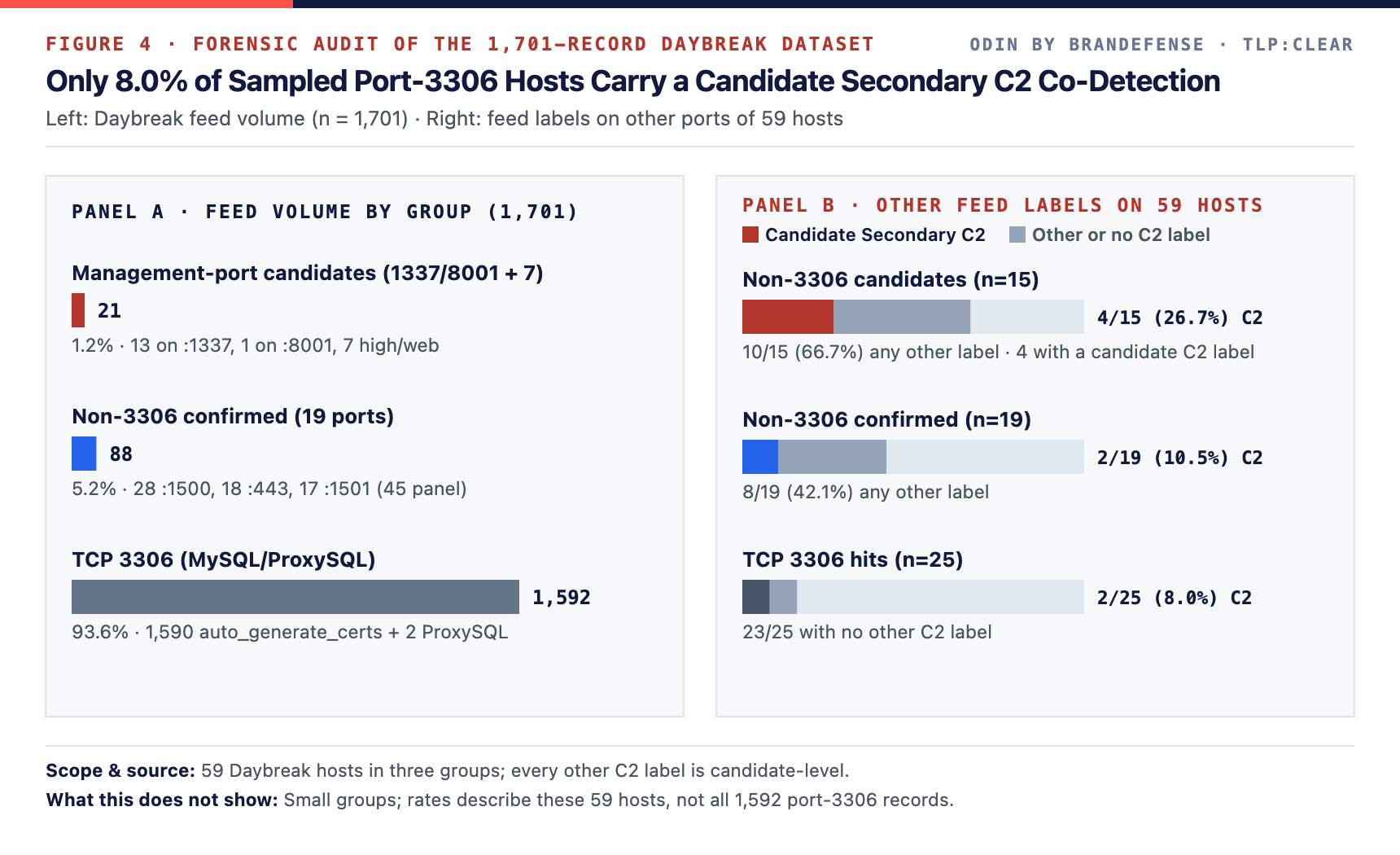
Our analysis examined other open ports on 59 Daybreak hosts. A candidate C2 label on another port appeared on 26.7% of non-database candidates (4 of 15). On port-3306 MySQL hosts it appeared on only 8.0% (2 of 25), and 21 of those 25 showed nothing else at all.
Two more collisions stand out. 45 records on ports 1500 and 1501 match a common shared-hosting control panel. And 239 of 240 MITRE Caldera records (99.6%) sit inside one security vendor's network, consistent with a Fortinet demo lab. Together with the MySQL servers, that makes 1,876 records that a blocking rule should never act on.
What can network monitoring not see?
Passive network monitoring has blind spots. Under TLS 1.3 the server certificate is encrypted, so certificate rules cannot read it. Sliver's operator listeners on port 31337 use TLS 1.3 only. Reverse proxies hide the C2 program behind a generic TLS profile. Many of these frameworks are also used by authorized red teams and managed service providers. Network rules need endpoint data next to them.
What to do now
- Require two independent signals before any automatic block. A certificate name, a JARM or a hosting network alone should go to analyst review.
- Exclude known collisions from automatic block lists: MySQL startup certificates on 3306, hosting panels on 1500 and 1501, and the vendor demo lab.
- Restrict workstation egress to ports 1337, 3306, 4321, 5001 to 5003, 8001, 8082, 8888, 9999, 31337 and 43211 unless there is a business need.
- Inspect TLS on both 443 and 8080, and add a TLS 1.3 rule for port 31337 paired with endpoint data.
- Deploy the rules in the full report's Detection rules tab (Suricata, Sentinel KQL and Sigma), and use the JARM values and certificate names in the full report to hunt. No individual address is published for this study.
The full report covers the port strategies, JARM values, certificate taxonomy, collision tests and rule logic in detail.
What is…?
Short explanations of the tools and families named in this study.
What is JARM?
JARM is an open TLS server fingerprinting method from Salesforce. It hashes how a server answers a set of crafted TLS handshakes.
More about JARMAI offensive toolWhat is CyberStrikeAI?
CyberStrikeAI is a public AI-driven offensive security platform. It spreads its operator interface, API and agent listener across several ports on one host and exposes tools through MCP.
More about CyberStrikeAIDetection heuristicWhat is Daybreak?
Daybreak is a public JA4X-based C2 heuristic. On port 3306 it also matches ordinary MySQL servers, which makes it a well-known source of false positives.
More about DaybreakC2 frameworkWhat is Brute Ratel C4?
Brute Ratel C4 is a commercial red-team C2 framework built to evade endpoint detection. Leaked copies have been used by criminal operators.
More about Brute Ratel C4AI offensive toolWhat is ARTEX?
ARTEX is an autonomous red-team console that chains AI agents and security tools. Operators fork and rebrand it; its default listener port is 8787.
More about ARTEXRemote access implantWhat is VShell?
VShell is a remote access implant and C2 panel that talks over WebSocket and other transports. It is popular with Chinese-speaking operators.
More about VShellFrequently asked questions
How do C2 servers blend in?
Most C2 frameworks choose one of four port strategies. Some listen on web ports such as 443 and 8080, so their traffic passes through web proxies. CyberStrikeAI spreads its operator UI, API and agent listener over four ports (5001, 5002, 5003 and 8082) on one host. VShell, AdaptixC2 and Sliver bind high ports such as 9999, 4321 and 31337. A fourth group overlaps with remote-management, hosting-panel and database ports.
Can defenders fingerprint them?
Yes, up to a point. C2 fleets reuse the same TLS setup and the same hosting providers. JARM is a fingerprint of how a server answers TLS handshakes. One JARM covers 93.9% of Brute Ratel C4 records, and single hosting providers hold up to 98.8% of a family.
Why do threat feeds flag harmless servers?
Raw volume is not attacker volume. The family called Daybreak tops the feed with 1,701 records. But 1,592 of them sit on port 3306 and carry the certificates that MySQL creates for itself at startup. These are ordinary database servers with self-signed TLS on an unusual port, which is exactly what a naive C2 rule looks for.
What can network monitoring not see?
Passive network monitoring has blind spots. Under TLS 1.3 the server certificate is encrypted, so certificate rules cannot read it. Sliver's operator listeners on port 31337 use TLS 1.3 only. Reverse proxies hide the C2 program behind a generic TLS profile. Many of these frameworks are also used by authorized red teams and managed service providers. Network rules need endpoint data next to them.