


Key takeaways
- One exposed server held 1,824 records of intrusion and monetization tooling.
- A Linux agent is designed to run from memory and is checked through a file lock, not a process name.
- Scripts are written to pivot over Oracle database links, Zimbra servers and Windows SMB shares.
- A watchdog evicts rival malware every two minutes without breaking the hosted website.
- Hunt memory-plus-lock pairs, audit Oracle database links, and block the staging hosts.
Between 13 and 16 November 2026, Odin by Brandefense observed an exposed staging server at 38.60.227[.]210. Across five open ports it held 1,824 records, including 99 scripts and configuration files. Together they show an operator equipped to move through enterprise database and mail servers, then earn money from them through cryptocurrency mining and search-engine spam. For defenders, this means a single intrusion can bring both a deep foothold and a quiet resource drain.
The files show what the operator built and configured. They do not show which targets were reached. Victim names, schemas, internal addresses and secrets are withheld.
What was on the server?
Each port had its own job. Port 8000 held the main toolkit, and port 9002 mirrored it, probably as a fallback if 8000 was blocked. Port 8082 held the Linux agent loader and the Windows tools. Port 8083 held the Oracle scripts, and port 8093 stored scan results and logs.
The scripts also name callback ports on the same server, a second check-in host at 38.60.252[.]110, and two cloud storage buckets, one on Cloudflare R2 and one on Alibaba Cloud. The listings named 122 more binaries and archives that were not retrieved. Their names point to privilege-escalation kits for sudo and polkit, and to chisel and plink tunnels for reaching internal networks.
How does the Linux agent hide?
The most carefully built file is a root bootstrapper called deploy_ghc2.sh. It downloads an agent named github-c2-agent-dual, which was not retrieved. The author's own comments in the script explain how the agent hides:
- It deletes its own file at startup and keeps running from memory.
- It blanks its command line, so
pgrepcannot find it. - It makes its executable path point at
/usr/lib/systemd/systemd, the system init binary.
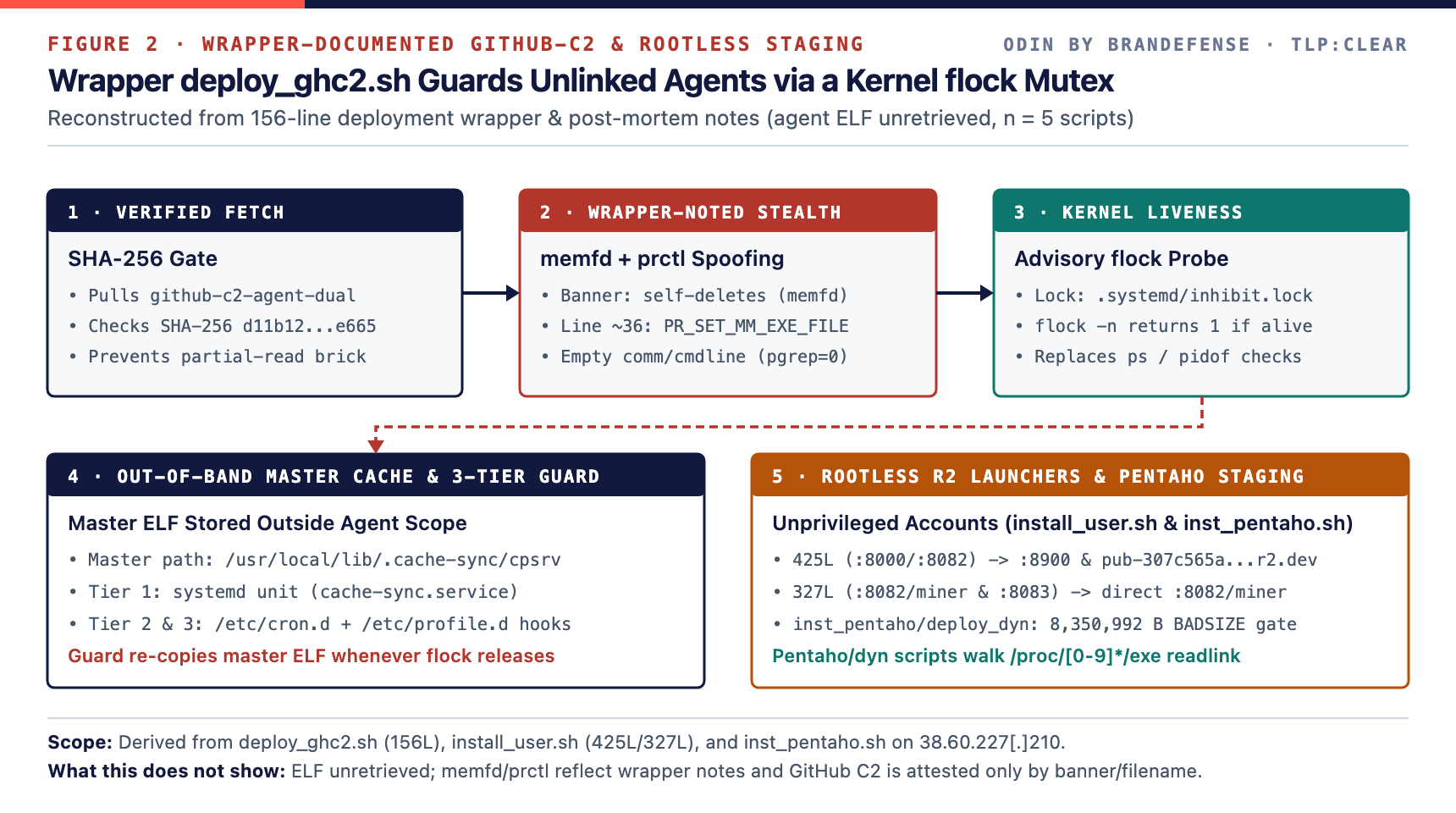
Because the agent is invisible to process names, the operator needed another way to know if it was alive. The answer is a kernel file lock on /var/tmp/.systemd/inhibit.lock. Three hooks (a systemd unit, a cron job and a login script, all named cache-sync) test that lock. If the lock is free, they restore the agent from a master copy after checking its SHA-256.
For unprivileged service accounts such as oracle or pentaho, separate launchers install a process called java_update. The main variant pulls its payload from a Cloudflare R2 bucket, so the download looks like ordinary Cloudflare traffic.
The lesson is clear. Scanning for bad process names will not find this agent. Look for executable memory with no file behind it, a systemd process that is not the real one, and a lock file under /var/tmp.
How does it move inside a network?
Thirty middleware scripts target the systems that hold business data. Twenty-six are aimed at Oracle Database, RAC and E-Business Suite.
The Oracle scripts use database links, the trusted connections that let one database query another. Through a link, a script can create folders, compile Java code and schedule operating-system jobs on a database the attacker cannot reach directly. Firewalls that isolate the E-Business Suite server do not stop this, because the traffic comes from a trusted neighbour database.
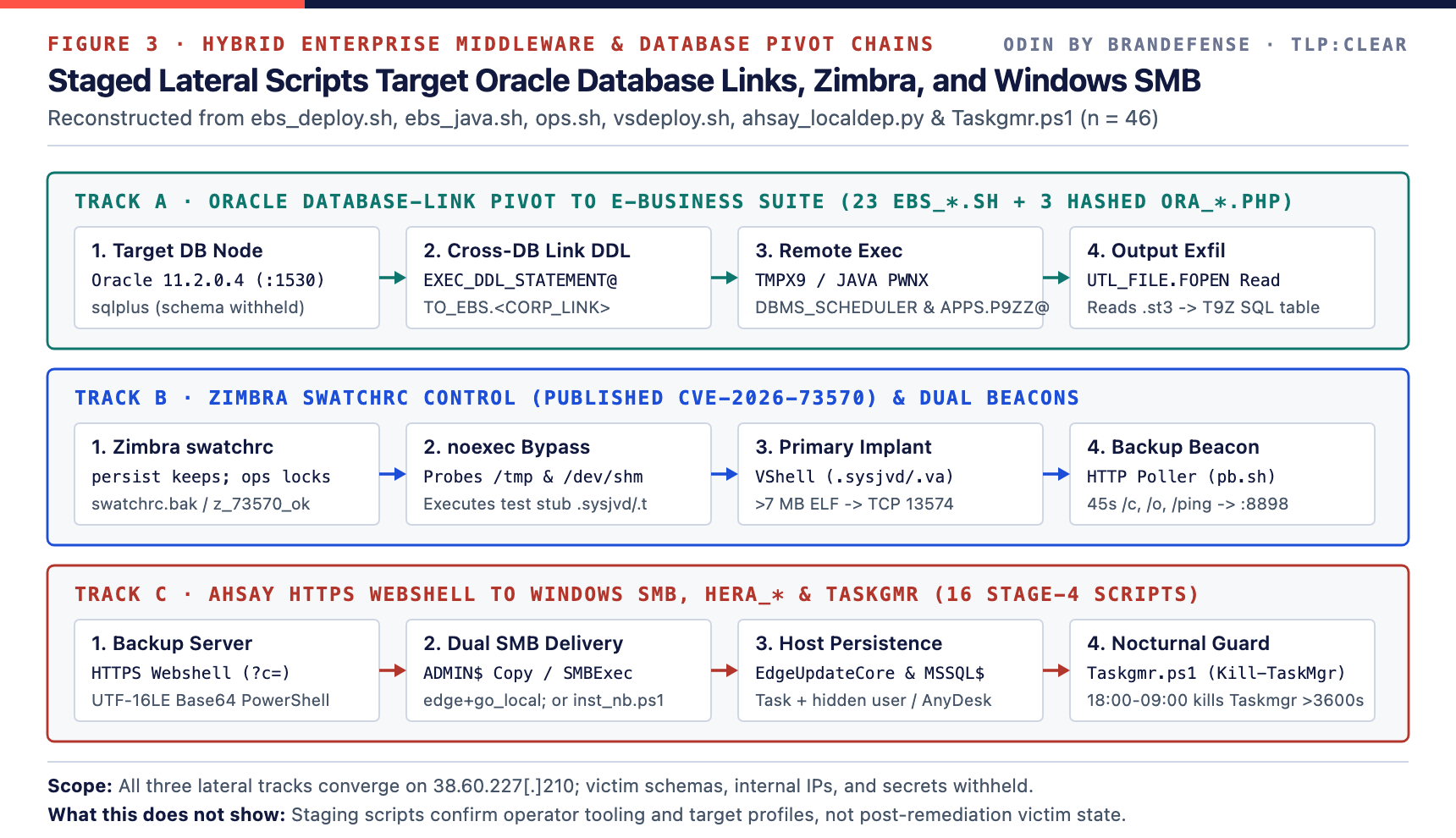
Zimbra scripts reference CVE-2026-73570, a Zimbra command-injection flaw fixed in version 10.1.20. One script keeps that entry point open for the operator. Another closes it to rival intruders.
On Windows, scripts start from a web shell on an Ahsay Backup server and spread over SMB shares. They are written to add a hidden administrator named MSSQL$, overwrite the AnyDesk password and register a fake Edge update task. One script watches Task Manager every 3 seconds. Between 18:00 and 09:00 it is written to close Task Manager if it stays open longer than 3,600 seconds, so mining can run through the night.
Why does it fight other malware?
Popular servers attract several intruders, and they compete for CPU. A watchdog script, excl_evict4.sh, is configured to run every two minutes. It is written to kill 13 rival process patterns, such as xmrig and kinsing, and moves files matching 11 rival names into a quarantine folder, /tmp/.excl_q.
The script never edits web server configuration. Other malware often breaks websites and triggers an investigation. This operator wants the site to stay up and the owner to stay unaware.
The same idea drives three PHP implants. They hook into every page request and show spam only to search bots and some mobile search visitors. The site owner and uptime monitors see a clean page.
Who runs the server is still open. An unauthorized intrusion and monetization operation fits all the evidence best: live mining accounts, third-party spam feeds and rival eviction sit next to the lateral tools. A red team, a research mirror or a test fixture cannot be fully ruled out without records from targets. As of 16 November 2026, none of six key indicators appeared in five public threat-intelligence sources.
What to do now
- Hunt Linux hosts for the memory-and-lock pattern. Correlate executable
memfdmemory, a fakesystemdprocess and lock files under/var/tmp. Check for/usr/local/lib/.cache-sync/andcache-sync.service. - Audit Oracle database links. Turn on Unified Auditing and alert on remote DDL, scheduler jobs and Java compiles over links.
- Patch and check Zimbra and PHP. Update Zimbra to 10.1.20 or later. Look for unexpected
auto_prepend_filesettings and test key pages with a search-bot user agent. - Block the staging hosts. Block 38.60.227[.]210, 38.60.252[.]110 and the R2 bucket. The full report lists all 47 indicators, and the full report's Indicators tab holds the 34 that suit automated feeds.
- Deploy the detection rules. The full report's Detection rules tab has auditd, Suricata, Sentinel KQL, Sigma and YARA rules.
The full report covers the tooling, the hypotheses, the indicators and the rule logic in detail.
What is…?
Short explanations of the tools and families named in this study.
What is Zimbra?
Zimbra Collaboration is an email and collaboration suite. Its internet-facing servers are frequent targets of exploitation.
More about ZimbraMining serviceWhat is Kryptex?
Kryptex is a commercial cryptocurrency mining service and pool. Its miner and pool accounts appear in cryptojacking kits.
More about KryptexOffensive toolWhat is PrintSpoofer?
PrintSpoofer is a public Windows privilege escalation tool that abuses impersonation privileges to gain SYSTEM.
More about PrintSpooferRemote access implantWhat is VShell?
VShell is a remote access implant and C2 panel that talks over WebSocket and other transports. It is popular with Chinese-speaking operators.
More about VShellFrequently asked questions
What was on the server?
Each port had its own job. Port 8000 held the main toolkit, and port 9002 mirrored it, probably as a fallback if 8000 was blocked. Port 8082 held the Linux agent loader and the Windows tools. Port 8083 held the Oracle scripts, and port 8093 stored scan results and logs.
How does the Linux agent hide?
The most carefully built file is a root bootstrapper called deploy_ghc2.sh. It downloads an agent named github-c2-agent-dual, which was not retrieved. The author's own comments in the script explain how the agent hides:
How does it move inside a network?
Thirty middleware scripts target the systems that hold business data. Twenty-six are aimed at Oracle Database, RAC and E-Business Suite. The Oracle scripts use database links, the trusted connections that let one database query another. Through a link, a script can create folders, compile Java code and schedule operating-system jobs on a database the attacker cannot reach directly.
Why does it fight other malware?
Popular servers attract several intruders, and they compete for CPU. A watchdog script, excl_evict4.sh, is configured to run every two minutes. It is written to kill 13 rival process patterns, such as xmrig and kinsing, and moves files matching 11 rival names into a quarantine folder, /tmp/.excl_q.