


1. Executive Summary
In short
Odin by Brandefense found 713 unique attacker file paths on eight IP addresses, most seen on 13 November 2026. The toolkits target middleware that workstation endpoint tools rarely watch: Epicor Kinetic business-rule tables, SQL Server Agent jobs, VMware Cloud Director Availability appliances, and the n8n and Apache Activiti workflow engines. A mirrored four-server cluster holds most of the files. Audit Ice.BpDirective writes, restrict SQL Agent CmdExec steps, keep VCDA management ports off the internet, and treat workflow imports as code deployments.
Enterprise monitoring often centres on laptops and servers, not on ERP database tables, replication appliances or workflow engines. These platforms compile custom code and hold service credentials by design. That makes them attractive to attackers, and their abuse can look like routine admin work. This report shows what the staged toolkits contain, how they are meant to work, and how defenders can tell abuse from normal operations.
A mirrored four-server cluster stages Epicor directive injection and SQL Agent persistence.
Four adjacent servers in 43.230.171[.]144/29 carry the same 544-path directory tree. The files inject custom code into the Epicor Kinetic directive table and set up SQL Server Agent jobs that call a relay at 43.230.171[.]146. The same tree holds Kerberos, AS-REP roasting and Windows privilege-escalation tools.
A dual-use workbench co-stages VMware VCDA probes, Jetty smuggling and keystore decryption.
A 65-file workbench targets VMware Cloud Director Availability (VCDA) 4.7.4 and VMware Cloud Director (VCD) 10.6.0 lab appliances. It holds path-traversal and root-reset probes, Eclipse Jetty request-smuggling tests (CVE-2026-2332) and an offline keystore decryptor. The tracks target separate lab systems. Nothing in the files links them into one end-to-end chain.
Workflow engine toolkits aim n8n and Activiti scripting at operating-system commands.
On a third-party n8n server, an inferred attacker working directory holds 24 files for session forgery, Code Node injection, a PostgreSQL webshell and PwnKit escalation. On a dedicated Apache Activiti workbench, 81 files build BPMN 2.0 models written to evade web application firewalls (WAFs) and to call Groovy. Operating-system command execution on any target is not shown.
Three Decisions for Leaders
- Audit ERP directives and lock down SQL Server Agent. Alert on Epicor directives that combine database-layer origin or Business Object update hooks with operating-system code. Limit SQL Agent
CmdExecand PowerShell steps to least-privilege proxies, require signed scripts, and disable ad-hoc linked servers. - Isolate VCDA management interfaces and rotate keystore secrets. Keep VCDA ports 8443, 8046 and 3030 on management networks only. Apply Broadcom and Jetty updates, and rotate Cloud Director encryption keys whenever pre-authentication exposure is suspected.
- Treat workflow and BPMN imports as privileged code deployments. Run n8n Code Nodes in sandboxed task runners without access to environment variables. Disable unrestricted Groovy in Apache Activiti. Keep adversary block lists separate from research and incident-response watchlists.
The Study in Numbers
| Number | What it is |
|---|---|
| 713 | Unique file paths across 8 IP addresses (7 HTTP hosts and 1 configured relay), in 2,346 directory entries |
| 2,176 | Entries on the mirrored Epicor and SQL Server cluster: 544 paths on each of 4 servers |
| 76 | SQL Server Agent job, dropper and diagnostic entries that point to the relay (19 per server) |
| 65 | Files on the dual-use VMware VCDA and VCD workbench |
| 81 | Files on the Apache Activiti workbench at 106.75.249[.]26:8081 |
| 24 | Files in an inferred attacker working directory on a third-party n8n server |
| 20 | Published indicators: 6 adversary IP addresses and 14 SHA-256 file hashes |
How to use this report.
Security leaders and architects can read Chapter 1, Chapter 6 and Chapter 7. ERP, database and virtualization engineers should read Chapters 3 and 4 and work through the checklist in Chapter 7. Detection engineers and threat hunters should start with Chapters 5, 8 and 9.
2. The Middleware Toolkits at a Glance
In short
Eight IP addresses hold 2,346 directory entries and 713 unique file paths. Before using any indicator, defenders should know which hosts are adversary staging, which is a dual-use research workbench, and which is a likely victim.
The eight addresses are seven HTTP servers and one TCP relay. The relay, 43.230.171[.]146, appears in attacker scripts on ports 9001 and 8080. It was not listed as a file server itself.
The four-server ERP mirror repeats the same 544 paths on each node, giving 2,176 entries. Counting each environment once gives 714 paths (544 + 81 + 65 + 24). One short .txt file name appears both on the ERP mirror and in the n8n working directory, so the global count of distinct paths is 713.
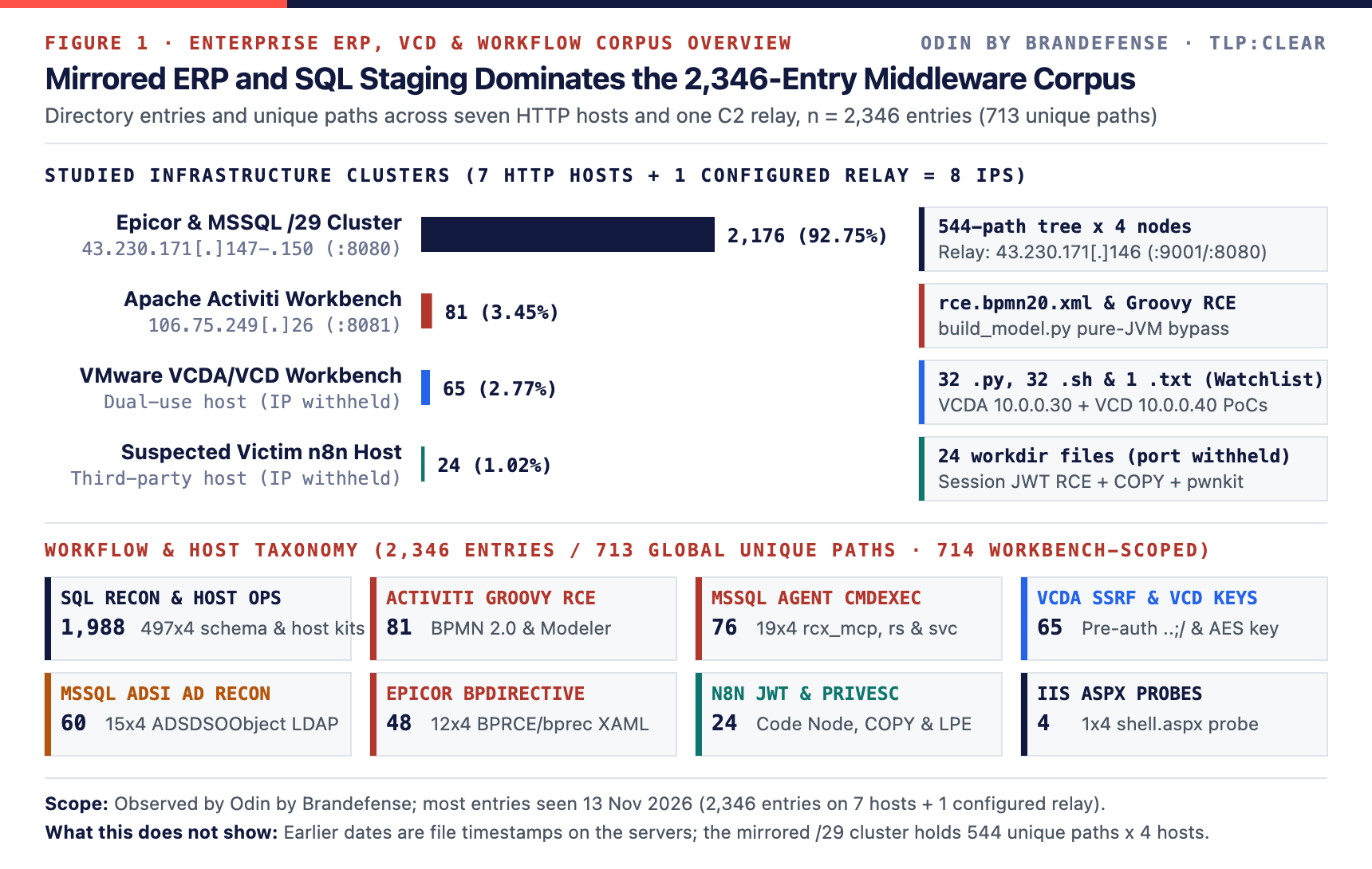
Four environments, four roles
| Environment | Role | Address (port) | Entries | Target stack | Main capability |
|---|---|---|---|---|---|
| Epicor and SQL Server cluster | Adversary staging plus relay | 43.230.171[.]147 to .150 (8080), relay .146 (9001) | 2,176 (544 x 4) | Epicor Kinetic ERP, Microsoft SQL Server | Ice.BpDirective injection, SQL Agent CmdExec tunnel, ADSI LDAP queries, AD and privilege-escalation tools |
| Apache Activiti workbench | Adversary staging | 106.75.249[.]26 (8081) | 81 | Apache Activiti BPMN 2.0 | WAF-evading Modeler JSON (build_model.py) and Groovy ProcessBuilder models |
| VMware VCDA and VCD workbench | Dual-use research, watchlist only | Withheld (10000) | 65 (32 .py, 32 .sh, 1 .txt) | VCDA 4.7.4, VCD 10.6.0 | Semicolon path traversal, Config-Secret root reset, Jetty smuggling, VCD key unwrap |
| n8n and PostgreSQL server | Inferred victim working directory | Withheld | 24 | n8n, PostgreSQL | JWT forgery, Code Node injection, PostgreSQL COPY webshell, PwnKit |
Only the first two environments are treated as adversary infrastructure. The workbench and the n8n server are withheld and go to watchlists, for reasons given in Chapters 4 and 5.
What the files are for
Grouping all 2,346 entries by purpose gives eight stages. Schema reconnaissance and host tooling on the mirror dominate the count.
| Stage | Unique paths | Entries | Share | Main files |
|---|---|---|---|---|
| SQL schema reconnaissance and host post-exploitation | 497 | 1,988 | 84.7% | BP*.sql, CFG*.sql, Kerberos .ccache, npusers.log, Potato privilege-escalation tools (497 x 4) |
| Activiti BPMN 2.0 Groovy models | 81 | 81 | 3.5% | 35 .json and 18 .xml models, rce*.bpmn20.xml, build_model.py, agent.x64.exe |
SQL Server Agent CmdExec persistence | 19 | 76 | 3.2% | A_job.sql, AA_mcp.sql, AB_diag.sql, AC_diag2.sql, AD_svc.sql (19 x 4) |
| VMware VCDA probes and VCD key decryption | 65 | 65 | 2.8% | set-site.sh, poc_iter1.py, rp.sh, decrypt_vcd_secrets.py, exploit_payloads.py |
| SQL Server ADSI linked-server AD reconnaissance | 15 | 60 | 2.6% | adsi.sql, adsi2.sql, domain user dumps users*.txt (15 x 4) |
Epicor Ice.BpDirective injection | 12 | 48 | 2.0% | BPRCE.sql to BPRCE5.sql, bprec.sql, bpm_off.sql, apply_BPRCE.json (12 x 4) |
| n8n JWT abuse and privilege escalation | 24 | 24 | 1.0% | Python, C, SQL and PHP files for session forgery, PostgreSQL COPY and PwnKit |
| IIS ASPX check file | 1 | 4 | 0.2% | /shell.aspx, which returns the marker RCX-211-OK (1 x 4) |
3. Epicor Kinetic Directive Injection and SQL Agent Persistence
In short
The four mirrored servers hold an ERP and SQL Server toolkit in four stages: schema discovery, directive injection, SQL Agent jobs that call a relay, and Active Directory queries from inside the database. Defenders should audit directive changes and SQL Agent job creation together.
Epicor Kinetic stores Business Process Management (BPM) hooks in the Ice.BpDirective SQL table. When a business method runs, Kinetic compiles and runs the C# custom actions attached to it. Whoever can write to that table can therefore place code inside the ERP application server.
Our analysis covers 40 SQL, JSON and ASPX files from 43.230.171[.]147:8080, seen on 13 November 2026. The same tree sits on .148, .149 and .150. These are staged files. No target-side record shows that a directive was compiled.
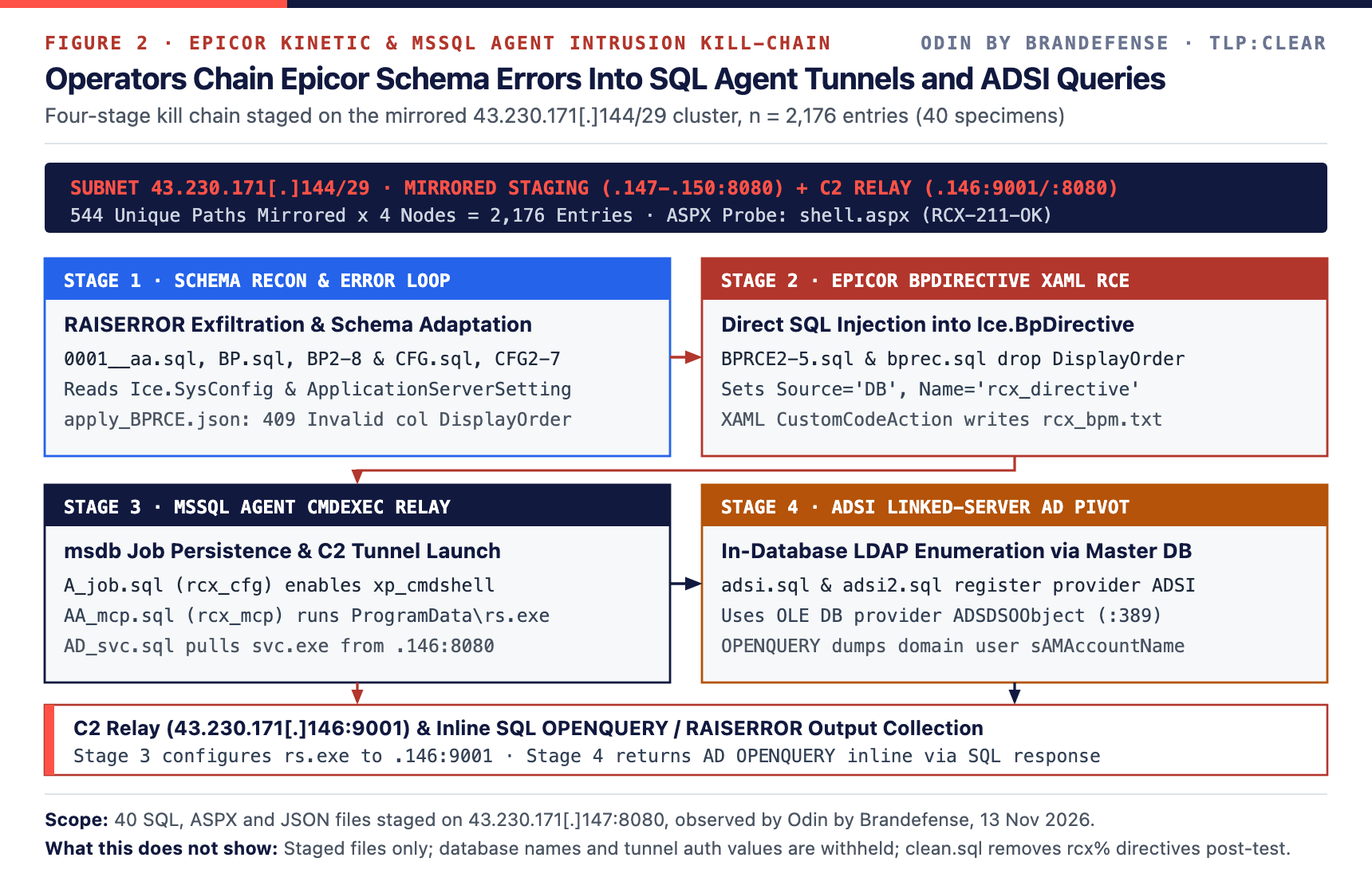
Stage 1: learning the schema from error messages
Schema enumeration scripts (BP.sql to BP8.sql, CFG.sql to CFG7.sql, C1.sql, C2.sql) read Ice.BpDirective, Ice.BpMethod and ApplicationServerSetting. They return the results through RAISERROR messages, so the data comes back inside SQL error text.
The operator then sent BPRCE.sql through an exposed target database migration endpoint. The target answered HTTP 409 with applied: false and Invalid column name 'DisplayOrder'. The response is saved in apply_BPRCE.json.
The operator staged revised scripts that drop the mismatched column and test UPDATE statements against the directive table. The server holds no later HTTP 200 response. So the files show adaptation to the error, but not a working directive on the target.
Stage 2: a directive written from the database layer
Directives built in the Workflow Designer normally carry Source = 'BO' or 'UI'. BPRCE.sql instead deletes any earlier rcx_directive row and inserts a DirectiveDefinition2 XAML payload with these values:
| Field | Value |
|---|---|
BpMethodCode | Ice.AlternateKey.Update |
Source | 'DB' |
Name | rcx_directive |
CGCCode | rcx00001 |
| Action | A CustomCodeAction that calls System.IO.File.WriteAllText to write rcx_bpm.txt into the IIS webroot (database folder name withheld) |
/shell.aspx returns RCX-211-OK to check that the webroot is writable. clean.sql removes rows with Name LIKE 'rcx%' after testing.
Scripts BPRCE.sql to BPRCE3.sql set Company = 'EPIC06', a standard Epicor training company code. That fits testing against a demo tenant or reuse of a template value. The wider 544-path tree also holds Windows and Active Directory tools. Together, the pattern fits an operator who pairs domain access tooling with ERP directive development.
| File group | Example paths | Size or count | Role |
|---|---|---|---|
| Migration error log | /apply_BPRCE.json | 11,416 B (1 x 4) | Holds the HTTP 409 reply (RC_UNKNOWN, Invalid column name 'DisplayOrder') |
| Directive injectors | /BPRCE.sql to /BPRCE5.sql, /bprec.sql, /bpm_off.sql | 433 to 2,893 B (8 x 4) | Drop DisplayOrder and insert a Source='DB' XAML CustomCodeAction on Ice.*.Update |
| Schema enumerators | /BP.sql to /BP8.sql, /CFG.sql to /CFG7.sql, /C1.sql, /C2.sql | 223 to 774 B (17 x 4) | Read directive, method and server settings through RAISERROR |
| Check and rollback | /shell.aspx, /clean.sql | 37 B and 238 B (2 x 4) | Return the RCX-211-OK marker; delete rcx% rows after testing |
| AD and Windows privilege escalation | Kerberos .ccache (user name withheld), npusers.log, GodPotato-NET4.exe, PrintSpoofer64.exe, efspotato.cs | Within the 544-path tree | Kerberos ticket cache, AS-REP roasting logs, domain user dumps (users*.txt) and local privilege escalation |
Stage 3: SQL Server Agent jobs instead of a shell
A_job.sql enables xp_cmdshell under job rcx_cfg. That path would make sqlservr.exe start cmd.exe, which many tools watch. The other scripts move persistence into SQL Server Agent instead. They call msdb.dbo.sp_add_jobstep with @subsystem = N'CmdExec'.
| Script | Size | Job | What the job is configured to do |
|---|---|---|---|
A_job.sql | 636 B | rcx_cfg | Enable xp_cmdshell |
AA_mcp.sql | 734 B | rcx_mcp | Start C:ProgramDatars.exe as a TCP tunnel to 43.230.171[.]146:9001 with --mode tcp --reconnect and an authentication value (withheld) |
AB_diag.sql | 985 B | rcx_diag | Write tasklist, a netstat -ano check for the relay, and Windows Defender status (Get-MpThreat) to C:ProgramDatadiag.txt |
AC_diag2.sql | 1,044 B | rcx_diag2 | A second diagnostic job with the same purpose |
AD_svc.sql | 832 B | rcx_svc | Download svc.exe and start_svc.ps1 from http://43.230.171[.]146:8080/ with curl.exe |
AE_read.sql | Not recorded | None | Read job output back through OPENROWSET(BULK ...) |
The diagnostic jobs check whether the tunnel is up and whether Defender has flagged anything. For defenders, the key signal is sqlagent.exe starting a binary from C:ProgramData.
Stage 4: Active Directory queries from inside SQL Server
adsi.sql (468 B) registers the OLE DB provider ADSDSOObject as a linked server named ADSI inside the master database. It sets @useself = 'TRUE', so SQL Server queries the directory with its own identity.
On Windows, this provider loads activeds.dll and adsldp.dll. The script then queries domain sAMAccountName and distinguishedName values over LDAP through OPENQUERY. The results return inside the SQL response, so no separate tool touches the domain controller.
4. VMware VCDA 4.7.4 and VCD 10.6.0 Workbench
In short
A 65-file workbench holds three separate tracks against VMware lab appliances: VCDA path-traversal probes, a VCDA root-password reset, and Jetty smuggling plus an offline keystore decryptor for VCD. Defenders should isolate appliance management ports and protect keystores.
Cloud service providers use VMware Cloud Director Availability (VCDA) and VMware Cloud Director (VCD) to run multi-tenant disaster recovery across vCenter and ESXi. A flaw in these appliances can expose many tenants at once.
The workbench listens on port 10000. It was first seen before this window. It shows clear research markers: a revalidation/ folder, paced probes such as oracle_probe.sh, and license-patching scripts aimed at private lab addresses (10.0.0.10 to .40 and 192.168.100.10 to .20).
Because it may be a legitimate research setup, we withhold its address and place it on a dual-use watchlist. Its file hashes are withheld as well, so it is not in the Indicators chapter.
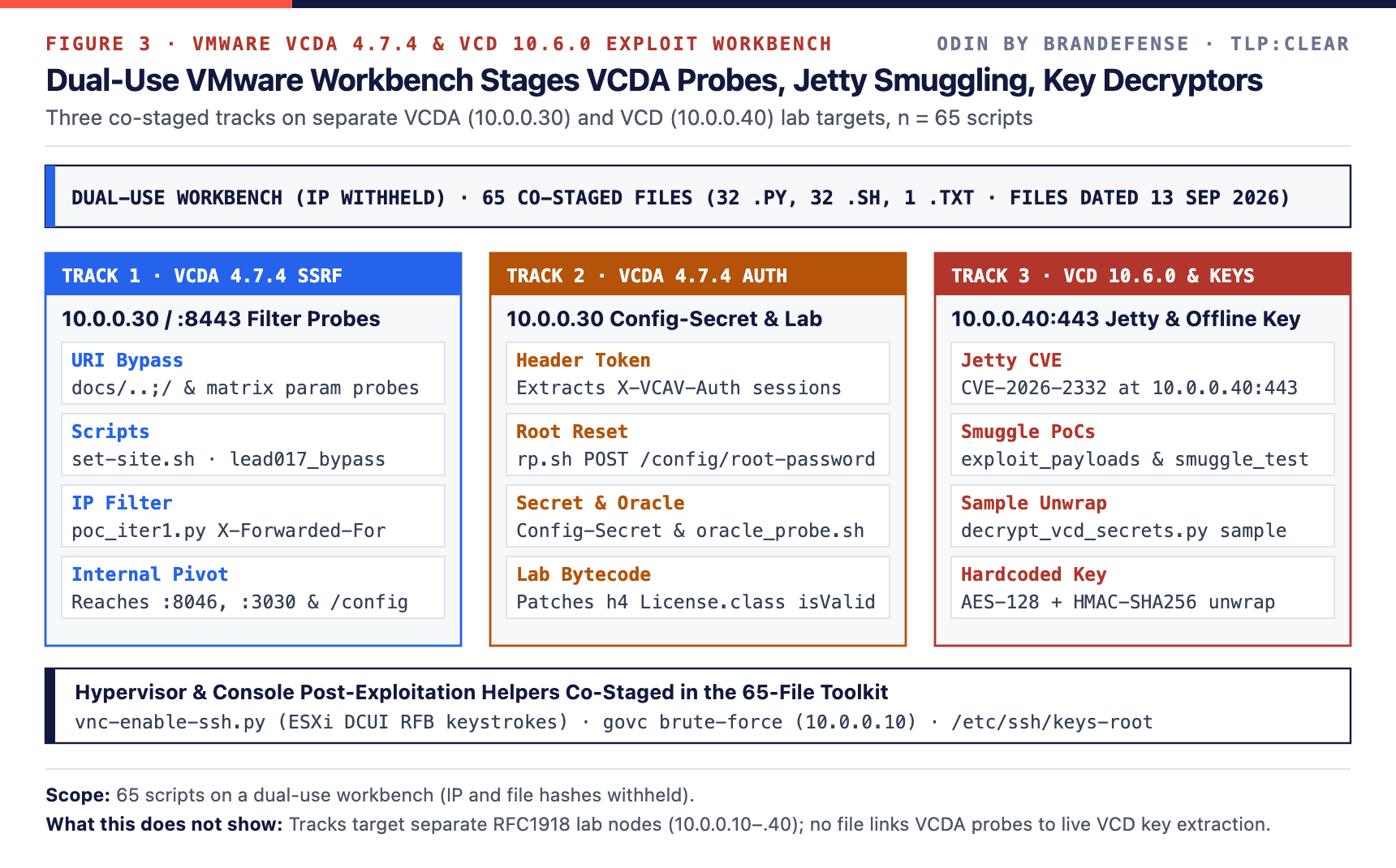
Three separate tracks
The 65 files are not one verified chain from VCDA into VCD keystores. The VCDA scripts target lab node 10.0.0.30 and local ports 8443, 8046 and 3030. The Jetty scripts target VCD at 10.0.0.40:443. The decryptor works on a hardcoded master key and sample values. No script links the VCDA probes to live key extraction.
| Track | Target | Key files (size) | What it tests |
|---|---|---|---|
| 1. VCDA 4.7.4 path traversal and IP filter | 10.0.0.30, localhost:8443 | set-site.sh (1,370 B), open_firewall_and_test.sh (893 B), revalidation/lead017_bypass_test.sh (4,748 B), vcda_poc/poc_iter1.py (21,220 B), vcda_poc/poc_iter4.py (16,737 B), chunk_ext_probe.py (2,604 B) | Semicolon matrix-parameter paths (docs/..;/) on 8443 with X-VCAV-Auth headers to reach internal :8046 and :3030 (/config, /is-configured); X-Forwarded-For tricks and raw TLS against the SourceIpAuthorizer.class allowlist; a Tomcat 9.0.83 probe |
| 2. VCDA 4.7.4 root password reset | 10.0.0.30 | rp.sh (789 B), weak_root_endpoint/attack.sh (16,936 B), b1/oracle_probe.sh (2,501 B) | POST /config/root-password with a lab-configured Config-Secret header; single-character password-oracle timing probes; local helpers that change iptables and patch License.class (isValid) |
| 3. VCD 10.6.0 Jetty smuggling and key unwrap | 10.0.0.40:443 (/cloudapi) | exploit_payloads.py (9,236 B), smuggle_test.py (13,055 B), ssrf_e2e_smuggle.py (10,165 B), decrypt_vcd_secrets.py (6,476 B) | Jetty 10.0.20 chunked-extension request smuggling (CVE-2026-2332); cross-appliance forwarding; offline AES-128 and HMAC-SHA256 unwrap of sample values |
The toolkit also holds a VCD 10.6 Jackson deserialization proof of concept (poc.py, 12,548 B), PostgreSQL token scripts, and an ESXi console helper (vnc-enable-ssh.py, 3,327 B). Figure 3 also shows govc brute-force against 10.0.0.10 and the path /etc/ssh/keys-root.
Which advisories apply
The Jetty probes target CVE-2026-2332, a published request-smuggling flaw in chunked-extension quoted-string parsing. NVD lists Jetty up to 9.4.59, 10.0.0 to 10.0.27, 11.0.0 to 11.0.28, 12.0.0 to 12.0.32 and 12.1.0 to 12.1.6 as affected. Fixed releases are 9.4.60, 10.0.28, 11.0.29, 12.0.33 and 12.1.7. The VCD target's Jetty 10.0.20 falls in the affected range.
LEAD-017 and CONF-002 are the author's own project labels, not Broadcom advisory IDs. Broadcom VMSA-2023-0026 (CVE-2023-34060) covers VCD Appliance 10.5 upgrades. It is cited only as hardening context, not as the flaw these scripts test.
5. Workflow Engines: n8n and Apache Activiti
In short
Workflow engines link stored credentials to scripting runtimes. Files on a third-party n8n server and on a dedicated Activiti workbench show workflow JSON and BPMN 2.0 models built to call operating-system commands once imported into an unsandboxed engine.
Workflow platforms run custom script nodes by design. A staged workflow definition can therefore ask for operating-system commands under the engine's service account. To get there, an attacker needs a valid session or an exposed model-import endpoint on an engine that allows scripts.
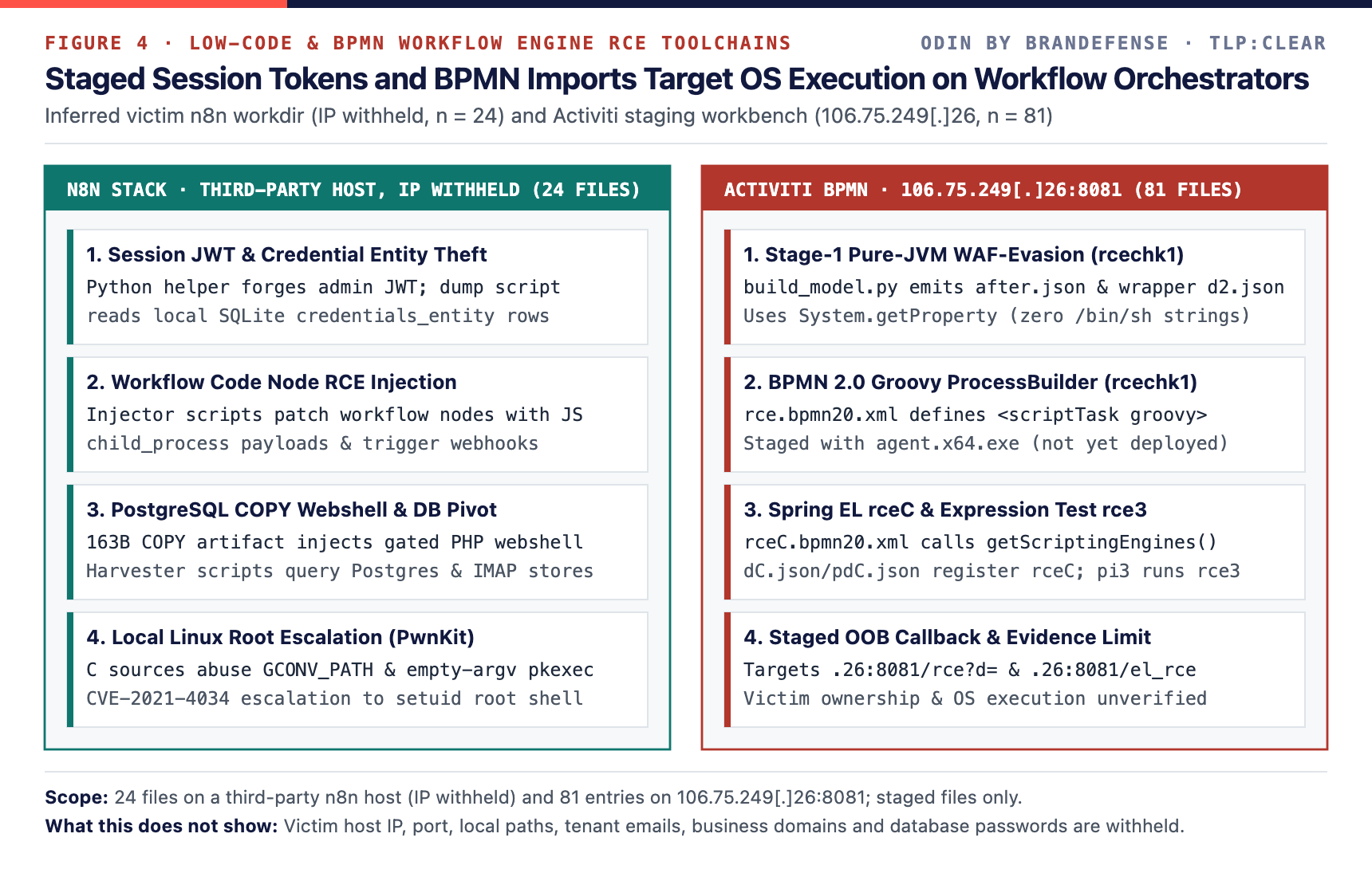
n8n: an inferred attacker working directory on a victim server
The 24 files sit on a server that is not adversary infrastructure. The files were first seen before this window. Two Python scripts (6,144 B and 6,466 B) query local PostgreSQL databases. A 1,178 B script reads a local n8n SQLite store. Other scripts probe local container-bridge and loopback services.
These local references suggest an attacker working directory on a third-party n8n and PostgreSQL server. We did not confirm this with the owner. We withhold the address, port and host paths, and place the host on a watchlist. Its two file hashes are withheld as well.
| Capability | Files | What they are written to do |
|---|---|---|
| JWT session forgery and Code Node injection | Three Python scripts (898 B, 3,701 B, 5,280 B) | Forge or replay n8n session JWTs to query /rest/workflows, read credentials_entity rows from SQLite, and patch workflows with n8n-nodes-base.code JavaScript nodes calling child_process |
| PostgreSQL webshell | One 163 B text file | Record a PostgreSQL COPY (SELECT ...) that writes a PHP webshell gated by a POST parameter (key withheld) |
| Credential harvesting | One 6,144 B Python script | Query local database and IMAP stores (all third-party identifiers withheld) |
| PwnKit escalation | Two C sources (781 B, 1,152 B) | Target Polkit pkexec (CVE-2021-4034) to start a setuid root shell |
Apache Activiti: WAF-evading BPMN models
The dedicated workbench at 106.75.249[.]26:8081 holds 81 entries, seen on 13 November 2026. They include 35 .json files and 18 .xml files, 13 of them rce*.bpmn20.xml definitions. The operator built three families of workflow definitions and kept REST replies from an Activiti endpoint.
Stage 1: a model with no shell strings (rcechk1).
build_model.py (4,021 B) carries a Chinese comment that translates as "stage1: pure JVM code without shell signature strings to evade WAF". It builds an Activiti Modeler graph with a start event, one script node and an end event.
The script node reads System.getProperty("user.name") and InetAddress.getLocalHost(). It then calls openStream() to http://106.75.249[.]26:8081/rce?d=.... It contains no /bin/sh string. The output is saved as after.json (2,970 B) and wrapped in Base64 in d2.json (4,530 B).
Stage 2: Groovy and Spring EL models.
rce.bpmn20.xml (1,150 B) defines process rcechk1 with <scriptTask scriptFormat="groovy"> calling new ProcessBuilder(...). It is staged next to agent.x64.exe. Query files pd2.json and pi2.json show that rcechk1 was not yet registered when they were saved.
rceC.bpmn20.xml defines process rceC. Its serviceTask expression calls springProcessEngineConfiguration.getScriptingEngines().evaluate(..., 'groovy') to send an HTTP callback to 106.75.249[.]26:8081/el_rce.
What the saved REST replies show.
The replies come from an Activiti endpoint whose address is withheld.
| Saved reply | Size | What it records |
|---|---|---|
d3.json to dB.json | 1,286 B | Deployment replies for test processes |
pi3.json | 372 B | Process rce3:1:695771 completed (completed: true); it evaluated the harmless expression ${1+1} |
dC.json | 1,494 B | Deployment 695800 |
pdC.json | 575 B | Process definition rceC:1:695802 registered |
These replies show that test processes were accepted. They do not show who owns the endpoint, and they do not show any operating-system command running.
6. Telling Abuse from Normal Admin Work
In short
ERP systems and SQL servers run many legitimate directives and scheduled jobs every day. Blocking on a single signal causes outages and false attribution, so each check below pairs two or more signals.
Blocking every Ice.BpDirective change, or treating every exposed server as attacker-owned, would break business processes and blame the wrong people. Four checks keep alerts accurate.
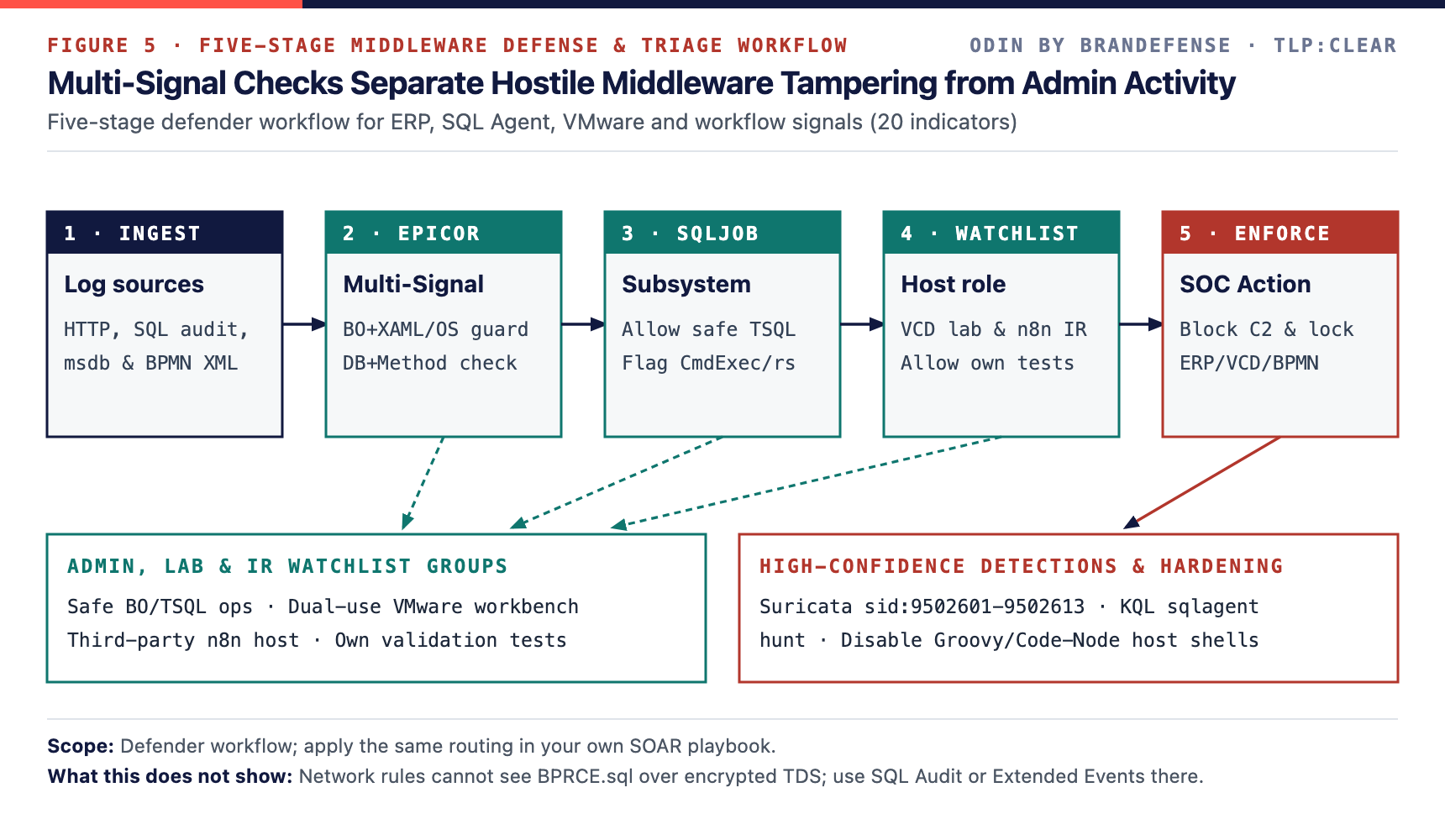
Epicor directives need more than one signal.
An attacker who injects SQL controls the Source column. Legitimate data directives may also use Source = 'DB'. So Source alone settles nothing. Correlate three signals:
Source = 'DB'on a Business Object update method (*.UpdateinIce.*orErp.*)CustomCodeActionXAML that calls operating-system or file namespaces (System.IO,Process,WebClient)- A write by a SQL principal that is not the Epicor application-server login
Treat an unknown SQL principal as unknown, not as benign. Only a verified application-server login should clear a directive change.
SQL Agent maintenance is not the same as CmdExec abuse.
Database administrators schedule msdb jobs with the TSQL or SSIS subsystems for index rebuilds, BULK INSERT feeds and backups. Allow those. Flag the CmdExec, PowerShell and ActiveScripting subsystems, and TSQL steps that call xp_cmdshell, sp_OACreate or OPENROWSET(BULK ...).
Research workbenches and victims go to watchlists.
The VMware workbench carries lab markers (LEAD-017, private targets 10.0.0.10 to .40). The n8n server looks like a victim hosting an attacker's working directory. Neither belongs on a permanent block list. Their addresses and file hashes are withheld, so hunt both through the behaviours in Chapters 4 and 5.
Allowlist your own validation tests.
Out-of-band callbacks from your own security testing or bug-bounty tooling can look like attacker callbacks. List those hosts explicitly so they are never flagged as hostile.
7. What Defenders Should Do
These steps cover the Epicor and SQL Server chain, the VMware workbench and the workflow engines in Chapters 3 to 5, ordered by urgency.
Within 24 hours
- Hunt or block 43.230.171[.]146 to .150 and 106.75.249[.]26 after checking their current owner and service banners. Cloud and VPS addresses get reassigned.
- Search SQL Server hosts for
sqlagent.exeorsqlservr.exestartingcmd.exe,powershell.exe,curl.exe,rs.exeorsvc.exewithC:ProgramDatapaths. - Search IIS webroots for
rcx_bpm.txtand unexpected.aspxfiles written byw3wp.exe.
Within 72 hours
- Audit
Ice.BpDirectivewith SQL Audit or Extended Events. Flag non-application-server principals,CustomCodeActioncode that callsSystem.IOorProcess, andSource='DB'on*.Updatemethods. - Revoke
SQLAgentOperatorRoleinmsdbfrom ERP application logins. - Disable
xp_cmdshelland OLE Automation. Restrict SQL AgentCmdExecand PowerShell steps to least-privilege proxies and require signed scripts or executables. - Remove unauthorized
ADSIlinked servers (sp_dropserver) and setDisallowAdhocAccess=1onADSDSOObject.
Within 7 to 30 days
- Remove VCDA ports 8443, 8046 and 3030 from public internet access. Apply Broadcom and Eclipse Jetty patches. Rotate VCD keystore secrets and
Config-Secretvalues. - In n8n, use sandboxed task runners, set
N8N_BLOCK_ENV_ACCESS_IN_NODE=trueand rotateN8N_ENCRYPTION_KEY. - Patch Polkit on Linux hosts and add
auditdEXECVEmonitoring forpkexecstarted with no arguments. - Disable unrestricted Groovy and JSR-223
<scriptTask>execution in Apache Activiti. Require role-based review of every BPMN 2.0 XML and Modeler JSON import. - Deploy the Suricata rules behind TLS offload, and send matches on the workbench and n8n behaviours to analyst review.
8. Detection Rules
The full rules are in the Detection rules tab. Network rules catch delivery and staging attempts; pair them with host logs before treating a match as execution.
| Rule file | What it catches |
|---|---|
suricata_erp_vcda_and_workflow_rce.rules | Suricata 7: thirteen signatures for directive injection, SQL Agent dropper staging, the IIS check marker, VCDA path traversal and root reset, and Activiti and n8n script uploads |
sentinel_mssql_cmdexec_and_erp_hunt.kql | Microsoft Sentinel and Defender XDR: SQL Agent child processes, ADSI module loads with LDAP traffic, IIS webroot writes, audited directive writes, and traffic to the listed IPs |
sigma_erp_sqlagent_and_bpmn_rce.yml | Sigma (3 rules): SQL Agent droppers, IIS writes of BPM marker files, and workflow runtimes starting shells or PwnKit |
yara_erp_vcda_and_workflow_toolkits.yar | YARA (4 rules): Epicor directive injectors, SQL Agent and ADSI scripts, VCDA and VCD tooling, and Activiti and n8n payloads |
What each rule needs
| Rule set | Data it needs |
|---|---|
| Suricata | Suricata 7 inspecting HTTP behind the reverse proxy or load balancer that ends TLS. Put ERP servers, SQL Server segments, VCDA appliances (443, 8443, 8046, 3030) and workflow engines in $HOME_NET. |
| KQL | Microsoft Defender for Endpoint process, image-load, file and network events on SQL Server and Epicor IIS hosts. SQL Server Audit logging SCHEMA_OBJECT_ACCESS_GROUP on Ice.BpDirective (Event ID 33205) to the Security or Application log. |
| Sigma | Windows process creation with command lines (Event ID 4688 or Sysmon Event ID 1) and file creation (Sysmon Event ID 11 or EDR). On Linux, process creation that records parent command line, working directory and empty command lines, plus auditd EXECVE rules on n8n and Activiti servers. |
| YARA | YARA 4 on endpoint file scans, web-upload inspection or incident-response collectors. Keep the file-size caps as written. |
Exclude authorized DBA script folders that hold ADSDSOObject linked-server scripts from the SQL Agent and ADSI YARA rule. Exclude approved security-assessment jump hosts from the VMware rule.
How the Suricata signatures work
| SID | Looks for | Why |
|---|---|---|
| 9502601 | Ice.BpDirective in a request body with CustomCodeAction, BpMethodCode, 'DB' or rcx_directive | Directive injection over HTTP (T1505.001) |
| 9502602 | sp_add_jobstep and CmdExec with ProgramData, rs.exe, svc.exe, curl.exe or --reconnect | SQL Agent dropper scripts in transit (T1505.001) |
| 9502603 | RCX-211-OK or RCX-BPM-RCE in a response from a protected server | The webroot check marker (T1505.003) |
| 9502604 | Literal ..;/ in the raw URI on ports 443, 8443, 8046, 3030 | VCDA semicolon path traversal (T1190) |
| 9502605 | POST /config/root-password with a Config-Secret header | VCDA root password reset (T1190) |
| 9502606 | ProcessBuilder and groovy in a request body | Plaintext Groovy BPMN upload (T1059) |
| 9502607 | /workflows URI with n8n-nodes-base.code and child_process | n8n Code Node injection (T1059.007) |
| 9502608 | URL-encoded %3b/ after .. or %2e%2e | Encoded VCDA path traversal (T1190) |
| 9502609 | json_xml with StartNoneEvent and JVM reconnaissance calls, in plaintext or Base64 | Activiti Modeler stage-1 upload (T1059) |
| 9502610 | getScriptingEngines().evaluate in a request body | Plaintext Spring EL BPMN deployment (T1059) |
| 9502611 to 9502613 | The same call in each of three Base64 alignments | Base64-wrapped Spring EL deployments, with no file name needed |
Tune SID 9502601 by allowlisting the hosts that deploy Epicor solution packages. Tune SID 9502607 by scoping it to approved CI/CD runners if your developers use child_process in Code Nodes.
How the KQL hunt works
The query looks back 14 days and joins five branches.
| Branch | Flags |
|---|---|
| SQL child processes | sqlagent.exe or sqlservr.exe starting cmd.exe, PowerShell, curl.exe, certutil.exe, rs.exe or svc.exe with C:ProgramData, --reconnect, --port 9001, start_svc.ps1, diag.txt or Get-MpThreat |
| ADSI module loads | sqlservr.exe loading activeds.dll, adsldp.dll or adsldpc.dll |
| IIS webroot writes | w3wp.exe writing .aspx files or rcx_bpm.txt under inetpubwwwroot |
| SQL Audit | Event ID 33205 inserts, updates or deletes on Ice.BpDirective by a principal outside your Epicor application logins |
| Network | Connections to the relay or staging IPs, public ports 9001, 8080 or 8081 from SQL or IIS processes, and SQL Server LDAP traffic on 389, 636 or 3268 |
SQL Server talks to domain controllers during normal Windows authentication. So LDAP traffic is labelled a linked-server query only when an ADSI DLL loaded in the same process within the previous 15 minutes. Otherwise it is a low-confidence hunt lead. Fill the authorized principal list with your real Epicor application-pool logins before you create incidents from this branch.
How the Sigma and YARA rules work
| Rule | Fires when |
|---|---|
| Sigma 1: SQL Agent dropper | sqlagent.exe or sqlservr.exe starts a shell, curl.exe, certutil.exe, rs.exe or svc.exe, and the command line holds a ProgramData path, tunnel flag, relay IP or diagnostic string |
| Sigma 2: IIS BPM write | w3wp.exe writes rcx_bpm.txt or an .aspx file under inetpubwwwroot; check .aspx writes against upgrade windows, but always alert on rcx_bpm.txt |
| Sigma 3: workflow shell or PwnKit | A Java or Node workflow runtime (Activiti, Flowable, n8n) starts a shell or curl, excluding npm build scripts; or pkexec starts with an empty command line from a writable directory or workflow parent; or GCONV_PATH=. or /pwned_bash appears |
| YARA: Epicor injector | A directive table name plus XAML or update-method strings plus 'DB' or rcx markers; or the DisplayOrder error with RC_UNKNOWN; or RCX-211-OK |
| YARA: SQL Agent and ADSI | sp_add_jobstep with CmdExec or xp_cmdshell plus a ProgramData, start_svc.ps1 or rcx_ string; or sp_addlinkedserver with ADSDSOObject and ADSI query strings |
| YARA: VCDA and VCD | Two or more VCDA strings (X-VCAV-Auth, /config/root-password, Config-Secret, docs/..;/ and others); or ECB mode with a key-unwrap or PBKDF2 string |
| YARA: Activiti and n8n | Groovy with ProcessBuilder or JVM reconnaissance calls; Base64 Modeler markers; getScriptingEngines().evaluate; n8n credential or REST strings with child_process; COPY (SELECT with PHP; or GCONV_PATH=. with /usr/bin/pkexec |
The YARA rules cap file size at 150 KB to 250 KB to avoid scanning database backups.
How to route an event
| What the event shows | Action |
|---|---|
| A host on your own validation-test allowlist | Allowlist |
A BO or UI directive by a verified application-server login, with no operating-system code | No action |
A TSQL, SSIS or Analysis Services job step with no dangerous calls | No action |
| A directive change by an unknown SQL principal | Analyst review |
A Source='DB' directive on an update method, a non-application-server writer, or a CmdExec or xp_cmdshell step | Block or isolate |
| Directive injection, SQL Agent tunnel and ADSI staging together | Block or isolate, highest priority |
| Any match on the dual-use VMware workbench | Dual-use watchlist |
| Any match on the third-party n8n server | Victim watchlist |
9. Indicators
The full list is in the Indicators tab. It holds 20 indicators: 6 addresses and 14 file hashes.
| Type | Count |
|---|---|
| Adversary IP addresses to block or hunt | 6 |
| SHA-256 file hashes for hunting | 14, all from the two adversary hosts (the dual-use workbench hashes and a captured target response are withheld) |
Withheld: the dual-use workbench address and the n8n server's address, port, paths and two file hashes. Also withheld: the internal Activiti endpoint, the ERP database name, user names, the tunnel authentication value and the webshell key.
Hunt surfaces
Some files land on target machines: rcx_bpm.txt, /shell.aspx, C:ProgramDatars.exe, svc.exe, start_svc.ps1, PostgreSQL COPY webshells and setuid pkexec binaries. Hunt for these on disk and in EDR logs. The other files live on attacker servers. Hunt for them on the wire with the Suricata rules and in SQL, IIS and workflow logs.
Adversary IP addresses
| Address | Port | Role |
|---|---|---|
| 43.230.171[.]146 | 9001 | Relay and payload host, configured in AA_mcp.sql (9001) and AD_svc.sql (8080) |
| 43.230.171[.]147 | 8080 | Epicor and SQL Agent staging node 1 (544 files, 40 analysed) |
| 43.230.171[.]148 | 8080 | Staging node 2, same tree, including apply_BPRCE.json and /UF.sql |
| 43.230.171[.]149 | 8080 | Staging node 3, same tree |
| 43.230.171[.]150 | 8080 | Staging node 4, same tree, including BPRCE2.sql to BPRCE5.sql |
| 106.75.249[.]26 | 8081 | Apache Activiti BPMN workbench (81 files) |
File hashes
| File | Size | Host | SHA-256 |
|---|---|---|---|
/BPRCE.sql | 2,484 B | 43.230.171[.]147 | c82a37d15dd6ace1980345c5a6546ef9661d36cdf68df071c9e8e04a4a490195 |
/BPRCE2.sql | 2,470 B | 43.230.171[.]147 | 2fc82f149dfd3548501cc6ecbfc7c03122b5cc43812e101720689ec538513b61 |
/BPRCE3.sql | 2,469 B | 43.230.171[.]147 | 8f37377809fe32920d519a908862547fbbb5d6fe4da7d895be5976ab5d839f7d |
/BPRCE4.sql | 816 B | 43.230.171[.]147 | 581cd858db05bc7f477f82b79f130e40737b7c4d73274518d18b332fb5610d8b |
/A_job.sql | 636 B | 43.230.171[.]147 | 4d639f02eac420635177cd7d9f8bf2d8b2c440ed76dcaaeb67e36556c97ef61c |
/AA_mcp.sql | 734 B | 43.230.171[.]147 | ebd371b85fef6d4337fe115a9bea3e741a188ac0c6584a501717aa7f9f06820f |
/AB_diag.sql | 985 B | 43.230.171[.]147 | fc2b41026eae4f1f6c18790b787f7adf5199f83b11f3a4236620fdee773224df |
/AD_svc.sql | 832 B | 43.230.171[.]147 | 1f783938b95a80c0974389401f8dc5df9f151244a176610964e812957d1757eb |
/adsi.sql | 468 B | 43.230.171[.]147 | eddefd7868e0687429d6529afe0fc30c909bae1f7cd07f10cc533fd0587e1e0e |
/shell.aspx | 37 B | 43.230.171[.]147 | ec01db6bdbbf6ca8f6a3e9f1569a9c5e7974046f04d4b1c26f178c53f12a791a |
/rce.bpmn20.xml | 1,150 B | 106.75.249[.]26 | 66cb5d6befdd13394da5f979e2021680ebe37a2e9059e4f8f08f35e750382ba7 |
/build_model.py | 4,021 B | 106.75.249[.]26 | 266e2b914dacfe7b24a6cb0dd41d76d0d19535accefd3daf6ad0e2a98e0a4427 |
/after.json | 2,970 B | 106.75.249[.]26 | d32ff4622418a9194bc19ae2b062df3a29d6b2fa2465ba21db1f0f29052ea7bc |
/d2.json (Base64 wrapper) | 4,530 B | 106.75.249[.]26 | 1b74813d4e4f39472402cdfb2baefb02988a27b280f56c6a81d2547ef1915126 |
MITRE ATT&CK mapping
| Tactic | Technique | How the toolkits use it | Detection |
|---|---|---|---|
| Persistence | T1505.001 Server Software Component: SQL Stored Procedures | Ice.BpDirective injection and SQL Agent CmdExec jobs | SID 9502601, 9502602; Sigma rule 1; KQL |
| Persistence | T1505.003 Server Software Component: Web Shell | /shell.aspx check file, rcx_bpm.txt, PostgreSQL COPY PHP webshell | SID 9502603; Sigma rule 2; YARA |
| Initial Access | T1190 Exploit Public-Facing Application | VCDA semicolon path traversal and Config-Secret root reset | SID 9502604, 9502605, 9502608 |
| Execution | T1059 Command and Scripting Interpreter | Groovy and Spring EL BPMN models, WAF-evading Modeler JSON | SID 9502606, 9502609 to 9502613 |
| Execution | T1059.007 JavaScript | n8n Code Nodes calling child_process | SID 9502607; YARA |
| Execution | T1059.004 Unix Shell | Workflow runtimes starting POSIX shells | Sigma rule 3 |
| Privilege Escalation | T1068 Exploitation for Privilege Escalation | PwnKit (CVE-2021-4034) sources on the n8n server | Sigma rule 3; YARA |
10. Scope and Limits
- Window. Most entries were seen on 13 November 2026, inside a two-week observation window ending 18 November 2026, with a research cutoff of 15 November. The VMware workbench and the n8n server were first seen earlier; no dates are given for them.
- Staged files, not outcomes. The files show intent and tooling. No target-side record shows a compiled directive, a running SQL Agent job, a decrypted live keystore or an operating-system command run through a workflow engine.
- Error replies are the attacker's own records. The HTTP 409 reply and the Activiti REST replies were saved by the operator. They show what an endpoint answered, not who owns it.
- Separate tracks. The VMware files target separate lab systems. Nothing links the VCDA probes to VCD key extraction.
- Roles are judgements. The dual-use and victim roles rest on markers in the files, not on contact with the owners. That is why both hosts are withheld and watchlisted.
- Addresses change. Cloud and VPS addresses can be reassigned. Check current ownership before a permanent block.
- Rule testing. Every published rule file loads without errors in its engine (Suricata 7.0.12, YARA-X, pySigma and Microsoft's Kusto.Language analyzer, checked on 20 November 2026). The rules were not replayed against live traffic, so test and tune them in your own environment before production use.
11. Sources
- MITRE ATT&CK. T1505.001 Server Software Component: SQL Stored Procedures. https://attack.mitre.org/techniques/T1505/001/ and T1505.003 Web Shell. https://attack.mitre.org/techniques/T1505/003/ (verified 18 November 2026)
- Microsoft. Create a CmdExec job step (SQL Server Agent). https://learn.microsoft.com/en-us/sql/ssms/agent/create-a-cmdexec-job-step (verified 18 November 2026)
- Broadcom. VMSA-2023-0026, VMware Cloud Director Appliance authentication bypass (CVE-2023-34060). https://support.broadcom.com/web/ecx/support-content-notification/-/external/content/SecurityAdvisories/0/23679 (verified 18 November 2026)
- Epicor. Epicor Kinetic product overview. https://www.epicor.com/en-us/products/enterprise-resource-planning-erp/kinetic/ (verified 18 November 2026)
- Activiti. BPMN 2.0 user guide, script task. https://www.activiti.org/userguide/#bpmnScriptTask (verified 18 November 2026)
- n8n. Securing n8n, hosting documentation. https://docs.n8n.io/hosting/securing/overview/ (verified 18 November 2026)
- NVD. CVE-2026-2332, Eclipse Jetty request smuggling via chunked-extension parsing. https://nvd.nist.gov/vuln/detail/CVE-2026-2332 and Eclipse Jetty security reports. https://jetty.org/security.html (verified 18 November 2026)
- NVD. CVE-2021-4034, Polkit
pkexeclocal privilege escalation (PwnKit). https://nvd.nist.gov/vuln/detail/CVE-2021-4034 (verified 18 November 2026)
What is…?
Short explanations of the tools and families named in this study.
What is n8n?
n8n is an open-source workflow automation platform. Its workflows can run code and hold credentials for connected services.
More about n8nEnterprise softwareWhat is Activiti?
Activiti is an open-source BPMN workflow engine for Java applications. Script tasks in a process definition can run code on the server.
More about ActivitiEnterprise softwareWhat is Epicor Kinetic?
Epicor Kinetic is an enterprise resource planning (ERP) suite for manufacturers and distributors. Its business process management (BPM) directives can run custom code inside the ERP.
More about Epicor KineticEnterprise softwareWhat is VMware Cloud Director?
VMware Cloud Director is a multi-tenant cloud management platform that service providers use to run virtual data centres for customers.
More about VMware Cloud DirectorTechniqueWhat is xp_cmdshell?
xp_cmdshell is a SQL Server extended stored procedure that runs operating system commands. Attackers enable it to move from database access to the host.
More about xp_cmdshellEnterprise softwareWhat is VMware ESXi?
VMware ESXi is a bare-metal hypervisor that runs virtual machines. Ransomware groups target it because one host can hold many servers.
More about VMware ESXiFrequently asked questions
What did we find?
Eight IP addresses held 2,346 directory entries. Seven were HTTP servers and one was a relay that attacker scripts call. They fall into four groups with different roles. Only the first two groups are treated as adversary infrastructure. The other two go on watchlists. Blocking a research lab or a victim's server would punish the wrong party.
How does the ERP attack work?
Epicor Kinetic keeps its business-rule hooks in a database table called Ice.BpDirective. When a business action runs, Kinetic compiles and runs the code attached to it. Anyone who can write to that table can place code inside the ERP server.
What is on the VMware workbench?
A 65-file workbench targets VMware Cloud Director Availability (VCDA) 4.7.4 and VMware Cloud Director (VCD) 10.6.0. They fall into three tracks: The workbench aims at private lab addresses and has a "revalidation" folder. It may be a legitimate research setup, so we withhold its address. The three tracks target separate lab systems. Nothing links them into one working chain.
Why are workflow engines a target?
Workflow engines run script steps by design, and they store credentials for the systems they connect. A malicious workflow can ask for operating-system commands under the engine's service account. On a third-party n8n server, an attacker's working directory holds 24 files. They forge login tokens, read stored credentials, add JavaScript steps that call system commands, write a PHP webshell through PostgreSQL, and try the PwnKit Linux root exploit (CVE-2021-4034). We withhold the server's address.
How do defenders avoid false alarms?
ERP and database teams make legitimate changes every day. A single signal is not enough to act on.