


1. Executive Summary
In short
In a two-week window, with data up to 16 November 2026, Odin by Brandefense reviewed 2,750 recently active phishing, proxy and tunnel listeners and three exposed workbenches. One server holds a kit built to capture keystrokes before a login form is submitted, beside Evilginx2 and Cobalt Strike. Another pairs a Mitmproxy listener with noVNC client files. Ligolo-ng relays favour port 11601 and HTTPS. These are separate findings, not one campaign. Require origin-bound passkeys, block outbound ports 11601 to 11610, and keep vendor proxies off blocklists.
Attackers who want to get past multifactor authentication (MFA) use three kinds of tools. Phishing managers such as GoPhish send the lures. Adversary-in-the-middle (AiTM) proxies such as Evilginx2 and Mitmproxy sit between the user and the real login page and capture session cookies. Tunnel relays such as Ligolo-ng then carry the attacker into internal networks. This report looks at the infrastructure behind each stage, and at three exposed operator workbenches.
A cloned login kit is built to send keystrokes before the user submits.
On Host A in the Philippines (address withheld, because a red-team exercise cannot be excluded), a 247-file open directory holds a static login cloner and a seven-line keystroke script. The script is designed to send typed text to the server when the user changes field or closes the tab. Evilginx2 and Cobalt Strike directories sit on the same server. Who operates it, and whether it is an authorized red-team host, is unknown.
Two unlinked workbenches hold M365 enumeration scripts and noVNC client files.
Host C in Indonesia (832 files) holds scripts written to check whether Microsoft 365 accounts exist and to test IMAP logins. Host B in India (117 files) pairs a confirmed Mitmproxy listener with a noVNC browser-viewer client. Replaying cookies from Host B would also need a browser, a VNC server and a WebSocket bridge. None was observed.
Recently active Ligolo-ng relays favour default port 11601 and HTTPS 443.
Of 347 recently active Ligolo-ng relays on 310 IPs in 42 countries, 37.2% listen on TCP 11601 and 27.1% on TCP 443. Global records hold 938 Ligolo-ng servers in 54 countries. Eleven relays carry third-party feed labels that link them to YoroTrooper-tagged infrastructure.
Three Decisions for Leaders
- Require origin-bound passkeys at sign-in. W3C WebAuthn passkeys with device-compliance Conditional Access stop reverse-proxy and remote-viewer lures at the login step. Add Entra ID Token Protection and DBSC pilots for protection after sign-in.
- Block default Ligolo-ng ports and hunt non-browser tunnels. Deny outbound TCP 11601 to 11610. Correlate risky Entra ID sign-ins with non-browser TLS or WebSocket connections from the same user within 24 hours.
- Keep blocklists for corroborated hosts only. Commercial proxy networks, awareness-training platforms, appliance certificates and stock open-source file hashes do not belong on blocklists. Keep single-banner listeners and dual-use workspaces on watchlists until a lure or egress signal appears.
The Study in Numbers
| Number | What it is |
|---|---|
| 2,750 | Recently active phishing, proxy and tunnel listeners on 2,212 IPv4 hosts in 69 countries |
| 26,329 | Global banner records for GoPhish (23,207), Mitmproxy (1,877), Ligolo-ng (938) and EvilGoPhish (307) |
| 48 | Listeners with commercial proxy (44) or awareness-training (4) certificate names, held out of blocklists |
| 136,742 bytes | Size of the log file beside the keystroke receiver on Host A (1,310 lines, contents not established) |
| 1,196 | Files on three exposed workbenches: 247, 117 (Host B) and 832 (Host C) |
| 347 | Recently active Ligolo-ng relays on 310 IPs in 42 countries |
| 3 | Published indicators: custom script hashes from Host A (selected set of 28; addresses withheld) |
How to use this report.
Security and identity leaders can read Chapters 1, 4 and 7. SOC engineers and threat hunters should start with Chapters 3, 5, 8 and 9. CTI analysts will find the infrastructure detail in Chapters 2 to 6.
2. The Landscape: Phishing, Proxy and Tunnel Listeners
In short
Most phishing and proxy listeners on the internet are unconfirmed. Among those that are confirmed, 48 carry the certificate names of a commercial proxy network or an awareness-training vendor, so raw listener feeds are not safe to block.
Three stages, three tool families
As an analytical model, the tools in this report map to three stages of a post-MFA intrusion. The model describes tool roles; it does not claim one actor uses all three.
| Stage | Tools | What they do | MITRE ATT&CK |
|---|---|---|---|
| Lure delivery | GoPhish, EvilGoPhish | Send phishing campaigns and track clicks | (delivery) |
| Credential and session interception | Evilginx2, Mitmproxy | Proxy the real login page and capture cookies | T1557, T1539 |
| Network pivoting | Ligolo-ng | Tunnel Layer-3 traffic into internal subnets | T1572 |
Global records and recent activity
Global records count every banner on file for each framework. The recently active set is the smaller group that answered within the observation window. It includes 1,200 GoPhish and 1,200 Mitmproxy listeners (a capped selection), all 347 recently active Ligolo-ng relays and 3 FRP control panels as a baseline.
| Framework | Global records (countries) | Recently active (IPs / countries) | Main ports in the active set | Top hosting providers in the active set |
|---|---|---|---|---|
| GoPhish | 23,207 (119) | 1,200 (1,080 / 62) | 3333 (764, 63.7%), 443 (142), 80 (32), 8443 (31), 3000 (16), 21 (11) | DigitalOcean (137), Amazon.com (127), OVH SAS (112), Microsoft (73), Google (54) |
| Mitmproxy | 1,877 (46) | 1,200 (820 / 38) | 32300 (304, 25.3%), 8081 (102), 8080 (80), 8443 (57), 8888 (19), 443 (19) | ALFA TELECOM (190), Hangzhou Alibaba (145), Serverel (114), Hetzner (55), DigitalOcean (49) |
| Ligolo-ng | 938 (54) | 347 (310 / 42) | 11601 (129, 37.2%), 443 (94, 27.1%), 80 (20), 8443 (14), 8080 (14), 2083 (12) | OVH SAS (33), Microsoft (28), DigitalOcean (26), UpCloud (22), Amazon.com (21), Contabo (21) |
| EvilGoPhish | 307 (32) | Not in the active set | 443, 8443, 3333 (local API) | Cloud VPS; source found on Host A |
| FRP (baseline) | n/a | 3 (3 / 3) | 7500 (3) | Snowd Security, Hangzhou Alibaba, Unesty (1 each) |
The 2,750 listeners sit on 2,212 IPv4 hosts in 69 countries and 462 autonomous systems.
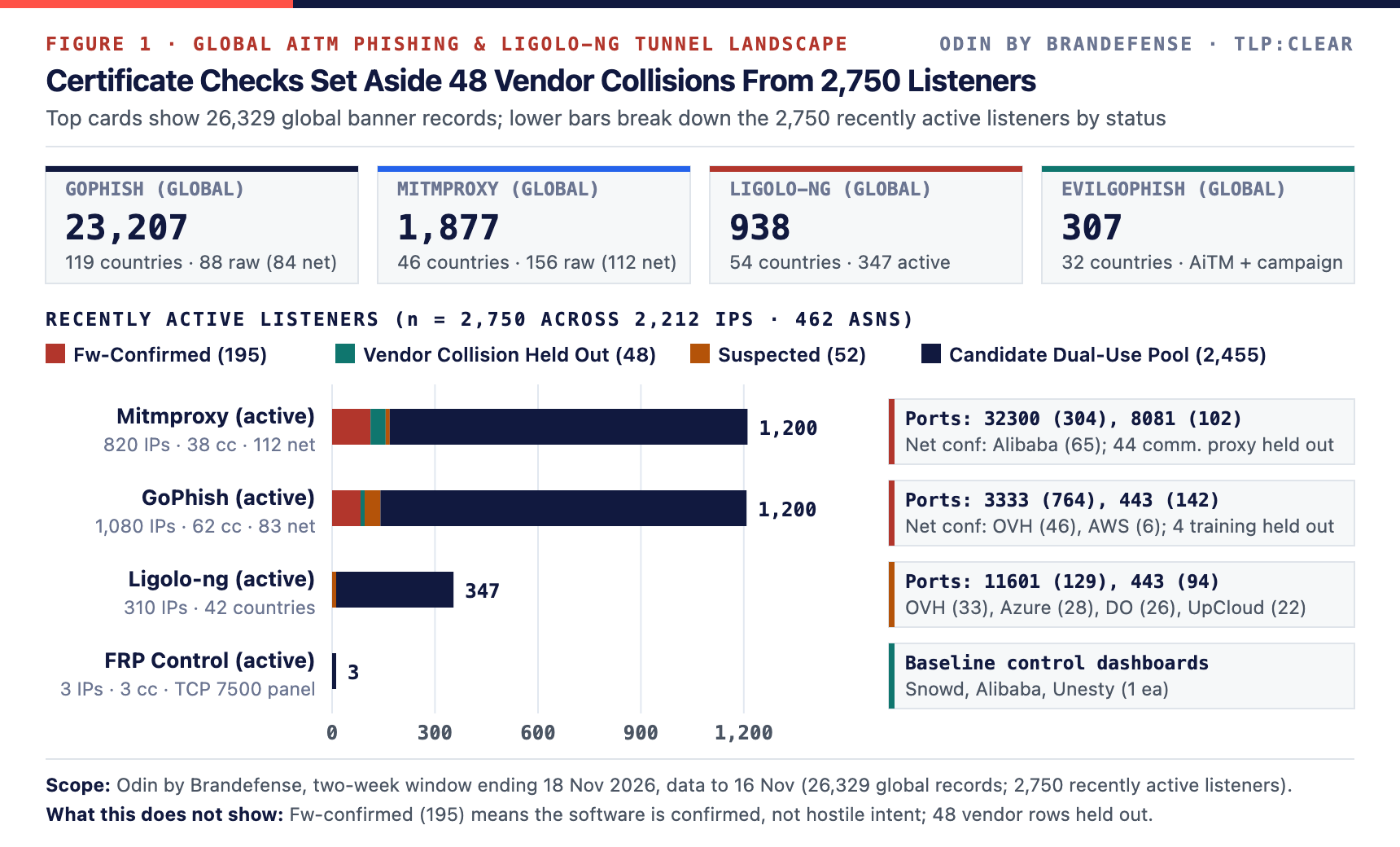
How the 2,750 listeners break down
"Framework confirmed" names the software. It does not mean hostile intent.
| Status | Listeners | What it contains | Handling |
|---|---|---|---|
| Watchlist, framework confirmed | 193 | 110 Mitmproxy, 72 GoPhish web or admin listeners, 11 FTPS rows reusing a GoPhish certificate | Watch; block only after a lure or egress signal |
| Watchlist, vendor certificate name | 48 | 44 commercial proxy and 4 awareness-training certificate names, chain trust not verified | Watch; verify the certificate chain before excluding or blocking |
| Suspected | 50 | 46 GoPhish, 1 Mitmproxy, 3 Ligolo-ng | Send to threat hunting |
| Candidate | 2,452 | 1,067 GoPhish, 1,043 Mitmproxy, 339 Ligolo-ng, 3 FRP | Hold; do not block |
| Held out | 7 | 2 FortiGate appliance certificates, 5 hits in a U.S. public-sector network | Keep off blocklists |
Figure 1 counts the 7 held-out rows inside their software status, so its legend shows 195 confirmed, 52 suspected and 2,455 candidates.
GoPhish: port 3333 and shared certificates
Of the 1,200 GoPhish listeners, 764 (63.7%) expose the default admin port 3333. Of those, 756 are candidates and 8 are confirmed.
Four confirmed rows carry the certificate name of a commercial security-awareness training vendor. Ownership and certificate-chain trust were not verified, so they are held out as possible collisions. That leaves 83 confirmed GoPhish rows: 72 web or admin listeners plus 11 FTPS rows.
The 72 web or admin listeners run on 443 (30), 8443 (12), 3000 (11), 3333 (8) and other web ports (11). OVH SAS hosts 46 of the 83 rows (55.4%), followed by Amazon.com (6), DigitalOcean (5) and netcup GmbH (1).
The 11 rows on TCP port 21 are FTPS daemons on OVH SAS. They reuse the same self-signed provider-default certificate that GoPhish uses on 443 and 8443 on the same cloned VPS hosts (33 rows share it). This is certificate reuse across services, not GoPhish speaking FTP.
Mitmproxy: a commercial proxy collision
Mitmproxy candidates cluster on high proxy ports: 32300 (304, on ALFA TELECOM s.r.o. and Serverel Inc.), 8081 (102) and 8080 (78 candidates plus 2 confirmed).
Of 156 confirmed Mitmproxy rows, 44 (28.2%) carry certificate names that match a commercial proxy network. Chain trust was not verified, so they stay on the watchlist as possible collisions. They make up all 37 of DigitalOcean's confirmed Mitmproxy rows and 7 of 8 on Constant/Vultr.
Removing the 44 leaves 112 confirmed rows, or 110 after setting aside 2 AWS listeners with CN=FortiGate appliance certificates. Hangzhou Alibaba Advertising hosts 65 of the 112 (58.0%). Of these, 64 share two private-range certificate names, 172.29.97.219 and 172.18.9.199, on 6xxx ports. Smaller groups sit on CV Griya Cloud Server (7), Contabo (7), Hetzner (6), AROSSCLOUD (1), HostPapa (1), Psychz Networks (1) and the small provider hosting Host B.
3. A Keystroke Streamer Beside Evilginx2 and Cobalt Strike
In short
An open directory on Host A holds three toolsets on one server: a static login cloner with a keystroke script, an Evilginx2 installation, and Cobalt Strike files. A 136,742-byte log file sits beside the keystroke receiver; its contents are not established.
Why capture keystrokes before submit
A static phishing clone only receives a password when the user clicks Submit. If the user types part of a password, notices the wrong domain and closes the tab, a normal clone gets nothing. The kit described here is designed to close that gap.
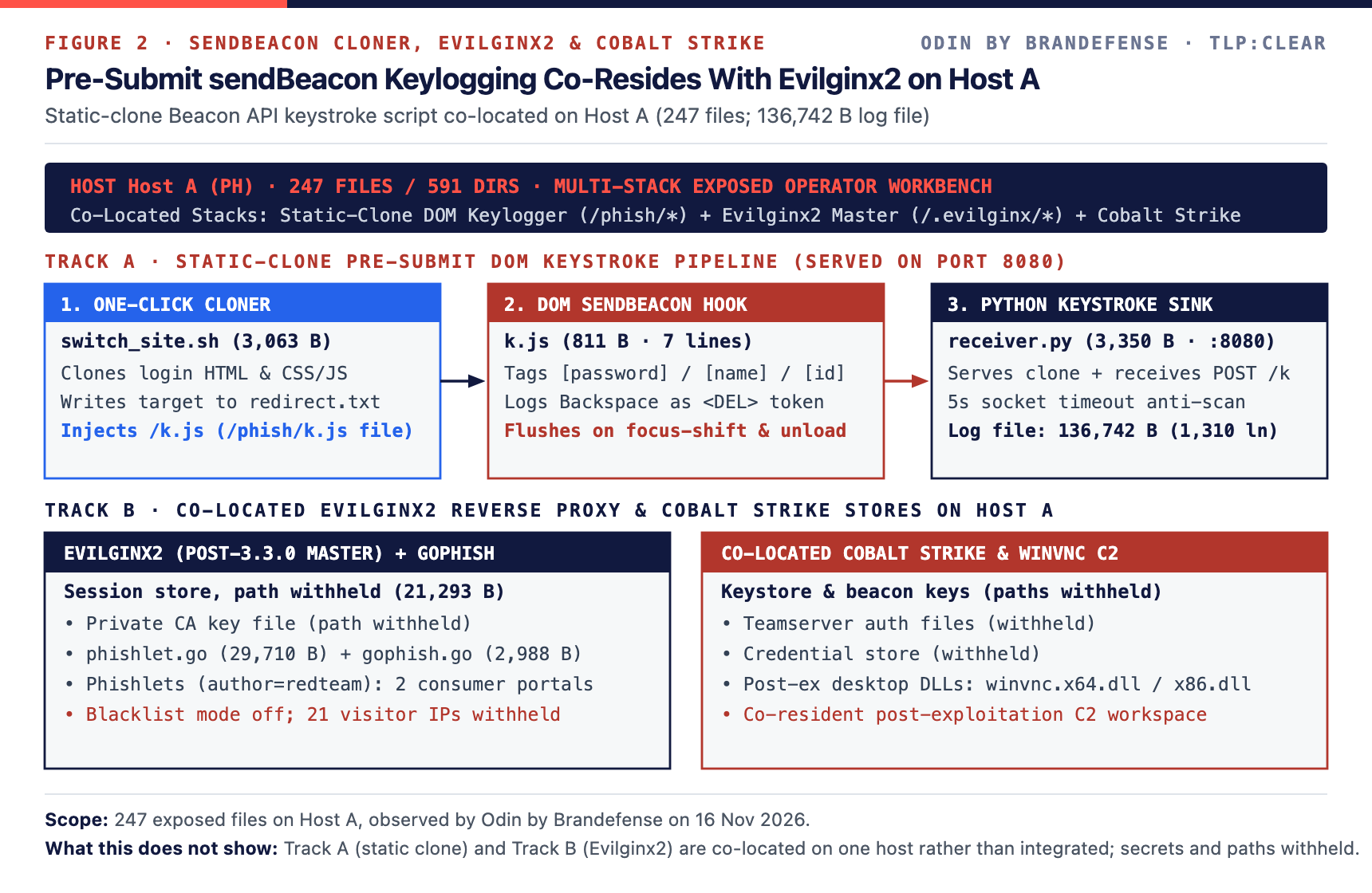
On 16 November 2026, Odin by Brandefense observed an open directory on Host A (Philippines). It exposes 247 files across 591 directories (4,258,037 bytes). Figure 2 maps how the parts fit together.
The static cloner kit
The kit has three files under /phish/. The table describes each one by structure only. No script content is reproduced.
| File | Size and lines | Role |
|---|---|---|
switch_site.sh | 3,063 bytes, 87 lines | Bash cloner. Downloads a target login page and its assets with a Chrome/133.0.0.0 User-Agent, inserts a script tag that loads k.js, and writes the real login URL to redirect.txt (51 bytes) |
k.js | 811 bytes, 7 lines | Keystroke script. Labels each input field by type, name or id, marks deletions with a text token, and sends the buffer to the server path /k |
receiver.py | 3,350 bytes, 89 lines | Python web server on port 8080. Serves the clone and the script, accepts posts to /k, sets a 5-second socket timeout and a wildcard CORS header |
The keystroke script uses the browser Beacon API (sendBeacon). A browser queues a Beacon request in the background and sends it even while the tab is closing. The request is a small text/plain POST. The script falls back to a keep-alive fetch only when the Beacon API is missing.
The script sends its buffer at two moments: when the user moves to a different field, and when the page unloads. That is why the kit can collect partial input from a user who never submits.
The cloner fetches every asset path without logging in. On single-page apps, this leaves a trace. Three files on the server with image names hold the same 27,793-byte HTML landing page instead of an image.
receiver.py carries comments in Simplified Chinese about protection against slow sockets. That is an artifact of whoever wrote the toolkit. It is not attribution of the operator.
Evilginx2 and Cobalt Strike on the same server
The same open directory holds a full Evilginx2 tree and a Cobalt Strike workspace. Paths and secrets are withheld.
| Component | What is exposed |
|---|---|
| Evilginx2 source | /evilginx2/ checkout built with Go 1.22. Its CHANGELOG opens with # Unreleased above # 3.3.0, so it is a post-3.3.0 master branch. Stock core/phishlet.go (29,710 bytes) and core/gophish.go (2,988 bytes) |
| Evilginx2 runtime | A BuntDB session store (21,293 bytes, 196 lines), a private root CA key file (1,679 bytes), a visitor blacklist with 21 addresses (withheld), and a config file (4,897 bytes) |
| Evilginx2 configuration | Binds its own public address (withheld) as external_ipv4, sets blacklist.mode: off, and lists two active lure paths |
| Phishlets | Two custom YAML phishlets (3,275 and 5,811 bytes) declare author: 'redteam' and target two Chinese consumer portals. Neither injects the keystroke script |
| Cobalt Strike | A keystore, teamserver authorization files, a beacon key pair, a credential store, the launcher source-common.sh, and TightVNC post-exploitation DLLs winvnc.x64.dll and winvnc.x86.dll |
The static cloner and Evilginx2 are co-located, not integrated. The phishlets do not load k.js. The author: 'redteam' tag and the unknown authorization mean a red-team exercise cannot be excluded.
File hashes for hunting
Hashes were recorded at acquisition.
| File | Size | SHA-256 | Use |
|---|---|---|---|
/phish/k.js | 811 bytes | dc89160b8501065099a69bc6a8f34ce085774878387d071f4e249eebb57a757b | Block: custom keystroke script |
/phish/receiver.py | 3,350 bytes | 629fd5033240e77684003b632c3b247671ac2043a4e87ae7f420feb836551a45 | Block: custom clone server and /k receiver |
/phish/switch_site.sh | 3,063 bytes | 7da269d7b5b55d409b71702dc53d4329bbeb0afb0540ab3d98896c3625836c54 | Block: custom portal cloner |
/evilginx2/core/phishlet.go | 29,710 bytes | 00d134e5be68c83a13c35101cd26aca6efe6af608144c35add5edf3a4139f336 | Context only: stock upstream source |
/evilginx2/core/gophish.go | 2,988 bytes | 6097864f26657ac5add013af5e17f508678dec3eb57548dbf37ea09e2a02a78c | Context only: stock upstream source |
The two Evilginx2 source files are unmodified upstream code. Do not block them on their own.
4. M365 Enumeration Scripts and a Co-Hosted noVNC Client
In short
Two separate, unlinked servers sit on the watchlist. Host C holds scripts written to enumerate Microsoft 365 accounts and test logins. Host B pairs a confirmed Mitmproxy listener with noVNC client files, which are one part of a possible replay setup.
Why replay location matters
When an attacker steals a session cookie through a cloud proxy and replays it from a laptop or VPN, identity systems often notice. Continuous Access Evaluation and risk-based Conditional Access react to the change of IP, network and location.
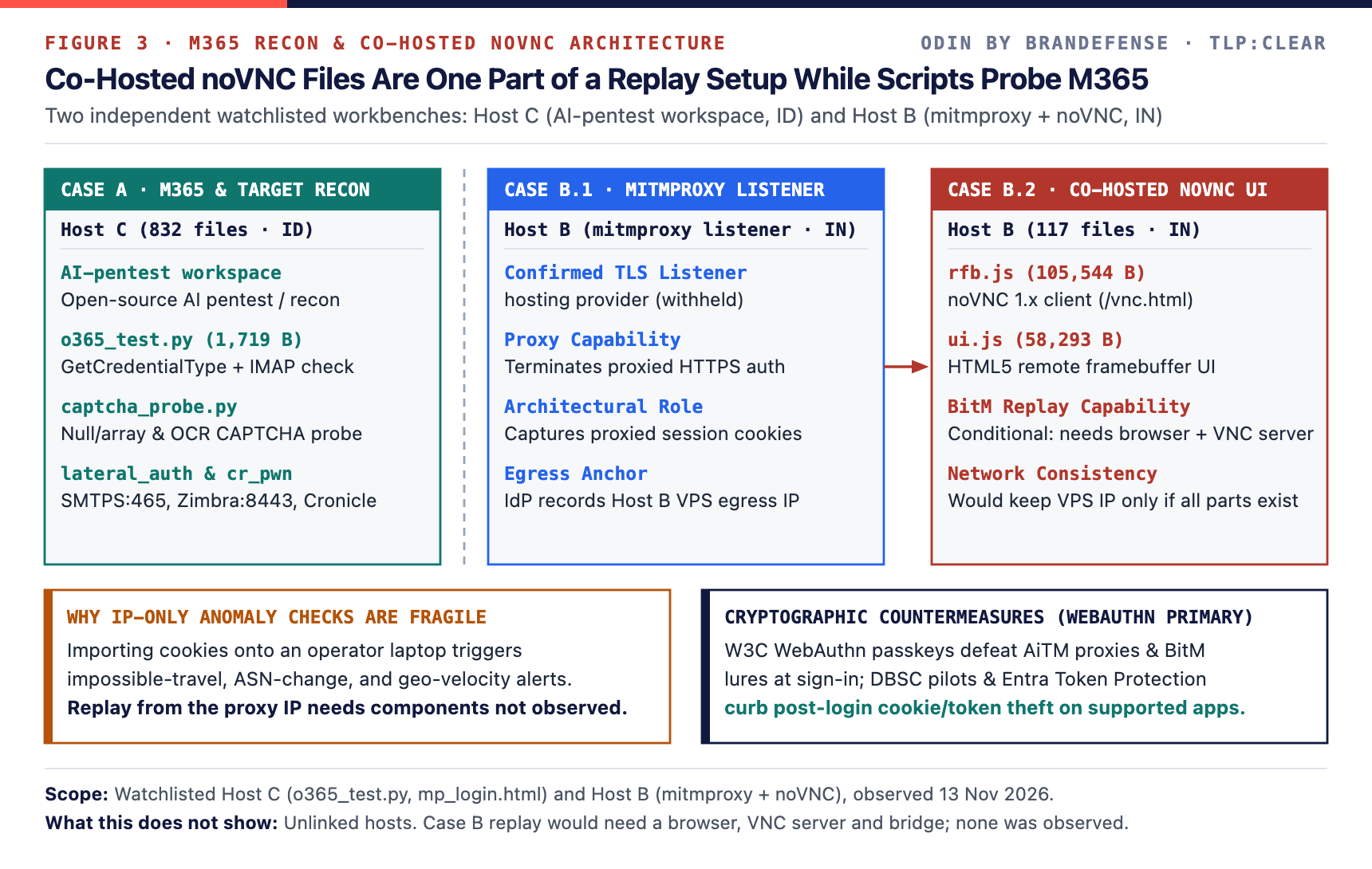
One way around this is to replay the cookie from the proxy server itself, through a remote browser. Host B shows one part of that setup. Figure 3 shows what was seen and what would still be needed.
Host C: an AI pentest workspace with M365 recon scripts
On 13 November 2026, Host C in Indonesia exposed 832 files (1,280,209 bytes). The directory was created by an open-source AI pentest workspace. That software is dual-use, and the scripts carry diagnostic strings such as zz-diag and auth-test. No result on any target is verified, so Host C stays on the watchlist and its address is withheld.
| File | Size and lines | SHA-256 | What it was written to do |
|---|---|---|---|
/o365_test.py | 1,719 bytes, 26 | 24146b8cbbafc57995e77c7a65e799fc471374b27c06a7ac931a7282c2c9cfaa | Query M365 GetCredentialType for 4 accounts and test IMAP login on port 993 |
/mp_login.html | 12,573 bytes, 109 | Withheld (copied third-party page) | Cloned merchant billing login page (also at /mplogin.html) |
/captcha_probe.py | 2,212 bytes, 51 | e0f5c20fa788887402f33aefbd98b5e6a5d33c2dc5af529adf72dcea7bbca871 | Test null and array CAPTCHA parameters and Tesseract OCR thresholds |
/lateral_auth.py | 2,153 bytes, 35 | e5c7d66e25771dded8a94810bd4ffe25ca05af325c30c666e29543a83d606f02 | Test credential reuse across SMTPS, Zimbra and Jenkins |
Account enumeration. o365_test.py is titled as an account-existence check. It was written to call the public login.microsoftonline[.]com/common/GetCredentialType endpoint and print whether each account exists, its throttle status, domain type and preferred credential. The isFidoSupported flag in its request is a standard client field, not a tenant check. A second loop was written to test basic-auth IMAP against outlook.office365[.]com:993. Outcomes are not verified.
Lures and CAPTCHA tests.
No Microsoft 365 phishing page sits on Host C. The lures are merchant billing login clones and a dark-theme Jenkins login (/login.html, 2,337 bytes). captcha_probe.py was written to test edge-case CAPTCHA inputs against a merchant endpoint.
Credential reuse and scheduler scripts.
lateral_auth.py was written to test reuse on SMTPS port 465, the Zimbra preauth service on 8443 and the Jenkins login check. Two more scripts, cr_pwn.py and cr_rce_proof.py, were written to modify jobs on a merchant's Cronicle scheduler with a callback to Host C. Target-side outcomes are not verified.
Host B: Mitmproxy beside a noVNC client
Host B is a VPS at a small hosting provider in India. It runs a confirmed Mitmproxy TLS listener. On 13 November 2026, the same IPv4 address also served an open HTTP directory of 117 files (917,101 bytes). It is a complete noVNC 1.x HTML5 remote-framebuffer client, with a 2020 copyright.
| File | Size | Note |
|---|---|---|
/core/rfb.js | 105,544 bytes, 2,988 lines | Stock noVNC core |
/app/ui.js | 58,293 bytes, 1,715 lines | Stock noVNC interface |
/core/websock.js | 10,593 bytes | Stock noVNC WebSocket layer |
/vnc.html, /vnc_lite.html, /utils/novnc_proxy | n/a | Client pages and proxy helper |
The listing shows static client files next to the proxy. It does not show a live VNC session or any cookie import. Replay from the same IP would also need a running browser, a VNC server, a WebSocket bridge and a cookie transfer. None of these was observed, and a noVNC client alone does not replay cookies. No login lure or victim session was found, so Host B stays on the watchlist and its address is withheld.
What stops this kind of attack
If an operator did run a browser on the proxy VPS, IP-consistency and impossible-travel rules would not fire. The main defence is at sign-in: origin-bound passkeys. A passkey is tied to the real site's origin, so it will not sign in through a reverse proxy or a remote viewer. A proxy can also strip DBSC headers, so DBSC alone is not enough at sign-in.
| Control | When it acts | Scope and limits |
|---|---|---|
| W3C WebAuthn / FIDO2 passkeys | At sign-in (primary AiTM and browser-in-the-middle defence) | Origin-bound challenge defeats reverse-proxy and remote-viewer phishing |
| W3C DBSC | After sign-in, at cookie refresh | Work-in-progress Editor's Draft; browser pilots only |
| Entra ID Token Protection | After sign-in, token binding | Native apps on Windows, iOS/iPadOS and macOS, plus limited browser preview support |
5. Ligolo-ng Tunnel Relays and the YoroTrooper Cluster
In short
Ligolo-ng gives an attacker a routed tunnel into an internal network through one encrypted connection. Recently active relays sit on mainstream cloud and VPS networks and favour the default port 11601 or HTTPS 443.
How Ligolo-ng works
Older pivoting through SOCKS proxies forces operators to wrap each tool in proxychains. That approach hooks sockets through LD_PRELOAD, handles ICMP and UDP poorly, and creates many short connections.
Ligolo-ng works differently. The relay on the operator side creates a virtual Layer-3 TUN interface (through ip tuntap, its own interface_create command, or wintun.dll on Windows). It handles the packets in Google's userland gVisor netstack.
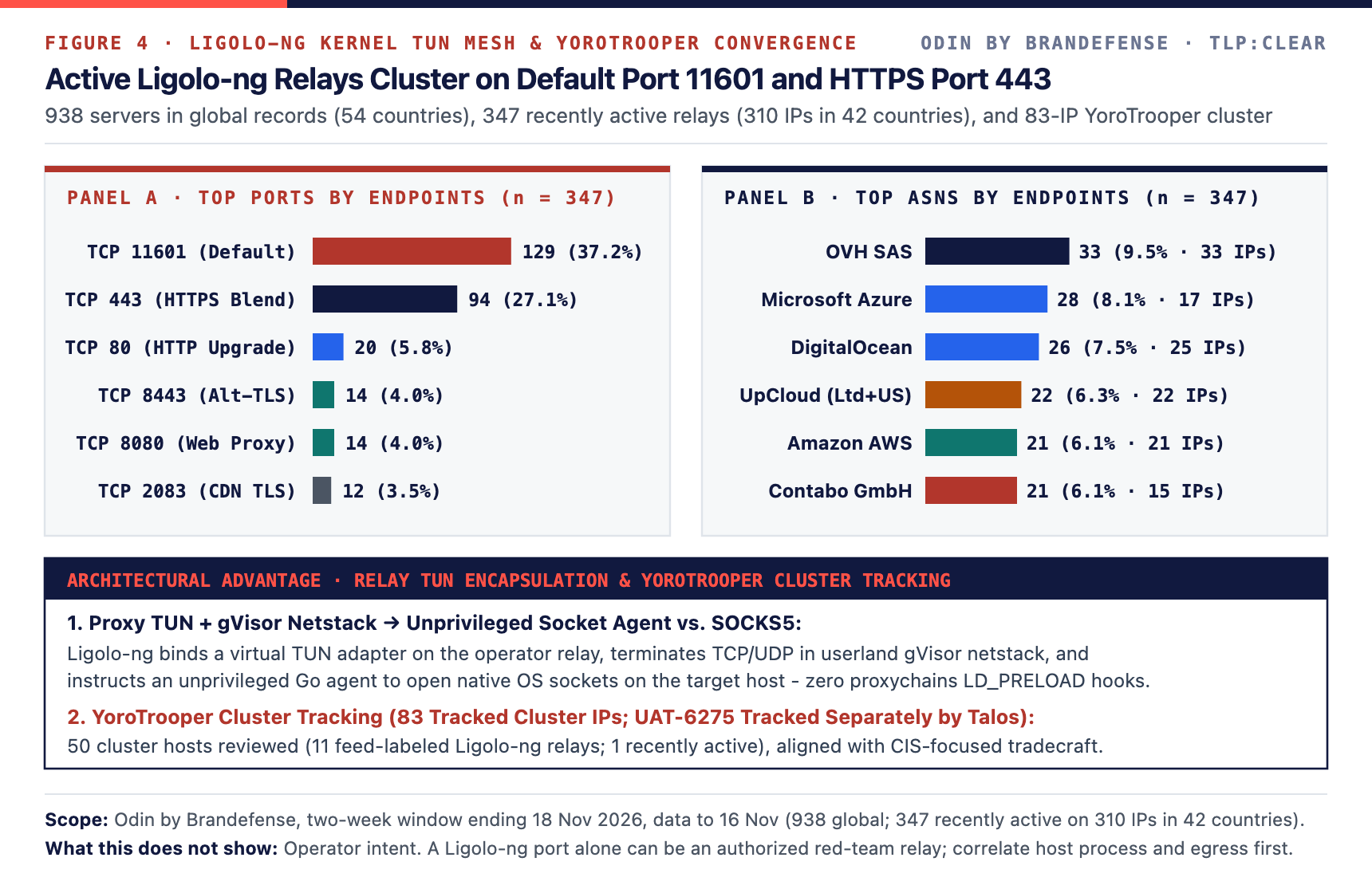
The relay then tells an unprivileged Go agent on the target host to open ordinary TCP and UDP sockets. All traffic travels over a single TLS or WebSocket stream (MITRE ATT&CK T1572). Figure 4 summarises ports, hosting and the YoroTrooper overlap.
Ports
| Port | Relays (share) | Profile | Typical hosting |
|---|---|---|---|
| TCP 11601 | 129 (37.2%) | Unchanged default relay port | OVH SAS (IN, FR), DigitalOcean (SG, DE), Contabo (DE), Hangzhou Alibaba (CN) |
| TCP 443 | 94 (27.1%) | HTTPS port to pass strict firewalls, with Let's Encrypt or self-signed TLS | Microsoft (US), Amazon.com (US, FR, KR), DigitalOcean (SG), Google (BE) |
| TCP 80 | 20 (5.8%) | Plain HTTP or WebSocket upgrade, or ACME HTTP-01 challenge | Amazon.com (CA), DigitalOcean (US), Contabo (FR), WorldStream (NL) |
| TCP 8443 and 8080 | 14 (4.0%) each, 28 (8.1%) combined | Alternate HTTPS and web-proxy ports, often paired on one relay | Microsoft (US), Oracle (CL), Yandex.Cloud (RU), Google (US) |
| TCP 2083, 11602 to 11607, 4445 | 19 (12 on 2083, 5 sequential, 2 on 4445) | CDN-compatible TLS port, multi-agent ports, a custom port | Microsoft (2083), HOSTING INDUSTRY (11601 to 11607), Contabo (4445) |
Countries and hosting
The United States (94), India (40), France (29), Germany (27), Russia (21) and Singapore (19) hold 230 of the 347 relays (66.3%). The relays sit inside mainstream cloud and European VPS networks, so their outbound TLS blends with ordinary SaaS traffic.
| Hosting provider (ASN) | Relays (share) | Distinct IPs | Pattern |
|---|---|---|---|
| OVH SAS (AS16276) | 33 (9.5%) | 33 | Single-listener VPS relays in India, France, Singapore and Canada |
| Microsoft (AS8075) | 28 (8.1%) | 17 | Azure relays pairing 443, 8443 and 2083 on shared IPs |
| DigitalOcean (AS14061) | 26 (7.5%) | 25 | Single-port droplets on 11601 and 443 in US, SG, DE and GB |
| UpCloud (AS202053 / AS25697) | 22 (6.3%) | 22 | 14 on UpCloud Ltd and 8 on UpCloud USA, mostly on 11601 |
| Amazon.com (AS16509 / AS14618) | 21 (6.1%) | 21 | Single-listener EC2 relays, mostly 443 and 80 |
| Contabo (AS51167) | 21 (6.1%) | 15 | Multi-port European VPS nodes on 11601, 443, 80 and 4445 |
None of the 347 relays is confirmed: 5 are suspected and 342 are candidates. At the port and banner level, a Ligolo-ng relay looks the same as an authorized red-team relay. Five of the hits sit inside a U.S. public-sector network and are held out, since they may be banner collisions, authorized testing or exposure on the victim side.
YoroTrooper overlap
Cisco Talos documents YoroTrooper espionage campaigns against organisations in the Commonwealth of Independent States (CIS), Turkey and Europe. The group uses spear-phishing, credential harvesting, Python information stealers and reverse shells.
In a 2026 assessment of the Kazakhstan-nexus group UAT-6275, Talos noted the two may sit in a broader CIS-targeting cluster. Talos still tracks UAT-6275 separately, because it saw no direct indicator or tool overlap.
Separately from Talos, third-party feeds tag 83 IPv4 addresses as YoroTrooper-related infrastructure (tags NIK C2, Chvost, Laplas, PickleShell and SSDPShell). Of 50 of these hosts that we reviewed, 11 carry feed labels for Ligolo-ng, dated 14 to 15 October 2026. They sit on DigitalOcean (6), MTS PJSC (3), Contabo (1) and Enterprise Cloud Ltd. (1).
Only 1 of the 11 appears among the recently active relays. The other 10 showed no recent Ligolo-ng banner. Feed tags are not attribution, so these addresses are not published.
6. Keeping Vendors and Dual-Use Tools off Blocklists
In short
Raw feeds label commercial proxies, training platforms and appliances as hostile. Separating them, and separating watchlists from blocklists, keeps enterprise controls accurate.
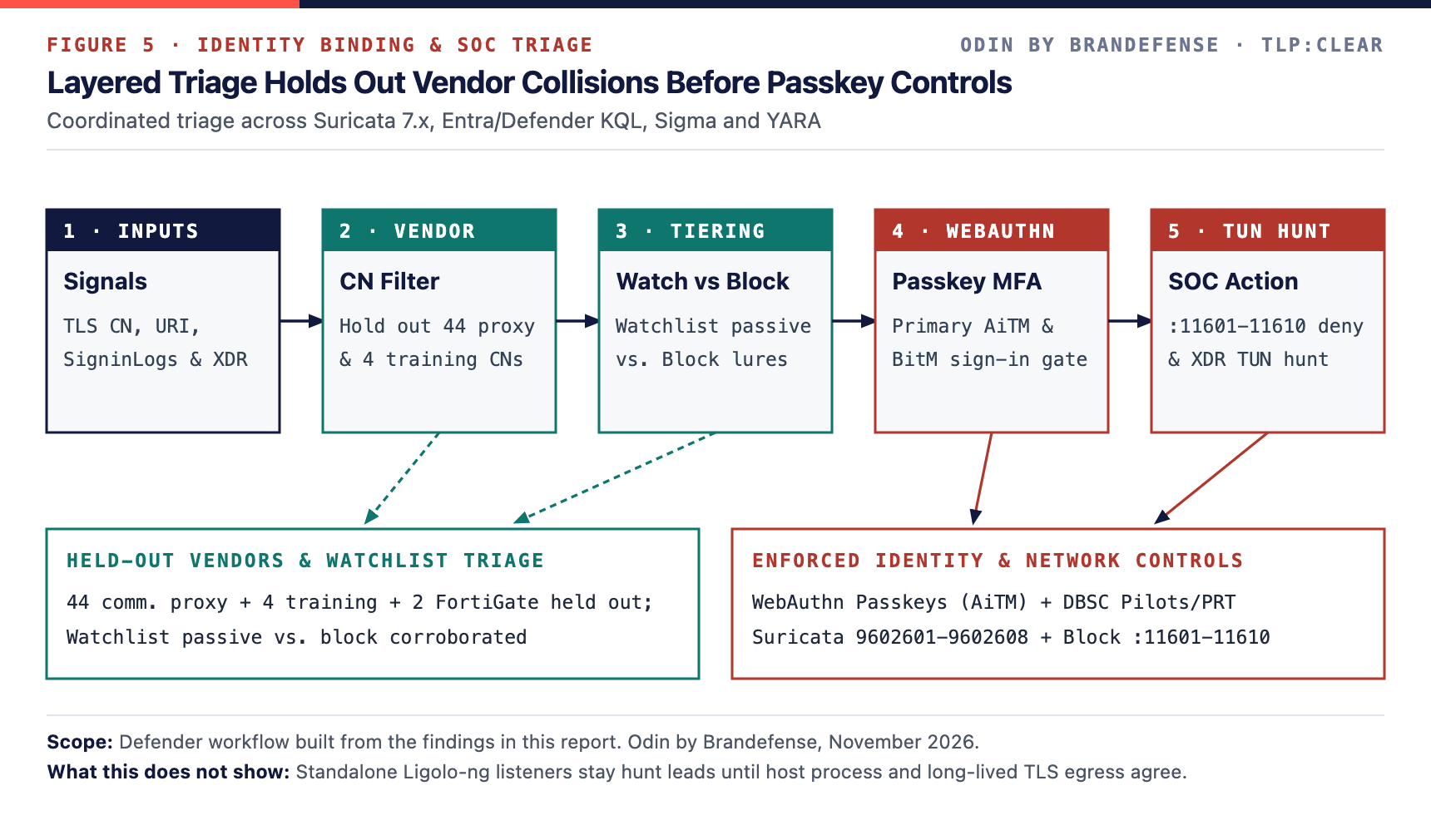
Seven rules shape every number and indicator in this report. Each one is also a rule a SOC can apply to its own feeds.
- Awareness-training certificates are held out. Four confirmed GoPhish rows on 2 AWS IPs carry a training vendor's certificate name. The 83 other confirmed GoPhish rows (84 in global records) stay on the watchlist. Unverified GoPhish banners (23,119 globally, 1,113 in the active set) are held.
- Commercial proxy and appliance certificates are held out. Of 156 confirmed Mitmproxy rows, 44 (37 DigitalOcean and 7 Constant/Vultr) carry commercial proxy certificate names and 2 carry
CN=FortiGate. The other 112 (110 without FortiGate) stay on the watchlist. Unverified Mitmproxy rows (1,721 globally, 1,044 in the active set) are held. - Authorized testing servers and public-sector hits are excluded. One authorized out-of-band testing server is left out of all hostile counts. The 5 Ligolo-ng hits in a U.S. public-sector network are excluded from adversary VPS claims and anonymised.
- Ligolo-ng listeners stay hunt leads. The 347 relays (342 candidates, 5 suspected) are never promoted to a blocklist without endpoint egress evidence.
- Stock open-source files are never blocked alone. The noVNC (
rfb.js,ui.js) and Evilginx2 (phishlet.go,gophish.go) hashes only show co-hosting context. Blocking them alone would break legitimate Proxmox VE, OpenStack and VDI consoles. - Red-team provenance is considered. Host A holds a keystroke receiver, an Evilginx2 store and Cobalt Strike files together. Its authorization is unknown and a red-team exercise cannot be excluded, so its address is withheld. Its custom script hashes stay published as tool indicators. Host B and Host C stay on watchlists with addresses withheld.
- Victim and third-party data are withheld. The 21 visitor IPs in the Evilginx2 blacklist, the consumer portal domains, the Cronicle server address, merchant paths, API keys, tested credentials and all non-confirmed listener addresses are withheld.
In total, 24,840 unverified dual-use records are kept off blocklists. Vendor certificate names should only lead to exclusion when the certificate chain is verified as trusted. A self-signed certificate that copies a vendor name is a reason to look closer, not to exclude.
7. What Defenders Should Do
Identity
- Require origin-bound W3C WebAuthn passkeys with device-compliance Conditional Access as the primary control against AiTM proxies and noVNC lures.
- Turn off legacy IMAP and SMTP basic authentication.
- Add Entra ID Token Protection on supported native apps (Windows, iOS/iPadOS, macOS, plus limited browser preview support) and pilot browser DBSC on supported sites.
Network
- Block outbound traffic to TCP 11601 to 11610.
- Run the Sentinel query that links risky sign-ins to tunnel connections within 24 hours.
- Test the eight Suricata signatures in a lab, then deploy them at the perimeter, in EASM tooling and on decrypted proxy taps. Exclude sanctioned VDI consoles from SIDs 9602604 and 9602608.
- Alert on
text/plainPOSTs to a/kpath whose body starts with a bracketed field label.
Endpoint
- Test, then deploy, the five Sigma rules for Ligolo-ng agents on Linux and Windows, unsanctioned
wintun.dllloads, and noVNC or Evilginx2 processes on cloud VMs.
Triage
- Keep commercial proxy, awareness-training and FortiGate certificate rows, port-3333 pools and stock open-source hashes off blocklists.
- Keep passive listeners and dual-use workspaces on watchlists until a lure or egress signal corroborates them.
8. Detection Rules
The full rules are in the Detection rules tab. No rule was run on a live engine; test each one in your own environment before deployment.
| Rule file | What it catches |
|---|---|
suricata_aitm_sendbeacon_and_ligolo.rules | Suricata 7: eight signatures for keystroke beacons, exposed Evilginx2 and noVNC, M365 enumeration bursts, Ligolo-ng ports, non-browser WebSocket upgrades and VNC greetings |
sentinel_aitm_token_replay_and_ligolo_hunt.kql | Microsoft Sentinel and Defender XDR: tunnel connections linked to risky Entra ID sign-ins by the same user |
sigma_evilginx_novnc_and_ligolo_agent.yml | Sigma (5 rules): Ligolo-ng agents, unsanctioned wintun.dll loads, noVNC and Evilginx2 or cloner processes |
yara_aitm_keylogger_and_phish_toolkits.yar | YARA (4 rules): the keystroke script, the receiver, the cloner, and the M365 and credential-reuse scripts |
How the Suricata signatures work
| SID | Looks for | Where to deploy |
|---|---|---|
| 9602601 | Outbound text/plain POST to a path ending in /k, whose body starts with a short bracketed field label | Perimeter or decrypted web proxy |
| 9602602 | Request URIs for exposed Evilginx2 runtime, phishlet, core or database folders | EASM and hunting |
| 9602603 | Inbound script that contains the Beacon API name, a deletion token and a page-unload event name close together | EASM and decrypted proxy |
| 9602604 | Inbound HTTP 200 response with noVNC client pages or core/rfb.js | EASM and hunting; exclude sanctioned VDI |
| 9602605 | Four or more GetCredentialType POSTs from one source in 120 seconds, from a client without the browser sec-fetch-site header | SSL-inspecting proxy or cloud tap |
| 9602606 | Outbound TLS client hello to ports 11601 to 11610 | Perimeter; a port-policy alert |
| 9602607 | Outbound WebSocket upgrade without Origin or Cookie headers, rate-limited per source | Perimeter; a hunting rule |
| 9602608 | Inbound raw VNC RFB 003.00x server greeting | EASM and hunting; exclude sanctioned VDI |
SID 9602605 tolerates both compact JSON and Python json.dumps() spacing in the request body. It excludes browsers by the missing header, not by user agent.
How the Sentinel query works
The query looks back 14 days. It first builds a list of successful Entra ID sign-ins that are risky: medium or high risk, risk events such as anomalousToken, or a sign-in from a high-concentration relay network on a non-compliant device. The relay network list holds six ASNs, including OVH (16276), Contabo (51167) and UpCloud (202053 and 25697).
It then takes device connections to ports 11601 to 11610, or to 443, 8443, 2083, 8080 and 4445 from non-browser processes whose command line names Ligolo-ng flags or wintun. It joins the two on the user account and keeps a sign-in only if the tunnel started within 24 hours of it.
The output labels each row. "Identity-correlated tunnel" means a risky sign-in matched. "Port policy only" means a connection to a default Ligolo-ng port with no matching sign-in. Connection counts are deduplicated so the join does not inflate them.
How the Sigma rules work
| Rule | Fires when |
|---|---|
| 1. Ligolo-ng Linux agent | A Linux process starts with a connect argument (host:port, https:// or wss://) under a default agent name, or a renamed binary carries Ligolo flags such as -ignore-cert, -accept-fingerprint, -retry or a :1160x port |
| 2. Ligolo-ng Windows agent | The same logic on Windows; curl --connect-timeout and openssl s_client are excluded |
| 3. Wintun DLL load | wintun.dll loads into a process that is not an approved VPN client executable (exact paths for WireGuard, Tailscale and Cloudflare WARP; add your own) |
| 4. noVNC on a cloud VM | noVNC or websockify starts on cloud or VPS hosts |
| 5. Evilginx2 or cloner on a cloud VM | Evilginx2 or a switch_site.sh cloner starts on cloud or VPS hosts |
A renamed agent that dials plain host:443 without Ligolo flags will not trip rules 1 and 2. The Sentinel query covers that case through network correlation.
How the YARA rules work
Each YARA rule is limited to files under 64 KB and needs all of its strings to match.
| YARA rule | Targets |
|---|---|
ODIN_AiTM_SendBeacon_PreSubmit_Keylogger_JS | The 811-byte keystroke script |
ODIN_AiTM_CORS_Keystroke_Receiver_Python | The Python clone server and /k receiver |
ODIN_AiTM_OneClick_Login_Site_Cloner_Shell | The Bash portal cloner |
ODIN_M365_GetCredentialType_And_Lateral_Auth_Toolkit | o365_test.py or lateral_auth.py |
How to sort a host
The triage logic never blocks on a file path alone. It needs reviewed file content, or live interception or egress evidence. It checks for exposed hostile files before it applies any vendor exclusion, so a self-signed certificate that copies a vendor name does not get a free pass.
| What the host shows | Action |
|---|---|
| Vendor certificate name with a verified trusted chain, FortiGate appliance, authorized testing server | Exclude |
| Vendor certificate name with unknown or failed chain trust | Watchlist |
| Unverified GoPhish on 3333, unverified Mitmproxy, Ligolo-ng on 11601 alone | Hold or hunt |
| A hit inside a public-sector network | Review only |
| Confirmed passive listener, co-hosted proxy and noVNC, dual-use recon workspace, workbench paths without reviewed content | Watchlist |
| Ligolo-ng relay with endpoint egress, keystroke receiver with reviewed content, active browser-in-the-middle | Block |
Vendor names in this logic are placeholders. Supply your own allowlists, and mark a chain as trusted only when you have checked it.
9. Indicators
The Indicators tab holds the 3 custom script hashes from Host A, whose address is withheld. The other 25 records in the selected set are watch, hunt or context entries described below.
| Type | Count | Action |
|---|---|---|
| Host A (address withheld) | 1 | Hunt by its file hashes |
| Custom script hashes (SHA-256) from that host | 3 | Hunt |
| Watchlisted hosts (Host B, Host C) | 2 | Watch; addresses withheld |
| Host C script and lure hashes (SHA-256) | 4 | Watch |
| Framework-confirmed Mitmproxy and GoPhish listener profiles | 9 | Watch; addresses withheld |
| Stock open-source hashes (Evilginx2, noVNC) | 4 | Context only; do not block alone |
| Candidate Ligolo-ng relay profiles | 5 | Hunt egress only; addresses withheld |
Hunt
| Indicator | Port | What it is |
|---|---|---|
dc89160b8501065099a69bc6a8f34ce085774878387d071f4e249eebb57a757b | n/a | k.js keystroke script |
629fd5033240e77684003b632c3b247671ac2043a4e87ae7f420feb836551a45 | n/a | receiver.py clone server and receiver |
7da269d7b5b55d409b71702dc53d4329bbeb0afb0540ab3d98896c3625836c54 | n/a | switch_site.sh portal cloner |
Context only (stock open-source files)
| SHA-256 | File | Where found |
|---|---|---|
00d134e5be68c83a13c35101cd26aca6efe6af608144c35add5edf3a4139f336 | Evilginx2 core/phishlet.go (29,710 bytes) | Host A |
6097864f26657ac5add013af5e17f508678dec3eb57548dbf37ea09e2a02a78c | Evilginx2 core/gophish.go (2,988 bytes) | Host A |
331109966c80bef620bcd09242d43dbc05fa83cb44eba439ad20148f86aa479e | noVNC core/rfb.js (105,544 bytes) | Host B |
70ba76ca86ceaea27dc338bbfee4cebcfef1160812c8d410241f3667dff4864c | noVNC app/ui.js (58,293 bytes) | Host B |
Three of the four Host C hashes are in the Host C table in Chapter 4. The fourth, for the cloned login page /mp_login.html, is withheld because the page copies a third-party site. The nine watchlisted listener profiles sit on hosting providers in the United States, Vietnam, Germany, Russia and Indonesia. The five candidate relays sit on providers in the United States, China and India.
Withheld: the addresses of Host B, Host C, the nine watchlisted listeners and the five candidate relays; the 83 YoroTrooper-tagged addresses; the 21 visitor IPs; and all third-party portal, merchant and certificate names.
MITRE ATT&CK mapping
| Tactic | Technique | Where it appears | Detection |
|---|---|---|---|
| Credential Access, Collection | T1557 Adversary-in-the-Middle | Evilginx2 tree on Host A; confirmed Mitmproxy listeners | SID 9602602; Sigma rule 5 |
| Credential Access | T1539 Steal Web Session Cookie | Evilginx2 session store; Host B proxy and noVNC pairing | SIDs 9602604, 9602608; Sigma rule 4 |
| Command and Control | T1572 Protocol Tunneling | 347 recently active Ligolo-ng relays | SIDs 9602606, 9602607; Sentinel query; Sigma rules 1 to 3 |
10. Scope and Limits
- Window. Findings come from a two-week observation window ending 18 November 2026, with a data cutoff of 16 November; most listeners were last seen from 12 November onward. The workbenches were observed on 13 and 16 November 2026.
- Global records are totals, not a timeline. The 26,329 global banner records count every record on file for each framework. They do not mean Odin watched these hosts for a long period, and they support no trend claims.
- Confirmed is not hostile. A framework-confirmed listener runs the software. It may be a red team, a researcher or a training platform. That is why confirmed listeners sit on watchlists.
- Files show intent, not outcomes. The scripts on all three workbenches show what they were written to do. No target-side result was verified, and the contents of the 136,742-byte log file are not established.
- No campaign link. Nothing links Host A, Host B and Host C to each other. They are three separate findings.
- Feed tags are not attribution. The YoroTrooper overlap rests on third-party feed labels. It is not tied to the Talos reports by a matching indicator.
- Rule testing. Every published rule file loads without errors in its engine (Suricata 7.0.12, YARA-X, pySigma and Microsoft's Kusto.Language analyzer, checked on 20 November 2026). The rules were not replayed against live traffic, so test and tune them in your own environment before production use.
11. Sources
- MITRE ATT&CK T1557: Adversary-in-the-Middle. https://attack.mitre.org/techniques/T1557/ (verified 18 November 2026)
- MITRE ATT&CK T1539: Steal Web Session Cookie. https://attack.mitre.org/techniques/T1539/ (verified 18 November 2026)
- W3C. Beacon specification. https://www.w3.org/TR/beacon/ (verified 18 November 2026)
- W3C. Web Authentication Level 3. https://www.w3.org/TR/webauthn-3/ (verified 18 November 2026)
- W3C. Device Bound Session Credentials, Editor's Draft. https://w3c.github.io/webappsec-dbsc/ (verified 18 November 2026)
- Microsoft. Token Protection in Entra ID Conditional Access. https://learn.microsoft.com/en-us/entra/identity/conditional-access/concept-token-protection (verified 18 November 2026)
- MITRE ATT&CK T1572: Protocol Tunneling. https://attack.mitre.org/techniques/T1572/ (verified 18 November 2026)
- nicocha30. Ligolo-ng repository. https://github.com/nicocha30/ligolo-ng (verified 18 November 2026)
- Cisco Talos. YoroTrooper espionage campaign targets CIS, Turkey and Europe. https://blog.talosintelligence.com/yorotrooper-espionage-campaign-cis-turkey-europe/ (verified 18 November 2026)
- Cisco Talos. Kazakhstan-nexus UAT-6275 targets CIS government organizations. https://blog.talosintelligence.com/break-the-silence-kazakhstan-nexus-uat-6275-targets-cis-government-organizations/ (verified 18 November 2026)
What is…?
Short explanations of the tools and families named in this study.
What is Ligolo-ng?
Ligolo-ng is an open-source tunneling tool that builds a network tunnel from a compromised host through a TUN interface.
More about Ligolo-ngPhishing frameworkWhat is Evilginx2?
Evilginx2 is an open-source adversary-in-the-middle phishing proxy that captures credentials and session cookies.
More about Evilginx2Remote accessWhat is noVNC?
noVNC is an open-source VNC client that runs in a web browser. Phishing kits abuse it to show victims a real browser hosted by the attacker.
More about noVNCPhishing frameworkWhat is GoPhish?
GoPhish is an open-source phishing simulation framework. Companies use it for awareness training and attackers use it for real campaigns.
More about GoPhishC2 frameworkWhat is Cobalt Strike?
Cobalt Strike is commercial adversary simulation software. Its Beacon implant gives an operator remote control of a compromised host. Cracked and leaked copies are widely used by ransomware and espionage operators.
More about Cobalt StrikeEnterprise softwareWhat is FortiGate?
FortiGate is Fortinet's line of firewall and VPN appliances. Exploited edge devices are a common entry point and a place to hide C2.
More about FortiGateFrequently asked questions
How does a phishing kit capture a password nobody submitted?
A normal phishing clone only receives a password when the user clicks Submit. If the user types half a password, notices the wrong web address and closes the tab, the attacker gets nothing.
What do the other two workbenches show?
The other two servers are on our watchlist, and their addresses are withheld. Why does that pairing matter? When an attacker replays a stolen cookie from a laptop, identity systems often flag the new location. Replaying it from a browser on the proxy server itself would keep the same address. But that also needs a running browser, a VNC server and a connecting bridge. None of these was observed on Host B.
Where do the tunnel relays run?
Once inside, attackers need a route into internal networks. Ligolo-ng provides one. Its relay creates a virtual network interface on the attacker's server. A small agent on the victim host then opens ordinary connections, all carried over a single encrypted stream.
Why not just block every listener?
Because many of them are not hostile. Among confirmed Mitmproxy listeners, 44 carry the certificate name of a commercial proxy network. Four confirmed GoPhish listeners carry the name of a security-awareness training vendor. Two more carry FortiGate appliance certificates.