


Key takeaways
- One exposed server holds a kit built to send keystrokes before a login form is submitted.
- The same server carries Evilginx2 and Cobalt Strike files; its authorization is unknown.
- A separate server pairs a Mitmproxy listener with noVNC client files, one part of a cookie-replay setup.
- 347 recently active Ligolo-ng relays favour default port 11601 and HTTPS 443.
- Origin-bound passkeys and an outbound block on ports 11601 to 11610 address the main risks.
In a two-week window, with data up to 16 November 2026, Odin by Brandefense reviewed 2,750 recently active phishing, proxy and tunnel listeners on 2,212 hosts in 69 countries. We also looked inside three exposed operator workbenches. One holds a phishing kit built to capture what a user types before they press Sign in. Another pairs an interception proxy with a remote browser viewer. Across the internet, Ligolo-ng tunnel relays sit on ordinary cloud networks. For defenders, these are the tools that get attackers past MFA and into internal networks.
These are three separate findings. Nothing links the three workbenches to each other, and we make no claim of a single campaign.
How does a phishing kit capture a password nobody submitted?
A normal phishing clone only receives a password when the user clicks Submit. If the user types half a password, notices the wrong web address and closes the tab, the attacker gets nothing.
On 16 November 2026, an open directory on a server in the Philippines exposed 247 files. Its address is withheld, because a red-team exercise cannot be excluded. Among them is a small kit that closes this gap. It has three parts:
- A cloner script (87 lines of Bash) copies a target login page and its assets to the server. It adds one line that loads a keystroke script and saves the real login address for a redirect.
- A keystroke script (811 bytes, 7 lines) labels each field it sees, such as a password or user-name box. It sends what was typed to the server when the user moves to another field or leaves the page.
- A small Python web server on port 8080 serves the clone and accepts the typed text. A 136,742-byte log file sits beside it. We did not establish what it contains.
The script uses the browser Beacon API. Browsers send Beacon requests in the background, even while a tab is closing. That is what lets the kit catch partial input.
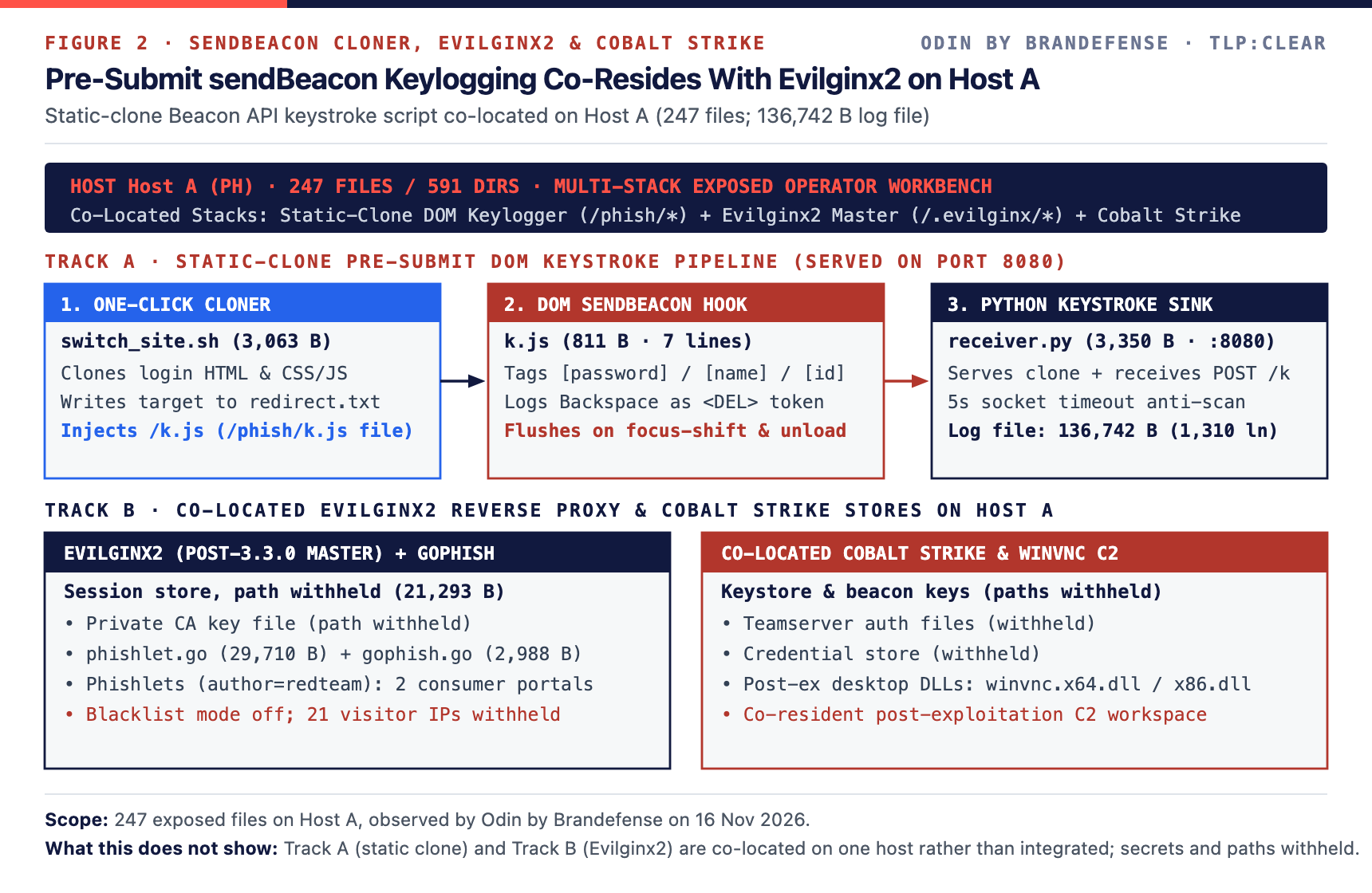
The same server holds a full Evilginx2 installation and a Cobalt Strike workspace. Evilginx2 is a reverse proxy that captures session cookies after MFA. Its two custom phishlets target Chinese consumer portals and are signed author: 'redteam'. The keystroke kit and Evilginx2 are side by side, not wired together.
We do not know who runs this server. A red-team exercise cannot be excluded. We still list the address and the three custom script hashes for blocking, because the toolsets together have no place in a normal network.
What do the other two workbenches show?
The other two servers are on our watchlist, and their addresses are withheld.
Host C, Indonesia (832 files).
An open-source AI pentest workspace left its project folder exposed. It holds scripts written to check whether Microsoft 365 accounts exist and to test old-style IMAP logins. Others test password reuse on mail, Zimbra and Jenkins, and try to change jobs on a merchant's task scheduler. Cloned merchant login pages sit next to them. The workspace is dual-use, and we did not verify any result on a target.
Host B, India (117 files).
This server runs a confirmed Mitmproxy listener, an interception proxy. On the same address, it serves the noVNC client, a browser-based remote desktop viewer.
Why does that pairing matter? When an attacker replays a stolen cookie from a laptop, identity systems often flag the new location. Replaying it from a browser on the proxy server itself would keep the same address. But that also needs a running browser, a VNC server and a connecting bridge. None of these was observed on Host B. The noVNC files are one part of such a setup, not proof of it.
Where do the tunnel relays run?
Once inside, attackers need a route into internal networks. Ligolo-ng provides one. Its relay creates a virtual network interface on the attacker's server. A small agent on the victim host then opens ordinary connections, all carried over a single encrypted stream.
Global records hold 938 Ligolo-ng servers in 54 countries. Of these, 347 were recently active, on 310 IPs in 42 countries.
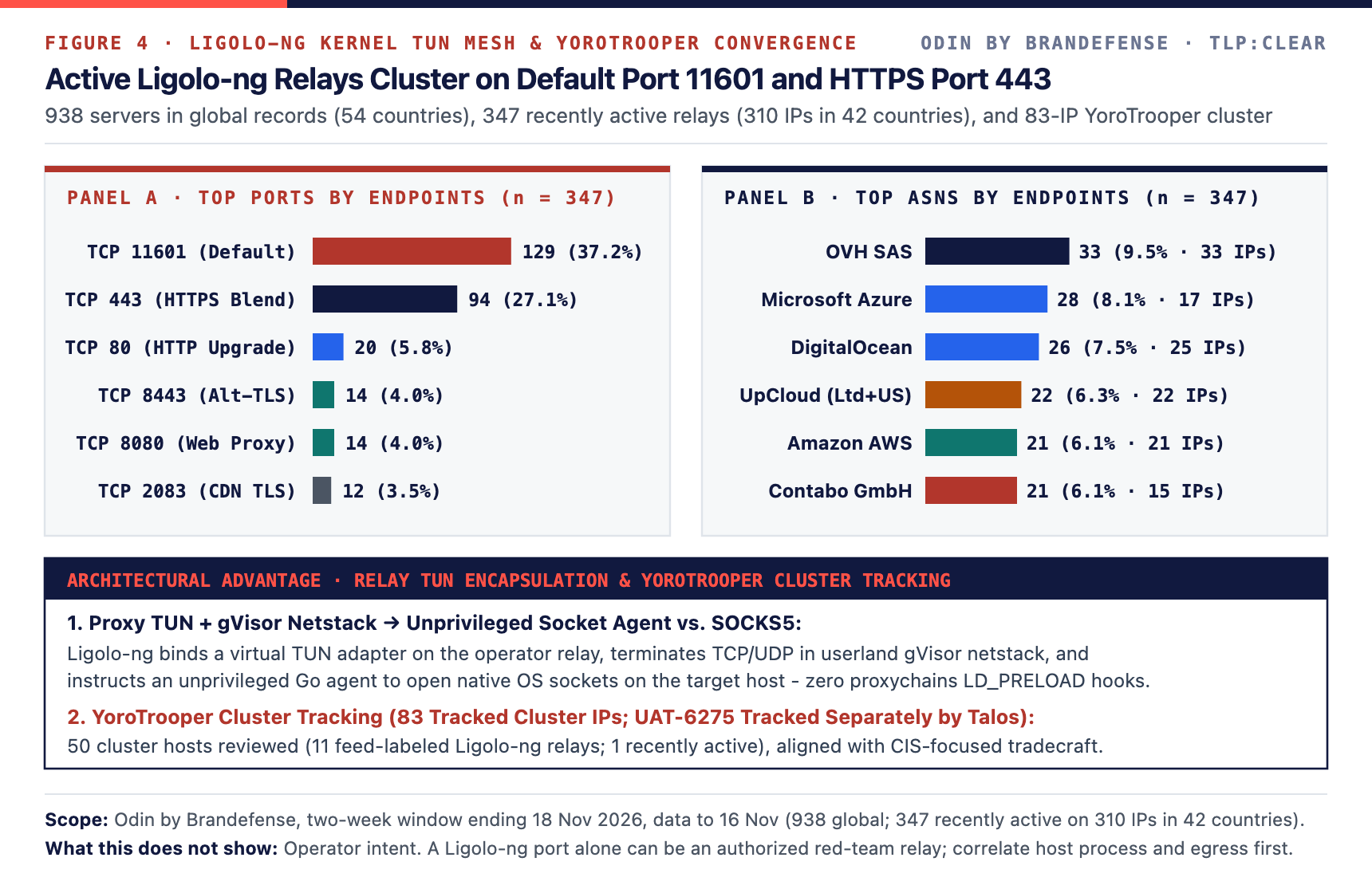
| Signal | Value |
|---|---|
| Relays on default port 11601 | 129 (37.2%) |
| Relays on HTTPS port 443 | 94 (27.1%) |
| Top hosting providers | OVH SAS (33), Microsoft (28), DigitalOcean (26) |
| Top countries | United States (94), India (40), France (29) |
The relays run on mainstream cloud and VPS networks, so their traffic blends with normal SaaS use. On its own, a Ligolo-ng relay looks the same as one run by an authorized red team. That is why we treat all 347 as hunting leads, not block entries.
Eleven relays carry third-party feed labels that tie them to YoroTrooper-tagged infrastructure. Cisco Talos has documented YoroTrooper espionage against CIS, Turkish and European targets. Feed labels are not attribution, and only one of the eleven was recently active.
Why not just block every listener?
Because many of them are not hostile. Among confirmed Mitmproxy listeners, 44 carry the certificate name of a commercial proxy network. Four confirmed GoPhish listeners carry the name of a security-awareness training vendor. Two more carry FortiGate appliance certificates.
Most listeners are unconfirmed: 2,452 of the 2,750 listeners are candidates. Even confirmed means only that the software is identified. It does not show hostile intent.
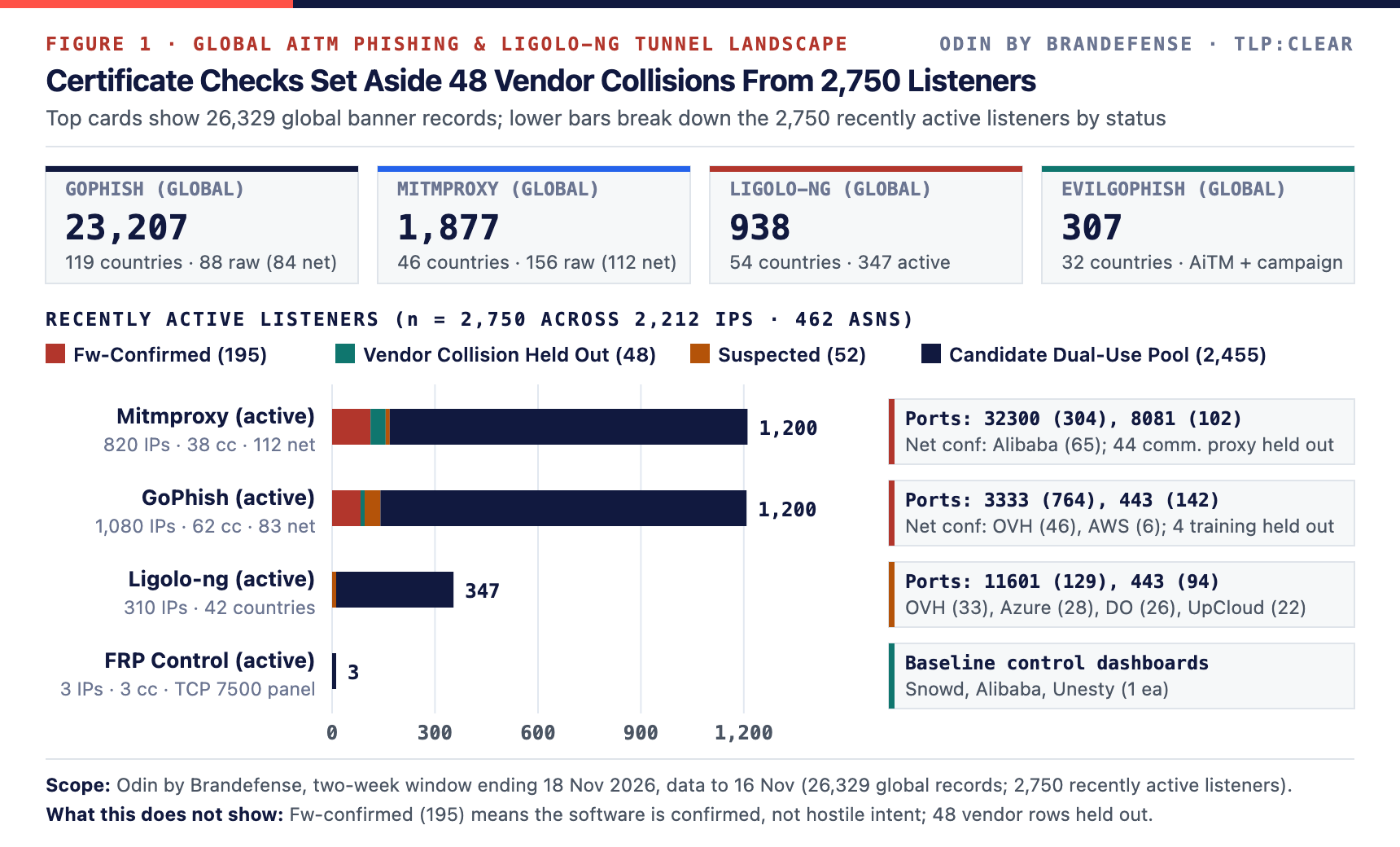
A blocklist built from raw listener feeds would break legitimate proxy and training services. Stock open-source files such as noVNC also appear in Proxmox, OpenStack and VDI consoles, so their hashes should never be blocked alone.
What to do now
- Require origin-bound passkeys at sign-in. WebAuthn passkeys will not sign in through a reverse proxy or remote viewer. Add Entra ID Token Protection and DBSC pilots for protection after sign-in, and turn off legacy IMAP and SMTP basic authentication.
- Block outbound TCP 11601 to 11610, and correlate risky Entra ID sign-ins with non-browser tunnel connections from the same user within 24 hours.
- Hunt for the three custom script hashes in the full report's Indicators tab. The host's address is withheld, because a red-team exercise cannot be excluded.
- Deploy the detections after testing them. The full report's Detection rules tab has Suricata, Sentinel KQL, Sigma and YARA rules for keystroke beacons, exposed Evilginx2 and noVNC, M365 enumeration bursts and Ligolo-ng agents.
- Keep vendor proxies, training platforms and stock open-source hashes off blocklists, and keep uncorroborated listeners on watchlists until a lure or egress signal appears.
The full report covers the infrastructure, file details, rule logic and indicators.
What is…?
Short explanations of the tools and families named in this study.
What is Ligolo-ng?
Ligolo-ng is an open-source tunneling tool that builds a network tunnel from a compromised host through a TUN interface.
More about Ligolo-ngPhishing frameworkWhat is Evilginx2?
Evilginx2 is an open-source adversary-in-the-middle phishing proxy that captures credentials and session cookies.
More about Evilginx2Remote accessWhat is noVNC?
noVNC is an open-source VNC client that runs in a web browser. Phishing kits abuse it to show victims a real browser hosted by the attacker.
More about noVNCPhishing frameworkWhat is GoPhish?
GoPhish is an open-source phishing simulation framework. Companies use it for awareness training and attackers use it for real campaigns.
More about GoPhishC2 frameworkWhat is Cobalt Strike?
Cobalt Strike is commercial adversary simulation software. Its Beacon implant gives an operator remote control of a compromised host. Cracked and leaked copies are widely used by ransomware and espionage operators.
More about Cobalt StrikeEnterprise softwareWhat is FortiGate?
FortiGate is Fortinet's line of firewall and VPN appliances. Exploited edge devices are a common entry point and a place to hide C2.
More about FortiGateFrequently asked questions
How does a phishing kit capture a password nobody submitted?
A normal phishing clone only receives a password when the user clicks Submit. If the user types half a password, notices the wrong web address and closes the tab, the attacker gets nothing.
What do the other two workbenches show?
The other two servers are on our watchlist, and their addresses are withheld. Why does that pairing matter? When an attacker replays a stolen cookie from a laptop, identity systems often flag the new location. Replaying it from a browser on the proxy server itself would keep the same address. But that also needs a running browser, a VNC server and a connecting bridge. None of these was observed on Host B.
Where do the tunnel relays run?
Once inside, attackers need a route into internal networks. Ligolo-ng provides one. Its relay creates a virtual network interface on the attacker's server. A small agent on the victim host then opens ordinary connections, all carried over a single encrypted stream.
Why not just block every listener?
Because many of them are not hostile. Among confirmed Mitmproxy listeners, 44 carry the certificate name of a commercial proxy network. Four confirmed GoPhish listeners carry the name of a security-awareness training vendor. Two more carry FortiGate appliance certificates.