


1. Executive Summary
In short
In files indexed 13 to 16 November 2026, Odin by Brandefense found two exposed attacker build servers. A Canadian host leaked a 1,096-file Rust implant build tree. A Russian host, 193.233.220[.]65, exposed 209 files: XWorm 5.6 source, keyboard hooks, browser cookie grafters and a per-user COM hijack script. Only 6 of 920 recent commodity RAT candidates were confirmed live. Alert on per-user CLSID writes into user-writable folders, and block RAT addresses only after live confirmation.
Two exposed servers show two different ways to build Windows intrusion tooling. One compiles a custom Rust implant on Linux for Windows. The other stages leaked .NET RAT source next to PowerShell scripts that live off the land. This report explains what each server held, how the tooling is designed to work, and which signals defenders can hunt. It also compares these high-signal servers with large, noisy lists of commodity RAT addresses.
A leaked Rust build tree maps a custom implant and 313 crates.
A Canadian host exposed 1,096 files from a Rust cross-compile tree under a custom project folder (path withheld). Its build manifests list 25 direct inputs to implant.exe. Their names point to a Beacon Object File loader, kernel-state routines, UAC bypass and persistence modules.
A Russian workbench pairs XWorm 5.6 source with browser and COM hijack scripts.
The host 193.233.220[.]65 exposed 323,901 bytes of unobfuscated XWorm 5.6 Visual Basic .NET source. A 121-file /rdp/ folder holds scripts written to graft stolen cookies into Chrome and to register a per-user COM server. None of this needs administrator rights.
Only 6 of 920 recent RAT candidates were confirmed live C2 servers.
Historical records for six commodity RAT families total 19,391. Of 920 recently active candidates, 6 were confirmed live between 13 and 16 November 2026. Passive RAT lists age fast on recycled VPS addresses.
Three Decisions for Leaders
- Stop per-user COM registrations that point into user-writable folders. Block or alert when a non-installer process writes a per-user
CLSID...InProcServer32value pointing intoC:UsersPublicorTemp. This persistence needs no UAC prompt. - Watch browser remote debugging and PowerShell hook compilation. Alert when a shell or scheduled task starts Chrome, Edge or Brave with a remote debugging port and a custom profile folder. Also alert when PowerShell compiles a
user32keyboard hook. Exclude known test automation. - Block commodity RAT addresses only after live confirmation. Most RAT-tagged addresses are stale. Confirm a live controller before blocking, and invest in file and compiler-path signatures that survive address changes.
The Study in Numbers
| Number | What it is |
|---|---|
| 1,305 | Exposed build-factory files on two servers: 1,096 on the Rust host and 209 on the XWorm host |
| 313 | Unique Rust crates in the implant's Cargo workspace, across five capability layers |
| 25 | Direct build inputs to the Rust implant.exe, listed in its exposed manifest |
| 323,901 bytes | Unobfuscated XWorm 5.6 Visual Basic .NET source in four files |
| 121 | Files in the /rdp/ folder: cookie grafters, HVNC builds and the COM hijack script |
| 6 of 920 | Recently active RAT candidates confirmed as live C2 servers (0.652%) |
| 19,391 | Historical commodity RAT records across six families (6 confirmed live, 0.031%) |
How to use this report.
Security leaders can read Chapter 1, Chapter 6 and Chapter 7. Endpoint and browser engineers should read Chapters 4, 5 and 7. Detection engineers will find the Rust workspace detail in Chapter 3 and the rule logic in Chapter 8.
2. Two Servers, Two Kinds of Tooling
In short
Exposed build servers leak compiler paths, source code and registry keys that outlast any IP address. Lists of suspected commodity RAT addresses, by contrast, go stale quickly.
The two servers in this study are unrelated. No shared address, certificate or path links them. They are useful together because they show two ends of the Windows tooling spectrum.
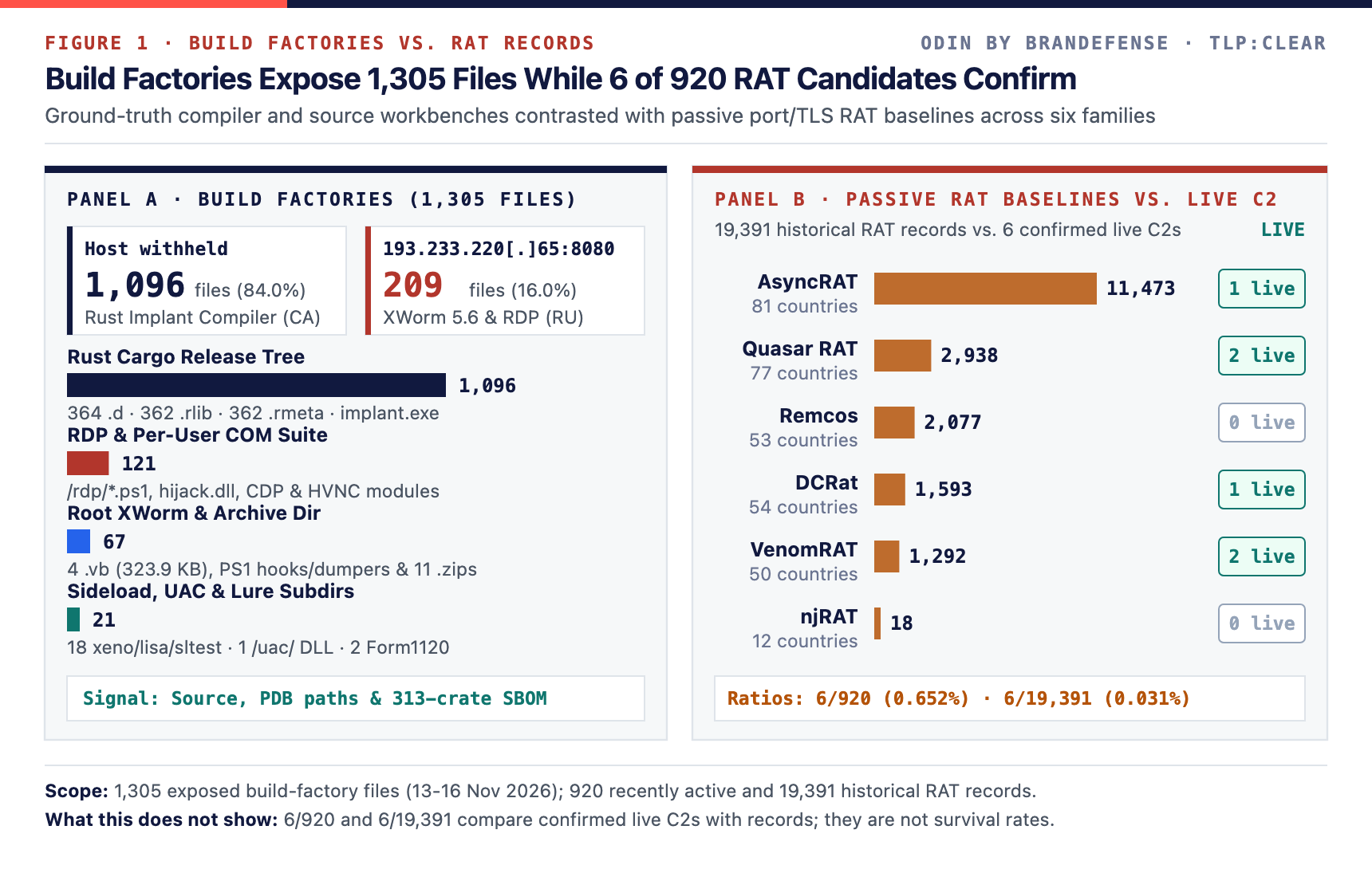
What each server held
| Server | Files | Main contents | What defenders get from it |
|---|---|---|---|
| Rust implant factory (Canada, address withheld, indexed 13 Nov 2026) | 1,096 (84.0%) | 364 .d, 362 .rlib, 362 .rmeta, 2 .exe, 2 .pdb, 1 .lib | Linux build paths under a custom project folder (path withheld), 25 implant inputs, and a 313-crate workspace list |
| XWorm 5.6 and RDP workbench (Russia, 193.233.220[.]65:8080, indexed 16 Nov 2026) | 209 (16.0%) | 123 .ps1, 22 .dll, 15 .bin, 15 .bat, 13 .zip, 4 .vb | VB.NET source, plain-HTTP staging on port 443, Chrome cookie grafting and per-user COM hijacks |
The Rust host's address is withheld because an authorized red-team owner remains plausible (see Chapter 6).
Commodity RAT records
The commodity RAT side tells a different story. Many feeds flag RAT controllers from a port, a banner or a self-signed certificate subject such as CN=default, CN=AsyncRAT Server or CN=Quasar Server CA. Those signals persist when a VPS address passes to a new tenant.
| Family | Historical records | Share | Countries | Confirmed live (13 to 16 Nov) | Confirmed C2 |
|---|---|---|---|---|---|
| AsyncRAT | 11,473 | 59.2% | 81 | 1 | 102.220.163[.]109:443, CN=default |
| Quasar | 2,938 | 15.2% | 77 | 2 | 141.98.157[.]101:2288; one more withheld (consumer broadband) |
| Remcos | 2,077 | 10.7% | 53 | 0 | None |
| DCRat | 1,593 | 8.2% | 54 | 1 | 148.113.214[.]176:443, CN=default |
| VenomRAT | 1,292 | 6.7% | 50 | 2 | 5.161.43[.]175:443 and 154.12.90[.]49:443, CN=default |
| njRAT | 18 | 0.1% | 12 | 0 | None |
| Total | 19,391 | 6 |
VenomRAT and njRAT together hold 1,310 records. All six confirmed controllers presented CN=default.
Read the ratios with care
Six of 920 recently active candidates is 0.652%. Six of all 19,391 records is 0.031%. These ratios compare confirmed live servers with a list. They are not survival rates, because not every record was checked in the window.
The other 19,385 records are unverified, not proven benign. One candidate host on Contabo alone exposes 14 candidate ports. Six unconfirmed Quasar candidates show the same CN=default subject as the confirmed servers. A certificate subject alone cannot separate a live controller from a recycled address.
An exposed build directory works differently. It yields compiler paths, assembly strings, registry keys and staging URIs. Those signals stay useful after the operator moves to a new address.
3. The Rust Build Factory
In short
A Canadian host exposed the release folder of a Rust toolchain that cross-compiles a Windows implant on Linux. Its build manifests reveal 25 implant modules and a 313-crate workspace that includes a C2 server.
On 13 November 2026, a Canadian host served an open HTTP directory listing. It exposed the output folder of a Rust cross-compile toolchain for 64-bit Windows: a target/x86_64-pc-windows-msvc/release/ folder (project path withheld). All 40 stored manifests point to this single build root.
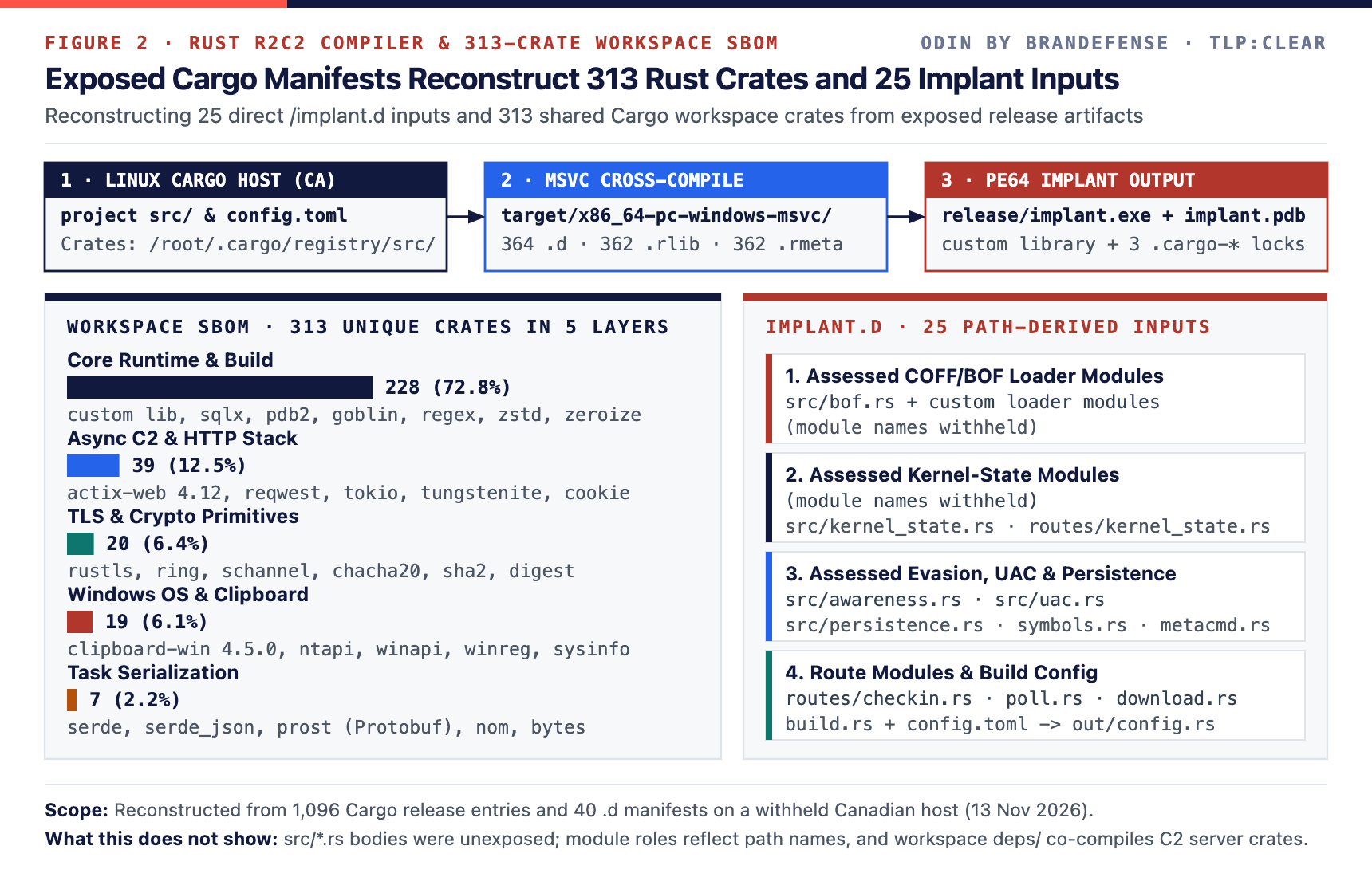
What the release folder held
| File type | Files | Manifests stored | Example paths and role |
|---|---|---|---|
.d (Cargo dependency info) | 364 | 40 | /implant.d, /deps/implant.d, and 362 hashed library manifests in /deps/ |
.rlib (Rust static library) | 362 | 0 | the custom library (name withheld), libclipboard_win-dc113935604f0ab2.rlib (163,452 bytes) |
.rmeta (metadata stub) | 362 | 0 | the custom library (name withheld), libclipboard_win-dc113935604f0ab2.rmeta (122,805 bytes) |
| No extension (Cargo lock files) | 3 | 0 | /.cargo-artifact-lock, /.cargo-build-lock, /.cargo-lock |
.exe (Windows PE64) | 2 | 0 | /implant.exe, /deps/implant.exe |
.pdb (debug symbols) | 2 | 0 | /implant.pdb, /deps/implant.pdb |
.lib (import library) | 1 | 0 | /deps/implant.lib |
Why dependency files are so revealing
When Cargo builds a Rust project, the compiler writes .d files that track which source files each output depends on. Cargo uses them for incremental rebuilds. Each .d file lists exact Linux paths of the operator's modules and of the third-party crates it pulled in.
The project's src/ folder was not exposed, so no .rs source bodies are available. The manifests still name every module. One counting detail matters: library files carry a lib prefix (liblibc-...rlib) while .d files do not (libc-...d). Removing the prefix only from .rlib and .rmeta names avoids double-counting crates such as libc, libsqlite3_sys and libz_rs_sys.
The 25 implant inputs
The manifest /implant.d is 928 bytes. It lists all 25 direct inputs to implant.exe: 22 module paths in the project's src/ folder, plus build.rs, config.toml and the generated out/config.rs. The module names suggest four subsystems. These roles are assessed from file names only.
| Assessed subsystem | Module paths | What the names suggest |
|---|---|---|
| COFF and Beacon Object File loader | bof.rs plus five custom loader modules and a C shim (names withheld) | A Rust and C loader modeled on Cobalt Strike Beacon Object File and BeaconPrintf conventions |
| Kernel-state modules | src/kernel_state.rs, src/routes/kernel_state.rs and two custom modules (names withheld) | Kernel-state inspection or driver-assisted tasking |
| Host awareness, UAC bypass, persistence | src/awareness.rs, src/uac.rs, src/persistence.rs, src/metacmd.rs, src/extensions.rs, src/symbols.rs, src/types.rs, src/lib.rs, src/implant/bin/implant.rs | Host discovery, UAC bypass, persistence and symbol resolution (with crates pdb2, pdb_addr2line, symsrv) |
| Build config and C2 routes | build.rs, config.toml, out/config.rs, src/routes/checkin.rs, src/routes/poll.rs, src/routes/download.rs | Build-time configuration plus shared check-in, polling and download routes |
The build script build.rs reads config.toml and generates out/config.rs.
The 313-crate workspace
A Cargo workspace caches compiled dependencies for every member built for the same target. So the /deps/ folder holds more than the implant. It also holds the C2 server and listener crates (actix-web, actix-server, actix-files, sqlx, libsqlite3_sys), operator command-line crates (clap, rustyline, cli_table) and a Windows clipboard crate (clipboard-win).
Deduplicating the 362 hashed library manifests gives 313 unique crates in five layers.
| Layer | Crates | Examples and versions | Assessed role |
|---|---|---|---|
| Core runtime and build support | 228 (72.8%) | sqlx, libsqlite3_sys, libc, pdb2, goblin, regex, clap, zstd, zeroize | A custom library (name withheld), PE/COFF/PDB parsing, C2 SQLite state and memory wiping |
| Async C2 HTTP and network | 39 (12.5%) | actix-web 4.12.0, actix-server 2.6.0, actix-files 0.6.6, reqwest, hyper, tokio, tokio-tungstenite, cookie | C2 listener and staging stack plus HTTP/1.1, HTTP/2, cookie jar and WebSocket clients |
| TLS and cryptography | 20 (6.4%) | rustls, ring, native-tls, schannel, chacha20, rand_chacha, sha2, sha1, digest, subtle, base64 | Both rustls and Windows schannel TLS stacks, ChaCha20 and RustCrypto digests |
| Windows OS and clipboard | 19 (6.1%) | clipboard-win 4.5.0, ntapi, winapi, windows, winreg, sysinfo | Native NT bindings, registry access, host profiling and clipboard access |
| Serialization and task parsing | 7 (2.2%) | serde, serde_json, prost, nom, bytes, serde_plain, serde_spanned | JSON and Protocol Buffers messages, binary packet and COFF parsing |
Of the 313 crates, 312 are public crates[.]io packages. Only one, a custom library whose name is withheld, is not public. That is why the crate list alone is a poor detection signal, and why the custom module names matter.
Key manifests
| Path on the Rust host | Size (lines) | What it shows |
|---|---|---|
/implant.d | 928 B (1) | The 25 direct implant inputs |
/deps/clipboard_win-dc113935604f0ab2.d | 1,757 B (10) | clipboard-win-4.5.0 compiled into the workspace |
/deps/actix_web-17e7c7e05985a20a.d | 34,788 B (93) | actix-web-4.12.0 HTTP C2 routing |
/deps/actix_server-c549e8f6e7ceaa5c.d | 5,155 B (19) | actix-server-2.6.0 multi-worker listener |
/deps/actix_files-75b175c3000ece1a.d | 3,941 B (16) | actix-files-0.6.6 chunked payload delivery |
Their hashes are withheld, because a red-team or tool-developer owner remains plausible for this host.
4. The XWorm 5.6 Workbench
In short
A Russian staging server exposed 209 files, including full XWorm 5.6 source that poses as a Windows Update component. Small PowerShell scripts add keystroke capture, screenshots, command polling and file theft without a custom executable.
On 16 November 2026, the Russian host 193.233.220[.]65 served 209 files on port 8080. Scripts on the host also reference ports 443, 8090 and 8091 on the same address. The files sit in three groups: 121 in /rdp/, 67 in the root folder (11 of the 13 .zip archives), and 21 in subfolders such as xeno_*, lisa, sltest, /uac/ and /docs/Form1120.*.
Of the 209 files, 45 source and script files were examined in detail. This report describes them by structure only. No working script body is reproduced.
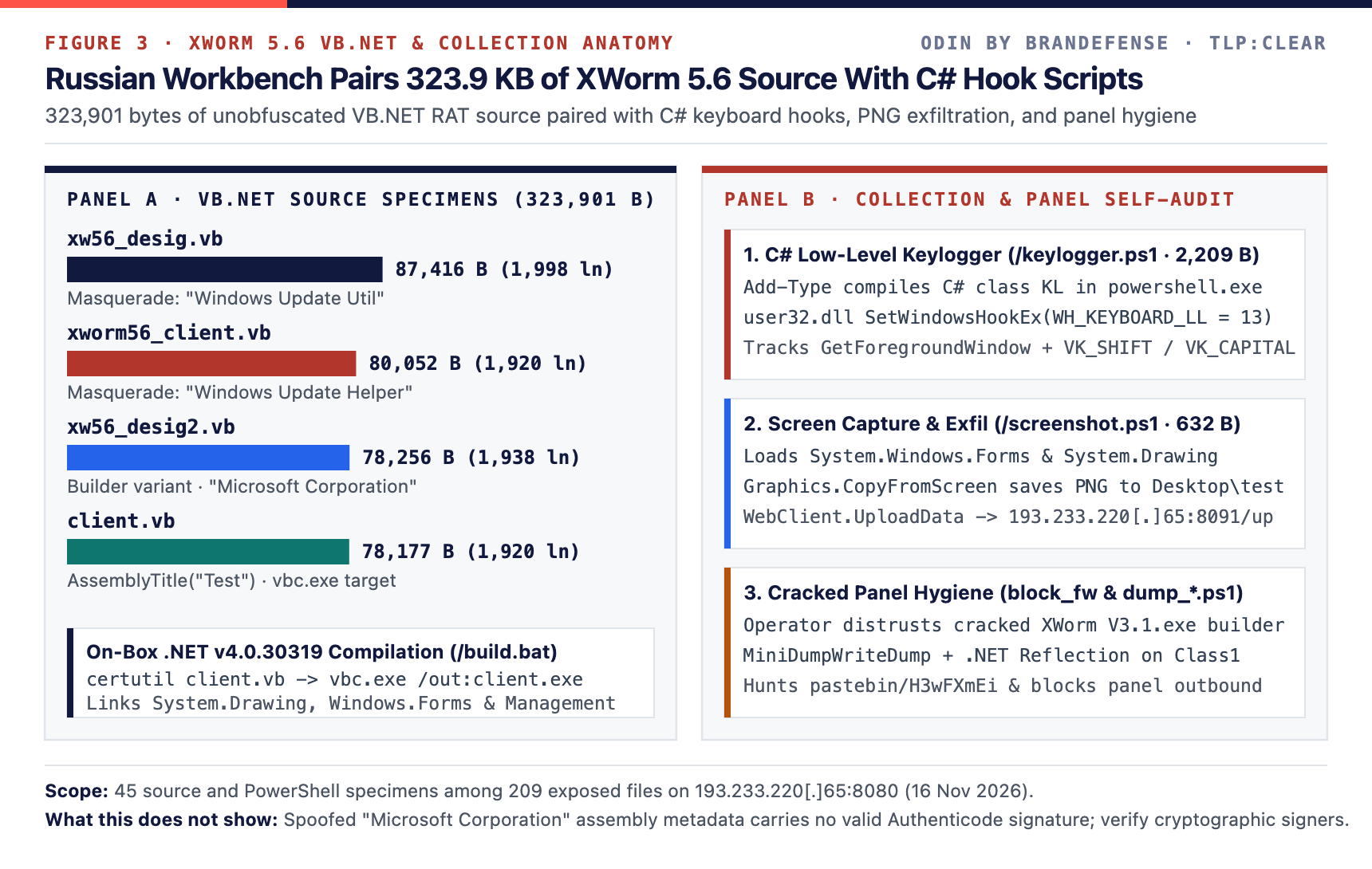
XWorm 5.6 source, ready to compile
XWorm is a commodity .NET remote access trojan whose source has leaked. Instead of only using prebuilt stubs that antivirus already knows, this operator staged four complete Visual Basic .NET source files: 323,901 bytes and 7,776 lines in total.
| File | Size (lines) | Role | Masquerade strings |
|---|---|---|---|
/xworm56_client.vb | 80,052 B (1,920) | Full XWorm 5.6 client source | AssemblyTitle("Windows Update Helper"), "Windows Update Helper Service", "Microsoft Corporation" |
/xw56_desig.vb | 87,416 B (1,998) | Builder or designer variant | "Windows Update Util", "Windows Update Util Service", "Microsoft Corporation" |
/xw56_desig2.vb | 78,256 B (1,938) | Second builder variant | "Microsoft Corporation" |
/client.vb | 78,177 B (1,920) | Client staged for on-box compilation | AssemblyTitle("Test") |
The client imports .NET namespaces for cryptography, WMI management, sockets, image capture and the registry. Its file version is written as a string concatenation ("1" + "." + "0" ...), which the compiler folds to 1.0.0.0.
A 569-byte /build.bat is written to fetch client.vb from the workbench with certutil and compile it with the built-in .NET Framework vbc.exe as a windowed executable (/target:winexe /out:client.exe). Compiling on the target avoids shipping a known binary hash.
The "Microsoft Corporation" strings are only metadata. Output from vbc.exe carries no valid Microsoft Authenticode signature. Allowlists must check the signature chain, not the company name.
Collection scripts
Three small script families collect data without a custom implant. They use the workbench's secondary ports.
| Script | Size | Structure | ATT&CK |
|---|---|---|---|
/keylogger.ps1 | 2,209 B, 47 lines | Compiles an inline C# class at run time with Add-Type. The class calls SetWindowsHookEx with a low-level keyboard hook (WH_KEYBOARD_LL) and records the foreground window title | T1056.001 |
/screenshot.ps1 | 632 B, 13 lines | Captures the primary screen with Graphics.CopyFromScreen, saves a PNG and uploads it with WebClient.UploadData to port 8091, path /up | T1113 |
/oldzip.bat, /runner.ps1 | 377 B, 1,846 B | Package SMB share folders with tar.exe and post them to port 8091 (share names withheld) | |
/np.bat | 398 B, 13 lines | Polls port 8090, path /cmd?box=, with curl.exe, runs any returned command and posts the output back to /r2?box= | |
/capture8002.ps1 | 1,153 B | Opens a local listener on port 8002 to capture the handshake of an xw56.exe build |
For hunting, the stable strings are the API names (SetWindowsHookEx, WH_KEYBOARD_LL, CopyFromScreen), the paths /up, /cmd?box= and /r2?box=, and a curl user agent on a polling loop.
The operator did not trust their own panel
Four scripts show the operator auditing a cracked XWorm V3.1 builder for a hidden backdoor. The backdoor pointed at a Pastebin paste, H3wFXmEi.
| Script | What it is written to do |
|---|---|
block_fw.ps1 | Resolves pastebin[.]com and adds a Windows Firewall rule named Block XWorm Panel Outbound against XWorm V3.1.exe |
dump_fresh.ps1 | Writes a memory dump of the panel with MiniDumpWriteDump and searches it for pastebin and H3wFXmEi |
reflect_decrypt.ps1 | Loads the panel through .NET reflection to call its obfuscated Class1 string decryptor |
deploy_clean.ps1 | Backs up the panel binary and swaps in XWormV3.1_clean.exe |
Cracked RAT builders often carry their own backdoors. This operator checked for one before use, which fits a criminal workbench rather than a research lab.
5. Browser Session Theft and Per-User COM Hijacking
In short
More than half of the workbench sits in /rdp/. These scripts are written to stage a DLL over plain HTTP on port 443, register it as a per-user COM server, graft stolen cookies into Chrome and run real browser profiles on a hidden desktop.
Chrome added two defenses that matter here. Since version 127, App-Bound Encryption (ABE) ties cookie decryption keys to an elevated system service. Since version 136, Chrome ignores --remote-debugging-port on the default profile folder. The /rdp/ scripts are built around both. We did not see these scripts run on any target system.
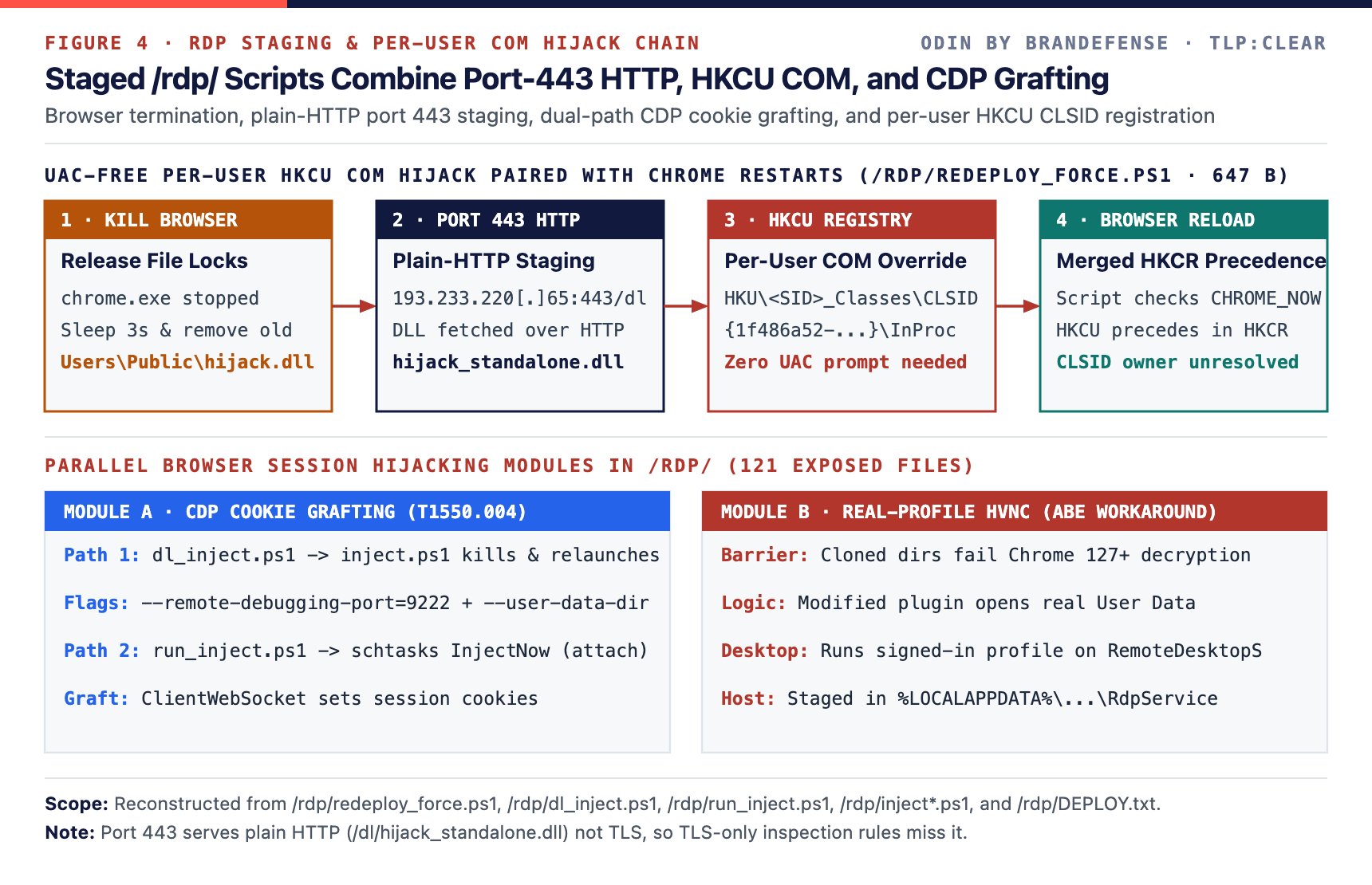
The per-user COM hijack script
/rdp/redeploy_force.ps1 is 647 bytes and 10 lines. It is structured as a four-step sequence that needs no administrator rights. The command text is withheld.
| Step | What the script is written to do | Why it matters |
|---|---|---|
| 1. Stop the browser | Stop chrome.exe, pause, and delete an older hijack.dll from the public user folder | Releases file locks on a loaded DLL |
| 2. Stage over plain HTTP on port 443 | Download hijack_standalone.dll from 193.233.220[.]65:443/dl over unencrypted HTTP and save it as hijack.dll in the public folder | Egress rules that exempt port 443 from inspection miss the protocol mismatch |
| 3. Write a per-user COM entry | Set HKCUSoftwareClassesCLSID{1f486a52-3cb1-48fd-8f50-b8dc300d9f9d}InProcServer32 to the staged DLL | Per-user entries need no UAC prompt (T1546.015) |
| 4. Check for a browser restart | Count Chrome processes (CHROME_NOW) | Suggests the operator expects Chrome to load the class |
Windows merges per-user and machine COM registrations into one view, HKEY_CLASSES_ROOT. The per-user entry wins. That is why this persistence needs no elevation.
The owner of CLSID {1f486a52-3cb1-48fd-8f50-b8dc300d9f9d} is not resolved in public Windows symbol tables. That Chrome loads it is an inference from the script's browser stop and restart check. Endpoint image-load records were outside the scope of this study.
Where to look in logs.
HKCUSoftwareClasses is stored in the user's UsrClass.dat hive. Sysmon logs the write as HKU<SID>_ClassesCLSID..., and Defender XDR as HKEY_USERS<SID>_ClassesCLSID.... Neither path contains Software. Rules must match the _ClassesCLSID substring, or they will miss it.
Cookie grafting over the Chrome DevTools Protocol
The scripts named inject*.ps1 do not inject into process memory (T1055). They graft session cookies that were stolen earlier (T1539) into a browser through the Chrome DevTools Protocol (CDP) WebSocket (T1550.004). CDP is the debugging interface Chrome exposes on a local port.
| Path | Scripts | Structure |
|---|---|---|
| Path 1: relaunch Chrome | /rdp/dl_inject.ps1 (244 B) then /rdp/inject.ps1 (20,209 B) | The first script fetches inject.ps1 from :443/dl/ into C:UsersPublic. The second stops Chrome and restarts it with --remote-debugging-port=9222 and a sibling profile folder named Chrome Data beside User Data |
| Path 2: attach without relaunch | /rdp/run_inject.ps1 (828 B), /rdp/setup_inject.ps1 (654 B), dl_inject_only.ps1 (240 B), then /rdp/inject_only.ps1 (20,000 B) or /rdp/inject_standalone.ps1 (3,489 B) | Fetches inject_only.ps1 as C:UsersPublicinj.ps1, writes C:UsersPublicrun_inj.bat, and starts a one-shot scheduled task named InjectNow. The grafter polls 127.0.0.1:9222/json and pushes cookie arrays over ClientWebSocket |
The sibling profile folder is deliberate. Chrome 136 and later ignores the debugging port on the default User Data folder, so the script points Chrome at a non-default folder under the vendor directory.
Real-profile HVNC against App-Bound Encryption
The operator's notes in /rdp/DEPLOY.txt (1,682 bytes, titled HVNC REAL-PROFILE BUILD - ALL BROWSERS) say that cloned profiles cannot decrypt Chrome, Edge or Brave 127+ cookies. HVNC (hidden VNC) gives an attacker a second, invisible desktop on the victim's machine.
The notes describe a modified HVNC plugin that skips profile cloning. It opens the user's real User Data profile in place on a hidden desktop named RemoteDesktopS. Patch details are withheld.
| File | Size | Role |
|---|---|---|
/rdp/hijack.dll | 42,496 B | Same size as the modified HVNC plugin described in DEPLOY.txt |
/hijack.dll | 233,836 B | A different DLL in the root folder |
/hvnc_test.dll (HVNC.dll in the notes) | 59,904 B | Size matches the HVNC build listed in DEPLOY.txt |
/rdp/hvnc_new.dll to HVNC_final.dll | 60,416 to 83,456 B | Four HVNC builds: hvnc_new.dll, HVNC_patched.dll (75,264 B), HVNC_mark3.dll (76,288 B), HVNC_final.dll (83,456 B) |
/rdp/shell_rp.bin (shell.bin in the notes) | 10,348,140 B | Bundled payload, written to %LOCALAPPDATA%MicrosoftRdpServiceshell.bin |
/rdp/shell.bin, /lisa/shell.bin | 96,255 B and 85,100 B | Smaller stage payloads; five /xeno_*/shell.bin copies also measure 85,100 B |
%LOCALAPPDATA%MicrosoftRdpServicemstsc.exe | Not listed | A masqueraded mstsc.exe paired with version.dll sideloaders (/rdp/version.dll 16,384 B, /sltest/version.dll 93,375 B) |
A real mstsc.exe lives in System32. A copy under AppDataLocal is a strong masquerade signal (T1036.005).
Key workbench files and their hashes
| Path | Size (lines) | SHA-256 | Function |
|---|---|---|---|
/xworm56_client.vb | 80,052 B (1,920) | d7907bd930b212675b2686f17a702339c7be3703f6b9e1c4c0c99a3b8df81ce2 | XWorm 5.6 client posing as "Windows Update Helper" |
/xw56_desig.vb | 87,416 B (1,998) | ca163c0a6e102d9bf1058fbe99db94964115bd414514accf7cb2b31111a54bb6 | XWorm 5.6 builder posing as "Windows Update Util" |
/client.vb | 78,177 B (1,920) | 1fd0695487372a62306721a3f4f70ef042bf224bf96adc31ea889c41febc2b34 | RAT client staged for vbc.exe compilation |
/keylogger.ps1 | 2,209 B (47) | c7caa7cadec4f43a0e72347a50da4cbf0473fa79f8ed09f7c1d5584e29415ae7 | Inline C# low-level keyboard hook |
/screenshot.ps1 | 632 B (13) | d747bd06488cf50c826327a7b0deb794d4cfa6c7051af9c2bd4809a75f99ba0a | Screen capture uploaded to :8091/up |
/rdp/dl_inject.ps1 | 244 B (3) | 1a0d0943bb4382a0e1d55bfd02f4970f572d4f7627691464f36755d354d7034e | Path 1 downloader for inject.ps1 |
/rdp/inject.ps1 | 20,209 B (44) | ceb17c70555ff457c2402f1d970626f59c3481377c1277ae6e8831c51cb12ecb | Chrome relaunch with debugging port, cookie grafting |
/rdp/inject_standalone.ps1 | 3,489 B (73) | 5ef9a57c68ce939589e0689b0ee86c0caadd48a2eb0eb587974403ddc7ed14ee | Cookie grafting over ClientWebSocket |
/rdp/redeploy_force.ps1 | 647 B (10) | 7f231f37f35f2283b492b28d3987be19cc43a0a22956a37e23ea46c0e1832565 | Browser stop, port-443 DLL staging, per-user CLSID write |
6. Who Runs These Servers
In short
The Russian workbench fits an intrusion and crimeware operator. The Rust factory is offensive, but an authorized red-team or tool developer cannot be ruled out.
We saw only exposed files, not victim systems. So we weighed four other explanations for each server.
| Hypothesis | For | Against | Assessment |
|---|---|---|---|
| 1. Authorized red team or adversary simulation | The Rust host builds a modular COFF loader with structured check-in and polling routes, and holds no victim data | A public, unauthenticated target/ folder and implant.pdb break red-team operational security. The Russian host stages cracked XWorm builders and tax-form (Form 1120) .lnk lures | Plausible for the Rust host; unlikely for the Russian host |
| 2. Research lab or analysis sandbox | The Russian host holds diagnostic scripts that inspect XWorm memory dumps | The same host stages captured session cookies, SMB share theft scripts, tax lures and port-443 payload delivery | Unlikely; the panel checks fit an operator who distrusts a cracked tool |
| 3. Honeypot or canary | Both directory listings were open to anyone | The Rust host holds a complete 1,096-file Cargo cache with consistent hashes. The Russian host held real share names and session cookies (withheld) | Refuted for the Russian host; low likelihood for the Rust host |
| 4. Open-source mirror or training set | 312 of 313 crates are public, and XWorm source has leaked | /implant.d compiles non-public custom modules (names withheld). The Russian host adds custom CDP grafters and target-specific share lists | Refuted; both hosts show active building and customization |
Our assessment. The evidence fits 193.233.220[.]65 as an intrusion and crimeware staging workbench prepared for Windows post-exploitation. Target-side outcomes are unverified. The Canadian host fits an offensive Rust implant build factory. A red-team or tool-developer owner remains plausible, because no victim data sits on it. Nothing links the two servers, so we treat them as separate toolchains.
Avoiding false positives
| Pitfall | Why it misleads | What to do instead |
|---|---|---|
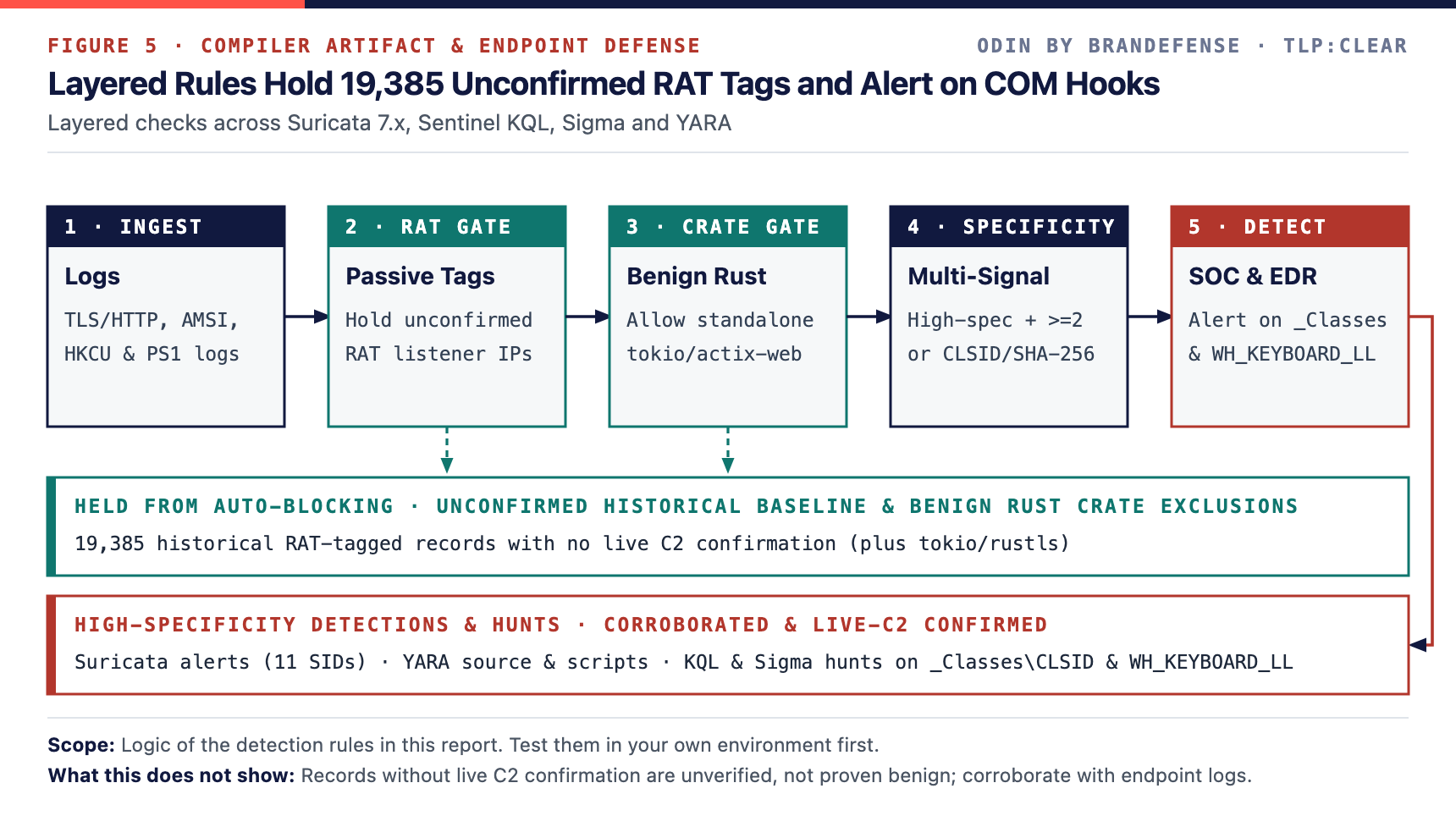
| Treating historical RAT records as live | CN=default certificates and port patterns persist on recycled VPS addresses (Contabo, M247, OVH). 19,385 records have no live confirmation | Hold them from automatic blocking. Confirmed live controllers take priority |
| Alerting on common Rust crates | tokio, actix-web, reqwest, rustls and serde power many legitimate services | Require a custom marker from your own case data plus a second signal |
| Alerting on generic file names | client.vb, screenshot.ps1, keylogger.ps1 and implant.exe appear in developer repositories | Require a high-specificity marker (xworm56_client.vb, xw56_desig*.vb, redeploy_force.ps1, inject_only.ps1, inject_standalone.ps1, the CLSID, or a known hash) plus a second signal |
| Alerting on every remote debugging launch | Selenium chromedriver.exe, msedgedriver.exe, Puppeteer, Playwright and Cypress use it, often with --headless, --enable-automation, --remote-debugging-port=0 or %TEMP%scoped_dir* profiles | Suppress approved test automation by exact host, not by parent name or flags. Alert on shell or task parents, --remote-allow-origins=*, or vendor-folder profiles |
| Trusting "Microsoft Corporation" in version info | The XWorm builds copy the string but carry no valid signature | Validate Authenticode chains, not CompanyName |
A single hash match is also only a file match. It does not show that a host runs a workbench.
7. What Defenders Should Do
Within 24 hours
- Search firewall, proxy, DNS and NetFlow logs for 193.233.220[.]65 on ports 8080, 443, 8090 and 8091, and for the five published RAT controllers in Chapter 9.
- Hunt registry events for writes under
_ClassesCLSIDwithInProcServer32that point intoC:UsersPublic,%TEMP%or%APPDATA%. Check CLSID{1f486a52-3cb1-48fd-8f50-b8dc300d9f9d}first. - Inspect plain HTTP on TCP 443 instead of exempting port 443 from non-TLS inspection.
Within 72 hours
- Use WDAC or AppLocker to block unsigned DLL loads from
C:UsersPublicandmstsc.exelaunches from%LOCALAPPDATA%(T1036.005). - Keep Chrome on version 136 or later, and set the
RemoteDebuggingAllowedpolicy to false on non-developer endpoints. - Confirm App-Bound Encryption on Chrome 127+, verify the vendor rollout for Edge and Brave, and watch for hidden desktop creation such as
RemoteDesktopS. - Enable PowerShell Script Block Logging (Event ID 4104) and AMSI content monitoring for
Add-TypewithSetWindowsHookExorCopyFromScreen.
Within 7 to 30 days
- Alert on
vbc.exe /target:winexestarted bycmd.exe, PowerShell or script hosts outsideMSBuild.exeanddevenv.exe. - Add the YARA rules for XWorm 5.6 source and the hijack and keylogger scripts to file and artifact scanning.
- Change commodity RAT feed handling: block only after live C2 confirmation, endpoint process evidence and an ASN reassignment check.
| Control | Owner |
|---|---|
Per-user CLSID InProcServer32 writes into user-writable paths | Endpoint security / EDR operations |
WDAC or AppLocker rules for C:UsersPublic DLLs and AppData mstsc.exe | Workstation engineering |
| App-Bound Encryption and hidden desktop monitoring | Enterprise browser / EDR operations |
Chrome 136+ and RemoteDebuggingAllowed = false | Enterprise browser / IAM |
| Script Block Logging and AMSI for hook compilation | Detection engineering / SOC |
Plain HTTP on port 443 and :8090/cmd?box= polling | Network security |
| Live confirmation before RAT blocklisting | CTI / threat hunting |
8. Detection Rules
The full rules are in the Detection rules tab. Each one targets a signal that outlasts an address change.
| Rule file | What it catches |
|---|---|
suricata_rust_xworm_and_rdp_staging.rules | Suricata 7: eleven signatures for DLL and script staging, screenshot upload, command polling and RAT certificate subjects |
sentinel_clsid_hijack_and_ps_hook_hunt.kql | Microsoft Sentinel and Defender XDR: per-user COM writes, public-folder DLL loads, hook and CDP command lines, and AMSI script content |
sigma_per_user_com_hijack_and_rdp_inject.yml | Sigma (4 rules): per-user COM hijack, debugging-port browser launches, inline keyboard hook compilation, masqueraded mstsc.exe |
yara_xworm56_and_rdp_workbench.yar | YARA (3 rules): XWorm 5.6 source, the CLSID hijack script, and the inline C# keylogger |
How the Suricata signatures work
These rules need HTTP parsing on TCP 443 as well as port 80, so cleartext requests on 443 are seen as HTTP. The certificate rules need visibility of the TLS certificate message.
| SID | Looks for | Why |
|---|---|---|
| 9802601 | Outbound request for hijack.dll or hijack_standalone.dll, optionally under /dl/ or /rdp/ | COM hijack DLL staging, including plain HTTP on 443 |
| 9802602 | Outbound request for inject.ps1, inject_only.ps1 or inject_standalone.ps1 under /dl/ or /rdp/ | Cookie grafter retrieval |
| 9802603 | POST to exactly /up with a body starting with the PNG header | Screenshot upload; the exact path excludes /upload |
| 9802605 | Request for xworm56_client.vb | XWorm 5.6 client source; ignores generic client.vb |
| 9802606 | Certificate subject CN=AsyncRAT Server | Stock AsyncRAT |
| 9802607 | Certificate subject exactly CN=default | Commodity RAT default; corroborate with endpoint process data, do not block alone |
| 9802608 | Certificate subject CN=Quasar Server CA | Stock Quasar |
| 9802609 | Certificate subject exactly CN=DcRat | Stock DCRat |
| 9802610 | Request for xw56_desig.vb or xw56_desig2.vb | XWorm 5.6 builder source |
| 9802611 | GET to a path starting /dl/ over cleartext HTTP to port 443 | Plain HTTP on the TLS port (policy rule) |
| 9802612 | URI with /cmd?box= and a curl/ user agent | The batch command poller |
SID 9802604 is retired and not used in this release, so the eleven SIDs run from 9802601 to 9802612 with one gap.
All six confirmed RAT controllers in the window presented CN=default. Appliances and development servers also use it. Before acting on SID 9802607, match the destination against EDR network events to find an unsigned .NET or script-launched process. For SID 9802603, exclude internal services that use an exact /up route by destination subnet.
How the KQL query works
The query runs over a 14-day lookback and joins four branches.
| Branch | Looks for |
|---|---|
| Registry | RegistryValueSet or RegistryKeyCreated on _ClassesCLSID...InProcServer32 that names the staged CLSID, points into C:UsersPublic or AppDataLocalTemp, or names hijack.dll |
| Image loads | Chrome, Edge, Brave, Explorer or mstsc.exe loading a DLL from C:UsersPublic, or a DLL named like the hijack and HVNC builds |
| Process | PowerShell or script hosts with hook, capture or grafter names; vbc.exe /target:winexe from shells (not MSBuild.exe or devenv.exe); curl, certutil or bitsadmin fetching :443/dl/ or /cmd?box=; mstsc.exe under AppData; non-QA browser launches with a debugging port |
| AMSI | PowerShell or AMSI script content containing the CLSID, SetWindowsHookEx, WH_KEYBOARD_LL, CopyFromScreen or ClientWebSocket |
The image-load and AMSI branches need Defender for Endpoint EDR data and AMSI auditing. Workspaces with only Windows Event IDs 4688 and 4104 should use the Sigma rules instead. Tune by excluding signed installers that register Temp COM servers, developer device groups, and named CI build accounts. Keep C:UsersPublic and the staged CLSID unexempted.
How the Sigma and YARA rules work
| Rule | Fires when | ATT&CK |
|---|---|---|
| Sigma 1: Per-user COM hijack | Sysmon Event ID 13 writes to _ClassesCLSID or ClassesCLSID InProcServer32 naming the staged CLSID or pointing into Public or Temp | T1546.015 |
| Sigma 2: Debugging-port browser launch | Chromium starts with --remote-debugging-port= and a shell or task parent, --remote-allow-origins=* or a vendor-folder profile; no exclusions are built in, so suppress approved test automation by exact host | T1550.004 |
| Sigma 3: Inline keyboard hook | PowerShell Event ID 4104 shows Add-Type with SetWindowsHookEx and WH_KEYBOARD_LL | T1056.001 |
Sigma 4: Masqueraded mstsc.exe | mstsc.exe runs from a user-writable AppData or Public path | T1036.005 |
YARA ODIN_XWorm56_VBNet_Windows_Update_Helper_Masquerade | XWorm 5.6 source or builds with the Windows Update masquerade strings, or build.bat with vbc.exe /target:winexe /out:client.exe | |
YARA ODIN_RDP_PerUser_CLSID_InProcServer32_Hijacker | The CLSID with an InProcServer32 or registry marker and a hijack DLL name | T1546.015 |
YARA ODIN_PowerShell_CSharp_WH_KEYBOARD_LL_Keylogger | Add-Type with the low-level keyboard hook and at least two supporting API names | T1056.001 |
Each YARA rule caps the scanned file size (2 MB to 25 MB depending on the rule) and matches both ASCII and wide strings.
How to sort an observation
The triage logic never escalates on uncorroborated evidence.
| What the observation shows | Action |
|---|---|
A confirmed live RAT controller, even next to benign crates such as tokio | Treat as confirmed C2 |
| A corroborated build factory (custom build markers or XWorm markers plus a second signal) | Critical |
Generic file names in a pair, such as client.vb with screenshot.ps1 | Workbench review |
| A single generic file name | Review |
| A lone hash match | Artifact review |
| An unconfirmed RAT candidate on a VPS | Hold |
A benign actix-web or rustls repository | Ignore |
9. Indicators
The Indicators tab holds 21 published indicators: 6 addresses and 15 file hashes. The two withheld addresses are described below.
| Type | Count | Where to hunt |
|---|---|---|
| Network indicators (IPv4) | 8 (6 published, 2 withheld) | Firewall, proxy, DNS and NetFlow logs |
| Script and source hashes that could reach endpoints (SHA-256) | 10 | EDR file-creation logs, proxy downloads, Script Block logs |
| Staging-server hashes (SHA-256); build-manifest hashes withheld | 5 | Infrastructure hunting and file provenance, not endpoint blocking |
Withheld: the Rust build host's address and port, and one confirmed Quasar controller on consumer broadband that may be a subscriber host.
Network indicators
| Indicator | Port | Role | Hosting | Confirmed |
|---|---|---|---|---|
| 193.233.220[.]65 | 8080 (also 443, 8090, 8091) | XWorm 5.6, CDP and per-user COM workbench | RU | 16 Nov 2026 |
| 102.220.163[.]109 | 443 | AsyncRAT C2, CN=default | VPS Dedicated LLC (SI) | 13 Nov 2026 |
| 148.113.214[.]176 | 443 | DCRat C2, CN=default | OVH SAS (CA) | 16 Nov 2026 |
| 141.98.157[.]101 | 2288 | Quasar C2, CN=default | EUGAMEHOST LTD (GB) | 16 Nov 2026 |
| 5.161.43[.]175 | 443 | VenomRAT C2, CN=default | Hetzner Online GmbH (US) | 16 Nov 2026 |
| 154.12.90[.]49 | 443 | VenomRAT C2, CN=default | cognetcloud INC (HK) | 16 Nov 2026 |
All six addresses sit on commercial cloud, VPS or ISP networks where addresses are reassigned. Use them for log hunting and time-bound watchlists. Recheck the listener, ASN, certificate subject or staging path before a lasting block.
Hashes that could reach endpoints
These scripts are written to land on targets, for example in C:UsersPublic or Desktoptest. Seven of them also appear in the Chapter 5 table.
| File | Size | SHA-256 |
|---|---|---|
/client.vb | 78,177 B | 1fd0695487372a62306721a3f4f70ef042bf224bf96adc31ea889c41febc2b34 |
/build.bat | 569 B | 01393dbf9a23130e2d3899b1f1c80df9d5ed28cff01d60c5472e56a737b28923 |
/keylogger.ps1 | 2,209 B | c7caa7cadec4f43a0e72347a50da4cbf0473fa79f8ed09f7c1d5584e29415ae7 |
/screenshot.ps1 | 632 B | d747bd06488cf50c826327a7b0deb794d4cfa6c7051af9c2bd4809a75f99ba0a |
/rdp/dl_inject.ps1 | 244 B | 1a0d0943bb4382a0e1d55bfd02f4970f572d4f7627691464f36755d354d7034e |
/rdp/run_inject.ps1 | 828 B | d657df005418f9cbee07391a0f2e05de7e908e87ec35db228062e6bbf2678278 |
/rdp/inject.ps1 | 20,209 B | ceb17c70555ff457c2402f1d970626f59c3481377c1277ae6e8831c51cb12ecb |
/rdp/inject_only.ps1 | 20,000 B | e29bbc5f3650cf3851ca8d8e25b22865809872216372b4672fff0322081109f4 |
/rdp/inject_standalone.ps1 | 3,489 B | 5ef9a57c68ce939589e0689b0ee86c0caadd48a2eb0eb587974403ddc7ed14ee |
/rdp/redeploy_force.ps1 | 647 B | 7f231f37f35f2283b492b28d3987be19cc43a0a22956a37e23ea46c0e1832565 |
Staging-server hashes
These five files come from the Russian workbench. The Rust build-manifest hashes are withheld. The two XWorm files also appear in the Chapter 5 table.
| File | Size | SHA-256 |
|---|---|---|
/xworm56_client.vb | 80,052 B | d7907bd930b212675b2686f17a702339c7be3703f6b9e1c4c0c99a3b8df81ce2 |
/xw56_desig.vb | 87,416 B | ca163c0a6e102d9bf1058fbe99db94964115bd414514accf7cb2b31111a54bb6 |
/xw56_desig2.vb | 78,256 B | c4c51d14e97504864ff493b202f57cb6bdc43c6a9b66f935ae878f706ea7837a |
/rdp/DEPLOY.txt | 1,682 B | bacba54b7b2cc61001c213089bcf104850d576dca37060aa03d0a141c48ef664 |
/reflect_decrypt.ps1 | 1,350 B | 0a0b9cf262dd57c04f8a7061f7841e1544f1080ece9ace2f1385743191c902c4 |
Supporting strings: CLSID {1f486a52-3cb1-48fd-8f50-b8dc300d9f9d}, scheduled task InjectNow, hidden desktop RemoteDesktopS, folder %LOCALAPPDATA%MicrosoftRdpService, and URI paths /dl/, /up, /cmd?box= and /r2?box=.
MITRE ATT&CK mapping
| Tactic | Technique | How the tooling uses it | Detection |
|---|---|---|---|
| Persistence, Privilege Escalation | T1546.015 Component Object Model Hijacking | Per-user InProcServer32 override pointing to a DLL in the public folder | Sigma 1; KQL registry branch; YARA CLSID rule |
| Collection | T1056.001 Input Capture: Keylogging | Inline C# WH_KEYBOARD_LL hook compiled by PowerShell | Sigma 3; KQL AMSI branch; YARA keylogger rule |
| Collection | T1113 Screen Capture | CopyFromScreen PNG capture uploaded to :8091/up | SID 9802603; KQL process and AMSI branches |
| Credential Access | T1539 Steal Web Session Cookie | Assessed upstream theft of the cookies the grafters reuse | Not directly covered |
| Defense Evasion, Lateral Movement | T1550.004 Use Alternate Authentication Material: Web Session Cookie | CDP WebSocket cookie grafting on port 9222 | Sigma 2; SID 9802602; KQL process branch |
| Defense Evasion | T1036.005 Masquerading: Match Legitimate Name or Location | mstsc.exe under %LOCALAPPDATA%MicrosoftRdpService; "Windows Update Helper" assembly strings | Sigma 4; KQL process branch; YARA XWorm rule |
10. Scope and Limits
- Window. The build-factory files were indexed on 13 November 2026 (Rust host) and 16 November 2026 (Russian host). The six RAT controllers were confirmed live between 13 and 16 November 2026.
- Files, not outcomes. We saw files on exposed servers, not activity on victim systems. Scripts are described by what they are written to do. Whether any of them ran against a target is unknown.
- Partial content. Of the 1,305 files, 85 text, source and manifest files have recorded SHA-256 values. The other 1,220 are known by name and size only. The Rust
src/folder was not exposed, so module roles come from file names. - RAT ratios are not survival rates. The 920 recently active candidates and 19,391 historical records were not each checked in the window. The 19,385 unconfirmed records are unverified, not benign.
- Attribution. The Russian workbench fits a criminal operator. A red-team owner of the Rust factory remains plausible. Nothing links the two servers.
- CLSID owner. The COM class behind
{1f486a52-3cb1-48fd-8f50-b8dc300d9f9d}is unresolved. Chrome loading it is an inference. - Rule testing. Every published rule file loads without errors in its engine (Suricata 7.0.12, YARA-X, pySigma and Microsoft's Kusto.Language analyzer, checked on 20 November 2026). The rules were not replayed against live traffic, so test and tune them in your own environment before production use.
11. Sources
- MITRE ATT&CK. T1546.015 Component Object Model Hijacking. https://attack.mitre.org/techniques/T1546/015/ (verified 18 November 2026)
- Rust Cargo Book. Build cache and dep-info files. https://doc.rust-lang.org/cargo/guide/build-cache.html (verified 18 November 2026)
- MITRE ATT&CK. T1056.001 Input Capture: Keylogging. https://attack.mitre.org/techniques/T1056/001/ (verified 18 November 2026)
- MITRE ATT&CK. T1113 Screen Capture. https://attack.mitre.org/techniques/T1113/ (verified 18 November 2026)
- MITRE ATT&CK. T1550.004 Use Alternate Authentication Material: Web Session Cookie. https://attack.mitre.org/techniques/T1550/004/ (verified 18 November 2026)
- MITRE ATT&CK. Software S1087 AsyncRAT. https://attack.mitre.org/software/S1087/ (verified 18 November 2026)
- Google Security Blog. Improving the security of Chrome cookies on Windows. https://security.googleblog.com/2024/07/improving-security-of-chrome-cookies-on.html (verified 18 November 2026)
- Chrome for Developers. Remote debugging switch changes in Chrome 136. https://developer.chrome.com/blog/remote-debugging-port (verified 18 November 2026)
- Microsoft Learn. Merged view of HKEY_CLASSES_ROOT. https://learn.microsoft.com/en-us/windows/win32/sysinfo/merged-view-of-hkey-classes-root (verified 18 November 2026)
What is…?
Short explanations of the tools and families named in this study.
What is XWorm?
XWorm is a commodity .NET remote access trojan sold to criminals. It offers remote control, keylogging and plugin modules.
More about XWormTechniqueWhat is HVNC?
Hidden VNC (HVNC) creates a second, invisible desktop on the victim's computer so an attacker can use the victim's browser sessions unseen.
More about HVNCRemote access trojanWhat is Quasar?
Quasar is an open-source .NET remote access tool for Windows that criminals and some state actors use as a RAT.
More about QuasarRemote access trojanWhat is AsyncRAT?
AsyncRAT is an open-source .NET remote access trojan widely used in commodity malware campaigns.
More about AsyncRATRemote access trojanWhat is VenomRAT?
VenomRAT is a commodity remote access trojan descended from the Quasar and AsyncRAT code bases.
More about VenomRATRemote access trojanWhat is DCRat?
DCRat (DarkCrystal RAT) is a low-cost commodity .NET remote access trojan sold on underground forums.
More about DCRatFrequently asked questions
What was on the Rust build server?
The Canadian server exposed 1,096 files from a Rust release folder under a custom project folder (path withheld). The source code itself was not exposed. The build manifests were, and they name every file that went into the implant.
What was on the Russian workbench?
The Russian server, 193.233.220[.]65, exposed 209 files on port 8080. Its scripts also use ports 443, 8090 and 8091. The root folder held four Visual Basic .NET source files for XWorm 5.6, a commodity remote access trojan. Together they come to 323,901 bytes. The code poses as "Windows Update Helper" from "Microsoft Corporation". That is only metadata: the compiled files carry no valid Microsoft signature.
How do the browser and COM hijack scripts work?
More than half of the Russian server, 121 files, sits in a folder named /rdp/. These scripts are built around two recent Chrome defenses: App-Bound Encryption in version 127, and limits on remote debugging in version 136.
Why not just block RAT addresses?
Many feeds list suspected commodity RAT servers based on a port or a default certificate such as CN=default. Those signals stay on an address after the server changes hands. Across six families, AsyncRAT, Quasar, Remcos, DCRat, VenomRAT and njRAT, there are 19,391 historical records. Of 920 recently active candidates, only 6 were confirmed live between 13 and 16 November 2026. That is 0.652% of the candidates and 0.031% of all records.