


1. Executive Summary
In short
In data with an evidence cutoff of 15 November 2026, Odin by Brandefense found a 24-script workbench built to pull OAuth secrets out of a commercial Electron AI IDE. We also found three single-host Java and JWKS exploit kits. Across 2,019 values shared between 140 exposed servers, all 52 apparent multi-server hubs were open-source fixtures or public constants. Replace static desktop OAuth secrets with PKCE, pin JWKS origins, and check multi-host matches before blocking them.
Desktop AI coding assistants and local agent gateways keep powerful credentials on developer machines. These include OAuth client secrets, model API keys and cloud session tokens. This report looks at three things: staged tooling that targets those secrets, three compact exploit workbenches, and a common analysis trap that makes unrelated servers look like one C2 network.
A 24-script workbench targets OAuth secrets inside an Electron AI IDE.
Host W (US, address withheld; 1,228 files) holds 24 Node.js scripts written to search a 249 MB Electron archive and a 12.5 MB CLI bundle. No recovered IDE secret was found. Separately, two exposed developer gateways serve .env files and upstream code that can fall back to CLI or Keychain tokens.
Three single-host workbenches stage Java deserialization, API recon and rogue JWKS kits.
Host 202.162.109[.]5 stages rogue LDAP and MySQL servers, an H2 database payload and a reverse shell to 143.92.57[.]247. Host 129.226.71[.]134 holds 15 custom Python recon tools. Host 38.246.253[.]11 stages a rogue RS256 JWKS keyset and cloud metadata redirectors.
All 52 apparent shared C2 hubs were fixtures or public constants.
Of 2,019 values, 52 appeared on three or more servers, up to 71. Forty were bundled open-source fixtures and 12 were public constants such as cloud metadata URLs. No real value appeared on more than 2 servers.
Three Decisions for Leaders
- Remove static OAuth secrets from desktop apps. Replace embedded client secrets in Electron archives and companion CLI bundles with PKCE (RFC 8252). Turn on Electron ASAR integrity checks.
- Pin JWKS origins and harden cloud metadata. Accept token-signing keys only from allowlisted origins. Re-check private and link-local addresses on every HTTP redirect hop, and turn on each cloud provider's metadata protections.
- Check multi-host matches before you block. Bundled wordlists, documentation URLs and cloud metadata addresses appear on many servers. Filter them out of threat feeds so they never look like a shared C2 network.
The Study in Numbers
| Number | What it is |
|---|---|
| 2,019 | Unique C2, callback and credential values found across 140 exposed servers (7,146 file hits) |
| 52 | Values that looked like shared hubs on 3 or more servers: 40 open-source fixtures and 12 public constants |
| 1,544 | Values that remain real findings (76.5%) once fixtures and constants are set aside |
| 126 | Real values seen on exactly 2 servers, the widest real overlap; 8 sit on adversary hosts |
| 24 | Node.js scripts written to slice a 249 MB Electron IDE archive on Host W |
| 192 of 200 | AI provider API keys that are real exposures rather than test fixtures |
| 27 | Published indicators: 12 IPv4 hosts and 15 SHA-256 file hashes |
How to use this report.
Security leaders can read Chapters 1, 7 and 10. Detection engineers and SOC analysts should start with Chapters 7 to 9. CTI analysts will find the workbench detail in Chapters 3 to 6 and the hub analysis in Chapter 2.
2. Look-Alike Hubs: What 2,019 Shared Values Really Were
In short
Values that appear on dozens of servers look like shared attacker infrastructure. In this data set, every one of them turned out to be a bundled fixture or a public constant.
The trap
A common way to find shared attacker infrastructure is to match the same URL, key or callback across many exposed servers. Taken at face value, our data looked alarming. Of 2,019 unique values, 210 appeared on two or more servers. Fifty-two appeared on 3 to 71 servers each.
Raw counts also suggested wide secret exposure: 66 Google API keys, 42 private keys and 30 AWS access keys. Most of these were not what they seemed.
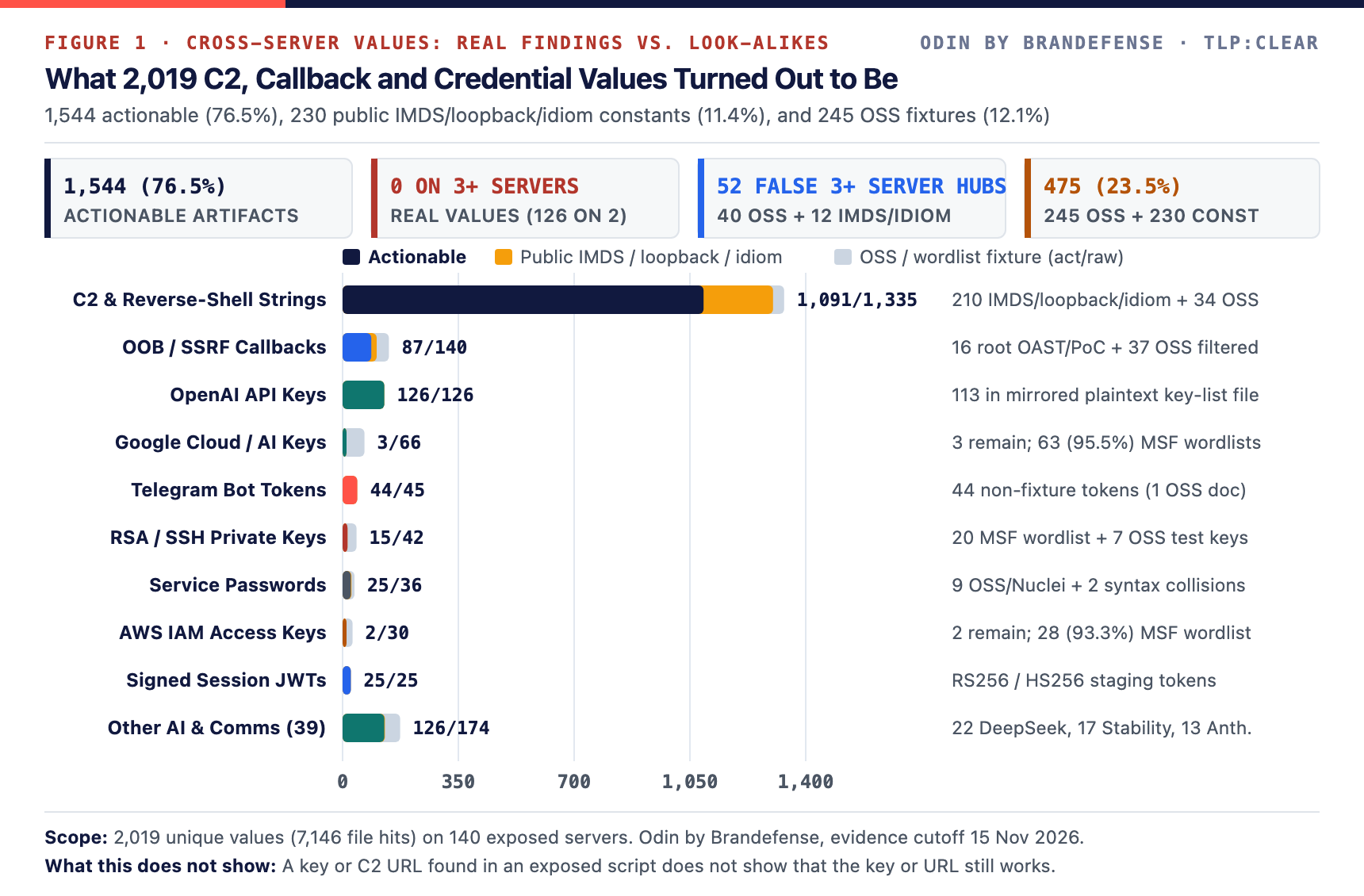
In Figure 1, the top bar adds the one bare reverse-shell prefix to the 1,334 C2 URLs, so it shows 1,335.
What the values turned out to be
| Outcome | Values | Share | What it covers |
|---|---|---|---|
| Real findings | 1,544 | 76.5% | Includes staged C2 URLs (1,091), AI provider keys (192), private keys and signed JWTs (40), and per-session OAST and Telegram tokens |
| Open-source fixtures | 245 | 12.1% | Documentation and unit-test examples, security wordlists, cloned Nuclei templates |
| Public constants | 230 | 11.4% | Loopback and RFC1918 URLs (200), public cloud metadata URLs (9), root OAST nameservers and code-syntax matches (20), one bare shell prefix |
| Total | 2,019 | 100% |
The two largest look-alike clusters were a Jupyter live-kernel documentation URL on 71 servers and a cli-config.yaml.example endpoint on 67 servers. Both ship inside open-source packages.
Where the fake secrets came from
A single Metasploit wordlist, flask_secret_keys.txt, explains most of the alarming secret counts.
| Secret type | Found | Real | Main source of the rest |
|---|---|---|---|
| C2 URLs | 1,334 | 1,091 | 200 loopback or RFC1918 URLs and 9 public cloud metadata URLs |
| Out-of-band callbacks | 140 | 87 | Nuclei CVE templates (37) and root OAST domains (16) |
| OpenAI API keys | 126 | 126 | None; 113 sit in one mirrored plaintext key list |
| Google API keys | 66 | 3 | 63 in Metasploit flask_secret_keys.txt |
| Telegram bot tokens | 45 | 44 | 1 open-source documentation example |
| Private keys | 42 | 15 | 20 in the Metasploit wordlist, 7 open-source test keys |
| Generic passwords | 36 | 25 | aiohttp and yarl tests, plus fallback_getpass on 7 servers |
| AWS access keys | 30 | 2 | 28 in the Metasploit wordlist |
| Slack tokens | 13 | 1 | 12 in MobSF signature rules and open-source tests |
Other real AI keys include 22 DeepSeek, 17 Stability, 13 Anthropic, 7 OpenRouter and 3 Groq keys. We did not test whether any key still works.
The 12 public constants behind the biggest "hubs"
Twelve of the 52 wide clusters were not open-source files at all. Each is a public value that many unrelated servers contain.
| Servers | Value | Example host and file |
|---|---|---|
| 42 | bash -i >& /dev/tcp/ (bare shell prefix, no target) | 202.162.109[.]5, /hr.sh |
| 42 | http://169.254.169.254/latest/meta-data/ (AWS metadata) | 129.226.71[.]134, /vt2.py |
| 23 | http://169.254.169.254/metadata/instance (Azure metadata) | Developer host, withheld |
| 21 | http://169.254.169.254/latest/meta-data/instance-id | Developer host, withheld |
| 19 | http://100.100.100.200/latest/meta-data/ (Alibaba Cloud metadata) | 38.246.253[.]11, /redir.log |
| 15 | http://169.254.169.254/metadata/v1/id (DigitalOcean metadata) | Developer host, withheld |
| 7 | fallback_getpass (code identifier) | Developer gateway, withheld |
| 5 | http://127.0.0.1:18789/__openclaw__/canvas/ (loopback) | Developer gateway, withheld |
| 5 | http://169.254.169.254/latest/user-data/ | 8.137.114[.]242, generate_rules.py |
| 4 | keyboardshortcuts (code identifier) | Unrelated host, withheld |
| 3 | http://100.100.100.200/latest/meta-data/ram/security-credentials/ | 38.246.253[.]11, /redir.log |
| 3 | e.oauth.grantType?n (minified code fragment) | 8.138.12[.]59, /k4_app.js |
The top two rows matter most. Each made a single-host workbench look like part of a 42-server network. Chapter 4 shows what those hosts really are.
The real overlap is small
Among real findings, no value appears on more than 2 servers. There are 126 such two-server values, anchored to 6 servers.
| Anchor host | Port | Values shared with one other server | Context |
|---|---|---|---|
| Exposure host, withheld | 8000 | 113 | Plaintext list of OpenAI project keys; owner unknown |
| 43.230.171[.]150 | 8080 | 7 | /apply_AC2.json, /D_job.sql, /AD_svc.sql and a settings file; adversary host |
| Developer host, withheld | 4000 | 3 | Agent session logs with 1 OpenAI, 1 Anthropic and 1 Telegram token |
| 129.226.71[.]134 | 8899 | 1 | Google API key in a staged web template; adversary host |
| Developer host, withheld | 8899 | 1 | DeepSeek key in an agent .env file |
| Developer host, withheld | 8888 | 1 | OpenRouter key in an agent profile .env file |
Only 8 of the 126 values sit on the 2 adversary hosts. The other 118 sit on 4 hosts that look like exposed developer or unattributed machines. Those 4 hosts are not on any block list in this report.
3. Electron IDE Secret Extraction and CLI Token Fallback
In short
One exposed server holds 24 scripts written to dig OAuth secrets out of a commercial Electron AI IDE. Separately, exposed agent gateways ship code that can borrow a developer's CLI login.
Why Electron apps leak secrets
Electron packs an app's source into an app.asar file. That file is not encrypted. Any Node.js script can read it with ordinary file calls. RFC 8252 (OAuth 2.0 for Native Apps) states that a desktop binary cannot keep a static client secret confidential.
So if an app embeds OAUTH_APP_SECRET or appSecret inside app.asar, a local script can recover it. The holder of that secret can then act as the app in the OAuth authorization_code exchange.
The 24-script workbench on Host W
Host W (US, address withheld) exposes 1,228 files totalling 3,066,253 bytes. They show someone reverse-engineering a commercial Electron AI IDE, whose name we withhold.
Instead of unpacking the archive with the standard @electron/asar tool, the operator wrote 24 numbered scripts. They run from find_secret.js through find_secret24.js, each between 303 and 1,148 bytes. The scripts load the IDE's resources/app.asar (about 249 MB) and a companion CLI .cjs bundle (about 12.5 MB) as text.
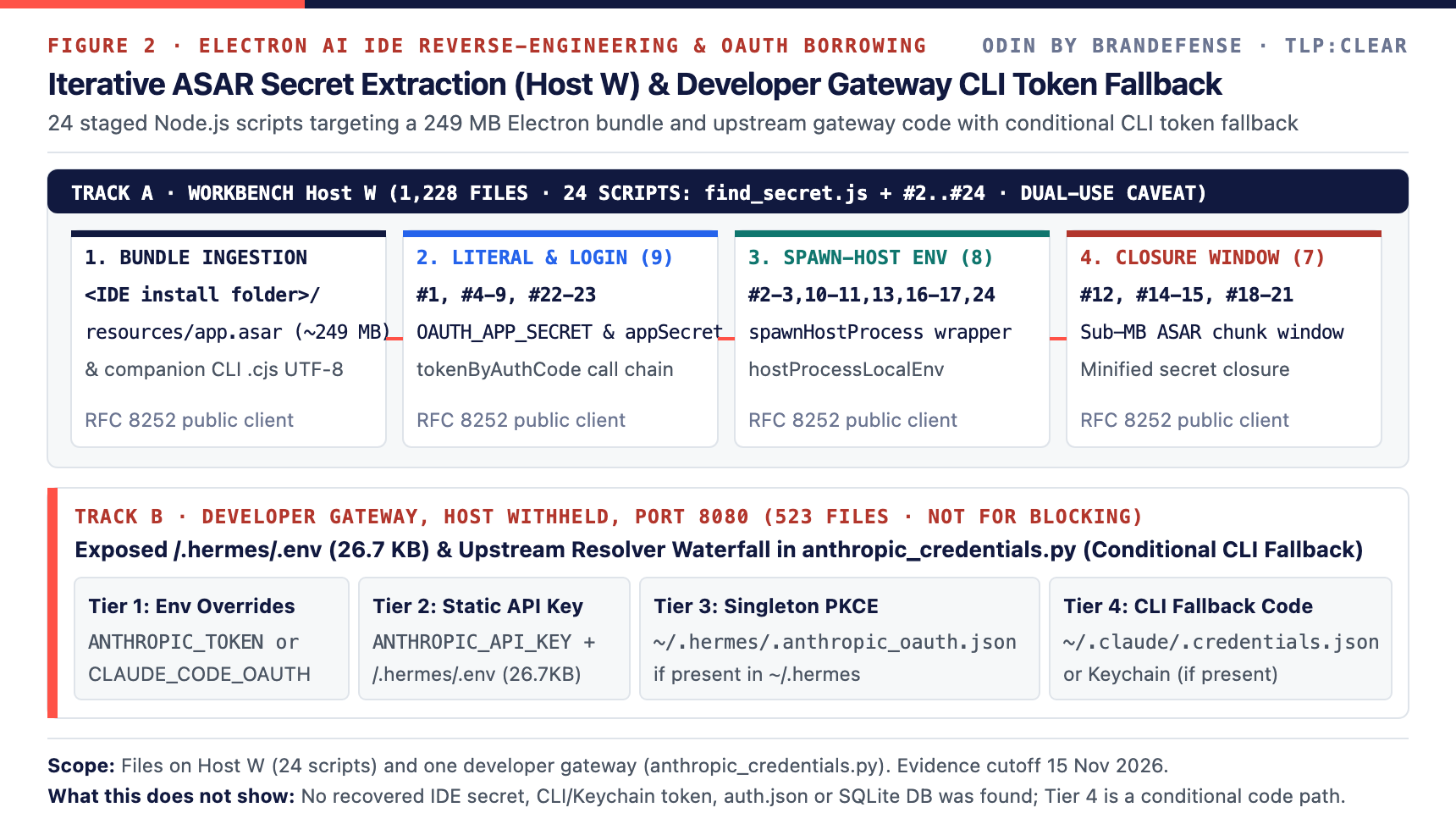
The scripts move through three phases, from simple string search to slicing the bundled code.
| Phase | Count | What the scripts look for |
|---|---|---|
| 1. String and login search | 9 | OAUTH_APP_SECRET, OAUTH_CLIENT_SECRET, appSecret and tokenByAuthCode, then walk back to the enclosing function to map the login call chain |
| 2. Child-process environment | 8 | The process spawner (spawnHostProcess) and its environment object (hostProcessLocalEnv), to find .env loaders and injected secrets |
| 3. Bundle slicing | 7 | Sub-megabyte windows of app.asar around hostProcessLocalEnv, measuring distance between webpack chunks to isolate the function that returns the secret |
The target archive and any extracted secret were not on the server. The scripts show intent and method, not a recovered secret or a breach of the IDE vendor.
What else sits on the same server
| Tool | Files | Purpose |
|---|---|---|
| Panel automation | agent_panel.js, agent_v3.js, agent_v4.js | Playwright scripts that drive a web panel |
| Browser capture | cdp_screenshot.js | Chrome DevTools Protocol screenshot utility |
| Account registration | exploit_register.py, exploit_semi.py, exploit_v2.py to exploit_v15.py (11 scripts) | Iterative scripts that register accounts |
| Wallet keystore | One file, 2,038 bytes (path withheld) | Exposed cryptocurrency wallet keystore |
A dual-use caveat. The registration scripts create accounts with names that suggest a penetration test. This server may belong to a red team that left its test box exposed, or to a hostile operator. We cannot tell which, and authorization is unknown.
Agent gateways that can borrow CLI logins
Two exposed gateways run the open-source NousResearch hermes-agent on port 8080. Their owners appear to be developers, not attackers, so both hosts stay anonymous.
The larger gateway serves 523 files over plain HTTP. They include its live /.hermes/.env (26,669 bytes, 542 lines) and gateway.log (17,889 bytes). They also include the upstream module anthropic_credentials.py (41,534 bytes, 816 lines).
That module's resolve_anthropic_token() function tries four sources in order.
| Step | Source | What it reads |
|---|---|---|
| 1 | Environment token | ANTHROPIC_TOKEN or CLAUDE_CODE_OAUTH_TOKEN |
| 2 | Static API key | ANTHROPIC_API_KEY (sk-ant-api* keys, sent as x-api-key) |
| 3 | Hermes OAuth file | ~/.hermes/.anthropic_oauth.json (sk-ant-oat* tokens, sent as a Bearer token) |
| 4 | Borrowed CLI login | ~/.claude/.credentials.json or the macOS Keychain entry for Claude Code, copied into the Hermes credential pool (auth.json) |
Step 4 is an upstream feature, not malware. The risk comes from serving ~/.hermes/ over HTTP. If a borrowed token or a session history database is stored there, anyone can read it.
We found no auth.json, no CLI or Keychain token, no SQLite history and no log showing step 4 ran. Across all servers in the study, .env files expose 22 DeepSeek and 13 Anthropic keys.
4. Java Deserialization and Recon Workbenches
In short
Two hosts looked like members of a 42-server network only because each contains a common public string. Each is in fact a self-contained, single-host workbench.
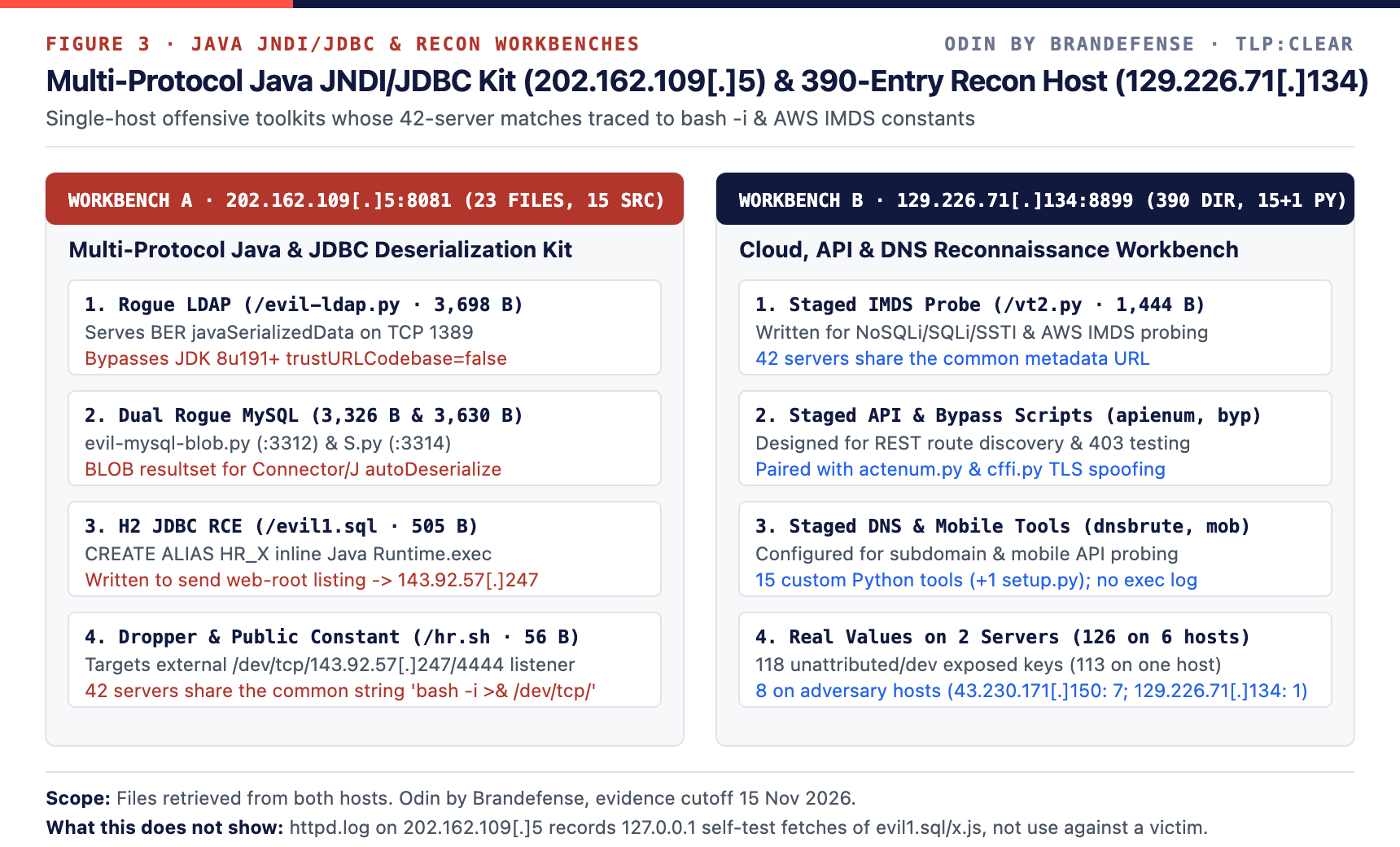
Hosts 202.162.109[.]5 and 129.226.71[.]134 each appeared in a 42-server cluster. For the first, the shared value was the bare shell prefix bash -i >& /dev/tcp/. For the second, it was the AWS metadata URL. Both strings appear on many unrelated servers, so neither cluster is evidence of shared infrastructure.
202.162.109[.]5: a Java deserialization kit
This host (Singapore) exposes 23 directory entries across ports 8081 and 8080. We retrieved 15 files. The operator did not use public frameworks such as ysoserial or rogue_mysql_server. Instead, they wrote small Python emulators for each protocol.
| File | Size | Listens on | What it does |
|---|---|---|---|
/evil-ldap.py | 3,698 B, 103 lines | TCP 1389 | Rogue JNDI LDAP server. Answers a search request with javaClassName: Exploit and a javaSerializedData payload, which sidesteps the trustURLCodebase limit in JDK 8u191 and later |
/evil-mysql-blob.py | 3,326 B, 105 lines | TCP 3312 | Rogue MySQL server with banner 5.7.36-evilblob. Returns a serialized object as a BLOB column to any MySQL Connector/J client using autoDeserialize=true |
/S.py | 3,630 B, 103 lines | TCP 3314 | Configurable rogue MySQL server with banner 5.7.36-debug. Lets the operator set column type and other fields, and injects a payload into SELECT results |
/evil1.sql | 505 B, 2 lines | Served over HTTP | H2 database script that defines CREATE ALIAS HR_X to call Runtime.getRuntime().exec, and sends id, hostname and a web-root listing to 143.92.57[.]247:8081 |
/hr.sh | 56 B | Served over HTTP | Bash reverse shell to 143.92.57[.]247:4444 |
/x.js | 172 B | Served over HTTP | Script that calls back to 143.92.57[.]247:8080 |
/start-blob.sh, /start-s.sh | 236 B, 179 B | Launchers for the two MySQL servers |
The server's own logs add context. /ldap.log (40,432 bytes, 1,472 lines) records evil-ldap on :1389 payload=1323B and repeated inbound LDAP connections. /blob3312.log (177 bytes) records two outside JDBC clients receiving 1,298-byte BLOB payloads.
/httpd.log (262,144 bytes, 3,287 lines) carries entries dated 25 October 2026. These show GET /evil1.sql requests from 127.0.0.1, which are the operator's own self-tests. Internet scanner probes such as GET /api/mcp also appear. This date is a timestamp in the attacker's log file, not part of our observation period.
The operator's infrastructure spans 2 hosts: 202.162.109[.]5 and the callback host 143.92.57[.]247.
129.226.71[.]134: an API and cloud recon workbench
This host (Hong Kong, port 8899) exposes 390 directory entries in 106 subfolders, totalling 4,416,662 bytes. We retrieved 15 custom Python tools, plus 1 vendored setup.py from the open-source SendSafely client library. A staged RSA private key also sits on the server (path withheld).
| Script | Size | What it is written to do |
|---|---|---|
/vt2.py | 1,444 B, 28 lines | Send 7 injection tests to /security/v1/verify: NoSQL injection, SQL injection, template injection ({{7*7}}), path traversal and an AWS metadata URL |
/apienum.py | 1,925 B, 27 lines | Probe 35 REST routes such as /api_gateway/v1/users, /wallets, /kyc and /auth/v1/token with 4 threads. Companions: /enum2.py, /enum3.py |
/actenum.py | 1,087 B, 14 lines | Enumerate 26 activity, admin, internal and debug endpoints with an Android Pixel 8 user agent |
/byp.py | 1,571 B, 23 lines | Probe 45 gateway routes with custom X-platform headers to find WAF bypass responses. Companions: /probe.py, /leads.py |
/cffi.py | 1,024 B, 20 lines | Test TLS-fingerprint bypass with curl_cffi impersonating Chrome 131 through 24 SOCKS5 proxies. Companions: /geo.py, /mob.py, /mob2.py, /proxycheck.py, /pw2.py |
/dnsbrute.py | 1,234 B, 31 lines | Brute-force subdomains with dnspython across 60 threads against 8.8.8[.]8 and 1.1.1[.]1 |
The routes in these scripts (wallets, KYC, auth tokens) suggest interest in financial or crypto platforms. We found no execution log on this host, so we cannot say whether any target was probed.
5. Rogue JWKS Keys and Cloud Metadata Redirectors
In short
Host 38.246.253[.]11 stages everything needed to test forged-token acceptance through the JWT jku header. It also runs redirectors aimed at Alibaba Cloud's metadata service.
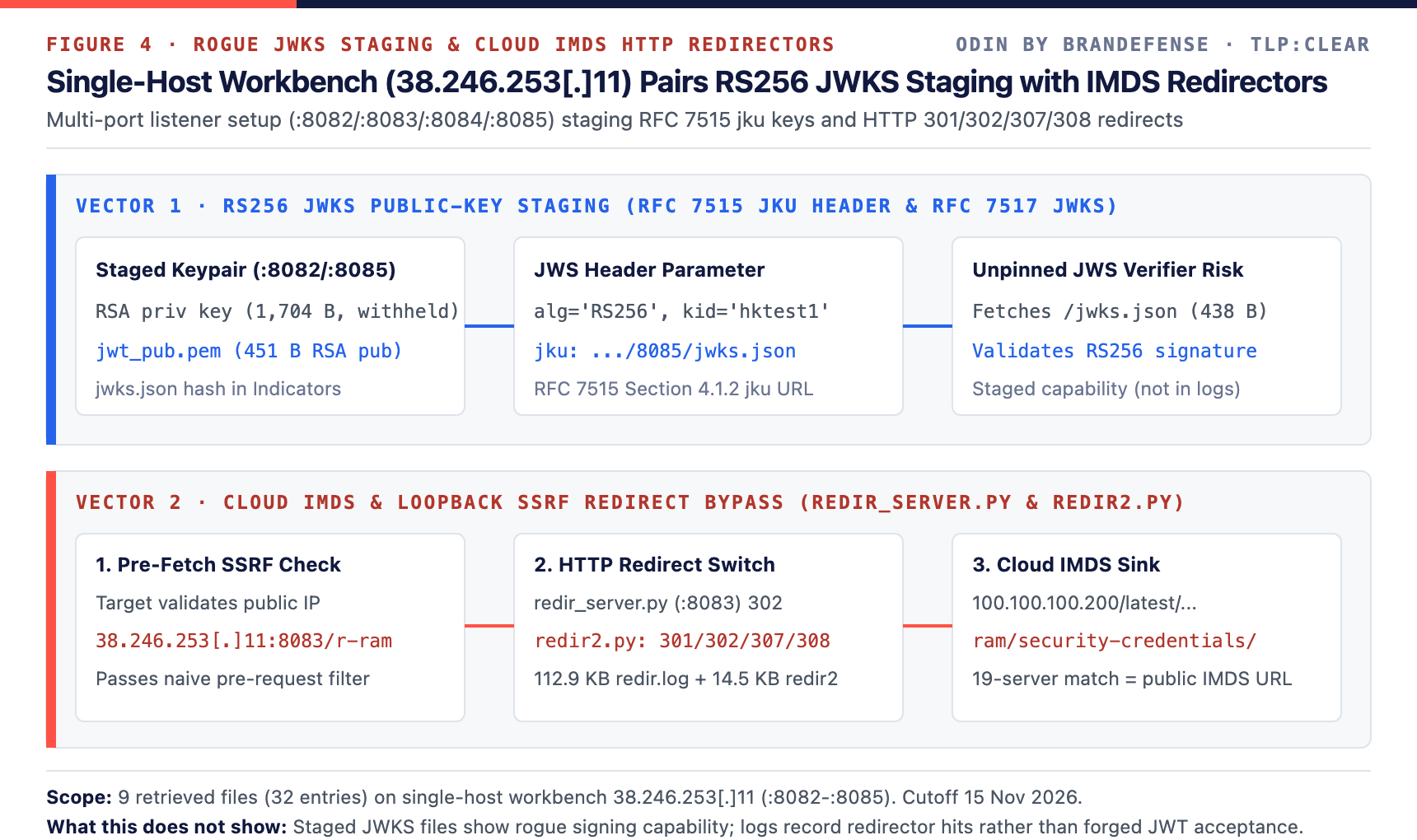
Host 38.246.253[.]11 (Hong Kong) exposes 32 directory entries across ports 8082 and 8085. We retrieved 9 files. Together they cover two attack paths.
Path 1: a rogue JWKS keyset
A signed JWT can carry a jku header (RFC 7515). It points to a URL that serves the public keys (a JWKS, RFC 7517) used to check the signature. If a server trusts any jku origin, an attacker can sign a token with their own key and point jku at their own keyset.
The host stages all three parts of this attack.
| Part | File | Size | Port |
|---|---|---|---|
| Attacker RSA private key | Name withheld | 1,704 B | 8082 |
| Matching public key | /jwt_pub.pem | 451 B (2048-bit RSA) | 8085 |
| Served keyset | /jwks.json | 438 B, "kid": "hktest1", "alg": "RS256" | 8085 |
The access log (/access.log, 262,144 bytes, 1,183 lines) mostly records internet scanners and directory browsing. We therefore do not claim that any service accepted a forged token. The key ID hktest1 is the most useful hunting value.
Path 2: redirectors that reach cloud metadata
Many web apps and AI agent sandboxes block requests to 169.254.169.254 or 100.100.100.200. Many do not re-check the address after following an HTTP redirect. The host stages two small Python servers built on BaseHTTPRequestHandler to exploit that gap.
/redir_server.py (897 bytes, 23 lines) listens on TCP 8083 and answers six short paths with 302 Found.
| Path | Redirects to |
|---|---|
/r-meta | http://100.100.100.200/latest/meta-data/ (Alibaba Cloud ECS metadata root) |
/r-ram | http://100.100.100.200/latest/meta-data/ram/security-credentials/ (RAM role temporary credentials) |
/r-img | http://38.246.253[.]11:8082/test.png (harmless test image) |
/r-local80, /r-local8080 | http://127.0.0.1/ and http://127.0.0.1:8080/ |
/r-self | The host's own address (withheld) |
/redir2.py (826 bytes, 21 lines) listens on TCP 8084. It maps /r301, /r302, /r307 and /r308 to redirects of the same status code. This tests which codes a client follows. Codes 307 and 308 also keep the POST method and body.
Two logs show the redirectors in use. /redir.log (112,905 bytes, 2,211 lines) and /redir2.log (14,456 bytes, 295 lines) record repeated 302 answers for /r-ram and /r-meta. The logs do not show which clients made the requests or what they received.
The metadata URLs inside /redir.log also produced two look-alike clusters, on 19 and 3 servers. Both are public constants (see Chapter 2).
6. Other Adversary Staging Hosts
In short
Eight more hosts stage droppers, phishing kits, callback harvesters and exploit tooling. They complete the published list of 12 adversary IPv4 hosts.
| Host | Port | What it stages |
|---|---|---|
| 43.230.171[.]150 | 8080 | /AD_svc.sql, /D_job.sql, /apply_AC2.json and a settings file; 7 of its values also appear on one other server (16 values in total) |
| 38.207.179[.]179 | 8088 | /cmds.txt and token files yielding 716 real C2 URL and token values |
| 51.194.215[.]35 | 8080 | /b/*.sh dropper scripts that fetch from http://51.194.215[.]35:8080/h/* (236 real values) |
| 8.137.114[.]242 | 8080 | GoPhish and recon tooling: /gophish/gophish.log, /gophish/nohup.out, /ApolloFish/nohup.out and key and config files (60 real values) |
| 144.172.99[.]199 | 8080 | /assemble_dnslog.py and /dbg18.log with 43 unique per-session OAST and DNSLog callbacks |
| 8.138.12[.]59 | 9999 | Fastjson tooling: /fastjson_probe.py, /ssrf_nacos.sh, /ssrf_probe2.sh and token-capture files (13 real values of 18) |
| 38.60.227[.]210 | 8082 | /deploy_ghc2.sh (a GitHub-based C2 agent), /actor.ps1 and /miner/install_user.sh (8 real C2 URLs) |
| 47.109.23[.]77 | 8888 | /jndi.log recording exploit.class and downstream botnet payload URLs (8 real values) |
Apart from the 7 values that 43.230.171[.]150 shares, nothing in this data links these hosts to each other or to the three workbenches. Treat them as separate operations.
7. What Defenders Should Do
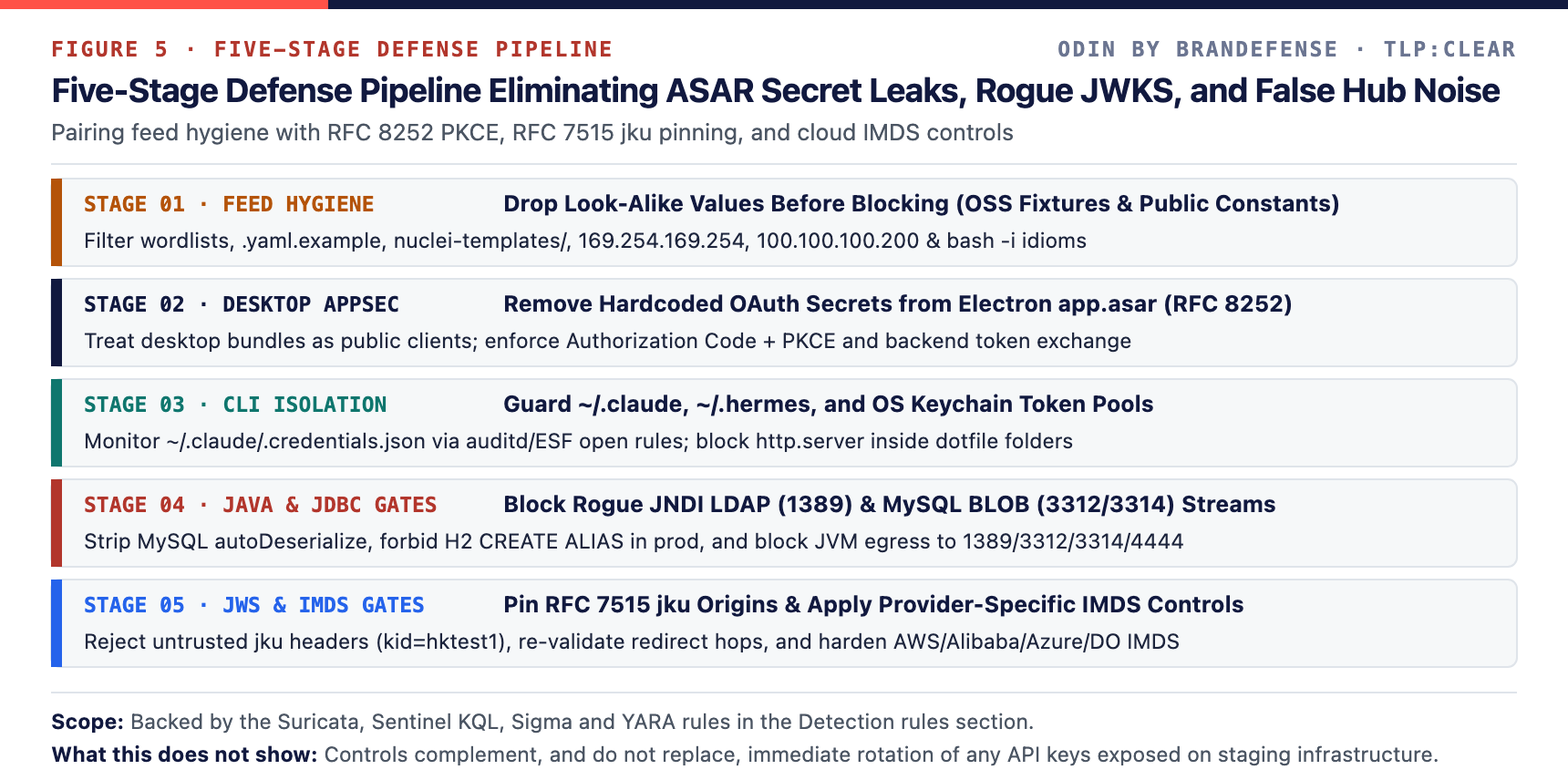
Within 24 hours
- Block the adversary IPv4 hosts in the Indicators tab, and alert on any internal host that contacts them.
- Hunt for the 15 file hashes, the script names
find_secret*.js,evil-ldap.py,evil-mysql-blob.py,redir_server.pyandredir2.py, and the JWKS key IDhktest1. - Rotate any API key that ever sat in an exposed
.envfile, agent profile or session log.
Within 72 hours (application and platform teams)
- Desktop apps. Treat Electron
.asarbundles and bundled.cjsCLI scripts as readable source. Replace staticOAUTH_APP_SECRETvalues with Authorization Code plus PKCE (S256). Enable the@electron/fusessettingEnableEmbeddedAsarIntegrityValidation. - JWT verification. Pin trusted JWKS origins. Reject unpinned
jkuheaders and unknownkidvalues such ashktest1. - Redirects. Re-check
169.254.0.0/16,100.100.100.200/32and127.0.0.0/8on every 301, 302, 303, 307 and 308 hop.
Within 7 to 30 days
- Cloud metadata. On AWS, require IMDSv2 (
HttpTokens=required). On Alibaba Cloud ECS, use hardened mode (HttpTokens=required,HttpEndpoint=enabled). On Azure, enforce theMetadata: trueheader and host firewall rules. On DigitalOcean Droplets, block non-root egress to169.254.169.254. - Java tiers. Block outbound traffic from application servers to untrusted LDAP (1389, 389) and MySQL (3306, 3312, 3314) ports. Remove
autoDeserializeandqueryInterceptorsfrom Connector/J connection strings, or upgrade to Connector/J 8.2.0 or later, whereautoDeserializeis removed. - H2. Disable H2 web consoles for remote users and forbid
INIT=RUNSCRIPTin JDBC URLs. - Agent dotfiles. Require an explicit opt-in before an agent framework reads
~/.claude/.credentials.jsonor the Keychain. Look for ad-hoc HTTP servers (python3 -m http.server) inside~/.hermes,~/.claudeand~/.codex, and set those files to mode 0600. - Threat feeds. Before a multi-host match goes on a block list, check what it is. Wordlist entries, documentation URLs, cloud metadata addresses, loopback URLs and bare shell prefixes are not shared infrastructure. Keep a full reverse shell with a routable IP and port as a real finding.
8. Detection Rules
The full rules are in the Detection rules tab. Each file targets one stage of the activity in this report.
| Rule file | What it catches |
|---|---|
suricata_ide_secrets_jndi_and_jwks_ssrf.rules | Suricata 7: seven signatures for the rogue JWKS response, metadata redirects, the H2 payload, Hermes path probes, raw-IP JWKS fetches, the reverse-shell script and rogue LDAP responses |
sentinel_electron_asar_and_imds_jwks_hunt.kql | Microsoft Sentinel and Defender XDR: ASAR scraping commands, extractor or credential file writes, and contact with staging hosts or rogue Java ports |
sigma_electron_asar_unpack_and_cli_cred_theft.yml | Sigma (3 rules): ASAR secret scraping, non-official access to agent credential stores, and JVM reverse shells |
yara_electron_asar_jndi_blob_and_jwks_toolkits.yar | YARA (4 rules): the find_secret extractors, the LDAP and MySQL servers, the H2 payload, and the JWKS and redirector kit |
How the Suricata signatures work
Signatures 9902601 to 9902606 read HTTP buffers. They need cleartext HTTP (ports 8080 to 8085 in this data) or TLS-inspected proxy or egress traffic. Signature 9902607 reads raw TCP on port 1389.
| SID | Looks for | Why |
|---|---|---|
| 9902601 | Inbound HTTP 200 response whose body holds "keys" and "hktest1" | Catches the rogue JWKS keyset used for jku abuse (RFC 7515) |
| 9902602 | HTTP 301, 302, 303, 307 or 308 whose Location points to an AWS, Alibaba, Azure, DigitalOcean or GCP metadata path, including encoded forms of 169.254.169.254 | Catches redirect-based SSRF into cloud metadata |
| 9902603 | Inbound HTTP 200 body with CREATE ALIAS and Runtime.getRuntime().exec | Catches the H2 RCE script in transit (T1190) |
| 9902604 | HTTP request for /.hermes/.env, a profile .env, .anthropic_oauth.json or sessions/ | Catches probes for exposed agent credential stores |
| 9902605 | Outbound request for /jwks.json to a raw IPv4 host | Catches a verifier fetching keys from an unpinned, IP-only origin |
| 9902606 | Outbound request for /hr.sh | Catches a fetch of the staged reverse-shell script (T1059.004) |
| 9902607 | javaSerializedData in traffic from external TCP port 1389 | Catches a rogue JNDI LDAP answer reaching an internal Java host |
How the other rules work
The KQL hunt has a 14-day lookback and three branches. The first reads process events. It flags asar extract, find_secret, or commands that touch app.asar or cli-bundle.cjs together with OAUTH, SECRET, readFileSync or hostProcessLocalEnv. It also flags non-official processes that reference agent credential files.
The second branch reads file events. It flags new find_secret files and writes to .credentials.json, .anthropic_oauth.json or .env inside .claude or .hermes by processes other than the official CLI. This matters because Defender file events record writes, not plain reads.
The third branch reads network events. It flags contact with the 12 staging hosts and Java processes connecting to public ports 1389, 3312, 3314 or 4444. It also flags plain-HTTP JWKS fetches from raw IP addresses.
The three Sigma rules cover Linux, macOS and Windows process creation:
| Sigma rule | Fires when | Main false positive |
|---|---|---|
| ASAR secret scraping | asar extract, or a command touching app.asar or cli-bundle.cjs with OAUTH, APP_SECRET, readFileSync or hostProcessLocalEnv, or node running find_secret | Authorized app security audits and packaging pipelines |
| Agent credential store access | A non-official process references ~/.claude/.credentials.json or ~/.hermes/ tokens, queries the Keychain for Claude entries, or runs python -m http.server inside .hermes, .claude or .codex | Developer debugging |
| JVM reverse shell | A Java process spawns sh, bash, cmd.exe or PowerShell with /dev/tcp/, nc -e, ncat, /hr.sh, /evil1.sql or :8081/r?d= in the command line | Security test harnesses; gradle, maven, jenkins, surefire and bazel builds are excluded |
Each YARA rule needs two or more independent strings and a small file size:
| YARA rule | Fires on |
|---|---|
ODIN_Electron_IDE_ASAR_Secret_Extractor | Files under 50 KB that combine readFileSync, an app.asar path and a secret or closure name such as OAUTH_APP_SECRET or hostProcessLocalEnv |
ODIN_Rogue_JNDI_LDAP_and_MySQL_JDBC_Blob_Kit | javaSerializedData with the BER encoder, or the MySQL packet helper with autoDeserialize or the 5.7.36-evilblob / 5.7.36-debug banners |
ODIN_H2_Database_Create_Alias_Java_RCE | Scripts with CREATE ALIAS IF NOT EXISTS, Runtime.getRuntime().exec and java[.]net.URLEncoder.encode together |
ODIN_Rogue_JWKS_and_Cloud_IMDS_SSRF_Redirector | A keyset with "keys", "hktest1" and "RS256", or a BaseHTTPRequestHandler script that sets Location to a metadata address or a redirect path such as /r-ram |
9. Indicators
The full list is in the Indicators tab. The published set has 27 indicators; the dual-use Host W address is withheld.
| Type | Count |
|---|---|
| Adversary IPv4 hosts | 12 |
| SHA-256 file hashes of staged tools | 15 |
| Exposed developer gateways or unattributed exposure hosts | 0 published |
Adversary hosts
| Host | Port | Role |
|---|---|---|
| 202.162.109[.]5 | 8081 | Java JNDI LDAP, MySQL BLOB and H2 exploit workbench |
| 143.92.57[.]247 | 4444 | Reverse-shell, H2 callback and script callback listener |
| 129.226.71[.]134 | 8899 | Cloud, API and DNS recon workbench |
| 38.246.253[.]11 | 8085 | Rogue RS256 JWKS and metadata redirector host |
| 43.230.171[.]150 | 8080 | AD and SQL dropper and credential staging host |
| 38.207.179[.]179 | 8088 | C2 payload and command staging server |
| 51.194.215[.]35 | 8080 | Shell-dropper staging host |
| 8.137.114[.]242 | 8080 | GoPhish and recon tooling workbench |
| 144.172.99[.]199 | 8080 | OAST and DNSLog callback harvest host |
| 8.138.12[.]59 | 9999 | Fastjson exploitation and token harvest workbench |
| 38.60.227[.]210 | 8082 | GitHub-based C2 agent and cryptominer dropper host |
| 47.109.23[.]77 | 8888 | JNDI class-loader and botnet staging host |
File hashes
| File | Size | Host | SHA-256 |
|---|---|---|---|
/find_secret.js | 957 B | Host W | 58d60d46032f0773450f3423c590e33def5c8d82d99ea7d3eeb030e48bcf75da |
/find_secret10.js | 1,015 B | Host W | fa4c8b7e32a988708b8be3f242f8da7b4950317e744d25dc29562f2d7668b89b |
/find_secret15.js | 936 B | Host W | ae94f76f756ba03d649fd1cfd5d5e4499964d35d240004ae1201f2d69a6ff561 |
/find_secret19.js | 706 B | Host W | 82bf3e60b1a88f3aec71340135071c7ef274bbc79d0af957feda96ef03ecd722 |
/find_secret21.js | 1,148 B | Host W | 67e0a6cd4f9d33100b5586db7fc520a9c3bdf552efba25eaa26193a271cacb96 |
/evil-ldap.py | 3,698 B | 202.162.109[.]5 | f168a63ff299f329042018ac619a5798ff7f32db84e00d695486dbdb52e230d5 |
/evil-mysql-blob.py | 3,326 B | 202.162.109[.]5 | fd02682812241e87923e1dd84c143172311e2fd2ccd96e24102902712d94c3bf |
/S.py | 3,630 B | 202.162.109[.]5 | 2905df5e743e78e506301a5eb5db64d5ee2693ac1b2db4f471e3752f27814240 |
/evil1.sql | 505 B | 202.162.109[.]5 | 1c17f27b9f5dac7c800e1e8525d51eaa776de908f55f17acd2acc8d9f465fd0f |
/hr.sh | 56 B | 202.162.109[.]5 | 6d52a91e2c376bb58f95d67b34bbdf6c79215d80074d77f19f21c551c56cf8fb |
/redir_server.py | 897 B | 38.246.253[.]11 | a6d229a047b79585c56440d4cf51bffda83431f4917d592abc15ca50bff5093a |
/redir2.py | 826 B | 38.246.253[.]11 | ecd9a613e61a457652b9a587e2c698687056ae961d743cfeb0d80235d69af23b |
/jwks.json | 438 B | 38.246.253[.]11 | ddf4f0ffd2f5a3d1f1e68801975a1788de48079f4746ff7f41eb6c14218796b7 |
/apienum.py | 1,925 B | 129.226.71[.]134 | 8215966f15ad99df70d12359b5357322fb2e4d6a9b47b0e97f47cbc25b823b68 |
/dnsbrute.py | 1,234 B | 129.226.71[.]134 | 5ef1c728993da674a1ce87e7dcce45fb377ef905338a6e0c553cb11b6df7ea59 |
Supporting hunting values: JWKS key ID hktest1, MySQL banners 5.7.36-evilblob and 5.7.36-debug, the log line evil-ldap on :1389, and H2 alias HR_X.
Withheld: the two developer gateways, the four developer or unattributed exposure hosts, and the IDE vendor and install paths. Also withheld are the staged private keys, the wallet keystore, the redirector's self-probe address, and all exposed API keys and tokens.
MITRE ATT&CK mapping
| Tactic | Technique | Where it appears | Detection |
|---|---|---|---|
| Credential Access | T1552.001 Credentials In Files | find_secret*.js scraping app.asar; exposed .env files | Sigma rule 1; YARA extractor rule; KQL branches 1 and 2 |
| Credential Access | T1528 Steal Application Access Token | Recovering an embedded OAuth client secret; borrowing CLI OAuth tokens | Sigma rules 1 and 2; SID 9902604 |
| Credential Access | T1555.001 Keychain | Hermes fallback code that queries the macOS Keychain | Sigma rule 2 |
| Initial Access | T1190 Exploit Public-Facing Application | Rogue JNDI LDAP, MySQL BLOB and H2 servers on 202.162.109[.]5 | SID 9902603, 9902607; YARA JNDI and H2 rules |
| Credential Access | T1552.005 Cloud Instance Metadata API | Redirectors to 100.100.100.200 RAM credentials | SID 9902602; YARA JWKS and redirector rule |
| Execution | T1059.004 Unix Shell | /hr.sh reverse shell to 143.92.57[.]247:4444 | SID 9902606; Sigma rule 3 |
10. Scope and Limits
- Time frame. Findings use an evidence cutoff of 15 November 2026. The 25 October 2026 date in Chapter 4 is a timestamp inside the attacker's own log, not a start date for our observation.
- Staged does not mean used. The scripts, kits and keys show intent and capability. We did not see any of them succeed against a victim. No IDE secret, borrowed CLI token or accepted forged JWT was found.
- Presence is not validity. A key or C2 URL found on a server may be expired or fake. We did not test any key.
- Dual use. Account names on Host W leave open that it is an exposed red-team server. Authorization is unknown, so its address is withheld; its script hashes stay published as tool indicators.
- Developer hosts are not attackers. The Hermes gateways and other exposure hosts look like misconfigured developer machines. They are withheld and not on any block list.
- No hidden network. Apart from 7 values shared by 43.230.171[.]150, nothing in this data links the adversary hosts to each other.
- Rule testing. Every published rule file loads without errors in its engine (Suricata 7.0.12, YARA-X, pySigma and Microsoft's Kusto.Language analyzer, checked on 20 November 2026). The rules were not replayed against live traffic, so test and tune them in your own environment before production use.
11. Sources
- Electron. ASAR Archives. https://www.electronjs.org/docs/latest/tutorial/asar-archives (verified 15 November 2026)
- IETF. RFC 8252, OAuth 2.0 for Native Apps (BCP 212). https://datatracker.ietf.org/doc/html/rfc8252 (verified 15 November 2026)
- MITRE ATT&CK. T1190 Exploit Public-Facing Application. https://attack.mitre.org/techniques/T1190/ (verified 15 November 2026)
- IETF. RFC 7515, JSON Web Signature, Section 4.1.2 (
jku), and RFC 7517, JSON Web Key. https://datatracker.ietf.org/doc/html/rfc7515 (verified 15 November 2026) - MITRE ATT&CK. T1552.005 Cloud Instance Metadata API. https://attack.mitre.org/techniques/T1552/005/ (verified 15 November 2026)
- MITRE ATT&CK. T1552.001 Credentials In Files. https://attack.mitre.org/techniques/T1552/001/ (verified 15 November 2026)
- Alibaba Cloud. ECS: Access instance metadata using hardened-only mode. https://help.aliyun.com/en/ecs/user-guide/access-instance-metadata-using-hardened-only-mode (verified 15 November 2026)
- Oracle. MySQL Connector/J 8.2.0 release notes. https://dev.mysql.com/doc/relnotes/connector-j/en/news-8-2-0.html (verified 15 November 2026)
What is…?
Short explanations of the tools and families named in this study.
What is JNDI injection?
JNDI injection makes a Java application look up a remote object, usually over LDAP or RMI, and load attacker code. Log4Shell is the best-known example.
More about JNDI injectionOffensive frameworkWhat is Metasploit?
Metasploit is an open-source penetration testing framework maintained by Rapid7. It bundles exploits, payloads and the Meterpreter post-exploitation agent.
More about MetasploitTechniqueWhat is OAST?
Out-of-band application security testing (OAST) detects blind vulnerabilities by making a target call back to a server the tester controls, usually over DNS or HTTP.
More about OASTAI agentWhat is Claude Code?
Claude Code is Anthropic's command-line coding agent. It stores project sessions and settings in a .claude folder.
More about Claude CodeOAST serviceWhat is DNSLog?
DNSLog is a family of open-source DNS callback collectors used to confirm blind injection and SSRF flaws.
More about DNSLogPhishing frameworkWhat is GoPhish?
GoPhish is an open-source phishing simulation framework. Companies use it for awareness training and attackers use it for real campaigns.
More about GoPhishFrequently asked questions
How do attackers get secrets out of a desktop AI app?
Many desktop apps are built with Electron. Electron packs the app's code into a file called app.asar, which is not encrypted. Any script can read it. The OAuth standard for native apps (RFC 8252) says plainly that a desktop app cannot keep a built-in client secret private.
Why are developer agent gateways a risk?
Two exposed servers run an open-source agent gateway called hermes-agent. Their owners look like developers, not attackers, so we keep them anonymous. One serves 523 files over plain HTTP, including its live .env file and logs.
What do the three exploit workbenches contain?
Each workbench is a small, self-contained kit on a single server. The Java kit targets old Java and MySQL driver settings that turn data into running code. The JWKS kit targets services that accept a token's signing key from any URL. The redirectors target apps that block cloud metadata addresses at first but follow redirects without checking again.
Why did so many servers look connected?
Matching the same value across many servers is a common way to find shared attacker infrastructure. In our data, 52 values appeared on three or more servers, up to 71. That looked like a large C2 network.