


Key takeaways
- One exposed server holds 24 scripts written to pull OAuth secrets out of a commercial Electron AI IDE.
- Exposed agent gateways ship code that can borrow a developer's CLI login if it is present.
- Three single-host workbenches stage Java deserialization, API recon and rogue JWKS kits.
- All 52 values that looked like shared C2 hubs were open-source fixtures or public constants.
- Use PKCE in desktop apps, pin JWKS origins, and check multi-host matches before blocking.
Desktop AI coding assistants keep powerful credentials on developer machines: OAuth client secrets, model API keys and cloud tokens. In data with an evidence cutoff of 15 November 2026, Odin by Brandefense found a server holding 24 scripts built to pull secrets out of a commercial Electron AI IDE. We also found three compact exploit workbenches. And we found that every apparent "shared C2 hub" in 2,019 cross-server values was a harmless look-alike. For defenders, the lesson is twofold: desktop apps cannot hide secrets, and threat feeds need a sanity check before they drive blocking.
How do attackers get secrets out of a desktop AI app?
Many desktop apps are built with Electron. Electron packs the app's code into a file called app.asar, which is not encrypted. Any script can read it. The OAuth standard for native apps (RFC 8252) says plainly that a desktop app cannot keep a built-in client secret private.
One US host (Host W), whose address we withhold, shows what that looks like in practice. It exposes 1,228 files. Among them are 24 numbered Node.js scripts, from find_secret.js to find_secret24.js. They read the IDE's 249 MB app.asar file and a 12.5 MB CLI bundle as text.
The scripts work in three phases. First, they search for names such as OAUTH_APP_SECRET and appSecret. Next, they trace how the app passes environment values to child processes. Finally, they cut the bundled code into small windows to find the function that returns the secret.
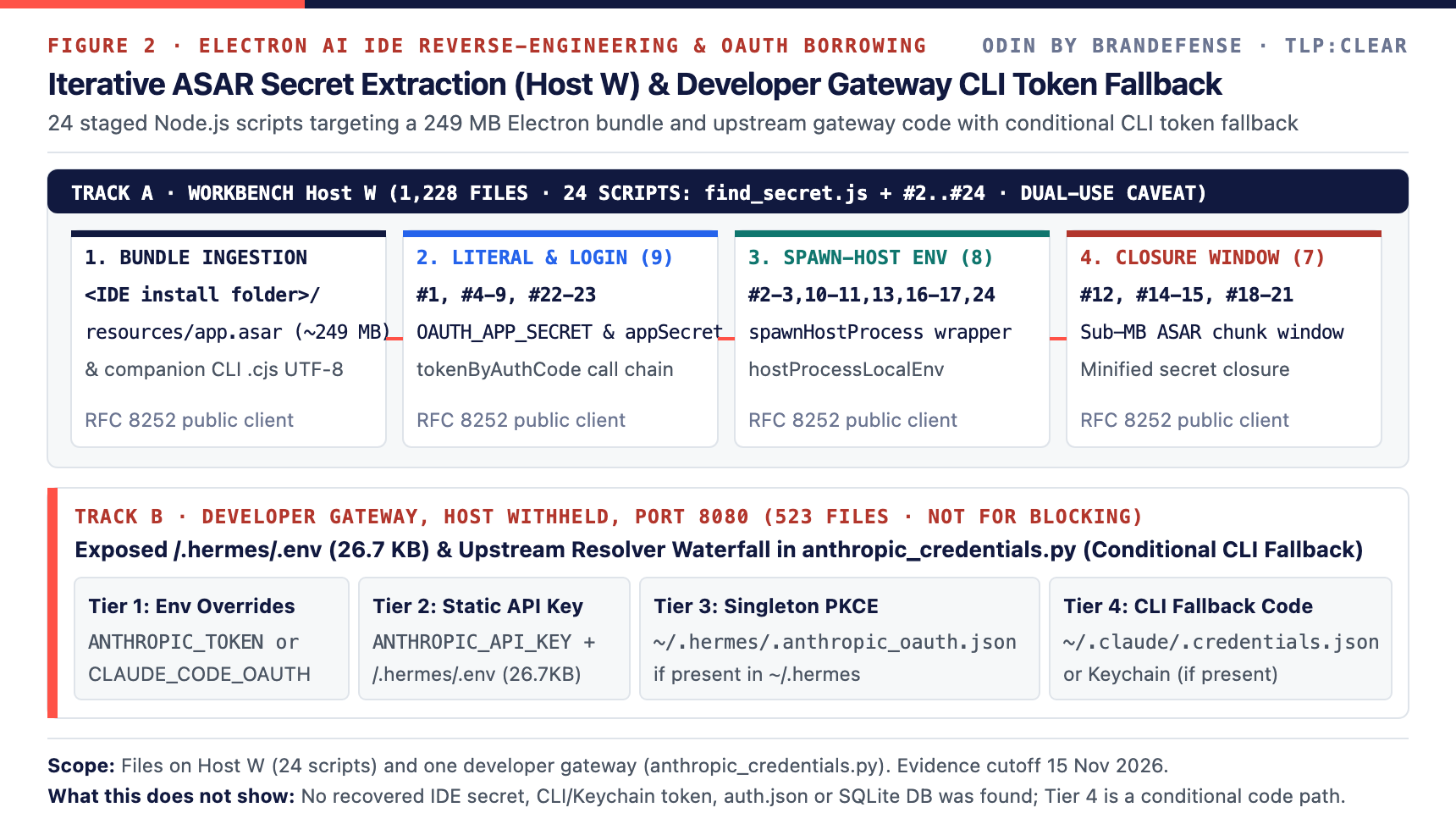
We found no recovered secret on the server. The same server also holds account-registration scripts with names that suggest a penetration test, so it may be an exposed red-team box. Either way, the method works against any desktop app that embeds a static secret.
Why are developer agent gateways a risk?
Two exposed servers run an open-source agent gateway called hermes-agent. Their owners look like developers, not attackers, so we keep them anonymous. One serves 523 files over plain HTTP, including its live .env file and logs.
The gateway's upstream code looks for an Anthropic token in four places. If the first three are empty, it can read the developer's Claude Code CLI login from disk or from the macOS Keychain. That is a design feature, not malware. But serving the gateway's folder over HTTP means any borrowed token stored there becomes public. We found no such token in this case.
What do the three exploit workbenches contain?
Each workbench is a small, self-contained kit on a single server.
| Host | What it stages |
|---|---|
| 202.162.109[.]5 | Rogue Java LDAP server (port 1389), two rogue MySQL servers (3312, 3314), an H2 database payload, and a reverse shell to 143.92.57[.]247 |
| 129.226.71[.]134 | 15 custom Python tools that probe APIs, WAF bypasses, TLS fingerprints and DNS, with routes for wallets, KYC and auth tokens |
| 38.246.253[.]11 | A rogue RS256 JWKS keyset (key ID hktest1) and redirectors that point to Alibaba Cloud's metadata service |
The Java kit targets old Java and MySQL driver settings that turn data into running code. The JWKS kit targets services that accept a token's signing key from any URL. The redirectors target apps that block cloud metadata addresses at first but follow redirects without checking again.
Logs on these servers show self-tests and redirector traffic. They do not show any attack succeeding against a victim.
Why did so many servers look connected?
Matching the same value across many servers is a common way to find shared attacker infrastructure. In our data, 52 values appeared on three or more servers, up to 71. That looked like a large C2 network.
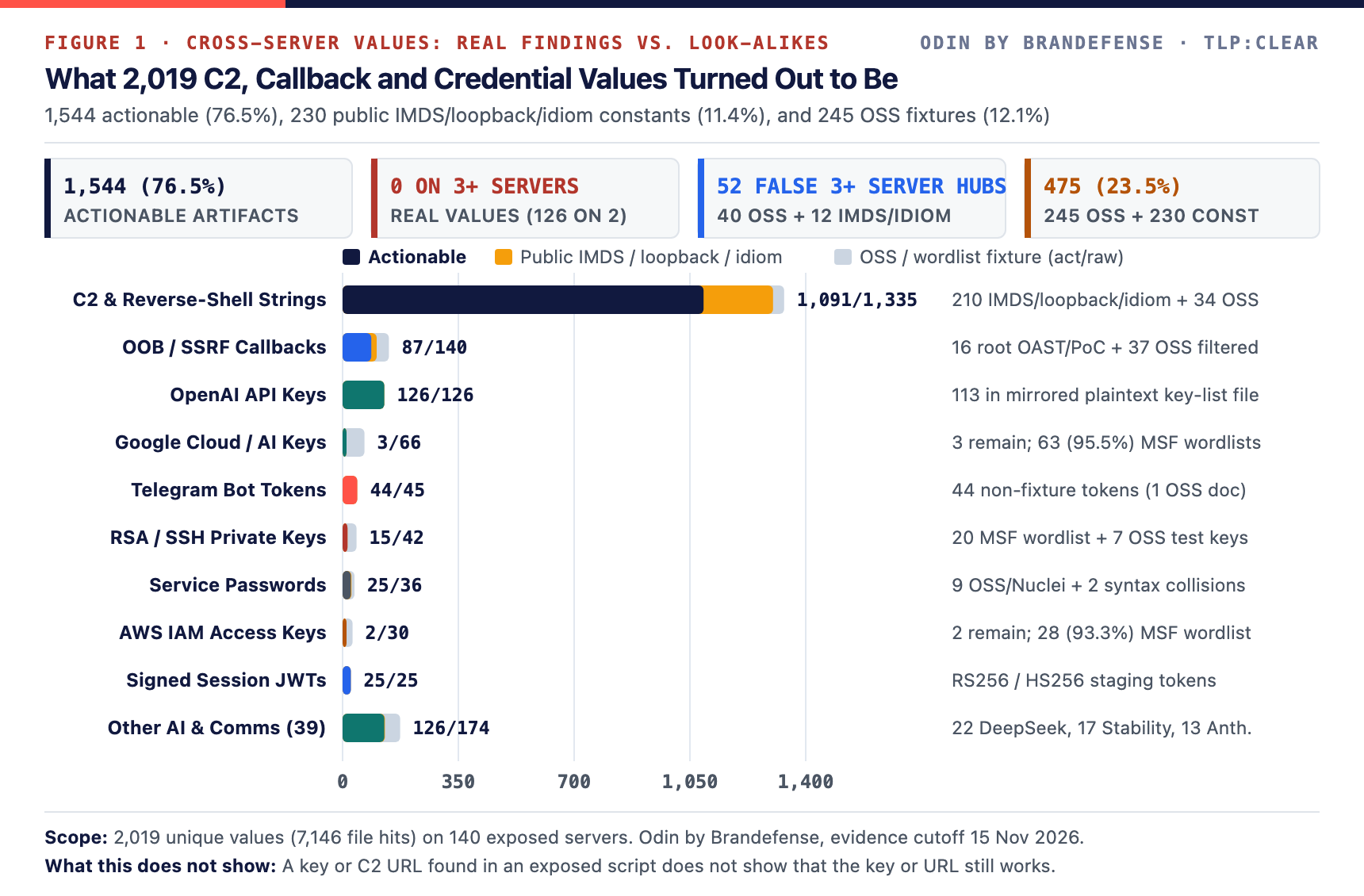
It was not. Forty of those values were open-source fixtures, such as documentation URLs and wordlists. The other 12 were public constants, such as the AWS metadata URL or the bare text bash -i >& /dev/tcp/. Two of the Java and recon workbenches each looked like part of a 42-server network for exactly this reason.
One Metasploit wordlist explained most of the alarming secret counts. It held 63 of 66 Google API keys and 28 of 30 AWS keys. Once fixtures and constants were set aside, 1,544 real values remained. None appeared on more than two servers.
Real exposures do exist. 192 of 200 AI provider keys were real exposures rather than test fixtures, and one host held 113 OpenAI keys in a plain list. We did not test whether any key still works.
What to do now
- Remove static OAuth secrets from desktop apps. Use Authorization Code with PKCE, and turn on Electron's ASAR integrity check.
- Pin JWKS origins and re-check every redirect. Reject unknown
jkuURLs and key IDs such ashktest1. Block metadata and loopback addresses on every redirect hop, and turn on IMDSv2 or the equivalent on each cloud. - Harden Java tiers. Block outbound LDAP and MySQL traffic to untrusted hosts, and remove
autoDeserializefrom MySQL driver settings. - Protect agent dotfiles. Never serve
~/.hermes,~/.claudeor similar folders over HTTP, and rotate any key that was exposed. - Check matches before blocking. Filter wordlists, documentation URLs and cloud metadata addresses out of threat feeds. The full report's Indicators tab and Detection rules tab have the hosts, hashes and Suricata, Sentinel KQL, Sigma and YARA rules.
What is…?
Short explanations of the tools and families named in this study.
What is JNDI injection?
JNDI injection makes a Java application look up a remote object, usually over LDAP or RMI, and load attacker code. Log4Shell is the best-known example.
More about JNDI injectionOffensive frameworkWhat is Metasploit?
Metasploit is an open-source penetration testing framework maintained by Rapid7. It bundles exploits, payloads and the Meterpreter post-exploitation agent.
More about MetasploitTechniqueWhat is OAST?
Out-of-band application security testing (OAST) detects blind vulnerabilities by making a target call back to a server the tester controls, usually over DNS or HTTP.
More about OASTAI agentWhat is Claude Code?
Claude Code is Anthropic's command-line coding agent. It stores project sessions and settings in a .claude folder.
More about Claude CodeOAST serviceWhat is DNSLog?
DNSLog is a family of open-source DNS callback collectors used to confirm blind injection and SSRF flaws.
More about DNSLogPhishing frameworkWhat is GoPhish?
GoPhish is an open-source phishing simulation framework. Companies use it for awareness training and attackers use it for real campaigns.
More about GoPhishFrequently asked questions
How do attackers get secrets out of a desktop AI app?
Many desktop apps are built with Electron. Electron packs the app's code into a file called app.asar, which is not encrypted. Any script can read it. The OAuth standard for native apps (RFC 8252) says plainly that a desktop app cannot keep a built-in client secret private.
Why are developer agent gateways a risk?
Two exposed servers run an open-source agent gateway called hermes-agent. Their owners look like developers, not attackers, so we keep them anonymous. One serves 523 files over plain HTTP, including its live .env file and logs.
What do the three exploit workbenches contain?
Each workbench is a small, self-contained kit on a single server. The Java kit targets old Java and MySQL driver settings that turn data into running code. The JWKS kit targets services that accept a token's signing key from any URL. The redirectors target apps that block cloud metadata addresses at first but follow redirects without checking again.
Why did so many servers look connected?
Matching the same value across many servers is a common way to find shared attacker infrastructure. In our data, 52 values appeared on three or more servers, up to 71. That looked like a large C2 network.