


Key takeaways
- A leaked Rust build folder names 25 implant modules and a 313-crate workspace.
- A Russian server held XWorm 5.6 source that poses as a Windows Update component.
- Staged scripts are written to graft stolen cookies into Chrome and hijack COM without admin rights.
- Only 6 of 920 recent commodity RAT candidates were confirmed live C2 servers.
- Alert on per-user CLSID writes into user-writable folders and confirm RAT C2s before blocking.
In files indexed 13 to 16 November 2026, Odin by Brandefense found two attacker build servers left open to the internet. One, in Canada, held the output of a Rust toolchain that compiles a custom Windows implant on Linux. The other, in Russia, held leaked XWorm 5.6 source code and a folder of scripts for browser session theft and quiet persistence. Together they hold 1,305 files. For defenders, these servers are more useful than any address list. They show the file names, registry keys and command lines that the tooling leaves behind.
What was on the Rust build server?
The Canadian server exposed 1,096 files from a Rust release folder under a custom project folder (path withheld). The source code itself was not exposed. The build manifests were, and they name every file that went into the implant.
The main manifest lists 25 direct inputs to implant.exe. Their names point to four parts:
- a loader for Beacon Object Files, small plug-ins in the style popularized by Cobalt Strike
- custom modules for kernel-state work
- UAC bypass, persistence and host discovery modules
- check-in, polling and download routes for a C2 server
The same workspace also compiled a C2 server built on the actix-web framework. In all, the build used 313 Rust libraries. Of these, 312 are public packages, so a list of common libraries is a poor detection signal. The custom module names are withheld, because the owner may be a red team or tool developer.
We cannot rule out that this server belongs to an authorized red team or a tool developer. It held no victim data. We withhold its address.
What was on the Russian workbench?
The Russian server, 193.233.220[.]65, exposed 209 files on port 8080. Its scripts also use ports 443, 8090 and 8091.
The root folder held four Visual Basic .NET source files for XWorm 5.6, a commodity remote access trojan. Together they come to 323,901 bytes. The code poses as "Windows Update Helper" from "Microsoft Corporation". That is only metadata: the compiled files carry no valid Microsoft signature. A small batch file is written to download the source to a target and compile it there with the built-in .NET compiler, so no known binary hash is shipped.
Short PowerShell scripts add the rest without a custom executable. One compiles a keyboard hook at run time to record keystrokes. One captures the screen and uploads it to port 8091. Another polls port 8090 for commands. Others package network share folders for theft.
The operator also checked their own tools. Four scripts audit a cracked XWorm builder for a hidden backdoor before use. That fits a criminal operator who does not trust a pirated panel, not a research lab.
How do the browser and COM hijack scripts work?
More than half of the Russian server, 121 files, sits in a folder named /rdp/. These scripts are built around two recent Chrome defenses: App-Bound Encryption in version 127, and limits on remote debugging in version 136.
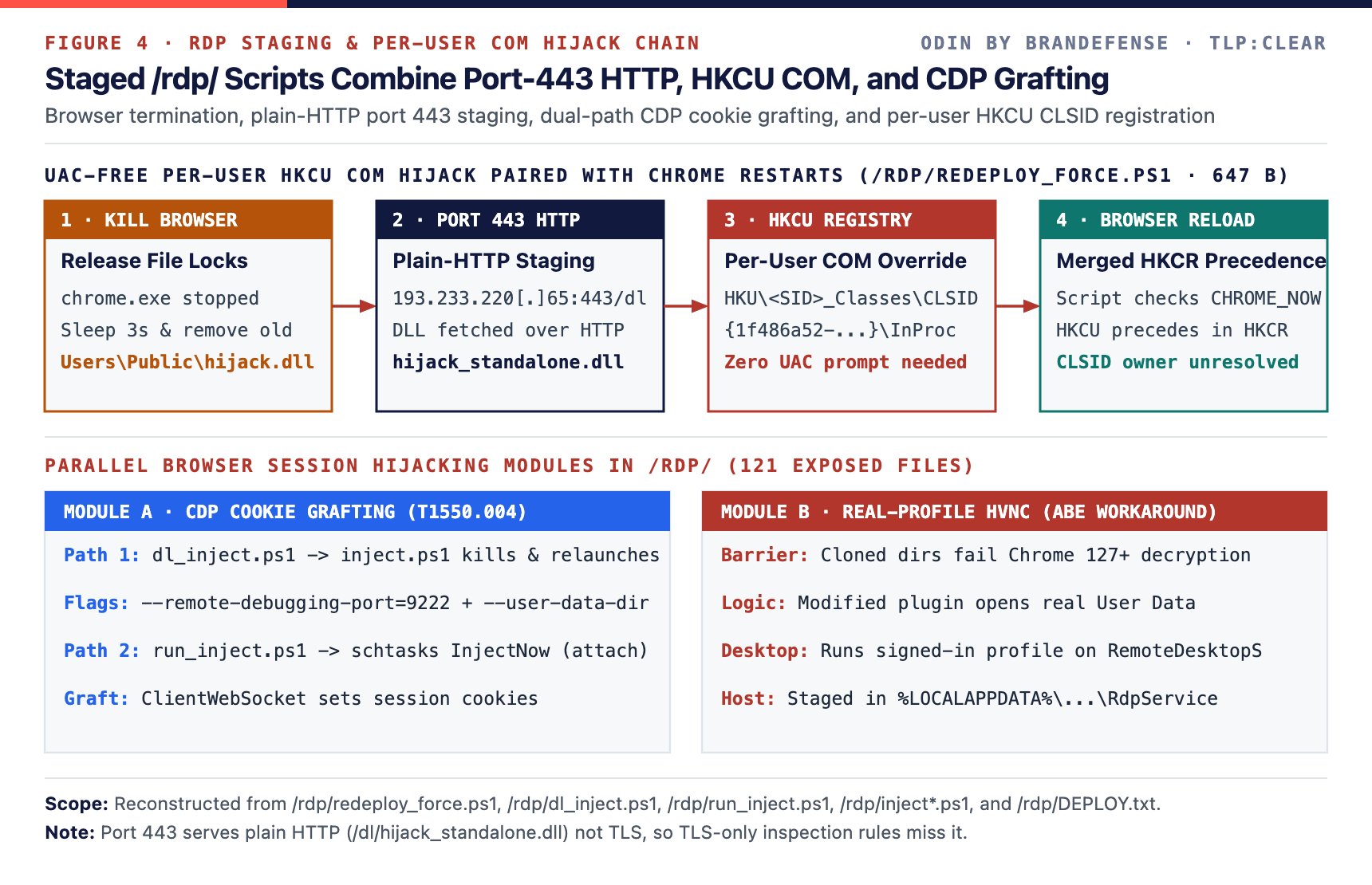
One 647-byte script is written to do four things. It stops Chrome. It downloads a DLL over plain, unencrypted HTTP on port 443, the port most firewalls assume is encrypted web traffic. It registers that DLL as a per-user COM server under CLSID {1f486a52-3cb1-48fd-8f50-b8dc300d9f9d}. Then it checks whether Chrome has restarted.
Per-user COM entries take priority over machine-wide ones, and writing them needs no administrator rights or UAC prompt. The owner of this CLSID is not public, so the link to Chrome is an inference from the script.
Other scripts graft stolen session cookies into Chrome through its debugging interface. One path restarts Chrome with a debugging port and a non-default profile folder. The other attaches to a running browser through a scheduled task named InjectNow. A third approach opens the user's real browser profile on a hidden desktop, because cloned profiles cannot decrypt cookies under App-Bound Encryption.
These are staged files. We did not see them run on any target system.
Why not just block RAT addresses?
Many feeds list suspected commodity RAT servers based on a port or a default certificate such as CN=default. Those signals stay on an address after the server changes hands.
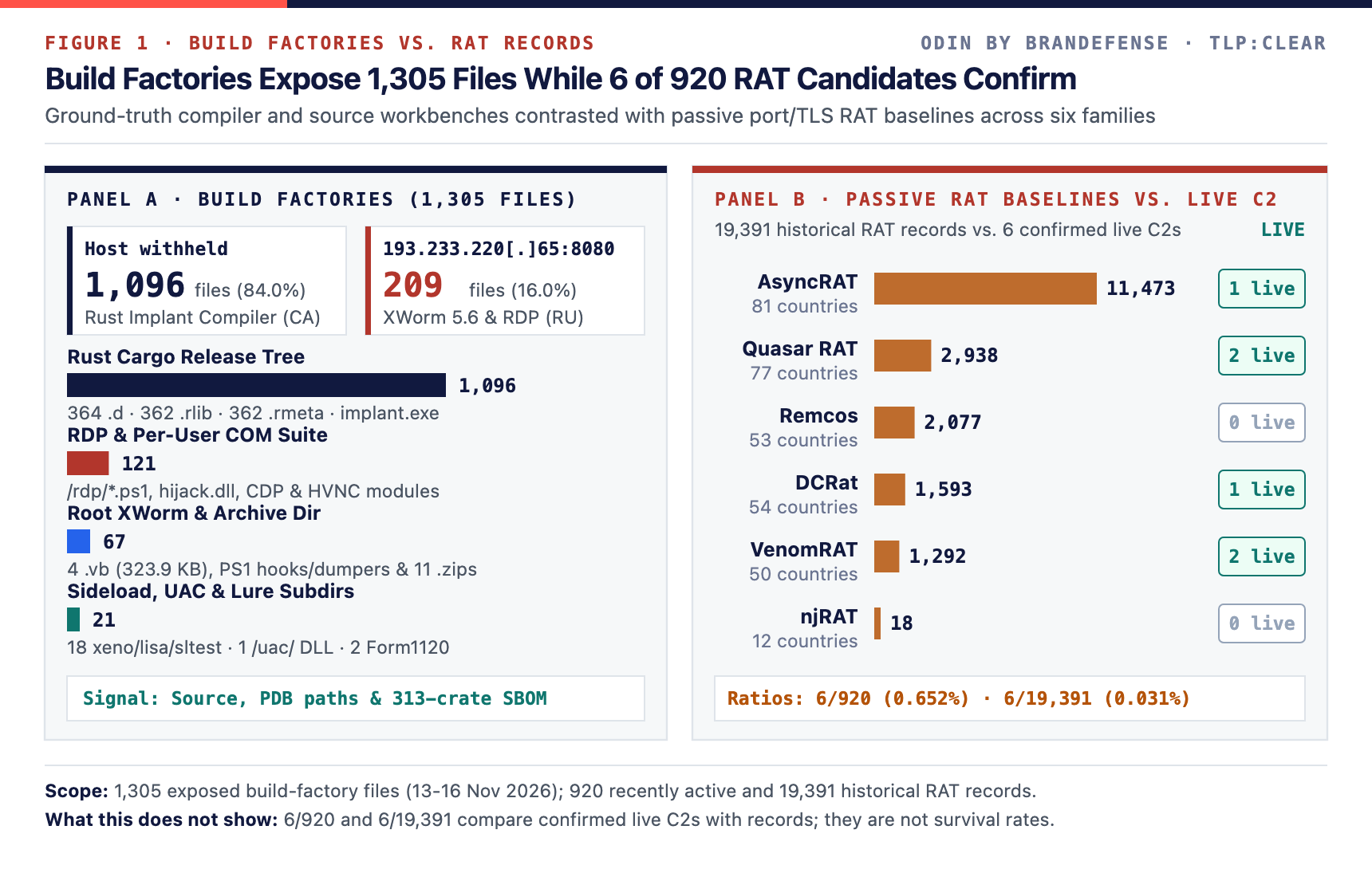
Across six families, AsyncRAT, Quasar, Remcos, DCRat, VenomRAT and njRAT, there are 19,391 historical records. Of 920 recently active candidates, only 6 were confirmed live between 13 and 16 November 2026. That is 0.652% of the candidates and 0.031% of all records. The other records are unverified, not proven benign. Blocking them wholesale catches recycled VPS addresses, not attackers.
What to do now
- Watch per-user COM registrations. Alert when a non-installer process writes a
_ClassesCLSID...InProcServer32value pointing intoC:UsersPublicorTemp. Check the CLSID above first. - Lock down browser debugging. Keep Chrome on version 136 or later, set
RemoteDebuggingAllowedto false on non-developer machines, and alert when a shell or scheduled task starts a browser with a debugging port. Exclude known test automation. - Inspect plain HTTP on port 443 instead of exempting the port from inspection.
- Log PowerShell script blocks and alert on inline keyboard hooks and screen capture.
- Confirm before you block. Block commodity RAT addresses only after live C2 confirmation. The full report's Indicators tab lists the confirmed servers and file hashes. The full report's Detection rules tab has Suricata, Sentinel KQL, Sigma and YARA rules.
The full report covers the Rust workspace, the script structure, the indicators and the rule logic in detail.
What is…?
Short explanations of the tools and families named in this study.
What is XWorm?
XWorm is a commodity .NET remote access trojan sold to criminals. It offers remote control, keylogging and plugin modules.
More about XWormTechniqueWhat is HVNC?
Hidden VNC (HVNC) creates a second, invisible desktop on the victim's computer so an attacker can use the victim's browser sessions unseen.
More about HVNCRemote access trojanWhat is Quasar?
Quasar is an open-source .NET remote access tool for Windows that criminals and some state actors use as a RAT.
More about QuasarRemote access trojanWhat is AsyncRAT?
AsyncRAT is an open-source .NET remote access trojan widely used in commodity malware campaigns.
More about AsyncRATRemote access trojanWhat is VenomRAT?
VenomRAT is a commodity remote access trojan descended from the Quasar and AsyncRAT code bases.
More about VenomRATRemote access trojanWhat is DCRat?
DCRat (DarkCrystal RAT) is a low-cost commodity .NET remote access trojan sold on underground forums.
More about DCRatFrequently asked questions
What was on the Rust build server?
The Canadian server exposed 1,096 files from a Rust release folder under a custom project folder (path withheld). The source code itself was not exposed. The build manifests were, and they name every file that went into the implant.
What was on the Russian workbench?
The Russian server, 193.233.220[.]65, exposed 209 files on port 8080. Its scripts also use ports 443, 8090 and 8091. The root folder held four Visual Basic .NET source files for XWorm 5.6, a commodity remote access trojan. Together they come to 323,901 bytes. The code poses as "Windows Update Helper" from "Microsoft Corporation". That is only metadata: the compiled files carry no valid Microsoft signature.
How do the browser and COM hijack scripts work?
More than half of the Russian server, 121 files, sits in a folder named /rdp/. These scripts are built around two recent Chrome defenses: App-Bound Encryption in version 127, and limits on remote debugging in version 136.
Why not just block RAT addresses?
Many feeds list suspected commodity RAT servers based on a port or a default certificate such as CN=default. Those signals stay on an address after the server changes hands. Across six families, AsyncRAT, Quasar, Remcos, DCRat, VenomRAT and njRAT, there are 19,391 historical records. Of 920 recently active candidates, only 6 were confirmed live between 13 and 16 November 2026. That is 0.652% of the candidates and 0.031% of all records.