


Key takeaways
- Of 600 Sliver-associated endpoints, only 36 are confirmed Sliver listeners.
- One confirmed server holds cloned PHP2Shell exploits, a PAM backdoor and a disguised systemd loop.
- Another stages a PowerShell script that hides data in HTTP GET query strings.
- Localhost certificates and MySQL certificates often look like Sliver but are not.
- Patch PHP, watch PAM and systemd, and block direct workstation HTTP egress.
In a two-week observation window ending 18 November 2026, Odin by Brandefense studied 600 internet-facing endpoints linked to Sliver, an open-source command-and-control (C2) framework. Only 36 of them are confirmed Sliver listeners. Four operators also left their working folders open on the web. Those folders show what sits next to a modern C2 server: cloned PHP exploits, a Linux login backdoor, a disguised service and a script built to slip data past web proxies. For defenders, each item maps to a control you can check this week.
Where do Sliver servers run?
Sliver is a free framework from BishopFox. Red teams use it for authorized tests, and intruders use it too. The 600 endpoints in this study were last seen between 13 and 15 November 2026. They sit on 452 IP addresses in 41 countries, spread across ordinary cloud providers such as DigitalOcean, The Constant Company, Tencent, Amazon and Alibaba.
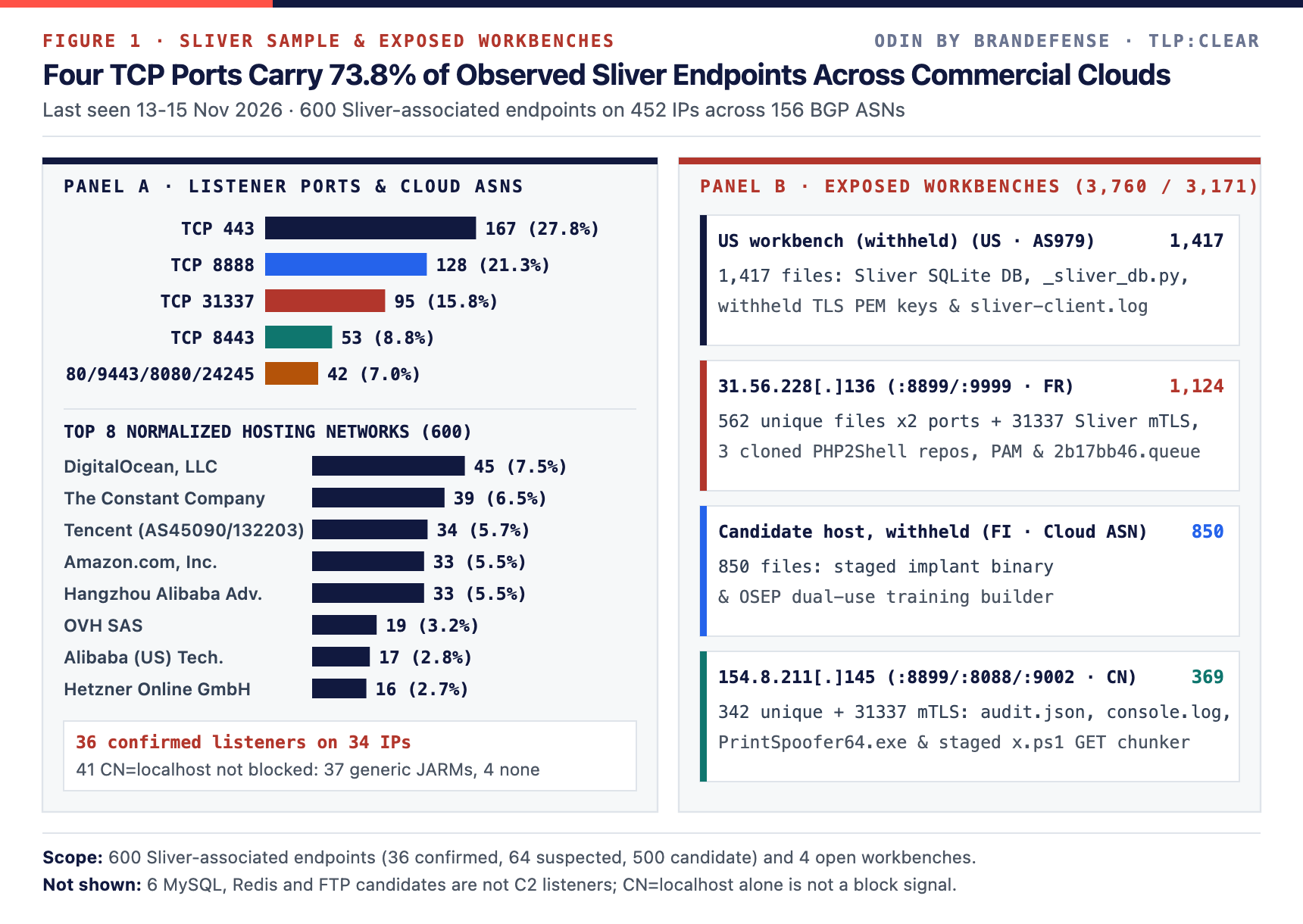
Four ports carry 73.8% of them: 443, 8888, 31337 and 8443. Ports 8888 and 31337 are Sliver defaults that many operators never change.
Most of the 600 are not proven Sliver servers. Thirty-six show a Sliver-specific signal, such as the CN=multiplayer operator certificate on port 31337. Another 64 are suspected and 500 are candidates. The 15 confirmed C2 addresses published in the full report are the ones to block now.
What did the open servers contain?
Operators often start a quick web server in their home folder to move tools around. That makes the whole folder browsable, including Sliver's own state. Four servers exposed 3,760 file entries this way (3,171 unique files).
A PHP exploit lab on a C2 server.
On 31.56.228[.]136 in France, the operator cloned three public PHP2Shell repositories within four minutes. Git timestamps on the server date the clones to 21 October 2026. The repositories target CVE-2026-109618 and CVE-2026-109619, two PHP flaws rated CVSS v4.0 9.2. Git history shows no local changes, so the operator adopted public code rather than writing a zero-day.
A Linux login backdoor.
The same server stages toomanysecrets.sh, a small script meant to hook into PAM, the system that checks Linux passwords. It accepts a hardcoded master password for any local account. For every other login, it writes the user name, source and plaintext password to a hidden file, /var/log/.pam.log.
A disguised service and a task queue.
A systemd unit named systemd-resolver-helper.service imitates a real Linux component. It runs a hidden binary every 60 seconds and restarts itself if stopped. A small /c2/ folder holds a text-file task queue that a host can poll over HTTP.
Leaked operator logs and a GET exfiltration script.
On 154.8.211[.]145 in China, open folders expose Sliver's own audit logs and console logs. The server also stages PrintSpoofer, a Windows privilege-escalation tool. A third server, a US server (address withheld) in the United States, exposes a Sliver database and TLS key bundles.
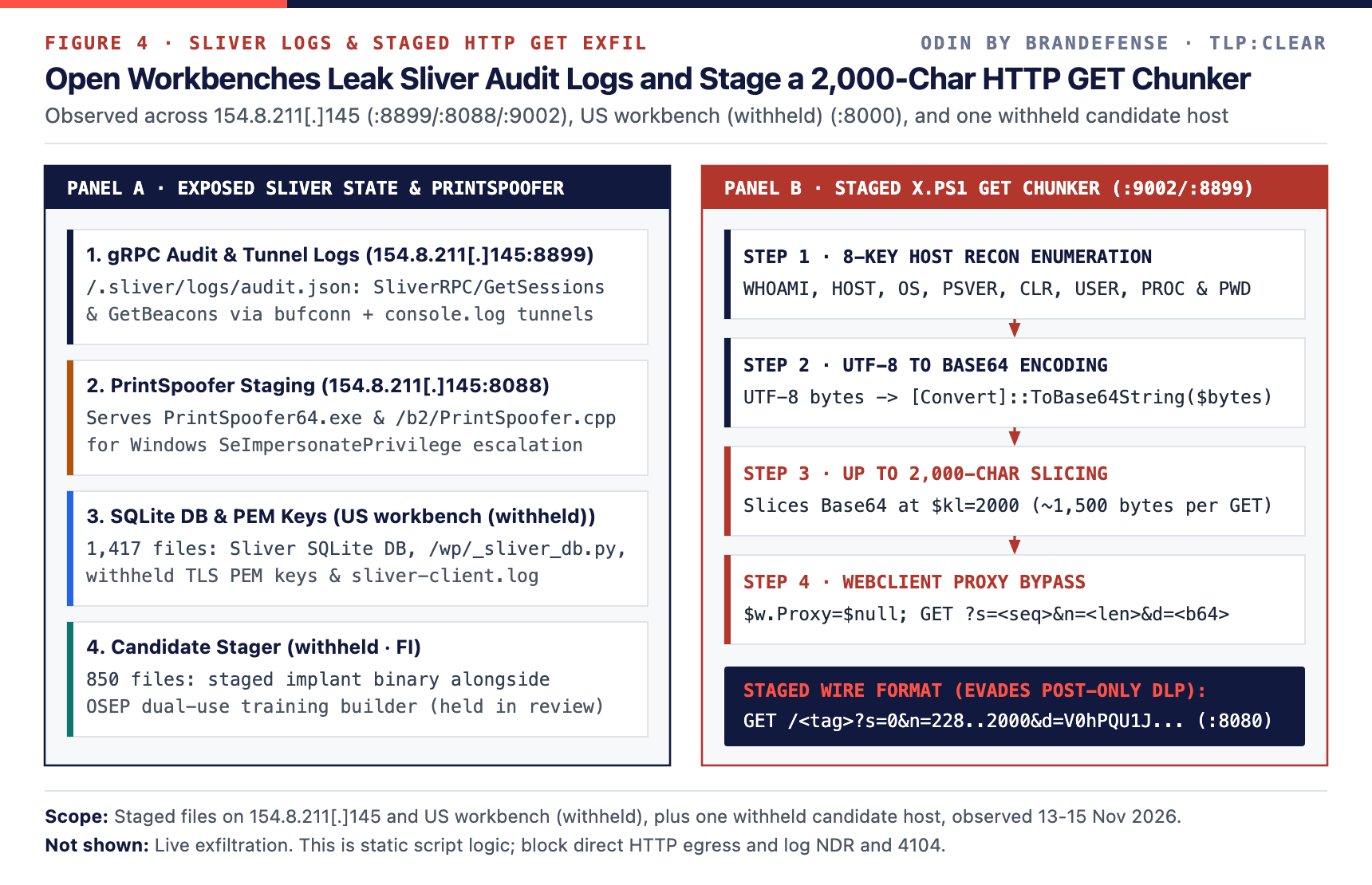
All of these are staged files. We saw no evidence that they ran on a victim. Some test strings would fit an adversary-emulation lab as well as an intrusion.
How does the GET exfiltration script work?
Many web proxies and data loss prevention tools inspect the body of HTTP POST requests. They often pass GET requests with little inspection. The PowerShell script x.ps1 is written to use that gap.
It collects eight facts about the host, such as user name, computer name and OS version. It encodes them in Base64 and cuts the result into pieces of up to 2,000 characters. Each piece goes into the query string of a plain HTTP GET request. The script also turns off the system proxy, so it connects directly to the operator's server.
A typical host summary is only a few hundred characters long. So a rule that waits for very large URLs will miss it. Alert on 64 or more Base64 characters in a GET parameter instead. Blocking direct HTTP from workstations stops the proxy bypass outright.
Why do so many alerts point at the wrong servers?
Three traps cause false Sliver alerts or false attribution.
- Generic certificates. Many harmless web and container servers present a
CN=localhostcertificate. Of the suspected endpoints, 41 show only that. A certificate like this is not proof of Sliver. - Database certificates. A public C2 detection heuristic matches the certificate that MySQL 8.x creates by default. On one server, port 3306 matched it, while port 31337 carried the real Sliver certificate. Check the Sliver ports before you block.
- Cloned code. Finding exploit code on a server does not make its operator the author. Git logs showed clean clones of public repositories. A fourth server, in Finland, held a training-course builder and is withheld from block lists.
Blocking on these signals alone fills SOC queues with harmless hosts. It can also overstate what an attacker can do.
What to do now
- Patch PHP to 8.2.35, 8.3.36, 8.4.27 or 8.5.12 or later. Turning off session upload progress only reduces exposure.
- Watch Linux logins and services. Monitor
/etc/pam.d/*,/lib*/security/*and hidden files in/var/log/. Alert whensshdorsshd-sessionstarts a shell script, and hunt systemd units that run hidden binaries. - Close the GET gap. Block direct outbound HTTP from workstations, log long Base64 values in GET query strings, and turn on PowerShell script block logging.
- Block Sliver carefully. Block the 15 confirmed C2 addresses in the full report's Indicators tab. Pair them with endpoint alerts on outbound ports 31337 and 8888, and do not auto-block on localhost certificates or database ports.
- Deploy the rules. The full report's Detection rules tab has Suricata, Sentinel KQL, Sigma and YARA rules for each finding.
The full report covers the PHP flaws, the Linux persistence kit, the indicators and the rule logic in detail.
What is…?
Short explanations of the tools and families named in this study.
What is Sliver?
Sliver is an open-source command-and-control (C2) framework from Bishop Fox, written in Go. Red teams use it for adversary emulation, and criminal and state operators use it as a free alternative to Cobalt Strike.
More about SliverTechniqueWhat is JARM?
JARM is an open TLS server fingerprinting method from Salesforce. It hashes how a server answers a set of crafted TLS handshakes.
More about JARMOffensive toolWhat is PrintSpoofer?
PrintSpoofer is a public Windows privilege escalation tool that abuses impersonation privileges to gain SYSTEM.
More about PrintSpooferDetection heuristicWhat is Daybreak?
Daybreak is a public JA4X-based C2 heuristic. On port 3306 it also matches ordinary MySQL servers, which makes it a well-known source of false positives.
More about DaybreakFrequently asked questions
Where do Sliver servers run?
Sliver is a free framework from BishopFox. Red teams use it for authorized tests, and intruders use it too. The 600 endpoints in this study were last seen between 13 and 15 November 2026. They sit on 452 IP addresses in 41 countries, spread across ordinary cloud providers such as DigitalOcean, The Constant Company, Tencent, Amazon and Alibaba.
What did the open servers contain?
Operators often start a quick web server in their home folder to move tools around. That makes the whole folder browsable, including Sliver's own state. Four servers exposed 3,760 file entries this way (3,171 unique files).
How does the GET exfiltration script work?
Many web proxies and data loss prevention tools inspect the body of HTTP POST requests. They often pass GET requests with little inspection. The PowerShell script x.ps1 is written to use that gap.
Why do so many alerts point at the wrong servers?
Three traps cause false Sliver alerts or false attribution. Blocking on these signals alone fills SOC queues with harmless hosts. It can also overstate what an attacker can do.