


Key takeaways
- Odin found 713 unique attacker file paths on eight IP addresses, most seen on 13 November 2026.
- A mirrored four-server cluster stages Epicor directive injection and SQL Server Agent tunnel jobs.
- A dual-use workbench holds VMware VCDA probes, Jetty smuggling tests and a keystore decryptor.
- Workflow toolkits target n8n and Apache Activiti scripting, with models built to dodge WAFs.
- Audit ERP directives, restrict SQL Agent CmdExec, isolate VCDA ports and review workflow imports.
Odin by Brandefense found 713 unique attacker file paths on eight IP addresses, with most entries seen on 13 November 2026. The files target enterprise middleware: Epicor Kinetic ERP, Microsoft SQL Server Agent, VMware Cloud Director, and the n8n and Apache Activiti workflow engines. These systems compile custom code and hold service credentials by design. Their abuse can look like routine admin work, and workstation endpoint tools rarely watch them. That gap is what these toolkits are built for.
What did we find?
Eight IP addresses held 2,346 directory entries. Seven were HTTP servers and one was a relay that attacker scripts call. They fall into four groups with different roles.
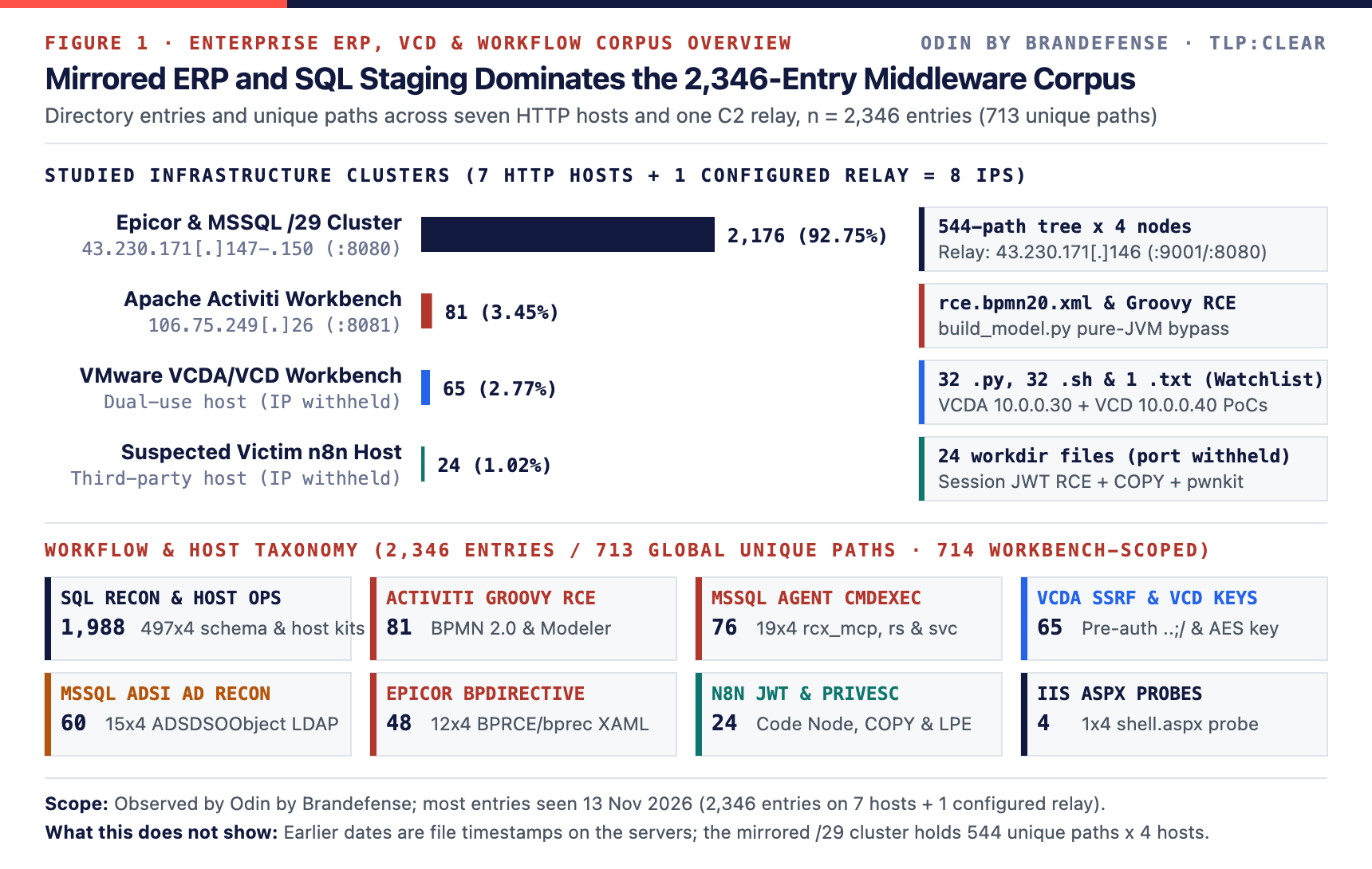
| Group | Files | Role |
|---|---|---|
| Epicor and SQL Server cluster, 43.230.171[.]147 to .150 | 544 paths on each of 4 servers (2,176 entries) | Adversary staging, with relay 43.230.171[.]146 |
| Apache Activiti workbench, 106.75.249[.]26 | 81 | Adversary staging |
| VMware VCDA and VCD workbench | 65 | Dual-use research, address withheld |
| n8n and PostgreSQL server | 24 | Likely victim hosting an attacker's working directory, address withheld |
Only the first two groups are treated as adversary infrastructure. The other two go on watchlists. Blocking a research lab or a victim's server would punish the wrong party.
How does the ERP attack work?
Epicor Kinetic keeps its business-rule hooks in a database table called Ice.BpDirective. When a business action runs, Kinetic compiles and runs the code attached to it. Anyone who can write to that table can place code inside the ERP server.
The cluster's files show an operator learning the database layout from error messages. One upload was rejected with an "invalid column" error. The operator then staged revised scripts that drop the missing column. The final script inserts a directive that writes a marker file into the web server's folder. A small .aspx page checks whether that worked.
These are staged files. We saw no reply showing that the directive was accepted.
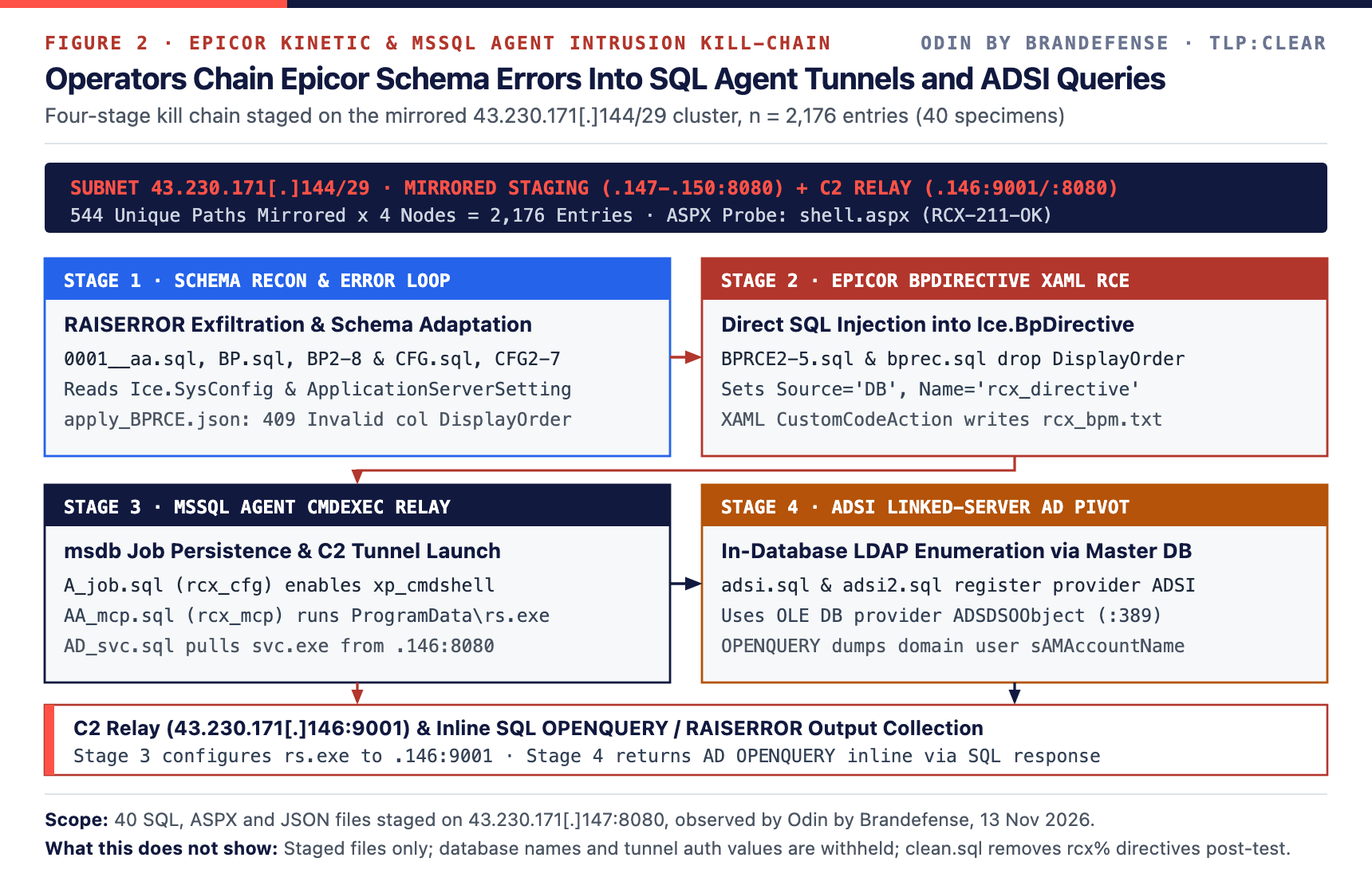
The same cluster sets up SQL Server Agent jobs. Agent jobs are scheduled tasks inside the database. One job is configured to start a tunnel program, rs.exe, from C:ProgramData toward the relay on port 9001. Another downloads svc.exe with curl.exe. Two more check whether the tunnel is up and whether Microsoft Defender has raised alerts.
A last script makes SQL Server query Active Directory directly. It registers a directory provider as a linked server, so user lists come back inside normal SQL results. The cluster also holds Kerberos ticket caches, AS-REP roasting logs and Windows privilege-escalation tools.
What is on the VMware workbench?
A 65-file workbench targets VMware Cloud Director Availability (VCDA) 4.7.4 and VMware Cloud Director (VCD) 10.6.0. They fall into three tracks:
- VCDA path tricks. Requests with
..;/in the path try to reach internal management ports 8046 and 3030. - VCDA root password reset. Scripts send a lab secret header to a root-password endpoint, with timing probes to guess characters.
- VCD request smuggling and key decryption. Tests for the published Eclipse Jetty flaw CVE-2026-2332, plus an offline tool that decrypts sample keystore values.
The workbench aims at private lab addresses and has a "revalidation" folder. It may be a legitimate research setup, so we withhold its address. The three tracks target separate lab systems. Nothing links them into one working chain.
Why are workflow engines a target?
Workflow engines run script steps by design, and they store credentials for the systems they connect. A malicious workflow can ask for operating-system commands under the engine's service account.
On a third-party n8n server, an attacker's working directory holds 24 files. They forge login tokens, read stored credentials, add JavaScript steps that call system commands, write a PHP webshell through PostgreSQL, and try the PwnKit Linux root exploit (CVE-2021-4034). We withhold the server's address.
On the Activiti workbench, a script builds workflow models with no shell strings in them. A comment in Chinese says the aim is to evade WAFs. Other models call Groovy or Spring expressions. Saved replies show that test processes were accepted by an Activiti endpoint. No operating-system command run is shown.
How do defenders avoid false alarms?
ERP and database teams make legitimate changes every day. A single signal is not enough to act on.
- An Epicor directive is suspicious when it comes from the database layer, contains file or process code, and was written by a login other than the ERP application server.
- A SQL Agent job is suspicious when it uses the
CmdExecor PowerShell subsystems, or callsxp_cmdshell. RoutineTSQLmaintenance and backups are fine. - Research workbenches and victim servers go to watchlists. Hunt them by behaviour, since their addresses and file hashes are withheld.
What to do now
- Hunt or block the six adversary addresses, 43.230.171[.]146 to .150 and 106.75.249[.]26, after checking current ownership. The full report's Indicators tab has 14 file hashes as well.
- Audit
Ice.BpDirectivechanges with SQL Audit, and alert whensqlagent.exestarts programs fromC:ProgramData. - Disable
xp_cmdshell, restrict SQL AgentCmdExecsteps to least-privilege proxies, and remove unneeded ADSI linked servers. - Keep VCDA ports 8443, 8046 and 3030 off the internet, patch Jetty and VMware, and rotate Cloud Director keys after any exposure.
- Treat workflow imports as code deployments: sandbox n8n Code Nodes, disable unrestricted Groovy in Activiti, and review every imported model. The full report's Detection rules tab has Suricata, Sentinel KQL, Sigma and YARA rules.
The full report covers the file details, indicators and rule logic.
What is…?
Short explanations of the tools and families named in this study.
What is n8n?
n8n is an open-source workflow automation platform. Its workflows can run code and hold credentials for connected services.
More about n8nEnterprise softwareWhat is Activiti?
Activiti is an open-source BPMN workflow engine for Java applications. Script tasks in a process definition can run code on the server.
More about ActivitiEnterprise softwareWhat is Epicor Kinetic?
Epicor Kinetic is an enterprise resource planning (ERP) suite for manufacturers and distributors. Its business process management (BPM) directives can run custom code inside the ERP.
More about Epicor KineticEnterprise softwareWhat is VMware Cloud Director?
VMware Cloud Director is a multi-tenant cloud management platform that service providers use to run virtual data centres for customers.
More about VMware Cloud DirectorTechniqueWhat is xp_cmdshell?
xp_cmdshell is a SQL Server extended stored procedure that runs operating system commands. Attackers enable it to move from database access to the host.
More about xp_cmdshellEnterprise softwareWhat is VMware ESXi?
VMware ESXi is a bare-metal hypervisor that runs virtual machines. Ransomware groups target it because one host can hold many servers.
More about VMware ESXiFrequently asked questions
What did we find?
Eight IP addresses held 2,346 directory entries. Seven were HTTP servers and one was a relay that attacker scripts call. They fall into four groups with different roles. Only the first two groups are treated as adversary infrastructure. The other two go on watchlists. Blocking a research lab or a victim's server would punish the wrong party.
How does the ERP attack work?
Epicor Kinetic keeps its business-rule hooks in a database table called Ice.BpDirective. When a business action runs, Kinetic compiles and runs the code attached to it. Anyone who can write to that table can place code inside the ERP server.
What is on the VMware workbench?
A 65-file workbench targets VMware Cloud Director Availability (VCDA) 4.7.4 and VMware Cloud Director (VCD) 10.6.0. They fall into three tracks: The workbench aims at private lab addresses and has a "revalidation" folder. It may be a legitimate research setup, so we withhold its address. The three tracks target separate lab systems. Nothing links them into one working chain.
Why are workflow engines a target?
Workflow engines run script steps by design, and they store credentials for the systems they connect. A malicious workflow can ask for operating-system commands under the engine's service account. On a third-party n8n server, an attacker's working directory holds 24 files. They forge login tokens, read stored credentials, add JavaScript steps that call system commands, write a PHP webshell through PostgreSQL, and try the PwnKit Linux root exploit (CVE-2021-4034). We withhold the server's address.
How do defenders avoid false alarms?
ERP and database teams make legitimate changes every day. A single signal is not enough to act on.