
Key takeaways
- An open HTTP directory on a US research VPS (Host R-01) reported 2,993 files on 20 November 2026 and exposed 1,278 entries (969.36 MB).
- Zone 1 holds 928 entries (72.6%) across three AI micro-VM sandbox builds testing eight scenarios, including host mounts and route-aware egress.
- Zone 4 holds 23 entries (50.06 MB) pairing BusyBox root filesystems with bound, self-contained, and raw cpio.gz initramfs boot archives.
- Forty-two secret records were detected across the workspace; Zone 5 contains 17 ACME key and certificate state files. All host identifiers are withheld.
- Close open HTTP listeners, jail micro-VMs without host mounts, pair self-contained initramfs bootstrap with a read-only guest root, and drop 169.254.169.254 egress.
An unauthenticated HTTP directory service on a United States VPS (Host R-01) exposed 1,278 deduplicated AI sandbox, initramfs, binary, and TLS key entries. Recorded from 13 to 20 November 2026, the directory listing on 20 November 2026 reported 2,993 files and 1,340 directories.
Those 1,278 deduplicated entries span 937 sized files totaling 969,360,808 bytes (969.36 MB) and 341 unsized entries across 683 unique SHA-256 digests. Host R-01 is a misconfigured security-research and AI sandbox workspace, not an adversary operator. We therefore withhold its IP, port, names, 42 secrets, and 683 hashes.
What did the exposed AI sandbox research workspace contain?
Engineers and researchers sometimes start python3 -m http.server to copy logs or test bundles from a cloud box without passing --bind 127.0.0.1. Python then binds to 0.0.0.0 across all interfaces and exposes hidden dot-folders over plain HTTP. Security teams can use external attack surface management to find open HTTP directory listeners across cloud accounts before outside scanners copy internal files.
Pairing those checks with cyber threat intelligence helps analysts separate misconfigured developer workspaces from threat-actor staging servers. All review of Host R-01 was passive and static, with zero credentials tested and zero scripts run.
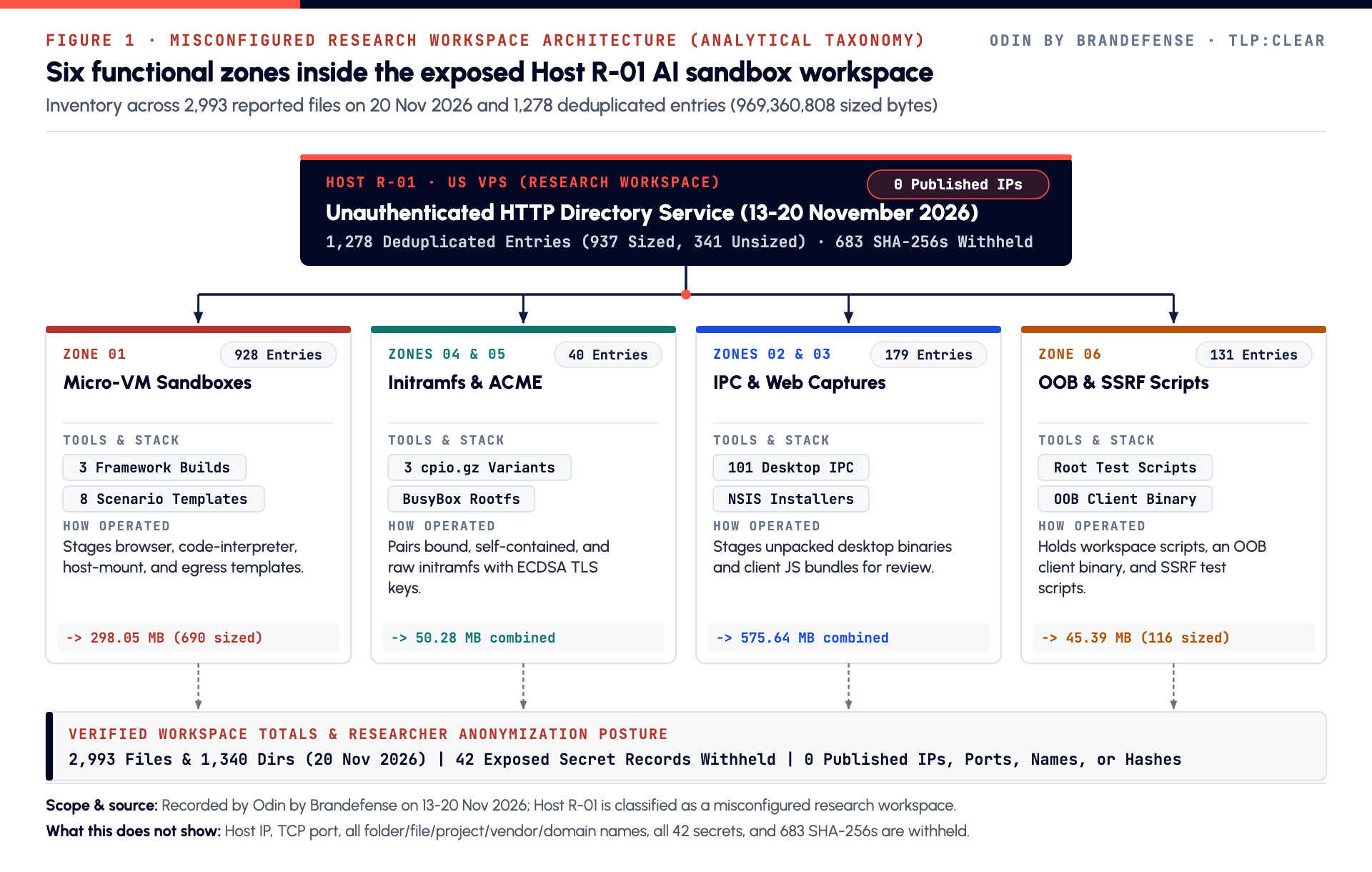
To protect the workspace owner, we group all 1,278 deduplicated entries into six anonymized functional zones (928 + 131 + 101 + 78 + 23 + 17 = 1,278):
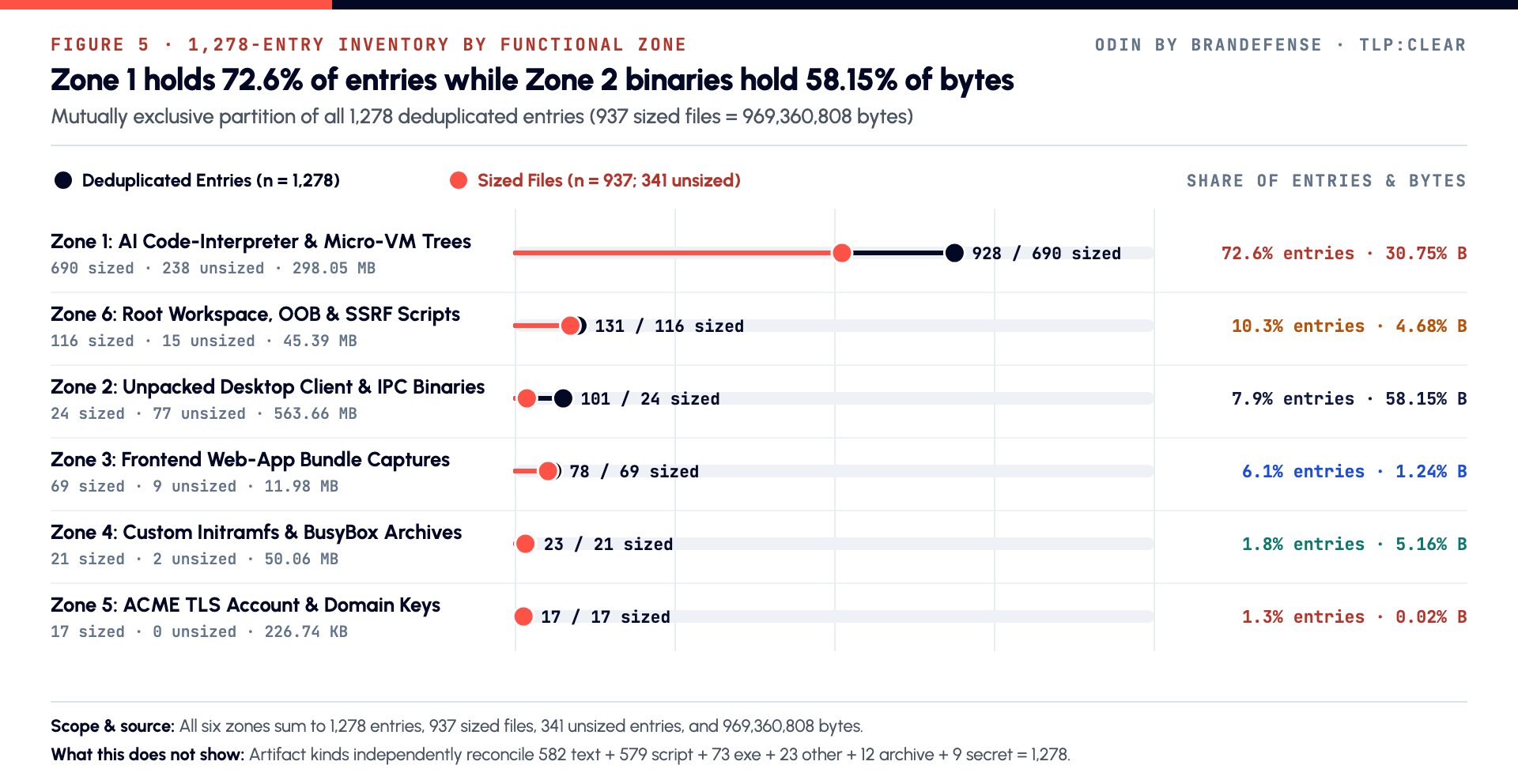
Functional zone on Host R-01 | Entries | Share (%) | Sized / unsized | Sized bytes | Core workspace role |
|---|---|---|---|---|---|
Zone 1: AI Micro-VM Sandbox Trees | 928 | 72.6% | 690 / 238 | 298,050,953 | Three framework builds, eight scenario templates, VMM metrics, and local DB configs |
Zone 6: Root, OOB & SSRF Scripts | 131 | 10.3% | 116 / 15 | 45,391,964 | Root workspace scripts, OOB interaction client binary, and SSRF test scripts |
Zone 2: Desktop Client & IPC Binaries | 101 | 7.9% | 24 / 77 | 563,655,605 | Unpacked desktop client installers and NSIS payloads for local IPC review |
Zone 3: Frontend Web Bundle Captures | 78 | 6.1% | 69 / 9 | 11,979,985 | Captured first-load JavaScript web bundles for client-side endpoint review |
Zone 4: Custom Initramfs & BusyBox | 23 | 1.8% | 21 / 2 | 50,055,564 | Bound, self-contained, and raw cpio.gz ramdisks with BusyBox rootfs trees |
Zone 5: ACME TLS Account & Keys | 17 | 1.3% | 17 / 0 | 226,737 | Automated ACME CA account keys, domain ECDSA keys, and cert state files |
Total (Host R-01) | 1,278 | 100.0% | 937 / 341 | 969,360,808 | 2,993 files reported on 20 Nov 2026; 683 unique SHA-256s withheld |
Sorting those 1,278 entries by file type counts 582 text, 579 script, 73 exe, 23 other, 12 archive, and 9 dedicated secret files. Zone 1 holds 72.6% of file entries, while unpacked desktop binaries in Zone 2 hold 58.15% of sized bytes (563.66 MB).
How do host mounts, custom initramfs builds, and egress rules shape micro-VM safety?
Running LLM-generated Python, Node.js, or browser code inside in-process language sandboxes has failed repeatedly. As architectural context, Node.js vm2 before 3.9.15 (CVE-2023-29017, fixed in 3.9.15) allowed host code execution via Error.prepareStackTrace handling during async errors. That class of escape pushed AI teams toward hardware micro-VMs (Firecracker) and user-space kernels (gVisor).
Even with a micro-VM hypervisor, Zone 1 and Zone 4 highlight three host-to-guest boundaries that platform teams must verify:
- Host-directory bind mounts (
Zone 1, 928 entries). Three successive framework builds repeat eight templates: browser, quickstart, and agent sandboxes, host mounts, multi-agent and RL loops, network policy, and route-aware egress. Passing a writable host folder (virtio-fsor9p) into a guest VM reopens host escape paths (T1611) without needing a KVM bug. - Bound versus self-contained
initramfsimages (Zone 4, 23 entries).Zone 4(50,055,564 bytes) stages bound, self-contained, and rawcpio.gzramdisks with minimal BusyBox root filesystems. A self-containedinitramfsavoids host mounts, but its RAMrootfsremains writable; discard each guest after its session. Bound or raw boot images can leave writable host hooks or BusyBox transfer tools inside guest RAM. - Route-aware egress and metadata blocks (
Zone 1andZone 6, 131 entries). PairingZone 1's route-aware egress templates withZone 6's OOB client binary and SSRF scripts underscores a core cloud rule. Host tap interfaces must drop169.254.169.254and RFC1918 routes before NAT so guest code cannot steal cloud IAM roles or reach local databases.
Why do ACME TLS folders inside open workspaces create lasting risk?
Across Host R-01, static review found 26 environment and config entries and 42 secret records. Those 42 records span 9 standalone secret files plus credentials inside ACME and database configs. Zone 5 (17 files, 226,737 bytes) shows why home-folder HTTP sharing is risky.
Automated ACME tools such as acme.sh store both domain ECDSA private keys and CA account.key credentials inside hidden folders like ~/.acme.sh/. When python3 -m http.server runs in a parent directory, external clients can fetch both key types over plain HTTP (T1552.001). Replacing a leaked domain certificate is not enough if an unrevoked account.key still holds cached domain authorizations at the certificate authority.
What should AI platform and cloud defenders do first?
Defenders can harden cloud workspaces and AI code-interpreter clusters in four direct steps:
- Shut down open HTTP directories and rotate ACME account keys. Sweep cloud VPCs across all ports for
Server: SimpleHTTP/directory listings (sid:9569001) and audit Python HTTP server processes (Sigma Rule 1). Move ACME state to 0700 root-owned/etcdirectories, replace exposed domain keys, and deactivate any leaked ACMEaccount.key(sid:9569002–9569005, YARA Rule 1). - Jail micro-VMs and ban host-directory mounts. Run untrusted LLM code and browser agents inside Firecracker
jailercages or gVisor sandboxes rather than language sandboxes (CVE-2023-29017). Forbid writablevirtio-fs,9p, orhostPathmounts into guest VMs (Sigma Rule 2, YARA Rule 3) and boot fresh VMs per session. - Lock
initramfsbuilds and drop metadata routes before NAT. Use self-contained BusyBoxinitramfsbootstrap stripped ofwgetandncwith a separately enforced read-only guest root, and scan unpacked 070701cpiostreams in CI with YARA Rule 2. Drop169.254.0.0/16and RFC1918 routes on host tap devices before NAT (KQL), setIMDSv2hop limit 1, and watch OOB calls (sid:9569006–9569007). - Isolate security-testing files from keys and configs. Keep unpacked desktop binaries (
Zone 2), web bundles (Zone 3), and SSRF scripts (Zone 6) on isolated lab VMs holding zero keys or database secrets.
The full report's Indicators tab holds 0 network addresses and 0 file hashes because all Host R-01 identifiers and digests are withheld. The full report provides 10 self-audit markers alongside Suricata, Sentinel KQL, Sigma, and YARA rules.
Frequently asked questions
What did the exposed AI sandbox research workspace contain?
Engineers and researchers sometimes start python3 -m http.server to copy logs or test bundles from a cloud box without passing --bind 127.0.0.1. Python then binds to 0.0.0.0 across all interfaces and exposes hidden dot-folders over plain HTTP. Security teams can use external attack surface management to find open HTTP directory listeners across cloud accounts before outside scanners copy internal files.
How do host mounts, custom initramfs builds, and egress rules shape micro-VM safety?
Running LLM-generated Python, Node.js, or browser code inside in-process language sandboxes has failed repeatedly. As architectural context, Node.js vm2 before 3.9.15 (CVE-2023-29017, fixed in 3.9.15) allowed host code execution via Error.prepareStackTrace handling during async errors. That class of escape pushed AI teams toward hardware micro-VMs (Firecracker) and user-space kernels (gVisor).
Why do ACME TLS folders inside open workspaces create lasting risk?
Across Host R-01, static review found 26 environment and config entries and 42 secret records. Those 42 records span 9 standalone secret files plus credentials inside ACME and database configs. Zone 5 (17 files, 226,737 bytes) shows why home-folder HTTP sharing is risky.
What should AI platform and cloud defenders do first?
Defenders can harden cloud workspaces and AI code-interpreter clusters in four direct steps: The Indicators tab holds 0 network addresses and 0 file hashes because all Host R-01 identifiers and digests are withheld. The full report provides 10 self-audit markers alongside Suricata, Sentinel KQL, Sigma, and YARA rules.