
1. Executive Summary
In short
From 13 to 20 November 2026, Odin by Brandefense analyzed an unauthenticated HTTP directory service on a misconfigured United States research VPS (Host R-01). On 20 November 2026, the open directory reported 2,993 files and exposed 1,278 deduplicated AI sandbox, initramfs, binary, and key entries alongside 42 secret records. Shut down open HTTP listeners, jail micro-VMs without host mounts, and isolate ACME private keys.
Platforms that run model-generated code or headless browsers depend on virtualized micro-VMs and minimal Linux ramdisks to protect host servers. Strong guest isolation can still fail when developers or researchers leave working folders open over plain HTTP. Starting an unauthenticated directory server on a cloud box turns sandbox templates, custom boot archives, and credentials in files into public downloads.
From 13 to 20 November 2026, Odin by Brandefense examined an unauthenticated HTTP directory service on a United States commercial VPS (Host R-01). On 20 November 2026, that open directory reported 2,993 files and 1,340 directories across its tree. Deduplicated indexing across 13 to 20 November 2026 captured 1,278 unique workspace entries totaling 969,360,808 sized bytes (969.36 MB).
We classify Host R-01 consistently as a misconfigured security-research and AI sandbox-testing workspace rather than an adversary operator. All inspection was passive and static, with zero keys or credentials tested. We withhold the server IP, TCP port, all folder, file, vendor, and domain names, all 42 secrets, and all 683 SHA-256 digests.
Three AI micro-VM framework builds make up 72.6 percent of entries.
Zone 1 holds 928 deduplicated entries (690 sized files totaling 298,050,953 bytes and 238 unsized entries). Those folders hold three successive builds of an AI agent micro-VM framework across eight recurring isolation scenarios, plus hypervisor metrics and local database credentials.
Three custom BusyBox initramfs variants test guest boot boundaries.
Zone 4 holds 23 entries (21 sized files totaling 50,055,564 bytes and 2 unsized entries). It pairs minimal BusyBox root filesystems with bound, self-contained, and raw cpio.gz ramdisk images built to compare Linux guest-to-host boot isolation.
Desktop IPC binaries, web bundles, and SSRF scripts confirm research use.
Zones 2, 3, and 6 hold 310 entries totaling 621,027,554 sized bytes. Unpacked desktop installers in Zone 2 represent 58.15% of total workspace bytes (563,655,605 bytes), sitting beside captured JavaScript web bundles and out-of-band or SSRF test scripts.
Co-located configs and ACME TLS folders expose 42 secret records.
Across all 1,278 entries sit 26 environment-template and configuration entries and 42 detected secret records. Zone 5 alone leaves 17 ACME key and certificate state files (226,737 bytes) inside the HTTP-served tree.
Three Decisions for Security Leaders
- Shut down ad-hoc HTTP file servers and isolate ACME keys. Sweep cloud VPCs for open Python or Node directory listings and bind local dev servers to
127.0.0.1. Store ACME account and domain private keys in 0700 root-owned/etcdirectories outside user workspaces. - Run AI code interpreters in jailed micro-VMs without host mounts. Confine untrusted agent code inside jailed KVM micro-VMs or user-space application kernels. Pair self-contained
initramfsbootstrap with a separately enforced read-only guest root and block host-directory bind mounts into guest VMs. - Drop metadata and private routes before sandbox NAT forwarding. Block guest VM traffic to
169.254.169.254and RFC1918 ranges on host tap interfaces. Enforce cloudIMDSv2with a hop limit of 1 and watch outbound callback polling.
The Study in Numbers
| Number | What it represents |
|---|---|
| 2,993 / 1,340 | Files (2,993) and directories (1,340) reported by the live HTTP listing on Host R-01 on 20 November 2026 |
| 1,278 | Deduplicated workspace entries indexed across 13–20 November 2026 (937 sized files + 341 unsized entries) |
| 969,360,808 | Total sized bytes (969.36 MB) across the 937 sized files (683 unique SHA-256 digests withheld) |
| 928 (72.6%) | Entries in Zone 1 across 3 AI micro-VM framework builds and 8 recurring isolation scenarios (298.05 MB) |
| 23 + 17 | Zone 4 initramfs entries (3 variants, 50.06 MB) plus Zone 5 ACME key and certificate state files (226.74 KB) |
| 42 / 26 | Detected secret records (42, zero tested, all withheld) and 26 environment or configuration entries |
| 0 | Published IPv4 addresses, TCP ports, filenames, vendor/domain names, or SHA-256 hashes (10 self-audit markers in text) |
2. Six Functional Zones Across the 1,278-Entry Workspace
Engineers and security researchers often use Python’s HTTP server to share files from a cloud VM. By default, it binds to all interfaces and serves the working directory, including dot-folders. Cloud teams can run external attack surface management scans to catch unauthenticated HTTP directory listings before outside scanners index them.
Pairing perimeter discovery with cyber threat intelligence helps analysts separate misconfigured developer hosts from threat-actor staging boxes. On 20 November 2026, Host R-01 reported 2,993 files and 1,340 directories. Static indexing across 13–20 November 2026 captured 1,278 deduplicated entries: 937 sized files (969,360,808 bytes) and 341 unsized entries.
Across those 937 sized files sit 683 unique SHA-256 digests, all of which are withheld. The other 254 sized instances (937 - 683 = 254) reflect repeated templates and shared helpers across the three Zone 1 builds. Figure 1 maps the six functional zones on Host R-01.
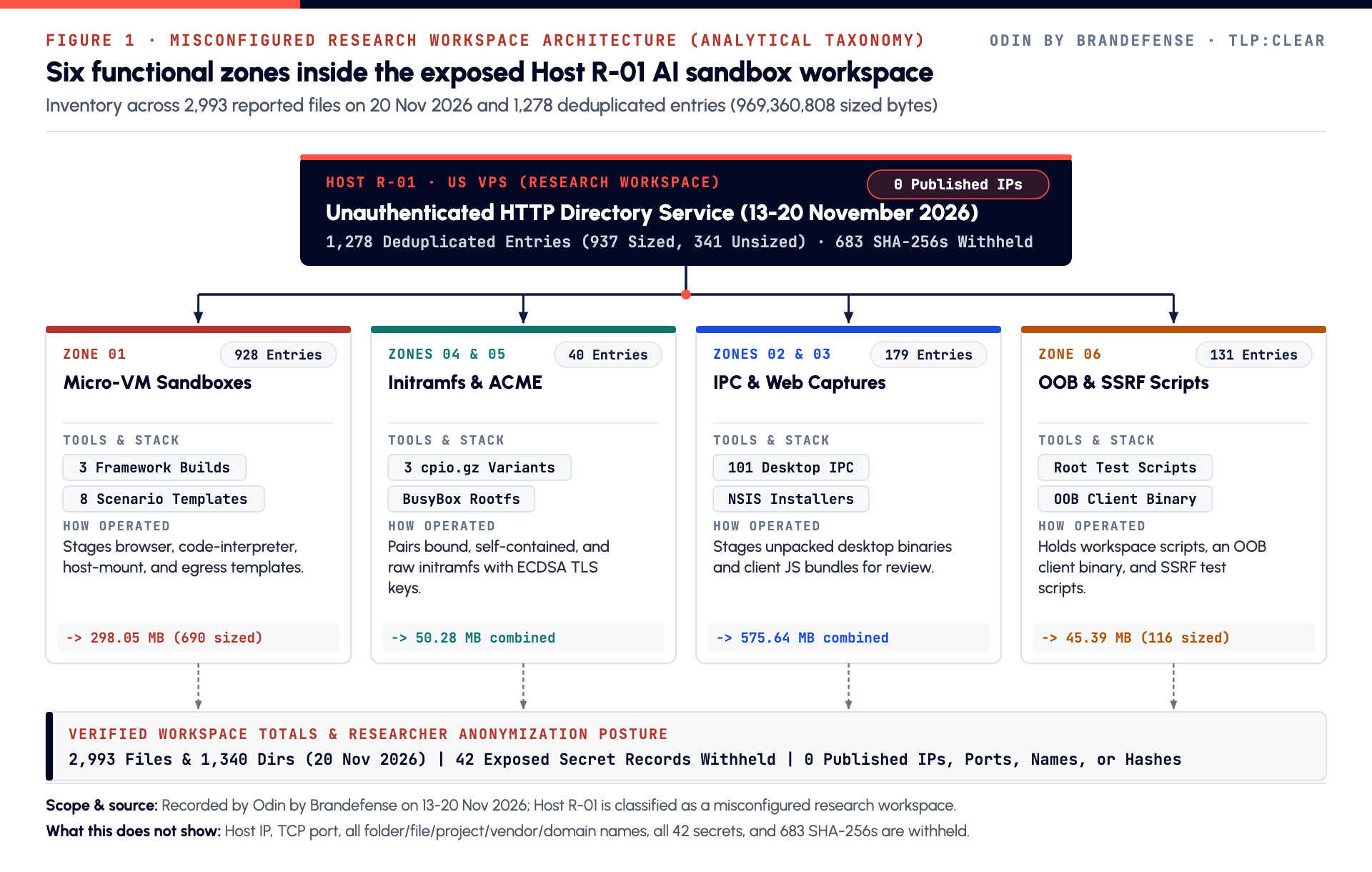
Six-Zone Functional Partition (n = 1,278)
We group the workspace into six functional zones and withhold its folder and project names. Table 1 reconciles all 1,278 entries, 937 sized files, 341 unsized entries, and 969,360,808 bytes (928 + 131 + 101 + 78 + 23 + 17 = 1,278).
Functional zone (Host R-01) | Entries | Share (%) | Sized / unsized | Sized bytes | Byte share (%) | Anonymized architectural role |
|---|---|---|---|---|---|---|
Zone 1: AI Micro-VM Sandbox Trees | 928 | 72.6% | 690 / 238 | 298,050,953 | 30.75% | Three AI micro-VM builds, eight scenario templates, VMM metrics, and local DB configs |
Zone 6: Root, OOB & SSRF Scripts | 131 | 10.3% | 116 / 15 | 45,391,964 | 4.68% | Root workspace scripts, compiled OOB client binary, and SSRF test scripts |
Zone 2: Desktop Client & IPC Binaries | 101 | 7.9% | 24 / 77 | 563,655,605 | 58.15% | Unpacked desktop client binaries and NSIS payloads for local IPC review |
Zone 3: Frontend Web Bundle Captures | 78 | 6.1% | 69 / 9 | 11,979,985 | 1.24% | Captured first-load JavaScript web bundles for client-side endpoint review |
Zone 4: Custom Initramfs & BusyBox | 23 | 1.8% | 21 / 2 | 50,055,564 | 5.16% | Bound, self-contained, and raw cpio.gz ramdisks with BusyBox rootfs trees |
Zone 5: ACME TLS Account & Keys | 17 | 1.3% | 17 / 0 | 226,737 | 0.02% | Automated ACME CA account keys, domain ECDSA keys, and cert state files |
Total (Host R-01) | 1,278 | 100.0% | 937 / 341 | 969,360,808 | 100.00% | 2,993 files and 1,340 dirs on 20 Nov 2026; 683 unique SHA-256s withheld |
Entry count and byte volume pull in opposite directions across Host R-01, as shown in Figure 5. Zone 1 holds 928 entries (72.6% of items) across small sandbox scripts and configs totaling 298.05 MB (30.75% of bytes). By contrast, Zone 2 holds 101 entries (24 sized and 77 unsized) yet accounts for 563,655,605 bytes (58.15% of volume). Meanwhile, Zone 5 holds 17 ACME key and certificate state files (226,737 bytes, 0.02%) exposed over HTTP.
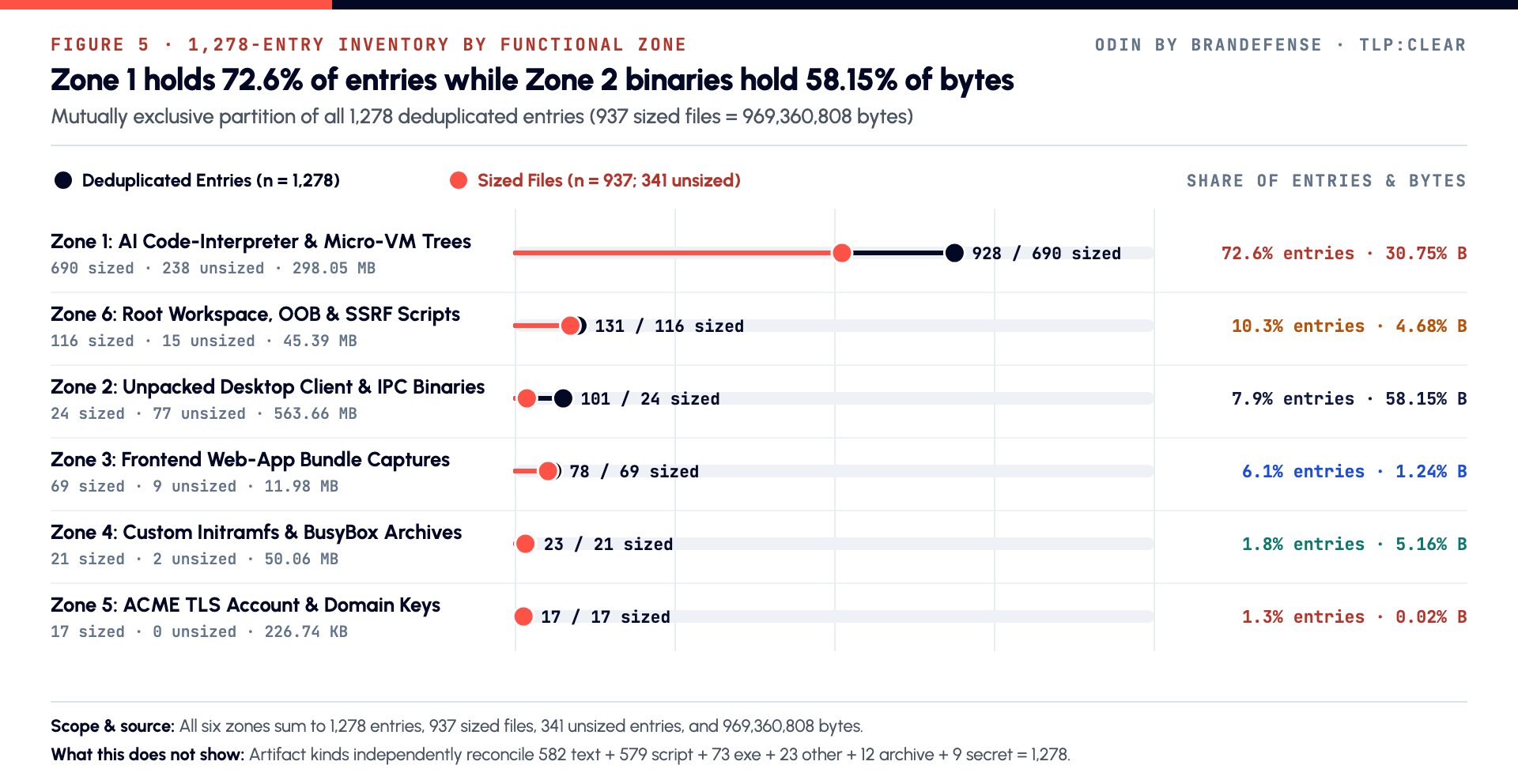
Artifact-Class Reconciliation (6 Kinds) and Secret Boundaries
Sorting the same 1,278 entries by file type confirms exact byte parity (969,360,808 bytes across 582 + 579 + 73 + 23 + 12 + 9 = 1,278).
| Artifact class | Entries | Share (%) | Sized / unsized | Sized bytes | Byte share (%) | Structural contents |
|---|---|---|---|---|---|---|
text | 582 | 45.54% | 377 / 205 | 6,534,974 | 0.67% | Scenario manifests, VMM metric logs, ACME state configs, and notes |
script | 579 | 45.31% | 525 / 54 | 16,106,168 | 1.66% | Micro-VM controller code, captured JS bundles, and SSRF or route scripts |
exe | 73 | 5.71% | 14 / 59 | 639,918,578 | 66.01% | Unpacked desktop IPC binaries, NSIS payloads, BusyBox, and OOB binary |
other | 23 | 1.80% | 5 / 18 | 10,829,540 | 1.12% | Desktop installer data segments and guest filesystem support blobs |
archive | 12 | 0.94% | 7 / 5 | 295,949,241 | 30.53% | Compressed micro-VM bundles and cpio.gz initramfs root archives |
secret | 9 | 0.70% | 9 / 0 | 22,307 | 0.00% | Dedicated .key or credential files (subset of 42 secret records) |
| Total | 1,278 | 100.00% | 937 / 341 | 969,360,808 | 100.00% | Exact match with Table 1 (937 sized + 341 unsized = 1,278) |
Together, text (582) and script (579) make up 1,161 of 1,278 entries (90.85%), but only 22,641,142 bytes (2.34%). Meanwhile, exe (73 entries) and archive (12 entries) hold 935,867,819 bytes (96.54% of bytes) across just 85 items (6.65%).
Four secret-related counts measure nested scopes without contradiction ([REF-07]). Nine files (22,307 bytes) carry the secret file kind based on extension, while Zone 5 holds 17 ACME files (226,737 bytes) pairing .key files with certificate state files. Across the full workspace sit 26 config entries and 42 detected secret records, spanning Zone 5 ACME keys and Zone 1 database and environment configs.
3. AI Code-Interpreter Micro-VM Templates and Initramfs Isolation
AI platforms that run model-generated Python, Node.js, shell, or browser tasks cannot rely on in-process language sandboxes ([REF-01], [REF-02]). Language-level sandboxes share the host runtime and kernel, so a single object-handling flaw exposes the underlying server ([REF-09]).
For architectural context ([REF-04]), Node.js vm2 versions before 3.9.15 carried CVE-2023-29017 (fixed in 3.9.15 on 6 April 2023). Under CVE-2023-29017, vm2 mishandled host objects passed to Error.prepareStackTrace during unhandled async errors, letting untrusted code escape the sandbox and run host commands ([REF-04]).
We cite CVE-2023-29017 strictly as industry context rather than a package exploited on Host R-01. Escapes of that class pushed AI teams toward KVM micro-VMs like Firecracker ([REF-01]) and application kernels like gVisor ([REF-02]).
Hardware virtualization still fails when host mounts, ramdisks, or network routes are misconfigured ([REF-06]). Figure 3 shows an analytical model of the guest boot, mount, and egress boundaries tested across Zones 1, 4, and 6.
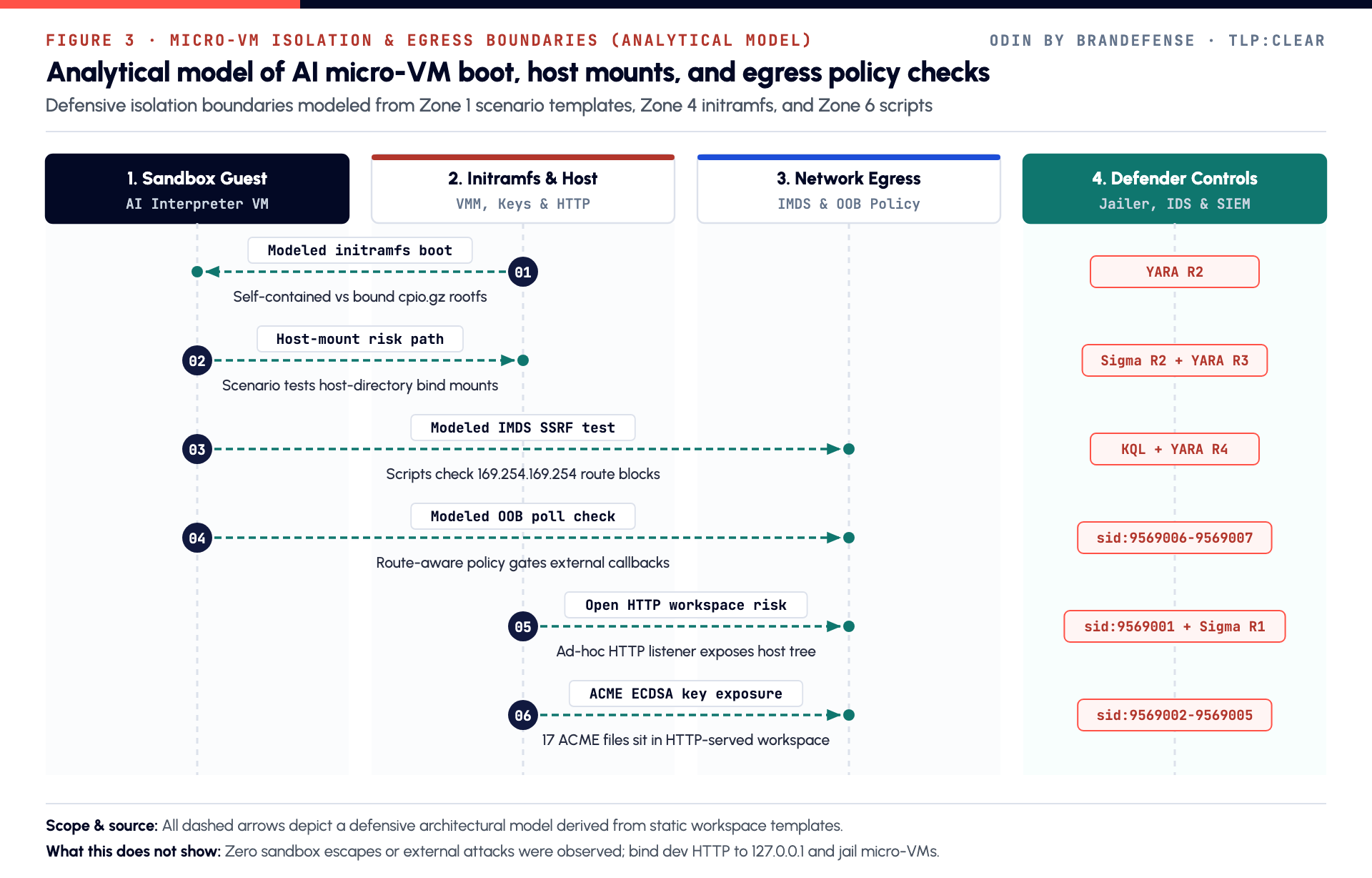
Eight Scenario Templates Across Three Framework Builds (Zone 1)
Zone 1 (928 entries, 298,050,953 bytes) stores three successive builds of an AI agent micro-VM framework alongside cloud-hypervisor metric captures and local database credentials. Across all three builds, eight recurring scenario templates test distinct sandbox boundaries:
| Component or template | Zone & multiplicity | Isolation boundary under review | Failure mode if misconfigured | Primary defensive control |
|---|---|---|---|---|
| Browser sandbox | Zone 1 (3 builds) | Headless browser rendering untrusted pages in a guest VM | Unjailed browser escape reaches host user files ([REF-01]) | Confine browser VMs with jailer, chroot, and seccomp |
| Code-interpreter quickstart | Zone 1 (3 builds) | Single-turn execution of LLM-generated Python or shell code | Reusing warm VMs across users leaks prior /tmp or RAM data | Boot fresh ephemeral VMs per session and wipe memory on exit |
| Agent code-interpreter | Zone 1 (3 builds) | Multi-step tool loop reading and writing task artifacts | Uncapped guest CPU or disk starves host hypervisor threads | Enforce cgroup v2 CPU, RAM, and block-I/O limits ([REF-01]) |
| Host-directory mount | Zone 1 (3 builds) | Shared host-to-guest folder passthrough (virtio-fs or 9p) | Mounting /root, /.ssh, /.acme.sh, or docker.sock allows host escape (T1611, [REF-05], [REF-06]) | Ban host bind mounts into untrusted VMs; pass inputs over vsock |
| Multi-agent workflow | Zone 1 (3 builds) | Parallel sandboxes exchanging intermediate agent outputs | Shared Linux bridges allow east-west ARP or packet spoofing | Isolate each micro-VM on a dedicated /30 tap interface |
| Reinforcement-learning loop | Zone 1 (3 builds) | High-rate rollout workers sending reward metrics to host | Exposed host metric ports accept forged guest inputs | Bind hypervisor metric sockets to host-only UNIX paths |
| Network-policy enforcement | Zone 1 (3 builds) | L3/L4 firewall rules on outbound guest sandbox traffic | Default-allow NAT lets untrusted code scan external hosts | Apply default-deny egress rules on every guest tap device |
| Route-aware egress | Zone 1 (3 builds) | Prefix routing checks before host NAT or proxy forwarding | Missing link-local drops expose 169.254.169.254 IAM tokens ([REF-02]) | Drop 169.254.0.0/16 and RFC1918 destinations before NAT |
Bound initramfs (cpio.gz) | Zone 4 (1 of 3) | Guest ramdisk mounting host-supplied shares at boot | Writable host mounts risk symlink traversal during /init | Mount external shares MS_RDONLY, MS_NOSUID, and MS_NODEV |
Self-contained initramfs | Zone 4 (1 of 3) | Standalone BusyBox RAM rootfs with zero host disk mounts | Full BusyBox builds leave wget or nc inside guest RAM ([REF-03]) | Strip transfer applets, enforce a separate read-only guest root, and discard VMs per session |
Raw initramfs (cpio.gz) | Zone 4 (1 of 3) | Unhardened baseline boot archive for latency comparison | Accidental CI deployment ships debug shells into production | Scan unpacked 070701 cpio streams in CI via YARA Rule 2 |
Two scenarios in Table 3 pose the highest real-world risk. First, the host-directory mount scenario mirrors Kubernetes hostPath risks restricted under Pod Security Standards ([REF-05]). Passing a writable host folder into a KVM micro-VM lets untrusted code edit host files or read co-located keys without exploiting a hypervisor bug (T1611, [REF-06]).
Second, route-aware egress controls decide whether a guest VM can pivot into cloud control planes. Missing nftables drops for 169.254.169.254 or 10.0.0.0/8 before NAT create direct SSRF risk. Untrusted guest code can then query cloud metadata roles or reach local databases on the host.
Bound, Self-Contained, and Raw initramfs Archives (Zone 4)
During Linux boot ([REF-03]), the kernel unpacks any initramfs (cpio.gz) archive into an in-memory rootfs instance and runs /init. In micro-VM designs, engineers either run the guest userland directly inside that RAM rootfs or mount an external block or shared filesystem ([REF-01], [REF-03]).
Zone 4 (23 entries, 50,055,564 bytes) stages three cpio.gz BusyBox variants to test that trade-off:
- Self-contained
initramfs. Packs BusyBox,/dev/console, and/initinto one RAM image with zero host mounts. Ephemeral AI code interpreters gain clean teardown and strong isolation from this model. - Bound
initramfs. Uses early/initmounts to attach host-supplied runtime directories. Any bound share exposed to untrusted guest code must enforce kernel read-only flags at the hypervisor boundary. - Raw
initramfs. Serves as an unstripped reference archive for boot speed and memory comparisons. Leaving raw test images beside production builds risks accidental deployment if CI pipelines do not verify image manifests.
4. Co-Hosted Research Artifacts, OOB Harnesses, and ACME Key Sprawl
Examining Zones 2, 3, 5, and 6 explains why Host R-01 is a misconfigured researcher and developer VPS rather than an attacker staging server. Application auditing files, sandbox test scripts, and personal ACME TLS keys all sat under one parent workspace when an open HTTP listener exposed them ([REF-07], [REF-10]). Figure 4 shows the structural layout of Host R-01.
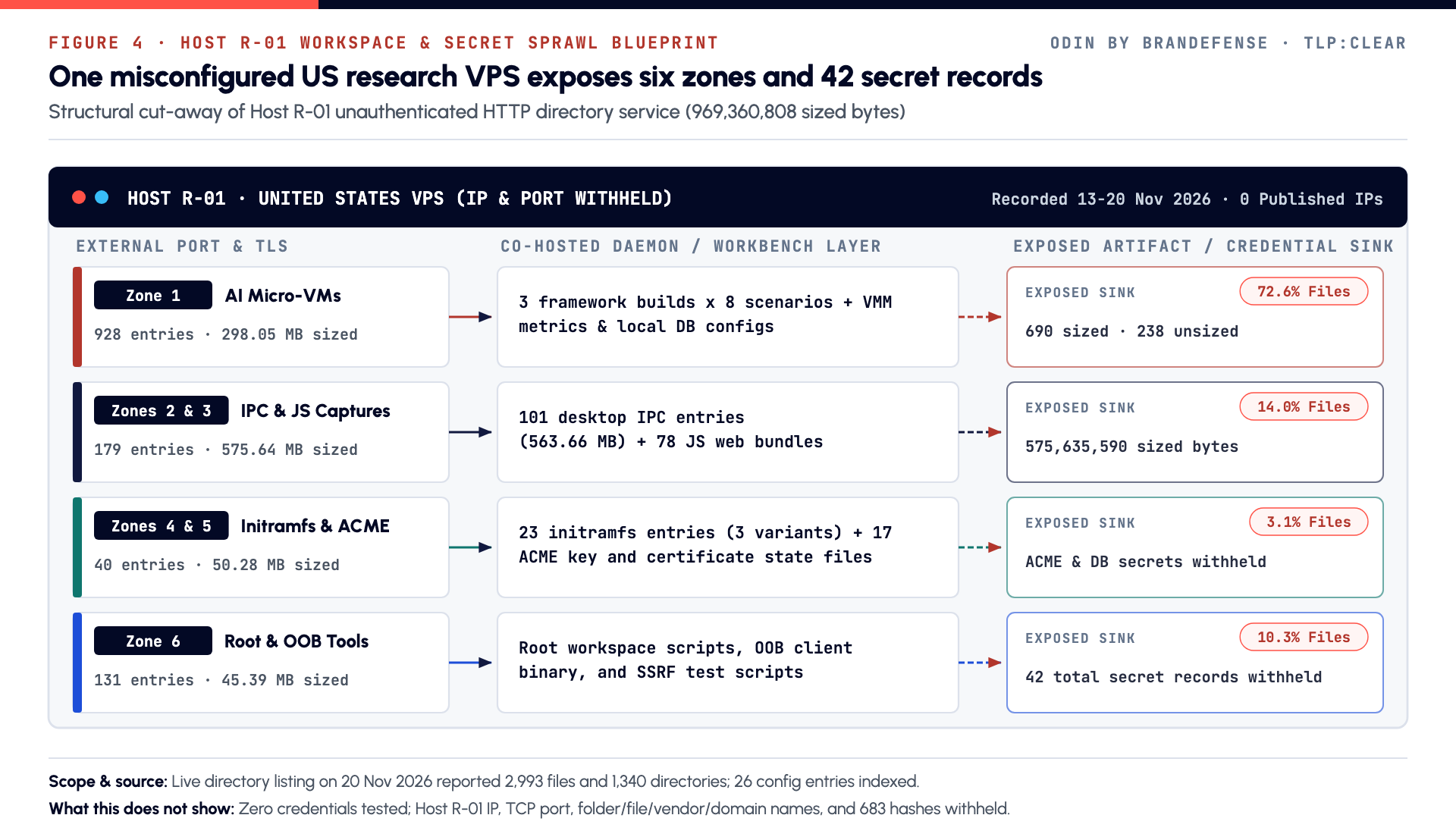
Desktop IPC Binaries, Web Bundles, and SSRF Scripts (Zones 2, 3, and 6)
Across Zones 2, 3, and 6 sit 310 entries (209 sized files = 621,027,554 bytes and 101 unsized entries):
Zone 2(101 entries, 563,655,605 bytes). Holds 24 sized files and 77 unsized entries from unpacked desktop installers andNSISpackages (vendors withheld) staged for localIPCand URI-scheme review.Zone 3(78 entries, 11,979,985 bytes). Holds 69 sized files and 9 unsized entries of first-load web JavaScript bundles (domains withheld) saved for static route and token-sink inspection.Zone 6(131 entries, 45,391,964 bytes). Holds 116 sized files and 15 unsized entries pairing workspace scripts with a compiledOOBclient binary and SSRF scripts testing callback and169.254.169.254paths.
Plain-HTTP ACME ECDSA Key Sprawl (Zone 5 and 42 Secret Records)
Zone 5 (17 sized files, 226,737 bytes, 0 unsized) shows how fast an open HTTP listener turns into a cryptographic leak (T1552.001, [REF-07]). Automated ACME clients such as acme.sh keep two key types inside ~/.acme.sh/ by default:
- Domain ECDSA private keys. Leaking a domain key lets outsiders impersonate that TLS service until the certificate is revoked and replaced.
- ACME CA
account.keyfiles. Rotating a leaked domain key alone is not enough. An unrevokedaccount.keycan keep cached CA domain authorizations and issue or revoke certificates until deactivated.
Starting python3 -m http.server in a home or parent research folder serves hidden dot-directories like .acme.sh/ with 200 OK responses. Figure 2 links all five exposure surfaces on Host R-01 to the defensive controls and rules in Chapters 7 and 8.
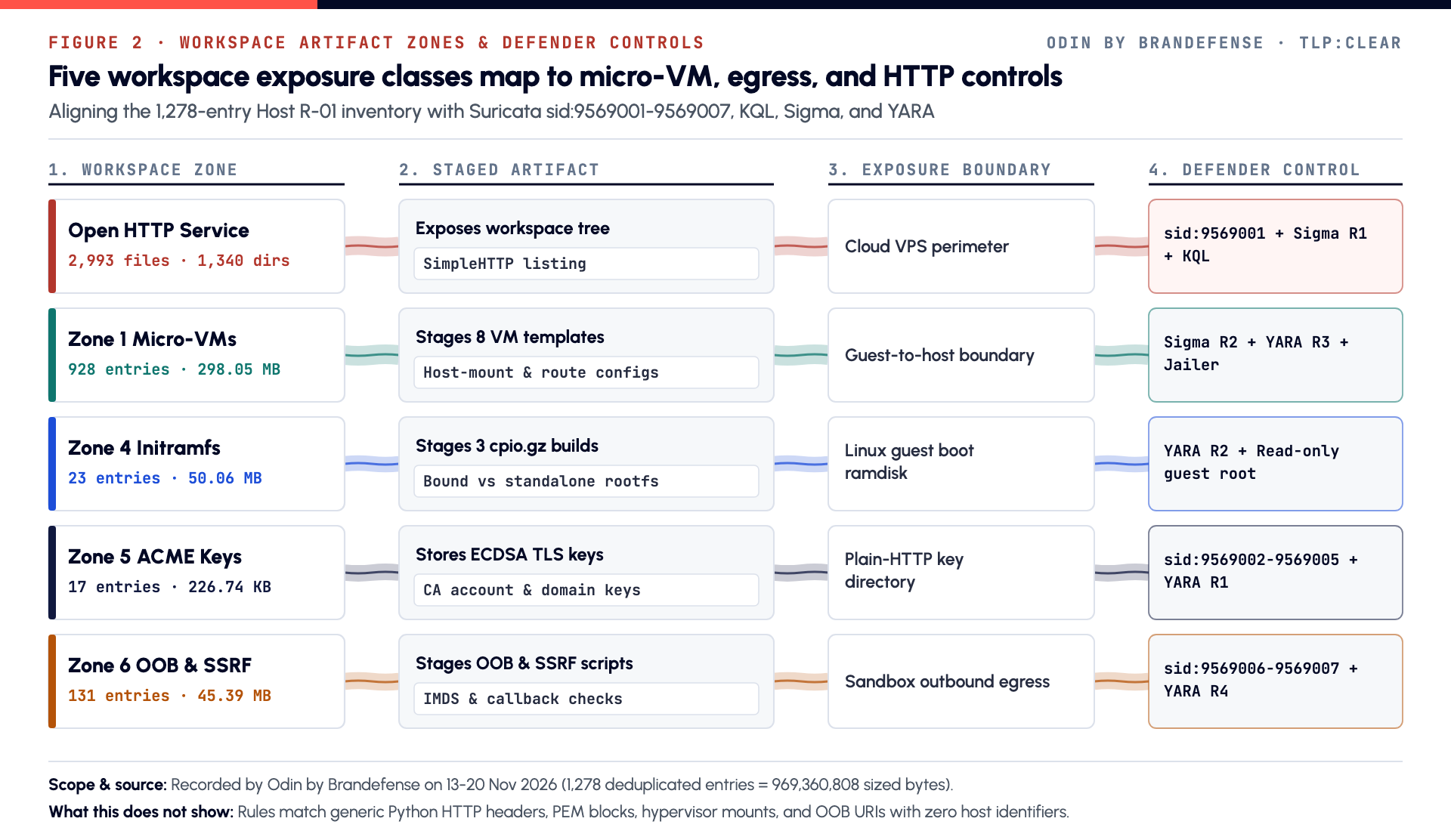
5. Enterprise Exposure and Control Verification
Platform and cloud security teams running internal AI sandboxes or research VMs should verify five controls rather than assuming unverified root causes:
| Exposure layer | Observed evidence on Host R-01 | Control to verify | Operational risk |
|---|---|---|---|
| Open HTTP dev listeners | Live listing reported 2,993 files and 1,340 dirs on 20 Nov 2026 (1,278 dedup entries). | Verify whether VPC firewalls block unapproved ports and whether local dev servers bind to 127.0.0.1 ([REF-10]). | Internet scanners can copy sandbox code, audit files, and keys (T1552.001). |
| Micro-VM host bind mounts | Zone 1 stages 3 builds of a host-directory mount scenario within 928 entries. | Verify whether micro-VMs run inside jailer cages ([REF-01]) and forbid virtio-fs, 9p, or hostPath mounts ([REF-05]). | Guest code edits host files, reads host keys, or escapes to the node (T1611, [REF-06]). |
Custom initramfs images | Zone 4 stages 23 entries (50.06 MB) across bound, self-contained, and raw cpio.gz archives. | Verify whether production VMs use signed, self-contained initramfs bootstrap stripped of transfer tools with a separately enforced read-only guest root ([REF-03]), and discard guests after each session. | Bound or raw debug ramdisks leave writable mounts or BusyBox network tools in guest RAM. |
| Sandbox metadata & OOB egress | Zone 1 route-aware egress templates + Zone 6 OOB binary and SSRF scripts (131 entries). | Verify whether host nftables drop guest packets to 169.254.169.254 and RFC1918 ranges before NAT ([REF-02]). | Guest code steals cloud IAM credentials via SSRF or reaches local host databases. |
| ACME & DB secret storage | Zone 5 (17 ACME files, 226.74 KB) + 26 config entries + 42 secret records. | Verify whether ACME keys sit in 0700 /etc folders outside web roots and whether DB secrets use vaults ([REF-07]). | One ad-hoc HTTP server leaks both domain ECDSA keys and CA account.key authority. |
6. Alternative Hypotheses
| Hypothesis | Evidence for | Evidence against | Assessment |
|---|---|---|---|
| Misconfigured security-research and AI sandbox workspace | Pairs 3 AI micro-VM framework builds (928 entries) and 3 initramfs builds (23 entries) with unpacked IPC clients, JS bundles, SSRF scripts, and personal ACME keys. | None; all six zones match sandbox engineering and app-security testing exposed by an accidental HTTP server. | Supported. Classify Host R-01 consistently as a misconfigured research workspace; withhold all identifiers. |
| Adversary C2 or intrusion staging server | Holds an OOB interaction client binary, SSRF scripts (Zone 6), and web JS bundles (Zone 3). | Holds 0 C2 implants, 0 webshells, and 0 victim data dumps; 72.6% of files are defensive micro-VM isolation templates. | Rejected. Dual-use OOB and SSRF scripts beside sandbox isolation tests reflect security research ([REF-08]). |
Custom initramfs and mount files show a live escape | Zone 1 has host-mount templates and Zone 4 has bound and raw cpio.gz archives. | All 8 scenarios repeat cleanly across 3 framework versions as structured templates; static listings show storage only. | Unsupported. Treat Zones 1 and 4 strictly as staged engineering templates ([REF-01], [REF-03]). |
| All 42 secret records and ACME keys are active | Zone 5 stores 17 ACME files and configs hold 42 secret records across the workspace. | Odin by Brandefense tested 0 keys, made 0 login calls, and queried 0 external domains. | Unverified. Never call untested keys live; rotate both domain keys and ACME account keys on any exposed box. |
7. What Defenders Should Do
AI platform engineers and cloud security teams can close these five gaps in order:
- Close ad-hoc HTTP listeners and rotate exposed ACME keys (
0–48 Hours). Scan research, dev, and GPU VPCs across all ports forDirectory listing for /orIndex of /responses ([REF-10],sid:9569001). Bind local Python servers to127.0.0.1and audithttp.serverprocesses (Sigma Rule 1). If.acme.shever sat in an open folder, replace affected domain TLS keys and deactivate the ACMEaccount.key([REF-07]). Move ACME state to a 0700 root-only/etcfolder outside user workspaces. - Isolate AI code interpreters in jailed micro-VMs without host mounts (
0–72 Hours). Avoid in-process language sandboxes (CVE-2023-29017,[REF-04]) and privileged containers ([REF-05]) for untrusted LLM code. Launch Firecracker insidejailer(chroot, unprivileged UID, cgroup v2 quotas,seccomp,[REF-01]) or use gVisorrunsc([REF-02]). Ban writablevirtio-fs,9p, orhostPathmounts into guest VMs (T1611,[REF-06], Sigma Rule 2). - Use self-contained
initramfsbootstrap and a separately enforced read-only guest root (Days 1–7). Because Linux extractsinitramfsinto a writable RAMrootfs, mount a read-onlysquashfsor block root for persistent guest state and discard each micro-VM after its session ([REF-03]). Strip BusyBox transfer applets (wget,nc,tftp,mount) from production guest images. Unpack.cpio.gzramdisks in CI and scan 070701cpiostreams with YARA Rule 2 before signing. - Drop metadata and RFC1918 routes before guest NAT (
Days 7–14). Use hostnftablesor eBPF rules on each micro-VM tap interface to drop packets to169.254.0.0/16,127.0.0.0/8, and RFC1918 ranges before NAT ([REF-02]). Require cloudIMDSv2with hop limit 1 on hypervisor hosts and route allowed internet calls through a TLS egress proxy watched bysid:9569006–9569007. - Isolate research files from keys and schedule weekly audits (
Days 14–30). Keep unpacked installers (Zone 2), JS captures (Zone 3), and SSRF scripts (Zone 6) on isolated lab VMs with zero keys or database secrets. Run the Chapter 8 Sentinel KQL and YARA workspace checks each week.
8. Detection Rules
The full rules are in the Detection rules tab. Because all Host R-01 identifiers and hashes are withheld, each rule file targets generic protocol headers, PEM blocks, hypervisor mount arguments, or cpio archive structures.
Validation scope: the Suricata rules passed the Odin Suricata linter (0 problems). YAML and modifier checks confirmed all three Sigma rules, and structural checks verified the Sentinel KQL and YARA files. Native suricata -T, Kusto.Language, pySigma, and yara binaries were not installed locally, and rules were not replayed on live traffic. Test and tune them in staging before rollout.
| Rule file | What it catches |
|---|---|
odin_sandbox_workspace_acme_and_oob_hunt.rules | Suricata 7.x (7 alert http rules, sid:9569001–9569007). Flags Python SimpleHTTP listings, /.acme.sh/ and account.key probes, PEM key leaks, and OOB calls |
sentinel_sandbox_microvm_http_and_egress_hunt.kql | Microsoft Sentinel KQL (7-day lookback). Unions process events with metadata-IP network events; OOB URI polling requires full-URL proxy logs. |
sigma_microvm_sandbox_http_and_acme_exposure.yml | Portable Sigma (3 Linux rules). Flags ad-hoc Python HTTP servers, sensitive VMM host-mount paths, and /.acme.sh/ or account.key copies |
odin_sandbox_initramfs_acme_and_oob_artifacts.yar | Structural YARA (4 bounded rules). Matches PEM private keys when scans are scoped to ACME state directories, unpacked 070701 BusyBox cpio ramdisks, micro-VM mount configs, and SSRF/OOB scripts |
How the Suricata 7.x Signatures Work (sid:9569001–9569007)
All seven rules use alert and do not block packets inline; enforce blocks in WAFs, proxies, and firewalls. Because they inspect http buffers, sid:9569001–9569005 require cleartext HTTP or a TLS reverse proxy. Rules sid:9569006 and sid:9569007 require cleartext HTTP or a TLS-inspecting egress proxy.
| SID | Direction & flow | What it matches | Defensive purpose |
|---|---|---|---|
| 9569001 | $HOME_NET any -> $EXTERNAL_NET any (to_client) | HTTP 200 with Server: SimpleHTTP/ and Directory listing for / | Self-audit alert when an internal host exposes a Python HTTP directory |
| 9569002 | $EXTERNAL_NET any -> $HOME_NET any (to_server) | Inbound GET with http.uri containing /.acme.sh/ (nocase) | Flags external requests probing ACME client state directories |
| 9569003 | $EXTERNAL_NET any -> $HOME_NET any (to_server) | Inbound GET with http.uri containing account.key (nocase) | Flags external requests targeting ACME CA account private keys |
| 9569004 | $HOME_NET any -> $EXTERNAL_NET any (to_client) | HTTP 200 body containing -----BEGIN EC PRIVATE KEY----- | Self-audit alert when an internal HTTP port leaks an ECDSA private key |
| 9569005 | $HOME_NET any -> $EXTERNAL_NET any (to_client) | HTTP 200 body containing -----BEGIN PRIVATE KEY----- | Self-audit alert when an internal HTTP port leaks a PKCS#8 private key |
| 9569006 | $HOME_NET any -> $EXTERNAL_NET any (to_server) | Outbound POST to exact /register (bsize:9) with "correlation-id" and "public-key" | Flags generic OOB correlation session registration from sandbox subnets |
| 9569007 | $HOME_NET any -> $EXTERNAL_NET any (to_server) | Outbound GET starting with /poll?id= followed by &secret= | Flags generic OOB callback polling requests from sandbox subnets |
How the Sentinel KQL, Sigma, and YARA Rules Work
The Sentinel KQL hunt unions two branches over a 7-day lookback and excludes two sample FQDNs in ApprovedSandboxBuildHosts (sandbox-ci-01.corp.example and acme-renew-01.corp.example). Replace both placeholders with your own build or certificate-renewal hosts before scheduling.
The first KQL branch checks DeviceProcessEvents for python, python3, or python.exe running http.server or SimpleHTTPServer. It also flags firecracker, cloud-hypervisor, or qemu-system-x86_64 commands containing /var/run/docker.sock, /etc/shadow, /root/, /.ssh/, or /.acme.sh/. The second branch checks DeviceNetworkEvents for python, python3, node, curl, or wget connecting to exact RemoteIP == "169.254.169.254". Because DeviceNetworkEvents.RemoteUrl often logs only an FQDN, hunt OOB /poll?id= and /register URIs separately in full-URL egress proxy logs.
| Host or file rule | Engine | Trigger condition |
|---|---|---|
Ad-Hoc Python HTTP Directory Server Execution on Cloud or Sandbox Hosts (R1) | Sigma (linux) | /python, /python3, /python3.11, or /python3.12 with http.server or SimpleHTTPServer outside sandbox-ci-01.corp.example (T1552.001) |
Micro-VM or Hypervisor Launched With Sensitive Host Path Mounts (R2) | Sigma (linux) | /firecracker, /cloud-hypervisor, or /qemu-system-x86_64 with /var/run/docker.sock, /etc/shadow, /root/, /.ssh/, or /.acme.sh/ (T1611) |
Unexpected Archiving or Copy of Automated ACME Private Key Directories (R3) | Sigma (linux) | /tar, /zip, /cp, /scp, /rsync, or /curl referencing /.acme.sh/ or account.key outside acme-renew-01.corp.example (T1552.001) |
ODIN_Unencrypted_ACME_ECDSA_or_PKCS8_Key (YARA R1) | YARA (< 64KB) | -----BEGIN EC PRIVATE KEY----- or -----BEGIN PRIVATE KEY----- when scans are scoped to ACME state directories |
ODIN_Custom_Cpio_Newc_Initramfs_BusyBox_Archive (YARA R2) | YARA (< 60MB) | Unpacked 070701 SVR4 newc cpio header at offset 0 with bin/busybox, dev/console, and sbin/init or init |
ODIN_MicroVM_Host_Bind_Mount_and_Egress_Config (YARA R3) | YARA (< 1MB) | Two of boot_source, vcpu_count, initramfs paired with host_path, virtio-fs, egress_policy, or 169.254.169.254 |
ODIN_SSRF_Metadata_and_OOB_Callback_Test_Script (YARA R4) | YARA (< 512KB) | Python/HTTP client (urllib.request, requests.get, aiohttp) + 169.254.169.254 or X-aws-ec2-metadata-token + correlation-id or /poll?id= |
9. Indicators (0 Published IPs or File Hashes)
The Indicators tab holds 0 published indicators: 0 network addresses and 0 file hashes. Host R-01 is a misconfigured security-research and developer VPS exposing 42 secret records. Its IPv4 address, TCP port, all folder, file, vendor, and domain names, and all 683 SHA-256 digests are withheld to protect the workspace owner.
| Indicator or marker group | Published in Indicators tab | Status in this report |
|---|---|---|
Host R-01 IPv4 address and TCP port (United States VPS) | 0 | Withheld to protect the workspace owner |
| Workspace file SHA-256 digests (683 unique across 937 sized files) | 0 | Withheld (42 secret records and all names also withheld) |
| Generic self-audit and sandbox-boundary markers | 0 (text-only table below) | 10 markers published in the table below |
Behavioral and Protocol Self-Audit Markers
| Marker category | Pattern / protocol artifact | Layer | Defensive self-audit & control |
|---|---|---|---|
| Python HTTP listing | Server: SimpleHTTP/ + Directory listing for / | Outbound HTTP 200 | Alert with sid:9569001; close exposed listeners and bind dev tools to 127.0.0.1. |
| ACME folder probe | GET URI containing /.acme.sh/ | Inbound HTTP | Alert with sid:9569002 and Sigma Rule 3; block dot-folders at reverse proxies. |
| ACME account key probe | GET URI containing account.key | Inbound HTTP | Alert with sid:9569003 and Sigma Rule 3; keep ACME keys in 0700 /etc folders. |
| ECDSA key HTTP leak | -----BEGIN EC PRIVATE KEY----- | Outbound HTTP 200 | Alert with sid:9569004 and YARA Rule 1; rotate leaked domain ECDSA keys. |
| PKCS#8 key HTTP leak | -----BEGIN PRIVATE KEY----- | Outbound HTTP 200 | Alert with sid:9569005 and YARA Rule 1; deactivate exposed ACME CA accounts. |
| OOB session register | POST /register ("correlation-id" + "public-key") | Outbound HTTP/TLS | Alert behind TLS egress proxy with sid:9569006 and full-URL proxy logs. |
| OOB callback poll | GET /poll?id=...&secret=... | Outbound HTTP/TLS | Alert behind TLS egress proxy with sid:9569007 and full-URL proxy logs. |
| Python HTTP server CLI | python3 -m http.server / SimpleHTTPServer | Linux / Windows CLI | Flag with Sigma Rule 1 and Sentinel DeviceProcessEvents; check open sockets. |
| Unsafe VMM host mount | firecracker / cloud-hypervisor / qemu with /root/, /.ssh/, /.acme.sh/, or docker.sock | Hypervisor CLI / config | Flag with Sigma Rule 2, Sentinel KQL, and YARA Rule 3; enforce jailer. |
Unpacked cpio rootfs | 070701 SVR4 newc header + bin/busybox + init | Unpacked cpio stream | Decompress .cpio.gz ramdisks in CI and scan with YARA Rule 2 before signing. |
10. Scope and Limits
Odin by Brandefense passively analyzed an unauthenticated HTTP directory service on Host R-01 (United States VPS) recorded from 13 to 20 November 2026. On 20 November 2026, that open directory reported 2,993 files and 1,340 directories. Static indexing across 13–20 November 2026 captured 1,278 deduplicated entries: 937 sized files (969,360,808 bytes) and 341 unsized entries. Across those 937 sized files sit 683 unique SHA-256 digests, alongside 26 config entries and 42 secret records.
Zero credentials or ACME keys were tested, and zero binaries or scripts were run. Node.js vm2 CVE-2023-29017 (< 3.9.15, [REF-04]) is cited strictly as architectural context for micro-VM adoption rather than an artifact on Host R-01. All host IPs, ports, folder/file/project/vendor/domain names, 42 secret records, and 683 SHA-256 digests are withheld.
11. Sources
[REF-01]Firecracker MicroVM Documentation, *Firecracker Lightweight Virtualization and Jailer Isolation Architecture* (verified on 25 November 2026).[REF-02]gVisor Official Documentation, *What is gVisor? Application Kernel for Containers* (verified on 25 November 2026).[REF-03]The Linux Kernel Documentation, *Ramfs, rootfs and initramfs* (verified on 25 November 2026).[REF-04]NIST NVD, *CVE-2023-29017 Detail - Node.js vm2 Sandbox Escape Prior to Version 3.9.15* (verified on 25 November 2026).[REF-05]Kubernetes Documentation, *Pod Security Standards and HostPath Volume Restrictions* (verified on 25 November 2026).[REF-06]MITRE ATT&CK, *Escape to Host (T1611)* (verified on 25 November 2026).[REF-07]MITRE ATT&CK, *Unsecured Credentials: Credentials In Files (T1552.001)* (verified on 25 November 2026).[REF-08]MITRE ATT&CK, *Exploit Public-Facing Application (T1190)* (verified on 25 November 2026).[REF-09]MITRE ATT&CK, *Deploy Container (T1610)* (verified on 25 November 2026).[REF-10]CISA, *BOD 23-02: Mitigating the Risk from Internet-Exposed Management Interfaces* (verified on 25 November 2026).
Frequently asked questions
What did the exposed AI sandbox research workspace contain?
Engineers and researchers sometimes start python3 -m http.server to copy logs or test bundles from a cloud box without passing --bind 127.0.0.1. Python then binds to 0.0.0.0 across all interfaces and exposes hidden dot-folders over plain HTTP. Security teams can use external attack surface management to find open HTTP directory listeners across cloud accounts before outside scanners copy internal files.
How do host mounts, custom initramfs builds, and egress rules shape micro-VM safety?
Running LLM-generated Python, Node.js, or browser code inside in-process language sandboxes has failed repeatedly. As architectural context, Node.js vm2 before 3.9.15 (CVE-2023-29017, fixed in 3.9.15) allowed host code execution via Error.prepareStackTrace handling during async errors. That class of escape pushed AI teams toward hardware micro-VMs (Firecracker) and user-space kernels (gVisor).
Why do ACME TLS folders inside open workspaces create lasting risk?
Across Host R-01, static review found 26 environment and config entries and 42 secret records. Those 42 records span 9 standalone secret files plus credentials inside ACME and database configs. Zone 5 (17 files, 226,737 bytes) shows why home-folder HTTP sharing is risky.
What should AI platform and cloud defenders do first?
Defenders can harden cloud workspaces and AI code-interpreter clusters in four direct steps: The Indicators tab holds 0 network addresses and 0 file hashes because all Host R-01 identifiers and digests are withheld. The full report provides 10 self-audit markers alongside Suricata, Sentinel KQL, Sigma, and YARA rules.