
1. Executive Summary
In short
Through 25 November 2026, Odin by Brandefense evaluated 598 candidate endpoints across 401 IPv4s on AS40065 (CNSERVERS LLC). Thirty-two endpoints were active in the two-week window, and 113 multi-service hosts held 310 endpoints. The intrusion IPv4 reported in the November 2026 Rackspace Spot Kubernetes breach falls within AS40065. Restrict Secret RBAC, enforce Pod Security and volume admission policy, and block high-port egress.
Cloud providers that allow fast server setup and broad port binding host both benign test labs and attacker tools. Reading threat feeds one port at a time hides how users stack scanners, relays, autonomous panels, and C2 listeners onto a single IPv4 host. Whereas Monograph 60 covered seven-framework growth and Storm-0940 overlaps, Monograph 68 examines 598 AS40065 endpoints (113 multi-service hosts) and Rackspace Spot Kubernetes Secret and pod hardening.
During a two-week observation window ending 25 November 2026, Odin by Brandefense reviewed 598 candidate endpoints on 401 IPv4s in AS40065 (CNSERVERS LLC / cloudradium[.]com). Within those 598 indexed records, 32 endpoints across 18 hosts carried active last-seen timestamps from 12 to 25 November 2026. The other 566 records carried earlier baseline timestamps before 12 November 2026.
Every one of the 598 records carries candidate status without independent C2 beacon captures. Odin by Brandefense therefore withholds all 401 IPv4 addresses. Zero blocklist IPs or file SHA-256 hashes appear in our feeds.
Multi-service hosting places 51.8 percent of AS40065 endpoints onto 113 servers.
Across 401 unique IPv4s, 288 hosts (71.8 percent) exposed one candidate endpoint, while 113 hosts (28.2 percent) exposed two to eight endpoints each. Those 113 multi-service hosts carry 310 of the 598 endpoints (51.8 percent), peaking at eight endpoints on one IPv4. Ninety-four hosts bound multiple ports of one tool, and 19 hosts paired two distinct tools on one box.
Six framework groups reconcile all 598 endpoints and show a November shift to autonomous panels.
Cobalt Strike and unverified profiles lead with 294 endpoints (49.2 percent), followed by recon scanners with 143 endpoints (23.9 percent, including 108 ARL panels). Post-exploitation C2s add 54 endpoints, RATs and other panels add 52, autonomous consoles add 33, and relays add 22.
Among the 32 endpoints active from 12 to 25 November 2026, autonomous consoles account for 24 endpoints (75.0 percent). Nineteen of those active ports ran ARTEX, alongside three AutoCVE ports and two CyberStrikeAI ports.
The single reported Rackspace Spot intrusion IPv4 falls within AS40065.
In late November 2026, Rackspace customer notices disclosed a 17 November 2026 credential-based intrusion into its managed Kubernetes service Rackspace Spot. Intruders entered customer clusters, created unauthorized pods, listed nodes and volumes, and may have read Kubernetes Secrets and storage-volume files.
The reported Rackspace Spot intrusion IP falls within AS40065 (CNSERVERS LLC / cloudradium[.]com); no evidence links it to a specific console or service.
Shared ASN overlap neither attributes the breach to tool authors nor names a threat group.
Open-source testing consoles, scanners, and relays run across shared clouds, and 113 AS40065 hosts expose multiple candidate endpoints across standard and high ports. Shared ASN hosting alone cannot show which service or tenant sent the 17 November cluster API calls. Defenders should skip blanket ASN IP blocks and harden Kubernetes clusters directly.
Three Decisions for Security Leaders
- Lock down Kubernetes Secret RBAC and storage encryption. Remove cluster-wide
get,list, andwatchverbs onSecretsto stop bulk API reads, and enable KMS v2 encryption foretcdat rest. Disable automaticServiceAccounttoken mounting on pods to reduce credentials in files exposure. - Enforce Restricted Pod Security, RBAC, and volume admission policy. Use
RestrictedPod Security to rejectprivilegedpods,hostNetwork, andhostPathmounts, and use RBAC and admission policy to restrict pod creation andpersistentVolumeClaimmounts. Alert on imperativekubectl runcalls outside approved CI pipelines. - Sweep cloud ports and block non-standard high-port egress. Audit corporate cloud subnets across standard web ports and high scanner ports (8787, 50003, 5003, 7880, 13000). Block server and worker VLANs from direct outbound calls to uncategorized high ports.
The Study in Numbers
| Number | What it is |
|---|---|
| 598 | Cumulative deduplicated candidate endpoints on AS40065 (CNSERVERS LLC / cloudradium[.]com) evaluated through 25 November 2026 |
| 401 | Unique IPv4 addresses across AS40065 (288 single-endpoint hosts and 113 multi-service hosts; all 401 IPs withheld) |
| 310 | Candidate endpoints (51.8% of 598) concentrated on the 113 multi-service hosts (2 to 8 endpoints per IP) |
| 32 | Candidate endpoints active during the 12-25 November 2026 two-week window across 18 IPs (24 autonomous console endpoints) |
| 94 + 19 | Ninety-four same-tool multi-port hosts plus 19 cross-tool hosts reconciling all 113 multi-service AS40065 servers |
| 0 | Published blocklist IPv4 addresses or file SHA-256 hashes in our feeds (10 protocol, CLI, and Kubernetes hunt markers) |
2. Six Framework Groups and Port Density on AS40065
Single-ASN analysis shows how diverse toolkits share commercial cloud space ([REF-10]). On AS40065 (CNSERVERS LLC / cloudradium[.]com), Odin by Brandefense reviewed 598 candidate endpoints on 401 unique IPv4s (CloudRadium L.L.C) through 25 November 2026. Teams can use external attack surface management to audit cloud subnets on both standard HTTPS ports and high management ports. Figure 1 maps the four study tracks.
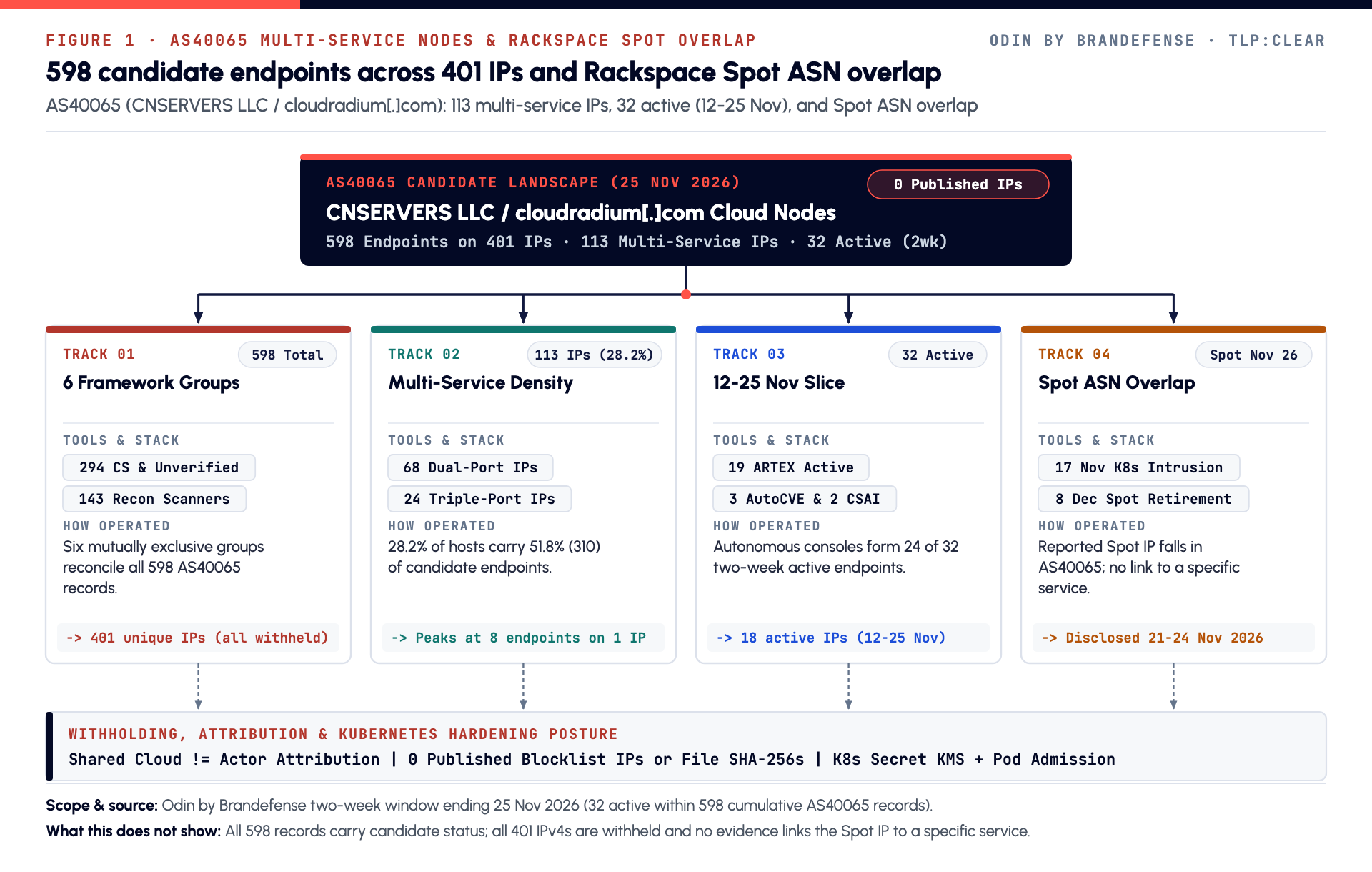
All 598 records (100.0%) hold candidate status (0 confirmed beacon captures). By country, 518 endpoints (86.6%) map to the United States and 67 (11.2%) to Hong Kong, plus 8 (1.3%) in China and 5 (0.8%) in Mauritius. Upstream role tags span c2 (300), red-team-tools (162), team-server (77), management (29), and admin-panel (22). The remaining eight rows carry phishing (4), victim (3), and exploit-server (1) tags.
Separating 32 Two-Week Active Endpoints from 566 Earlier Records
To keep time boundaries clear, we separate recent two-week activity from older upstream record dates. Within the 598 AS40065 records reviewed on 25 November 2026, 32 endpoints on 18 IPv4s carried last-seen dates from 12 to 25 November 2026. Twenty-two of those 32 active endpoints (across 8 IPs) were first seen during that same 12-25 November window.
The other 566 candidate endpoints across 387 unique IPv4s carry earlier upstream first-seen and last-seen dates before 12 November 2026 (32 + 566 = 598). Four IPv4 hosts held both an earlier baseline record and a 12-25 November active record, reconciling 18 + 387 - 4 = 401 unique ASN IPv4s. Keeping those slices distinct stops older Cobalt Strike and scanner churn from hiding late-November console trends.
Reconciling All 598 Endpoints Across Six Framework Groups
Table 1 groups all 598 AS40065 records into six mutually exclusive framework groups (294 + 143 + 54 + 52 + 33 + 22 = 598). Pairing this breakdown with cyber threat intelligence helps defenders weigh historical C2 density against active autonomous testing panels.
| Framework group | Cumulative endpoints | Share (%) | Unique IPs in group | Active (12-25 Nov) | Observed tool breakdown |
|---|---|---|---|---|---|
| Cobalt Strike & Unverified Profiles | 294 | 49.2% | 143 | 1 | Cobalt Strike (276), CS Unverified (18). |
| Recon & Vulnerability Scanners | 143 | 23.9% | 133 | 3 | ARL (108), Acunetix (21), Yakit (13), reNgine (1). |
| Interactive Post-Exploitation C2s | 54 | 9.0% | 54 | 0 | Viper (23), VShell (13), Brute Ratel C4 (7), Metasploit (4), Havoc (3), Sliver (2), Supershell (2). |
| RATs, Loaders, Phishing & Other Panels | 52 | 8.7% | 50 | 1 | PlugX (9), AsyncRAT (6), Kaiji (5), GoPhish (4), PrismX (4), Emotet (4), QakBot (4), XenoRAT (3), Ramnit (3), BeEF (3), plus 7 single-endpoint tools. |
| Autonomous & AI Testing Consoles | 33 | 5.5% | 17 | 24 | ARTEX (22 on 8 IPs), CyberStrikeAI (7 on 6 IPs), AutoCVE (3 on 3 IPs), PentAGI (1 on 1 IP). |
| C2 Fronting, Reverse SSH & Relays | 22 | 3.7% | 16 | 3 | RedGuard (13), ReverseSSH (8), FRP (1). |
| Total | 598 | 100.0% | 401 unique ASN IPs | 32 | Group IPs sum to 413 due to 12 cross-group IP overlaps. |
Why do the six group IP counts add up to 413 (143 + 133 + 54 + 50 + 17 + 16) when AS40065 has 401 unique IPv4s? Twelve cross-group multi-service hosts appear in two groups (413 - 12 = 401). In the fourth row, the seven single-endpoint tools (1 each) are Hashtopolis, Moobot, Hookbot, Responder, PupyC2, Meterpreter, and Bumblebee. Figure 5 compares cumulative endpoints with group IP counts and two-week active totals.
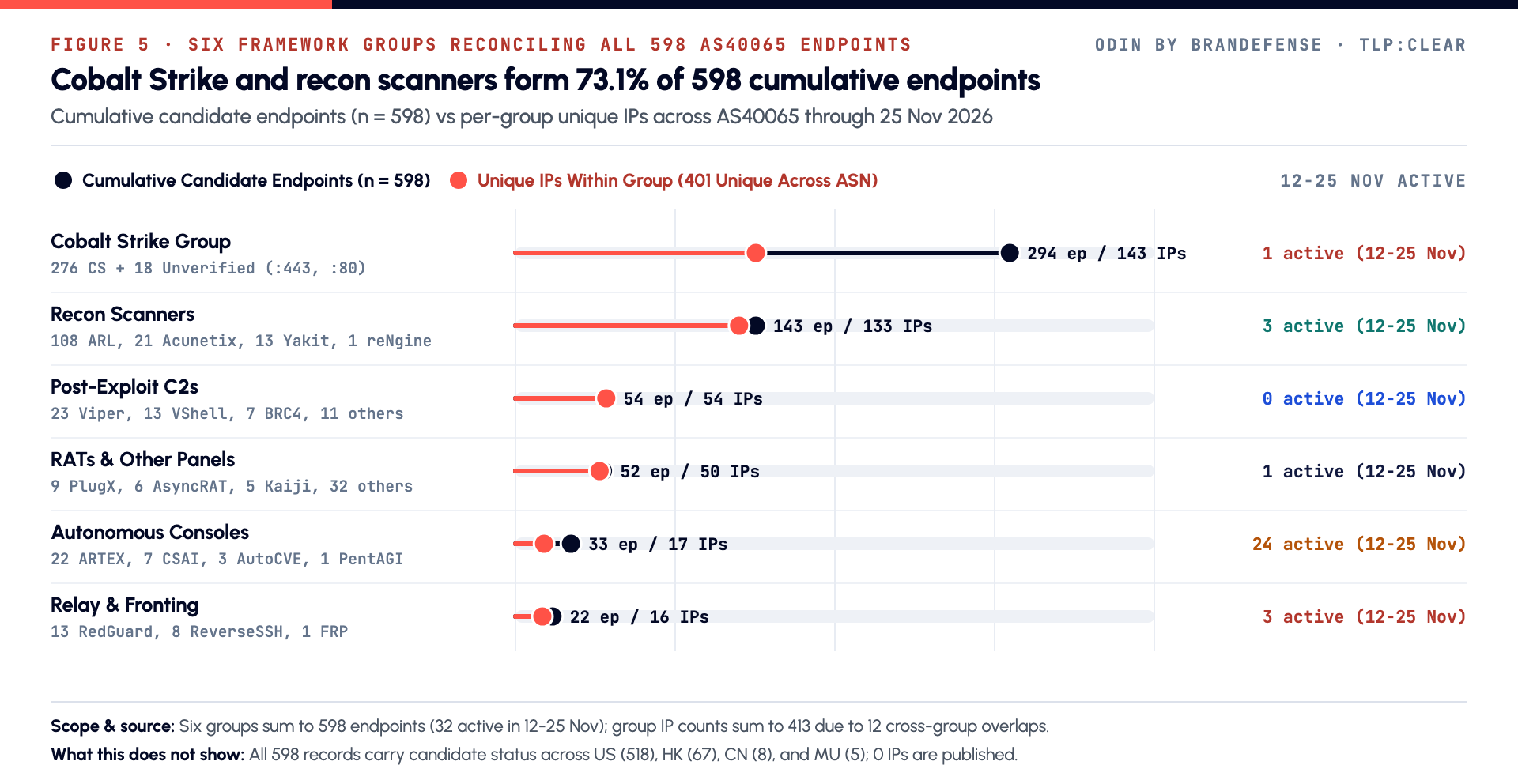
Three clear patterns stand out in Table 1 and Figure 5:
- High port-per-host density in
Cobalt StrikeandARL.Cobalt Strike(294 endpoints on 143 IPs, or 2.06 per IP) and recon scanners (143 endpoints) form 73.1% (437 of 598) of cumulative records. - Autonomous consoles dominate the
12-25 Novemberactive slice. Autonomous testing consoles form just 5.5% (33 of 598) of cumulative records, yet they drive 75.0% (24 of 32) of two-week active endpoints. Those 24 active ports span 19ARTEX, 3AutoCVE, and 2CyberStrikeAIbindings. Eight other active ports span 3Yakit, 2ReverseSSH, 1FRP, 1Cobalt Strike, and 1Hashtopolislistener (24 + 8 = 32). - Dedicated fronting and tunnel relays. Twenty-two relay endpoints span 13
RedGuardC2-fronting reverse proxies, 8ReverseSSHservices, and 1FRPtunnel port across 16 hosts.
Port Distribution Across 120 Distinct TCP Ports
Across all 598 candidate endpoints, services span 120 distinct TCP ports. Table 2 reconciles the top 12 ports (366 endpoints, 61.2%) and the other 108 ports (232 endpoints, 38.8%).
| TCP port | Candidate endpoints | Share (%) | Primary observed tools on port |
|---|---|---|---|
TCP 443 | 92 | 15.4% | Cobalt Strike (51), ARTEX (6), CS Unverified (6), ARL (5), others (24). |
TCP 50003 | 58 | 9.7% | ARL (58) alternate management console port. |
TCP 5003 | 45 | 7.5% | ARL (45) default web console port. |
TCP 80 | 43 | 7.2% | Cobalt Strike (31), ARTEX (4), Ramnit (2), VShell (1), others (5). |
TCP 50050 | 28 | 4.7% | Cobalt Strike (28) default team-server port. |
TCP 60000 | 23 | 3.8% | Viper (23) post-exploitation web panel port. |
TCP 8080 | 19 | 3.2% | CyberStrikeAI (6), Cobalt Strike (6), ARTEX (5), PlugX (2). |
TCP 8443 | 19 | 3.2% | Cobalt Strike (14), Havoc (2), PentAGI (1), others (2). |
TCP 4433 | 13 | 2.2% | Cobalt Strike (12), CS Unverified (1). |
TCP 7880 | 10 | 1.7% | Acunetix (10) vulnerability scanner port. |
TCP 8085 | 8 | 1.3% | Yakit (5), CS Unverified (2), Cobalt Strike (1). |
TCP 11111 | 8 | 1.3% | RedGuard (6), Brute Ratel C4 (2). |
Other 108 TCP ports | 232 | 38.8% | Includes TCP 8787 (ARTEX: 7), TCP 13000 (AutoCVE: 3), and 106 other ports. |
| Total (120 ports) | 598 | 100.0% | 366 on top 12 ports (61.2%) + 232 on other 108 ports (38.8%). |
Standard web ports (:443, :80, :8080, :8443) carry 173 endpoints (28.9%). Non-standard and high ports carry 425 endpoints (71.1%), showing why server VLANs should block direct outbound calls to uncategorized high TCP ports.
3. Multi-Service Multiplexing and the Rackspace Spot Overlap
Grouping AS40065 by unique IPv4 host shows that 113 multi-service hosts (28.2% of 401 IPs) hold 310 of the 598 candidate endpoints (51.8%). Table 3 breaks all 401 hosts into four density bands.
| Host density band | Unique IPs | IP share (%) | Candidate endpoints | Endpoint share (%) | Same-tool multi-port IPs | Cross-tool IPs |
|---|---|---|---|---|---|---|
| 1 endpoint per IP | 288 | 71.8% | 288 | 48.2% | 0 | 0 |
| 2 endpoints per IP | 68 | 17.0% | 136 | 22.7% | 55 | 13 |
| 3 endpoints per IP | 24 | 6.0% | 72 | 12.0% | 22 | 2 |
4 to 8 endpoints per IP (peak 8 on 1 IP) | 21 | 5.2% | 102 | 17.1% | 17 | 4 |
| Multi-endpoint subtotal (2-8) | 113 | 28.2% | 310 | 51.8% | 94 | 19 |
| Total | 401 | 100.0% | 598 | 100.0% | 94 | 19 |
Inside the 4-8 endpoint band (21 hosts, 102 endpoints), 13 hosts ran 4 endpoints (52) and 2 hosts ran 5 endpoints (10). Three hosts ran 6 endpoints (18), 2 hosts ran 7 (14), and 1 peak host ran 8 endpoints (8).
Ninety-four multi-endpoint servers bound multiple ports of one tool, led by 72 Cobalt Strike, 6 RedGuard, 5 Yakit, and 5 ARTEX hosts. The other six same-tool hosts ran Acunetix (2), CS Unverified (2), CyberStrikeAI (1), and PlugX (1).
Nineteen servers paired two distinct tools, led by Cobalt Strike with CS Unverified (4) and ARL with Cobalt Strike (3). Other pairs linked Acunetix with ARL (2), AsyncRAT (2), or CS Unverified (2), plus six single-host tool pairs including ARTEX with CyberStrikeAI (1).
AS40065 Overlap and the November 2026 Rackspace Spot Disclosures
In late November 2026, Rackspace customer notices disclosed a security incident on Rackspace Spot ([REF-01], [REF-02]), its managed cloud and Kubernetes service. Public reporting states that intruders signed in with stolen or valid credentials on 17 November 2026 and reached customer Kubernetes clusters. Inside affected clusters, intruders created unauthorized pods ([REF-07]), listed nodes and persistent volumes ([REF-06]), and may have read Kubernetes Secret objects and storage-volume files ([REF-08]).
Rackspace detected the activity on 18 November 2026 and turned off the Rackspace Spot management console ([REF-01], [REF-02]). Console access returned on 21 November 2026 for customer migration ([REF-01]), and on 24 November 2026 Rackspace announced permanent Spot retirement set for 8 December 2026 ([REF-02]). Figure 4 summarizes the four AS40065 host density bands across 113 multi-service cloud nodes.
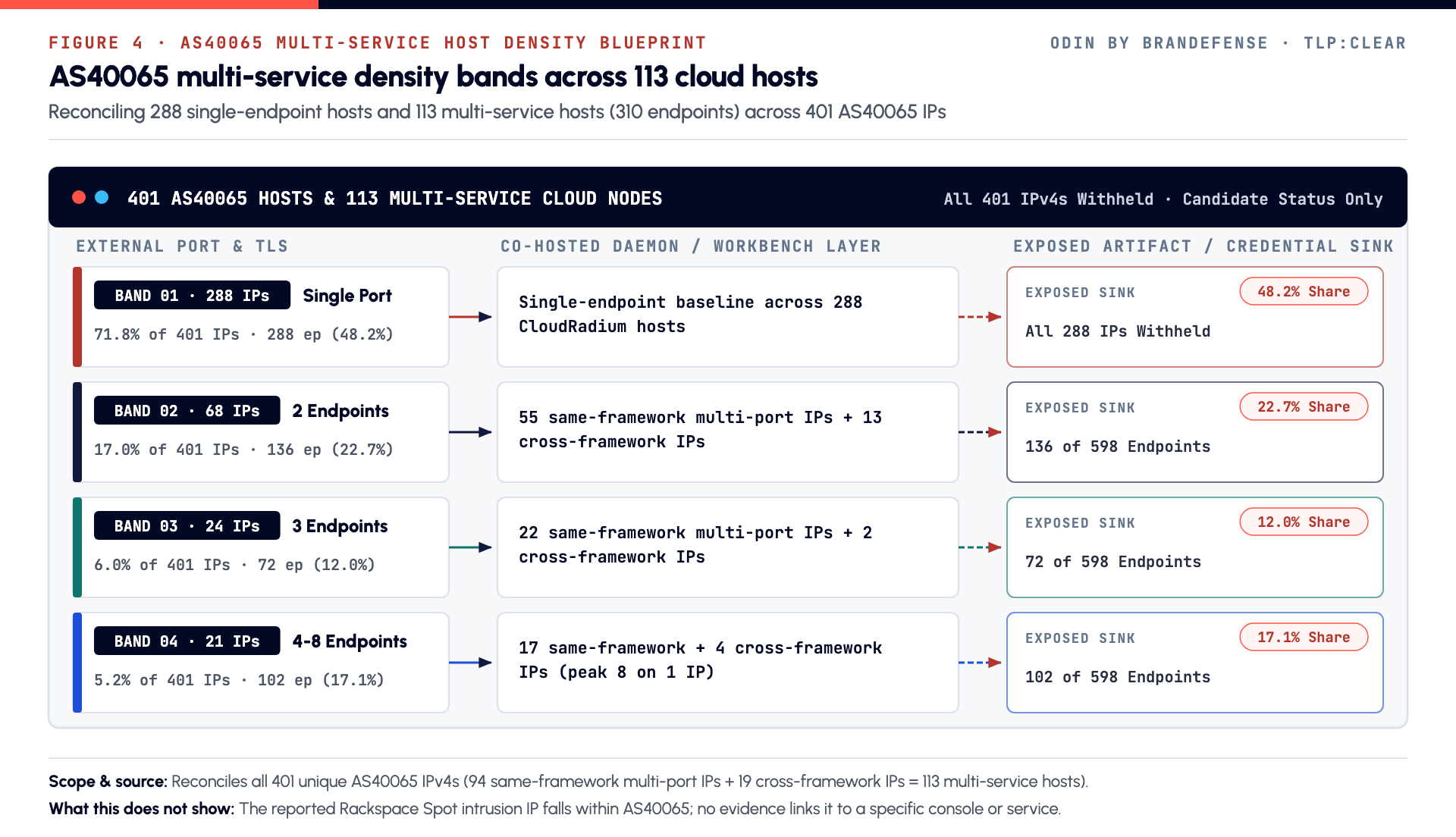
The reported Rackspace Spot intrusion IP falls within AS40065; no evidence links it to a specific console or service. That United States host IP space is withheld because the candidate addresses lack independent adversary confirmation. Table 4 lines up our 12-25 November 2026 AS40065 observation window with the disclosed Spot timeline.
Date (Nov-Dec 2026) | Source | Observed AS40065 window or disclosed Rackspace Spot event |
|---|---|---|
12-25 Nov 2026 | Odin observation | Two-week active window on AS40065: 32 active candidate endpoints across 18 IPs (24 autonomous console ports) within 598 cumulative records. |
17 Nov 2026 | Public Spot notice | Credential-based entry into Rackspace Spot from an IP within AS40065. Unauthorized pods created; Secrets and storage-volume files may have been read ([REF-01], [REF-02]). |
18 Nov 2026 | Public Spot notice | Rackspace detects unauthorized cluster activity and disables the Rackspace Spot management console ([REF-01], [REF-02]). |
21 Nov 2026 | Public Spot notice | Spot console restored for credential rotation and customer migration; customer breach notice reported ([REF-01]). |
24 Nov 2026 | Public Spot notice | Permanent Rackspace Spot platform retirement announced for 8 December 2026 ([REF-02]). |
Three strict boundaries guide how analysts should read the AS40065 overlap:
- ASN overlap does not link the IP to a specific console or service. The reported Rackspace Spot intrusion IP falls within
AS40065, where 32 candidate endpoints (24 autonomous consoles) were active from12 to 25 November. However, no evidence links it to a specific console or service, and external scans hold no cluster API payloads. - Zero attribution to tool builders or named threat groups. Public
ARTEXforks appear across 22AS40065endpoints (8 IPs), alongside 113 multi-service hosts running diverse scanners, relays, and C2 listeners. Odin by Brandefense makes zero attribution toARTEXauthors or any named actor. - Withholding candidate IPs. Because the candidate addresses lack independent adversary confirmation, all 401 IPv4s stay withheld.
4. Managed Kubernetes Secret and Pod Hardening Architecture
When an intruder signs in with stolen cloud portal credentials or a leaked kubeconfig file, cluster actions follow a clear path ([REF-03], [REF-06]). Figure 3 shows an analytical model pairing AS40065 multi-service hosting context (Step 01) with the Kubernetes actions reported in Rackspace Spot customer notices (Steps 02-06).
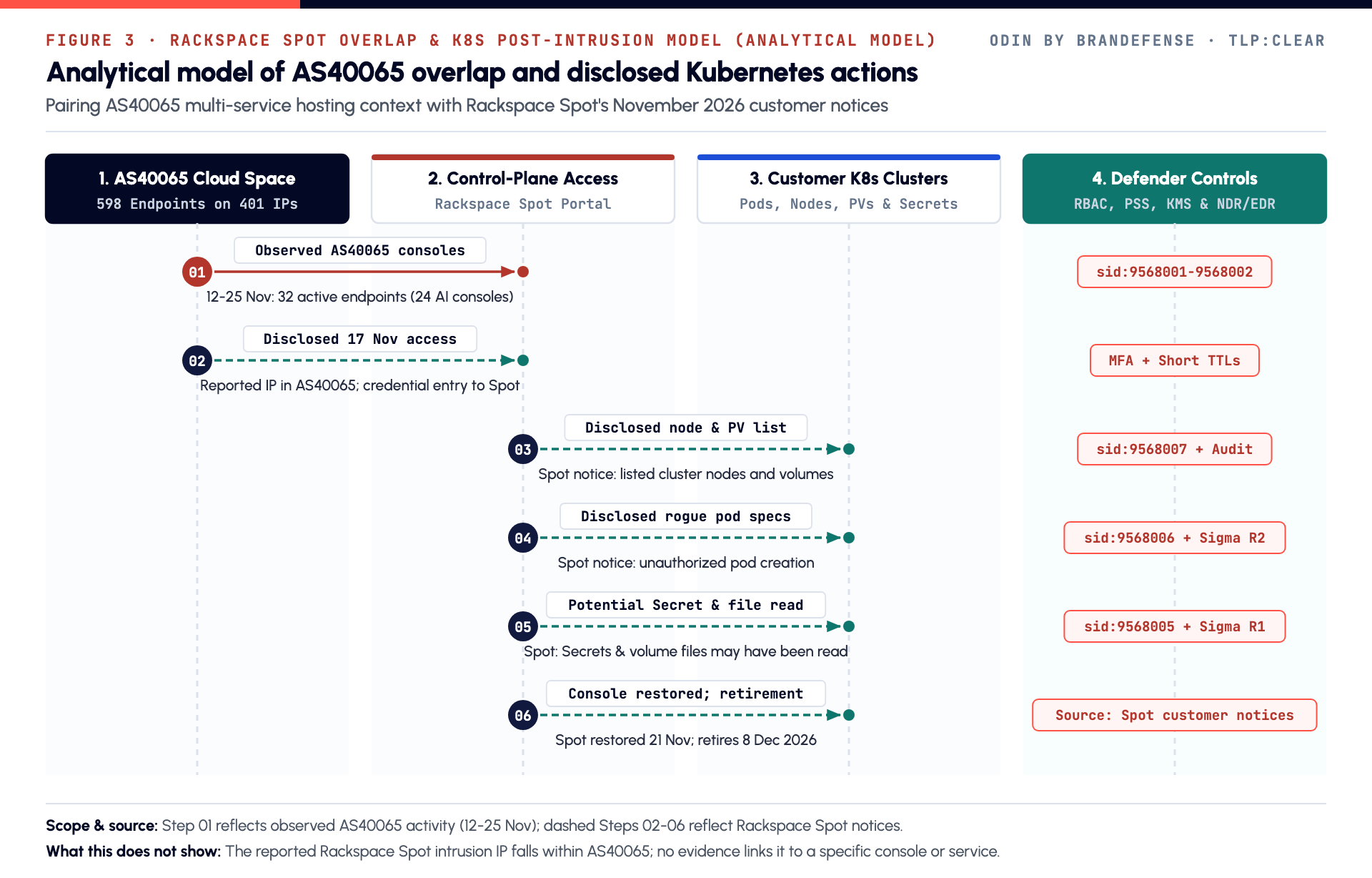
How Credential Access Reaches Cluster Pods, Volumes, and Secrets
The Spot notices confirm unauthorized pod creation and node and volume listing. They say Secret and storage-volume files may also have been read.
- Potential cluster-wide
Secretaccess (T1552.007,[REF-03],[REF-08]). Any role holding cluster-wideget,list, orwatchverbs onsecrets(GET /api/v1/secrets) can export database logins, TLS keys, and.dockerconfigjsontokens through the API ([REF-05]). KMS envelope encryption protects storedSecretsat rest inetcd, not authorized API responses ([REF-03]). - Rogue pod creation and volume mounts (
T1610,[REF-04],[REF-07]). CallingPOST /api/v1/namespaces/*/podsschedules new containers onto worker nodes.RestrictedPod Security blocksprivilegedandhostPathpods, but still permitspersistentVolumeClaimmounts and does not stop pod creation orServiceAccounttoken automounting ([REF-04]). Limit pod creation and volume use through RBAC and admission policy ([REF-05]), and disable token automounting explicitly ([REF-06]). - Node and volume listing (
[REF-06]). Querying/api/v1/nodesand/api/v1/persistentvolumesmaps worker hosts, CSI storage paths, and backing cloud volumes across zones.
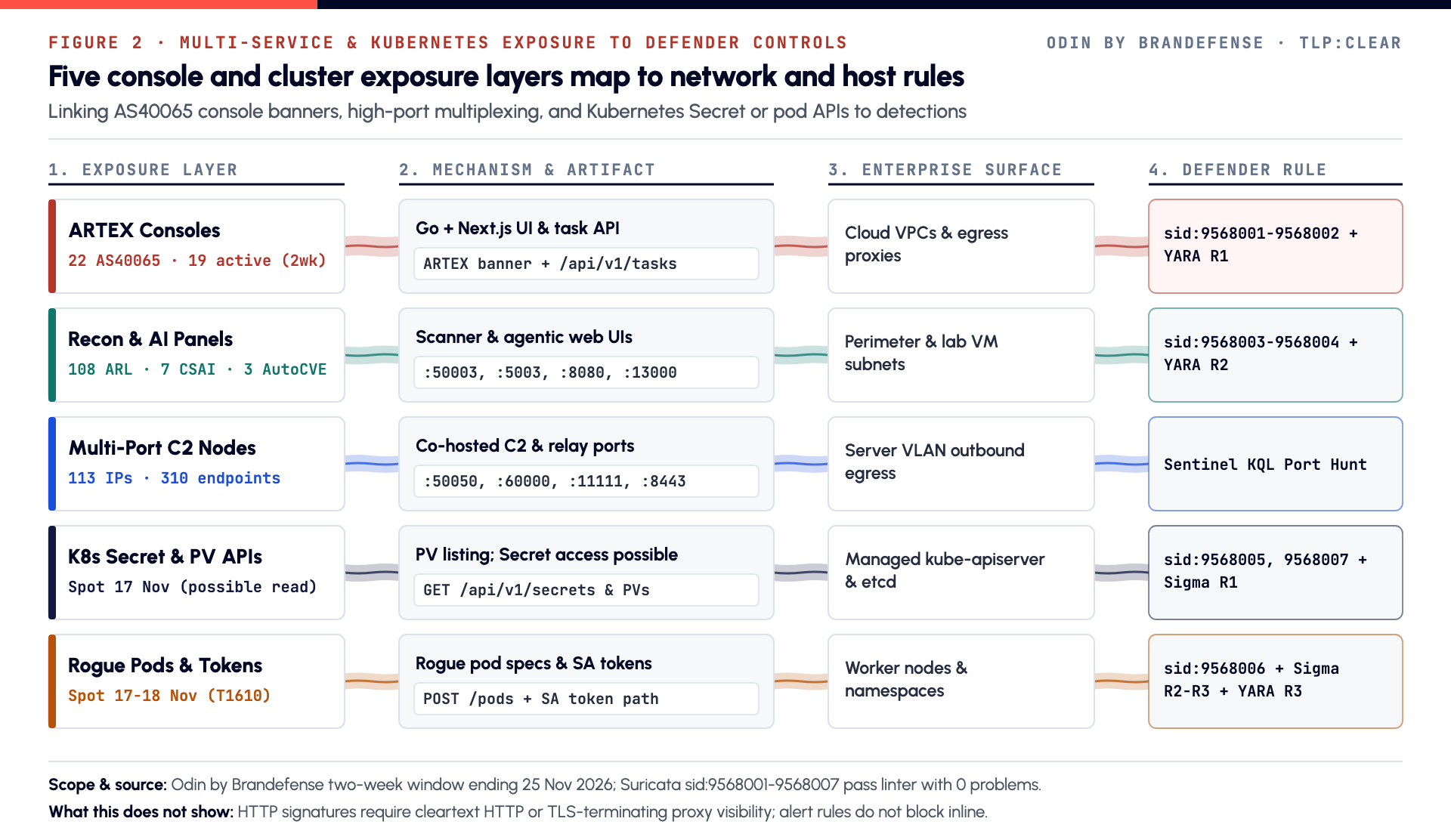
Figure 2 links all five console and cluster layers to the defender actions in Section 7 and the rules in Section 8.
5. Enterprise Exposure and Control Verification
Teams should check five concrete controls across cloud subnets and Kubernetes clusters rather than assuming unverified root causes:
| Exposure layer | Observed or disclosed evidence | Control to verify | Operational risk |
|---|---|---|---|
| Exposed scanner & AI panels | 598 AS40065 candidates (108 ARL, 22 ARTEX, 21 Acunetix, 13 Yakit, 7 CyberStrikeAI). | Verify whether cloud VPCs expose :8787, :50003, :5003, :7880, :8080, or :443 panels without mTLS. | Open panels leak scan scopes, API keys, and task routes ([REF-10]). |
| Multi-port high-port egress | 113 multi-service IPs (310 endpoints); 71.1% (425/598) sit outside :443/:80/:8080/:8443. | Verify whether worker nodes and server VLANs block direct outbound calls to random high ports. | Pods or hosts can reach co-hosted C2, RedGuard, or scanner ports. |
Kubernetes Secret RBAC & KMS | Spot customer notices: intruders may have read Kubernetes Secrets in customer clusters ([REF-01], [REF-02], [REF-08]). | Verify whether RBAC blocks cluster-wide get, list, and watch on secrets ([REF-05]) and etcd uses KMS v2 encryption at rest ([REF-03]). | Broad Secret RBAC exposes credentials via the API, while unencrypted etcd snapshots expose stored Secrets at rest. |
| Rogue pod & volume admission | Spot customer notices: unauthorized pods created and volume files may have been read ([REF-01], [REF-02], [REF-07]). | Verify whether namespaces enforce Restricted Pod Security ([REF-04]) and whether RBAC and admission policies restrict pod creation and persistentVolumeClaim mounts ([REF-05]). | Restricted Pod Security blocks privileged and hostPath pods, but still permits persistentVolumeClaim mounts if a role can create pods. |
Pod ServiceAccount tokens | Default pods mount JWTs at /var/run/secrets/kubernetes.io/serviceaccount/token ([REF-06], [REF-09]). | Verify whether automountServiceAccountToken: false is set on pods that do not call kube-apiserver. | Container shell bugs grant instant authenticated cluster API queries. |
6. Alternative Hypotheses
| Hypothesis | Evidence for | Evidence against | Assessment |
|---|---|---|---|
ARTEX authors or a named APT ran the Spot breach | The reported Spot intrusion IP falls within AS40065, where 22 candidate ARTEX endpoints (19 active in 12-25 Nov) operate. | ARTEX is open-source, AS40065 hosts 598 endpoints across 401 commercial VPS IPs ([REF-10]), and no evidence links the intrusion IP to a specific console or service. | Unsupported. Zero attribution to tool authors or named groups. |
An ARTEX console on AS40065 issued the 17 Nov K8s API calls | Autonomous consoles account for 24 of 32 active AS40065 endpoints (12-25 Nov), including 19 ARTEX ports. | No evidence links the reported intrusion IP to a specific console or service, and external scans hold no API payloads. | Unproven mechanism. ASN overlap cannot identify which service sent the cluster API traffic. |
Blocking all 401 AS40065 IPs solves the risk | 113 multi-service hosts hold 310 candidate endpoints across C2 and scanner tools. | All 598 records hold candidate status without beacons, and shared cloud IPs churn fast. | Rejected for static blocking. Withhold all 401 IPs and harden K8s RBAC and PSS. |
AS40065 mostly runs active Cobalt Strike today | Cobalt Strike and unverified profiles form 49.2% (294/598) of cumulative records. | Only 1 of 294 Cobalt Strike ports was active in 12-25 Nov, versus 24 autonomous console ports. | Refuted by date slicing. Splitting 32 active ports from 566 older records avoids bias. |
7. What Defenders Should Do
Teams migrating off retiring platforms (Rackspace Spot retires 8 December 2026, [REF-02]) or running Kubernetes clusters can close post-credential gaps in five steps:
- Rotate Spot secrets and tighten
SecretRBAC (0-48 Hours). Treat everySecret, registry token, TLS key, and volume credential from November 2026 Spot clusters as exposed and rotate them ([REF-01],[REF-02],[REF-03]). Remove cluster-wideget,list, andwatchverbs onsecretsfrom human and CI roles, scoping reads to single named objects ([REF-05]). - Enforce
RestrictedPod Security, RBAC, and volume admission (0-72 Hours). Label production namespaces withpod-security.kubernetes.io/enforce: restrictedto rejectprivilegedpods,hostNetwork, andhostPathmounts ([REF-04],[REF-07]). BecauseRestrictedPod Security still permitspersistentVolumeClaimmounts, limit pod creation and volume claims through RBAC and admission policy ([REF-05], Sigma Rule 2). - Turn on KMS v2
etcdencryption and disable token automounts (Days 1-7). Configure KMS v2 envelope encryption soSecretsstay encrypted at rest inetcdbackups ([REF-03]). SetautomountServiceAccountToken: falseon defaultServiceAccountsand app pods ([REF-06],[REF-09]), using short-lived projected tokens where needed (Sigma Rule 3). - Lock down
kube-apiserveraccess and storage volumes (Days 7-14). Putkube-apiserverbehind private VPC links or mTLS proxies and require phishing-resistant MFA on cloud portals ([REF-06]). Restrict CSI volume binds and auditGET /api/v1/persistentvolumescalls ([REF-06],sid:9568007). - Sweep cloud ports and block high-port worker egress (
Days 14-21). Scan cloud ranges on web ports and high ports (8787, 50003, 5003, 7880, 13000) for openARTEX,ARL,CyberStrikeAI, andAutoCVEpanels (sid:9568001-9568004, YARA Rules 1-2). Block worker VLANs from direct calls to high ports (50003, 5003, 50050, 60000, 11111, 8787, 13000) and hunt with Sentinel KQL.
8. Detection Rules
The full rules are in the Detection rules tab. Because all 401 candidate IPv4s are withheld, every rule targets HTTP banners, Kubernetes API paths, CLI flags, or manifest strings.
Verification scope: the Suricata file passed the Odin Suricata linter (0 problems). YAML checks confirmed all three Sigma rules, and structural checks verified the Sentinel KQL and YARA files. Live engine binaries (suricata -T, Kusto.Language, pySigma, and yara) were not installed on the build host. Rules were not replayed on live cluster traffic, so test and tune them before rollout.
| Rule file | What it catches |
|---|---|
odin_as40065_consoles_and_k8s_api_hunt.rules | Suricata 7.x (sid:9568001-9568007). Flags ARTEX, ARL, and CyberStrikeAI banners, POST /api/v1/tasks, and inbound K8s Secret, Pod, and PV API calls. |
sentinel_k8s_secret_pod_and_multiservice_hunt.kql | Sentinel KQL (7-day lookback). Links kubectl Secret exports, imperative pod calls, and SA token reads with high-port console egress. |
sigma_k8s_secret_read_pod_deploy_and_token_access.yml | Portable Sigma (3 Linux rules). Flags kubectl bulk Secret exports, imperative pod creation or overrides, and CLI reads of mounted SA tokens. |
odin_as40065_consoles_and_k8s_artifacts.yar | Structural YARA (4 filesize-bounded rules). Flags ARTEX and ARL console bundles, privileged hostPath Pod specs, and SecretList dumps. |
How the Suricata 7.x Signatures Work (sid:9568001-9568007)
All seven http signatures require cleartext HTTP or placement behind a TLS-terminating reverse or API proxy (required to inspect kube-apiserver HTTPS requests). Because alert rules do not drop traffic inline, enforce blocks in Kubernetes RBAC, Pod Security Admission, or your API gateway.
| SID | Direction & flow | What it matches | Defensive purpose |
|---|---|---|---|
| 9568001 | $HOME_NET any -> $EXTERNAL_NET any (to_client) | http.response_body containing ARTEX - Autonomous Red-Team Expert | Flags exposed home-network ARTEX panels answering external clients |
| 9568002 | $HOME_NET any -> $EXTERNAL_NET any (to_server) | POST request with http.uri starting with /api/v1/tasks | Flags outbound task dispatch calls to an ARTEX controller |
| 9568003 | $HOME_NET any -> $EXTERNAL_NET any (to_client) | http.response_body containing Asset Reconnaissance Lighthouse | Flags exposed ARL recon scanner panels (108 on AS40065) |
| 9568004 | $HOME_NET any -> $EXTERNAL_NET any (to_client) | http.response_body containing CyberStrikeAI | Flags exposed CyberStrikeAI panels (7 on AS40065) |
| 9568005 | $EXTERNAL_NET any -> $HOME_NET any (to_server) | Inbound GET with http.uri starting with /api/v1/secrets | Flags cluster-wide Secret list queries via TLS proxy (T1552.007) |
| 9568006 | $EXTERNAL_NET any -> $HOME_NET any (to_server) | Inbound POST with http.uri starting /api/v1/namespaces/ and containing /pods | Flags pod-route POSTs; confirm the Kubernetes audit verb is create before classifying pod creation. |
| 9568007 | $EXTERNAL_NET any -> $HOME_NET any (to_server) | Inbound GET with http.uri starting with /api/v1/persistentvolumes | Flags cluster storage-volume discovery calls |
How the Sentinel KQL, Sigma, and YARA Rules Work
The Sentinel KQL hunt unions two branches over a 7-day lookback. Replace the sample hostnames in ApprovedAdminHosts (k8s-admin-01.corp.example, sec-scanner-01.corp.example) with your own admin bastions before scheduling.
The first branch checks DeviceProcessEvents for kubectl commands pairing secrets with -A, --all-namespaces, -o yaml, or -o json, or imperative pod flags (create pod, --overrides=, run). That same branch also flags curl, wget, cat, and base64 reading /var/run/secrets/kubernetes.io/serviceaccount/token. The second branch checks DeviceNetworkEvents for RemotePort in (MultiServicePorts) (8787, 50003, 5003, 50050, 60000, 13000, 11111) or RemoteUrl contains "/api/v1/tasks".
| Host or file rule | Engine | Trigger condition |
|---|---|---|
Linux Kubectl Bulk Secret Export or All-Namespaces Enumeration (R1) | Sigma (linux) | /kubectl with secrets and -A, --all-namespaces, -o yaml, or -o json outside k8s-admin-01.corp.example (T1552.007) |
Linux Kubectl Imperative Pod Creation or Spec Override (R2) | Sigma (linux) | /kubectl with run, create pod, or --overrides= outside ci-deployer-01.corp.example (T1610) |
Linux Container ServiceAccount Token Read via CLI Utilities (R3) | Sigma (linux) | /curl, /wget, /cat, or /base64 referencing /var/run/secrets/kubernetes.io/serviceaccount/token (T1552.001, T1552.007, [REF-09]) |
ODIN_R68_ARTEX_Console_Bundle_and_Task_API (YARA R1) | YARA (< 5MB) | ARTEX - Autonomous Red-Team Expert paired with /api/v1/tasks or artex-swarm-root |
ODIN_R68_ARL_Recon_Lighthouse_Bundle (YARA R2) | YARA (< 5MB) | Asset Reconnaissance Lighthouse paired with /api/user/login or arl_web |
ODIN_R68_Privileged_HostPath_Pod_Manifest (YARA R3) | YARA (< 512KB) | kind: Pod paired with hostPath or hostNetwork: true and privileged: true |
ODIN_R68_Exported_K8s_Secret_List_Dump (YARA R4) | YARA (< 10MB) | SecretList and apiVersion: v1 paired with kubernetes.io/service-account-token or dockerconfigjson |
9. Indicators
The Indicators tab holds 0 published blocklist IPv4 addresses and 0 file SHA-256 hashes. All 401 candidate IPv4s on AS40065 are withheld because the candidate addresses lack independent adversary confirmation.
| Indicator or marker group | Published in Indicators tab | Status in this report |
|---|---|---|
Candidate AS40065 host IPv4s (401 IPs across 598 endpoints) | 0 | Withheld (candidate addresses lack independent adversary confirmation) |
Rackspace Spot intrusion IPv4 (AS40065 overlap) | 0 | Withheld (no evidence links the IP to a specific console or service) |
| File SHA-256 hashes | 0 | None published (0 malware payload files in scope) |
| Behavioral, protocol, and Kubernetes hunt markers | 0 (text-only table below) | 10 markers published in the table below |
Behavioral, Protocol, and Kubernetes Hunt Markers
| Marker category | Pattern / protocol artifact | Layer | Defensive hunt & control |
|---|---|---|---|
| ARTEX icon MD5 | cd3ebd16437d6d3963592f7365dd3980 | All web ports | Scan cloud subnets for /favicon.ico (15,406 B) on 8787, 443, 8080, and 80. |
| ARTEX HTML banner | ARTEX - Autonomous Red-Team Expert | HTTP / TLS proxy | Alert on exposed panels (sid:9568001, YARA R1). Gate approved tools behind mTLS. |
| ARTEX task API | POST /api/v1/tasks | HTTP / TLS egress | Alert on outbound task calls (sid:9568002) and Sentinel DeviceNetworkEvents. |
| ARL scanner banner | Asset Reconnaissance Lighthouse | 50003, 5003, 443 | Sweep cloud VPCs for exposed ARL consoles (sid:9568003, YARA R2; 108 on AS40065). |
| CyberStrikeAI banner | CyberStrikeAI | 8080, 8445 | Sweep external assets and alert on exposed home responses (sid:9568004). |
| K8s Secret API route | GET /api/v1/secrets | K8s API / TLS proxy | Audit cluster-wide Secret list calls (sid:9568005, K8s audit logs, YARA R4). |
| K8s Pod route POST | POST /api/v1/namespaces/*/pods | K8s API / Admission | Restrict pod creation and volume use via RBAC and admission policy ([REF-04], [REF-05]); alert via sid:9568006 and YARA R3. |
| K8s PV list route | GET /api/v1/persistentvolumes | K8s API / TLS proxy | Restrict storage-discovery RBAC verbs ([REF-05]) and alert via sid:9568007. |
| Bulk Secret CLI | kubectl get secrets --all-namespaces | Linux / admin EDR | Hunt -A, -o yaml, and -o json exports with Sentinel KQL and Sigma Rule 1. |
| Pod SA token path | /var/run/secrets/kubernetes.io/serviceaccount/token | Container / node EDR | Set automountServiceAccountToken: false and hunt CLI reads (Sigma Rule 3, KQL). |
10. Scope and Limits
Odin by Brandefense reviewed 598 candidate endpoints across 401 IPv4s on AS40065 (CNSERVERS LLC / cloudradium[.]com) during a two-week observation window ending 25 November 2026. Thirty-two endpoints on 18 IPs carried active dates from 12 to 25 November 2026, including 22 newly seen on 8 IPs. Another 566 records across 387 IPs carried earlier upstream dates before 12 November 2026, with 4 IPs appearing in both slices. Whereas Monograph 60 covered seven-framework growth and Storm-0940 overlaps, Monograph 68 examines single-ASN multi-framework density on AS40065 and managed Kubernetes post-compromise defense.
All 598 AS40065 records hold candidate status without independent C2 beacon captures, so all 401 IPv4s are withheld. Public Rackspace Spot dates span the 17 Nov intrusion, 18 Nov shutdown, 21 Nov restore, and 24 Nov retirement notice for 8 Dec 2026. Those milestones come from public reporting of customer notices ([REF-01], [REF-02]).
The reported Rackspace Spot intrusion IP falls within AS40065; no evidence links it to a specific console or service. Shared ASN overlap does not identify which service sent the cluster API calls. Odin by Brandefense makes zero attribution to tool authors or named threat groups.
11. Sources
[REF-01]BleepingComputer, *Rackspace Spot breach let hackers access customer Kubernetes secrets* (21 November 2026; verified on 25 November 2026).[REF-02]BleepingComputer, *Rackspace shuts down Spot cloud platform after security breach* (24 November 2026; verified on 25 November 2026).[REF-03]Kubernetes Documentation, *Secrets Configuration and Encryption at Rest* (verified on 25 November 2026).[REF-04]Kubernetes Documentation, *Pod Security Standards (Baseline and Restricted Profiles)* (verified on 25 November 2026).[REF-05]Kubernetes Documentation, *Role-Based Access Control (RBAC) Good Practices (Restricting Secret and Pod Verbs)* (verified on 25 November 2026).[REF-06]Kubernetes Documentation, *Securing a Cluster* (verified on 25 November 2026).[REF-07]MITRE ATT&CK, *Deploy Container (T1610)* (verified on 25 November 2026).[REF-08]MITRE ATT&CK, *Unsecured Credentials: Container API (T1552.007)* (verified on 25 November 2026).[REF-09]MITRE ATT&CK, *Unsecured Credentials: Credentials In Files (T1552.001)* (verified on 25 November 2026).[REF-10]MITRE ATT&CK, *Acquire Infrastructure: Virtual Private Server (T1583.003)* (verified on 25 November 2026).
What is…?
Short explanations of the tools and families named in this study.
What is ARTEX?
ARTEX is an autonomous red-team console that chains AI agents and security tools. Operators fork and rebrand it; its default listener port is 8787.
More about ARTEXC2 frameworkWhat is Cobalt Strike?
Cobalt Strike is commercial adversary simulation software. Its Beacon implant gives an operator remote control of a compromised host. Cracked and leaked copies are widely used by ransomware and espionage operators.
More about Cobalt StrikeReconnaissance platformWhat is ARL?
ARL (Asset Reconnaissance Lighthouse) is an open-source asset discovery platform, popular with Chinese-speaking testers and attackers.
More about ARLAI offensive toolWhat is CyberStrikeAI?
CyberStrikeAI is a public AI-driven offensive security platform. It spreads its operator interface, API and agent listener across several ports on one host and exposes tools through MCP.
More about CyberStrikeAIAI security toolWhat is AutoCVE?
AutoCVE is an AI-assisted tool that turns new vulnerability advisories into HTTP checks.
More about AutoCVESecurity testing suiteWhat is Yakit?
Yakit is a security testing suite with a desktop interface and a remote engine that can intercept traffic, fuzz web parameters and run exploit checks.
More about YakitFrequently asked questions
How do six framework groups and 113 multi-service hosts shape AS40065?
Flat port feeds often treat each cloud IP as a single-purpose box. Grouping AS40065 by host tells a different story. While 288 hosts (71.8% of 401 IPs) exposed one candidate endpoint (288 endpoints), 113 multi-service hosts (28.2%) exposed two to eight endpoints each (310 endpoints, 51.8%).
What did the November 2026 Rackspace Spot overlap on AS40065 show?
In late November 2026, Rackspace customer notices disclosed a 17 November 2026 credential-based intrusion into its managed Kubernetes service Rackspace Spot. Intruders entered customer clusters, created unauthorized pods, listed nodes and volumes, and may have read Kubernetes Secrets and storage-volume files. Rackspace disabled the portal on 18 November, restored access on 21 November, and on 24 November set permanent Spot retirement for 8 December 2026.
Why do credential-based Kubernetes intrusions escalate so fast?
Once an attacker signs in with stolen portal or kubeconfig credentials, three default Kubernetes settings speed up data theft:
What should Kubernetes and cloud defenders do first?
Defenders migrating off retiring platforms or running managed Kubernetes clusters can cut post-credential blast radius in three direct steps: