
Key takeaways
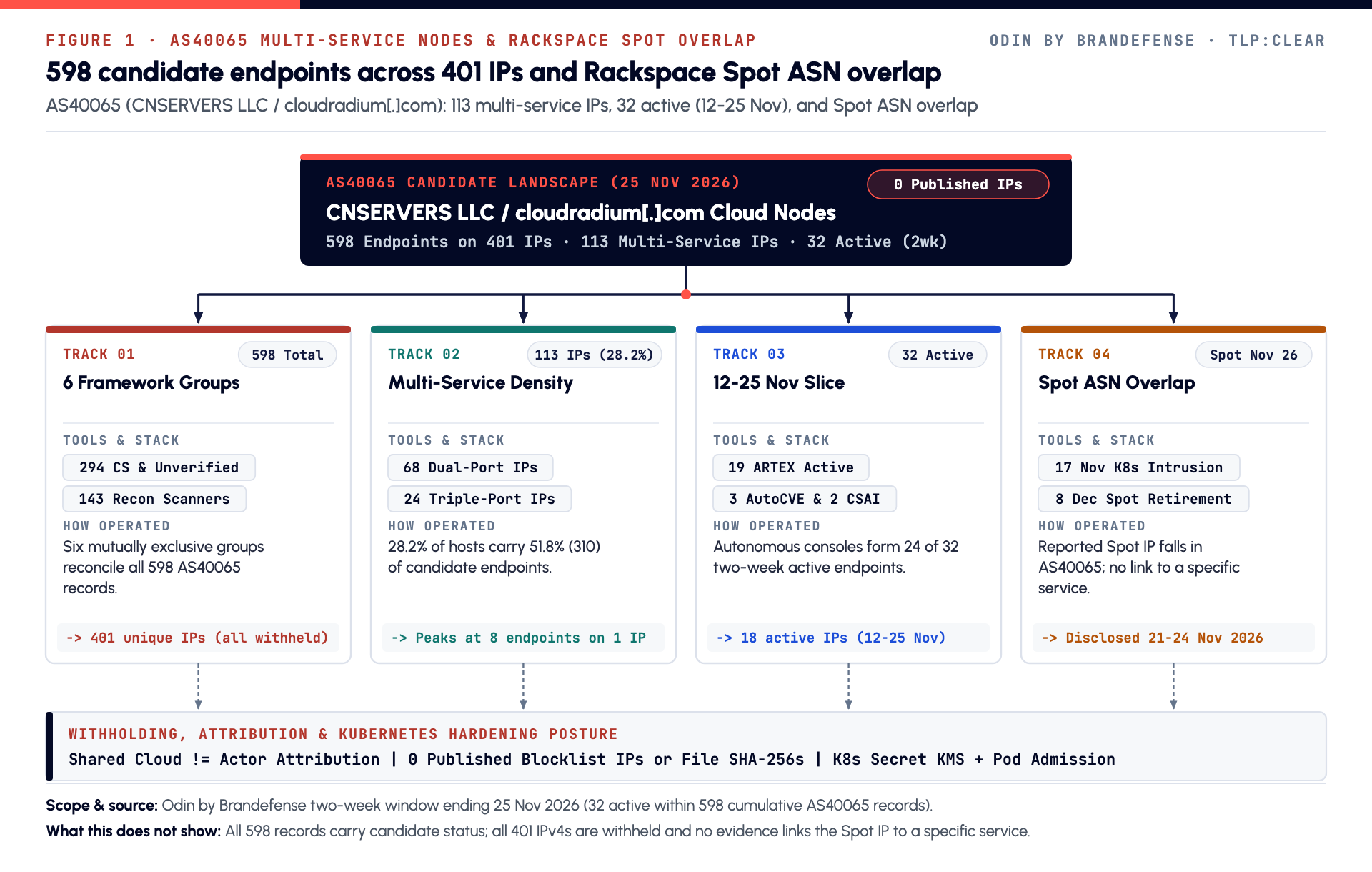
- On AS40065 (CNSERVERS LLC / cloudradium[.]com), 598 candidate endpoints sat on 401 IPv4s through 25 November 2026, including 32 active two-week endpoints.
- Multi-service hosting placed 310 of the 598 endpoints (51.8%) onto 113 servers (28.2% of IPs), peaking at 8 candidate endpoints on one IPv4.
- Autonomous consoles made up 24 of the 32 two-week active endpoints (75.0%), led by 19 ARTEX ports alongside 3 AutoCVE and 2 CyberStrikeAI ports.
- The reported Rackspace Spot intrusion IP falls within AS40065; no evidence links it to a specific console or service.
- All 401 candidate IPv4s are withheld (0 published IPs) with zero actor or tool-author attribution; lock down Kubernetes Secret RBAC, Pod Security, and high-port egress.
One hundred thirteen multi-service servers on AS40065 (CNSERVERS LLC / cloudradium[.]com) held 310 of 598 candidate endpoints (51.8%) evaluated through 25 November 2026. During a two-week observation window ending 25 November 2026, Odin by Brandefense studied how scanners, proxies, C2 panels, and AI consoles share 401 unique IPv4s.
Whereas Monograph 60 covered seven-framework growth and Storm-0940 overlaps, Monograph 68 examines 598 AS40065 endpoints (113 multi-service hosts) and Rackspace Spot Kubernetes Secret and pod hardening. Within the 598 indexed AS40065 records, 32 endpoints across 18 hosts carried active timestamps from 12 to 25 November 2026. The other 566 records carried earlier baseline timestamps before 12 November 2026. Because all 598 records hold candidate status without beacon captures, we withhold all 401 IPv4s (0 published IPs).
How do six framework groups and 113 multi-service hosts shape AS40065?
Flat port feeds often treat each cloud IP as a single-purpose box. Grouping AS40065 by host tells a different story. While 288 hosts (71.8% of 401 IPs) exposed one candidate endpoint (288 endpoints), 113 multi-service hosts (28.2%) exposed two to eight endpoints each (310 endpoints, 51.8%).
Ninety-four multi-endpoint servers bound multiple ports of the same tool, such as 72 multi-port Cobalt Strike hosts and 5 multi-port ARTEX hosts. Nineteen servers combined two distinct tools on one IP, including ARL with Cobalt Strike (3 hosts) and ARTEX with CyberStrikeAI (1 host). One IP had eight candidate endpoint records across Cobalt Strike and unverified profile ports; the records do not establish simultaneous exposure.
Security teams can run external attack surface management scans across cloud accounts to spot exposed scanner and testing panels on high ports. Pairing those scans with cyber threat intelligence keeps analysts from treating shared cloud hosts as single-actor servers.
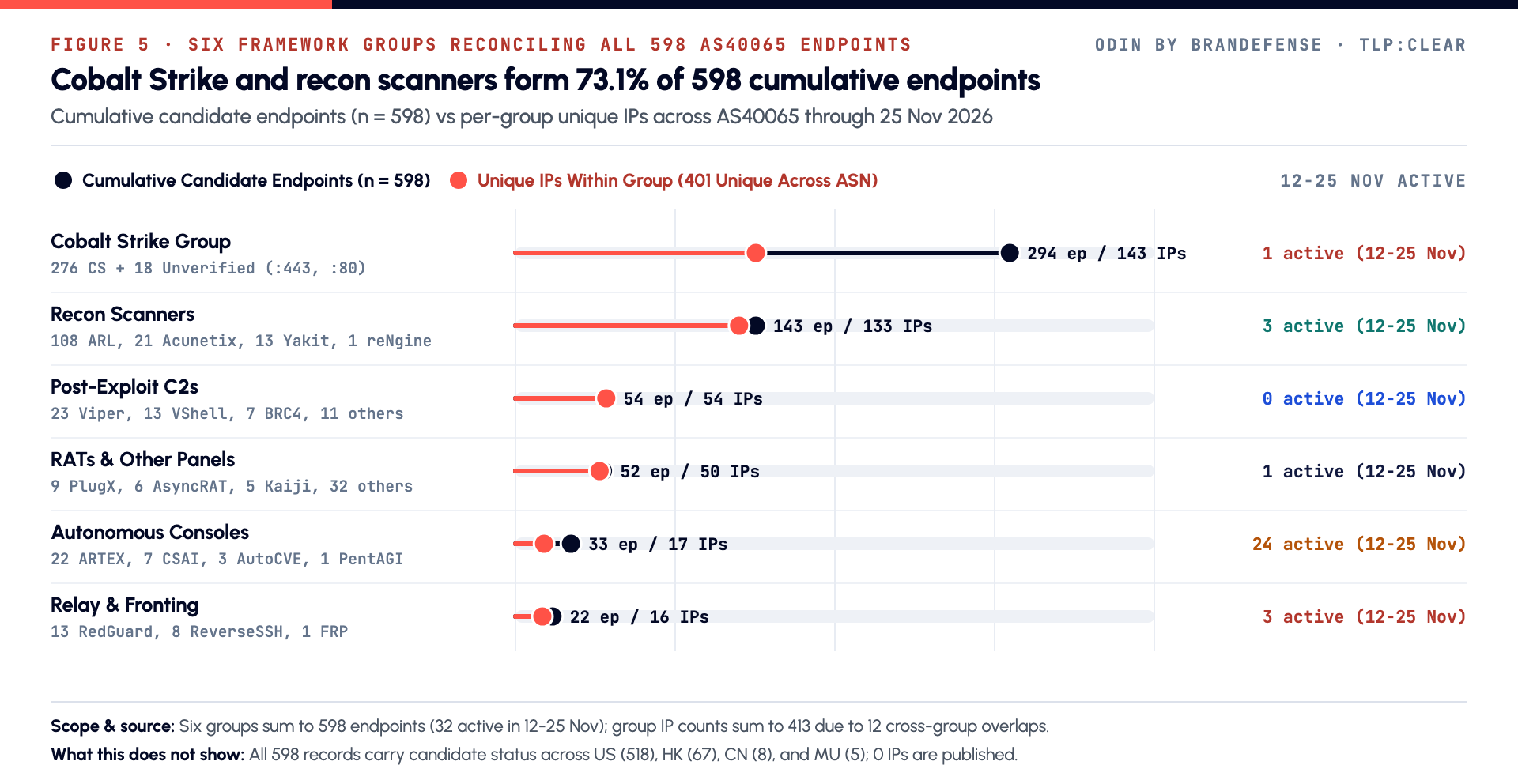
Six mutually exclusive groups reconcile all 598 cumulative AS40065 endpoints and all 32 two-week active endpoints (12-25 November 2026). Although Cobalt Strike (294) and recon scanners (143, led by 108 ARL panels) form 73.1% of cumulative records, autonomous testing consoles drive recent activity. Autonomous panels make up 24 of the 32 two-week active endpoints (75.0%), led by 19 ARTEX listeners, 3 AutoCVE ports, and 2 CyberStrikeAI ports.
| Framework group | Cumulative endpoints | Share (%) | Unique IPs in group | Active (12-25 Nov) | Top observed tools |
|---|---|---|---|---|---|
| Cobalt Strike Group | 294 | 49.2% | 143 | 1 | Cobalt Strike (276), CS Unverified (18). |
| Recon Scanners | 143 | 23.9% | 133 | 3 | ARL (108), Acunetix (21), Yakit (13), reNgine (1). |
| Post-Exploit C2s | 54 | 9.0% | 54 | 0 | Viper (23), VShell (13), Brute Ratel C4 (7), 4 others (11). |
| RATs & Other Panels | 52 | 8.7% | 50 | 1 | PlugX (9), AsyncRAT (6), Kaiji (5), GoPhish (4), 13 others (28). |
| Autonomous Consoles | 33 | 5.5% | 17 | 24 | ARTEX (22), CyberStrikeAI (7), AutoCVE (3), PentAGI (1). |
| Relay & Fronting | 22 | 3.7% | 16 | 3 | RedGuard (13), ReverseSSH (8), FRP (1). |
| Total | 598 | 100.0% | 401 unique ASN IPs | 32 | Group IPs sum to 413 due to 12 cross-group overlaps. |
Across 120 distinct TCP ports, standard web ports (:443, :80, :8080, :8443) hold 173 endpoints (28.9%). High ports hold 425 endpoints (71.1%), led by TCP 50003 (58 ARL), 5003 (45 ARL), 50050 (28 Cobalt Strike), and 60000 (23 Viper). Additional high ports include TCP 7880 (10 Acunetix), 11111 (8), and 8787 (7 ARTEX).
What did the November 2026 Rackspace Spot overlap on AS40065 show?
In late November 2026, Rackspace customer notices disclosed a 17 November 2026 credential-based intrusion into its managed Kubernetes service Rackspace Spot. Intruders entered customer clusters, created unauthorized pods, listed nodes and volumes, and may have read Kubernetes Secrets and storage-volume files. Rackspace disabled the portal on 18 November, restored access on 21 November, and on 24 November set permanent Spot retirement for 8 December 2026.
The reported Rackspace Spot intrusion IP falls within AS40065 (CNSERVERS LLC / cloudradium[.]com); no evidence links it to a specific console or service. That IPv4 address remains withheld because the candidate addresses lack independent adversary confirmation.
Two strict limits apply here. First, shared ASN hosting across 401 commercial VPS addresses (113 multi-service hosts) cannot show which service or tenant carried the 17 November Kubernetes API calls. Second, open-source testing consoles and scanners run across shared cloud VMs, so we make zero attribution to tool authors or any named threat group.
Why do credential-based Kubernetes intrusions escalate so fast?
Once an attacker signs in with stolen portal or kubeconfig credentials, three default Kubernetes settings speed up data theft:
- Potential cluster-wide
Secretaccess. Cluster-wide RBAC access tosecretscan expose database logins, TLS keys, and registry tokens through the API. KMS encryption protects stored Secrets, not authorized API responses. - Permissive pod creation.
RestrictedPod Security blocks privileged andhostPathpods, but permits persistent-volume-claim mounts. Limit pod creation and volume use through RBAC and admission policy. - Auto-mounted pod tokens. Pods mount
/var/run/secrets/kubernetes.io/serviceaccount/tokenby default, exposing credentials in files that let container shells querykube-apiserverdirectly.
What should Kubernetes and cloud defenders do first?
Defenders migrating off retiring platforms or running managed Kubernetes clusters can cut post-credential blast radius in three direct steps:
- Rotate cluster secrets and tighten RBAC. Rotate every
Secret, registry key, and storage credential from affected Spot clusters. Strip cluster-wideget,list, andwatchverbs onsecrets, enable KMS v2etcdencryption at rest, and run Sigma Rule 1 plus Suricatasid:9568005behind TLS proxies. - Enforce
RestrictedPod Security, admission policy, and token controls. Setpod-security.kubernetes.io/enforce: restrictedto blockprivilegedandhostPathpods (YARA Rule 3). Restrict pod creation and persistent-volume-claim mounts through RBAC and admission policy (sid:9568006, Sigma Rule 2). SetautomountServiceAccountToken: falseon workloads (Sigma Rule 3). - Sweep cloud panels and block high-port egress. Scan cloud VPCs for exposed
ARTEX(cd3ebd16437d6d3963592f7365dd3980, :8787/:443),ARL(:50003/:5003), andCyberStrikeAIpanels (sid:9568001-9568004). Block worker nodes from direct outbound calls to high ports (50003, 5003, 50050, 60000, 11111, 8787, 13000) and hunt with Sentinel KQL.
What is…?
Short explanations of the tools and families named in this study.
What is ARTEX?
ARTEX is an autonomous red-team console that chains AI agents and security tools. Operators fork and rebrand it; its default listener port is 8787.
More about ARTEXC2 frameworkWhat is Cobalt Strike?
Cobalt Strike is commercial adversary simulation software. Its Beacon implant gives an operator remote control of a compromised host. Cracked and leaked copies are widely used by ransomware and espionage operators.
More about Cobalt StrikeReconnaissance platformWhat is ARL?
ARL (Asset Reconnaissance Lighthouse) is an open-source asset discovery platform, popular with Chinese-speaking testers and attackers.
More about ARLAI offensive toolWhat is CyberStrikeAI?
CyberStrikeAI is a public AI-driven offensive security platform. It spreads its operator interface, API and agent listener across several ports on one host and exposes tools through MCP.
More about CyberStrikeAIAI security toolWhat is AutoCVE?
AutoCVE is an AI-assisted tool that turns new vulnerability advisories into HTTP checks.
More about AutoCVESecurity testing suiteWhat is Yakit?
Yakit is a security testing suite with a desktop interface and a remote engine that can intercept traffic, fuzz web parameters and run exploit checks.
More about YakitFrequently asked questions
How do six framework groups and 113 multi-service hosts shape AS40065?
Flat port feeds often treat each cloud IP as a single-purpose box. Grouping AS40065 by host tells a different story. While 288 hosts (71.8% of 401 IPs) exposed one candidate endpoint (288 endpoints), 113 multi-service hosts (28.2%) exposed two to eight endpoints each (310 endpoints, 51.8%).
What did the November 2026 Rackspace Spot overlap on AS40065 show?
In late November 2026, Rackspace customer notices disclosed a 17 November 2026 credential-based intrusion into its managed Kubernetes service Rackspace Spot. Intruders entered customer clusters, created unauthorized pods, listed nodes and volumes, and may have read Kubernetes Secrets and storage-volume files. Rackspace disabled the portal on 18 November, restored access on 21 November, and on 24 November set permanent Spot retirement for 8 December 2026.
Why do credential-based Kubernetes intrusions escalate so fast?
Once an attacker signs in with stolen portal or kubeconfig credentials, three default Kubernetes settings speed up data theft:
What should Kubernetes and cloud defenders do first?
Defenders migrating off retiring platforms or running managed Kubernetes clusters can cut post-credential blast radius in three direct steps: