
1. Executive Summary
In short
During a two-week observation window ending 24 November 2026, Odin by Brandefense tracked 5,681 seven-day candidate consoles across seven autonomous testing tools. From 20 to 24 November, four tallied tools added 1,073 new candidates, led by 841 ARTEX endpoints. An aggregate summary against Wiz's 156-IP lists records 10 overlap hosts, including one Vshell server staging 49 files. Gate exposed panels, hunt ZQAgent persistence, and lock web origins.
Public security warnings often push cloud hosts to take down abused open-source servers. Autonomous testing tools driven by large language models took the opposite turn in late November 2026. One week after the FBI issued FLASH-20261113-001 on 13 November 2026 warning of ARTEX abuse, new candidate consoles kept appearing across cloud networks.
During a two-week observation window ending 24 November 2026, Odin by Brandefense tracked seven autonomous testing tools across public internet space. Across all seven tools, 5,681 candidate console endpoints appeared in the seven-day slice from 18 to 24 November 2026. Those 5,681 endpoints sit inside 8,311 thirty-day candidate endpoints.
Candidate consoles include red teams, university labs, and developer test VMs alongside threat actors. Odin by Brandefense therefore withholds all candidate console IPs, open-directory host IPs, and overlap host IPs. Zero IPv4 addresses or file SHA-256 hashes appear in our feeds.
Late-November console growth stayed focused in ARTEX and CyberStrikeAI.
From 20 to 24 November 2026, four tallied tools added 1,073 new candidate endpoints. That total spans 841 ARTEX endpoints, 155 CyberStrikeAI endpoints, 42 AutoHunter endpoints, and 35 PentAGI endpoints. Across the full seven-day slice, ARTEX (3,361) and CyberStrikeAI (1,388) made up 83.6 percent of all 5,681 candidates.
Only 10 of 156 Wiz-published IPv4s overlapped observed consoles and directories.
On 23 November 2026, Wiz Research released a study of agentic attack tools following its 22 October 2026 Storm-0940 report. The two cited Wiz IOC files contain 156 unique IPv4 addresses: 74 in the agentic-attacks list and 82 in the Black October list. The retained aggregate summary records 10 overlapping hosts (6.4 percent) and 146 non-overlapping IPs (93.6 percent), though the row-level comparison is unavailable for verification.
Eight overlap hosts exposed ARTEX panels across TCP ports 8787, 443, and 8080. One host paired Vshell on TCP 443 with two open HTTP directories on TCP 8085 and 8093. One overlap host paired a BrainstormV2 console with a single-file open directory; its owner is unconfirmed and its ports are withheld.
Open-source ARTEX panels on shared cloud ranges do not imply Storm-0940 ownership.
Public ARTEX forks run on shared cloud VMs around the world. Wiz also showed that broad-spray actors route active requests through rotating home and ISP proxies. Treating every exposed ARTEX panel on a shared cloud subnet as Storm-0940 infrastructure causes false claims and noisy blocklists.
Multi-port staging and NVISO's ZQAgent case show the need for host and protocol hunts.
On the Vshell overlap server (Host W-09), two HTTP directories held 49 staged files totaling 570,418 bytes. Those files held three ASP.NET templates and 12 Python WAF-test and matrix scripts. Also on 23 November 2026, NVISO Labs reported an ARTEX case planting ZQAgent, a Linux backdoor using RAM-only files and systemd linger.
Three Decisions for Security Leaders
- Find and gate exposed testing panels. Scan corporate cloud accounts and lab subnets on standard web ports and high ports for ARTEX, CyberStrikeAI, PentAGI, HexStrikeAI, AutoCVE, AutoHunter, and BrainstormV2. Put approved panels behind mTLS or VPNs.
- Treat third-party agentic IP lists as short-lived context. Separate rotating home proxy exits from static cloud panels when reviewing external IP feeds. Require matching sign-in, OAuth, and HTTP request proof before naming an actor.
- Run protocol, IIS origin, and Linux persistence checks together. Lock IIS origins to verified CDN or WAF edges and alert when
w3wp.exestarts a shell. On Linux hosts, alert on/memfd:alinks, spoofeddbus-daemonflags, and unapprovedloginctl enable-lingercalls.
The Study in Numbers
| Number | What it is |
|---|---|
| 8,311 | Rolling 30-day candidate console endpoints across seven tracked autonomous testing tools ending 24 November 2026 |
| 5,681 | Trailing 7-day candidate console endpoints (18-24 November 2026), a subset of the 30-day total |
| 1,073 | New candidate endpoints from 20 to 24 November 2026 across four tallied tools (841 ARTEX, 155 CyberStrikeAI, 42 AutoHunter, 35 PentAGI) |
| 156 | Unique IPv4 addresses in the two cited Wiz 23 November 2026 IOC files (74 agentic-attacks and 82 Black October) |
| 10 | Wiz-published IPv4s (6.4%) recorded in the retained overlap summary (row-level join unavailable); 146 (93.6%) had no console or directory match |
| 49 | Staged files (570,418 bytes) on Host W-09 across TCP 8085 (36 files) and TCP 8093 (13 files) beside Vshell on TCP 443 |
| 0 | Published blocklist IPv4 addresses or file SHA-256 hashes in our feeds (10 behavioral and protocol hunt markers) |
2. Post-Disclosure Growth Across Seven Autonomous Frameworks
On 13 November 2026, the FBI Cyber Division issued FLASH-20261113-001 ([REF-01]) warning of malicious ARTEX use ([REF-06]). Even after the author removed the original repo in October 2026, public forks, mirrors, and peer multi-agent tools kept spreading across cloud providers ([REF-01], [REF-02]).
During the two-week observation window ending 24 November 2026, Odin by Brandefense tracked seven autonomous testing tools: ARTEX, CyberStrikeAI, PentAGI, HexStrikeAI, AutoCVE, AutoHunter, and BrainstormV2. Teams can use external attack surface management to find exposed panels on both high ports and reverse-proxied web ports. Figure 1 maps the four study tracks.
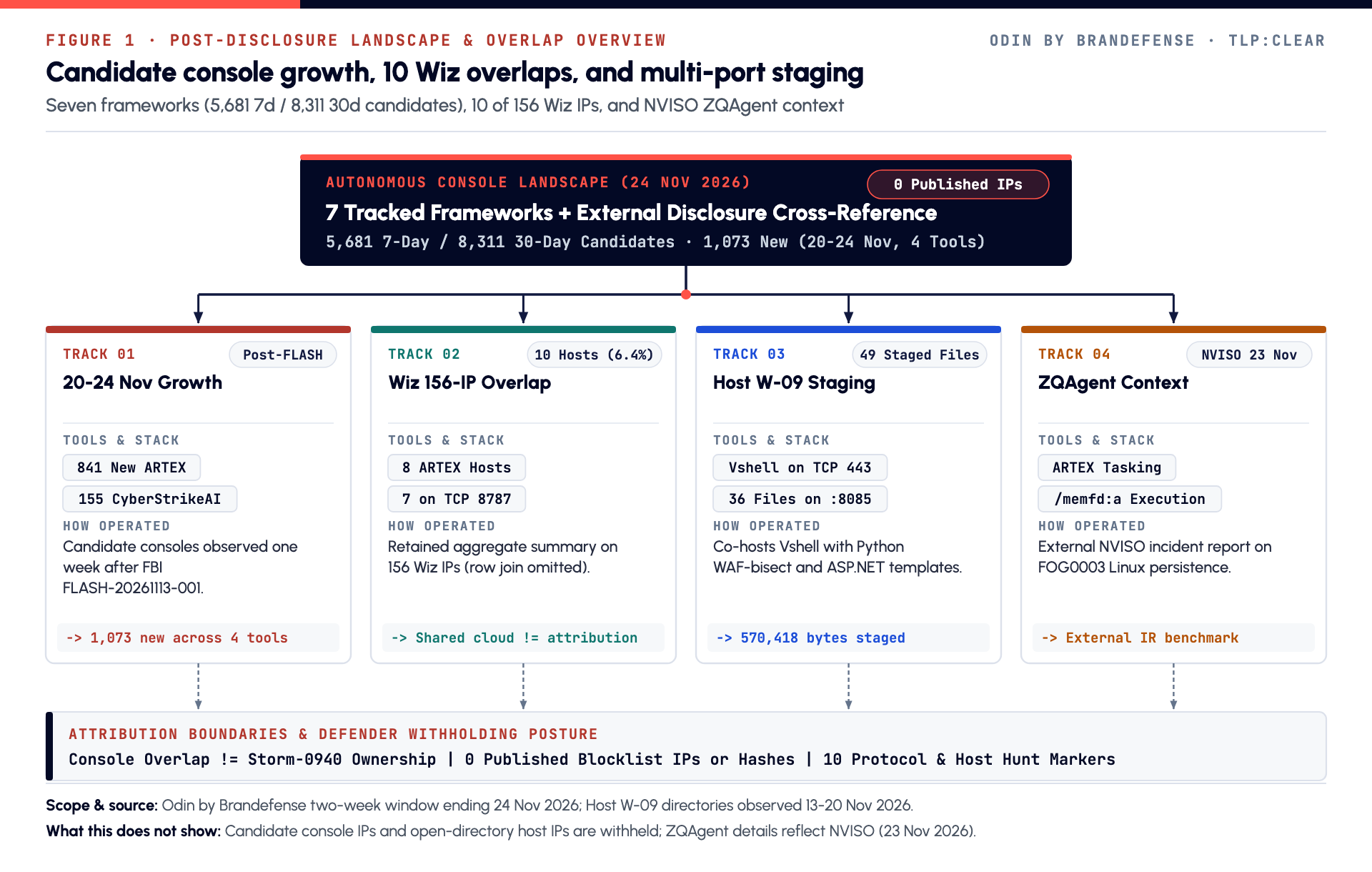
Rolling 30-Day, Trailing 7-Day, and 20-24 November Candidate Counts
Table 1 separates three related counts recorded through 24 November 2026. Rolling 30-day candidate endpoints total 8,311 across all seven tools. Trailing 7-day candidate endpoints (18-24 November 2026) form a 5,681-endpoint subset of that 30-day count. New candidates from 20 to 24 November 2026 total 1,073 across the four tools tallied for late-November growth.
| Framework | 30-day candidates | 30d share (%) | 7-day candidates (18-24 Nov) | 7d share (%) | 7d / 30d ratio (%) | New (20-24 Nov) |
|---|---|---|---|---|---|---|
| ARTEX | 4,860 | 58.5% | 3,361 | 59.2% | 69.2% | 841 |
| CyberStrikeAI | 2,114 | 25.4% | 1,388 | 24.4% | 65.7% | 155 |
| PentAGI | 853 | 10.3% | 552 | 9.7% | 64.7% | 35 |
| HexStrikeAI | 167 | 2.0% | 123 | 2.2% | 73.7% | not tallied |
| AutoCVE | 159 | 1.9% | 155 | 2.7% | 97.5% | not tallied |
| AutoHunter | 111 | 1.3% | 101 | 1.8% | 91.0% | 42 |
| BrainstormV2 | 47 | 0.6% | 1 | 0.0% | 2.1% | not tallied |
| Total (7 tools) | 8,311 | 100.0% | 5,681 | 100.0% | 68.4% | 1,073 (4 tools) |
Three clear trends stand out in Table 1 and Figure 5. First, ARTEX (3,361) and CyberStrikeAI (1,388) account for 4,749 of the 5,681 seven-day endpoints (83.6%).
Second, from 20 to 24 November 2026, one week after FLASH-20261113-001, four tools added 1,073 new candidates (841 ARTEX, 155 CyberStrikeAI, 42 AutoHunter, and 35 PentAGI). Third, AutoCVE (155 of 159; 97.5%) and AutoHunter (101 of 111; 91.0%) cluster in the recent seven-day slice, while BrainstormV2 dropped to 1 seven-day endpoint (2.1%).
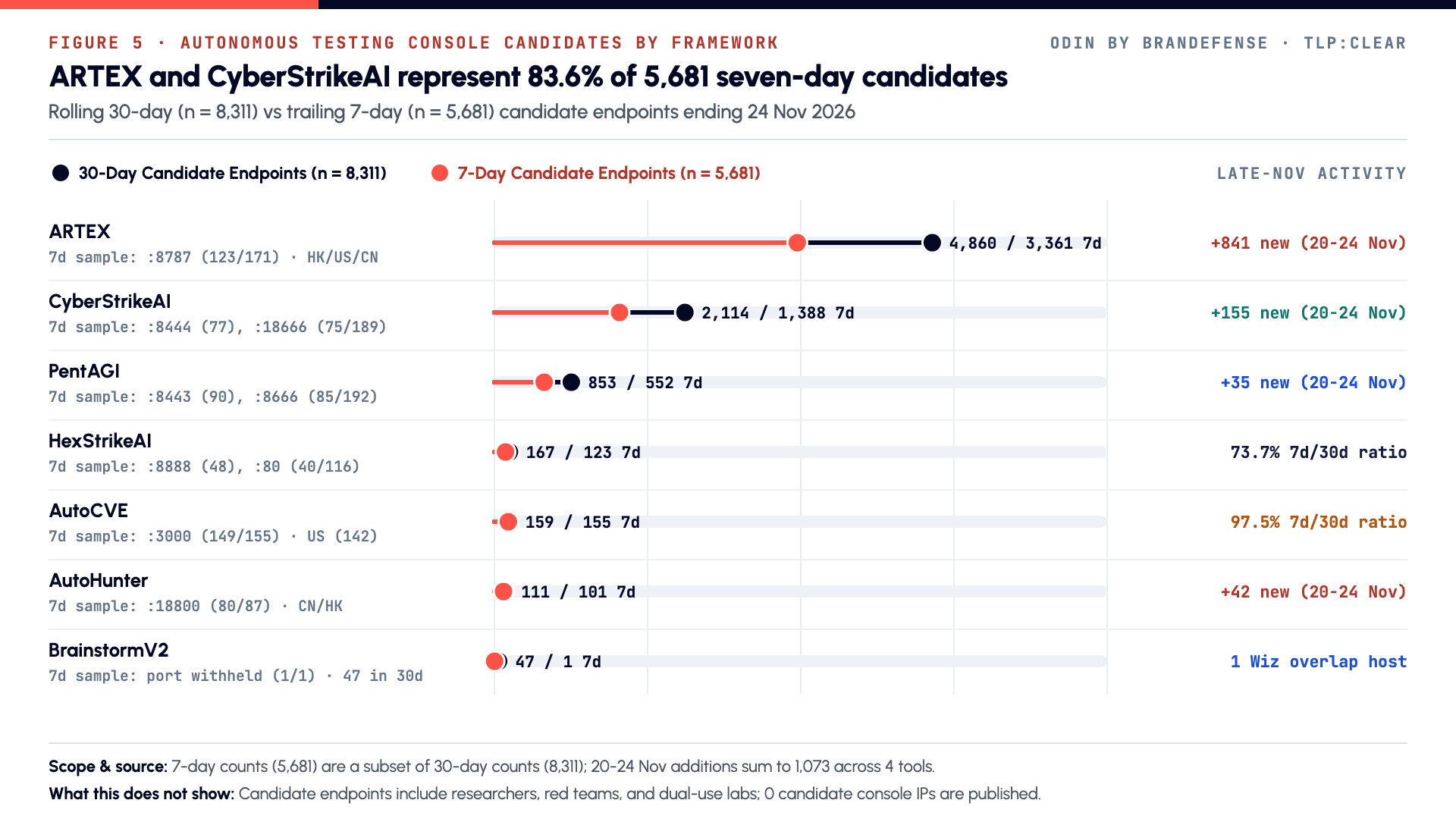
Sampled Seven-Day Port and Country Subsets
Users bind these panels to both default high ports and standard web ports. Because our port and country counts come from top-six seven-day samples per tool, Table 2 gives each sample size (n) beside its counts.
| Framework | Port sample (n) | Sampled 7-day TCP ports (count) | Country sample (n) | Sampled 7-day countries (count) |
|---|---|---|---|---|
| ARTEX | 171 | 8787 (123), 443 (22), 80 (12), 18787 (5), 39721 (5), 8443 (4) | 177 | HK (63), US (43), CN (43), JP (12), SG (11), NL (5) |
| CyberStrikeAI | 189 | 8444 (77), 18666 (75), 8080 (31), 18080 (3), 8443 (2), 8085 (1) | 196 | US (158), CN (24), MD (4), HK (4), KR (4), JP (2) |
| PentAGI | 192 | 8443 (90), 8666 (85), 443 (11), 8444 (3), 18443 (2), 9521 (1) | 165 | US (112), CN (17), HK (13), DE (10), SG (7), FR (6) |
| HexStrikeAI | 116 | 8888 (48), 80 (40), 5000 (13), 443 (6), 8080 (5), 8000 (4) | 79 | US (28), IN (13), DE (12), SG (11), SE (8), AU (7) |
| AutoCVE | 155 | 3000 (149), 13000 (4), 18080 (1), 8088 (1) | 155 | US (142), CN (12), JP (1) |
| AutoHunter | 87 | 18800 (80), 443 (3), 26398 (1), 1880 (1), 10001 (1), 8080 (1) | 100 | CN (68), HK (21), US (7), SG (2), KR (1), FR (1) |
| BrainstormV2 | 1 | port withheld (1) | 1 | US (1) |
In the 171-endpoint ARTEX port sample, 123 endpoints used default TCP 8787 and 5 used TCP 18787. Another 38 sampled ARTEX endpoints listened on TCP 443, 80, or 8443. Asset sweeps should match HTTP banners and icon hashes across all web ports. Checking TCP 8787 alone misses proxied panels that still serve the ARTEX favicon MD5 (cd3ebd16437d6d3963592f7365dd3980).
3. Wiz 23 November 2026 Indicator Overlaps and Multi-Port Staging
On 23 November 2026, Wiz Research published Agentic Attacks in the Wild: ARTEX & Offensive AI Frameworks ([REF-02], [REF-05]), following its 22 October 2026 report on Storm-0940 ([REF-03]). The two cited Wiz IOC files contain 156 unique IPv4 addresses: 74 in the agentic-attacks list and 82 in the Black October list.
Analysts can use cyber threat intelligence to separate rotating proxy traffic from static staging servers when reviewing external feeds. The retained aggregate summary records 10 overlapping hosts among 156 Wiz IPv4s, but the row-level comparison is unavailable for independent verification.
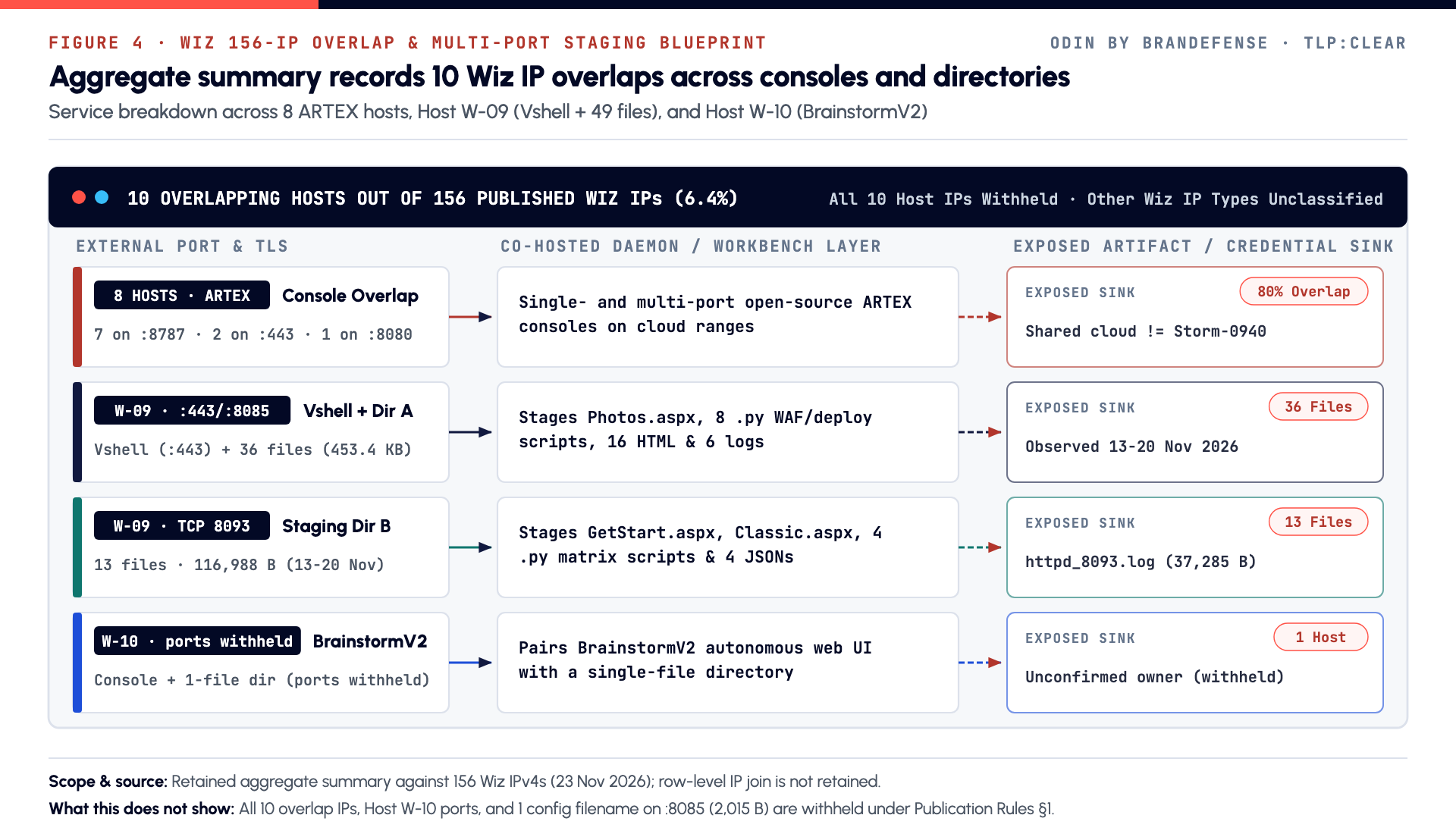
Segmentation of the 156 Published Wiz IPv4s
| Segment | Host count | Share of 156 (%) | Observed TCP ports & co-hosted services | IP status |
|---|---|---|---|---|
ARTEX single- or multi-port hosts | 8 | 5.1% | 10 ARTEX bindings on 8 hosts: TCP 8787 (7), TCP 443 (2), TCP 8080 (1). | Withheld (0 IPs) |
Vshell + dual directory server (Host W-09) | 1 | 0.6% | TCP 443 (Vshell), TCP 8085 (36 files, 453,430 B), TCP 8093 (13 files, 116,988 B). | Withheld (0 IPs) |
BrainstormV2 + open directory (Host W-10) | 1 | 0.6% | One overlap host paired a BrainstormV2 console with a single-file open directory; its owner is unconfirmed and its ports are withheld. | Withheld (0 IPs) |
| Wiz IPv4s without a console or directory | 146 | 93.6% | No observed console or open directory; other Wiz IP types unclassified ([REF-02], [REF-05]). | External Wiz list |
| Total | 156 | 100.0% | 10 console/directory overlaps (6.4%) + 146 non-overlapping IPs (93.6%). | 0 IPs in Odin feed |
Two clear lessons come from Figure 4 and Table 3. First, 146 of the 156 Wiz IPs (93.6%) had no observed console or open directory in our data. A missing console match leaves those 146 addresses unclassified by console role, though Wiz separately noted that broad-spray actors also route requests through home and ISP proxy pools ([REF-02]).
Second, across the 8 overlapping ARTEX hosts, listeners span TCP 8787 (7 hosts), TCP 443 (2 hosts), and TCP 8080 (1 host). Wiz's 23 November lists group several campaigns alongside Black October cases rather than a single actor ([REF-02], [REF-05]).
Finding an open-source ARTEX panel on a shared cloud subnet does not establish Storm-0940 ownership. Shared cloud IPs churn often, and public ARTEX forks are easy to copy. Teams need matching sign-in and tooling proof before claiming a named actor.
Host W-09: Vshell (:443) Paired with 49 Staged Files on :8085 and :8093
One overlap host (Host W-10) paired a BrainstormV2 console with a single-file open directory; its owner is unconfirmed and its ports are withheld. By contrast, Host W-09 (IP withheld) shows a multi-port staging server ([REF-07], [REF-08]). Alongside Vshell on TCP 443, Host W-09 exposed two open HTTP directories first seen on 13 November 2026 and last seen on 20 November 2026.
Across both ports, Host W-09 held 49 files totaling 570,418 bytes (36 files = 453,430 B on :8085; 13 files = 116,988 B on :8093). Fifteen script files (12 .py and 3 .aspx) total 25,537 bytes. Thirty-four text, JSON, HTML, and log files total 544,881 bytes. Table 4 groups all 49 files into five staging clusters.
Staging cluster on Host W-09 | Kind | :8085 files | :8085 bytes | :8093 files | :8093 bytes | Total files | Total bytes | Staged examples |
|---|---|---|---|---|---|---|---|---|
| Python WAF & Matrix Scripts | script | 8 | 10,360 | 4 | 7,604 | 12 | 17,964 | Port 8085 holds waf_bisect.py, urlvar.py, write_ws.py, write_mgmt.py, and 4 more scripts. Port 8093 adds write_classic.py, verify_http_281.py, fill_matrix_281.py, and probe_dirs.py. |
| Staged ASP.NET Templates | script | 1 | 3,178 | 2 | 4,395 | 3 | 7,573 | Photos.aspx (3,178 B on :8085). GetStart.aspx (3,932 B) and Classic.aspx (463 B) on :8093. |
| HTML Edge & Origin Captures | text | 17 | 178,590 | 2 | 20 | 19 | 178,610 | h1.html-h3.html (56,611 B each), ar.html, ws1.html-ws3.html, mg1.html-mg6.html, og1.html-og3.html. Also body_edge1.txt, body_origin1.txt, and out.txt. |
| JSON State & Web-Config Text | text | 1 | 2,015 | 4 | 67,684 | 5 | 69,699 | probe_dirs.json (55,136 B), write_classic.json (7,400 B), verify_http_281.json, and fill_matrix_281.json. Also 1 web-config text file (2,015 B, name withheld). |
| HTTP Daemon & Run Logs | text | 9 | 259,287 | 1 | 37,285 | 10 | 296,572 | httpd.log (249,645 B), httpd_8093.log (37,285 B), write_matrix_ws.log, write_mgmt.out, and write_ws.out. Also write_matrix_mgmt.log, http_verify_ws.log, write_matrix.log, delete_old.log, del_old.out. |
| Total | All | 36 | 453,430 | 13 | 116,988 | 49 | 570,418 | Seen 13-20 November 2026; host IP withheld. |
Three strict rules guide how we read Host W-09:
- Split-port HTTP staging. Keeping
Vshellon :443 while hosting file servers on :8085 and :8093 splits C2 traffic from staged scripts. Log sizes (249,645 B and 37,285 B) show verbose HTTP logs, not how long an operation lasted. - WAF testing and edge-vs-origin checks. File names such as
waf_bisect.py,urlvar.py,body_edge1.txt, andbody_origin1.txtpoint to scripts built to compare CDN edges with origin hosts. They pair with benign-named.aspxtemplates ([REF-08]). - Staged prep, not confirmed target impact. Directory listings show operator prep only. Nothing confirms that
Photos.aspx,GetStart.aspx, orClassic.aspxworked on a victim host. One 2,015-byte web-config file name on :8085 is withheld along withHost W-09's IP.
4. External ZQAgent Persistence Context (23 November 2026)
Early LLM-driven intrusions mostly looked like fast, noisy key-theft runs ([REF-01], [REF-02]). In Wiz's 23 November 2026 cases ([REF-02]), actors sprayed OAuth and sign-up flows while leaving self-labeled strings like pentest-recon user-agents, pentest-iNNNNNN counters, and csai-pentest-role names.
On 23 November 2026, NVISO Labs shared incident findings ([REF-04]) showing that operators also use ARTEX to plant long-term Linux malware. Figure 3 shows an analytical model joining our Host W-09 staging data with Wiz's proxy recon findings ([REF-02]) and NVISO's ZQAgent report ([REF-04]).
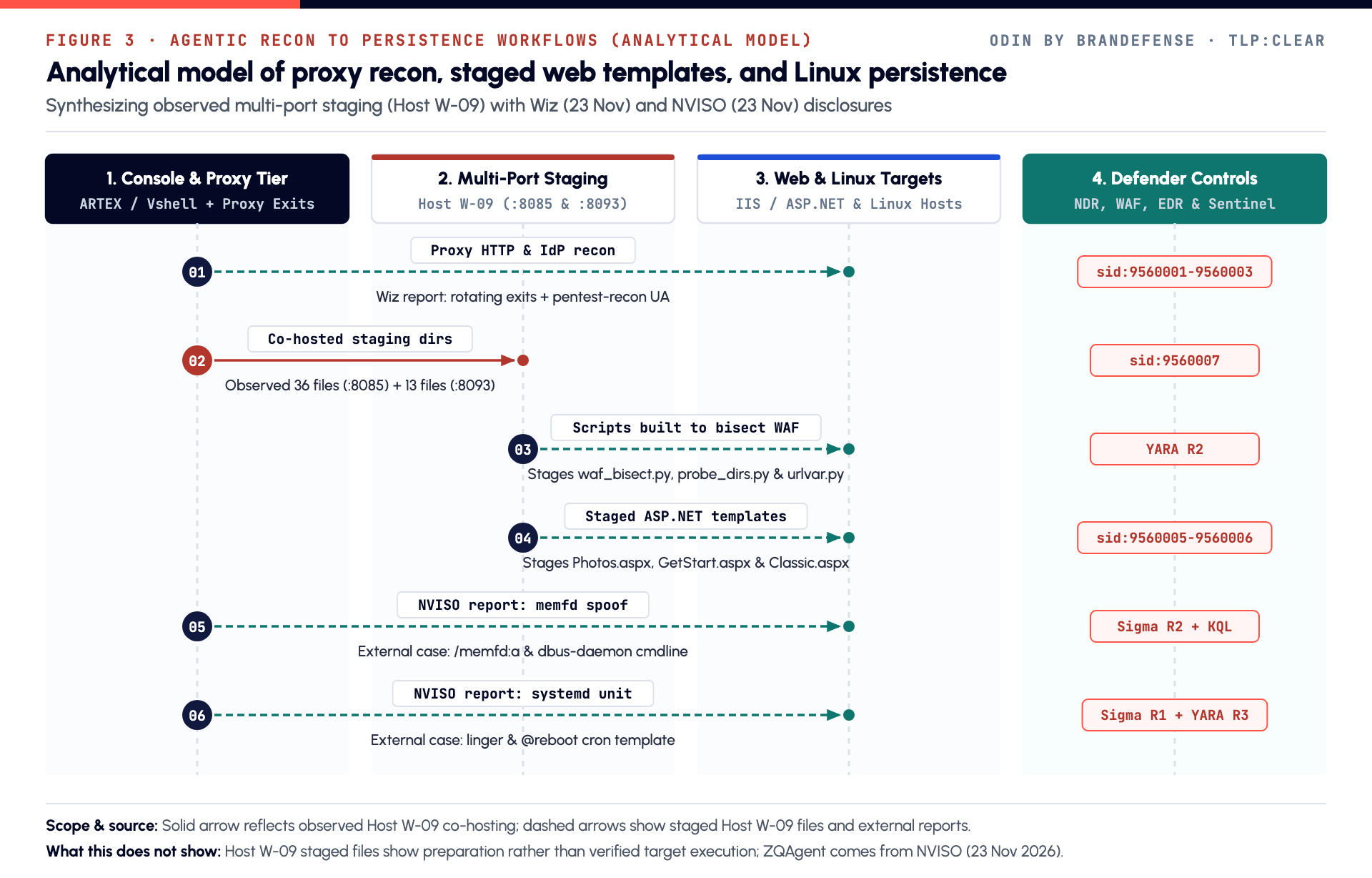
How ZQAgent Establishes Linux Persistence ([REF-04])
Odin by Brandefense did not find ZQAgent on Host W-09. We include NVISO's 23 November 2026 report ([REF-04]) so teams hunting ARTEX cases check Linux hosts for quiet backdoors. In a Belgian incident tied to FOG0003 (with related links in Asia), NVISO saw ARTEX plant ZQAgent under direct operator tasking ([REF-04]):
- RAM-only
memfdmove ([REF-09]).ZQAgentcopies itself into an unnamed RAM file viamemfd, so/proc/<pid>/exepoints to/memfd:a (deleted). - Spoofed
dbus-daemoncommand line. After detaching,ZQAgentspoofs/usr/bin/dbus-daemon --session --address=systemd: --nofork --nopidfile --systemd-activation --syslog-onlywithout linking to/usr/bin/dbus-daemonon disk. - Dual
systemd([REF-10]) andcronsurvival.ZQAgentwrites asystemdunit (Description=Device event journal daemon) and@rebootcron jobs. For non-root users, it enables a--userunit and runsloginctl enable-lingerto outlive logouts while offering shell, file, and TCP/UDP tunnel features ([REF-04]).
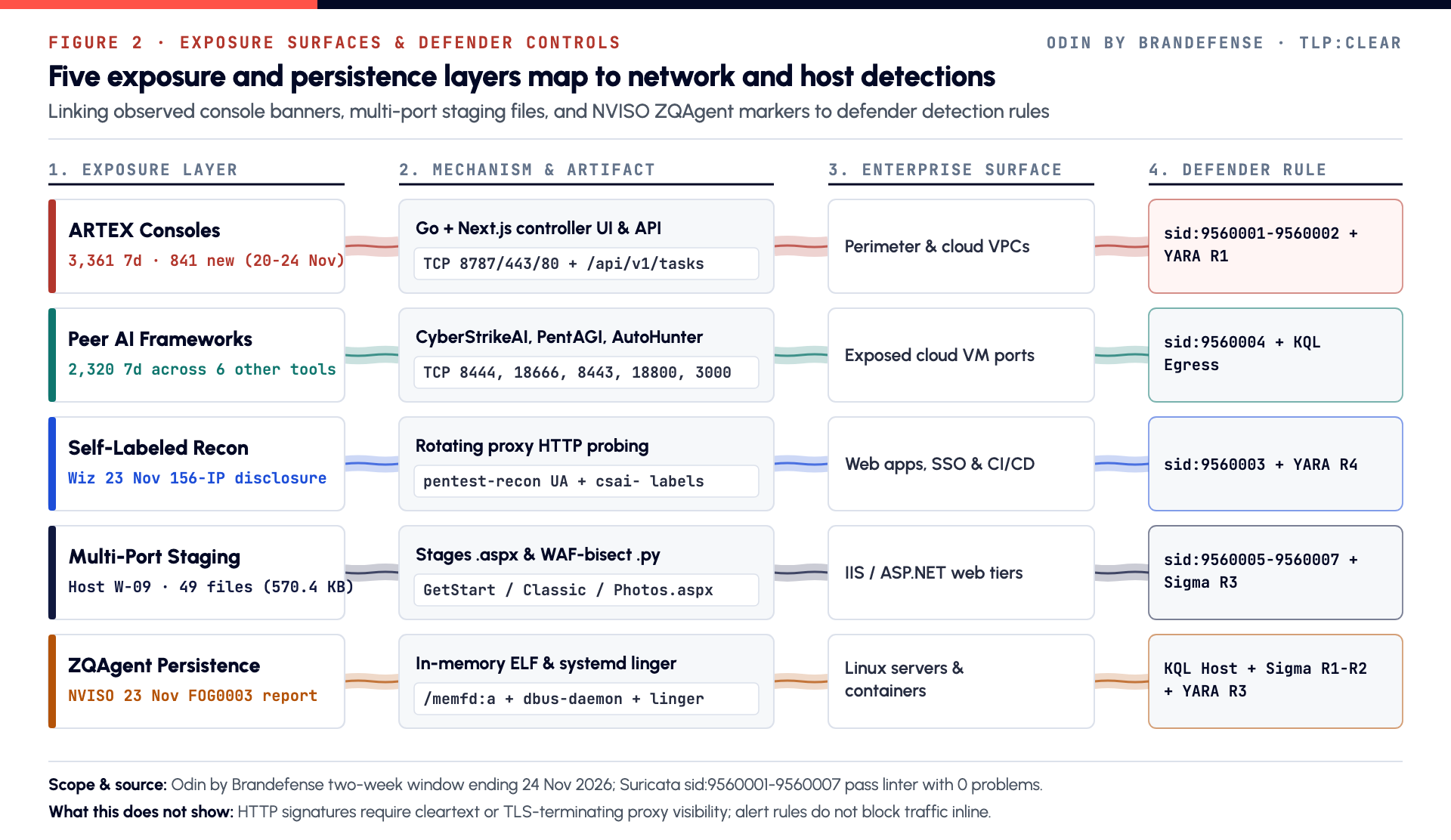
Figure 2 links all five exposure and persistence layers to the defender actions in Chapter 7 and the rules in Chapter 8.
5. Enterprise Exposure and Control Verification
Teams should check five concrete controls across cloud, web, sign-in, and Linux tiers rather than assuming unverified root causes:
| Exposure layer | Observed or reported evidence | Control to verify | Operational risk |
|---|---|---|---|
| Exposed testing panels | 5,681 7d / 8,311 30d candidates; 841 new ARTEX (20-24 Nov). | Verify whether cloud VPCs expose 8787, 8444, 18666, 8443, 18800, 3000, or proxied 443 panels without mTLS. | Open panels leak target scopes, LLM keys, and cloud tokens ([REF-01], [REF-02]). |
| Proxy sprays & OAuth | 146 of 156 Wiz IPs (93.6%) had no console match; pentest-recon labels ([REF-02]). | Verify whether IdPs and WAFs enforce MFA, rate limits, and OAuth or CI checks regardless of source IP. | IP blocklists miss home-proxy password sprays and CI secret theft ([REF-02]). |
Origin bypass & .aspx | Host W-09 stages waf_bisect.py, body_edge1.txt, body_origin1.txt, and 3 .aspx files. | Verify whether IIS origins drop non-CDN traffic and block .aspx writes in web roots ([REF-07], [REF-08]). | Direct origin access lets attackers skip edge WAF rules and test web shells. |
| High-port file fetches | Host W-09 serves 49 files on :8085 and :8093. One overlap host (Host W-10) paired a BrainstormV2 console with a single-file open directory; its owner is unconfirmed and its ports are withheld. | Verify whether server VLANs block direct outbound HTTP calls to random high ports. | Web hosts could pull staging scripts from external high ports. |
Linux memfd & linger | NVISO 23 Nov ZQAgent report (/memfd:a, spoofed dbus-daemon, enable-linger, [REF-04]). | Verify whether Linux EDR flags /memfd:* links ([REF-09]) and non-root systemd linger edits ([REF-10]). | Treating agentic cases as brief smash-and-grab runs misses Linux implants. |
6. Alternative Hypotheses
| Hypothesis | Evidence for | Evidence against | Assessment |
|---|---|---|---|
All 8 overlap ARTEX hosts belong to Storm-0940 | Listed in Wiz's 23 Nov 156-IP files ([REF-02], [REF-05]) and run ARTEX on 8787, 443, or 8080. | Wiz's 23 Nov lists span several campaigns and Black October cases. ARTEX is open-source (3,361 7d candidates) on shared clouds. | Unsupported as single-actor proof. Shared cloud panels do not imply Storm-0940 ownership. |
All 3,361 7d ARTEX candidates are attacker C2s | FBI FLASH-20261113-001 ([REF-01]) and vendor posts confirm real abuse. | Red teams, researchers, and builders test ARTEX forks on cloud VMs after major alerts. | Rejected for blanket blocking. Withhold candidate IPs (0 published IPs) and hunt behavior. |
Host W-09 is a benign dev test box | Serves HTML pages (h1.html-h3.html) and Python HTTP logs. | Sits in Wiz's intrusion list ([REF-05]), runs Vshell on :443, and stages waf_bisect.py, run_cmd.py, and 3 .aspx files. | Contradicted. Treated consistently as an attacker staging box; IP and 1 config name stay withheld. |
ARTEX cases never plant host persistence | Many broad-spray runs focus on quick cloud key theft ([REF-02]). | NVISO (23 Nov 2026, [REF-04]) saw ARTEX plant ZQAgent using /memfd:a and systemd linger. | Refuted as a blanket rule. Pair cloud key resets with Linux host sweeps. |
7. What Defenders Should Do
Security teams can close console, web-origin, and Linux persistence gaps in five practical steps:
- Sweep and gate testing panels (
0-48 Hours). Scan cloud accounts and lab ranges across standard web ports and default high ports (8787, 18787, 8444, 18666, 8443, 8666, 18800, 3000) ([REF-01]). Put approved testing tools behind VPNs or mTLS proxies, and rotate LLM or cloud keys kept on exposed boxes. - Harden sign-in and CI flows against proxy sprays (
0-72 Hours). Because 146 of 156 Wiz IPs (93.6%) had no console match and Wiz reported proxy-routed sprays ([REF-02]), enforce phishing-resistant MFA, rate-limit sign-up and reset pages, govern OAuth app consent, and gate CI workload branches. Huntpentest-recon,pentest-i, andcsai-strings in cloud logs ([REF-02]). - Lock IIS and ASP.NET origins behind CDN or WAF edges (
Days 1-7). Set origin firewalls to accept HTTP and HTTPS traffic only from verified CDN or WAF proxy ranges using origin-pull certs ([REF-07]). Mount web code folders read-only outside releases and alert for web shell behavior whenw3wp.exestartscmd.exeor PowerShell ([REF-08], Sigma Rule 3). - Block direct server egress to random high ports (
Days 7-14). Stop DMZ and app VLANs from making direct outbound calls to external hosts on ports like 8085, 8093, 8787, 8444, 18666, and 18800. Send allowed web traffic through a TLS proxy watched by Suricatasid:9560001-9560007. - Check Linux hosts for
memfdlinks andsystemdlinger (Days 7-21). Alert when/proc/<pid>/exepoints to/memfd:* (deleted)([REF-04],[REF-09]) or whendbus-daemonflags run outside/usr/bin/dbus-daemon(Sigma Rule 2). Check/var/lib/systemd/linger/, usersystemdfolders, and/etc/cron.d/for unapprovedDevice event journal daemonor@rebootentries ([REF-10], Sigma Rule 1).
8. Detection Rules
The full rules are in the Detection rules tab. Because all candidate console IPs, open-directory IPs, and overlap host IPs are withheld, each rule file targets protocol, process, or file structure signals.
Check scope (Publication Rules §6): the Suricata rules passed the Odin Suricata linter (0 problems). YAML checks confirmed all three Sigma rules, and structural checks verified the Sentinel KQL and YARA files. Live engine binaries (suricata -T, Kusto.Language, pySigma, and yara) were not installed on the build host. Rules were not replayed on live traffic, so test and tune them before rollout.
| Rule file | What it catches |
|---|---|
odin_artex_console_staging_and_recon_hunt.rules | Suricata 7.x (7 alert http rules, sid:9560001-9560007): exposed home-network ARTEX and CyberStrikeAI banners, outbound POST /api/v1/tasks calls, inbound pentest-recon user-agents, inbound POST calls to /GetStart.aspx or /Classic.aspx, and high-port .aspx directory listings |
sentinel_artex_console_zqagent_and_staging_hunt.kql | Microsoft Sentinel KQL (7-day lookback): correlates DeviceProcessEvents (ZQAgent /memfd:a, spoofed dbus-daemon flags, loginctl enable-linger, and IIS w3wp.exe shells) with DeviceNetworkEvents (default console ports or RemoteUrl contains "/api/v1/tasks") |
sigma_artex_zqagent_memfd_and_iis_webshell.yml | Portable Sigma (3 process-creation rules): Linux loginctl enable-linger or systemctl --user enablement, spoofed dbus-daemon arguments outside /usr/bin/dbus-daemon and /bin/dbus-daemon, and Windows w3wp.exe child shells |
odin_artex_console_and_staging_artifacts.yar | Structural YARA (4 filesize-bounded rules): exposed ARTEX console bundles, Python WAF-bisect and matrix scripts, ZQAgent systemd and dbus-daemon strings ([REF-04]), and self-labeled agentic task logs ([REF-02]) |
How the Suricata 7.x Signatures Work (sid:9560001-9560007)
All seven http signatures require cleartext HTTP traffic or a sensor behind a TLS proxy. Because alert rules do not block packets inline, enforce blocks in your WAF or egress proxy.
| SID | Direction & flow | What it matches | Defensive purpose |
|---|---|---|---|
| 9560001 | $HOME_NET any -> $EXTERNAL_NET any (to_client) | http.response_body containing ARTEX - Autonomous Red-Team Expert | Flags exposed home-network ARTEX panels answering external clients |
| 9560002 | $HOME_NET any -> $EXTERNAL_NET any (to_server) | POST request with http.uri starting with /api/v1/tasks | Flags outbound task dispatch calls to an ARTEX controller |
| 9560003 | $EXTERNAL_NET any -> $HOME_NET any (to_server) | http.user_agent containing pentest-recon (nocase) | Flags self-labeled agentic recon sweeps ([REF-02]) |
| 9560004 | $HOME_NET any -> $EXTERNAL_NET any (to_client) | http.response_body containing CyberStrikeAI | Flags exposed home-network CyberStrikeAI panels answering external clients |
| 9560005 | $EXTERNAL_NET any -> $HOME_NET any (to_server) | Inbound POST with http.uri ending in /GetStart.aspx (nocase) | Flags calls to the staged GetStart.aspx template path (Host W-09) |
| 9560006 | $EXTERNAL_NET any -> $HOME_NET any (to_server) | Inbound POST with http.uri ending in /Classic.aspx (nocase) | Flags calls to the staged Classic.aspx template path (Host W-09) |
| 9560007 | $EXTERNAL_NET [8085,8093] -> $HOME_NET any (to_client) | HTTP 200 response body containing Index of / and .aspx | Flags responses from high-port open staging directories |
How the Sentinel KQL, Sigma, and YARA Rules Work
The Sentinel KQL hunt unions two branches over a 7-day lookback. Replace the two sample FQDNs in ApprovedSecurityHosts (app-ci-01.corp.example, sec-scanner-01.corp.example) with your own scanner host list before scheduling.
The first branch checks DeviceProcessEvents for ProcessCommandLine contains "--address=systemd: --nofork --nopidfile" outside /usr/bin/dbus-daemon and /bin/dbus-daemon. It also flags ProcessCommandLine contains "enable-linger" with loginctl, FolderPath startswith "/memfd:a", or w3wp.exe starting cmd.exe or PowerShell. The second branch checks DeviceNetworkEvents for RemotePort in (ConsolePorts) (8787, 18787, 8444, 18666, 8666, 18800) or RemoteUrl contains "/api/v1/tasks".
| Host or file rule | Engine | Trigger condition |
|---|---|---|
Linux ZQAgent Non-Root Systemd User Service and Linger Persistence (R1) | Sigma (linux) | /loginctl with CommandLine|contains: 'enable-linger', or /systemctl with --user and enable or daemon-reload (T1543.002) |
Linux ZQAgent Spoofed dbus-daemon Command Line Outside System Paths (R2) | Sigma (linux) | CommandLine|contains: '--address=systemd: --nofork --nopidfile --systemd-activation --syslog-only' where Image is not /usr/bin/dbus-daemon or /bin/dbus-daemon (T1620, T1036.004) |
Windows IIS Worker Spawning Command Shell After ASP.NET Staging (R3) | Sigma (windows) | ParentImage|endswith: 'w3wp.exe' spawning cmd.exe, powershell.exe, or pwsh.exe (T1505.003) |
ODIN_R60_ARTEX_Console_Bundle_and_Task_API (YARA R1) | YARA (< 5MB) | ARTEX - Autonomous Red-Team Expert paired with /api/v1/tasks or artex-swarm-root |
ODIN_R60_Python_WAF_Bisect_and_Matrix_Deployer (YARA R2) | YARA (< 128KB) | import requests or urllib.request, .aspx, and waf_bisect, fill_matrix, or write_classic |
ODIN_R60_ZQAgent_Memfd_and_Systemd_Template (YARA R3) | YARA (< 4MB) | Description=Device event journal daemon, --address=systemd: --nofork --nopidfile --systemd-activation, and enable-linger or memfd |
ODIN_R60_Agentic_Self_Labeled_Recon_Log (YARA R4) | YARA (< 2MB) | pentest-recon paired with csai-pentest-role or /api/v1/tasks |
9. Indicators
The Indicators tab holds 0 published blocklist IPv4 addresses and 0 file SHA-256 hashes. Candidate console IPs, open-directory host IPs, all 10 Wiz-overlapping host IPs, and staged file SHA-256 hashes are withheld under Publication Rules §1. We also withhold one 2,015-byte web-config file name on Host W-09 (:8085).
| Indicator or marker group | Published in Indicators tab | Status in this report |
|---|---|---|
| Candidate console and open-directory host IPv4s (8,311 30d / 5,681 7d) | 0 | Withheld (Publication Rules §1.3) |
| Wiz-overlapping host IPv4s (10 of 156 unique Wiz IPs) | 0 | Withheld (8 ARTEX candidates, Host W-09, and Host W-10 IPs and W-10 ports) |
Staged file SHA-256 digests (49 files on Host W-09) | 0 | Withheld (1 web-config file name on :8085 also withheld) |
| Behavioral, protocol, and host hunt markers | 0 (text-only table below) | 10 markers listed in the table below |
Behavioral and Protocol Hunt Markers
| Marker category | Pattern / protocol artifact | Layer | Defensive hunt & control |
|---|---|---|---|
| ARTEX icon MD5 | cd3ebd16437d6d3963592f7365dd3980 | All web ports | Scan cloud ranges for /favicon.ico (15,406 B) on 8787, 443, 80, and 8080. |
| ARTEX HTML banner | ARTEX - Autonomous Red-Team Expert | HTTP / TLS proxy | Alert on exposed home panels with sid:9560001. Put approved panels behind mTLS. |
| ARTEX task API | POST /api/v1/tasks | HTTP / TLS egress | Alert on outbound calls (sid:9560002) and Sentinel DeviceNetworkEvents. |
| Agentic User-Agent | pentest-recon | HTTP / WAF ingress | Hunt WAF and IdP logs ([REF-02]). Rule sid:9560003 flags visible headers. |
| CyberStrikeAI banner | CyberStrikeAI | 8444, 18666, 8080 | Sweep external assets and alert on exposed home responses (sid:9560004). |
| Staged ASP.NET path A | /GetStart.aspx | IIS / WAF ingress | Staged (3,932 B) on Host W-09 (:8093). Alert on POST calls (sid:9560005). |
| Staged ASP.NET path B | /Classic.aspx (with Photos.aspx) | IIS / WAF ingress | Staged (463 B) on Host W-09 (:8093). Alert with sid:9560006 and Sigma R3. |
| Directory index | Index of / (.aspx + .py) | TCP 8085 / 8093 | Alert on high-port file indexes (sid:9560007) and block high-port egress. |
ZQAgent memfd spoof | /memfd:a (deleted) + dbus-daemon | Linux EDR | NVISO 23 Nov report ([REF-04]). Hunt with Sentinel KQL and Sigma R2. |
ZQAgent systemd unit | Description=Device event journal daemon | Linux systemd | NVISO 23 Nov report ([REF-04]). Check enable-linger with Sigma R1 and YARA R3. |
10. Scope and Limits
Odin by Brandefense studied autonomous testing console counts and open-directory listings during a two-week observation window ending 24 November 2026. Rolling 30-day (8,311) and trailing 7-day (5,681, 18-24 November 2026) counts cover seven tools (ARTEX, CyberStrikeAI, PentAGI, HexStrikeAI, AutoCVE, AutoHunter, and BrainstormV2). Newly observed 20-24 November 2026 counts (1,073) cover four tallied tools (ARTEX, CyberStrikeAI, AutoHunter, and PentAGI). Port and country counts reflect top-six sampled subsets (n = 1 to 196).
Overlap counts (10 of 156 unique IPv4s) come from an aggregate summary against the two cited Wiz Research 23 November 2026 IOC files ([REF-02], [REF-05]). Those files list 74 unique IPv4s in the agentic-attacks CSV and 82 in the Black October CSV, while the row-level comparison is unavailable for independent verification.
A missing console match across the remaining 146 Wiz IPv4s (93.6%) does not classify their roles (Other Wiz IP Types Unclassified). Staged files on Host W-09 (36 on :8085 and 13 on :8093, seen 13-20 November 2026) show prep rather than verified victim impact.
All ZQAgent details come from NVISO Labs (23 November 2026, [REF-04]) and were not seen on Host W-09. All candidate console IPs, open-directory IPs, overlap host IPs, Host W-10's ports, and one 2,015-byte web-config file name on Host W-09 are withheld.
11. Sources
[REF-01]FBI Cyber Division, *FLASH-20261113-001: Malicious Use of Autonomous Penetration Testing Tool ARTEX* (13 November 2026; verified on 24 November 2026).[REF-02]Wiz Research, *Agentic Attacks in the Wild: ARTEX & Offensive AI Frameworks* (23 November 2026; verified on 24 November 2026).[REF-03]Wiz Research, *ARTEX in the Wild: Storm-0940 Expands Targeting of IT and Software Vendors* (22 October 2026; verified on 24 November 2026).[REF-04]NVISO Labs, *ARTEX Leads to Persistent ZQAgent Backdoor* (23 November 2026; verified on 24 November 2026).[REF-05]Wiz Research, *Wiz Research Public IOC Repository (Agentic Attacks in the Wild & Black October CSVs)* (23 November 2026; verified on 24 November 2026).[REF-06]Help Net Security, *ARTEX Goes from Pentesting Tool to Attacker Staple in Three Months* (9 November 2026; verified on 24 November 2026).[REF-07]MITRE ATT&CK, *Exploit Public-Facing Application (T1190)* (verified on 24 November 2026).[REF-08]MITRE ATT&CK, *Server Software Component: Web Shell (T1505.003)* (verified on 24 November 2026).[REF-09]MITRE ATT&CK, *Reflective Code Loading (T1620)* (verified on 24 November 2026).[REF-10]MITRE ATT&CK, *Create or Modify System Process: Systemd Service (T1543.002)* (verified on 24 November 2026).
What is…?
Short explanations of the tools and families named in this study.
What is ARTEX?
ARTEX is an autonomous red-team console that chains AI agents and security tools. Operators fork and rebrand it; its default listener port is 8787.
More about ARTEXAI offensive toolWhat is CyberStrikeAI?
CyberStrikeAI is a public AI-driven offensive security platform. It spreads its operator interface, API and agent listener across several ports on one host and exposes tools through MCP.
More about CyberStrikeAIAI security toolWhat is AutoHunter?
AutoHunter automates headless bug-bounty reconnaissance of subdomains, API routes and query parameters.
More about AutoHunterAI offensive toolWhat is PentAGI?
PentAGI is an open-source autonomous penetration testing system that coordinates AI agents and security tools in containers.
More about PentAGIAI security toolWhat is AutoCVE?
AutoCVE is an AI-assisted tool that turns new vulnerability advisories into HTTP checks.
More about AutoCVEAI offensive toolWhat is HexStrike AI?
HexStrikeAI is a public project that exposes many security tools to AI agents through the Model Context Protocol (MCP).
More about HexStrike AIFrequently asked questions
Why did autonomous testing consoles keep growing after the 13 November FBI warning?
On 13 November 2026, the FBI issued FLASH-20261113-001 warning that threat actors use open-source ARTEX builds to reach cloud access in under three hours. Deleting the original source repo in October 2026 did not stop growth. Public forks, mirrors, and peer LLM testing tools kept spreading across cloud providers.
What did checking Wiz's 156 published IPv4s show about Storm-0940 attribution?
On 23 November 2026, Wiz Research published a study of agentic attack tools following its 22 October 2026 report on Storm-0940. The two cited Wiz IOC files contain 156 unique IPv4 addresses: 74 in the agentic-attacks list and 82 in the Black October list. The retained aggregate summary records 10 overlapping hosts (6.4%) and 146 non-overlapping IPs (93.6%), but the row-level comparison is unavailable for independent verification.
How does NVISO's ZQAgent report expand Linux post-intrusion hunting?
On 23 November 2026, NVISO Labs also reported an incident (FOG0003) where an operator used ARTEX to plant ZQAgent. We did not see ZQAgent on Host W-09. Still, NVISO's case shows that ARTEX runs do not always end with fast key theft.
What should cloud, web, and Linux defenders do first?
Defenders can cut risk across cloud panels, web origins, and Linux hosts with three direct steps. Each step pairs perimeter hygiene with host and proxy rules: