
Key takeaways
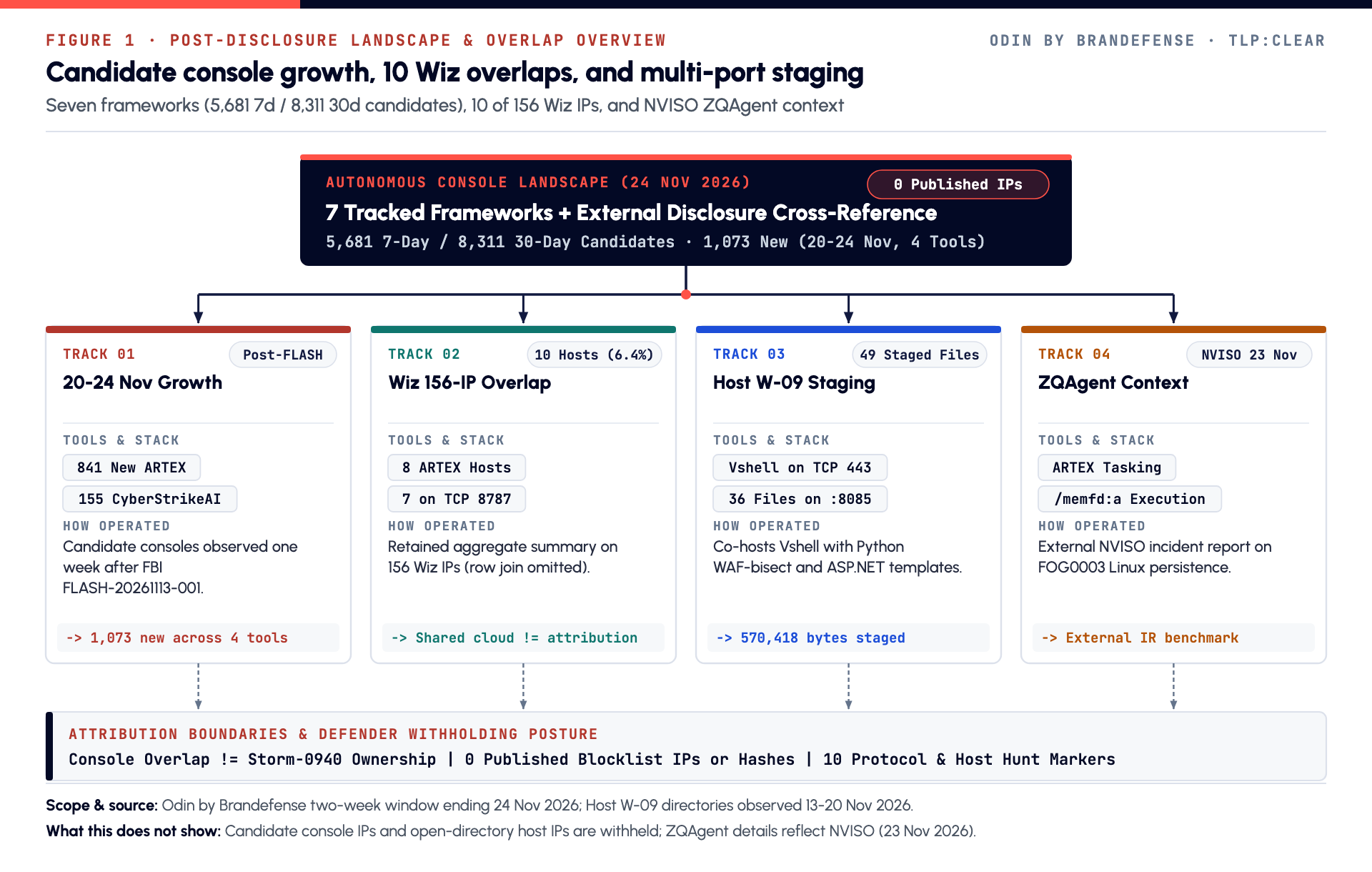
- Across seven autonomous testing tools tracked through 24 November 2026, 5,681 seven-day candidate consoles appeared within 8,311 thirty-day endpoints.
- From 20 to 24 November 2026, one week after FBI FLASH-20261113-001, four tallied tools added 1,073 new candidates, led by 841 ARTEX endpoints.
- An aggregate summary against Wiz's 23 November 2026 156-IP lists (74 agentic-attacks and 82 Black October IPs) records 10 overlapping hosts (6.4%), though the row-level join is not retained.
- Host W-09 paired Vshell on TCP 443 with 49 staged files (570,418 bytes) on TCP 8085 and 8093, while NVISO reported ZQAgent persistence.
- Public ARTEX forks on shared cloud subnets do not imply Storm-0940 ownership; withhold candidate IPs and hunt protocol, IIS, and memfd signals.
Eight hundred forty-one new ARTEX candidate consoles appeared from 20 to 24 November 2026, one week after FBI warning FLASH-20261113-001. During a two-week observation window ending 24 November 2026, Odin by Brandefense tracked 5,681 seven-day candidate endpoints across seven autonomous testing frameworks.
Those 5,681 seven-day endpoints (18-24 November 2026) sit inside 8,311 thirty-day candidate endpoints. Candidate consoles include red teams, university labs, and developer test VMs alongside threat actors. We therefore withhold all candidate console IPs, open-directory host IPs, and overlap host IPs (0 published IPs).
Why did autonomous testing consoles keep growing after the 13 November FBI warning?
On 13 November 2026, the FBI issued FLASH-20261113-001 warning that threat actors use open-source ARTEX builds to reach cloud access in under three hours. Deleting the original source repo in October 2026 did not stop growth. Public forks, mirrors, and peer LLM testing tools kept spreading across cloud providers.
From 20 to 24 November 2026, four tools tracked for late-November growth added 1,073 new candidate endpoints. ARTEX added 841 candidates, CyberStrikeAI added 155, AutoHunter added 42, and PentAGI added 35. Three other tracked tools (HexStrikeAI, AutoCVE, and BrainstormV2) were not tallied in that four-tool slice.
Security teams can run external attack surface management scans across cloud accounts to find exposed testing panels on non-default ports. Pairing those scans with cyber threat intelligence helps analysts separate public tool use from tracked threat groups.
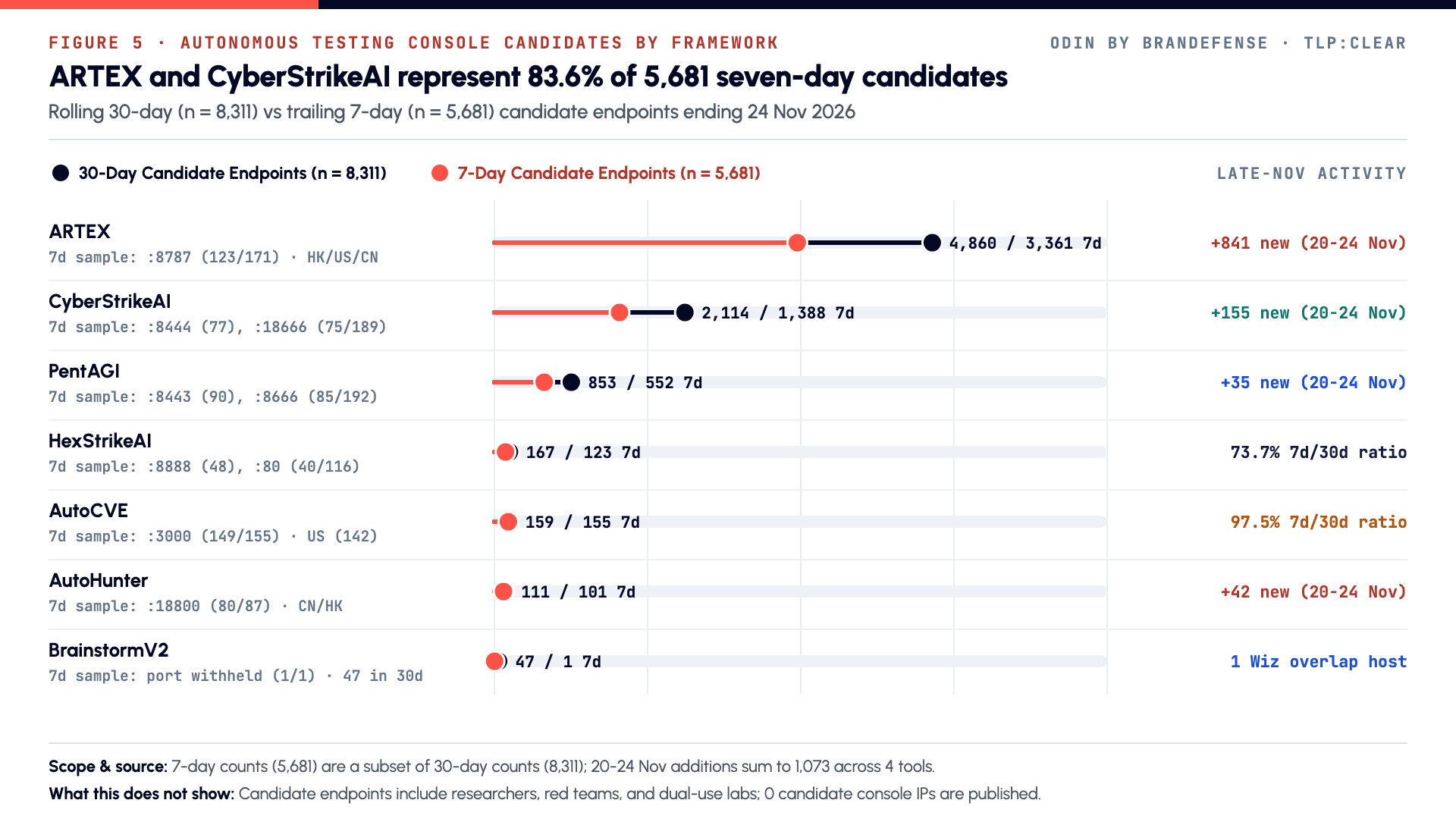
Across all seven tools, ARTEX (3,361 seven-day candidates; 59.2%) and CyberStrikeAI (1,388 seven-day candidates; 24.4%) make up 83.6% of the 5,681 seven-day total. Port-only firewall blocks miss many of these panels. In our 171-endpoint seven-day ARTEX port sample, 123 endpoints used TCP 8787, while 38 used TCP 443, 80, or 8443.
| Framework | 30-day candidates | 7-day candidates (18-24 Nov) | New (20-24 Nov) | Top sampled 7-day TCP ports (n = sample size) |
|---|---|---|---|---|
| ARTEX | 4,860 | 3,361 | 841 | 8787 (123), 443 (22), 80 (12) in n = 171 |
| CyberStrikeAI | 2,114 | 1,388 | 155 | 8444 (77), 18666 (75), 8080 (31) in n = 189 |
| PentAGI | 853 | 552 | 35 | 8443 (90), 8666 (85), 443 (11) in n = 192 |
| HexStrikeAI | 167 | 123 | not tallied | 8888 (48), 80 (40), 5000 (13) in n = 116 |
| AutoCVE | 159 | 155 | not tallied | 3000 (149), 13000 (4) in n = 155 |
| AutoHunter | 111 | 101 | 42 | 18800 (80), 443 (3) in n = 87 |
| BrainstormV2 | 47 | 1 | not tallied | port withheld (n = 1) |
| Total | 8,311 | 5,681 | 1,073 (4 tools) | Top-6 port samples per tool |
What did checking Wiz's 156 published IPv4s show about Storm-0940 attribution?
On 23 November 2026, Wiz Research published a study of agentic attack tools following its 22 October 2026 report on Storm-0940. The two cited Wiz IOC files contain 156 unique IPv4 addresses: 74 in the agentic-attacks list and 82 in the Black October list. The retained aggregate summary records 10 overlapping hosts (6.4%) and 146 non-overlapping IPs (93.6%), but the row-level comparison is unavailable for independent verification.
- Eight
ARTEXconsole hosts. Eight overlap hosts exposedARTEXacrossTCP 8787(7 hosts),TCP 443(2 hosts), andTCP 8080(1 host). Open-sourceARTEXpanels on shared cloud ranges do not meanStorm-0940owns those hosts. Meanwhile, a missing console match leaves the other 146 Wiz IPs unclassified by console role, though Wiz noted that broad-spray actors also use rotating proxies. - One
Vshelland dual-directory server (Host W-09). One overlap server hostedVshellonTCP 443plus two open HTTP directories seen from13 to 20 November 2026.TCP 8085held 36 files (453,430 bytes) andTCP 8093held 13 files (116,988 bytes), or 49 staged files (570,418 bytes) in all. - One
BrainstormV2and single-file server (Host W-10). One overlap host paired aBrainstormV2console with a single-file open directory; its owner is unconfirmed and its ports are withheld.
On Host W-09, ports 8085 and 8093 staged Photos.aspx, GetStart.aspx, and Classic.aspx alongside 12 Python scripts (waf_bisect.py, urlvar.py, fill_matrix_281.py). Staged files show operator prep rather than confirmed target impact. One 2,015-byte web-config text file name on :8085 is withheld along with the host IP.
How does NVISO's ZQAgent report expand Linux post-intrusion hunting?
On 23 November 2026, NVISO Labs also reported an incident (FOG0003) where an operator used ARTEX to plant ZQAgent. We did not see ZQAgent on Host W-09. Still, NVISO's case shows that ARTEX runs do not always end with fast key theft.
Per NVISO, ZQAgent moves into an unnamed RAM file shown as /memfd:a (deleted). It then restarts as a background job spoofing /usr/bin/dbus-daemon --session --address=systemd: --nofork --nopidfile --systemd-activation --syslog-only. To survive reboots, ZQAgent writes a systemd unit (Description=Device event journal daemon), calls loginctl enable-linger for non-root users, and adds @reboot cron jobs.
What should cloud, web, and Linux defenders do first?
Defenders can cut risk across cloud panels, web origins, and Linux hosts with three direct steps. Each step pairs perimeter hygiene with host and proxy rules:
- Sweep and gate testing consoles. Scan corporate cloud subnets across all web and high ports for
ARTEX(cd3ebd16437d6d3963592f7365dd3980),CyberStrikeAI,PentAGI, andAutoHunter. Put approved red-team panels behind mTLS or VPNs, and rotate exposed LLM or cloud keys. - Lock web origins and inspect proxy traffic. Allow IIS and ASP.NET origins to accept traffic only from verified CDN or WAF edges. Alert for web shell behavior when
w3wp.exestartscmd.exeor PowerShell (Sigma Rule 3), and run Suricatasid:9560001-9560007 behind TLS proxies. - Hunt Linux
memfdand linger changes. Alert when/proc/<pid>/exepoints to/memfd:* (deleted). Flagdbus-daemonflags running outside/usr/bin/dbus-daemon(Sigma Rule 2), and check/var/lib/systemd/linger/for unapprovedenable-lingerchanges (Sigma Rule 1).
What is…?
Short explanations of the tools and families named in this study.
What is ARTEX?
ARTEX is an autonomous red-team console that chains AI agents and security tools. Operators fork and rebrand it; its default listener port is 8787.
More about ARTEXAI offensive toolWhat is CyberStrikeAI?
CyberStrikeAI is a public AI-driven offensive security platform. It spreads its operator interface, API and agent listener across several ports on one host and exposes tools through MCP.
More about CyberStrikeAIAI security toolWhat is AutoHunter?
AutoHunter automates headless bug-bounty reconnaissance of subdomains, API routes and query parameters.
More about AutoHunterAI offensive toolWhat is PentAGI?
PentAGI is an open-source autonomous penetration testing system that coordinates AI agents and security tools in containers.
More about PentAGIAI security toolWhat is AutoCVE?
AutoCVE is an AI-assisted tool that turns new vulnerability advisories into HTTP checks.
More about AutoCVEAI offensive toolWhat is HexStrike AI?
HexStrikeAI is a public project that exposes many security tools to AI agents through the Model Context Protocol (MCP).
More about HexStrike AIFrequently asked questions
Why did autonomous testing consoles keep growing after the 13 November FBI warning?
On 13 November 2026, the FBI issued FLASH-20261113-001 warning that threat actors use open-source ARTEX builds to reach cloud access in under three hours. Deleting the original source repo in October 2026 did not stop growth. Public forks, mirrors, and peer LLM testing tools kept spreading across cloud providers.
What did checking Wiz's 156 published IPv4s show about Storm-0940 attribution?
On 23 November 2026, Wiz Research published a study of agentic attack tools following its 22 October 2026 report on Storm-0940. The two cited Wiz IOC files contain 156 unique IPv4 addresses: 74 in the agentic-attacks list and 82 in the Black October list. The retained aggregate summary records 10 overlapping hosts (6.4%) and 146 non-overlapping IPs (93.6%), but the row-level comparison is unavailable for independent verification.
How does NVISO's ZQAgent report expand Linux post-intrusion hunting?
On 23 November 2026, NVISO Labs also reported an incident (FOG0003) where an operator used ARTEX to plant ZQAgent. We did not see ZQAgent on Host W-09. Still, NVISO's case shows that ARTEX runs do not always end with fast key theft.
What should cloud, web, and Linux defenders do first?
Defenders can cut risk across cloud panels, web origins, and Linux hosts with three direct steps. Each step pairs perimeter hygiene with host and proxy rules: