
1. Executive Summary
In short
Odin by Brandefense indexed 362 candidate endpoints across 202 hosts in a two-week observation window ending 24 November 2026. The set holds 347 PandaV7 ports on 187 hosts and 15 AndroidRAT ports on 15 hosts, sharing zero IPv4s. Zero IPs are published without a second C2 beacon. Restrict TCP 3000 and 3002, block unmanaged APK sideloading, and deploy behavioral hunt rules.
Security teams often ingest feeds that label newly discovered web panels as mobile command-and-control servers. When an upstream tag rests on an HTTP title or port layout alone, automatic IP blocking creates operational risk. Commercial virtual private server subnets host app-distribution tools, developer Node.js apps, and remote administration panels side by side.
In a two-week observation window ending 24 November 2026, Odin by Brandefense examined 362 candidate endpoints across two populations. The larger group holds 347 PandaV7 endpoints across 187 distinct IPv4 hosts in 15 countries and 48 autonomous systems. The smaller group holds 15 AndroidRAT endpoints across 15 distinct IPv4 hosts in six countries and five autonomous systems.
Comparing all 187 PandaV7 addresses with all 15 AndroidRAT addresses shows zero shared IPv4 addresses and zero shared TLS certificates. Neither population overlaps with any recorded open web directory. Every record carries candidate status without an independent second C2 beacon, so zero IPv4s or certificate domains are published.
Multi-port layouts define the 347 PandaV7 candidate endpoints.
Across 187 PandaV7 hosts observed from 10 to 24 November 2026, 117 hosts expose two to five ports at once. Listeners cluster on TCP 443, 3000, 3002, and 80 (331 endpoints, 95.4%), led by Hong Kong (258 endpoints on 136 hosts).
Stored banners on 29 of 187 PandaV7 hosts show shared TLS stacks and co-hosted panels.
Across 29 hosts carrying stored HTTP and TLS banners, 35 HTTP 200 responses returned the PandaV7 HTML title. Two TLS JARM hashes accounted for 13 of 18 fingerprinted TLS ports, while individual hosts co-hosted Alpha App Management or Android panels.
Fifteen AndroidRAT candidates form an unlinked TCP 443 cluster on dedicated servers.
Observed on 23 and 24 November 2026, all 15 AndroidRAT candidate records are on TCP 443 across 15 hosts; one bannered host also served TCP 80. Nine sit on UAB Cherry Servers ranges, led by the United States (8) and Singapore (3).
Behavioral network and Android permission rules outperform static IP blocklists.
Standard Ubuntu nginx TLS stacks produce the same JARM hashes seen on PandaV7 hosts. Alerting on high-port panels, blocking unmanaged APK sideloading, and restricting accessibility grants gives defenders durable coverage.
Three Decisions for Security and Mobility Leaders
- Keep single-signal candidate panels off automated blocklists. Route unverified panel feeds into SIEM watchlists until an implant beacon or verified APK payload confirms malicious use.
- Restrict outbound access to TCP ports 3000 and 3002. Block non-browser workstation tools and managed mobile devices from reaching external ports 3000, 3002, and 8080 outside allowlisted CI hosts.
- Block unmanaged APK sideloading and restrict high-risk permissions. Enforce Google Play Protect, block unknown APK sources in MDM, restrict AccessibilityService grants, and audit workstation Android Debug Bridge commands.
2. Two Non-Overlapping Candidate Populations: Ports, Geography, and Hosting
Between 10 November and 24 November 2026, Odin by Brandefense indexed 362 candidate management endpoints across 202 distinct IPv4 hosts. Those endpoints split into 347 PandaV7 endpoints on 187 hosts and 15 AndroidRAT endpoints on 15 hosts. Enterprise defenders use external attack surface management to spot similar multi-port web exposures on their own cloud assets.
Nothing in the dataset links the two populations: they share 0 IPv4 addresses, 0 TLS certificates, and 0 JARM fingerprints. Only NetLab Global appears in both autonomous system lists (11 PandaV7 ports on 8 hosts versus 1 AndroidRAT port on 1 host), reflecting ordinary VPS tenancy ([REF-02]). Figure 1 maps the population split.
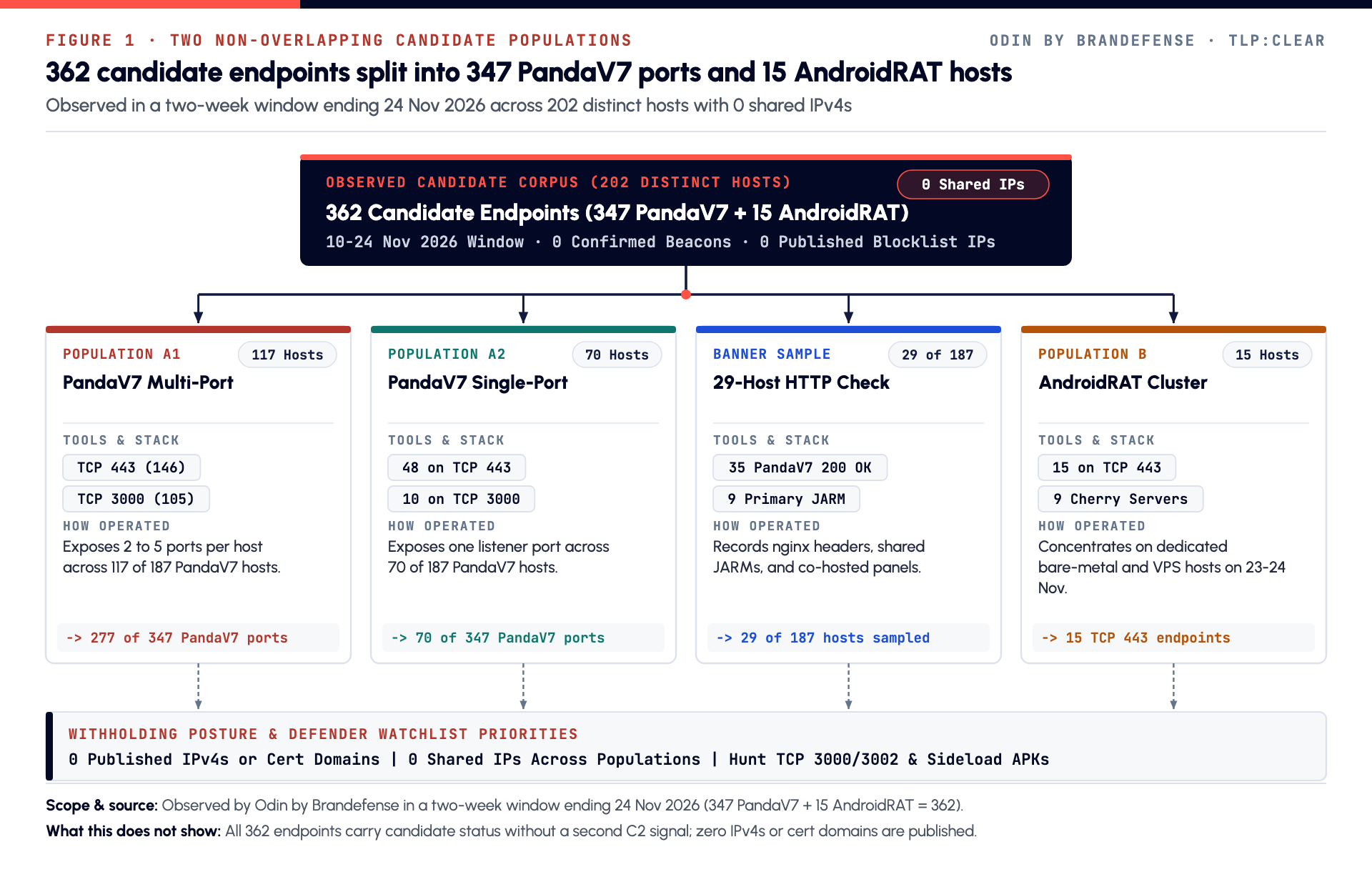
Port Distribution and Multi-Port Host Density (n = 362 Endpoints, 202 Hosts)
Within PandaV7 (347 endpoints on 187 hosts), 1 endpoint was first recorded on 10 November 2026. Another 333 appeared on 23 November and 13 on 24 November (75 last seen 23 November, 272 last seen 24 November). All 15 AndroidRAT endpoints were first recorded on 23 November 2026 (1 last seen 23 November, 14 last seen 24 November).
Out of 187 PandaV7 hosts, 117 hosts (62.6%) expose two to five PandaV7 ports at once, generating 277 of 347 endpoints (79.8%). Seventy hosts expose 1 port (70 endpoints) and 83 expose 2 ports (166 endpoints). Twenty-seven hosts expose 3 ports (81 endpoints), 5 expose 4 ports (20 endpoints), and 2 expose 5 ports (10 endpoints).
Across individual port pairings, 52 hosts pair 443 + 3000 (104 endpoints), 48 expose 443 alone (48), and 23 expose 443 + 3000 + 3002 (69). Twelve hosts pair 80 + 443 (24), 10 expose 3000 alone (10), and 9 pair 3000 + 3002 (18). Five expose 80 alone (5), 5 expose 80 + 443 + 3000 + 3002 (20), and 23 use other pairings (49). All 15 AndroidRAT candidate records are on TCP 443 (1 bannered host also served TCP 80).
| Population | TCP port | Endpoints | Family share | Port classification | Observed infrastructure role |
|---|---|---|---|---|---|
| PandaV7 | 443 | 146 | 42.1% | Standard HTTPS web port | Primary TLS front-end console listener ([REF-03]) |
| PandaV7 | 3000 | 105 | 30.3% | Non-standard Node.js / app port | Primary high-port PandaV7 web listener ([REF-01]) |
| PandaV7 | 3002 | 47 | 13.5% | Secondary non-standard app port | Companion API or secondary panel port ([REF-01]) |
| PandaV7 | 80 | 33 | 9.5% | Cleartext HTTP web port | Cleartext PandaV7 or co-hosted reverse-proxy listener |
| PandaV7 | 8080 | 5 | 1.4% | Alternate HTTP web port | Alternate HTTP panel port |
| PandaV7 | 8443 | 3 | 0.9% | Alternate HTTPS web port | Alternate TLS panel port |
| PandaV7 | 8 single-hit ports (3001, 3022, 3100, 3110, 8089, 8553, 20080, 39002) | 8 | 2.3% | Custom high TCP ports (1 each) | Long-tail custom port bindings |
| PandaV7 subtotal | 14 distinct ports | 347 | 100.0% | Across 187 distinct hosts | 117 multi-port hosts + 70 single-port hosts |
| AndroidRAT | 443 | 15 | 100.0% | Standard HTTPS listener port | Candidate records on TCP 443 across 15 hosts (23-24 Nov 2026; 1 bannered host also on 80) |
| Combined corpus | 14 distinct TCP ports | 362 | 100.0% | Across 202 distinct hosts | 0 cross-family shared IPv4 addresses |
Geographic and Hosting Provider Concentration
In PandaV7, Hong Kong (HK) holds 258 of 347 endpoints (74.4%) across 136 of 187 hosts (72.7%). The United States holds 44 endpoints on 22 hosts (12.7%), and Singapore holds 14 on 9 hosts (4.0%). Malaysia holds 6 on 4 hosts (1.7%), while the United Kingdom (4 on 2) and Japan (4 on 4) hold 1.2% each.
Nine more countries hold 17 PandaV7 endpoints across 10 hosts. Indonesia and Hungary hold 3 on 1 host each, while India, China, and Brazil hold 2 on 1 each. Germany holds 2 on 2 hosts, and France, Jordan, and Thailand hold 1 each. Across AndroidRAT, the United States holds 8 hosts (53.3%), Singapore holds 3 (20.0%), and Japan, Brazil, Spain, and Hong Kong hold 1 each (6.7%).
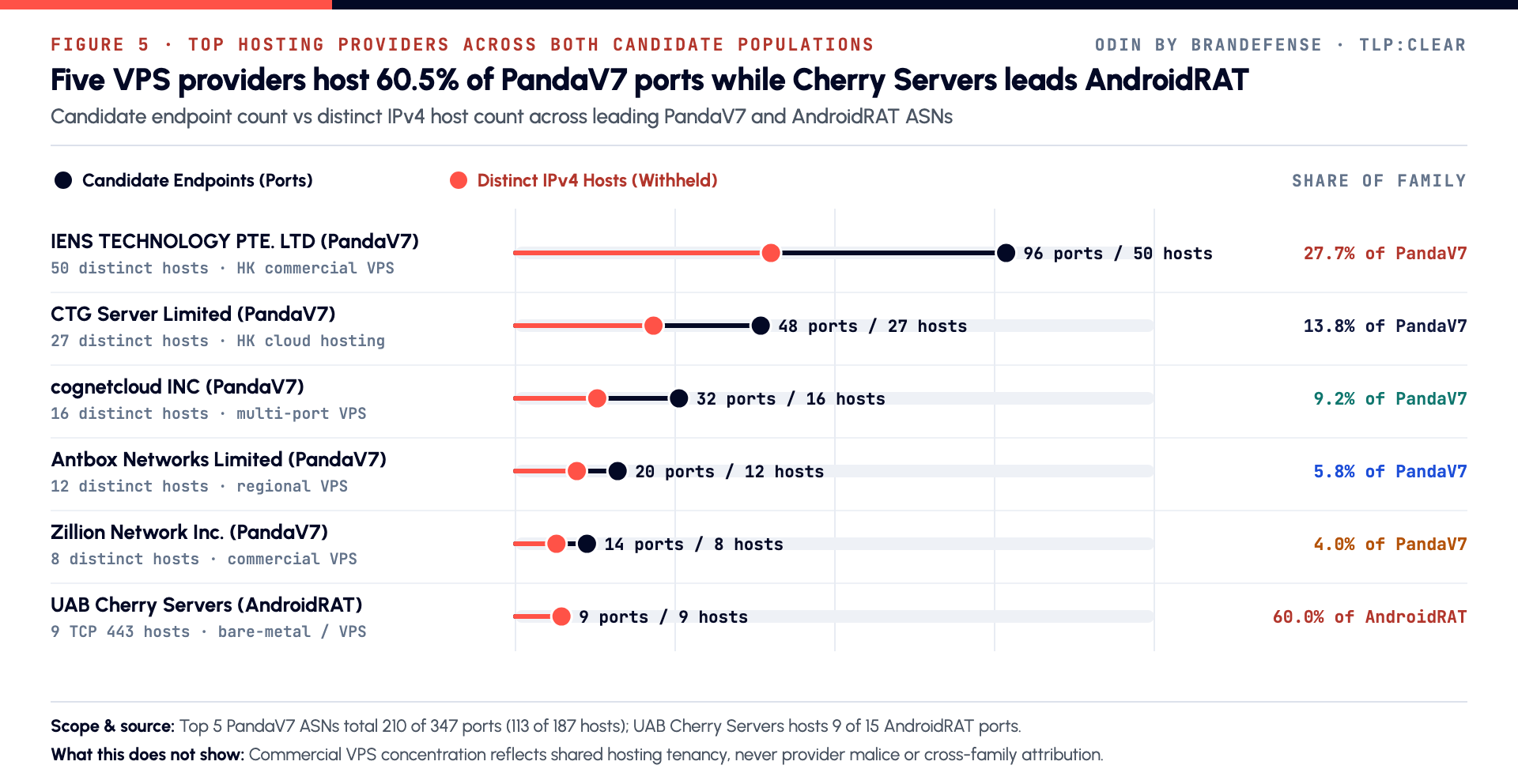
All 347 PandaV7 endpoints span 48 autonomous systems (210 endpoints, 60.5%, across the top five ASNs, and 277, 79.8%, across the top 12). In AndroidRAT, UAB "Cherry Servers" hosts 9 of 15 endpoints (60.0%).
| Population | Autonomous system / provider | Endpoints | Distinct hosts | Family share | Hosting profile |
|---|---|---|---|---|---|
| PandaV7 | IENS TECHNOLOGY PTE. LTD | 96 | 50 | 27.7% | Regional Hong Kong / APAC commercial VPS |
| PandaV7 | CTG Server Limited | 48 | 27 | 13.8% | Hong Kong cloud and VPS hosting |
| PandaV7 | cognetcloud INC | 32 | 16 | 9.2% | Multi-port commercial cloud VPS |
| PandaV7 | Antbox Networks Limited | 20 | 12 | 5.8% | Regional commercial VPS hosting |
| PandaV7 | Zillion Network Inc. | 14 | 8 | 4.0% | Regional cloud VPS hosting |
| PandaV7 | GNET INC. | 12 | 5 | 3.5% | Commercial cloud hosting |
| PandaV7 | Cloudie Limited | 12 | 5 | 3.5% | Hong Kong VPS infrastructure |
| PandaV7 | NetLab Global | 11 | 8 | 3.2% | Commercial VPS provider |
| PandaV7 | Nebula Global LLC | 9 | 3 | 2.6% | Multi-port VPS hosting (3.0 ports/host) |
| PandaV7 | Alibaba (US) Technology Co., Ltd. | 8 | 4 | 2.3% | Public cloud compute instances |
| PandaV7 | Yancy Limited | 8 | 2 | 2.3% | Multi-port VPS hosting (4.0 ports/host) |
| PandaV7 | CORENET CLOUD SDN. BHD. | 7 | 3 | 2.0% | Southeast Asian cloud VPS |
| PandaV7 | Other 36 commercial ASNs (1-6 endpoints each) | 70 | 44 | 20.2% | Long-tail VPS and cloud providers |
| PandaV7 subtotal | 48 commercial ASNs | 347 | 187 | 100.0% | Zero open-directory overlaps (0 of 187) |
| AndroidRAT | UAB "Cherry Servers" | 9 | 9 | 60.0% | Dedicated bare-metal and cloud VPS |
| AndroidRAT | Latitude[.]sh | 2 | 2 | 13.3% | Dedicated bare-metal cloud instances |
| AndroidRAT | Ultahost, Inc. | 2 | 2 | 13.3% | Commercial VPS hosting |
| AndroidRAT | ByteVirt LLC | 1 | 1 | 6.7% | Budget regional VPS hosting |
| AndroidRAT | NetLab Global | 1 | 1 | 6.7% | Commercial VPS (0 shared IPs with PandaV7) |
| AndroidRAT subtotal | 5 commercial ASNs | 15 | 15 | 100.0% | Zero open-directory overlaps (0 of 15) |
| Combined total | 52 unique ASNs (1 shared provider name) | 362 | 202 | 100.0% | Complete host and port reconciliation |
3. PandaV7 Multi-Port Architecture, Banner Samples, and Co-Hosted Panels
Evaluating PandaV7 requires separating full-population port counts (347 endpoints on 187 hosts) from smaller HTTP and TLS banner subsets ([REF-07]). Analysts working with cyber threat intelligence can correlate these banner traits without turning unverified VPS hosts into blocklists. Figure 4 contrasts the multi-port PandaV7 VPS stack with AndroidRAT.
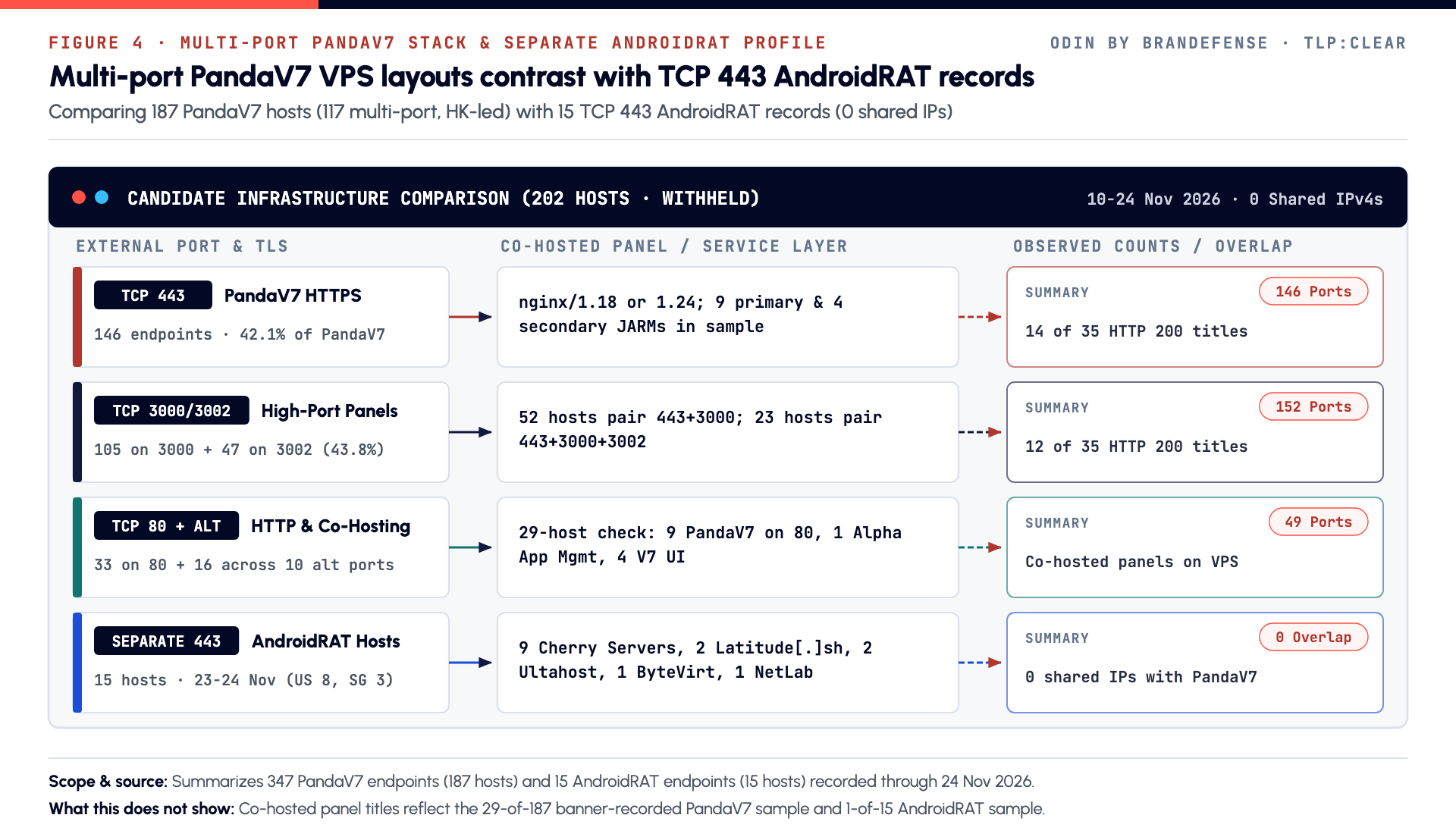
Reconciling the 25-Host Spot-Check and the 29-of-187 Banner Sample
Two banner checks clarify HTTP responses and TLS profiles across the 187 PandaV7 hosts:
- Initial lexicographical check (25 of 187 hosts). Checking the first 25 lexicographically sorted
PandaV7hosts found 5 endpoints with<title>PandaV7</title>and the primary JARM hash below. Zero of those 25 hosts servedAlpha App ManagementonTCP 80. - Full stored-banner review (29 of 187 hosts). Checking all 187
PandaV7hosts identified 29 of 187 hosts (15.5%) with stored HTTP and TLS banner records. Across those 29 hosts, 35 endpoints returned HTTP 200 with<title>PandaV7</title>: 14 onTCP 443, 12 onTCP 3000, and 9 onTCP 80.
Response headers on those 35 <title>PandaV7</title> endpoints show nginx/1.18.0 (Ubuntu) on 15 of 35 responses and nginx/1.24.0 (Ubuntu) on 5 of 35. Three report bare nginx, and 12 omit the Server header. Administrators often place nginx on 80 and 443 in front of app ports 3000 and 3002 while leaving both high ports open ([REF-01], [REF-03]).
Recurring TLS JARM Fingerprints and Co-Hosted Panels (29 of 187 Hosts)
Within the 29-of-187 banner sample, 18 <title>PandaV7</title> endpoints carried TLS JARM fingerprints ([REF-07]). Two hashes accounted for 13 of 18 TLS listeners, while five distinct JARM hashes appeared once each. Standard Ubuntu nginx builds share these JARM hashes, so none is a standalone blocklist indicator.
| JARM role & population | Recorded 62-character TLS JARM fingerprint | Sample count | Stack interpretation |
|---|---|---|---|
PandaV7 primary JARM | 2ad2ad0002ad2ad00042d42d0000000464fb8c6842ac133bede81390a48134 | 9 of 18 (5 of 25 initial) | Standard Ubuntu nginx TLS profile (10 total ports on the 29 hosts); enrichment only. |
PandaV7 secondary JARM | 29d29d00000000000042d42d000000dd5c266caaa8baaf93008418f7774284 | 4 of 18 | Secondary nginx / TLS stack profile; enrichment only. |
PandaV7 single-hit JARMs | 5 distinct single-instance JARM hashes (1 each) | 5 of 18 | Custom TLS cipher ordering or upstream reverse proxies. |
AndroidRAT bannered host | 28d28d28d00028d00042d42d000000831b6af40378e2dd35eeac4e9311926e | 1 of 15 hosts | Recorded on the 1 AndroidRAT host carrying stored nginx / nginx/1.31.3 banners. |
Reviewing other open ports across the 29 banner-recorded PandaV7 hosts revealed co-hosted Chinese-language panels on subsets of hosts (English translations below). Because each co-hosted title appears on 1 to 4 endpoints inside a 29-of-187 sample, it cannot be projected onto the 158 unbannered hosts.
| Observed HTTP panel title (English translation) | Port(s) | Count in 29-host sample | Analytical significance & sample boundary |
|---|---|---|---|
PandaV7 (<title>PandaV7</title>) | 443, 3000, 80 | 35 endpoints | Core HTTP 200 panel title (14 on 443, 12 on 3000, 9 on 80) across 29 of 187 hosts. |
| Fat Wealth God V7 (PangCaishen V7) | 80, 443 | 4 endpoints | 2 on 80 and 2 on 443; shares the V7 naming pattern on co-hosted VPS instances. |
| Alpha App Management (Alpha App Mgmt) | 80 | 1 endpoint | Co-hosted on TCP 80 on 1 of 29 banner-recorded hosts (0 of 25 in initial check). |
| Eagle Android Remote Management | 80, 443 | 2 endpoints | 1 on 80 and 1 on 443 on 1 of 29 hosts; Chinese-language Android management console. |
| BlackHole Tech Device Management Backend | 443 | 1 endpoint | 1 of 29 hosts; Chinese-language mobile device administration login page. |
BTMOB Mobile RAT Panel | 5000 | 1 endpoint | 1 of 29 hosts; commodity Android RAT web administration console on TCP 5000. |
RAT0 Panel | 8200 | 1 endpoint | 1 of 29 hosts; remote-access login banner on high port 8200. |
4. Dedicated AndroidRAT Cluster and Mobile Abuse Tradecraft Model
On 23 and 24 November 2026, Odin by Brandefense indexed 15 AndroidRAT candidate endpoints across 15 distinct IPv4 hosts. Four traits separate these 15 hosts from PandaV7:
TCP 443candidate record posture (100.0%). All 15AndroidRATcandidate records are onTCP 443across 15 hosts ([REF-04]). One bannered host also served a panel onTCP 80, while 0 hosts used 3000 or 3002.- Bare-metal and VPS provider mix.
UAB "Cherry Servers"hosts 9 of 15 endpoints (60.0%), alongsideLatitude[.]sh(2) andUltahost, Inc.(2).ByteVirt LLCandNetLab Globalhost 1 each, with the US (8) and Singapore (3) leading geographically. - Banner sample (1 of 15 hosts). One host carried stored banners (
nginx/nginx/1.31.3), serving Vermilion Bird Android Device Management on 443 and Eagle Android Remote Management on 80. Seeing that second title on 1 host per group reflects a shared commodity template, not an operator link. - Tight
23-24 Novemberwindow. All 15 records first appeared on23 November 2026, with 14 responsive on24 November.
Analytical Model: Rogue App Managers and Android RAT Clients
Odin by Brandefense observed candidate server ports without capturing victim mobile traffic or APK binaries. Client steps therefore form an analytical defender model grounded in MITRE ATT&CK Mobile ([REF-04], [REF-05], [REF-06]) and Android security documentation ([REF-08], [REF-09]). Figure 3 maps that model.
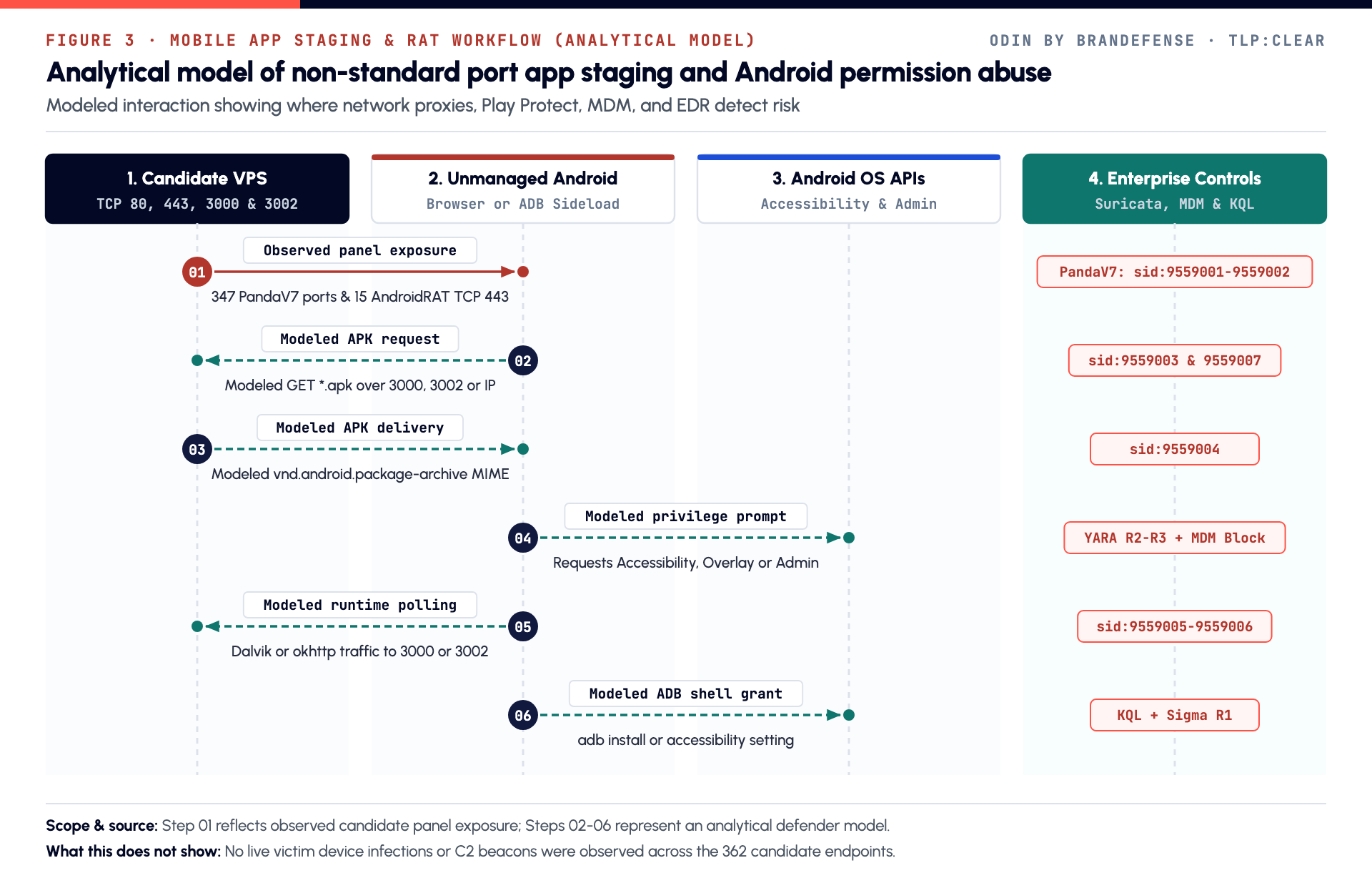
Commodity Android RAT and rogue app-manager workflows typically span three client stages:
- Out-of-store
.apkdelivery. Panels or direct links serve.apkpackages (application/vnd.android.package-archive) from high ports (3000, 3002, 8080) or bare IPv4 hosts, bypassing Google Play review ([REF-09]). AccessibilityServiceand overlay prompts (T1453,[REF-05],[REF-08]). Sideloaded packages requestBIND_ACCESSIBILITY_SERVICE,SYSTEM_ALERT_WINDOW, and SMS rights. Lures guide users past Android Restricted Settings or rely onadb shell settings put secure enabled_accessibility_services([REF-08]).DeviceAdminReceiverand runtime polling (T1626.001,[REF-06]). Many templates requestBIND_DEVICE_ADMIN,BOOT_COMPLETED, andFOREGROUND_SERVICEwhileDalvik/orokhttp/HTTP clients poll 443, 3000, or 3002 ([REF-01]).
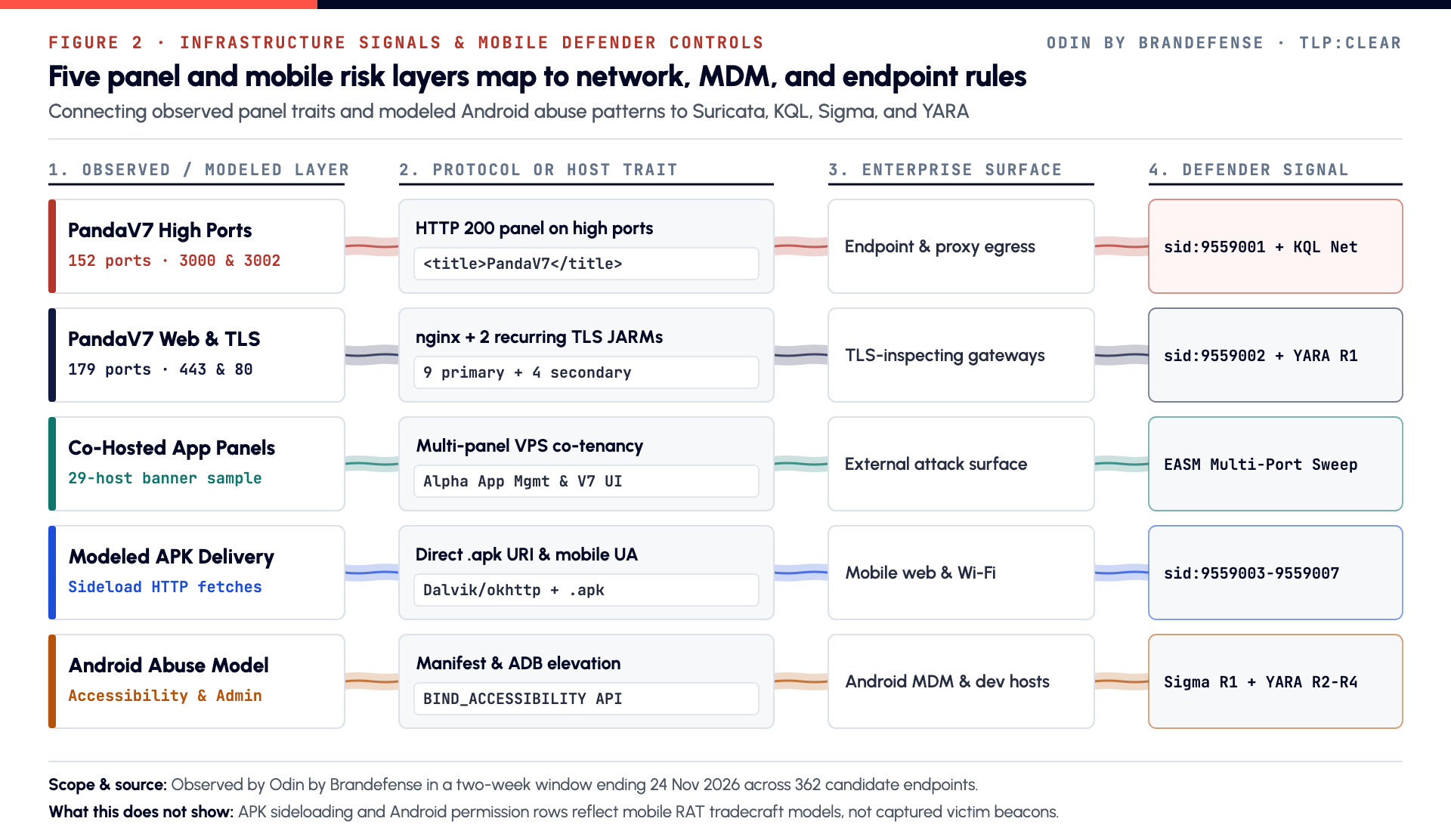
Figure 2 maps these observed and modeled layers to the detection rules in Chapter 7.
5. Enterprise Mobile and Perimeter Exposure Analysis
Security teams should verify four network and mobile governance controls ([REF-10]):
| Exposure surface | Observed Monograph 59 evidence | Control to verify | Operational risk |
|---|---|---|---|
| Egress to ports 3000 & 3002 | 152 of 347 PandaV7 endpoints (43.8%) use 3000 (105) or 3002 (47). At least 80 hosts pair 443 with 3000 or 3002: 52 dual-port, 23 triple-port, and 5 four-port hosts. | Verify whether firewalls and mobile gateways block outbound TCP 3000, 3002, and 8080 from non-CI hosts ([REF-01]). | Endpoints can reach high-port web panels that bypass port-80/443 policies. |
| Unmanaged Android sideloading | Co-hosted Alpha App Management (1 of 29 banner hosts), BTMOB (1 of 29), and Android management panels (1 of 29 PandaV7; 1 of 15 AndroidRAT). | Verify whether MDM ([REF-10]) blocks unknown APK sources and requires Google Play Protect ([REF-09]) before SSO sign-in. | BYOD or unmanaged phones can sideload trojanized APKs that capture corporate credentials. |
AccessibilityService & DeviceAdmin | Android RAT panels rely on AccessibilityService ([REF-08]) and DeviceAdminReceiver APIs ([REF-05], [REF-06]). | Verify whether MDM work profiles restrict non-allowlisted accessibility services and unmanaged device admins. | Accessibility grants allow UI reading, notification scraping, and gesture injection. |
Workstation adb bridges | Developer laptops often carry adb tools able to install APKs and edit secure settings. | Verify whether EDR restricts adb usage to approved mobile QA hosts (qa-appium-01.corp[.]example). | Local scripts can sideload packages and enable accessibility services silently. |
6. Alternative Hypotheses
| Hypothesis | Evidence for | Evidence against | Assessment |
|---|---|---|---|
PandaV7 (187 hosts) and AndroidRAT (15 hosts) form one campaign | Both surged on 23-24 November 2026, and 1 bannered host in each set showed Eagle Android Remote Management. | Comparing 187 PandaV7 IPs and 15 AndroidRAT IPs shows 0 shared IPv4s, and candidate port profiles (62.6% multi-port vs 100% of AndroidRAT records on 443) and top ASNs differ. | Unsupported. Treat them as separate populations; commodity panel templates do not link operators. |
All 347 PandaV7 ports belong on IP blocklists | 29 of 187 hosts return <title>PandaV7</title> or co-host BTMOB, RAT0, and Android panels. | All 347 records carry candidate status with 0 victim C2 beacons, and commercial Hong Kong VPS ranges host mixed web services. | Unconfirmed per host. Withhold raw IPs and deploy protocol and permission hunt rules. |
Primary JARM uniquely identifies PandaV7 | Appears on 9 of 18 TLS-fingerprinted <title>PandaV7</title> ports (5 of 25 in initial check). | PandaV7 runs behind standard Ubuntu nginx/1.18 and 1.24 builds ([REF-07]) shared with benign sites. | Enrichment pivot only. Combine JARM with HTTP title and port signals, never standalone blocking. |
Alpha App Management co-hosting is universal across PandaV7 | Observed on TCP 80 on 1 of 29 banner-recorded PandaV7 hosts. | Seen on 0 of 25 hosts in the initial check and 1 of 29 bannered hosts (158 of 187 lacked stored banners). | Localized co-hosting. Keep exact 1-of-29 sample bounds. |
7. Validated Detection Rules
Zero candidate IPv4 addresses or unverified certificate domains are published. Defenders should deploy port-aware HTTP, proxy, MDM, and endpoint rules across any server IP.
All rules below were checked statically against Suricata 7.x HTTP buffer syntax (0 linter problems), Sentinel KQL schema, Sigma structure (3 rules), and filesize-bounded YARA syntax (4 rules). Live Suricata, Sentinel, Sigma, and YARA engines were not run on this build host, so validate each rule in staging first.
7.1 Suricata 7.x Network Signatures (sid:9559001-9559007)
Rules sid:9559001-9559002 detect HTTP 200 <title>PandaV7</title> responses on 3000/3002 and web ports. Rules sid:9559003 and sid:9559007 match outbound .apk requests over 3000/3002 or bare IPv4 Host headers. Rule sid:9559004 matches inbound application/vnd.android.package-archive responses, and sid:9559005-9559006 match Dalvik/ or okhttp/ traffic on 3000/3002/8080. All seven are alert rules (not inline blocks) and require cleartext HTTP or a TLS-inspecting proxy on encrypted ports.
# Odin by Brandefense - Monograph 59 (PandaV7 Panels & Mobile RAT Clusters) Suricata 7.x Ruleset
# Static syntax checked against Suricata 7.x HTTP buffer rules and Odin Suricata linter (0 problems).

alert http $EXTERNAL_NET [3000,3002] -> $HOME_NET any (msg:"ODIN-R59 PandaV7 Web Panel Title on Non-Standard Ports 3000 or 3002"; flow:established,to_client; http.stat_code; content:"200"; bsize:3; http.response_body; content:"<title>PandaV7</title>"; fast_pattern; classtype:trojan-activity; sid:9559001; rev:1;)
alert http $EXTERNAL_NET [80,443,8080,8443] -> $HOME_NET any (msg:"ODIN-R59 PandaV7 Web Panel Title on Standard or Alt Web Ports"; flow:established,to_client; http.stat_code; content:"200"; bsize:3; http.response_body; content:"<title>PandaV7</title>"; fast_pattern; classtype:trojan-activity; sid:9559002; rev:1;)
alert http $HOME_NET any -> $EXTERNAL_NET [3000,3002] (msg:"ODIN-R59 Outbound Android APK Fetch over Non-Standard Ports 3000 or 3002"; flow:established,to_server; http.method; content:"GET"; bsize:3; http.uri; content:".apk"; nocase; endswith; fast_pattern; classtype:trojan-activity; sid:9559003; rev:1;)
alert http $EXTERNAL_NET [3000,3002,8080] -> $HOME_NET any (msg:"ODIN-R59 Inbound Android APK Package Delivery from Non-Standard Port"; flow:established,to_client; http.content_type; content:"application/vnd.android.package-archive"; nocase; fast_pattern; classtype:trojan-activity; sid:9559004; rev:1;)
alert http $HOME_NET any -> $EXTERNAL_NET [3000,3002,8080] (msg:"ODIN-R59 Outbound Android Dalvik Runtime Request to Non-Standard Port"; flow:established,to_server; http.user_agent; content:"Dalvik/"; startswith; fast_pattern; classtype:command-and-control; sid:9559005; rev:1;)
alert http $HOME_NET any -> $EXTERNAL_NET [3000,3002,8080] (msg:"ODIN-R59 Outbound Android OkHttp POST Beacon to Non-Standard Port"; flow:established,to_server; http.method; content:"POST"; bsize:4; http.user_agent; content:"okhttp/"; startswith; fast_pattern; classtype:command-and-control; sid:9559006; rev:1;)
alert http $HOME_NET any -> $EXTERNAL_NET any (msg:"ODIN-R59 Outbound Android APK Fetch Using Bare IPv4 Host Header"; flow:established,to_server; http.uri; content:".apk"; nocase; endswith; fast_pattern; http.host; pcre:"/^d{1,3}(?:.d{1,3}){3}(?::d+)?$/"; classtype:trojan-activity; sid:9559007; rev:1;)
7.2 Microsoft Sentinel KQL Hunt
Replace the placeholder FQDNs in ApprovedMobileDevHosts (mobile-ci-01.corp[.]example and qa-appium-01.corp[.]example) with your approved mobile CI and QA runners before scheduling.
// Odin by Brandefense - Monograph 59 (PandaV7 Panels & Mobile RAT Clusters)
// Hunts non-browser endpoint connections to external TCP 3000/3002, APK fetches, and ADB sideload/accessibility commands.
let Lookback = 7d;
let ApprovedMobileDevHosts = dynamic(["mobile-ci-01.corp.example", "qa-appium-01.corp.example"]);
let NonBrowserClients = dynamic(["curl", "curl.exe", "wget", "python", "python3", "python.exe", "powershell.exe", "pwsh", "pwsh.exe", "java", "java.exe", "adb", "adb.exe"]);
let NonStandardPortOrApkEgress =
    DeviceNetworkEvents
    | where Timestamp >= ago(Lookback)
    | where not(DeviceName in~ (ApprovedMobileDevHosts))
    | where RemoteIPType == "Public"
    | where (
        (RemotePort in (3000, 3002) and InitiatingProcessFileName in~ (NonBrowserClients))
        or (RemotePort in (3000, 3002, 8080) and RemoteUrl endswith ".apk")
    )
    | project Timestamp, DeviceName, AccountName = InitiatingProcessAccountName, SignalType = "NonStandardPortOrApkEgress", Detail = strcat(InitiatingProcessFileName, " -> ", RemoteIP, ":", tostring(RemotePort), " ", RemoteUrl);
let AndroidAdbSideloadOrAdminGrant =
    DeviceProcessEvents
    | where Timestamp >= ago(Lookback)
    | where not(DeviceName in~ (ApprovedMobileDevHosts))
    | where FileName in~ ("adb", "adb.exe")
    | where (
        (ProcessCommandLine has "install" and ProcessCommandLine has ".apk")
        or ProcessCommandLine has_any ("enabled_accessibility_services", "dpm set-active-admin", "BIND_ACCESSIBILITY_SERVICE")
    )
    | project Timestamp, DeviceName, AccountName, SignalType = "AndroidAdbSideloadOrAdminGrant", Detail = ProcessCommandLine;
union NonStandardPortOrApkEgress, AndroidAdbSideloadOrAdminGrant
| summarize FirstSeen = min(Timestamp), LastSeen = max(Timestamp), EventCount = count(), Signals = make_set(SignalType, 6), SampleDetails = make_set(Detail, 5) by DeviceName, AccountName
| order by LastSeen desc
7.3 Portable Sigma and YARA Rules
- Sigma (
sigma_pandav7_nonstandard_ports_and_adb_sideload.yml). Rule 1 detects Windowsadb.execommand lines containing.apk,enabled_accessibility_services, ordpm set-active-admin. Rule 2 catches Linux CLI tools (curl,wget,python,python3) connecting to :3000/ or :3002/. Rule 3 catches proxy sessions to port 3000 or 3002 fromDalvik/orokhttp/clients or ending in.apk. - YARA (
odin_pandav7_panel_and_android_rat_artifacts.yar). Fourfilesize-bounded rules detect cached<title>PandaV7</title>web panels and Android manifests pairingBIND_ACCESSIBILITY_SERVICEwithSYSTEM_ALERT_WINDOWand SMS or install rights. They also matchBIND_DEVICE_ADMINboot persistence and extracted configs pairing Android HTTP clients with :3000/ or :3002/.
8. Behavioral and Protocol Hunt Markers (0 Published IPs or SHA-256s)
No candidate IPv4 addresses or unverified certificate domains appear in the indicator feeds. Defenders should hunt using the 10 protocol, TLS stack, and Android markers below.
| Marker category | Pattern / protocol artifact | Layer | Defensive hunt & caution |
|---|---|---|---|
| HTTP panel title | <title>PandaV7</title> | HTTP 200 (443, 3000, 80) | Seen on 35 ports across 29 bannered hosts. Alert with sid:9559001-9559002 behind a TLS proxy. |
| Multi-port profile | TCP 443 + TCP 3000 (+ TCP 3002) | External VPS (443, 3000, 3002) | The two listed 443/3000 configurations cover 75 hosts; five more expose 80 + 443 + 3000 + 3002. Use in multi-port asset sweeps. |
| Primary TLS JARM | 2ad2ad0002ad2ad00042d42d0000000464fb8c6842ac133bede81390a48134 | TLS (443, 3000) | Seen on 9 of 18 TLS-fingerprinted PandaV7 titles (5 of 25 initial check). Shared with Ubuntu nginx; enrichment only. |
| Secondary TLS JARM | 29d29d00000000000042d42d000000dd5c266caaa8baaf93008418f7774284 | TLS (443, 3000) | Seen on 4 of 18 TLS-fingerprinted PandaV7 titles. Use only as an enrichment pivot. |
| APK MIME delivery | application/vnd.android.package-archive | HTTP (3000, 3002, 8080) | Alert on direct .apk downloads from high ports or bare IPv4 hosts (sid:9559003-9559004, sid:9559007). |
| Android HTTP UA | Dalvik/ and okhttp/ | HTTP (3000, 3002, 8080) | Alert when Android runtime clients poll external high ports (sid:9559005-9559006, Sigma Rule 3). |
| Accessibility abuse | android.permission.BIND_ACCESSIBILITY_SERVICE | Android APK / MDM | Hunt sideloaded APKs pairing accessibility bindings with SYSTEM_ALERT_WINDOW and SMS rights (YARA Rule 2). |
| Device admin abuse | android.permission.BIND_DEVICE_ADMIN | Android APK / MDM | Block unmanaged apps requesting DEVICE_ADMIN_ENABLED with BOOT_COMPLETED (YARA Rule 3). |
| ADB shell elevation | enabled_accessibility_services | Workstation EDR | Alert on adb commands installing .apk files or changing accessibility settings (Sentinel KQL, Sigma Rule 1). |
| High-port egress | Outbound TCP 3000 / TCP 3002 | Firewall / EDR | Restrict non-browser CLI and endpoint traffic to external TCP 3000 and 3002 (Sentinel KQL, Sigma Rule 2). |
9. Hardening Priorities for Enterprise Mobility and Network Teams
Enterprise teams should close non-standard port egress and unmanaged Android sideloading paths together:
- Keep candidate VPS lists out of automated IP blocklists (
0-48 Hours). Route upstreamcandidatefeeds into SIEM watchlists rather than firewall drop rules across shared VPS subnets ([REF-02]). - Block unmanaged outbound access to
TCP 3000, 3002, and 8080 (0-72 Hours). Deny direct outbound connections to ports 3000, 3002, and 8080 from corporate Wi-Fi, VPN, and workstation VLANs outside allowlisted CI runners ([REF-01]). - Block unknown APK sideloading and require Google Play Protect (
Days 1-7). Enforce Android EnterpriseDISALLOW_INSTALL_UNKNOWN_SOURCESpolicies ([REF-10]) and require Play Protect attestation ([REF-09]) before SSO sign-in. - Restrict
AccessibilityServiceand legacyDeviceAdminbindings (Days 7-14). Set Android EnterprisepermittedAccessibilityServicesallowlists ([REF-05],[REF-08]) and audit non-MDMDeviceAdminReceivergrants ([REF-06]). - Audit workstation
adbtools and inspect mobile web traffic (Days 14-30). Deploy Sentinel KQL and Sigma Rules 1-2 on endpoints, Sigma Rule 3 at web proxies, and Suricatasid:9559001-9559007 behind TLS-inspecting gateways.
10. Scope, Limits, and External References
Odin by Brandefense analyzed 362 candidate endpoints recorded in a two-week observation window ending 24 November 2026. That corpus covers 347 PandaV7 endpoints on 187 hosts (10 to 24 November) and 15 AndroidRAT endpoints on 15 hosts (23 to 24 November). Zero shared IPv4 addresses or open directories link the two sets.
All 362 endpoints carry upstream candidate status without an independent second C2 beacon, so 0 IPv4 addresses and 0 certificate domains are published. Banner, nginx, JARM, and co-hosting counts cover 29 of 187 PandaV7 hosts (25 in the initial check) and 1 of 15 AndroidRAT hosts. Live Suricata, Sentinel, Sigma, and YARA engines were not run on this build host, so validate each rule in staging before deployment.
[REF-01]MITRE ATT&CK Enterprise, *Non-Standard Port (T1571)* (verified on 24 November 2026).[REF-02]MITRE ATT&CK Enterprise, *Acquire Infrastructure: Virtual Private Server (T1583.003)* (verified on 24 November 2026).[REF-03]MITRE ATT&CK Enterprise, *Application Layer Protocol: Web Protocols (T1071.001)* (verified on 24 November 2026).[REF-04]MITRE ATT&CK Mobile, *Application Layer Protocol: Web Protocols (T1437.001)* (verified on 24 November 2026).[REF-05]MITRE ATT&CK Mobile, *Abuse Accessibility Features (T1453)* (verified on 24 November 2026).[REF-06]MITRE ATT&CK Mobile, *Abuse Elevation Control Mechanism: Device Administrator Permissions (T1626.001)* (verified on 24 November 2026).[REF-07]Salesforce Engineering, *JARM: An Active Transport Layer Security (TLS) Server Fingerprinting Tool* (verified on 24 November 2026).[REF-08]Android Developers, *AccessibilityService API Reference and Security Model* (verified on 24 November 2026).[REF-09]Google Developers, *Google Play Protect Overview and Potentially Harmful Application Defenses* (verified on 24 November 2026).[REF-10]NIST Computer Security Resource Center, *SP 800-124 Rev. 2: Guidelines for Managing the Security of Mobile Devices in the Enterprise* (verified on 24 November 2026).
What is…?
Short explanations of the tools and families named in this study.
Frequently asked questions
How do the 347 PandaV7 ports differ from the 15 AndroidRAT hosts?
Multi-port density, provider choice, and geography separate the two candidate sets cleanly. Network teams can use external attack surface management to audit open high-numbered ports across their own cloud servers. Analysts using cyber threat intelligence can enrich candidate panel alerts without rushing unverified VPS addresses onto firewall blocklists.
What did the HTTP banner and TLS JARM spot-checks actually show?
Sample denominators matter when reading web banner checks across candidate hosts. Overgeneralizing small banner samples is a common mistake in infrastructure reporting:
Why should candidate VPS hosts stay off automated IP blocklists?
Shared commercial VPS subnets in Hong Kong, Singapore, and the United States host grayware app tools, developer Node.js apps, and RAT panels side by side. Blocking 202 single-signal candidate IPs without a verified C2 beacon risks breaking benign web services while missing rotated VPS nodes.
What should enterprise mobility and network teams do first?
Defenders can close both non-standard port exposure and mobile sideloading paths with three priority actions: