
Key takeaways
- Newly indexed candidate infrastructure totaled 362 endpoints across 202 distinct hosts through 24 November 2026, with 0 shared IPv4s between PandaV7 and AndroidRAT.
- Across 187 PandaV7 hosts, 117 expose 2 to 5 ports at once, led by TCP 443, 3000, 3002, and 80, with 74.4% of endpoints in Hong Kong.
- Stored banners on 29 of 187 PandaV7 hosts returned 35 <title>PandaV7</title> responses, two recurring TLS JARMs, and co-hosted Alpha App Management or V7 panels.
- All 15 AndroidRAT candidate records are on TCP 443 across dedicated bare-metal and VPS hosts led by UAB Cherry Servers (9) and the United States (8).
- Withhold single-signal candidate IPs from automated blocklists; restrict TCP 3000 and 3002, block unmanaged APK sideloading, and deploy behavioral hunt rules.
Newly indexed PandaV7 and AndroidRAT candidate panels totaled 362 endpoints across 202 distinct IPv4 hosts during a two-week observation window ending 24 November 2026. Those records split into 347 PandaV7 ports across 187 hosts (10 to 24 November) and 15 AndroidRAT ports across 15 hosts (23 to 24 November).
Nothing in our dataset links the two populations: comparing all 187 PandaV7 hosts with all 15 AndroidRAT hosts shows 0 shared IPv4 addresses. Every one of the 362 records carries upstream candidate status without an independent second C2 beacon or captured APK payload. Odin by Brandefense therefore publishes 0 raw IPv4 addresses and 0 unverified certificate domains.
How do the 347 PandaV7 ports differ from the 15 AndroidRAT hosts?
Multi-port density, provider choice, and geography separate the two candidate sets cleanly. Network teams can use external attack surface management to audit open high-numbered ports across their own cloud servers. Analysts using cyber threat intelligence can enrich candidate panel alerts without rushing unverified VPS addresses onto firewall blocklists.
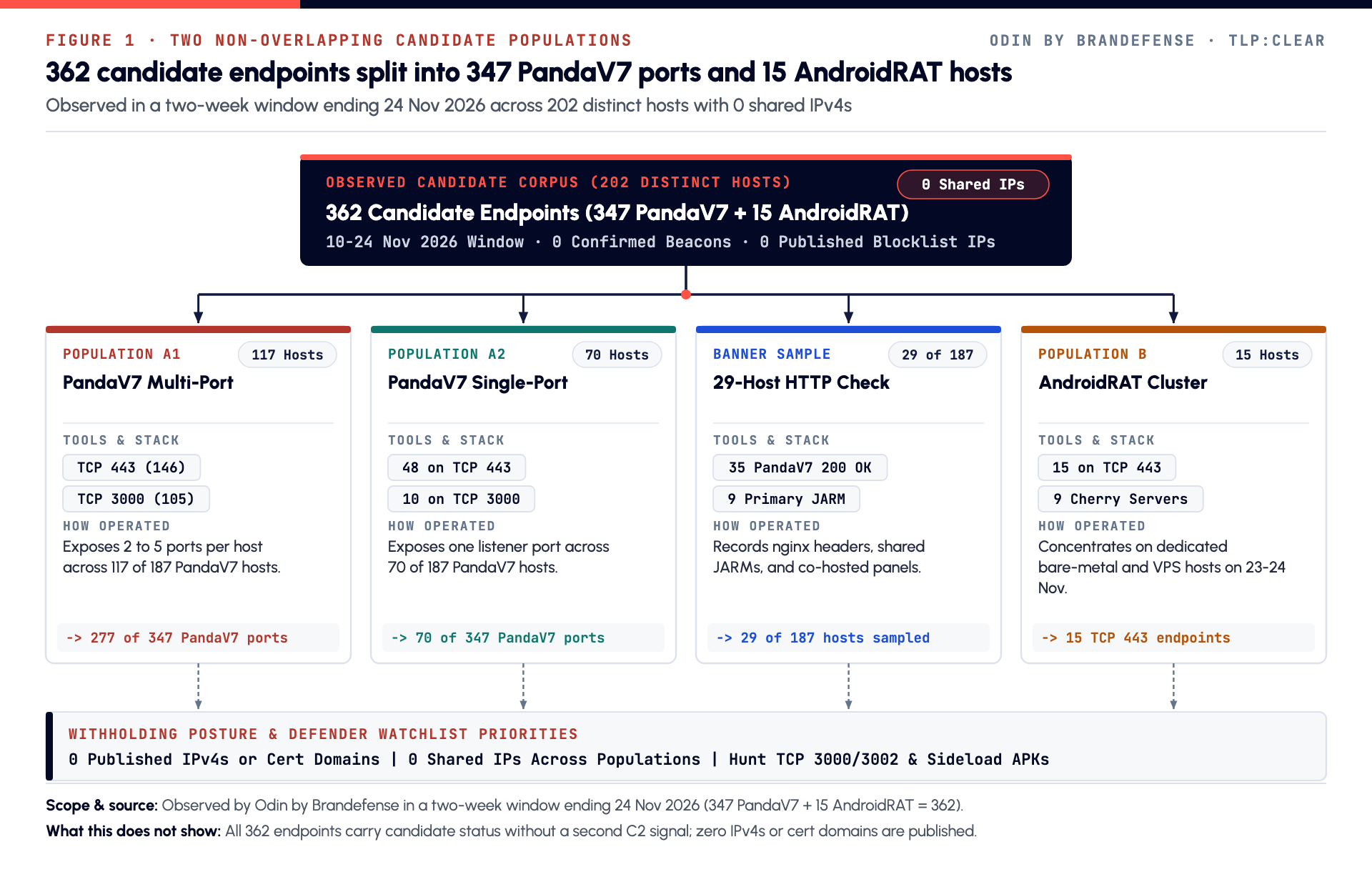
Across 187 PandaV7 hosts, 117 hosts (62.6%) expose 2 to 5 ports at once, generating 277 of the 347 endpoints (79.8%). The remaining 70 hosts expose a single port. Specifically, 52 hosts pair TCP 443 + 3000, 48 expose 443 only, and 23 expose 443 + 3000 + 3002.
Four TCP ports account for 331 of 347 PandaV7 endpoints (95.4%): 443 (146), 3000 (105), 3002 (47), and 80 (33). Ten alternate ports hold the remaining 16 endpoints (8080 holds 5, 8443 holds 3, and eight custom ports hold 1 each). Hong Kong hosts 258 PandaV7 endpoints (74.4% across 136 hosts), followed by the United States (44 on 22 hosts) and Singapore (14 on 9 hosts).
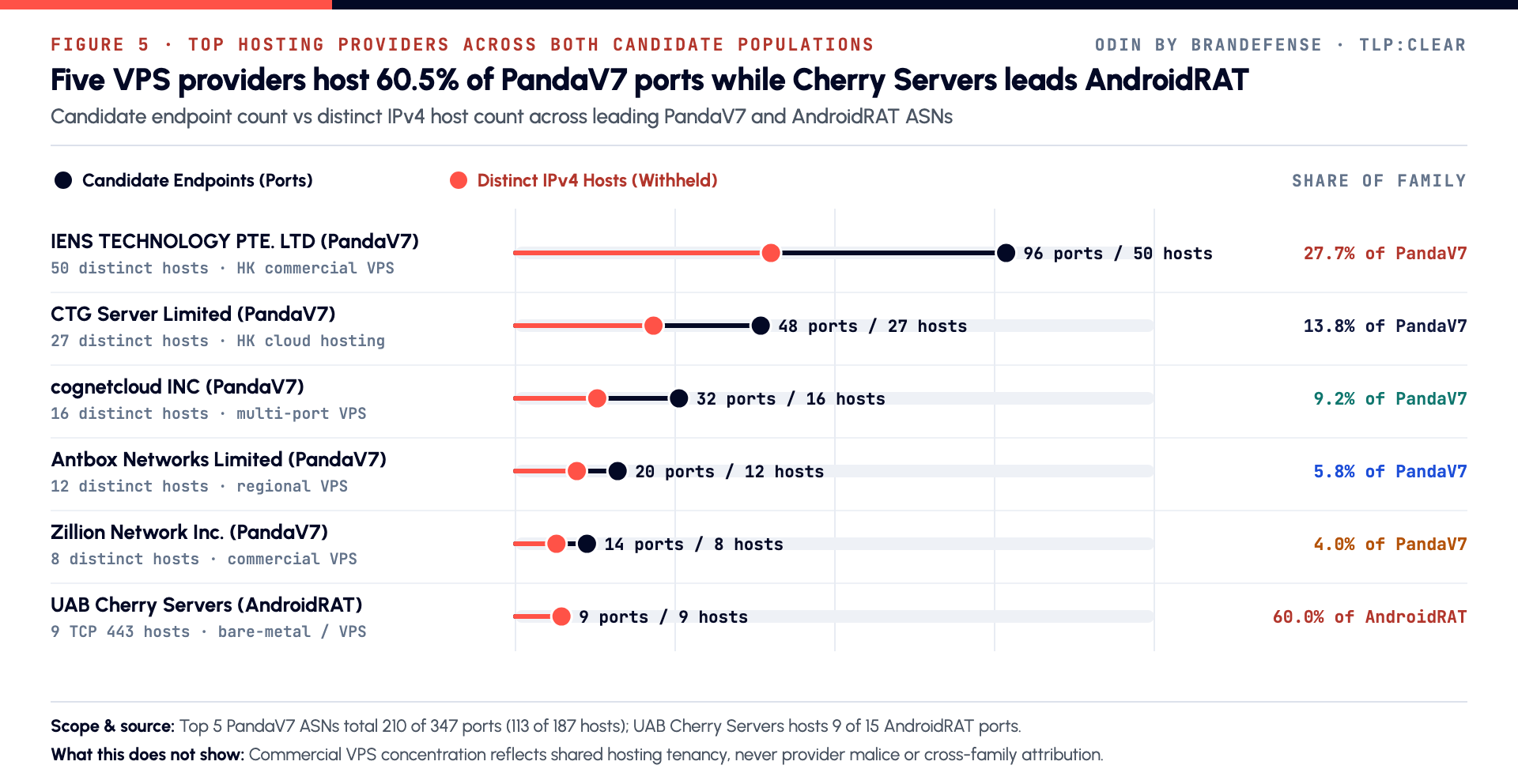
All 15 AndroidRAT candidates follow a different footprint. All 15 AndroidRAT candidate records are on TCP 443 across six countries; one bannered host also served a panel on TCP 80. The United States leads with 8 hosts and Singapore holds 3, while Japan, Brazil, Spain, and Hong Kong hold 1 each. Nine of the 15 hosts (60.0%) sit on UAB "Cherry Servers", alongside Latitude[.]sh (2), Ultahost, Inc. (2), ByteVirt LLC (1), and NetLab Global (1).
| Population & leading providers | Endpoints | Distinct hosts | Share of family | Dominant ports & geography |
|---|---|---|---|---|
PandaV7 top 5 ASNs (IENS, CTG, cognetcloud, Antbox, Zillion) | 210 | 113 | 60.5% | Multi-port 443, 3000, 3002, 80; Hong Kong-led (74.4% overall). |
PandaV7 next 7 ASNs (GNET, Cloudie, NetLab, Nebula, Alibaba US, Yancy, CORENET) | 67 | 30 | 19.3% | Regional commercial cloud and VPS subnets. |
PandaV7 remaining 36 ASNs (1-6 endpoints each) | 70 | 44 | 20.2% | Long-tail commercial VPS providers across 15 countries. |
AndroidRAT all 5 ASNs (Cherry Servers 9, Latitude[.]sh 2, Ultahost 2, ByteVirt 1, NetLab 1) | 15 | 15 | 100.0% | All 15 candidate records on TCP 443 (1 bannered host also on 80); led by US (8) and SG (3); 0 shared IPs. |
What did the HTTP banner and TLS JARM spot-checks actually show?
Sample denominators matter when reading web banner checks across candidate hosts. Overgeneralizing small banner samples is a common mistake in infrastructure reporting:
- Initial 25-host check vs 29-of-187 banner sample. Checking the first 25 lexicographically sorted
PandaV7hosts found 5 primary JARM matches and 0Alpha App Managementpanels. Reviewing all 187PandaV7hosts found 29 hosts carrying stored HTTP and TLS banner records. Those 29 hosts produced 35HTTP 200<title>PandaV7</title>responses (14 on 443, 12 on 3000, 9 on 80). Most ran behind Ubuntunginx/1.18.0(15) ornginx/1.24.0(5). - Shared TLS JARM stacks (13 of 18 fingerprinted
PandaV7TLS ports). Across 18 TLS-fingerprinted<title>PandaV7</title>endpoints in the 29-host sample, two recurring JARM hashes accounted for 13 ports (table below). Standard Ubuntunginxservers generate the same JARM hashes, so use them only as enrichment pivots, never as blocklists. - Co-hosted panels on subsets of bannered hosts. Within the 29-host
PandaV7sample, 1 of 29 hosts co-hosted Chinese-language Alpha App Management onTCP 80. Four endpoints served Fat Wealth God V7 (2 on 80 and 2 on 443). Individual hosts in that sample also served Eagle Android Remote Management, BlackHole Tech Device Management Backend,BTMOB(:5000), orRAT0(:8200). InAndroidRAT, 1 of 15 hosts carried stored banners, serving Vermilion Bird Android Device Management (:443) and Eagle Android Remote Management (:80).
| Observed TLS or HTTP marker | Recorded value | Sample count | Defensive handling |
|---|---|---|---|
PandaV7 primary JARM | 2ad2ad0002ad2ad00042d42d0000000464fb8c6842ac133bede81390a48134 | 9 of 18 (5 of 25 initial) | Shared Ubuntu nginx TLS profile; enrichment pivot only. |
PandaV7 secondary JARM | 29d29d00000000000042d42d000000dd5c266caaa8baaf93008418f7774284 | 4 of 18 | Secondary TLS profile; never blocklist standalone. |
PandaV7 HTML title | <title>PandaV7</title> (HTTP 200) | 35 ports on 29 of 187 hosts | Alert via Suricata sid:9559001-9559002 behind a TLS proxy. |
Why should candidate VPS hosts stay off automated IP blocklists?
Shared commercial VPS subnets in Hong Kong, Singapore, and the United States host grayware app tools, developer Node.js apps, and RAT panels side by side. Blocking 202 single-signal candidate IPs without a verified C2 beacon risks breaking benign web services while missing rotated VPS nodes.
Because Odin by Brandefense observed server ports without capturing victim mobile beacons, client behavior is framed as an analytical model. Rogue app managers and Android RAT operators typically serve sideloaded .apk files (application/vnd.android.package-archive) over high ports (3000, 3002, 8080) or bare IPs. Those packages then request BIND_ACCESSIBILITY_SERVICE, SYSTEM_ALERT_WINDOW, or BIND_DEVICE_ADMIN rights and poll servers via Dalvik/ or okhttp/ HTTP clients.
What should enterprise mobility and network teams do first?
Defenders can close both non-standard port exposure and mobile sideloading paths with three priority actions:
- Restrict outbound
TCP 3000, 3002, and 8080. Block non-browser workstation tools and mobile Wi-Fi clients from connecting directly to external ports 3000, 3002, and 8080 outside allowlisted CI hosts. Deploy Suricatasid:9559001-9559007 behind a TLS-inspecting proxy to alert on<title>PandaV7</title>banners and.apkfetches. - Block unmanaged APK sideloading and enforce Play Protect. Apply Android Enterprise
DISALLOW_INSTALL_UNKNOWN_SOURCESpolicies across managed phones and work profiles. Require active Google Play Protect attestation in Conditional Access before corporate SSO sign-in. - Lock down
AccessibilityServiceand workstationadbtools. Use MDMpermittedAccessibilityServicespolicies to block unapproved accessibility bindings and unmanagedDeviceAdminReceiverregistrations. Hunt unauthorized workstationadbsideloading with Sentinel KQL and Sigma Rule 1. Use Sigma Rules 2-3 for high-port activity and YARA Rules 1-4 for relevant files; test all rules in staging first.
What is…?
Short explanations of the tools and families named in this study.
Frequently asked questions
How do the 347 PandaV7 ports differ from the 15 AndroidRAT hosts?
Multi-port density, provider choice, and geography separate the two candidate sets cleanly. Network teams can use external attack surface management to audit open high-numbered ports across their own cloud servers. Analysts using cyber threat intelligence can enrich candidate panel alerts without rushing unverified VPS addresses onto firewall blocklists.
What did the HTTP banner and TLS JARM spot-checks actually show?
Sample denominators matter when reading web banner checks across candidate hosts. Overgeneralizing small banner samples is a common mistake in infrastructure reporting:
Why should candidate VPS hosts stay off automated IP blocklists?
Shared commercial VPS subnets in Hong Kong, Singapore, and the United States host grayware app tools, developer Node.js apps, and RAT panels side by side. Blocking 202 single-signal candidate IPs without a verified C2 beacon risks breaking benign web services while missing rotated VPS nodes.
What should enterprise mobility and network teams do first?
Defenders can close both non-standard port exposure and mobile sideloading paths with three priority actions: