
1. Executive Summary
In short
Operation FalsePort pairs JDBC driver source audits across MySQL, PostgreSQL, and SQL Server with rogue TCP 3306 MySQL listeners on a China-hosted server. Odin by Brandefense analyzed 1,039 deduplicated entries recorded on 13–20 November 2026. Stored logs record 2,167 inbound connects, one Connector/J 8.0.28 session, and seven captured files. Patch JDBC drivers, disable local file reads, and block outbound TCP 3306.
Java web portals, BI tools, and schedulers often let admins test database connections from a browser form. When an app passes a raw JDBC string to its driver, the database client turns into an attack surface.
Instead of breaking into a backend SQL host, an attacker points the Java app at an external fake database port. Operation FalsePort pairs multi-engine JDBC code review with live rogue MySQL listeners and seven captured target files.
From 13 to 20 November 2026, Odin by Brandefense analyzed an exposed workbench on a China-hosted cloud server on TCP port 80. On 20 November 2026, that open folder reported 485 active files and 32 subfolders.
Across the 13–20 November 2026 snapshots, the deduplicated dataset holds 1,039 entries. Those entries span 263 sized files totaling 927.36 megabytes and 776 unsized entries across 267 unique SHA-256 digests.
The server stores captured Linux account files, Git credentials, SSH private keys, and a Spring Boot log. Odin by Brandefense publishes zero server IPv4 addresses and zero workbench SHA-256 digests. Both server addresses, all client IPs, folder names, and target filenames are withheld.
Source and bytecode audits across three SQL engines make up 89.22 percent of entries.
Two folders dominate the workbench file count. An audit folder holds 539 entries, including PostgreSQL JDBC source code, while a MySQL folder holds 388 Connector/J source files.
In the root workspace, compiled PostgreSQL and Microsoft SQL Server JDBC JARs sit beside an extracted SQL Server connection class. Root also stages Apache Shiro JARs and a 42.67-megabyte JNDI exploit JAR.
Two TCP 3306 listener logs record 2,167 inbound connects and one Connector/J 8.0.28 session.
Log fake3306c2b.log holds 3,171 lines and 1,145 inbound connect events. A second log (fakemysql_test.log) holds 2,083 lines and 1,022 connect events.
Most raw TCP 3306 connects on a public cloud IP come from internet port scanners. Still, fake3306c2b.log logs one MySQL Connector/J 8.0.28 client receiving 3,432-byte and 1,686-byte payloads.
A seven-file captured-output folder holds 21.63 megabytes of returned Linux and Spring Boot data.
Inside a seven-file captured-output folder (name withheld), 30 entries include seven sized files totaling 21,627,228 bytes. Those files include a 941-byte /etc/passwd file, Git credentials, two SSH private keys, configs, and a 21.59-megabyte Spring Boot log.
An unlinked India-hosted VPS on TCP 8001 shares zero non-public file hashes.
On 20 November 2026, a second open workbench on an India-hosted VPS reported 713 active files (874 entries; 506 unique digests). Comparing all 267 primary digests with all 506 digests on that second host shows zero shared non-public hashes, and nothing links the two operators.
Three Decisions for Platform and Security Leaders
- Lock down JDBC DataSource URLs and strip risky client flags. Build database URLs from checked host, port, and schema fields only. Reject local file-read, deserialize, query-interceptor, and socket-factory options at the API layer.
- Upgrade MySQL Connector/J and PostgreSQL pgjdbc drivers. Update MySQL Connector/J to version 8.2.0 or later and update PostgreSQL pgjdbc to version 42.2.25 or 42.3.2 or later. Check bundled drivers inside BI tools and app containers.
- Block outbound SQL ports from Java app subnets. Stop web and middleware hosts from opening outbound TCP 3306, 5432, 1433, or 1389 connections to public IPs. Run Java apps under accounts without SSH keys or Git credential files.
2. Workbench Architecture, 1,039-Entry Dataset, and Parallel Comparison
Operation FalsePort ran from a China-hosted cloud server on TCP 80 (address withheld), recorded on 13–20 November 2026. On 20 November 2026, the open folder reported 485 active files and 32 subfolders.
Across the 13–20 November 2026 snapshots, the deduplicated dataset holds 1,039 entries. It spans 263 sized files totaling 927,357,421 bytes (927.36 MB) and 776 unsized entries across 267 SHA-256 digests. Platform teams can use external attack surface management to find exposed Java panels before attackers change DataSource settings. Figure 1 maps the four workbench tracks.
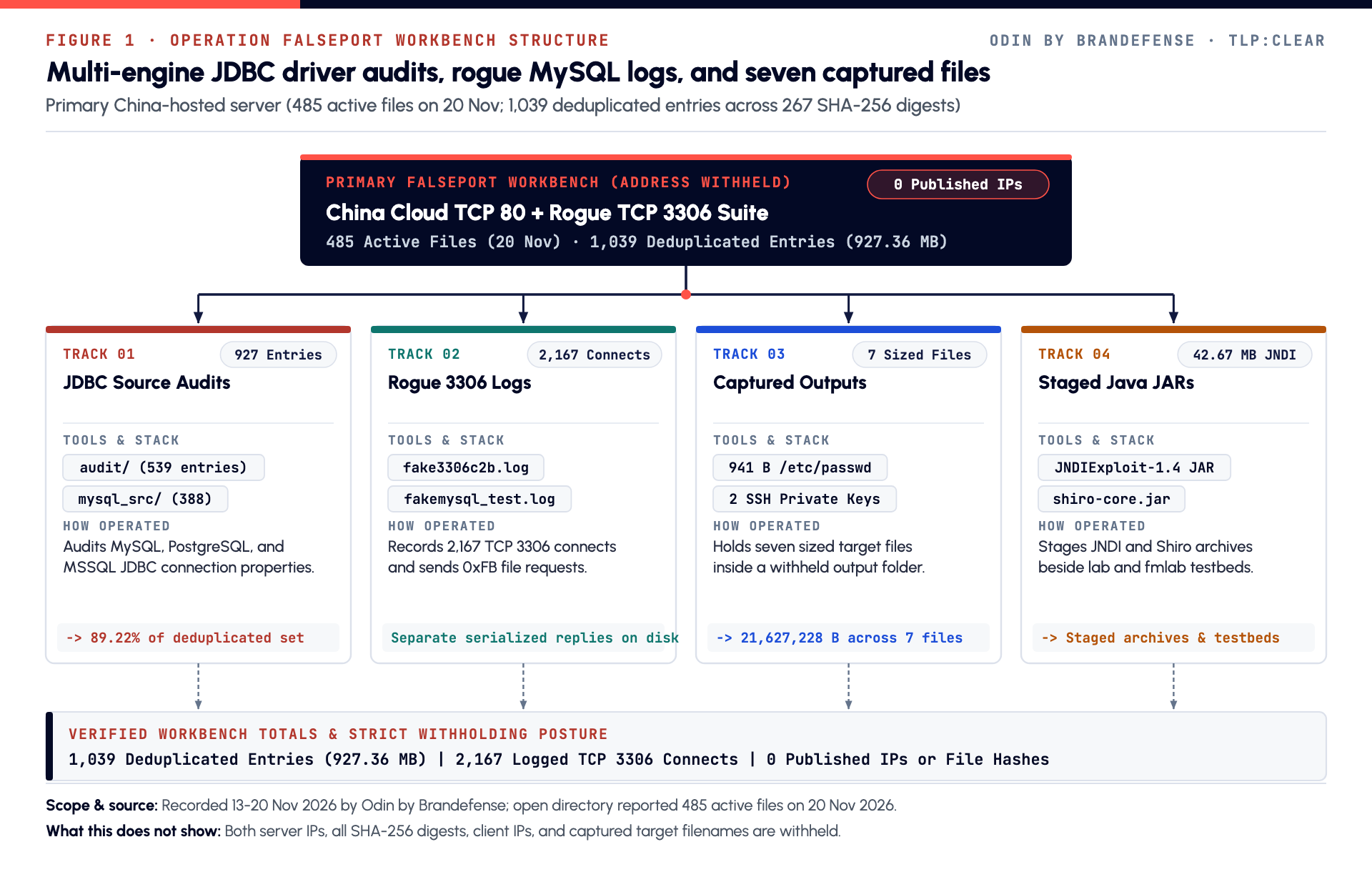
Seven-Zone Partition and File-Type Breakdown (n = 1,039)
Every table in this report sums to the exact 1,039 entries, 263 sized files, 776 unsized entries, and 927,357,421 sized bytes on the primary host. Seven top-level zones divide the workspace (539 + 388 + 52 + 30 + 15 + 14 + 1 = 1,039).
| Top-level workspace zone | Zone count | Entries | Share (%) | Sized files | Unsized entries | Sized bytes | Role on workbench |
|---|---|---|---|---|---|---|---|
Multi-Engine Audit Tree (audit/) | 1 | 539 | 51.88% | 80 | 459 | 583,901 | PostgreSQL pgjdbc source (audit/src_pg/) and cross-driver property checks. |
MySQL Driver Source (mysql_src/) | 1 | 388 | 37.34% | 114 | 274 | 541,993 | Extracted com.mysql.cj.* Connector/J files for file-read and interceptor checks. |
| Root Operator Workspace | 1 (root) | 52 | 5.00% | 40 | 12 | 904,597,314 | Rogue 3306 logs (fake3306c2b.log, fakemysql_test.log), JNDIExploit-1.4-SNAPSHOT.jar, pg.jar, sqljdbc4.jar, Shiro JARs, and payloads. |
| Captured-Output Folder (name withheld) | 1 | 30 | 2.89% | 7 | 23 | 21,627,228 | Seven sized captures: 941 B /etc/passwd, 2 SSH keys, Git creds, configs, and 21.59 MB Spring Boot log. |
Driver Test Lab (lab/) | 1 | 15 | 1.44% | 11 | 4 | 5,319 | Local JDBC URL and property test files. |
Fake-MySQL Test Lab (fmlab/) | 1 | 14 | 1.35% | 11 | 3 | 1,666 | Rogue MySQL greeting and 0xFB LOCAL INFILE packet tests. |
Auxiliary Tools (tools/) | 1 | 1 | 0.10% | 0 | 1 | 0 | Unsized helper folder entry. |
| Total primary dataset | 6 dirs + root | 1,039 | 100.00% | 263 | 776 | 927,357,421 | 485 active files & 32 dirs on 20 Nov 2026; 267 SHA-256s (withheld). |
Two volume patterns stand out in this layout. Folders audit/ (539) and mysql_src/ (388) hold 89.22% (927 / 1,039) of all entries while taking only 1.13 MB of sized text. Meanwhile, the 52 root entries hold 97.55% (904.60 MB) of total byte volume because root stores large JAR bundles and logs.
The next table splits the same 1,039 entries across five file classes (684 + 346 + 6 + 2 + 1 = 1,039). Java source files (587 .java) and JAR archives (304 .jar) make up 85.76% of all items.
| Artifact class | Entries | Share (%) | Sized files | Unsized entries | Sized bytes | Exact extension counts & contents |
|---|---|---|---|---|---|---|
Text, source & logs (text) | 684 | 65.83% | 236 | 448 | 881,377,599 | 587 .java, 26 .log, 25 .yml, 24 .txt, 9 .properties, 6 .bin, 5 .xml, 1 .html, 1 .json. |
Archives & bytecode (exe) | 346 | 33.30% | 20 | 326 | 45,964,797 | 304 .jar (JNDIExploit-1.4-SNAPSHOT.jar, pg.jar, sqljdbc4.jar, shiro-core.jar, shiro-web.jar), 23 .bin, 19 .class. |
Scripts (script) | 6 | 0.58% | 5 | 1 | 11,664 | 6 .py rogue MySQL listener and JDBC test scripts. |
Serialized & other (other) | 2 | 0.19% | 1 | 1 | 1,686 | 1 .ser serialized Java payload (1,686 B) and 1 .types file. |
Secrets & keys (secret) | 1 | 0.10% | 1 | 0 | 1,675 | 1 .bin captured SSH private key (1,675 B; target names withheld). |
| Total | 1,039 | 100.00% | 263 | 776 | 927,357,421 | Exact byte parity (927.36 MB). |
Figure 5 combines lab/ (15), fmlab/ (14), and tools/ (1) into one 30-entry testbed track (22 sized files = 6,985 B). All five tracks sum to 1,039 entries (539 + 388 + 52 + 30 + 30 = 1,039).
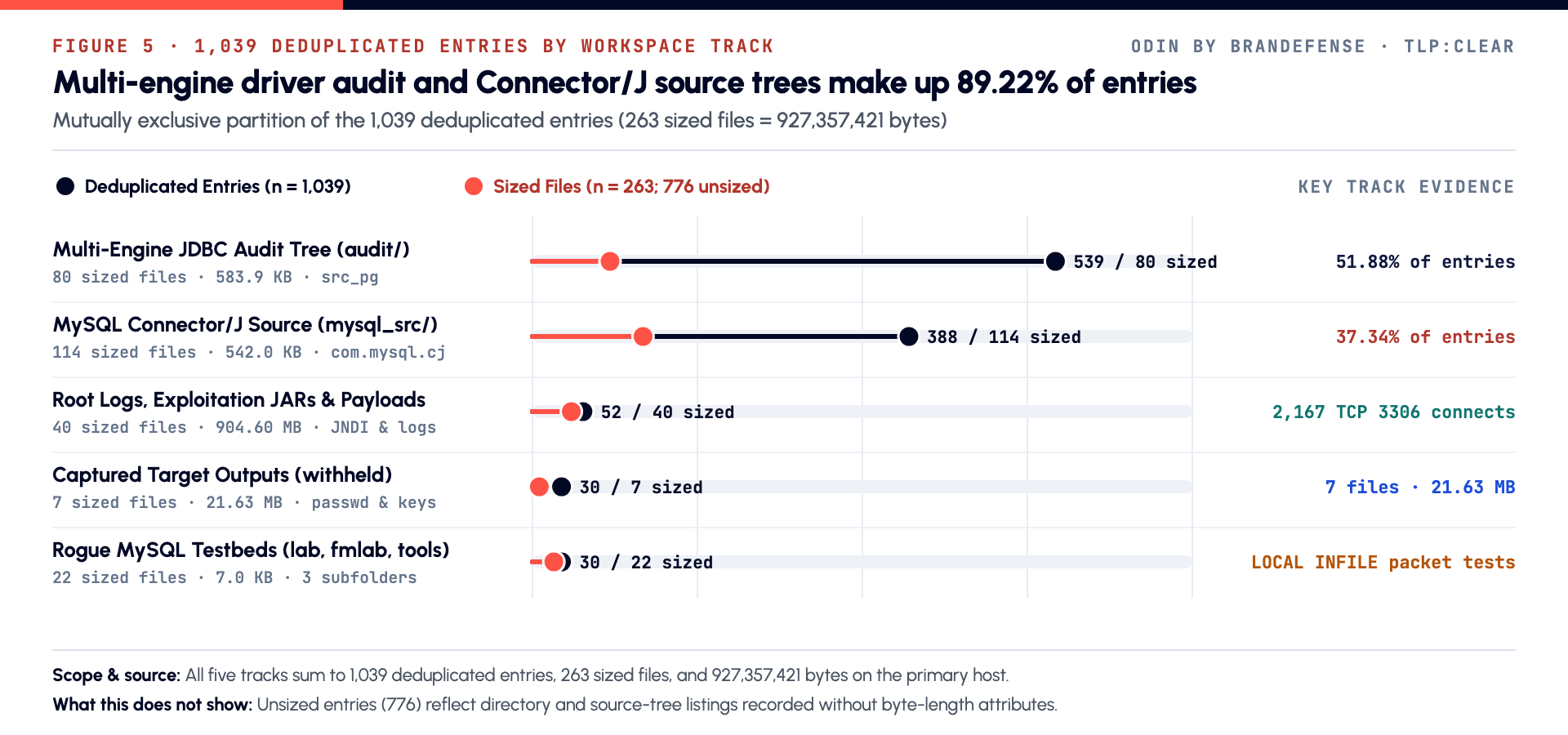
Independent Parallel Workbench: India-Hosted VPS on TCP 8001
On 20 November 2026, Odin by Brandefense also examined a second open folder on an India-hosted VPS on TCP 8001 (address withheld). That host reported 713 active files and 114 folders on 20 November. Its deduplicated dataset holds 874 entries: 715 sized files (1,577,851,064 bytes, or 1.58 GB) and 159 unsized entries across 506 SHA-256 digests.
Four top-level folders divide those 874 entries. Folder java-chains/ holds 712 entries (versions 2.0.0/2.0.1, 1,311 log lines). Root holds 115 entries, including Linux /proc/self/environ, /proc/1/cmdline, and /proc/self/cmdline captures.
Folder payloads/ holds 24 entries, while MySQL_Fake_Server/ holds 23 entries. Comparing the 267 primary SHA-256 digests with the 506 India VPS digests shows zero shared non-public hashes, and nothing links the two operators.
3. Multi-Engine JDBC Driver Auditing and Rogue TCP 3306 Listeners
BI dashboards, data tools, and Java admin panels often expose "Test Connection" forms ([REF-09]). Defenders using cyber threat intelligence can track how attackers point those forms at external database ports. Figure 3 shows an analytical model of staged URL edits, logged TCP 3306 handshakes, and stored file captures.
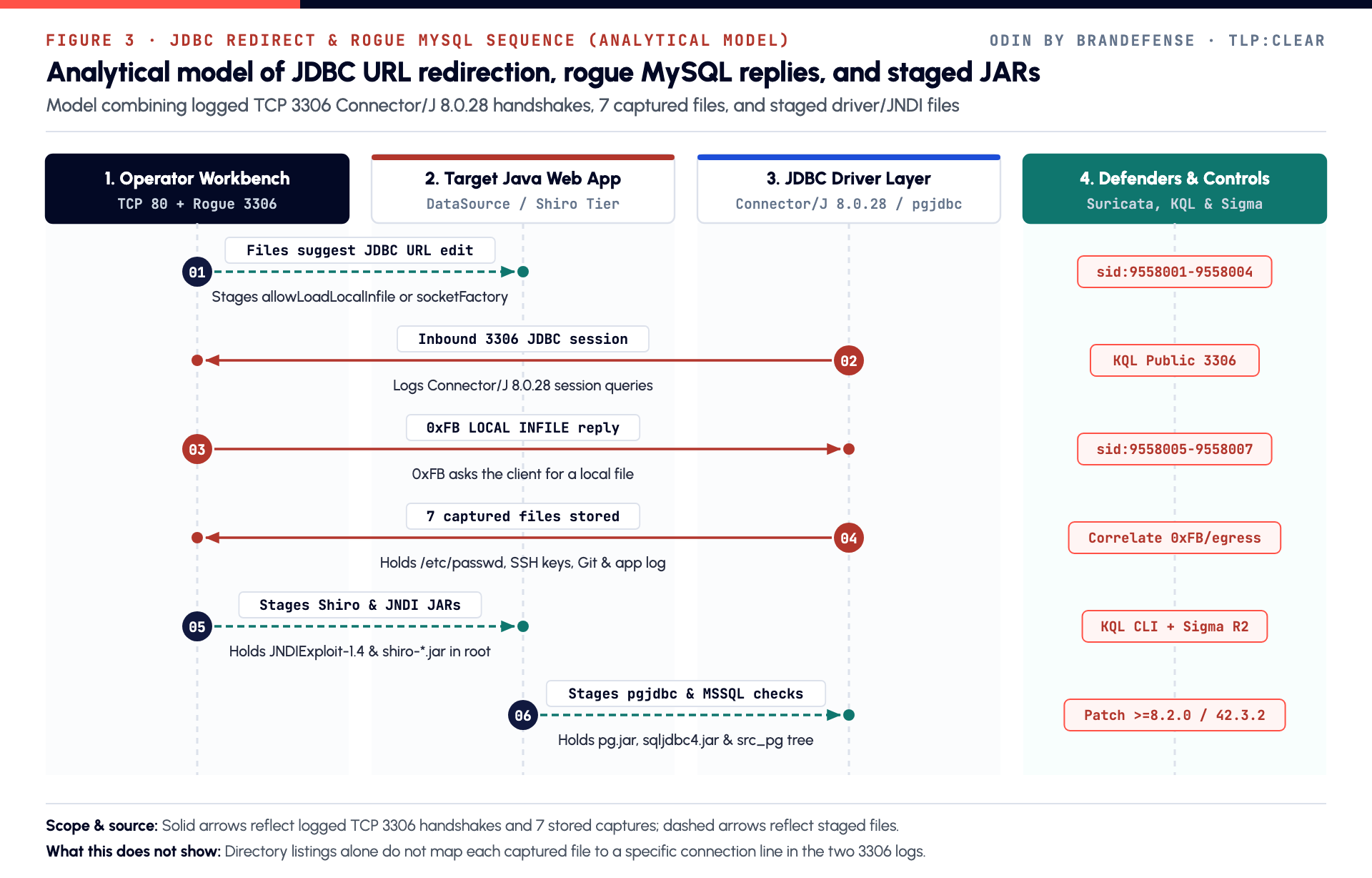
Auditing MySQL, PostgreSQL, and SQL Server JDBC Drivers (927 Entries)
The primary operator unpacked 927 source entries across mysql_src/ (388 entries, 541,993 B) and audit/ (539 entries, 583,901 B). Root also holds compiled driver JARs and classes:
- MySQL Connector/J (
com.mysql.cj.*,[REF-01]–[REF-04]). Foldermysql_src/holds 388 source files tracing Connector/J 8.x URL flags ([REF-03]). FlagallowLoadLocalInfile=truelets a server read local JVM files ([REF-04]). FlagautoDeserialize=truepaired withqueryInterceptors=triggers Java deserialization of server replies. Oracle fixed Connector/J flaws inCVE-2021-2471(8.0.26and prior; fixed in8.0.27,[REF-02]) andCVE-2023-22102(8.1.0and prior; fixed in8.2.0,[REF-01]). - PostgreSQL
pgjdbc(audit/src_pg/andpg.jar1,006,732 B,[REF-05],[REF-06]). FlawCVE-2022-21724affectspgjdbc9.4.1208before42.2.25and42.3.0before42.3.2(fixed in42.2.25and42.3.2). Vulnerable builds load classes named insocketFactory,sslfactory,sslhostnameverifier,sslpasswordcallback, orauthenticationPluginClassNamebefore checking interfaces ([REF-05],[REF-06]). - Microsoft SQL Server JDBC (
sqljdbc4.jar584,207 B andSQLServerConnection.class57,341 B,[REF-07]). Root stagessqljdbc4.jarandSQLServerConnection.classto inspect URL parsing and TLS trust flags ([REF-07]). Because no SQL Server or PostgreSQL listener logs appear on disk, both stay staged research.
Live TCP 3306 Rogue MySQL Listener Logs (2,167 Connect Events)
Two root logs record live inbound traffic hitting rogue MySQL listeners on TCP 3306:
| Stored listener log | Sized bytes | Total lines | == connect from events | Observed protocol details |
|---|---|---|---|---|
fake3306c2b.log | 151,645 | 3,171 | 1,145 | Logs inbound TCP 3306 connects (client IPs withheld) and 1 mysql-connector-java-8.0.28 client running SELECT @@session.auto_increment_increment... and SHOW SESSION STATUS. |
fakemysql_test.log | 95,593 | 2,083 | 1,022 | Logs 1,022 inbound TCP 3306 connects during listener tests and exposure (client IPs withheld). |
| Combined TCP 3306 logs | 247,238 | 5,254 | 2,167 | Paired on disk with 3,432-byte and 1,686-byte reply payloads. |
Three protocol facts govern those two logs:
- Scan noise vs real JDBC clients. Public TCP 3306 ports draw constant bot scans, so 2,167 connects do not equal 2,167 targets. Real JDBC clients send
mysql-connector-java-8.0.28strings andSELECT @@session.auto_increment_increment...queries. Build8.0.28is newer than8.0.26(CVE-2021-2471) yet falls under8.1.0and prior (CVE-2023-22102). It also honors0xFBfile reads whenallowLoadLocalInfile=trueis set ([REF-03]). - Server
0xFBLOCAL INFILErequests ([REF-04]). In reply to any SQL query, a fake MySQL server can send byte0xFBplus a file path like/etc/passwd. When local infile reads are active, the client JVM reads that local file and streams its bytes back ([REF-10]). - Serialized payloads. Root also holds 3,432-byte and 1,686-byte payloads (including the 1,686-byte
.serfile) built forSHOW SESSION STATUSdeserialization tests.
4. Returned Target File Captures and Staged Java Tooling
Operation FalsePort moves beyond code review inside a seven-file captured-output directory (folder name withheld). Figure 4 compares the primary server stack with the unlinked India-hosted VPS.
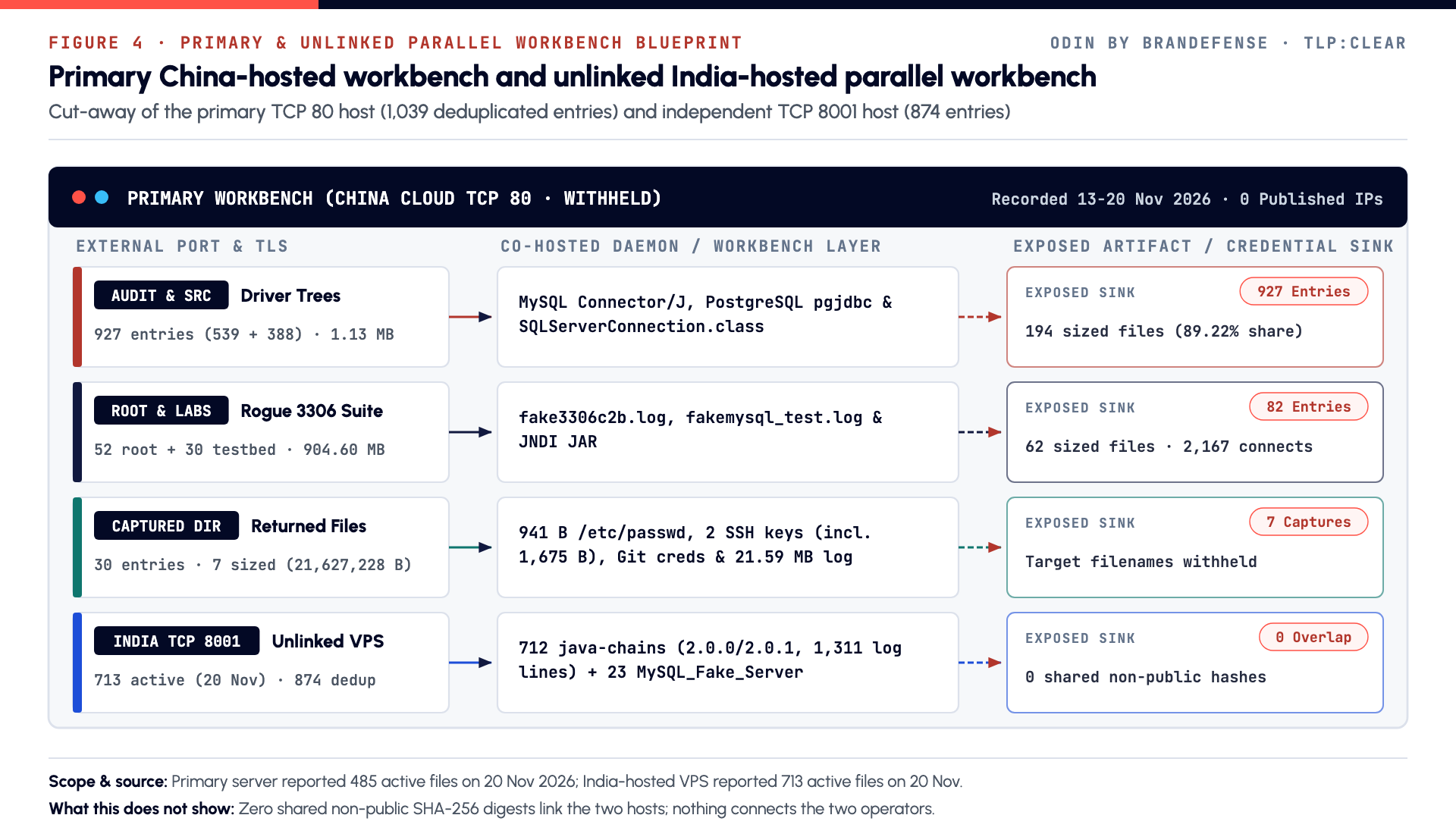
Seven Sized Target File Captures (21,627,228 Bytes)
The captured-output folder holds 30 entries: 23 unsized entries and 7 sized files totaling 21,627,228 bytes (21.63 MB). Every filename, user name, and project label is withheld (21,586,294 + 24,348 + 7,810 + 3,904 + 2,256 + 1,675 + 941 = 21,627,228 bytes):
| Capture item | Exact bytes | Share (%) | Generic capture description (names withheld) | Security impact ([REF-10]) |
|---|---|---|---|---|
| Capture 01 | 21,586,294 | 99.81% | Spring Boot app log (21.59 MB; service name withheld). | Exposes stack traces, internal URLs, tokens, and app state. |
| Capture 02 | 24,348 | 0.11% | App config or credential file (24.35 KB). | Reveals backend service and database settings. |
| Capture 03 | 7,810 | 0.04% | App config or credential file (7.81 KB). | Reveals service endpoints or auth state. |
| Capture 04 | 3,904 | 0.02% | SSH private key or Git credentials (3.90 KB). | Supports SSH login or private repo cloning. |
| Capture 05 | 2,256 | 0.01% | Git credentials or second SSH key (2.26 KB). | Pairs with home-folder credential reads from the JVM user. |
| Capture 06 | 1,675 | 0.01% | SSH private key (1,675 B, secret class in file table). | Matches PEM or OpenSSH private-key length. |
| Capture 07 | 941 | <0.01% | Linux /etc/passwd file (941 B; accounts withheld). | Lists OS users and home paths for follow-up 0xFB reads. |
| Total | 21,627,228 | 100.00% | 7 sized files + 23 unsized entries = 30 entries. | All target filenames and folder names withheld. |
Reading /etc/passwd (941 B) first lets an operator find the JVM user's home path. Follow-up 0xFB packets can then request .ssh/id_rsa, .git-credentials, and Spring Boot logs (21.59 MB).
Folder listings alone do not show whether all seven files came from one host or several. They also do not tie each file to a single line in fake3306c2b.log or fakemysql_test.log.
Staged Apache Shiro and JNDIExploit-1.4-SNAPSHOT.jar (42.67 MB)
Root also stages shiro-core.jar, shiro-web.jar, and JNDIExploit-1.4-SNAPSHOT.jar (42,671,630 bytes). Attackers often test Apache Shiro for rememberMe or path-filter bypasses on Java admin panels ([REF-08]).
Archive JNDIExploit stages rogue LDAP and HTTP controllers. Because no Shiro or LDAP callback logs appear in sized files, both JAR sets stay staged capabilities. Figure 2 maps all five workbench groups to Chapter 7 rules.
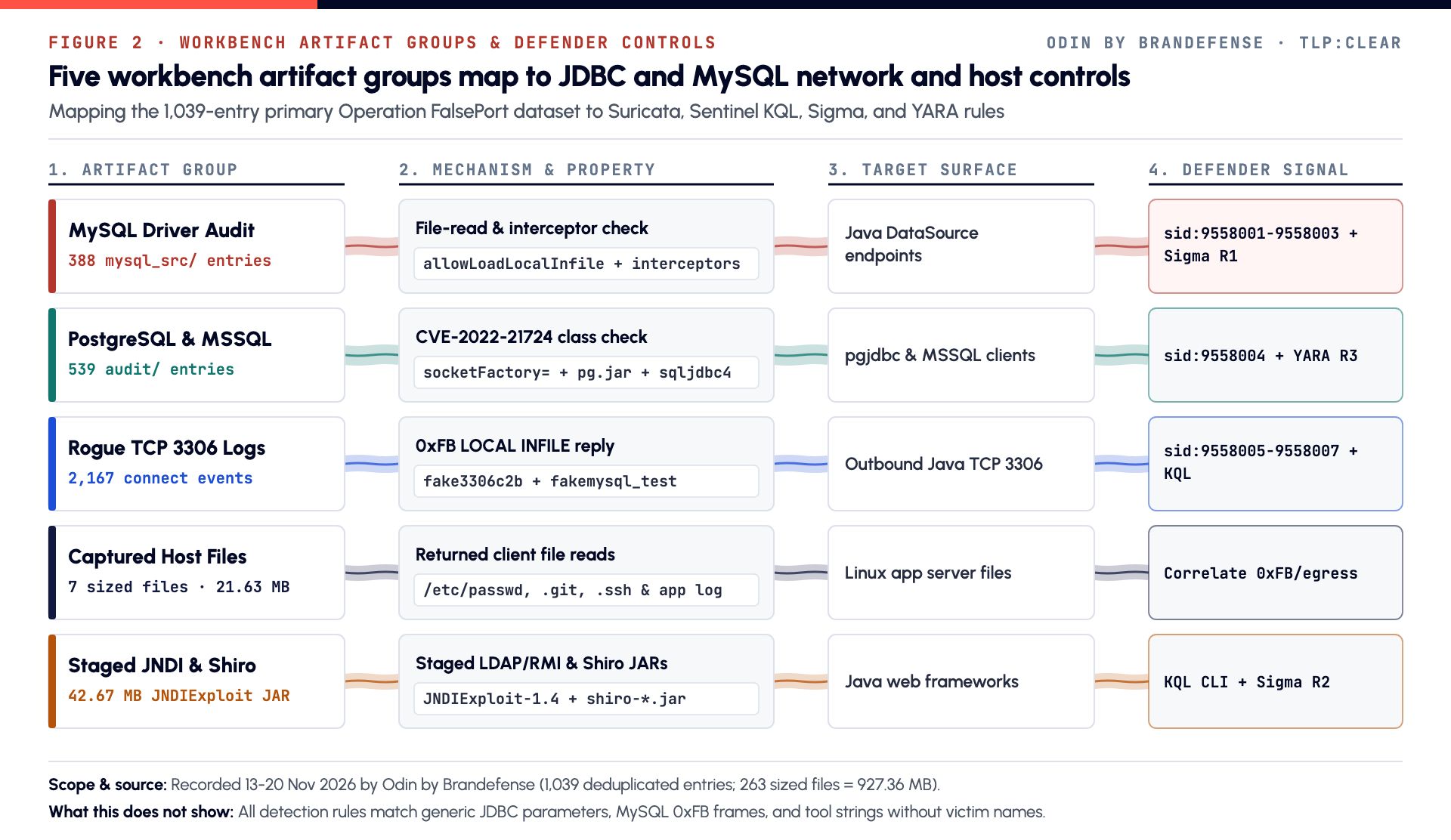
5. Java DataSource and JDBC Exposure Analysis
Platform teams should check four controls across Java web apps and BI tools before treating any gap as a root cause:
| Exposure layer | Observed FalsePort evidence | Control to verify | Risk if unguarded |
|---|---|---|---|
| User-editable JDBC URLs | 388 mysql_src/ + 539 audit/ source entries. | Verify whether admin forms or APIs accept raw jdbc: strings or custom flags ([REF-09]). | Users can inject allowLoadLocalInfile=true, autoDeserialize=true, or socketFactory=. |
| Outdated JDBC drivers | Logged mysql-connector-java-8.0.28; staged pg.jar & src_pg/. | Verify whether WAR/JAR builds ship Connector/J <= 8.1.0 (CVE-2023-22102) or pgjdbc < 42.2.25 / 42.3.2 (CVE-2022-21724). | Old drivers allow client driver abuse or unchecked class loading ([REF-01], [REF-05]). |
| Java TCP 3306 egress | 2,167 == connect from events across 2 TCP 3306 logs. | Verify whether Java subnets can open outbound TCP 3306, 5432, or 1389 sessions to public IPs. | Edited DataSource tests reach external fake MySQL or LDAP ports. |
| JVM file permissions | 7 captures (21.63 MB): /etc/passwd, 2 SSH keys, Git creds, log. | Verify whether JVM accounts can read .ssh/, .git-credentials, and verbose logs ([REF-10]). | One 0xFB exchange returns SSH keys, repo tokens, and app logs. |
6. Alternative Hypotheses
| Hypothesis | Evidence for | Evidence against | Assessment |
|---|---|---|---|
| 2,167 connects equal 2,167 affected Java hosts | fake3306c2b.log (1,145) and fakemysql_test.log (1,022) log 2,167 connects. | Public TCP 3306 ports draw constant bot scans; fake3306c2b.log logs 1 mysql-connector-java-8.0.28 query session, and 7 sized captures sit on disk. | Unsupported. 2,167 mixes internet scan hits with real JDBC callbacks. |
| Shared operator with the India TCP 8001 VPS | Both hosts were open on 20 November 2026 and target MySQL JDBC clients. | Comparing 267 primary hashes with 506 India VPS hashes yields 0 shared non-public hashes, and toolsets differ (java-chains + MySQL_Fake_Server). | Unlinked parallel host. Nothing links the two operators. |
| Authorized driver security research | 89.22% of entries (927 / 1,039) sit in audit/ and mysql_src/. | Runs public TCP 3306 listeners and keeps 7 captured target files (/etc/passwd, SSH keys, Git creds, 21.59 MB log) on an open cloud host. | Contradicted. Keeping third-party keys and logs on an open server breaks testing rules. |
Confirmed attacks via pgjdbc, MSSQL, Shiro, or JNDI | Stages src_pg/, pg.jar, sqljdbc4.jar, shiro-*.jar, and JNDIExploit-1.4-SNAPSHOT.jar. | Stored logs record TCP 3306 MySQL traffic only; no PostgreSQL, MSSQL, Shiro, or LDAP callback logs appear. | Staged only. Keep staged multi-engine and JNDI files separate from observed MySQL captures. |
7. Validated Detection Rules
Both server IPs, all client IPs, and all 267 + 506 SHA-256 digests are withheld. Defenders should deploy protocol, HTTP body, and process rules that catch this tradecraft on any host. Every rule passed checks on Suricata 7.0.12 (suricata -T and linter, 0 problems), Microsoft Kusto.Language (0 errors), pySigma (3 rules), and YARA-X (4 filesize-bounded rules).
7.1 Suricata 7.x Network Signatures (sid:9558001–9558007)
Rules sid:9558001–9558004 match inbound HTTP POST bodies holding jdbc:mysql: or jdbc:postgresql: URLs with allowLoadLocalInfile=true, autoDeserialize=true, queryInterceptors=, or socketFactory=. They need cleartext HTTP or a TLS reverse proxy, and URL-encoded form data needs WAF decoding.
Rules sid:9558005–9558007 match server-to-client TCP packets (flow:established,to_client) holding MySQL LOCAL INFILE bytes |01 fb| for /etc/passwd, .git-credentials, or .ssh/id_. They inspect cleartext MySQL streams (fake servers skip TLS) and do not see TLS MySQL traffic. Because alert rules do not block inline, enforce blocks in the WAF or firewall.
# Odin by Brandefense - Monograph 58 (Operation FalsePort) Suricata 7.x Ruleset
# Validated against Suricata 7.0.12 (-T) and Odin Suricata linter (0 problems).

alert http $EXTERNAL_NET any -> $HOME_NET any (msg:"ODIN-R58 FalsePort Inbound MySQL JDBC allowLoadLocalInfile Tampering"; flow:established,to_server; http.method; content:"POST"; bsize:4; http.request_body; content:"jdbc:mysql:"; nocase; content:"allowLoadLocalInfile=true"; nocase; fast_pattern; classtype:web-application-attack; sid:9558001; rev:1;)
alert http $EXTERNAL_NET any -> $HOME_NET any (msg:"ODIN-R58 FalsePort Inbound MySQL JDBC autoDeserialize Tampering"; flow:established,to_server; http.method; content:"POST"; bsize:4; http.request_body; content:"jdbc:mysql:"; nocase; content:"autoDeserialize=true"; nocase; fast_pattern; classtype:web-application-attack; sid:9558002; rev:1;)
alert http $EXTERNAL_NET any -> $HOME_NET any (msg:"ODIN-R58 FalsePort Inbound MySQL JDBC queryInterceptors Tampering"; flow:established,to_server; http.method; content:"POST"; bsize:4; http.request_body; content:"jdbc:mysql:"; nocase; content:"queryInterceptors="; nocase; fast_pattern; classtype:web-application-attack; sid:9558003; rev:1;)
alert http $EXTERNAL_NET any -> $HOME_NET any (msg:"ODIN-R58 FalsePort Inbound PostgreSQL JDBC socketFactory Tampering"; flow:established,to_server; http.method; content:"POST"; bsize:4; http.request_body; content:"jdbc:postgresql:"; nocase; content:"socketFactory="; nocase; fast_pattern; classtype:web-application-attack; sid:9558004; rev:1;)
alert tcp $EXTERNAL_NET any -> $HOME_NET any (msg:"ODIN-R58 FalsePort Rogue MySQL Server 0xFB LOCAL INFILE /etc/passwd Request"; flow:established,to_client; content:"|01 fb|"; content:"/etc/passwd"; distance:0; within:64; fast_pattern; classtype:attempted-recon; sid:9558005; rev:1;)
alert tcp $EXTERNAL_NET any -> $HOME_NET any (msg:"ODIN-R58 FalsePort Rogue MySQL Server 0xFB LOCAL INFILE Git Credentials Request"; flow:established,to_client; content:"|01 fb|"; content:".git-credentials"; distance:0; within:96; fast_pattern; classtype:policy-violation; sid:9558006; rev:1;)
alert tcp $EXTERNAL_NET any -> $HOME_NET any (msg:"ODIN-R58 FalsePort Rogue MySQL Server 0xFB LOCAL INFILE SSH Private Key Request"; flow:established,to_client; content:"|01 fb|"; content:".ssh/id_"; distance:0; within:96; fast_pattern; classtype:attempted-user; sid:9558007; rev:1;)
7.2 Microsoft Sentinel KQL Hunt
Replace the placeholder hosts and IPs in ApprovedAutomationHosts and ApprovedExternalDatabaseIPs with your exact CI servers and external SQL hosts before scheduling.
// Odin by Brandefense - Monograph 58 (Operation FalsePort)
// Hunts Java processes initiating unapproved external TCP 3306 MySQL sessions and CLI invocations with risky JDBC properties or rogue listener tools.
let Lookback = 7d;
let ApprovedAutomationHosts = dynamic(["app-ci-01.corp.example", "db-etl-01.corp.example"]);
let ApprovedExternalDatabaseIPs = dynamic(["198.51.100.10", "198.51.100.11"]);
let SuspiciousJdbcOrListenerProcess =
    DeviceProcessEvents
    | where Timestamp >= ago(Lookback)
    | where not(DeviceName in~ (ApprovedAutomationHosts))
    | where (
        ProcessCommandLine has_any ("allowLoadLocalInfile=true", "autoDeserialize=true", "queryInterceptors=", "socketFactory=", "authenticationPluginClassName=")
        or ProcessCommandLine has_any ("JNDIExploit", "MySQL_Fake_Server", "java-chains", "fakemysql")
    )
    | project Timestamp, DeviceName, AccountName, SignalType = "RiskyJdbcOrListenerCLI", Detail = ProcessCommandLine;
let UnapprovedJavaMySqlEgress =
    DeviceNetworkEvents
    | where Timestamp >= ago(Lookback)
    | where not(DeviceName in~ (ApprovedAutomationHosts))
    | where InitiatingProcessFileName in~ ("java", "java.exe")
    | where RemoteIPType == "Public" and RemotePort == 3306
    | where not(RemoteIP in (ApprovedExternalDatabaseIPs))
    | project Timestamp, DeviceName, AccountName = InitiatingProcessAccountName, SignalType = "UnapprovedJavaPublic3306Egress", Detail = strcat(InitiatingProcessFileName, " -> ", RemoteIP, ":", tostring(RemotePort));
union SuspiciousJdbcOrListenerProcess, UnapprovedJavaMySqlEgress
| summarize FirstSeen = min(Timestamp), LastSeen = max(Timestamp), EventCount = count(), Signals = make_set(SignalType, 6), SampleDetails = make_set(Detail, 5) by DeviceName, AccountName
| order by LastSeen desc
7.3 Portable Sigma and YARA Rules
- Sigma (
sigma_falseport_jdbc_tampering_and_rogue_mysql.yml). Rule 1 catches/javaCLI flagsallowLoadLocalInfile=true,autoDeserialize=true,queryInterceptors=,socketFactory=, orauthenticationPluginClassName=. Rule 2 catchesJNDIExploit,MySQL_Fake_Server,java-chains,fakemysql, orfake3306runs. Rule 3 catches child processes of/javanaming/etc/passwd,.git-credentials,.ssh/id_rsa, or.ssh/id_ed25519. Pair Rule 3 withsid:9558005–9558007 because directLOCAL INFILEreads stay inside the JVM. - YARA (
odin_falseport_rogue_mysql_and_jdbc_audit.yar). Fourfilesize-bounded generic rules match0xFBLOCAL INFILEscripts, stored rogue MySQL logs, multi-engine JDBC audit scripts, andJNDIExploitorjava-chainsoutputs and configs.
8. Behavioral and Protocol Hunt Markers (0 Published IPs or Workbench SHA-256s)
No server IPv4 addresses or workbench SHA-256 digests appear in the indicator feeds because both servers hold captured target files. Defenders should hunt with the 10 protocol, JDBC, and host markers below.
| Marker category | Pattern / protocol artifact | Layer | Defensive hunt & control |
|---|---|---|---|
| MySQL JDBC file-read flag | allowLoadLocalInfile=true | HTTP / JVM | Reject in DataSource URL checks; alert on visible HTTP POST bodies (sid:9558001). |
| MySQL JDBC deserialize flag | autoDeserialize=true | HTTP / JVM | Strip from user jdbc:mysql: URLs; alert via sid:9558002 and Sigma Rule 1. |
| MySQL 8.x interceptor flag | queryInterceptors= | HTTP / JVM | Reject custom interceptors in jdbc:mysql: URLs; alert via sid:9558003. |
PostgreSQL pgjdbc sink | socketFactory= (CVE-2022-21724) | HTTP / JVM | Upgrade pgjdbc to >= 42.2.25 / 42.3.2 and alert on POST bodies (sid:9558004). |
Rogue MySQL 0xFB packet | |01 fb| + /etc/passwd | TCP 3306 | Alert on cleartext server LOCAL INFILE requests (sid:9558005) and block egress. |
Rogue MySQL 0xFB packet | |01 fb| + .git-credentials | TCP 3306 | Alert on cleartext LOCAL INFILE Git credential reads (sid:9558006). |
Rogue MySQL 0xFB packet | |01 fb| + .ssh/id_ | TCP 3306 | Alert on cleartext LOCAL INFILE SSH key requests (sid:9558007) and isolate JVM users. |
| Connector/J session query | SELECT @@session.auto_increment_increment | TCP 3306 | Hunt unapproved outbound Java TCP 3306 sessions to public IPs (Sentinel KQL). |
| Staged JNDI archive | JNDIExploit-1.4-SNAPSHOT.jar (42.67 MB) | Linux EDR | Alert on CLI runs via Sentinel KQL and Sigma Rule 2. |
| Parallel rogue MySQL suite | MySQL_Fake_Server / java-chains | Linux EDR | Sweep hosts and lab VMs for fake MySQL and Java gadget suites (Sigma Rule 2, YARA Rule 4). |
9. Hardening Priorities for Java Platforms and Database Teams
Security and platform teams should close DataSource URL checks, driver patches, and egress gaps together:
- Lock down DataSource URLs and disable
LOCAL INFILE(0–48 Hours). Buildjdbc:URLs from checked host, port, and database fields rather than raw user input ([REF-09]). StripallowLoadLocalInfile,autoDeserialize,queryInterceptors, andsocketFactory. ForceallowLoadLocalInfile=false,allowUrlInLocalInfile=false,allowLoadLocalInfileInPath="", andautoDeserialize=falsein code ([REF-03],[REF-04]). - Patch MySQL Connector/J, PostgreSQL
pgjdbc, and Shiro (0–72 Hours). Upgrade MySQL Connector/J to8.2.0or later. That patch fixesCVE-2023-22102([REF-01]) andCVE-2021-2471(fixed in8.0.27,[REF-02]). Upgradepgjdbcto42.2.25or42.3.2or later (CVE-2022-21724,[REF-05],[REF-06]), replace oldsqljdbc4.jarfiles withmssql-jdbcusingencrypt=true;trustServerCertificate=false([REF-07]), and check Apache Shiro ([REF-08]). - Block outbound SQL and JNDI ports from JVM subnets (
Days 1–7). Stop web and BI hosts from opening outbound TCP 3306, 5432, 1433, 1099, or 1389 sessions to public IPs. Use default-deny internet egress on JVM VLANs so custom fake MySQL ports also fail. - Isolate JVM accounts from keys, Git stores, and verbose logs (
Days 7–14). Run Spring Boot and Java apps under dedicatednologinLinux users with empty home folders ([REF-10]). Keep.ssh/id_*keys and.git-credentialsoff app hosts, and scrub secrets from app logs. - Deploy wire and host detections (
Days 7–30). Deploy Suricatasid:9558001–9558007 behind TLS proxies and on egress links. Schedule the Sentinel KQL hunt and scan build hosts with the bounded YARA rules.
10. Scope, Limits, and External References
Odin by Brandefense analyzed workbench files recorded on 13–20 November 2026. Primary counts cover all 1,039 deduplicated entries: 263 sized files (927,357,421 bytes) plus 776 unsized entries (485 active files and 32 folders reported on 20 November 2026).
Inbound == connect from totals (2,167 across two TCP 3306 logs) mix automated internet scan noise with real JDBC client sessions. Folder listings alone do not tie each of the seven captured files to a specific log line or count affected organizations. Both server IPv4 addresses, all 267 + 506 SHA-256 digests, client IPs, and captured filenames are withheld.
[REF-01]NIST NVD, *CVE-2023-22102 - Oracle MySQL Connector/J (8.1.0 and prior)* (verified on 24 November 2026).[REF-02]NIST NVD, *CVE-2021-2471 - Oracle MySQL Connector/J (8.0.26 and prior)* (verified on 24 November 2026).[REF-03]Oracle MySQL Documentation, *MySQL Connector/J Developer Guide: Security Connection Properties* (verified on 24 November 2026).[REF-04]Oracle MySQL Documentation, *MySQL 8.0 Reference Manual: Security Considerations for LOAD DATA LOCAL* (verified on 24 November 2026).[REF-05]NIST NVD, *CVE-2022-21724 - PostgreSQL JDBC Driver (pgjdbc) Unchecked Class Instantiation* (verified on 24 November 2026).[REF-06]PostgreSQL JDBC (pgjdbc) Security Advisory, *GHSA-v7wg-cpwc-24m4: Arbitrary Class Instantiation via Connection Properties* (verified on 24 November 2026).[REF-07]Microsoft Learn, *Understanding Encryption Support - Microsoft JDBC Driver for SQL Server* (verified on 24 November 2026).[REF-08]Apache Software Foundation, *Apache Shiro Security Reports* (verified on 24 November 2026).[REF-09]MITRE ATT&CK, *Exploit Public-Facing Application (T1190)* (verified on 24 November 2026).[REF-10]MITRE ATT&CK, *Data from Local System (T1005)* (verified on 24 November 2026).
What is…?
Short explanations of the tools and families named in this study.
Frequently asked questions
How was the 1,039-entry FalsePort workbench organized, and how does the India VPS compare?
On 20 November 2026, the open directory on the China-hosted server reported 485 active files across 32 folders. Across the 13–20 November 2026 snapshots, the deduplicated dataset holds 1,039 entries. Those entries span 263 sized files (927,357,421 bytes, or 927.36 MB) and 776 unsized entries across 267 unique SHA-256 digests.
How do multi-engine JDBC audits, TCP 3306 logs, and seven captured files fit together?
Three artifact groups on the primary server show how driver code review pairs with live rogue MySQL listeners. Staged JARs and stored TCP 3306 logs play distinct roles on disk:
What should Java platform and security teams do first?
Java architects and SOC teams can close this JDBC client attack surface with three direct actions. Each step cuts a link in the rogue-listener workflow: