
1. Executive Summary
In short
Operation SapperSync ran on an East Asian cloud server on TCP 9099 recorded on 13–20 November 2026. Odin by Brandefense analyzed 400 deduplicated entries totaling 435.30 MB across 199 sized files. The workbench holds staged AI skill packs, 11 ImageMagick MSL scripts, eight Alpine layers, and one 6 November ownCloud 10.13.0.4 diagnostic report. Block MSL coders in policy.xml, update ownCloud Graph API to 0.2.1 or 0.3.1, sign agent skills, and enforce read-only containers.
Enterprise stacks now place AI agent skill loaders beside image converters and containerized file shares. Each service accepts user archives or media uploads inside Linux containers. Weak upload rules, open ImageMagick policies, or writable container roots give attackers room to test several paths at once.
Between 13 and 20 November 2026, Odin by Brandefense examined an open HTTP directory on TCP port 9099. That directory sat on an East Asian virtual private server. On 20 November 2026, the listing reported 399 active files and 23 directories.
Across captures from 13 to 20 November 2026, deduplication yields 400 unique entries. Those entries include 199 sized files totaling 435,295,482 bytes (435.30 MB) and 201 unsized entries. Hashing identifies 190 unique SHA-256 digests across the sized files.
The server holds a diagnostic report from an external ownCloud host and logs third-party scanner hits. Odin by Brandefense publishes zero IPv4 addresses and zero workbench SHA-256 digests. The server address, scanner addresses, diagnostic filename, transfer filenames, and container hostname are withheld.
Local-upload AI agent skill archives sit beside a 54-skill catalogue slice.
The root folder holds a 918,252-byte full skills JSON index and a 251,977-byte slice with 54 skills. Two identical test ZIP files unpack to 290 bytes each and mark their origin as a local upload. A 5,304-byte shell script prepares the Sapper environment. These staged files show preparation, not confirmed use against an external AI platform.
Eleven ImageMagick MSL scripts pair with PNG and PHP upload tests.
Seven sized MSL scripts total 128,802 bytes alongside four unsized MSL entries. The root folder also holds 15 PNG files across three content classes and 13 PHP-family files. These files align with known image-coder policy risks and PNG profile-chunk read flaws.
Eight Alpine Linux tarballs model startup and cron persistence.
A persistence folder holds 10 sized files totaling 3,735,731 bytes, led by eight numbered tarballs. Those layers add an Alpine BusyBox rootfs, version and hotfix markers, and a wrapper entrypoint. Two hidden scripts target PHP web cache paths and database variables on startup and every 15 minutes.
One ownCloud 10.13.0.4 diagnostic report confirms external output without proving initial access.
The root folder holds a 349,235-byte diagnostic file dated 6 November 2026 from containerized ownCloud 10.13.0.4 Community. It also holds a 1,986-line HTTP hit log. Older ownCloud builds carried vulnerable graphapi vendor files, yet this report alone does not show how access occurred.
Three Decisions for Security Leaders
- Require signed AI agent skill packages from internal repositories. Disable ad-hoc local ZIP uploads on production agent gateways. Verify skill signatures in CI and run agent tools in isolated sandboxes.
- Lock down ImageMagick policy files and patch ownCloud appliances. Block MSL, MVG, TEXT, HTTPS, and indirect coders in ImageMagick policy files and update past PNG profile flaws. Update ownCloud Graph API to 0.2.1 or 0.3.1 (bundled from 10.13.1), delete GetPhpInfo.php, and rotate container secrets.
- Enforce read-only container root filesystems and immutable digests. Mount container root filesystems read-only so web workers cannot write startup scripts or cron jobs. Pin images by SHA-256 digest and monitor hidden binary paths.
2. Workbench Architecture, 400-Entry Inventory, and Operational Context
Operation SapperSync takes its name from two staged files on the TCP 9099 East Asian cloud server (address withheld). Those files are /deploy_sapper_v2.sh (5,304 bytes) in root and usr/local/bin/.agent_sync (1,471 bytes unpacked) inside /la/L6.tgz. Defenders can use cyber threat intelligence to track how operators pair new AI skill tests with container persistence.
On 20 November 2026, the open HTTP directory on TCP 9099 reported 399 active files and 23 directories. Across captures recorded on 13–20 November 2026, deduplication yields 400 unique entries. One transient entry from an earlier capture rotated out before the 20 November listing.
Teams can also apply vulnerability intelligence when reviewing the ImageMagick and ownCloud version context tied to these files. Figure 1 maps the four workbench tracks and withholding rules.
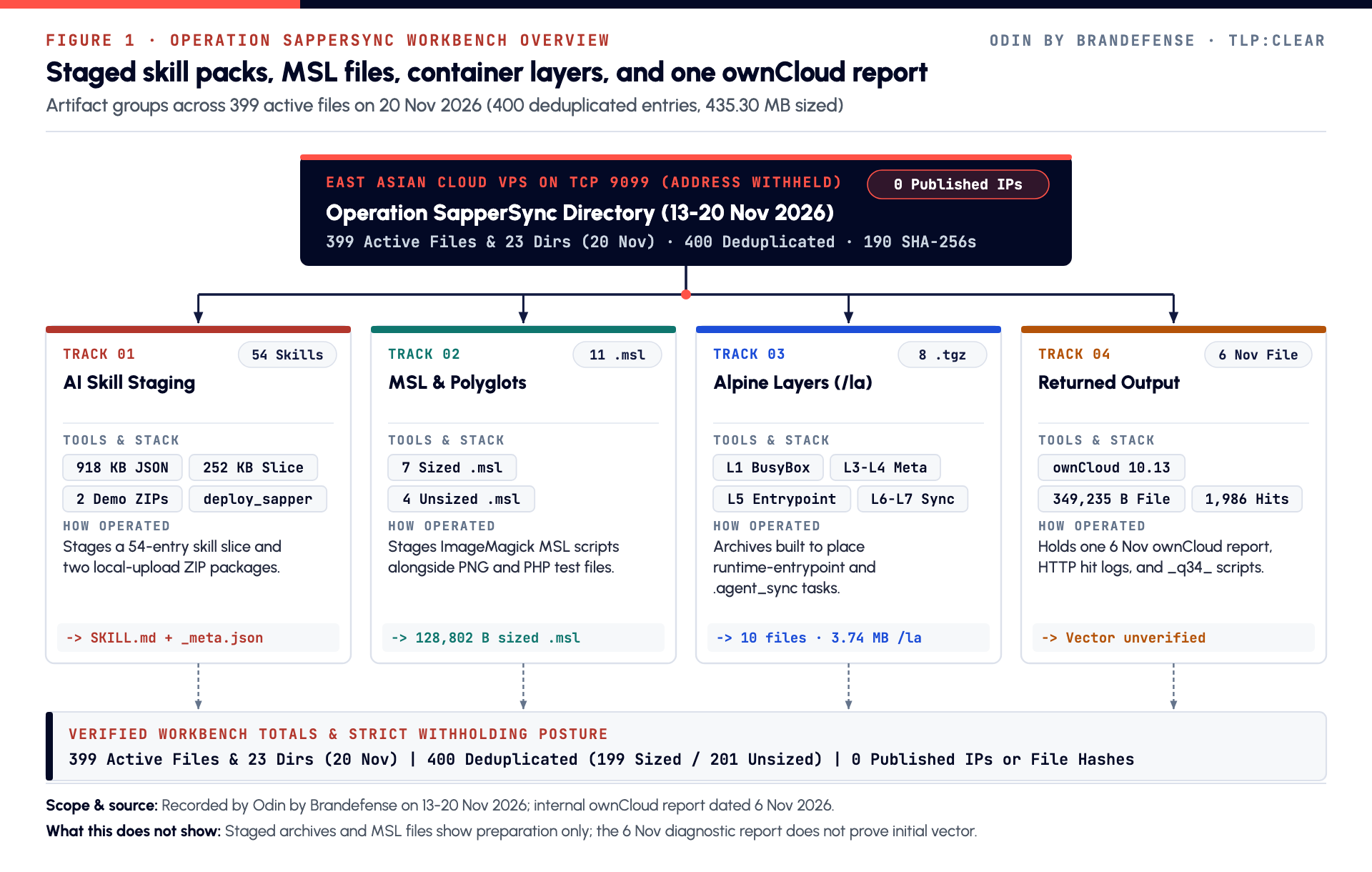
Workspace Zone Partition and File-Class Breakdown (n = 400)
Within the 400 deduplicated entries, 199 sized files total 435,295,482 bytes (435.30 MB). The remaining 201 entries omit byte sizes in directory listings.
The 199 sized files span 190 unique SHA-256 digests, all withheld. Nine sized files are exact byte duplicates, including the twin demo-skill.zip and demo.zip archives. Table 1 reconciles all 400 entries across the five top-level zones.
| Workspace zone | Deduplicated entries | Share (%) | Sized files | Unsized entries | Sized bytes | Operational role on TCP 9099 |
|---|---|---|---|---|---|---|
Root Workspace (root) | 387 | 96.75% | 189 | 198 | 431,559,751 | Staging scripts, 11 .msl files, 54-skill slice, 2 skill ZIPs, 6 Nov ownCloud report (349,235 B), and 1,986 hit lines. |
Alpine Layers /la | 10 | 2.50% | 10 | 0 | 3,735,731 | Holds 8 numbered .tgz layers (L1.tgz–L8.tgz, 3,733,376 B) plus 2 sized companion files (2,355 B). |
Task Folder /q33 | 1 | 0.25% | 0 | 1 | 0 | Subfolder holding the unsized Python script /q33/patch33.py. |
Output Folder /q33o | 1 | 0.25% | 0 | 1 | 0 | Companion output subfolder holding 1 unsized entry. |
Multiplexer /tmux-0 | 1 | 0.25% | 0 | 1 | 0 | Terminal multiplexer folder holding 1 unsized session socket entry. |
| Total deduplicated set | 400 | 100.00% | 199 | 201 | 435,295,482 | Matches 399 active files and 23 dirs on 20 Nov 2026 (190 SHA-256s withheld). |
Most workbench activity sits directly in root. The root zone holds 96.75% of entries (387 of 400) and 99.14% of sized bytes (431,559,751 bytes). Only /la holds sized subdirectory files (10 files, 3,735,731 bytes).
Table 2 reconciles the exact same 400 deduplicated entries (199 sized files, 201 unsized entries, 435,295,482 bytes) across six mutually exclusive content classes.
| Artifact class | Deduplicated entries | Share (%) | Sized files | Unsized entries | Sized bytes | Representative extensions & contents |
|---|---|---|---|---|---|---|
Text, HTML & MSL (text) | 187 | 46.75% | 106 | 81 | 7,026,344 | Led by 74 .html, 30 extensionless, 19 .txt, 11 .json, 10 .log, 10 .out, 8 .png, 7 sized .msl, 5 .jar, and 4 .b64 files. |
Operator Scripts (script) | 157 | 39.25% | 75 | 82 | 5,103,159 | Exact split: 82 .py, 57 .sh, 10 .php, 6 .js, 1 .png, and 1 .phtml. |
Unsized & Polyglots (other) | 31 | 7.75% | 0 | 31 | 0 | Exact split: 15 extensionless, 4 unsized .msl, 3 .b64, 3 .out, 1 .sock, 1 .lock, 1 .hdr, 1 .533805, 1 .php5, and 1 .phar. |
Archives (archive) | 14 | 3.50% | 12 | 2 | 423,164,869 | Exact split: 9 .tgz (including /la/L1.tgz–L8.tgz), 3 .gz, and 2 .zip (demo-skill.zip, demo.zip); 97.21% of sized bytes. |
Image Fixtures (image) | 7 | 1.75% | 2 | 5 | 74 | Exact split: 6 .png and 1 .gif small image test files. |
Keys & Secrets (secret) | 4 | 1.00% | 4 | 0 | 1,036 | Exact split: 2 extensionless key files, 1 .openssh key, and 1 .pem key (withheld). |
| Total deduplicated set | 400 | 100.00% | 199 | 201 | 435,295,482 | Exact byte-level parity with Table 1 (435.30 MB). |
Figure 5 shows how entry counts and byte volume split across these six classes. Text outputs (187) and scripts (157) make up 86.00% (344 of 400) of entries. Archives (14 entries, 12 sized) hold 97.21% (423,164,869 bytes) of sized bytes.
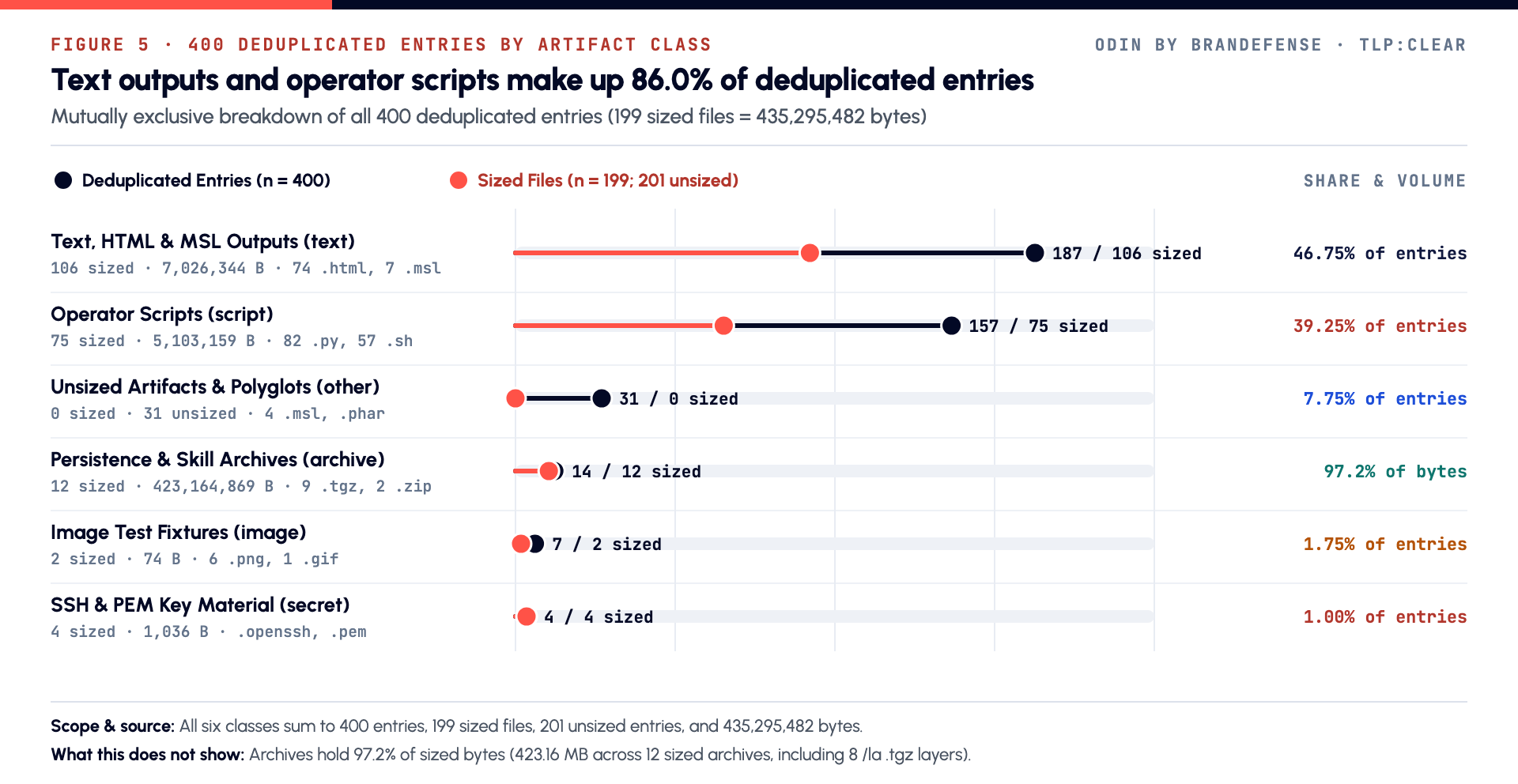
Iterative Script Waves (_q34_* and ch*.py) and the 1,986-Line Hit Log
File names and sizes across the 157 scripts (82 .py and 57 .sh) show an iterative testing workflow rather than one commercial tool. Table 3 summarizes the script groups and root access log.
| Script or log group | Representative files | Recorded byte range | Role on workbench |
|---|---|---|---|
Sapper & _q34_* shell set | /deploy_sapper_v2.sh, /_q34_recon.sh, /bruteforce.sh, /_q34_s2.sh–s38.sh | 687–5,304 B | Environment setup and numbered target recon tasks. |
_q34_* Python analyzers | /analyze_34.py, /_q34_diff.py, /_q34_rhythm.py, /_q34_mem2.py, /_q34_mem.py | 528–1,981 B | Response diffing, timing analysis, and memory checks. |
ch*.py & helper utilities | /ch.py–/ch11.py, /count_loki.py, /dbg.py, /q33/patch33.py | 201–2,005 B (plus unsized) | Channel tests, log counting, and state debugging. |
| Root HTTP hit log | Root HTTP access log (1,986 lines) | 1,986 lines | Records inbound hits on TCP 9099; scanner IPs withheld. |
3. AI Agent Skill Staging and ImageMagick MSL Upload Artifacts
Two staged artifact sets in root target web upload and agent ingestion workflows ([REF-06], [REF-08]). One set prepares local-upload AI agent skill archives. The second set prepares ImageMagick .msl, PNG, and PHP polyglot files.
Figure 3 models how these staged sets (dashed arrows) sit beside the verified captures on TCP 9099 (solid arrows).
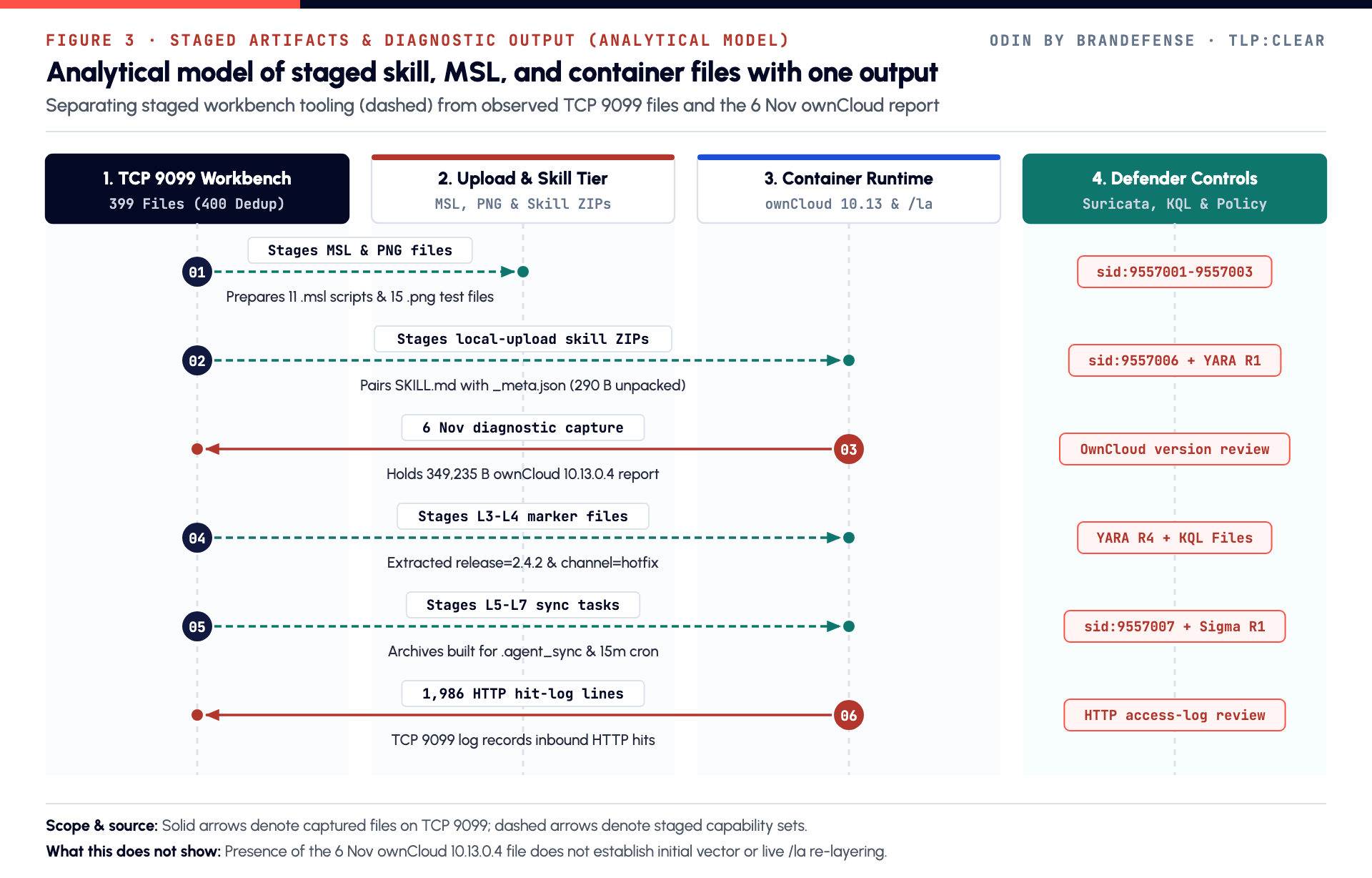
AI Agent Skill Catalogue Slices (54 Skills) and local-upload ZIPs (290 B Unpacked)
Many AI agent platforms load skills from portable ZIP packages. Each package usually pairs a SKILL.md instruction file with a _meta.json manifest and optional scripts. When an agent gateway allows unsigned local uploads (source=local-upload), an untrusted ZIP can alter agent prompts or tool calls ([REF-06], [REF-09]).
Four artifacts define the SapperSync skill-staging track:
- Full skills catalogue (918,252 bytes). A root JSON file stores 918,252 bytes of skill registry definitions. It provides a reference for manifest fields and package layout.
- Filtered 54-skill slice (251,977 bytes). A second JSON file keeps 251,977 bytes covering 54 selected skill entries.
- Twin
local-uploadarchives (demo-skill.zipanddemo.zip). Both.zipfiles in thearchiveclass unpack to 290 bytes. They hold identical test content pairingSKILL.mdwith_meta.json(source=local-upload). - Deployment script (
/deploy_sapper_v2.sh, 5,304 bytes). This root shell script handles staging setup. No returned logs on the server show external ingestion ofdemo-skill.zipordemo.zip, so this set remains staged preparation.
Eleven ImageMagick .msl Scripts (128,802 Sized Bytes), 15 PNGs, and PHP Variants
Web portals and file-sharing apps often call ImageMagick (magick or convert) to resize avatars and build previews. Unhardened ImageMagick deployments create two well-known upload risks ([REF-01], [REF-02], [REF-03]):
- Enabled script coders (
CVE-2016-3714andMSL,[REF-02],[REF-03]). ImageMagick 6.x before6.9.3-10and 7.x before7.0.1-1allowed unsafe delegate calls (CVE-2016-3714). Newer builds still include Magick Scripting Language (MSL), an XML coder supporting<image>,<read>, and<write>tags. Unlesspolicy.xmlblocksMSL,MVG,TEXT, andHTTPS([REF-03]),MSLinputs can read local files or write files into web folders ([REF-06]). - PNG profile-chunk file disclosure (
CVE-2022-44268,[REF-01]). In ImageMagick7.1.0-49, parsing a PNG with a craftedprofiletext chunk embeds local file bytes inside the resized output PNG. Upstream releases7.1.0-52and6.9.12-67fixed this flaw ([REF-01]).
Table 4 lists all 11 .msl entries alongside the cross-class PNG and PHP-family files staged in root.
| Staged file or group | Class | Count | Recorded size (bytes) | Structural role in upload testing |
|---|---|---|---|---|
/e_z4.msl | text (sized) | 1 | 64,064 | Padded 64 KB ImageMagick MSL XML script in root. |
/e_z6.msl | text (sized) | 1 | 64,062 | Companion 64 KB MSL variant two bytes shorter than /e_z4.msl. |
/d.msl | text (sized) | 1 | 181 | Compact 181-byte MSL directive test file. |
/z4.msl, /z2.msl, /a.msl, /b.msl | text (sized) | 4 | 495 (151+127+111+106) | Four small MSL XML templates testing <read> and <write> tags. |
/p.msl, /z1.msl, /z3.msl, /z6.msl | other (unsized) | 4 | Unsized (0 sized B) | Four additional MSL files without recorded byte sizes. |
Cross-class .png files | text (8), image (6), script (1) | 15 | In class totals | 15 .png files spanning text-bearing, minimal (74 B), and script polyglot tests. |
| PHP-family extensions | script (11), other (2) | 13 | In class totals | 10 .php, 1 .phtml, 1 .php5, and 1 .phar testing upload extension filters ([REF-06]). |
The seven sized .msl files sum to 128,802 bytes, and four unsized .msl files bring the total to 11. Splitting 15 .png files across text (8), image (6), and script (1) reflects polyglot testing. Valid PNG headers or chunks can wrap XML or script text to test naive MIME checks ([REF-06], [REF-10]).
4. Layered Alpine Container Persistence and Returned ownCloud Output
Two other workbench components connect container-layer design with external appliance output. The /la folder holds 10 sized files (3,735,731 bytes), and root holds a returned ownCloud 10.13.0.4 Community diagnostic report (349,235 bytes, dated 6 November 2026). Figure 4 shows the TCP 9099 workspace and /la archive stack.
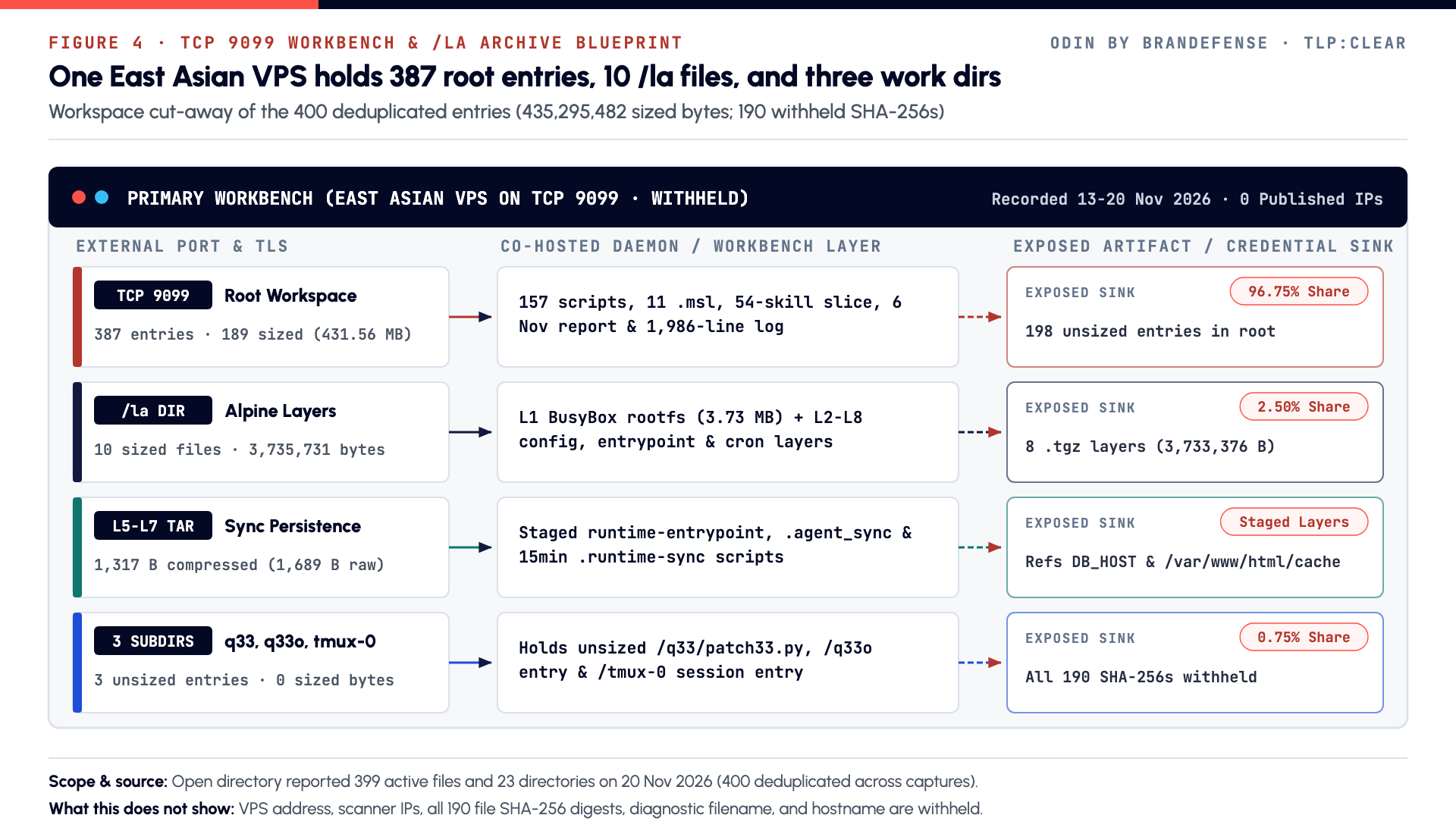
Inside /la/L1.tgz Through /la/L8.tgz (3,733,376 Compressed Bytes)
Inside /la, eight numbered .tgz files (L1.tgz through L8.tgz) total 3,733,376 compressed bytes. Two small companion files (2,355 bytes) complete the 10-file, 3,735,731-byte directory.
Each tarball mirrors an incremental OCI or Docker image layer ([REF-07]). Together they disguise hidden startup and cron scripts behind routine release=2.4.2 and channel=hotfix markers ([REF-09], [REF-10]). Table 5 describes all eight layers without printing shell code.
| Archive path | Compressed (B) | Unpacked size / members | Target container path | Structural description |
|---|---|---|---|---|
/la/L1.tgz | 3,731,518 | 7,800,274 B (87 members) | bin/busybox, etc/apk/* | Alpine Linux BusyBox root filesystem layout (bin/busybox 808,712 B and etc/apk keys). |
/la/L2.tgz | 142 | Compact layer | Base config path | Compact 142-byte configuration layer archive. |
/la/L3.tgz | 181 | 14 B (1 file) | opt/runtime/VERSION | Single-file tar writing release=2.4.2 to opt/runtime/VERSION. |
/la/L4.tgz | 184 | 15 B (1 file) | opt/runtime/CHANNEL | Single-file tar writing channel=hotfix to opt/runtime/CHANNEL. |
/la/L5.tgz | 148 | 148 B (1 file) | usr/local/bin/runtime-entrypoint | POSIX shell entrypoint wrapper built to invoke /usr/local/bin/.agent_sync and sleep hourly. |
/la/L6.tgz | 912 | 1,471 B (1 file) | usr/local/bin/.agent_sync | Hidden script referencing APP_ENV, DB_HOST, DB_PORT, and /var/www/html/cache. |
/la/L7.tgz | 257 | 70 B (1 file) | etc/periodic/15min/.runtime-sync | BusyBox 15-minute cron task built to invoke /usr/local/bin/.agent_sync. |
/la/L8.tgz | 34 | Minimal marker | Layer marker | Minimal 34-byte marker archive closing the eight-layer set. |
Companion /la files (2) | 2,355 | Sized metadata | /la/* | Two remaining sized entries (3,733,376 + 2,355 = 3,735,731 B across 10 files). |
Three design choices in L5.tgz through L7.tgz stand out for container defenders ([REF-07]):
- Redundant startup and 15-minute cron triggers.
L5.tgzplacesusr/local/bin/runtime-entrypointto launch.agent_syncat container boot and loop hourly.L7.tgzplacesetc/periodic/15min/.runtime-syncso BusyBoxcrondre-runs.agent_syncevery 15 minutes ([REF-09]). - Dot-prefixed hidden filenames (
[REF-10]). Both.agent_syncand.runtime-syncstart with a leading dot. Standardlschecks without-askip them, whileopt/runtime/VERSIONandopt/runtime/CHANNELmimic a benign hotfix. - PHP web-container variable references. The 1,471-byte unpacked script in
L6.tgzreferencesAPP_ENV,DB_HOST,DB_PORT, and/var/www/html/cache. Those names match containerized PHP apps that pass database settings in environment variables and mount/var/www/html/cachewritable.
Returned 6 November 2026 ownCloud 10.13.0.4 Community Diagnostic File (349,235 Bytes)
The root workspace holds a returned ownCloud diagnostic report (349,235 bytes; filename and hostname withheld). Its internal report date is 6 November 2026, and it identifies ownCloud 10.13.0.4 Community on containerized Linux.
Defenders should separate verified version facts from unproven assumptions about initial entry:
- Containerized ownCloud version context (
CVE-2023-49103,[REF-04],[REF-05]). NIST NVD ([REF-04]) and ownCloud ([REF-05]) documentCVE-2023-49103ingraphapi0.2.x before0.2.1and 0.3.x before0.3.1. The ownCloud 10.13.0 complete bundle included affected Graph API 0.3.0; the 10.13.1 complete bundle included fixed Graph API 0.3.1. Check separately installed app versions. On containerized hosts, a vendorGetPhpInfo.phpfile under/apps/graphapi/vendor/exposed container environment secrets ([REF-04],[REF-05]). - Initial-access vector remains unverified. Although
10.13.0.4belongs to the10.13.0line, holding a10.13.0.4diagnostic report does not establish how access occurred. Admin diagnostic exports can also follow stolen credentials, session cookies, or reverse-proxy flaws. Likewise, workbench files do not show whether/la/L1.tgz–L8.tgzwere applied to that container.
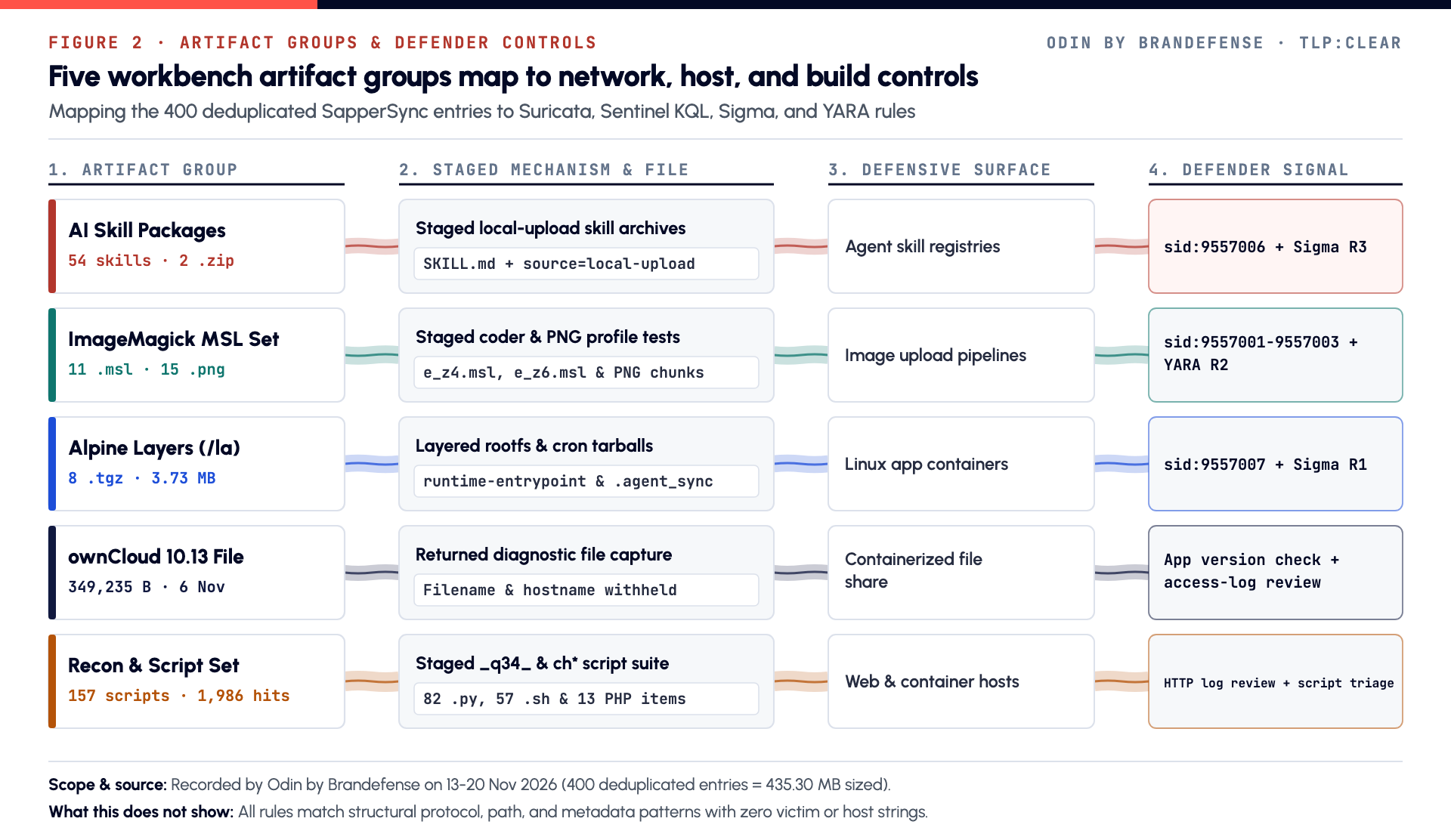
Figure 2 links all five workbench artifact groups to the network, host, and file rules in Chapter 7.
5. Enterprise Upload, Skill Registry, and Container Exposure Analysis
The workbench highlights four defensive control areas. Teams should verify each control in their own environments before treating any gap as an established root cause:
| Exposure layer | Observed SapperSync evidence | Control to verify | Operational risk |
|---|---|---|---|
| AI agent skill registries | 918,252 B catalogue, 251,977 B slice (54 skills), demo-skill.zip & demo.zip (source=local-upload). | Verify whether agent gateways accept unsigned local-upload skill ZIPs or mutable SKILL.md files ([REF-06]). | Untrusted skill packs could steer agent prompts or invoke tools under service accounts. |
| ImageMagick upload pipelines | 11 .msl files (128,802 B sized), 15 .png files, and 13 PHP-family files. | Verify ImageMagick version (>= 7.1.0-52 / 6.9.12-67, [REF-01]) and policy.xml blocks on MSL, MVG, and HTTPS ([REF-03]). | PNG profile chunk reads (CVE-2022-44268) or file read/write via MSL XML tags. |
| Containerized ownCloud hosts | Returned 6 Nov 2026 ownCloud 10.13.0.4 Community report (349,235 B; filename withheld). | Verify graphapi >= 0.2.1 / 0.3.1 (ownCloud >= 10.13.1 complete bundle or app update), removal of GetPhpInfo.php, and secret rotation ([REF-05]). | Container environment disclosure (CVE-2023-49103) or unauthorized admin config export. |
| Container root mutability | /la/L1.tgz–L8.tgz (3,733,376 B) staging runtime-entrypoint, .agent_sync, and 15min/.runtime-sync. | Verify --read-only container root filesystems, image digest pinning, and registry write access ([REF-07]). | Hidden startup wrappers or 15-minute cron tasks reading DB_HOST and /var/www/html/cache. |
6. Alternative Hypotheses
| Hypothesis | Evidence for | Evidence against | Assessment |
|---|---|---|---|
CVE-2023-49103 was the initial vector on the ownCloud 10.13.0.4 host | Returned 6 Nov 2026 report (349,235 B) comes from containerized ownCloud 10.13.0.4 (10.13.0 bundle line, prior to 10.13.1 graphapi 0.3.1; [REF-04], [REF-05]). | No exploit request log for /apps/graphapi/vendor/ appears on the server; admin exports also follow stolen logins or cookies. | Unverified vector. Cite CVE-2023-49103 as version context only, and rotate secrets when patching. |
Staged /la/L1.tgz–L8.tgz layers ran on the external target | L6.tgz references APP_ENV, DB_HOST, DB_PORT, and /var/www/html/cache, matching PHP containers. | Tarballs sit on TCP 9099 without target container logs showing live extraction. | Staged capability. Hunt for .agent_sync and .runtime-sync without claiming live target deployment. |
| Benign developer or CTF test server | Holds demo-skill.zip, ch*.py scripts, and tiny .msl files (106–181 B). | Stores a 349,235-byte external ownCloud 10.13.0.4 report, /deploy_sapper_v2.sh, /bruteforce.sh, hidden .agent_sync layers, and 4 key files. | Contradicted. Pairing external appliance output with hidden persistence layers reflects offensive staging. |
| All 1,986 HTTP hit lines come from targets | Root log records 1,986 inbound HTTP hits on TCP 9099. | Open non-standard cloud ports receive constant automated internet scanning. | Mixed traffic. Scanner IPv4s are third-party noise and are withheld (0 published IPs). |
7. Validated Detection Rules
All server and scanner IPv4 addresses and all 190 workbench SHA-256 digests are withheld. Defenders should deploy protocol, path, and structural file rules that work across any staging host. Every rule passed syntax checks before release, including the Suricata linter (0 problems), Sentinel KQL column validation, three Sigma rules, and four filesize-bounded YARA rules.
7.1 Suricata 7.x Network Signatures (sid:9557001-9557007)
These seven alert rules match multipart .msl uploads (sid:9557001), MSL <image> and <write tags (sid:9557002), and PNG profilex00 keywords (sid:9557003). Rules sid:9557004 and sid:9557005 alert on ownCloud graphapi vendor PHP probes and serverinfo API calls. Rules sid:9557006 and sid:9557007 match SKILL.md local-upload posts and outbound TCP 9099 /la/L*.tgz fetches.
All seven HTTP rules require cleartext traffic or an IDS tap behind a TLS-terminating reverse proxy or forward proxy. Because alert rules do not block inline, enforce active blocks in the WAF, proxy, or firewall.
# Odin by Brandefense - Monograph 57 (Operation SapperSync) Suricata 7.x Ruleset
# Validated against Odin Suricata linter (0 problems): covers MSL uploads, PNG profile chunks, ownCloud diagnostic probes, local-upload skill metadata, and TCP 9099 layer fetches.

alert http $EXTERNAL_NET any -> $HOME_NET any (msg:"ODIN-R57 SapperSync Inbound Multipart ImageMagick MSL File Upload"; flow:established,to_server; http.method; content:"POST"; bsize:4; http.request_body; content:"filename="; content:".msl|22|"; distance:0; nocase; fast_pattern; classtype:web-application-attack; sid:9557001; rev:1;)
alert http $EXTERNAL_NET any -> $HOME_NET any (msg:"ODIN-R57 SapperSync Inbound ImageMagick MSL XML Write Directive"; flow:established,to_server; http.method; content:"POST"; bsize:4; http.request_body; content:"<image>"; nocase; content:"<write "; distance:0; nocase; fast_pattern; classtype:web-application-attack; sid:9557002; rev:1;)
alert http $EXTERNAL_NET any -> $HOME_NET any (msg:"ODIN-R57 SapperSync Inbound PNG Raw Profile Metadata Upload"; flow:established,to_server; http.method; content:"POST"; bsize:4; http.request_body; content:"|89 50 4E 47 0D 0A 1A 0A|"; fast_pattern; content:"profile|00|"; distance:0; classtype:web-application-attack; sid:9557003; rev:1;)
alert http $EXTERNAL_NET any -> $HOME_NET any (msg:"ODIN-R57 SapperSync Inbound ownCloud graphapi Vendor PHP Probe"; flow:established,to_server; http.method; content:"GET"; bsize:3; http.uri; content:"/apps/graphapi/vendor/"; nocase; fast_pattern; content:".php"; distance:0; nocase; classtype:web-application-attack; sid:9557004; rev:1;)
alert http $EXTERNAL_NET any -> $HOME_NET any (msg:"ODIN-R57 SapperSync Inbound ownCloud Serverinfo Diagnostic API Request"; flow:established,to_server; http.method; content:"GET"; bsize:3; http.uri; content:"/ocs/v2.php/apps/serverinfo/api/v1/info"; nocase; fast_pattern; classtype:attempted-recon; sid:9557005; rev:1;)
alert http $EXTERNAL_NET any -> $HOME_NET any (msg:"ODIN-R57 SapperSync Inbound Local-Upload AI Agent Skill Package"; flow:established,to_server; http.method; content:"POST"; bsize:4; http.request_body; content:"SKILL.md"; fast_pattern; content:"local-upload"; classtype:policy-violation; sid:9557006; rev:1;)
alert http $HOME_NET any -> $EXTERNAL_NET 9099 (msg:"ODIN-R57 SapperSync Outbound Alpine Container Layer Tarball Fetch on TCP 9099"; flow:established,to_server; http.method; content:"GET"; bsize:3; http.uri; content:"/la/L"; startswith; fast_pattern; content:".tgz"; distance:0; endswith; classtype:trojan-activity; sid:9557007; rev:1;)
7.2 Microsoft Sentinel KQL Hunt
This query hunts hidden container persistence scripts, ImageMagick MSL coder invocations, local-upload skill writes, and selected process connections to TCP 9099. Replace the two placeholder hostnames in ApprovedBuildHosts with your own CI and media-worker host allowlist before scheduling it.
// Odin by Brandefense - Monograph 57 (Operation SapperSync)
// Hunts hidden container persistence scripts, ImageMagick MSL coder invocations, local-upload skill writes, and selected process connections to TCP 9099.
let Lookback = 7d;
let ApprovedBuildHosts = dynamic(["app-ci-01.corp.example", "img-worker-01.corp.example"]);
let ContainerAndMslProcess =
    DeviceProcessEvents
    | where Timestamp >= ago(Lookback)
    | where not(DeviceName in~ (ApprovedBuildHosts))
    | where (
        ProcessCommandLine has_any ("/usr/local/bin/runtime-entrypoint", "/usr/local/bin/.agent_sync", "/etc/periodic/15min/.runtime-sync")
        or (FileName in~ ("magick", "convert", "identify") and (ProcessCommandLine has ".msl" or ProcessCommandLine has "msl:"))
        or (FileName in~ ("unzip", "python", "python3", "tar") and ProcessCommandLine has_any ("SKILL.md", "demo-skill.zip") and ProcessCommandLine has "_meta.json")
    )
    | project Timestamp, DeviceName, AccountName, SignalType = "ContainerSyncOrMslProcess", Detail = ProcessCommandLine;
let ContainerAndSkillFiles =
    DeviceFileEvents
    | where Timestamp >= ago(Lookback)
    | where not(DeviceName in~ (ApprovedBuildHosts))
    | where (
        FolderPath in ("/usr/local/bin", "/etc/periodic/15min", "/opt/runtime")
        and FileName in ("runtime-entrypoint", ".agent_sync", ".runtime-sync", "VERSION", "CHANNEL")
    ) or (FileName == "_meta.json" and FolderPath has_any ("/tmp", "/var/www", "/uploads"))
    | project Timestamp, DeviceName, AccountName = InitiatingProcessAccountName, SignalType = "PersistenceOrSkillFileWrite", Detail = strcat(FolderPath, "/", FileName, " via ", InitiatingProcessFileName);
let Port9099ArchiveEgress =
    DeviceNetworkEvents
    | where Timestamp >= ago(Lookback)
    | where not(DeviceName in~ (ApprovedBuildHosts))
    | where RemotePort == 9099
    | where InitiatingProcessFileName in~ ("curl", "wget", "python", "python3", "busybox", "sh", "ash")
    | project Timestamp, DeviceName, AccountName = InitiatingProcessAccountName, SignalType = "Port9099StagingEgress", Detail = strcat(InitiatingProcessFileName, " -> ", RemoteIP, ":", tostring(RemotePort));
union ContainerAndMslProcess, ContainerAndSkillFiles, Port9099ArchiveEgress
| summarize FirstSeen = min(Timestamp), LastSeen = max(Timestamp), EventCount = count(), Signals = make_set(SignalType, 6), SampleDetails = make_set(Detail, 5) by DeviceName, AccountName
| order by LastSeen desc
7.3 Portable Sigma and YARA Rules
- Sigma (
sigma_sappersync_container_persistence_msl_and_skills.yml). Rule 1 detects Linux command lines referencing/usr/local/bin/runtime-entrypoint,/usr/local/bin/.agent_sync, or/etc/periodic/15min/.runtime-sync. Rule 2 catches/magick,/convert,/identify, or/mogrifyreceiving.mslormsl:inputs. Rule 3 detects/unzip,/tar,/python, or/python3referencingdemo-skill.ziporSKILL.mdarchive or manifest names in command lines; verify_meta.jsonandsource=local-uploadseparately in file telemetry. - YARA (
odin_sappersync_skill_msl_and_container_layers.yar). Fourfilesize-bounded structural rules matchlocal-uploadskill manifests (< 64KB) and MSL XML<read/<writescripts (< 256KB). Rule 3 detects.agent_syncwrappers (< 64KB), and Rule 4 hunts individual extractedrelease=2.4.2orchannel=hotfixmarker contents (< 64KB; verify paths separately).
8. Behavioral and Protocol Hunt Markers (0 Published IPs or Workbench SHA-256s)
No IPv4 addresses or workbench SHA-256 digests appear in the indicator feeds because the server holds an external ownCloud 10.13.0.4 diagnostic file and scanner logs. Defenders should hunt using the 10 structural protocol, path, and metadata markers below.
| Marker category | Pattern / structural artifact | Layer | Defensive hunt & control |
|---|---|---|---|
| Skill upload metadata | source=local-upload (SKILL.md + _meta.json) | HTTP / Agent host | Block unsigned local-upload skill ZIPs; alert with sid:9557006, Sigma Rule 3, and YARA Rule 1. |
| ImageMagick MSL script | .msl (<image>, <read, <write) | HTTP / Media host | Block MSL in policy.xml; alert with sid:9557001-9557002, Sigma Rule 2, and YARA Rule 2. |
| PNG profile chunk | PNG header + profilex00 keyword | HTTP ingress | Patch ImageMagick to >= 7.1.0-52 / 6.9.12-67 ([REF-01]); alert on visible HTTP with sid:9557003. |
| Container entrypoint | /usr/local/bin/runtime-entrypoint | Linux container | Enforce read-only rootfs; hunt with Sentinel KQL, Sigma Rule 1, and YARA Rule 3. |
| Hidden sync script | /usr/local/bin/.agent_sync (DB_HOST, /var/www/html/cache) | Linux container | Inspect /usr/local/bin with ls -la or file integrity monitoring; alert via KQL and Sigma Rule 1. |
| BusyBox periodic cron | /etc/periodic/15min/.runtime-sync | Linux container | Disable unneeded container crond services and alert on /etc/periodic/* writes. |
| Layer hotfix markers | /opt/runtime/VERSION (2.4.2) & /opt/runtime/CHANNEL (hotfix) | Container image | Hunt individual extracted marker contents with YARA Rule 4 and verify /opt/runtime/ paths separately via KQL. |
ownCloud graphapi URI | GET /apps/graphapi/vendor/*.php | HTTPS / Proxy | Update graphapi to >= 0.2.1 / 0.3.1 (ownCloud >= 10.13.1 bundle, [REF-05]), delete GetPhpInfo.php, and alert via sid:9557004. |
| ownCloud diagnostic API | GET /ocs/v2.php/apps/serverinfo/api/v1/info | HTTPS / Proxy | Restrict admin diagnostic endpoints with MFA and IP allowlists (sid:9557005). |
| Layer staging URI | GET /la/L*.tgz on TCP 9099 | HTTP / TCP egress | Block unexpected container egress to port 9099; alert on /la/L*.tgz fetches with sid:9557007 and on selected process connections to TCP 9099 with KQL. |
9. Hardening Priorities for Enterprise Defenders
Platform, application, and container security teams should apply five practical controls in priority order:
- Patch containerized ownCloud and rotate secrets (
0-48 Hours). Updategraphapito>= 0.2.1or>= 0.3.1(included from theownCloud 10.13.1complete bundle; check separately installed app versions). Delete/apps/graphapi/vendor/microsoft/microsoft-graph/tests/GetPhpInfo.php([REF-04],[REF-05]). Rotate database passwords, ownCloud admin passwords, S3 keys, and secret tokens stored in container environment variables ([REF-05]). - Lock down ImageMagick
policy.xmland update binaries (0-72 Hours). Upgrade ImageMagick to>= 7.1.0-52or>= 6.9.12-67to closeCVE-2022-44268([REF-01]). Setrights="none"inpolicy.xmlforMSL,MVG,TEXT,EPHEMERAL,URL,HTTPS,HTTP, and@*indirect reads ([REF-02],[REF-03]). Re-encode user images inside isolated, networkless worker containers ([REF-06]). - Disable unsigned
local-uploadAI agent skills (Days 1-7). Turn offsource=local-uploadZIP uploads on production AI agent gateways. Require CI-signedSKILL.mdand_meta.jsonpackages from internal repositories, and isolate agent tool runners from database secrets. - Enforce read-only container root filesystems (
Days 1-7). Run web and file-sharing containers with--read-only(readOnlyRootFilesystem: truein Kubernetes,[REF-07]). Mounttmpfswithnoexec,nosuid,nodevonly on required scratch paths so web workers cannot write/usr/local/bin/.agent_syncor/etc/periodic/15min/.runtime-sync. Pin container images by@sha256:digest. - Block script execution on upload paths and filter egress (
Days 7-14). Disable PHP and script handlers on upload directories so.php,.phtml,.php5, and.pharfiles never run ([REF-06]). Restrict container egress to approved internal databases and APIs, blocking outbound connections to non-standard ports likeTCP 9099.
10. Scope, Limits, and External References
Odin by Brandefense analyzed workbench files recorded between 13 and 20 November 2026 on TCP 9099 of an East Asian cloud VPS. On 20 November 2026, the open directory reported 399 active files and 23 directories. Deduplication across 13–20 November captures yields 400 entries (199 sized files totaling 435,295,482 bytes and 201 unsized entries, with 190 unique SHA-256 digests).
Staged .msl scripts, local-upload skill ZIPs, and /la/L1.tgz–L8.tgz tarballs show operator preparation rather than verified target execution. Likewise, the 6 November 2026 ownCloud 10.13.0.4 Community diagnostic report (349,235 bytes) does not establish whether CVE-2023-49103 or another method gave initial access. The VPS IPv4 address, scanner IPs in the 1,986-line hit log, all 190 SHA-256 digests, diagnostic and cookie filenames, and the container hostname are withheld.
[REF-01]NIST National Vulnerability Database, *CVE-2022-44268 - ImageMagick PNG Profile Chunk Information Disclosure* (verified on 24 November 2026).[REF-02]NIST National Vulnerability Database, *CVE-2016-3714 - ImageMagick Coder Policy Vulnerability* (verified on 24 November 2026).[REF-03]ImageMagick Studio LLC, *ImageMagick Security Policy (policy.xmlHardening Guide)* (verified on 24 November 2026).[REF-04]NIST National Vulnerability Database, *CVE-2023-49103 - ownCloud graphapi Containerized Information Disclosure* (verified on 24 November 2026).[REF-05]ownCloud Security Advisories, *Disclosure of Sensitive Credentials and Configuration in Containerized Deployments* (verified on 24 November 2026).[REF-06]OWASP Foundation, *Unrestricted File Upload Vulnerability Defense Guidance* (verified on 24 November 2026).[REF-07]Docker Documentation, *Docker Engine Security and Container Hardening* (verified on 24 November 2026).[REF-08]MITRE ATT&CK, *Exploit Public-Facing Application (T1190)* (verified on 24 November 2026).[REF-09]MITRE ATT&CK, *Persistence Tactic (TA0003)* (verified on 24 November 2026).[REF-10]MITRE ATT&CK, *Stealth Tactic (TA0005)* (verified on 24 November 2026).
Frequently asked questions
How was the 400-entry TCP 9099 workbench organized?
On 20 November 2026, the open HTTP directory on TCP 9099 reported 399 active files and 23 directories. Across captures recorded from 13 to 20 November 2026, deduplication yields 400 unique entries (1 transient entry rotated out before 20 November).
How do the staged AI skill packs, MSL files, and Alpine layers work?
Four artifact groups sit across the root folder and /la subdirectory. Staged scripts and archives show preparation, while the 6 November 2026 ownCloud file confirms external output:
What should platform and container defenders do first?
Security and engineering teams can close these upload, appliance, and container gaps with four direct steps: