
1. Executive Summary
In short
An exposed Java workbench sits on an open directory on a Singapore server recorded on 14–20 November 2026. The workbench reported 208 active files on 20 November and 225 deduplicated entries totaling 193.12 megabytes. It holds Spring Boot heap snapshots, 77 sized Java class files decompiled into 56 sized source files, FFmpeg callback logs, and staged STOMP and JNDI scripts. Block public Actuator routes, restrict FFmpeg network protocols, and authorize STOMP channels.
Enterprise web applications often pair JavaScript frontends with Spring Boot services, media workers, and WebSocket message brokers. Exposed diagnostic routes or permissive media workers can reveal backend logic and internal network paths. This exposed Java workbench brings four distinct Java and media artifact groups onto one server.
Between 14 and 20 November 2026, Odin by Brandefense analyzed an open HTTP directory on a Singapore virtual private server. On 20 November 2026, that directory reported 208 active files and 55 directories.
Across the full 14 to 20 November observation window, deduplicated indexing captured 225 entries. Those entries span 211 sized files totaling 193,118,194 bytes (193.12 megabytes) and 14 unsized entries across 199 unique digests.
The workbench holds JVM heap snapshots, compiled target Java classes, and private key and hash files. Odin by Brandefense therefore publishes zero server addresses, zero host ports, and zero file SHA-256 digests. All organization names, telecom brands, Java package and class names, scanner domains, client addresses, and captured filenames are withheld.
JVM heap snapshots and frontend bundles expose routes and memory state.
Forty entries (159.57 megabytes) hold a raw heap capture, an HPROF snapshot, extracted heap strings, route and trace captures, four parsers, and 29 frontend bundle items. The raw heap capture (117.14 megabytes), HPROF snapshot (25.74 megabytes), and extracted strings (14.11 megabytes) sit in root. Together they reveal controller paths, classloaders, and active configuration secrets.
CFR bytecode decompilation rebuilds readable Java source trees.
One hundred forty-six entries cover bytecode extraction and CFR source recovery. An unpacked folder holds 77 sized class files (82 total), while six output folders hold 56 sized Java source files (62 total). Compiled Java archives provide no secrecy once bytecode leaks.
Listener logs record FFmpeg and FFprobe client strings.
Eight entries (2.42 megabytes) pair a Python media server and test MP4 file with HTTP and LDAP listeners. Both listener logs carry internal timestamps dated 13 and 14 October 2026. Across 2,307 HTTP lines and 2,751 LDAP lines, three lines record Lavf/58.29.100 and one records ffprobe.
Five STOMP scripts and six JNDI files show staged broker preparation.
Eleven entries (11.69 megabytes) hold five STOMP-over-WebSocket scripts alongside two JNDI archives and four JNDI logs. Legacy flaws such as CVE-2018-1270 provide architectural context, while staged scripts alone do not confirm remote code execution.
Three Decisions for Enterprise Application Leaders
- Block external Spring Boot Actuator routes and rotate exposed secrets. Disable heapdump, mappings, and trace endpoints in production, block
/actuator/*at reverse proxies, and rotate credentials after any heap exposure. - Enforce file-only FFmpeg protocol allowlists and isolate worker egress. Run FFmpeg and FFprobe with strict local protocol allowlists, reject remote playlist URLs, and block outbound internet access from media subnets.
- Patch Spring messaging libraries, authorize STOMP topics, and block JNDI egress. Keep Spring Framework on current branches, enforce per-user checks on SUBSCRIBE and SEND frames, and block outbound LDAP and RMI ports.
2. Workbench Architecture, 225-Entry Reconciliation, and Timeline Scope
The exposed directory sat on a Singapore commercial virtual private server (address and port withheld). That server exposed an open HTTP directory alongside a 16,468,015-byte HTTP directory service log. Security teams use external attack surface management to find exposed diagnostic routes before memory snapshots leak; attack surface management starts with knowing which routes are public.
Odin by Brandefense recorded the directory between 14 and 20 November 2026. Analysts also apply cyber threat intelligence to map how application-tier artifacts connect across staging hosts. Figure 1 shows the four technical tracks present on the server.
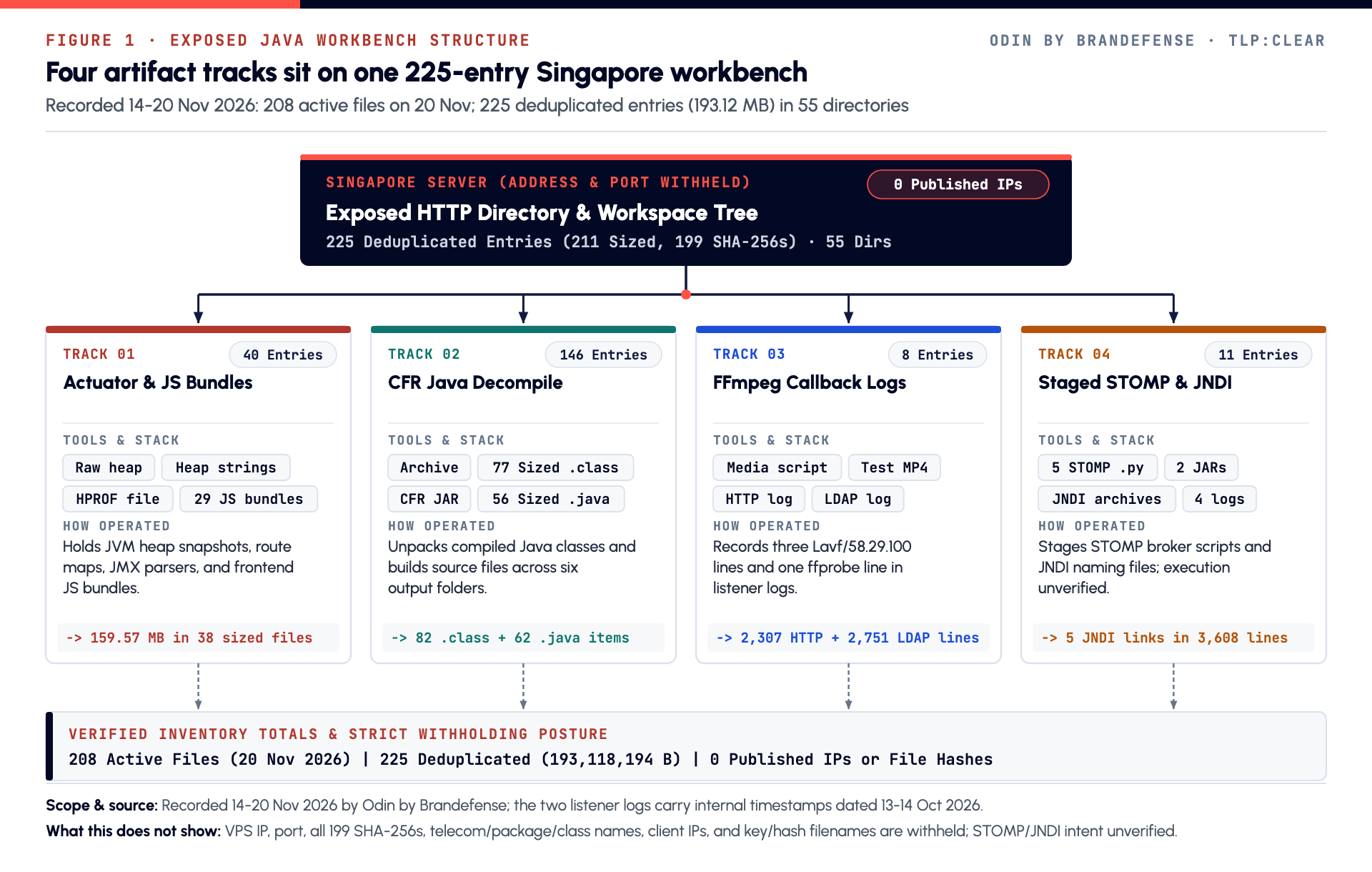
Reconciling the 20 November Listing (208 Files) and 225 Deduplicated Entries
Two exact counts describe the server across 14–20 November 2026. On 20 November 2026, the live directory listing reported 208 active files and 55 directories (8 top-level folders plus 47 nested subdirectories).
Across the full 14–20 November 2026 observation period, deduplicated indexing captured 225 total entries. Those 225 entries include 211 sized files totaling 193,118,194 bytes (193.12 MB) and 14 unsized entries. The 208 active files and 225 deduplicated entries are counts from different scopes; the available inventory does not identify which entries account for the difference.
All 225 entries span 199 unique SHA-256 digests, every one of which is withheld. The table below reconciles the 225 deduplicated entries across the four workspace zones.
| Workspace zone | Top-level dirs | Deduplicated entries | Share (%) | Sized files | Unsized entries | Sized bytes | Operational role |
|---|---|---|---|---|---|---|---|
| Extracted Bytecode Tree | 1 | 82 | 36.4% | 77 | 5 | 277,277 | Unpacked Java .class tree from a 90,453-byte bytecode archive (77 sized .class files + 5 unsized; folder, package, and class names withheld). |
| CFR Decompiled Source | 6 | 62 | 27.6% | 56 | 6 | 284,408 | Decompiled .java source across six output folders: primary folder (48; 43 sized = 218,348 B) plus five subset folders (5, 3, 3, 2, and 1). |
Root Workspace ((root)) | 0 (root) | 52 | 23.1% | 51 | 1 | 190,819,312 | Holds a raw heap capture, an HPROF snapshot, extracted heap strings, route and trace captures, an HTTP service log, a CFR archive, JNDI archives, callback logs, 5 STOMP .py scripts, and withheld files. |
| Frontend JS Bundle Snapshot | 1 | 29 | 12.9% | 27 | 2 | 1,737,197 | Captured web frontend .js bundles (27 sized .js files + 1 unsized .js + 1 unsized .txt; folder and filenames withheld). |
| Combined deduplicated inventory | 8 top dirs + root | 225 | 100.0% | 211 | 14 | 193,118,194 | Spans 199 withheld SHA-256 digests (208 active files & 55 dirs on 20 Nov 2026). |
A second breakdown reconciles the same 225 entries (211 sized, 14 unsized, 193,118,194 bytes) by file type. Text and Java source files (88), bytecode binaries (84), and scripts (46) represent 96.9% of entries. By byte volume, a raw heap capture (117.14 MB) and an HPROF snapshot (25.74 MB) make up 74.0% of the server.
Artifact class (kind) | Deduplicated entries | Share (%) | Sized files | Unsized entries | Sized bytes | Verified extensions & contents |
|---|---|---|---|---|---|---|
Text, source & logs (text) | 88 | 39.1% | 81 | 7 | 35,561,099 | 62 .java (56 sized + 6 unsized), 12 .log, 5 .txt, 2 .json, 2 .pub, 2 .conf, 1 .out, 1 .c, and 1 9-byte .jar stub. |
Bytecode & JAR tools (exe) | 84 | 37.3% | 79 | 5 | 12,797,060 | 82 .class entries in the extracted bytecode folder (77 sized = 277,277 B + 5 unsized) and 2 .jar archives (10,357,468 B JNDI archive; 2,162,315 B CFR archive). |
Scripts & bundles (script) | 46 | 20.4% | 45 | 1 | 1,783,103 | 29 .js (28 in the frontend bundle folder + a 1,586-byte root .js bundle), 13 .py (40,177 B), and 4 .sh (4,740 B). |
Raw captures & potfiles (other) | 2 | 0.9% | 1 | 1 | 117,139,838 | 1 .raw heap capture (117,139,838 B; filename withheld) and 1 unsized .pot entry. |
Heap & class archives (archive) | 2 | 0.9% | 2 | 0 | 25,826,510 | 1 .hprof snapshot (25,736,057 B; filename withheld) and 1 .tgz bytecode archive (90,453 B; filename withheld). |
Private key files (secret) | 2 | 0.9% | 2 | 0 | 3,654 | 2 extensionless SSH private keys (1,843 B and 1,811 B; filenames withheld). |
Test media (media) | 1 | 0.4% | 1 | 0 | 6,930 | 1 .mp4 test container (6,930 B; filename withheld). |
| Total | 225 | 100.0% | 211 | 14 | 193,118,194 | Exact byte-level parity (193.12 MB). |
Figure 5 groups all 225 deduplicated entries into six mutually exclusive clusters (146 + 40 + 15 + 11 + 8 + 5 = 225). Decompiled Java classes (146) and Actuator heap and bundle files (40) account for 82.7% of all indexed items.
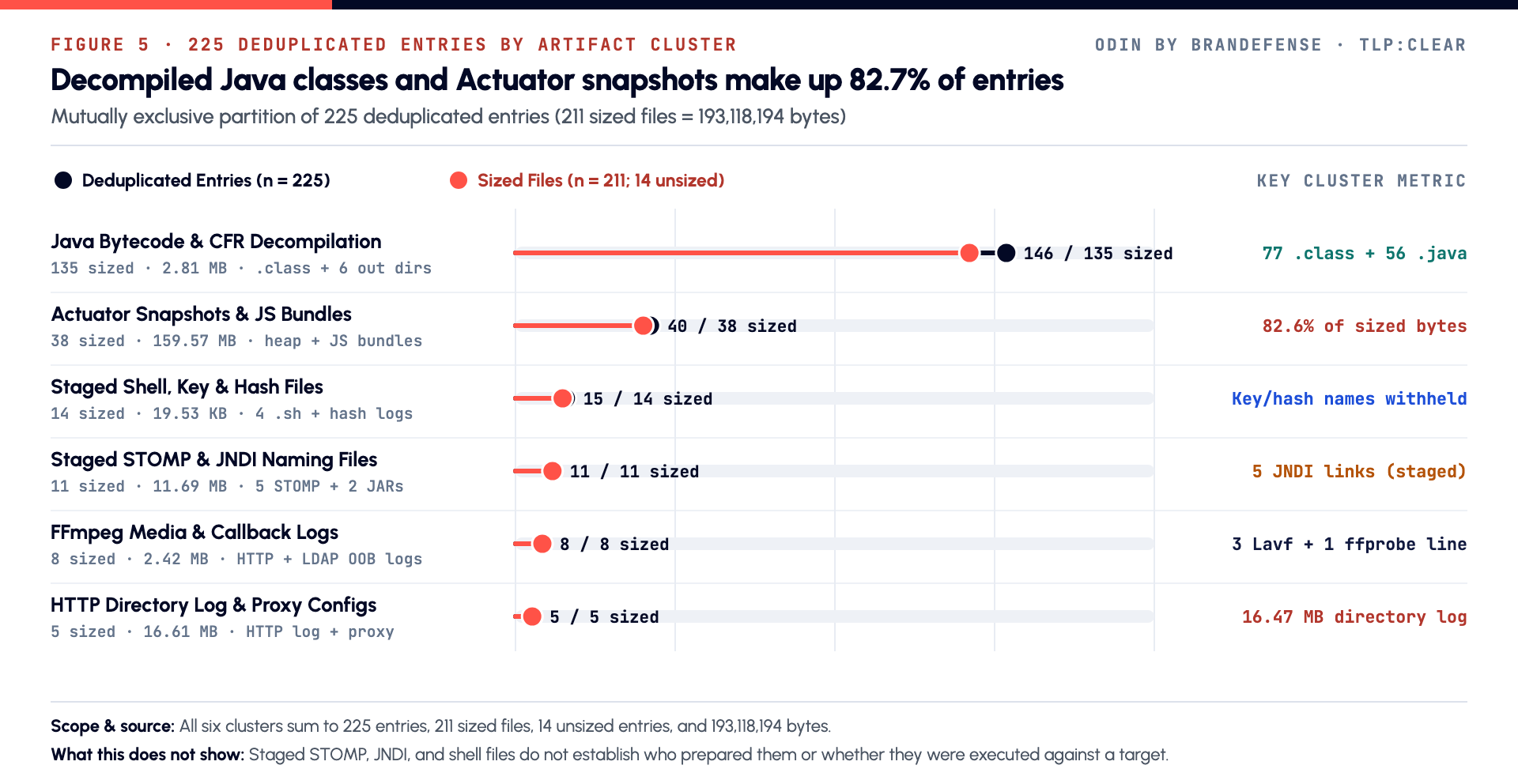
Internal Listener Log Dates Versus November Directory Observations
Two distinct date ranges appear in the dataset, and each carries a clear boundary.
Odin by Brandefense observed the open HTTP directory between 14 and 20 November 2026. That live directory reported 208 active files and 55 directories on 20 November 2026.
Inside (root), both the HTTP callback log (399,401 B) and the TCP/LDAP listener log (564,831 B) carry internal timestamps dated 13 and 14 October 2026. Those dates show that the logs contain October entries; they do not establish when or where the listeners started. Log byte sizes alone also do not establish continuous runtime.
3. Actuator Heapdump Exposure, CFR Decompilation, and FFmpeg Callbacks
Many enterprise and telecom portals place a single-page JavaScript frontend ahead of Spring Boot microservices and media-transcoding workers. Figure 3 presents an analytical model separating captured snapshots and logged Lavf/58.29.100 callbacks from staged STOMP and JNDI scripts.
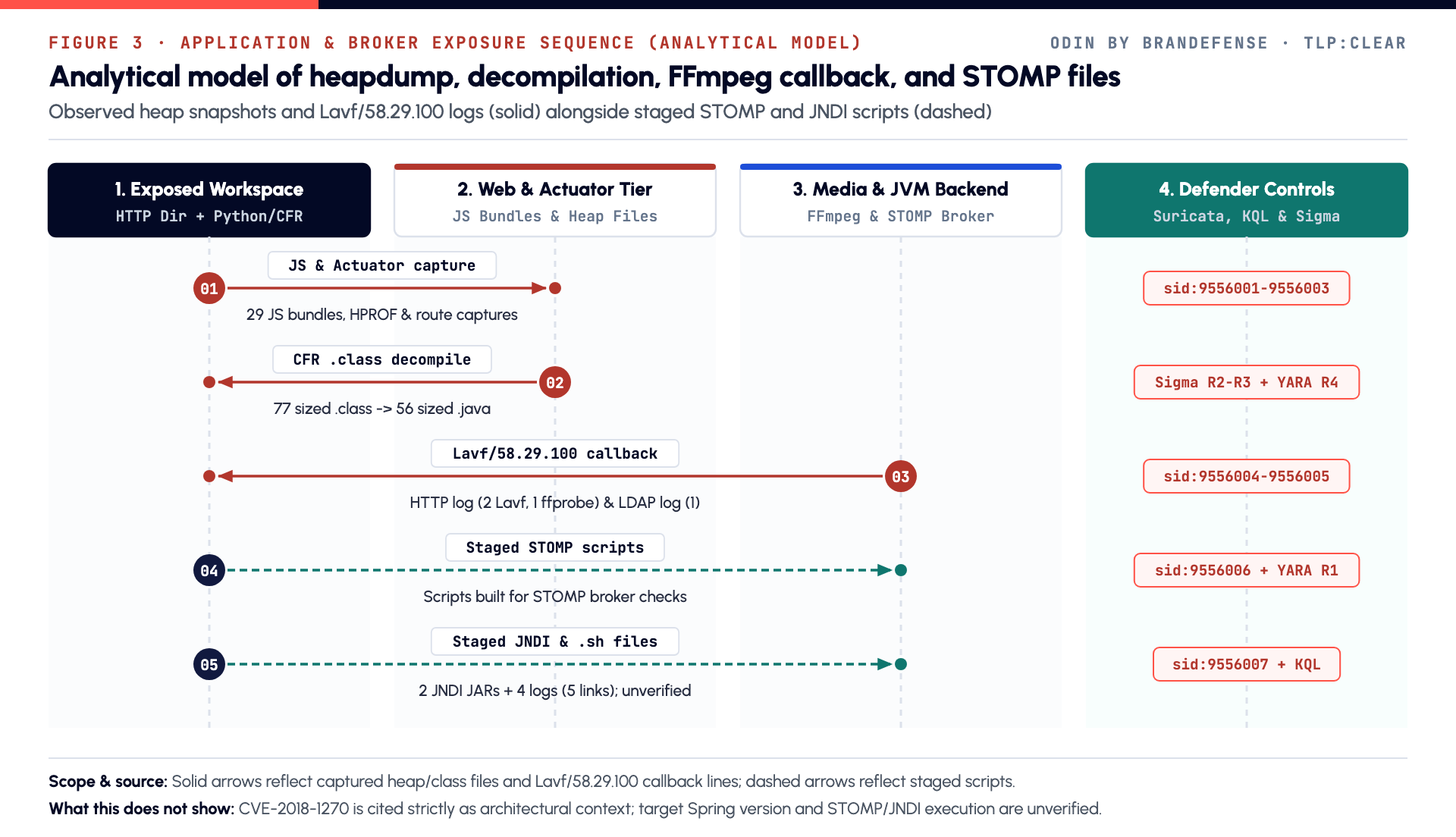
Protecting Spring Boot Actuator /heapdump Diagnostics and Frontend Bundles (40 Entries)
The Actuator and frontend cluster holds 40 entries (38 sized files totaling 159,569,751 bytes). Twenty-seven sized .js bundles (1,737,197 B) and two unsized items sit in a frontend bundle folder beside a 1,586-byte root bundle. Client bundles map REST paths, request headers, and WebSocket broker endpoints (folder, bundle, and brand names withheld).
Root also holds a raw heap capture (117,139,838 B) and an HPROF snapshot (25,736,057 B). Two text files hold extracted heap strings (14,111,011 B) and a secondary heap extract (799,397 B). Together with route and trace captures and 29 frontend bundle items, they reflect Spring Boot Actuator's /actuator/heapdump route (or legacy /heapdump; [REF-03]). Live JAVA PROFILE 1.0.2 memory exports contain active properties, database passwords, session tokens, and signing keys ([REF-10]).
Six diagnostic captures and Python helpers sit beside those heap files. Two JSON captures hold route and trace data (31,992 B and 5,634 B). Four scripts inspect proxy headers (2,581 B), JMX MBeans (1,717 B), and classloaders (1,379 B and 1,362 B). Workbench files alone do not show how the Actuator routes were reached.
Assessing Exposure from Decompiled Java .class Archives (146 Entries)
The Java decompilation cluster holds 146 entries (135 sized files totaling 2,814,453 bytes), making up 64.9% of the deduplicated inventory. A 90,453-byte compressed archive unpacks into an extracted bytecode folder holding 82 .class entries. Those entries span 77 sized .class files (277,277 bytes) and 5 unsized entries. All target organization, telecom brand, archive, folder, Java package, and class names are withheld.
Root holds a 2,162,315-byte CFR Java decompiler archive. CFR generated 62 .java entries (56 sized .java files totaling 284,408 bytes plus 6 unsized entries) across six output folders. Most source files sit in the primary output folder (48 entries; 43 sized = 218,348 B). Another 14 entries sit across five subset folders (5, 3, 3, 2, and 1).
Once an operator obtains .class files from a build artifact, container image, file-read bug, or classloader dump, CFR rebuilds readable Java source in seconds. Developers must never store static credentials, signing keys, or unauthenticated administrative URLs inside compiled .class bytecode.
Monitoring Media-Processing Outbound Requests (8 Entries)
The media and callback cluster holds 8 sized files totaling 2,418,477 bytes. Four files serve test media: a Python media script (2,041 B) and a test MP4 container (6,930 B). Two companion files store the media server log (1,032,656 B) and output (410,730 B). Two callback files run and log an HTTP listener (1,039-byte script and 399,401-byte log). The remaining two files run and log a TCP/LDAP listener (849-byte script and 564,831-byte log).
Both listener logs contain lines carrying FFmpeg media-library client strings ([REF-06]):
- HTTP callback log (399,401 bytes; 2,307 lines). Carries internal timestamps dated
13–14 October 2026and records 2Lavf/58.29.100HTTPUser-Agentlines plus 1ffprobeline (client IPs and scanner domains withheld). - TCP/LDAP listener log (564,831 bytes; 2,751 lines). Carries internal timestamps dated
13–14 October 2026, logging 1,375 TCP connection lines and 1Lavf/58.29.100line (client IPs withheld).
Lavf/58.29.100 is the libavformat network client identifier from FFmpeg 4.2.x ([REF-06]). Without -protocol_whitelist limits ([REF-06], [REF-08]), ffmpeg or ffprobe workers given external URLs or HLS playlists initiate outbound HTTP or TCP requests. Most of the 2,307 HTTP log lines and 1,375 LDAP log connections reflect routine internet scan noise. Those 3 Lavf/58.29.100 lines and 1 ffprobe line are consistent with media-tool requests to the listeners; they do not identify the client application or confirm SSRF.
4. STOMP-over-WebSocket Brokers, JNDI Lookups, and Staged Shell Files
Alongside the captured heap snapshots and Lavf/58.29.100 callback logs, the server holds staged WebSocket broker, Java naming, and Linux shell scripts. Figure 4 shows the directory layout across (root) and the eight top-level folders.
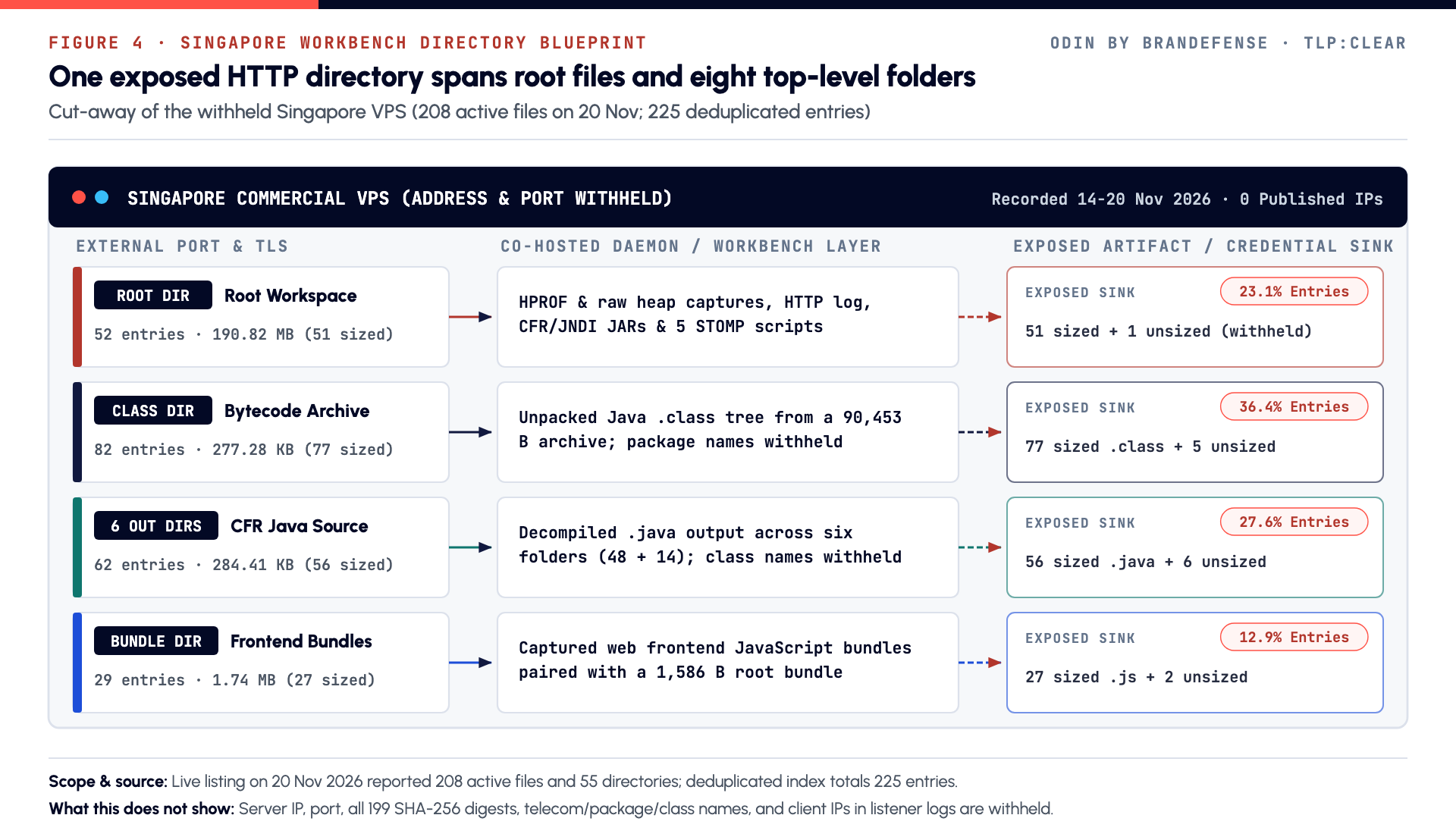
Hardening STOMP-over-WebSocket Brokers and Java Naming Lookups (11 Entries)
Eleven sized files (11,686,790 bytes) cover STOMP messaging scripts and JNDI naming files. Root holds five Python STOMP scripts totaling 27,844 bytes. Their file sizes are 6,467 B, 5,921 B, 5,495 B, 5,011 B, and 4,950 B. Spring WebSocket services often expose STOMP ([REF-04], [REF-05]) to route CONNECT, SUBSCRIBE, and SEND frames ([REF-05]).
NVD lists Spring Framework 5.0.0–5.0.4 and 4.3.0–4.3.14 for CVE-2018-1270. Spring’s advisory also lists 4.3.15; both sources describe STOMP selector remote code execution ([REF-01], [REF-02]). Defenders should upgrade to 5.0.5 or, on the 4.3.x branch, 4.3.16; Spring's current advisory lists 4.3.15 as affected ([REF-02]). NVD retains the earlier 4.3.15 boundary ([REF-01]).
We cite CVE-2018-1270 strictly as architectural context ([REF-09]) because the target's Spring version is unknown. Even on modern Spring versions, missing ChannelInterceptor destination checks let authenticated WebSocket users subscribe to foreign queues ([REF-04]).
Six JNDI files (11,658,946 B) sit beside those scripts, led by a 10,357,468-byte JNDI archive and a 9-byte archive stub. Four JNDI logs include one 1,296,250-byte log (3,608 lines; 5 JNDI reference links) and three smaller logs (2,811 B, 2,367 B, and 41 B). These files show staging only, not target code execution. JDK security updates disable remote JNDI class loading by default ([REF-07]); unsafe local object factories can still pose a lookup risk.
Staged Shell, Key, Hash-Cracking, and Hosting Files (20 Entries)
Fifteen staged shell, key, and hash entries (19,529 sized bytes plus 1 unsized .pot) sit in root. They include four .sh scripts, one run log, one .c file, two withheld SSH key pairs, one withheld 123-byte hash file, and four cracking logs/potfiles.
Five hosting and proxy files (16,609,194 B) complete the 225-entry total. They include a 16,468,015-byte HTTP directory log, a 768-byte proxy-verification script, two 113-byte proxy config files, and one 140,185-byte withheld .txt file. Directory presence alone does not tie generic shell, key, or hash files to the STOMP or FFmpeg tracks.
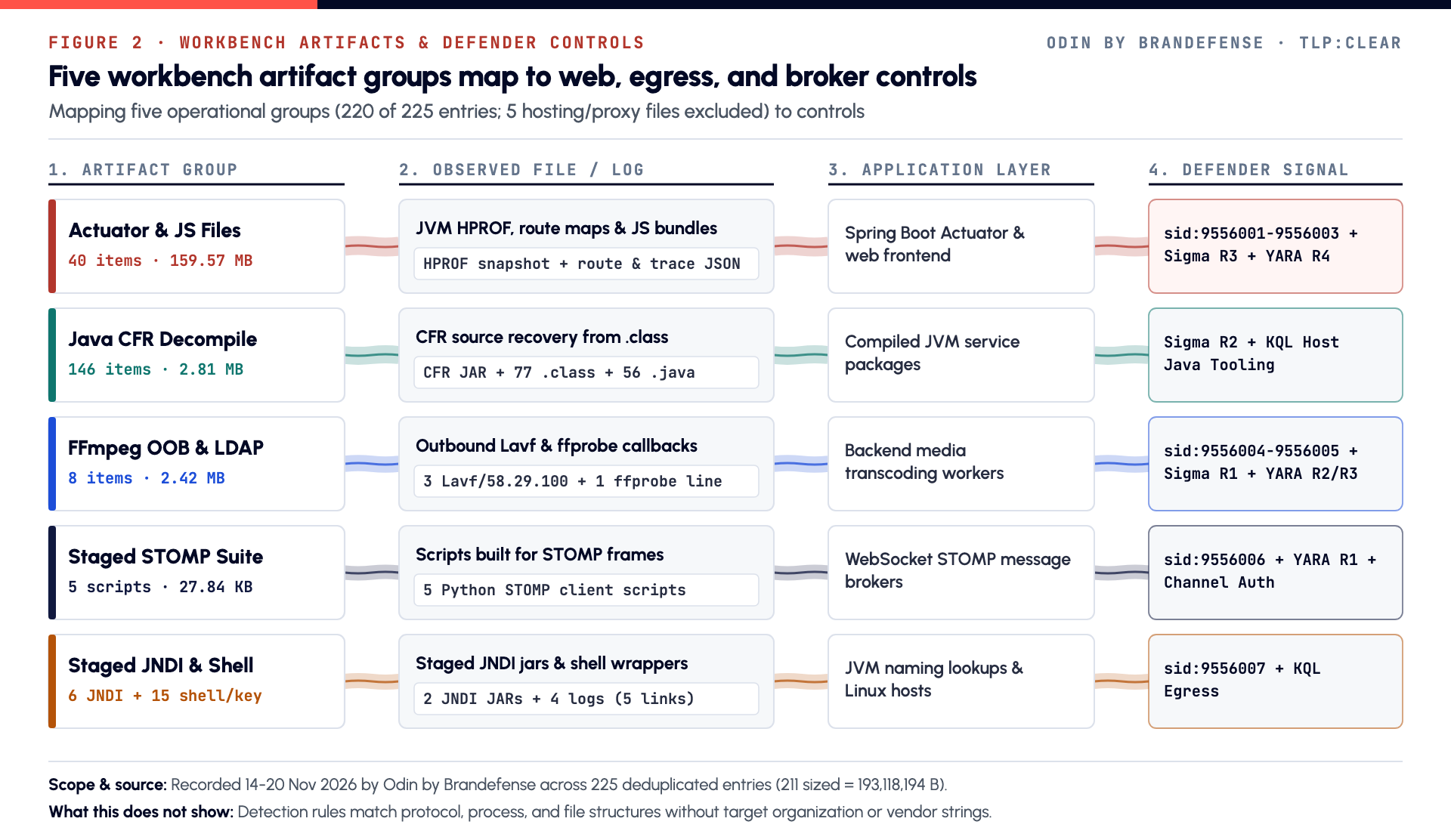
Figure 2 maps the five operational artifact groups (220 of 225 entries) to network, host, and file detections.
5. Enterprise Java, Media, and WebSocket Exposure Analysis
Application and platform teams should verify the four controls below against their own Spring Boot, media, and WebSocket services before treating any misconfiguration as an established root cause:
| Exposure layer | Observed workbench evidence | Control to verify | Operational risk |
|---|---|---|---|
| Spring Boot Actuator & frontend bundles | a raw heap capture (117.14 MB), an HPROF snapshot (25.74 MB), extracted heap strings, route and trace captures, and 29 frontend bundle items. | Verify whether /actuator/* and /heapdump are disabled and blocked at reverse proxies ([REF-03]); exact acquisition path is unverified. | JVM heap snapshots expose database credentials, session tokens, signing keys, and route tables ([REF-10]). |
Decompiled JVM .class packages | A compressed bytecode archive (90,453 B), 82 .class entries (77 sized), a CFR decompiler archive (2,162,315 B), and 62 .java entries (56 sized). | Verify whether compiled .class archives embed static secrets or unauthenticated internal endpoints; archive origin is unverified. | CFR decompilation turns leaked bytecode into readable controller annotations and parameter sinks. |
Media-worker outbound fetches (FFmpeg) | A Python media script, a test MP4 file, an HTTP callback log (2 Lavf/58.29.100 + 1 ffprobe), and a TCP/LDAP log (1 Lavf/58.29.100). | Verify whether ffmpeg and ffprobe enforce -protocol_whitelist file inside egress-blocked subnets ([REF-06], [REF-08]). | Unvalidated media URLs let backend transcoding workers probe internal services or external listeners. |
| STOMP brokers & JVM naming lookups | 5 Python STOMP scripts, two JNDI archives, and four logs (5 JNDI links); intent unverified. | Verify Spring Framework versions (>= 5.0.5 or 4.3.16, modern 6.x), STOMP ChannelInterceptor checks, and JNDI egress blocks ([REF-01], [REF-04], [REF-07]). | Missing topic checks expose cross-user WebSocket queues; legacy Spring or unsafe JNDI sinks risk code execution. |
6. Alternative Hypotheses
The table below evaluates four competing hypotheses regarding the workbench's purpose, log activity, and staged scripts.
| Hypothesis | Evidence for | Evidence against | Assessment |
|---|---|---|---|
Staged STOMP and JNDI scripts achieved RCE via CVE-2018-1270 | Directory holds 5 Python STOMP scripts, two JNDI archives, four JNDI logs (5 JNDI links), shell wrappers, and a 123-byte hash file. | Target Spring version is unknown; the JNDI logs reflect listener setup rather than target class loading, and root key/hash files have unverified provenance. | Unverified. Cite CVE-2018-1270 strictly as architectural context and treat STOMP/JNDI files as staged intent. |
| All 1,375 TCP/LDAP connections and 2,307 HTTP log lines came from targets | Both listener logs hold thousands of entries starting on 13–14 October 2026. | Public HTTP and TCP listeners log automated internet scanners and self-tests; only 3 lines match Lavf/58.29.100 and 1 matches ffprobe. | Refuted for total line counts. Those four lines are consistent with media-tool requests to the listeners; they do not identify the client application or confirm SSRF. |
| Authorized penetration test or developer debug host | Uses standard CFR Java decompilation and six structured output folders. | Exposes 142.88 MB of heap snapshots, target .class packages, SSH private keys, and cracking potfiles on an open HTTP directory on a foreign VPS. | Unresolved. Public exposure is unsafe but does not establish who owned or used the workspace. |
| Cohesive application assessment workspace | Root classloader, header, STOMP, and media scripts align with the extracted bytecode folder, frontend bundle items, and heap captures. | Generic shell scripts and hash logs in root could come from lab tests or separate targets. | Supported for the Java and media tracks, with explicit boundaries on generic shell and hash files. |
7. Validated Detection Rules
The Singapore VPS IPv4 address, host port, and all 199 file SHA-256 digests are withheld. Defenders should deploy protocol, process, and file-structure rules that detect this tradecraft on any network. Static checks passed in the Odin Suricata linter (0 problems) and offline structural checks across KQL, 3 Sigma rules, and 4 filesize-bounded YARA rules. Because live suricata -T, Kusto.Language, pySigma, and YARA engines were not run locally, teams should test each rule in staging before production rollout.
7.1 Suricata 7.x Network Signatures (sid:9556001–9556007)
Three alert rules monitor inbound GET requests to /heapdump (sid:9556001) and /actuator/mappings (sid:9556003), plus outbound JAVA PROFILE 1.0. responses (sid:9556002). Two rules alert on outbound Lavf/ and ffprobe HTTP User-Agent headers (sid:9556004 and sid:9556005). The final two rules cover external .stomp WebSocket upgrades (sid:9556006) and inbound ${jndi: HTTP request bodies (sid:9556007).
All seven HTTP alert rules generate alerts without blocking inline. They require cleartext HTTP traffic or placement behind a TLS-terminating reverse proxy or forward proxy, and sid:9556006 should be tuned if external browsers legitimately use .stomp subprotocols.
# Odin by Brandefense - Monograph 56 (Exposed Java Workbench) Suricata 7.x Ruleset
# Static syntax checked with Odin Suricata linter (0 problems); test with suricata -T before deployment.

alert http $EXTERNAL_NET any -> $HOME_NET any (msg:"ODIN-R56 Inbound Spring Boot Actuator Heapdump Request"; flow:established,to_server; http.method; content:"GET"; bsize:3; http.uri; content:"/heapdump"; fast_pattern; classtype:web-application-attack; sid:9556001; rev:1;)
alert http $HOME_NET any -> $EXTERNAL_NET any (msg:"ODIN-R56 Outbound JVM HPROF Heapdump Response Body"; flow:established,to_client; http.response_body; content:"JAVA PROFILE 1.0."; startswith; fast_pattern; classtype:credential-theft; sid:9556002; rev:1;)
alert http $EXTERNAL_NET any -> $HOME_NET any (msg:"ODIN-R56 Inbound Spring Boot Actuator Mappings Probe"; flow:established,to_server; http.method; content:"GET"; bsize:3; http.uri; content:"/actuator/mappings"; fast_pattern; classtype:attempted-recon; sid:9556003; rev:1;)
alert http $HOME_NET any -> $EXTERNAL_NET any (msg:"ODIN-R56 Outbound FFmpeg Lavf HTTP User-Agent Callback"; flow:established,to_server; http.user_agent; content:"Lavf/"; startswith; fast_pattern; classtype:policy-violation; sid:9556004; rev:1;)
alert http $HOME_NET any -> $EXTERNAL_NET any (msg:"ODIN-R56 Outbound FFprobe HTTP User-Agent Callback"; flow:established,to_server; http.user_agent; content:"ffprobe"; nocase; fast_pattern; classtype:policy-violation; sid:9556005; rev:1;)
alert http $EXTERNAL_NET any -> $HOME_NET any (msg:"ODIN-R56 Inbound STOMP over WebSocket Upgrade Handshake"; flow:established,to_server; http.header; content:"Upgrade: websocket"; nocase; content:"Sec-WebSocket-Protocol:"; nocase; content:".stomp"; nocase; fast_pattern; classtype:protocol-command-decode; sid:9556006; rev:1;)
alert http $EXTERNAL_NET any -> $HOME_NET any (msg:"ODIN-R56 Inbound JNDI Lookup Expression in HTTP Body"; flow:established,to_server; http.request_body; content:"${jndi:"; nocase; fast_pattern; classtype:web-application-attack; sid:9556007; rev:1;)
7.2 Microsoft Sentinel KQL Hunt
Replace the two placeholder FQDNs in ApprovedMediaAndBuildHosts with your approved media-ingestion and Java build hostnames before scheduling.
// Odin by Brandefense - Monograph 56 (Exposed Java Workbench)
// Hunts Spring Boot heapdump/decompiler/JNDI host execution and unexpected FFmpeg or Java LDAP/RMI public egress.
let Lookback = 7d;
let ApprovedMediaAndBuildHosts = dynamic(["media-worker-01.corp.example", "ci-java-01.corp.example"]);
let HostJavaAndMediaAnomalies =
    DeviceProcessEvents
    | where Timestamp >= ago(Lookback)
    | where not(DeviceName in~ (ApprovedMediaAndBuildHosts))
    | where (
        (FileName in~ ("ffmpeg", "ffmpeg.exe", "ffprobe", "ffprobe.exe") and (ProcessCommandLine contains "http://" or ProcessCommandLine contains "https://" or ProcessCommandLine contains "tcp://" or ProcessCommandLine contains "ldap://" or ProcessCommandLine contains "ftp://"))
        or (FileName in~ ("java", "java.exe") and (ProcessCommandLine contains "--outputdir" or ProcessCommandLine contains "--extraclasspath" or ProcessCommandLine contains "ldap://"))
        or (ProcessCommandLine contains "/actuator/heapdump" or ProcessCommandLine contains ".hprof" or ProcessCommandLine contains "jmap -dump:")
    )
    | project Timestamp, DeviceName, AccountName, SignalType = "HostMediaOrJavaTooling", Detail = ProcessCommandLine;
let MediaAndJndiUnexpectedEgress =
    DeviceNetworkEvents
    | where Timestamp >= ago(Lookback)
    | where not(DeviceName in~ (ApprovedMediaAndBuildHosts))
    | where RemoteIPType == "Public"
    | where (
        InitiatingProcessFileName in~ ("ffmpeg", "ffmpeg.exe", "ffprobe", "ffprobe.exe")
        or (InitiatingProcessFileName in~ ("java", "java.exe") and RemotePort in (389, 636, 1099, 1389))
    )
    | project Timestamp, DeviceName, AccountName = InitiatingProcessAccountName, SignalType = "UnexpectedMediaOrJndiEgress", Detail = strcat(InitiatingProcessFileName, " -> ", RemoteIP, ":", tostring(RemotePort), " (", RemoteUrl, ")");
union HostJavaAndMediaAnomalies, MediaAndJndiUnexpectedEgress
| summarize FirstSeen = min(Timestamp), LastSeen = max(Timestamp), EventCount = count(), Signals = make_set(SignalType, 6), SampleDetails = make_set(Detail, 5) by DeviceName, AccountName
| order by LastSeen desc
7.3 Portable Sigma and YARA Rules
- Sigma (
sigma_r56_ffmpeg_ssrf_cfr_and_jndi.yml). Rule 1 detects/ffmpegor/ffprobepassinghttp,https,tcp,ldap, orftpURL schemes outsidemedia-worker-01.corp.example. Rule 2 catches/javapassing--outputdir,--extraclasspath, orldap://outsideci-java-01.corp.example. Rule 3 detects/actuator/heapdump,.hprof, orjmap -dump:outsideapm-diag-01.corp.example. - YARA (
odin_r56_stomp_jndi_and_oob_artifacts.yar). Rules 1 and 2 detect STOMP-over-WebSocket test scripts and raw-socket Python LDAP or OOB listeners. Rules 3 and 4 detect HTTP callback listener logs containing aLavfidentifier and an HTTP request marker, plus Actuator heapdump or classloader parser scripts.
8. Behavioral and Protocol Hunt Markers (0 Published IPs or Workbench SHA-256s)
Zero server IPv4 addresses or workbench-file SHA-256 digests appear in the indicator feeds. The server holds target heap snapshots, compiled .class files, and withheld key and hash files. Defenders can hunt using the 10 behavioral markers below.
| Marker category | Pattern / protocol artifact | Layer | Defensive hunt & control |
|---|---|---|---|
| Actuator heap route | GET /actuator/heapdump (or /heapdump) | HTTP / proxy ingress | Block /actuator/* and /heapdump at reverse proxies and alert via sid:9556001. |
| JVM HPROF magic header | JAVA PROFILE 1.0. | HTTP response stream | Alert on HPROF headers in decrypted HTTP responses (sid:9556002). |
| Actuator route map | GET /actuator/mappings & /actuator/httptrace | HTTP / proxy ingress | Disable route-mapping and trace endpoints in production ([REF-03]; sid:9556003). |
| FFmpeg HTTP callback | User-Agent: Lavf/58.29.100 (Lavf/) | HTTP egress | Alert on Lavf/ outbound requests at web proxies (sid:9556004; 3 hits in logs). |
| FFprobe stream callback | User-Agent: ffprobe | HTTP egress | Alert on ffprobe outbound HTTP fetches (sid:9556005; 1 hit in HTTP log). |
| STOMP WebSocket upgrade | Sec-WebSocket-Protocol: v10.stomp–v12.stomp | WebSocket ingress | Audit unexpected external .stomp upgrades (sid:9556006) and require authentication ([REF-04]). |
| STOMP frame headers | SUBSCRIBE / SEND / selector: | STOMP broker | Enforce Spring Security ChannelInterceptor topic checks ([REF-04]; YARA Rule 1). |
| JNDI lookup & egress | ${jndi: & JVM egress to 389, 636, 1099, 1389 | HTTP / TCP egress | Alert on ${jndi: bodies (sid:9556007) and block JVM LDAP/RMI egress (KQL; [REF-07]). |
| Bytecode decompiler CLI | java with --outputdir or --extraclasspath | Linux / Windows EDR | Alert on decompiler or ldap:// flags outside build hosts (Sigma Rule 2; KQL). |
| Media URL CLI fetch | ffmpeg / ffprobe remote URL schemes | Linux / Windows EDR | Enforce -protocol_whitelist file ([REF-06]) and alert via Sigma Rule 1 and KQL. |
9. Hardening Priorities for Spring Boot, Media, and Messaging Tiers
Application, media, and network defenders should apply five controls in order:
- Disable external Actuator routes and rotate heap secrets (
0–48 Hours). Excludeheapdump,mappings,httptrace,httpexchanges,env, andthreaddumpin production ([REF-03]). Bind management ports to internal admin interfaces, block/actuator/*and/heapdumpat reverse proxies, and rotate secrets after any heap exposure ([REF-10]). - Enforce FFmpeg protocol allowlists and isolate worker egress (
0–72 Hours). Pass-protocol_whitelist file,pipe,cryptotoffmpegandffprobeso network protocols stay disabled ([REF-06]). Read media from local storage, reject external HLS playlist URLs, and block worker subnets from RFC1918,169.254.169.254, and internet egress ([REF-08]). - Patch Spring messaging and authorize STOMP destinations (
Days 1–7). Confirm no services run Spring Framework5.0.0–5.0.4or4.3.0–4.3.15(CVE-2018-1270). Upgrade to5.0.5or, on the 4.3.x branch,4.3.16; Spring's current advisory lists4.3.15as affected ([REF-02]). NVD retains the earlier4.3.15boundary ([REF-01]). Enforce Spring SecurityChannelInterceptorchecks onCONNECT,SUBSCRIBE, andSENDframes ([REF-04],[REF-05]). - Lock down JNDI lookups and outbound LDAP/RMI ports (
Days 7–14). Run current LTS JDKs where remote JNDI class loading defaults tofalse([REF-07]). Block untrusted strings fromInitialContext.lookup()and block outboundTCP 389, 636, 1099, and 1389. - Audit
.classpackages and.jsbundles in CI (Days 14–30). Scan Java archives and frontend bundles before release to strip static keys, internal hostnames, and debug route tables.
10. Scope, Limits, and External References
Odin by Brandefense analyzed workbench artifacts recorded between 14 and 20 November 2026 on a Singapore VPS (address and port withheld). On 20 November 2026, the open directory reported 208 active files and 55 directories. Across 14–20 November 2026, deduplicated indexing captured 225 entries (199 unique SHA-256 digests). Those entries span 211 sized files totaling 193,118,194 bytes and 14 unsized entries.
The two listener logs carry internal timestamps dated 13 and 14 October 2026. Staged STOMP scripts (5), JNDI files (6), and shell scripts do not establish target execution, and CVE-2018-1270 is cited strictly as architectural context. The VPS IPv4 address, host port, and all 199 file SHA-256 digests are withheld, alongside all organization, telecom brand, Java package/class, scanner-domain, client-IP, and captured filenames.
[REF-01]NIST National Vulnerability Database, *CVE-2018-1270 Detail: Spring Framework STOMP over WebSocket Remote Code Execution* (verified on 24 November 2026).[REF-02]VMware / Spring Security Advisory, *CVE-2018-1270: Remote Code Execution with spring-messaging* (verified on 24 November 2026).[REF-03]Spring Boot Reference Documentation, *Production-Ready Endpoints (Actuator)* (verified on 24 November 2026).[REF-04]Spring Framework Reference Documentation, *STOMP over WebSocket* (verified on 24 November 2026).[REF-05]STOMP Specification, *Simple Text Oriented Messaging Protocol 1.2* (verified on 24 November 2026).[REF-06]FFmpeg Official Documentation, *FFmpeg Protocols Documentation (protocol_whitelist)* (verified on 24 November 2026).[REF-07]Dev.java, *JDK Tools and Updates to Help Safeguard Java Applications* (verified on 25 November 2026).[REF-08]OWASP Cheat Sheet Series, *Server-Side Request Forgery Prevention Cheat Sheet* (verified on 24 November 2026).[REF-09]MITRE ATT&CK, *Exploit Public-Facing Application (T1190)* (verified on 24 November 2026).[REF-10]MITRE ATT&CK, *Unsecured Credentials (T1552)* (verified on 24 November 2026).
What is…?
Short explanations of the tools and families named in this study.
Frequently asked questions
How was the 225-entry Singapore workbench organized, and how do the dates align?
On 20 November 2026, the live directory listing reported 208 active files and 55 directories. Across 14–20 November 2026, deduplicated indexing captured 225 entries totaling 193,118,194 bytes (193.12 MB). Those entries span 211 sized files and 14 unsized entries (199 withheld SHA-256 digests).
How do the heap snapshots, decompiled classes, FFmpeg callbacks, and STOMP scripts relate?
Four technical artifact groups sit on the server. They span captured memory files, decompiled bytecode, logged media callbacks, and unverified broker test scripts:
What should Spring Boot, media, and platform teams do first?
Enterprise engineering and SOC teams can address each layer with three priority steps: