
Key takeaways
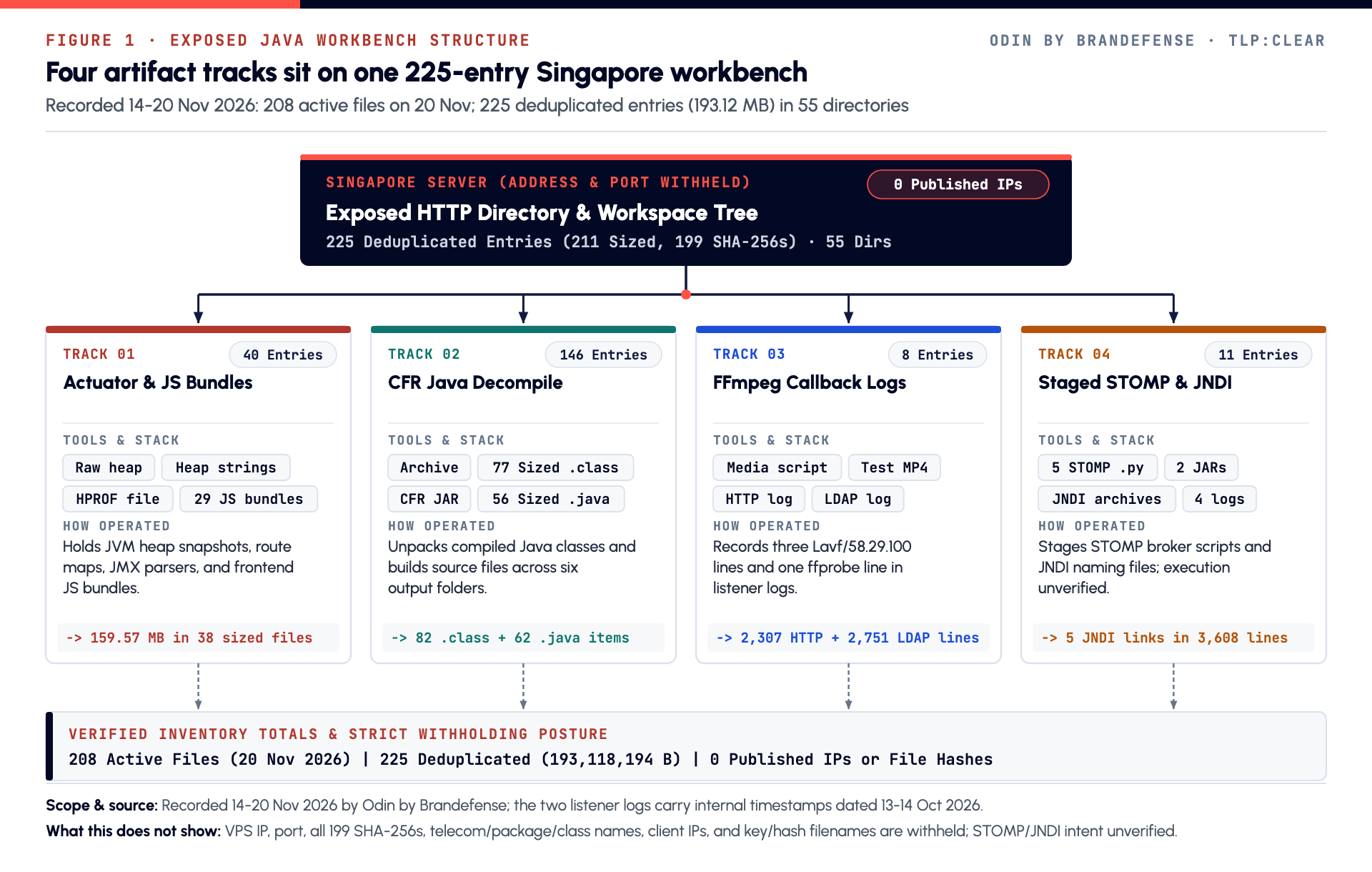
- An exposed Java workbench on a Singapore server recorded on 14-20 November 2026 held 208 active files and 225 deduplicated entries.
- Forty entries (159.57 MB) hold Spring Boot Actuator heap snapshots, route and trace captures, JMX parsers, and 29 frontend JavaScript bundle items.
- One hundred forty-six entries (64.9%) cover CFR Java decompilation across 77 sized .class files (82 total) and 56 sized .java files (62 total).
- HTTP (2,307 lines) and TCP/LDAP (2,751 lines) listener logs with 13-14 October 2026 entries record 3 Lavf/58.29.100 lines and 1 ffprobe line.
- Disable public Actuator diagnostic routes, enforce FFmpeg file-only protocol allowlists, patch Spring messaging, and authorize STOMP channels.
An exposed directory on a Singapore server held Spring Boot heap snapshots, decompiled Java classes, media-tool listener logs, and staged STOMP scripts. Odin by Brandefense analyzed 225 deduplicated entries from that exposed Java workbench recorded on 14–20 November 2026.
The directory holds JVM memory captures, compiled target .class files, and private key and hash files. Zero server addresses, zero host ports, and zero file SHA-256 digests are therefore published. All target organization names, telecom brands, Java package and class names, scanner domains, client addresses, and captured filenames are withheld.
How was the 225-entry Singapore workbench organized, and how do the dates align?
On 20 November 2026, the live directory listing reported 208 active files and 55 directories. Across 14–20 November 2026, deduplicated indexing captured 225 entries totaling 193,118,194 bytes (193.12 MB). Those entries span 211 sized files and 14 unsized entries (199 withheld SHA-256 digests).
The 208 active files and 225 deduplicated entries are counts from different scopes; the available inventory does not identify which entries account for the difference. Engineering teams can use external attack surface management to spot exposed diagnostic endpoints early; attack surface management starts with knowing which routes are public. Defenders also apply cyber threat intelligence to connect Java, media, and WebSocket staging patterns across infrastructure.
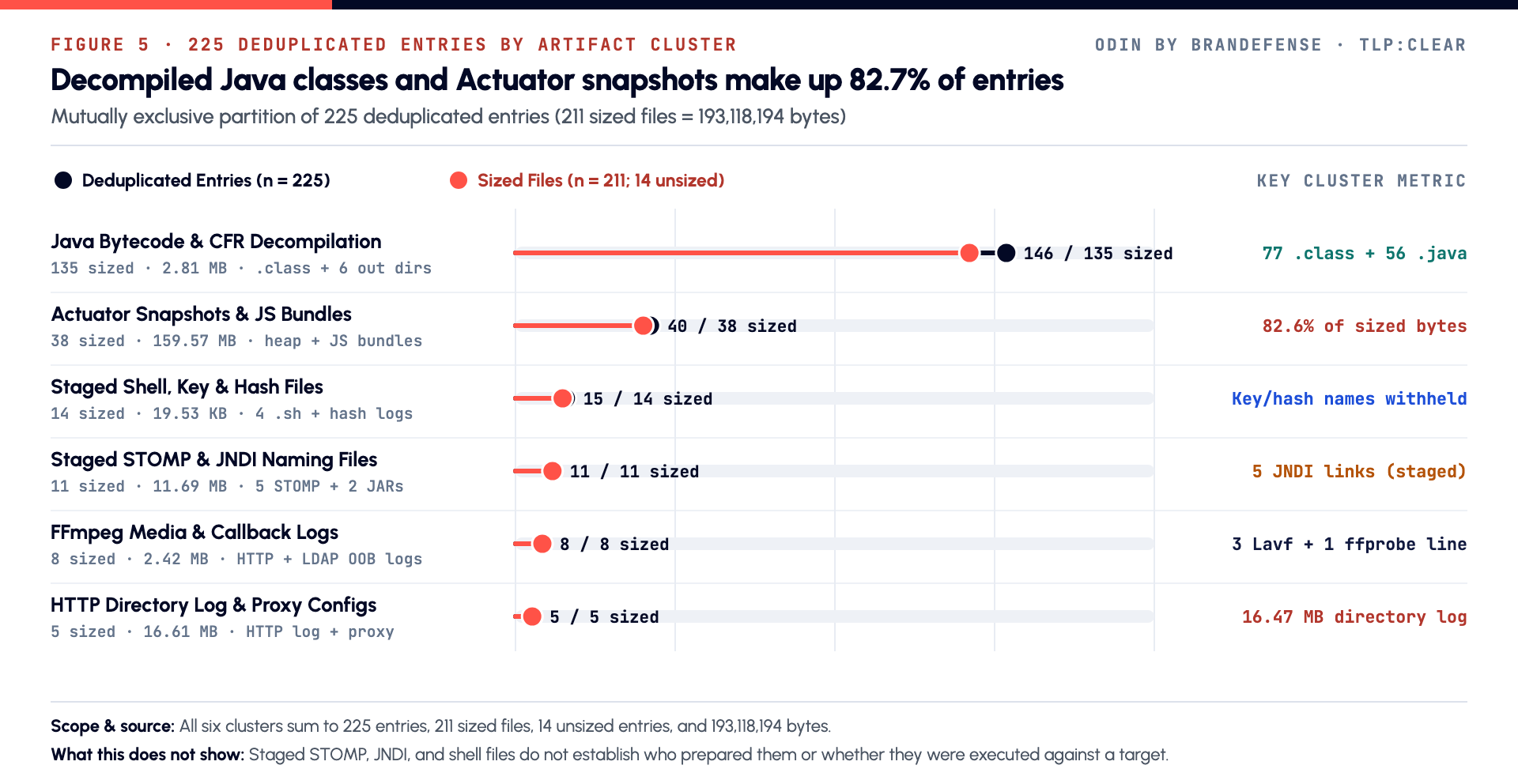
Across folders, 82 entries (36.4%) sit in an extracted bytecode folder and 62 (27.6%) sit in six CFR Java output folders. Another 52 entries (23.1%) sit in (root), and 29 (12.9%) sit in a frontend bundle folder. Text and .java files (88), .class and .jar binaries (84), and scripts (46) represent 96.9% of entries. By byte size, a raw heap capture (117.14 MB) and an HPROF snapshot (25.74 MB) make up 74.0% of the server.
Inside (root), the HTTP callback log (399,401 B) and TCP/LDAP listener log (564,831 B) carry internal timestamps dated 13 and 14 October 2026. Those dates show that the logs contain October entries; they do not establish when or where the listeners started. Log byte sizes alone do not show how long any listener stayed active.
| Artifact cluster in 225-entry inventory | Entries | Sized bytes | Verified workbench artifacts |
|---|---|---|---|
| Java Bytecode & CFR Decompilation | 146 | 2,814,453 | A compressed bytecode archive (90,453 B), a CFR decompiler archive (2,162,315 B), 82 .class items (77 sized), and 62 .java items (56 sized). |
| Actuator Snapshots & JS Bundles | 40 | 159,569,751 | a raw heap capture, an HPROF snapshot, extracted heap strings, route and trace captures, and 29 frontend bundle items. |
| Staged Shell, Key & Hash Files | 15 | 19,529 | 4 .sh scripts + run log, 1 .c file, 2 SSH key pairs, 1 hash file, and 4 cracking logs/potfiles. |
| Staged STOMP & JNDI Naming Files | 11 | 11,686,790 | 5 Python STOMP scripts (27,844 B), two JNDI archives (10,357,468 B and a 9 B stub), and four logs (5 JNDI links). |
| FFmpeg Media & Callback Logs | 8 | 2,418,477 | A Python media script, a test MP4 file, an HTTP callback log (2 Lavf/58.29.100 + 1 ffprobe), and a TCP/LDAP log (1 Lavf/58.29.100). |
| HTTP Directory Log & Proxy Configs | 5 | 16,609,194 | An HTTP directory log (16,468,015 B), a proxy-verification script (768 B), two proxy config files, and 1 withheld .txt (140,185 B). |
How do the heap snapshots, decompiled classes, FFmpeg callbacks, and STOMP scripts relate?
Four technical artifact groups sit on the server. They span captured memory files, decompiled bytecode, logged media callbacks, and unverified broker test scripts:
- Actuator heap snapshots and frontend bundles (40 entries). Twenty-seven sized
.jsbundles (1,737,197 B) and two unsized items sit in a frontend bundle folder beside a 1,586-byte root bundle. Root also holds a raw heap capture, an HPROF snapshot, extracted heap strings, a heap text extract, route and trace captures, and four Python parsers. Together, these files expose controller routes, session structures, and active JVM properties. - CFR Java decompilation (146 entries). Using a 2,162,315-byte CFR decompiler archive, the workspace unpacked a 90,453-byte bytecode archive into an extracted class folder. That folder holds 77 sized
.classfiles and 5 unsized entries. CFR generated 56 sized.javafiles and 6 unsized entries across six output folders. The primary folder holds 48 entries and five subset folders hold 14. Compiled.classarchives provide no protection for hardcoded keys or internal parameter sinks once bytecode leaks. - FFmpeg
Lavf/58.29.100outbound callbacks (8 entries). Alongside a Python media script and a test MP4 file, the HTTP callback log (2,307 lines) recorded 2Lavf/58.29.100lines and 1ffprobeline. Meanwhile, the TCP/LDAP listener log (2,751 lines; 1,375 TCP connections) recorded 1Lavf/58.29.100line. Most remaining log lines reflect internet scan noise. Those four lines are consistent with media-tool requests to the listeners; they do not identify the client application or confirm SSRF. - Staged STOMP and JNDI files (11 entries). Five Python STOMP scripts sit beside two JNDI archives and four logs, including one log with 3,608 lines and 5 JNDI links. NVD lists Spring Framework
5.0.0–5.0.4and4.3.0–4.3.14forCVE-2018-1270. Spring’s advisory also lists4.3.15; both sources describe STOMPselectorremote code execution. Teams should upgrade to5.0.5or, on the 4.3.x branch,4.3.16; Spring's current advisory lists4.3.15as affected. NVD retains the earlier4.3.15boundary. HereCVE-2018-1270is architectural context only, and staged scripts do not confirm target code execution.
What should Spring Boot, media, and platform teams do first?
Enterprise engineering and SOC teams can address each layer with three priority steps:
- Block external Spring Boot Actuator routes and rotate heap secrets. Exclude
heapdump,mappings,httptrace,httpexchanges, andenvin production. Bind management ports to internal admin interfaces and block/actuator/*and/heapdumpat external reverse proxies. Rotate all database, cache, and signing credentials if a heap snapshot was exposed. - Restrict FFmpeg protocols and media-worker egress. Pass
-protocol_whitelist file,pipe,cryptotoffmpegandffprobeworkers sohttp,https,tcp,tls, andftpfetches fail. Validate uploaded media from local disks, reject external HLS playlist URLs, and block media subnets from RFC1918,169.254.169.254, and internet egress. - Authorize STOMP destinations and lock down JNDI egress. Keep Spring Framework on supported releases well past
CVE-2018-1270. Enforce Spring SecurityChannelInterceptorchecks on everyCONNECT,SUBSCRIBE, andSENDframe so users cannot subscribe to foreign queues. Block outboundTCP 389, 636, 1099, and 1389 from JVM tiers and deploy Suricatasid:9556001–9556007 behind TLS-terminating proxies.
What is…?
Short explanations of the tools and families named in this study.
Frequently asked questions
How was the 225-entry Singapore workbench organized, and how do the dates align?
On 20 November 2026, the live directory listing reported 208 active files and 55 directories. Across 14–20 November 2026, deduplicated indexing captured 225 entries totaling 193,118,194 bytes (193.12 MB). Those entries span 211 sized files and 14 unsized entries (199 withheld SHA-256 digests).
How do the heap snapshots, decompiled classes, FFmpeg callbacks, and STOMP scripts relate?
Four technical artifact groups sit on the server. They span captured memory files, decompiled bytecode, logged media callbacks, and unverified broker test scripts:
What should Spring Boot, media, and platform teams do first?
Enterprise engineering and SOC teams can address each layer with three priority steps: