
1. Executive Summary
In short
Operation CampusKey pairs an ARTEX console with manual reverse engineering of a shared learning management system. South Korean universities use that LMS. Odin by Brandefense analyzed 500 sampled entries from the 6,203-file workbench recorded on 16–20 November 2026. The sample holds SSO token-forgery scripts and three shared LMS database dumps. It also holds a live 16 November campus tunnel log, two LSASS dumps, and Entra ID scripts. Rotate LMS signing keys, require MFA so Entra ROPC fails, isolate campus portals, and alert on WebSocket tunnels.
Higher-education networks connect open student portals with campus databases and research servers. Those networks also connect to Active Directory domains and cloud tenants. When universities license the same regional e-learning software, a shared authentication weakness can create a cross-campus supply-chain attack path. Operation CampusKey combines shared LMS research with one logged campus tunnel and staged cloud identity scripts.
Between 16 and 20 November 2026, Odin by Brandefense analyzed an exposed workbench on a commercial virtual private server. On 20 November 2026, an open directory on that server reported 6,203 total files.
From 16 to 19 November, the same host ran an ARTEX testing console on TCP port 8787. Counts in this report come from a 500-entry sample. That sample totals 70.89 megabytes across 388 sized files and 356 unique digests.
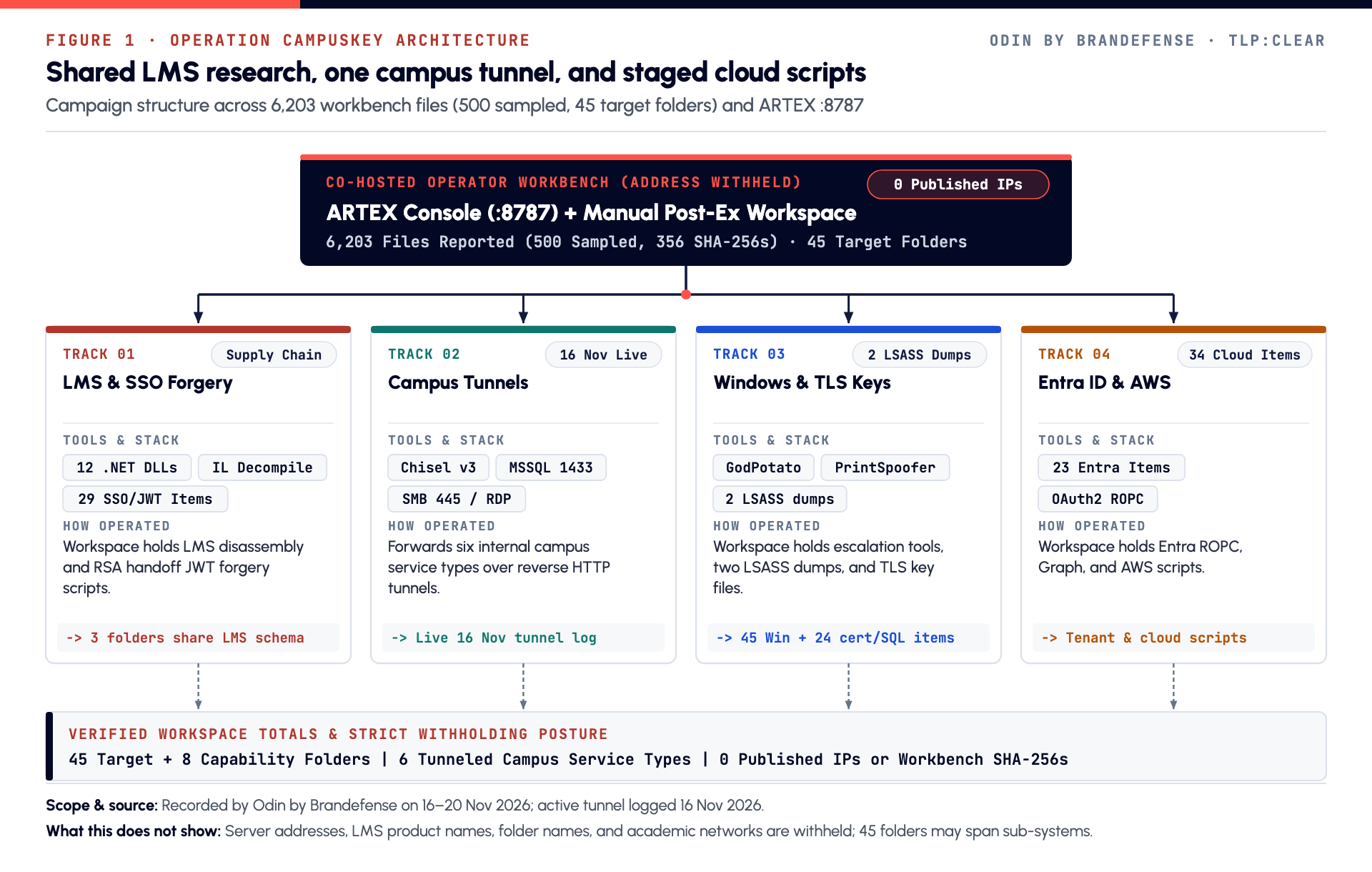
The server holds university database dumps, memory dumps, and institutional TLS private keys. Odin by Brandefense publishes no VPS addresses or workbench-file SHA-256 digests. The shared ARTEX favicon MD5 remains a console indicator. Both server addresses, all folder names, the LMS vendor name, academic subnets, and university names are withheld.
Shared LMS research and database dumps support product reuse across targets.
Across 45 numbered target folders (379 sampled entries) and 8 capability folders (55 entries), the operator collected 12 .NET libraries. The operator disassembled those libraries from a regional e-learning product.
The workspace also held 29 single sign-on and JSON Web Token scripts, RSA keys, and test outputs. Those files target the product's authentication bridge.
Database dumps sharing that identical LMS table schema sit inside three separate target folders. Those dumps support reuse of the same LMS product across targets. Directory listings alone do not show whether 45 folders map to 45 distinct universities. Some folders may map to several sub-systems per campus.
A live reverse tunnel on 16 November forwarded six internal campus service types.
A reverse-tunnel server log dated 16 November 2026 records active WebSocket sessions from a South Korean academic network. Those sessions forwarded six internal service types into the workbench.
The forwarded services cover Microsoft SQL Server, SMB, Remote Desktop, Windows Remote Management, FTP, and SQL Server Analysis Services. Across target folders, the workbench also held local privilege-escalation tools. It held 11 TLS certificate files and two LSASS memory dumps.
Staged cloud scripts target Microsoft Entra ID and AWS environments.
Thirty-four sampled items target cloud identity and storage services. Twenty-three scripts and logs target Microsoft 365 and Entra ID. They use single-factor password-grant requests, Microsoft Graph role queries, and password resets. Eleven more scripts query Amazon Web Services STS, S3, and Transcribe APIs.
Activity continued one month after South Korean police arrests involving ARTEX.
On 26 October 2026, South Korean police announced the 15 October arrest of a suspected ringleader. Police accused the group of using ARTEX across roughly 90 organizations. Six more suspects stayed under investigation. The 16 November campus tunnel and 16 to 20 November workbench activity ran one month later. Any link to that group remains an open question.
Three Decisions for University Leaders
- Eliminate shared or static SSO handoff keys across campus portals. Require unique per-campus asymmetric keys. Enforce strict algorithm, issuer, and audience checks on JWT handoff endpoints. Audit third-party .NET modules.
- Isolate e-learning web servers from campus Active Directory and database subnets. Place LMS servers in demilitarized zones with outbound proxy rules. Block WebSocket reverse tunnels from reaching internal SQL Server, SMB, RDP, or WinRM ports.
- Block legacy authentication, require MFA so ROPC fails, and protect LSASS. Require MFA for relevant Entra users and apps so ROPC requests fail. Block legacy authentication separately and migrate approved ROPC clients. Alert on scripted Microsoft Graph calls and enable Windows Credential Guard.
2. Workbench Architecture, 500-Entry Sample, and Regional Context
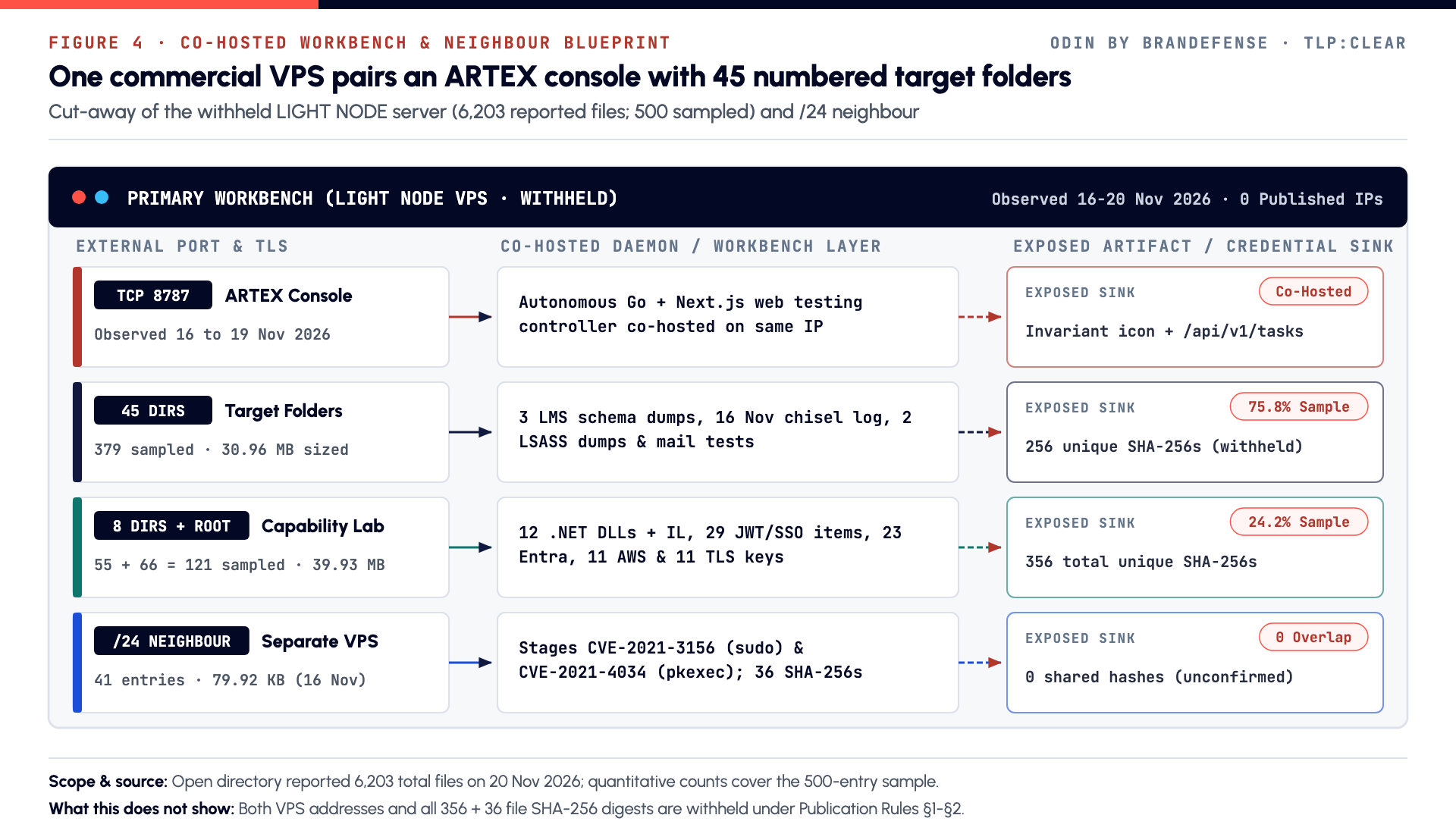
Operation CampusKey ran from a commercial virtual private server (LIGHT NODE, address withheld). That host ran an ARTEX console on TCP 8787 from 16 to 19 November 2026. On 20 November 2026, an open directory on the same server reported 6,203 total files.
Monograph 53 (Operation LedgerSwarm) examined an operator running ARTEX worker waves across fintech and Web3 targets. That operator followed web discovery with cloud-bucket scripting. Operation CampusKey follows a different workflow. Web discovery on TCP 8787 sits alongside a manual .NET reverse-engineering, Windows Active Directory, and cloud identity workspace. Figure 1 maps the four workbench tracks.
Workspace Zone Partition and File-Type Breakdown (n = 500)
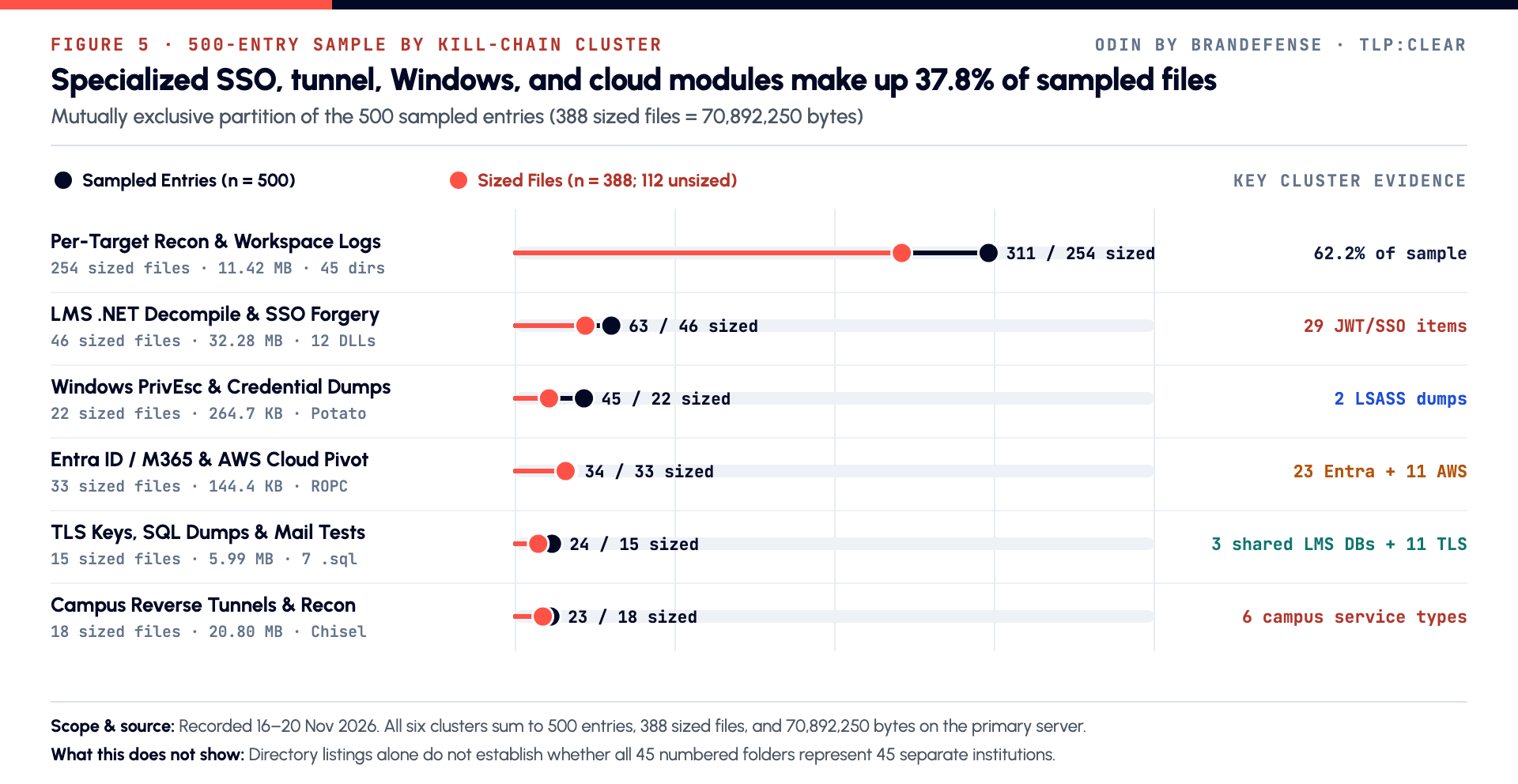
Counts in this study come from the 500-entry sample captured from the primary workbench. Within those 500 entries, 388 files report byte sizes totaling 70,892,250 bytes (70.89 MB). The remaining 112 entries omit byte size in listings. The sample spans 356 unique SHA-256 digests, all withheld.
| Workspace zone | Folder count | Sampled entries | Share (%) | Sized files | Unsized entries | Sized bytes | Unique SHA-256 (withheld) | Operational role |
|---|---|---|---|---|---|---|---|---|
| Numbered Target Folders | 45 | 379 | 75.8% | 282 | 97 | 30,963,020 | 256 | Per-target folders holding 3 shared-schema LMS SQL dumps, 16 Nov chisel logs, 2 LSASS memory dumps, and mail tests. |
| Functional Capability Folders | 8 | 55 | 11.0% | 42 | 13 | 3,197,973 | 41 | Dedicated folders for .NET LMS disassembly, SSO scripts, Entra Graph scripts, AWS scripts, and TLS key stores. |
| Root Operator Workspace | 1 (root) | 66 | 13.2% | 64 | 2 | 36,731,257 | 64 | Top-level RSA/JWT forgery scripts, compiled binaries, and session logs. |
| Combined primary sample | 53 dirs + root | 500 | 100.0% | 388 | 112 | 70,892,250 | 356 (cross-zone) | Sample from 6,203 directory-reported total files (20 Nov 2026). |
One analytical limit governs the 45 numbered target folders. Folder names use internal numeric codes, which are withheld. Directory listings alone cannot show whether 45 folders equal 45 distinct institutions. Universities often run separate sub-domains for main portals, e-learning, libraries, and departments. Defenders can use external attack surface management to inventory them.
| Artifact class | Sampled entries | Share (%) | Sized files | Unsized entries | Sized bytes | Representative extensions & contents |
|---|---|---|---|---|---|---|
Scripts (script) | 227 | 45.4% | 199 | 28 | 858,990 | 147 .py, 25 .ps1, 17 .php, 16 .js, and shell wrappers. |
Text & logs (text) | 150 | 30.0% | 140 | 10 | 1,380,922 | 46 .log, 18 .out, 15 .txt, and disassembled .NET IL files. |
Binaries & libraries (exe) | 74 | 14.8% | 16 | 58 | 23,625,412 | 12 .NET .dll assemblies and tools including chisel, GodPotato, and PrintSpoofer; extension counts require recounting. |
Data & memory dumps (data) | 14 | 2.8% | 8 | 6 | 28,793,918 | 7 .sql database dumps (3 sharing one LMS schema) and 2 LSASS memory dumps. |
Archives (archive) | 13 | 2.6% | 7 | 6 | 15,745,642 | 12 .zip archives and 1 compressed package. |
Secrets & keys (secret) | 12 | 2.4% | 12 | 0 | 272,366 | RSA handoff PEM keys, signed JWTs, and harvested TLS/PFX files. |
Other (other) | 8 | 1.6% | 4 | 4 | 135,640 | Raw HTTP session state and binary fragments. |
Documents (doc) | 2 | 0.4% | 2 | 0 | 79,360 | Target architecture and reference notes. |
| Total | 500 | 100.0% | 388 | 112 | 70,892,250 | Exact byte-level parity (70.89 MB). |
Figure 5 divides the 500 sampled entries into six mutually exclusive kill-chain clusters (311 + 63 + 45 + 34 + 24 + 23 = 500). LMS forgery, campus tunnelling, Windows escalation, TLS and SQL collection, and cloud identity files make up 37.8% (189 entries).
Post-Arrest Regional ARTEX Context and /24 Neighbour Comparison
Two external and hosting facts place Operation CampusKey in clear context:
- Activity one month after South Korean ARTEX arrests (
[REF-01],[REF-02]). On26 October 2026, Seoul police announced the15 Octoberarrest of a former penetration tester ([REF-01]). Police stated that the group used ARTEX ([REF-03],[REF-04]). The group targeted roughly 90 organizations, including universities. Police reported8.2 millionstolen records. Six suspects stayed under investigation. The CampusKey ARTEX console (16–19 November), tunnel log (16 November), and open directory (20 November) ran one month after that arrest. Artifacts alone cannot show whether this host belongs to remaining suspects, copycats, or an unrelated operator. - Unconfirmed
/24neighbour. On16 November 2026, a second open directory sat in the same/24LIGHT NODEsubnet (address withheld). That directory held 41 entries, 79,922 bytes, and 36 SHA-256s. It staged Linux privilege-escalation code forCVE-2021-3156(sudobefore1.9.5p2; fixed in1.9.5p2,[REF-09]) andCVE-2021-4034(polkitpkexecbefore 121; fixed upstream in 121,[REF-10]). Comparing all 356 primary digests with all 36 neighbour digests yields 0 shared hashes. We therefore treat the second server strictly as an unconfirmed neighbour.
3. Shared LMS Reverse Engineering, SSO Forgery, and Live Campus Tunnels
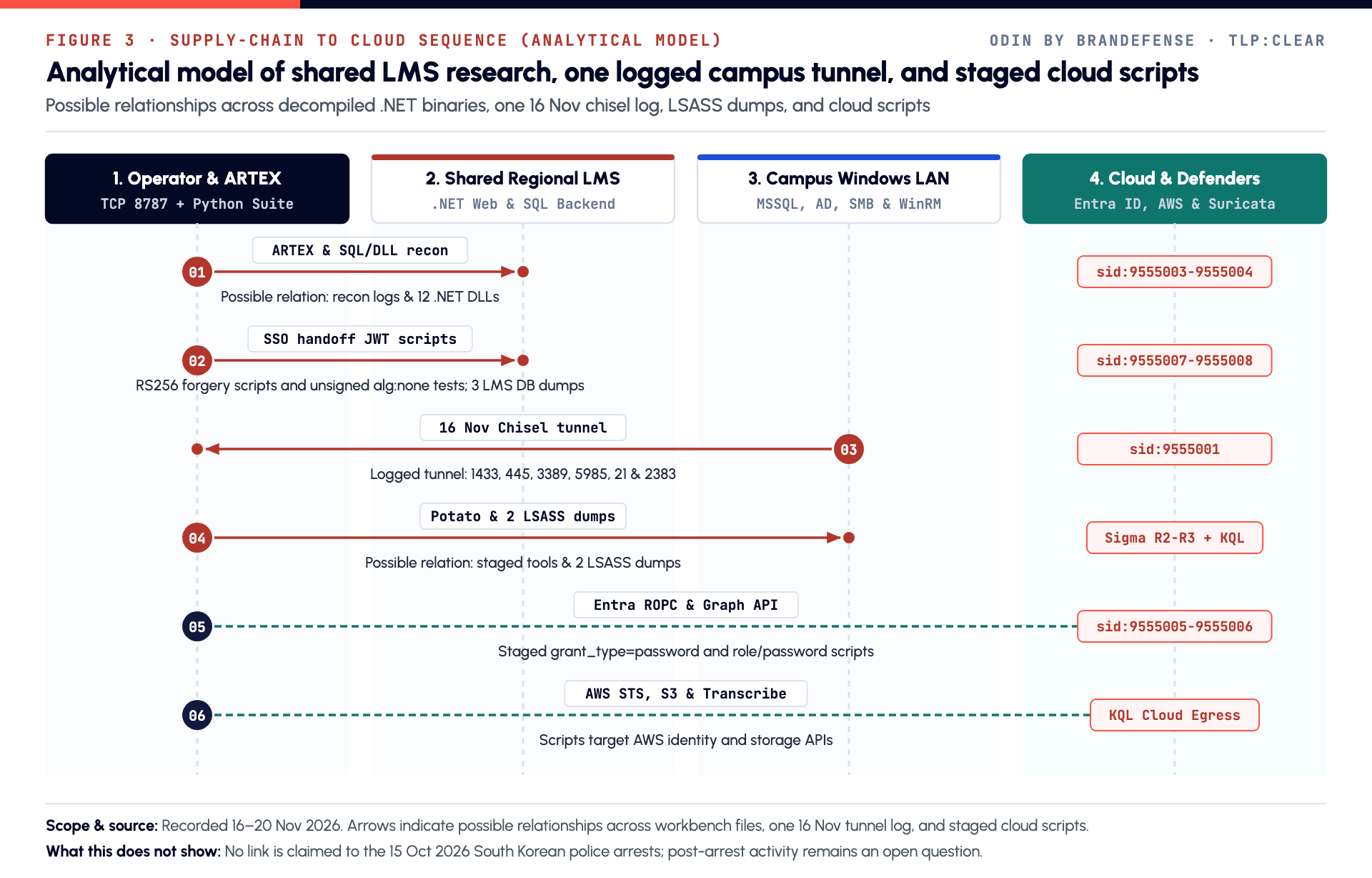
Regional universities often adopt the same .NET e-learning packages. They link those portals to campus single sign-on with signed JSON Web Token (JWT) redirects. Figure 3 maps a possible sequence that cyber threat intelligence can help defenders investigate across campus networks.
.NET Disassembly and RSA / JWT SSO Token Forgery (63 Entries)
Within the LMS capability folder and root workspace (63 entries, 32,278,804 sized bytes), the operator collected 12 compiled .NET .dll assemblies. Those binaries belong to a South Korean e-learning product, with the vendor and filenames withheld.
The operator ran custom Python Intermediate Language (IL) disassembly scripts on those files. The scripts extracted class structures, token checks, and signing parameters.
From that disassembled code, the operator built 29 SSO and JWT token-forgery scripts, PEM keys, and test outputs. Two artifact groups stand out in this cluster:
- Handoff token forgery (
RS256andalg:nonechecks). Campus main portals authenticate users and redirect them to the LMS with a signed handoff JWT. The staged scripts use extracted RSA private keys (.pem) and unsignedalg:nonevalidation tests. They build administrative SSO tokens designed to bypass interactive MFA prompts. - Shared LMS database dumps. The TLS and SQL cluster holds 24 entries (5,990,594 sized bytes), including 11
.pem,.pfx,.key, and.crtfiles and 7.sqldumps. Three separate numbered target folders hold database dumps of the identical LMS schema. That overlap supports reuse of the same LMS product across targets.
Live 16 November 2026 Campus Reverse Tunnels (23 Entries) and Windows Post-Exploitation (45 Entries)
Campus firewalls normally block direct internet access to internal SQL and Active Directory servers. The tunnel cluster holds 23 entries (20,798,257 sized bytes). In that cluster, the operator used chisel ([REF-08]) to wrap TCP port-forwards inside outbound HTTP WebSocket and SSH sessions.
Inside one numbered target folder, a chisel server log dated 16 November 2026 (21:36) records live reverse tunnels from a South Korean academic network (subnet withheld). Those sessions forwarded six internal campus service types:
- Microsoft SQL Server (
TCP 1433). Direct access to internal campus relational databases. - SMB (
TCP 445). Windows file shares, RPC named pipes, and NTLM authentication surfaces. - Remote Desktop Protocol (
TCP 3389). Interactive desktop sessions to internal Windows hosts. - Windows Remote Management (
TCP 5985and 5986). PowerShell Remoting and WinRM management ports. - FTP (
TCP 21). Legacy campus file and web-publishing servers. - SQL Server Analysis Services (
TCP 2383). Campus analytics cubes (SSAS) holding student and administrative data.
The Windows post-exploitation cluster holds 45 entries (264,679 sized bytes) alongside internal scanner logs (fscan). It includes two host-level privilege and credential artifact groups:
- Named-pipe privilege escalation tools. IIS and
.NETapplication pools holdSeImpersonatePrivilege. The workbench stagedGodPotatoandPrintSpooferbinaries designed to elevate web service accounts toSYSTEM. - Two LSASS memory dumps. Two separate numbered target folders hold captured LSASS memory dumps. Those folders also hold RPC and NTLM scripts and offline password-cracking logs.
4. Federated Cloud Identity Pivots: Microsoft Entra ID and AWS
Universities sync Active Directory accounts with Microsoft 365 / Entra ID for mail and administration. Many also link lecture-captioning workloads to AWS. Figure 4 shows the co-hosted workbench layout. Separately from the on-campus dumps, the cloud cluster (34 entries, 144,360 sized bytes) holds staged Entra ID and AWS scripts.
OAuth 2.0 ROPC, Microsoft Graph (23 Items), and AWS (11 Items)
The cloud folder holds 23 Microsoft 365 and Entra ID scripts, token files, and outputs. This staged tooling targets sign-in and directory APIs in three ways.
- Legacy
ROPCsingle-factor token requests ([REF-05]). Staged Python scripts preparePOSTrequests tologin.microsoftonline[.]com/<tenant>/oauth2/v2.0/tokenwithgrant_type=password. Resource Owner Password Credentials (ROPC) requests cannot carry MFA challenges ([REF-05]). Some tenants do not require MFA for the user and app in Conditional Access. In those cases, valid passwords can return Graph bearer tokens ([REF-05],[REF-06]). - Microsoft Graph role queries and password-reset scripts. Companion scripts query
graph.microsoft[.]com/v1.0/usersandgraph.microsoft[.]com/v1.0/directoryRoles. They list privileged roles and issuepasswordProfilereset calls. - AWS scripts and mail tests. Eleven scripts query
sts.amazonaws[.]comcaller identity,S3buckets, andAmazon Transcribecaptioning jobs tied to lecture portals. A separate target folder holds SMTP and typo-domain sender-spoofing test scripts.
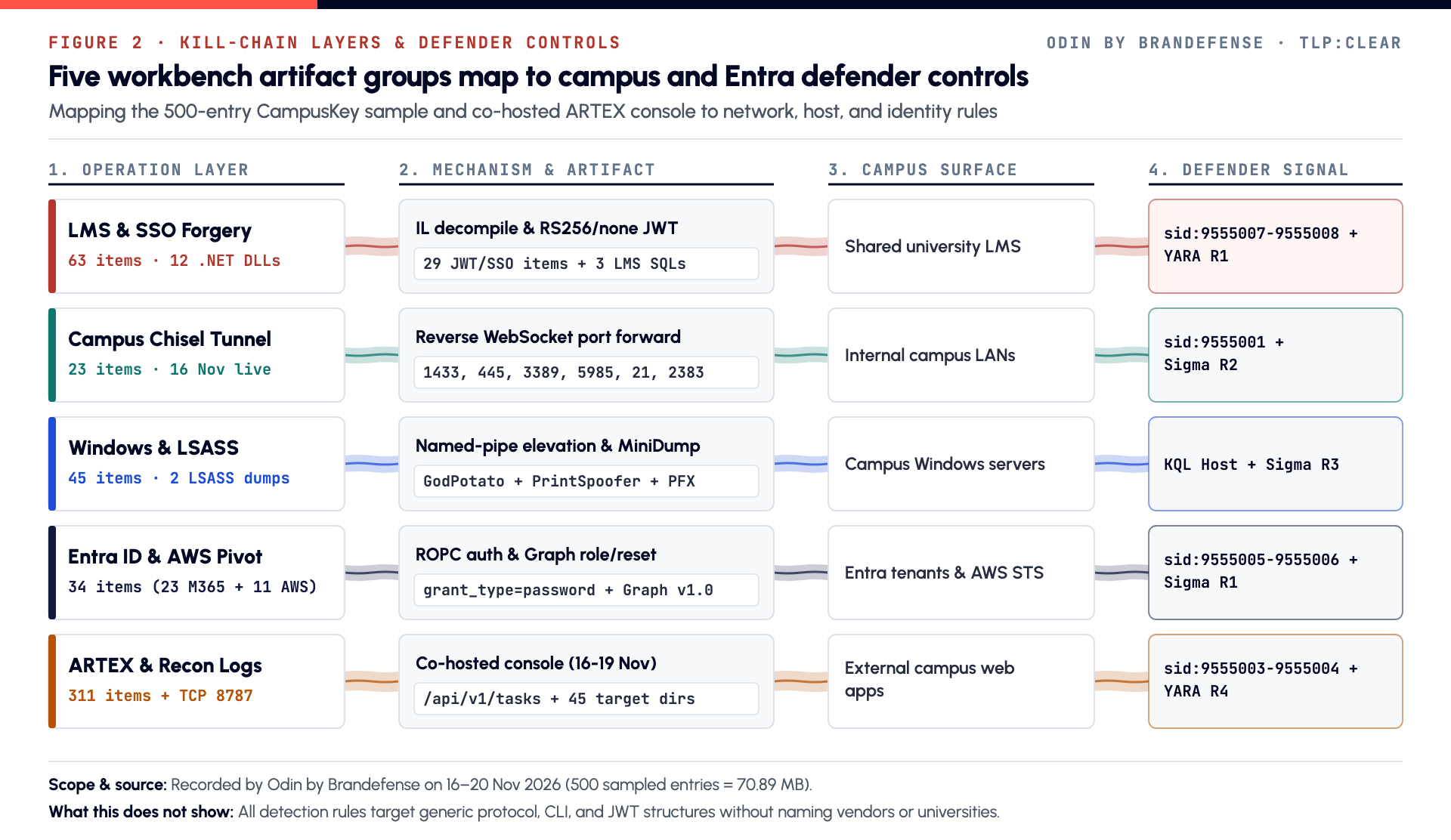
Figure 2 maps the five workbench artifact groups to the Suricata, Sentinel KQL, Sigma, and YARA rules in Chapter 7.
5. Higher-Education Supply-Chain Exposure Analysis
The workbench shows four artifact groups. Campus teams should verify the related controls before treating any configuration as a root cause:
| Exposure layer | Observed CampusKey evidence | Control to verify | Operational risk |
|---|---|---|---|
Shared .NET LMS & SSO bridges | 12 .dll files, 29 JWT/SSO items, 3 shared LMS SQL dumps. | Verify whether campuses share LMS modules or signing keys; the evidence establishes a shared database schema. | Cross-campus reuse of the forgery scripts remains unverified. |
| Campus network segmentation | 16 Nov chisel tunnel to 1433, 445, 3389, 5985/5986, 21, 2383. | Verify the tunnel’s origin host and its access to internal services; the log does not establish LMS server routing. | If a web host can reach these services, a foothold could expose internal administration ports. |
| LSASS protection & TLS key handling | GodPotato, PrintSpoofer, 2 LSASS memory dumps, 11 TLS/PFX files. | Verify IIS privileges, Credential Guard status, and TLS key export settings. | SYSTEM elevation, domain credential theft, and TLS key theft. |
Entra ROPC & AWS key handling | 23 Entra (ROPC + Graph) items and 11 AWS (STS, S3, Transcribe) items. | Verify whether ROPC grants can succeed without MFA and whether LMS hosts retain static AWS keys. | Single-factor cloud token minting, role checks, and bucket access. |
6. Alternative Hypotheses
| Hypothesis | Evidence for | Evidence against | Assessment |
|---|---|---|---|
Splinter or continuation of arrested Korean ARTEX ring ([REF-01]) | Co-hosts ARTEX (:8787), targets Korean campuses, and ran one month after the 15 Oct arrest while six suspects remained under investigation. | ARTEX is open-source; Censys counted 1,465 exposed consoles on 4 November 2026. Police forensic indicators are non-public. | Open question. Cite the October arrest strictly as context, not attribution. |
| 45 numbered folders equal 45 breached institutions | 45 distinct numbered directories hold 379 sampled entries (75.8%). | Universities run multiple sub-portals per campus, and several folders hold recon or mail tests only. | Unsupported as an exact victim count. State verified dump counts (3 shared LMS SQLs; 2 LSASS dumps). |
| Authorized red-team engagement | Uses numbered folders, ARTEX, and standard tunnel utilities. | Stores 3 LMS SQL dumps, 2 LSASS dumps, TLS private keys, and typo-domain mail tests on an open foreign VPS. | Contradicted. Multi-victim data retention and open exposure violate authorized testing rules. |
Linked /24 VPS neighbour (41 entries) | Same /24 LIGHT NODE subnet observed on 16 November 2026. | Comparing 356 primary hashes with 36 neighbour hashes shows 0 shared digests, and toolsets differ. | Unconfirmed neighbour. Shared VPS /24 tenancy is routine; both IPs are withheld. |
7. Validated Detection Rules
All VPS addresses and workbench-file SHA-256 digests are withheld. Defenders should deploy protocol, CLI, and identity rules that catch this tradecraft across any host. Every rule was tested before release. Checks passed on Suricata 7.0.12 (suricata -T and linter, 0 problems), Microsoft Kusto.Language (0 errors), pySigma (3 rules), and YARA-X (4 filesize-bounded rules).
7.1 Suricata 7.x Network Signatures (sid:9555001, sid:9555003-9555008)
These seven alert signatures detect chisel-v3 WebSocket reverse tunnels and exposed or queried ARTEX consoles on TCP 8787. They also match OAuth 2.0 grant_type=password (ROPC) requests, scripted Graph passwordProfile resets, and inbound alg:none JWT headers (eyJhbGciOiJub25lIg).
All seven HTTP rules need cleartext traffic or a sensor behind a TLS-inspecting proxy or reverse proxy. Defenders should enforce inline blocks in the firewall or proxy.
# Odin by Brandefense - Monograph 55 (Operation CampusKey) Suricata 7.x Ruleset
# Validated against Suricata 7.0.12 (-T) and Odin Suricata linter (0 warnings).

alert http $HOME_NET any -> $EXTERNAL_NET any (msg:"ODIN-R55 CampusKey Outbound Chisel v3 WebSocket Reverse Tunnel Handshake"; flow:established,to_server; http.header; content:"Sec-WebSocket-Protocol: chisel-v3"; nocase; fast_pattern; classtype:command-and-control; sid:9555001; rev:1;)
alert http $EXTERNAL_NET 8787 -> $HOME_NET any (msg:"ODIN-R55 CampusKey Exposed ARTEX Console Response Banner on TCP 8787"; flow:established,to_client; http.response_body; content:"ARTEX - Autonomous Red-Team Expert"; fast_pattern; classtype:trojan-activity; sid:9555003; rev:1;)
alert http $HOME_NET any -> $EXTERNAL_NET 8787 (msg:"ODIN-R55 CampusKey Outbound ARTEX Task Dispatch API Call"; flow:established,to_server; http.method; content:"POST"; bsize:4; http.uri; content:"/api/v1/tasks"; startswith; fast_pattern; classtype:trojan-activity; sid:9555004; rev:1;)
alert http $HOME_NET any -> $EXTERNAL_NET any (msg:"ODIN-R55 CampusKey Legacy OAuth2 ROPC Password Grant Token Request"; flow:established,to_server; http.method; content:"POST"; bsize:4; http.request_body; content:"grant_type=password"; fast_pattern; content:"scope="; classtype:policy-violation; sid:9555005; rev:1;)
alert http $HOME_NET any -> $EXTERNAL_NET any (msg:"ODIN-R55 CampusKey Scripted Graph API Password Reset Payload"; flow:established,to_server; http.request_body; content:"passwordProfile"; fast_pattern; content:"forceChangePasswordNextSignIn"; classtype:attempted-admin; sid:9555006; rev:1;)
alert http $EXTERNAL_NET any -> $HOME_NET any (msg:"ODIN-R55 CampusKey Inbound Unauthenticated alg-none JWT Header"; flow:established,to_server; http.header; content:"eyJhbGciOiJub25lIg"; fast_pattern; classtype:web-application-attack; sid:9555007; rev:1;)
alert http $EXTERNAL_NET any -> $HOME_NET any (msg:"ODIN-R55 CampusKey Inbound Unauthenticated alg-none JWT Handoff Query"; flow:established,to_server; http.uri; content:"eyJhbGciOiJub25lIg"; fast_pattern; classtype:web-application-attack; sid:9555008; rev:1;)
7.2 Microsoft Sentinel KQL Hunt
Replace the two placeholder FQDNs in ApprovedAutomationHosts with your campus IAM sync host allowlist before scheduling.
// Odin by Brandefense - Monograph 55 (Operation CampusKey)
// Hunts campus Chisel reverse tunnels, LSASS/Potato escalation, and non-browser Python/PowerShell calls to Entra ID and AWS STS.
let Lookback = 7d;
let ApprovedAutomationHosts = dynamic(["iam-sync-01.campus.example", "cloud-backup-01.campus.example"]);
let CampusTunnelPorts = dynamic([":1433", ":445", ":3389", ":5985", ":5986", ":21", ":2383"]);
let HostTunnelAndPostEx =
    DeviceProcessEvents
    | where Timestamp >= ago(Lookback)
    | where not(DeviceName in~ (ApprovedAutomationHosts))
    | where (
        (ProcessCommandLine has "chisel" and ProcessCommandLine has "client" and ProcessCommandLine matches regex @"(^|[^0-9]):(1433|445|3389|5985|5986|21|2383)([^0-9]|$)")
        or (ProcessCommandLine has_any ("GodPotato", "PrintSpoofer") or (ProcessCommandLine has_any ("comsvcs.dll", "lsass") and ProcessCommandLine has "MiniDump"))
        or (ProcessCommandLine has "grant_type=password" and ProcessCommandLine has_any ("microsoftonline.com", "graph.microsoft.com"))
    )
    | project Timestamp, DeviceName, AccountName, SignalType = "CampusPostExOrTunnel", Detail = ProcessCommandLine;
let ScriptedCloudIdentityCalls =
    DeviceNetworkEvents
    | where Timestamp >= ago(Lookback)
    | where not(DeviceName in~ (ApprovedAutomationHosts))
    | where InitiatingProcessFileName in~ ("python.exe", "python3", "python", "powershell.exe", "pwsh.exe", "pwsh")
    | where RemoteUrl has_any ("login.microsoftonline.com", "graph.microsoft.com", "sts.amazonaws.com", "transcribe.")
    | project Timestamp, DeviceName, AccountName = InitiatingProcessAccountName, SignalType = "ScriptedCloudIdentityEgress", Detail = strcat(InitiatingProcessFileName, " -> ", RemoteUrl, " (", RemoteIP, ":", tostring(RemotePort), ")");
union HostTunnelAndPostEx, ScriptedCloudIdentityCalls
| summarize FirstSeen = min(Timestamp), LastSeen = max(Timestamp), EventCount = count(), Signals = make_set(SignalType, 6), SampleDetails = make_set(Detail, 5) by DeviceName, AccountName
| order by LastSeen desc
7.3 Portable Sigma and YARA Rules
- Sigma (
sigma_campuskey_entra_ropc_chisel_and_lsass.yml). Rule 1 detects CLI scripts passinggrant_type=password,/v1.0/directoryRoles, orpasswordProfile. Rule 2 catcheschiselreverse tunnels (R:) across :1433, :445, :3389, :5985, :5986, :21, or :2383. Rule 3 detects Windows process command lines mentioningGodPotato,PrintSpoofer, orcomsvcs.dllMiniDump. - YARA (
odin_campuskey_jwt_forger_and_postex_artifacts.yar). Fourfilesize-bounded generic rules detect RS256 JWT token-forgery scripts andchiselmulti-service tunnel logs. They also match EntraROPCand Graph reset scripts and exposed ARTEX console bundles.
8. Behavioral and Protocol Hunt Markers (0 Published IPs or Workbench SHA-256s)
No VPS IPv4 addresses or workbench-file SHA-256 digests appear in the indicator feeds. The server holds campus database dumps, LSASS dumps, and TLS private keys. Defenders should hunt using the 10 protocol, API, and host markers below.
| Marker category | Pattern / protocol artifact | Layer | Defensive hunt & control |
|---|---|---|---|
| WebSocket tunnel header | Sec-WebSocket-Protocol: chisel-v3 | HTTP / TLS egress | Alert on visible chisel WebSocket upgrades with sid:9555001. Enforce outbound blocks in the proxy or firewall. |
| Inner Chisel SSH string | SSH-2.0-chisel | WebSocket stream / host | Match in decapsulated WebSocket streams or host binaries. Client WebSocket frames mask this banner on raw TCP. |
| ARTEX console icon MD5 | cd3ebd16437d6d3963592f7365dd3980 | TCP 8787 | Use the favicon MD5 in external asset sweeps. Rule sid:9555003 alerts on a visible ARTEX response-body banner. |
| ARTEX dispatch route | POST /api/v1/tasks | TCP 8787 | Hunt proxy logs for outbound ARTEX task calls (sid:9555004). |
| Entra legacy OAuth flow | grant_type=password (login.microsoftonline[.]com) | HTTPS (443) | Hunt Entra sign-in logs. Rule sid:9555005 alerts on visible HTTP at a TLS-inspecting proxy. |
| Microsoft Graph admin API | /v1.0/directoryRoles & passwordProfile | HTTPS (443) | Alert on scripted Graph calls in Entra logs or decrypted proxy HTTP (sid:9555006). |
Forged JWT header (none) | eyJhbGciOiJub25lIg ({"alg":"none") | HTTP / TLS ingress | Reject alg:none JWTs in the LMS. Rules sid:9555007-9555008 alert on visible HTTP. |
SSO handoff JWT (RS256) | eyJhbGciOiJSUzI1NiIs (RS256 SSO handoff) | HTTPS (443) | Enforce unique per-campus RSA keys, strict iss/aud checks, and <=60s lifetimes. |
| Credential dump artifact | comsvcs.dll MiniDump / LSASS access | Windows EDR | Enable LSA Protection (RunAsPPL) and Credential Guard, and alert on LSASS memory reads. |
| Token impersonation family | GodPotato / PrintSpoofer | Windows EDR | Alert on Windows process command lines mentioning GodPotato, PrintSpoofer, or comsvcs.dll MiniDump (Sigma Rule 3). |
9. Hardening Priorities for Universities and EdTech Vendors
Campus security teams should close third-party portal and cloud identity gaps together:
- Re-key third-party LMS SSO handoff bridges (
0-48 Hours). Replace shared or vendor-default signing keys with unique per-campus RSA or ECDSA keys ([REF-07]). Store those keys outside the web root. AllowlistRS256orES256only and rejectalg:none. Checkissandaud, and cap handoff token lifetimes at 60 seconds. - Block legacy authentication, require MFA against
ROPC, and remove static cloud keys (0-72 Hours): Require MFA for relevant Entra users and apps soROPCpassword grants fail. Block legacy authentication separately. Migrate approvedROPCclients ([REF-05],[REF-06]). Require phishing-resistant MFA for directory admins. Replace static AWS keys on lecture-caption servers with IAM roles. - Isolate LMS servers (
Days 1-7). Place e-learning hosts in DMZ VLANs. Block them from initiating internal 1433, 445, 3389, 5985, 21, or 2383 connections ([REF-08]). Enforce outbound proxy allowlists to blockchiseltunnels. - Protect LSASS and TLS keys (
Days 7-14). EnableRunAsPPLand Windows Defender Credential Guard on campus Windows servers. Mark institutional TLS private keys as non-exportable in the Windows Certificate Store. - Enforce DMARC and review binaries (
Days 14-30). Publish SPF, DKIM, and DMARC (p=reject) records on.ac.krand university mail domains. Require EdTech vendors to audit compiled.NETmodules for hardcoded keys before deployment.
10. Scope, Limits, and External References
Odin by Brandefense analyzed workbench artifacts recorded between 16 and 20 November 2026. File counts cover the 500-entry sample (70.89 MB across 388 sized files). That sample came from an open directory reporting 6,203 total files on 20 November 2026.
Directory listings alone do not show how many distinct institutions map to the 45 numbered target folders. Staged cloud scripts likewise do not show how many tenants experienced account changes. Both VPS addresses, all 356 + 36 workbench-file SHA-256 digests, LMS vendor names, folder names, and academic identifiers are withheld.
[REF-01]BleepingComputer, *Former pentester used ARTEX AI to steal 8.2 million data records* (26 October 2026; verified on 22 November 2026).[REF-02]FBI Cyber Division, *FLASH-20261113-001: Malicious Use of Autonomous Penetration Testing Tool ARTEX* (13 November 2026)[REF-03]Help Net Security, *ARTEX Goes from Pentesting Tool to Attacker Staple in Three Months* (9 November 2026)[REF-04]Infosecurity Magazine, *FBI Warns of Growing Abuse of AI Pentesting Frameworks* (November 2026)[REF-05]Microsoft Learn, *Microsoft Identity Platform and OAuth 2.0 Resource Owner Password Credentials (ROPC)*[REF-06]Microsoft Learn, *Token Protection in Microsoft Entra Conditional Access*[REF-07]IETF, *JSON Web Token Best Current Practices (RFC 8725)* (verified on 22 November 2026)[REF-08]MITRE ATT&CK, *Protocol Tunneling (T1572)*[REF-09]NIST NVD, *CVE-2021-3156 - Sudo Heap-Based Buffer Overflow*[REF-10]NIST NVD, *CVE-2021-4034 - Polkit pkexec Local Privilege Escalation*
What is…?
Short explanations of the tools and families named in this study.
What is ARTEX?
ARTEX is an autonomous red-team console that chains AI agents and security tools. Operators fork and rebrand it; its default listener port is 8787.
More about ARTEXOffensive toolWhat is PrintSpoofer?
PrintSpoofer is a public Windows privilege escalation tool that abuses impersonation privileges to gain SYSTEM.
More about PrintSpooferFrequently asked questions
How was the 6,203-file workbench organized, and why does the timing matter?
On 26 October 2026, South Korean police announced the 15 October arrest of a suspected ringleader accused of using ARTEX across roughly 90 organizations. Police reported 8.2 million stolen records while six suspects stayed under investigation. The CampusKey ARTEX console (16–19 November), live campus tunnel (16 November), and 6,203-file directory (20 November) ran one month after that arrest.
How do the LMS forgery scripts, campus tunnel log, and Entra ID items fit together?
Three artifact groups in the sample span public campus portals, an internal Windows tunnel log, and staged cloud identity scripts. Each group targets a distinct layer of the campus stack:
What should universities and EdTech teams do first?
Campus defenders and software teams can break each layer of this tradecraft with three priority actions. These steps address portal signing keys, cloud sign-in rules, and server network boundaries: