
1. Executive Summary
In short
Operation NightShift links enterprise middleware intrusion across Oracle E-Business Suite, Zimbra, and Windows IIS servers with off-hours Monero mining and search-bot SEO spam scripts. Odin by Brandefense analyzed the multi-port workbench on 38.60.227[.]210 during a two-week observation window ending 20 November 2026. The server exposed 1,580 entries and returned outputs from three affected environments. Audit Oracle database links, enforce Microsoft Defender Tamper Protection, hunt Linux anonymous-memory loaders paired with lock files, and block the three operator hosts.
Security teams often treat enterprise database lateral movement and compute or search-spam monetization as separate threat categories. High-end intrusion groups are expected to pursue data theft or extortion. Cryptomining and search-spam crews are assumed to rely on opportunistic web exploits. Defenders can use cyber threat intelligence to connect this middleware intrusion with the mining and search-spam scripts on the operator's server.
Odin by Brandefense analyzed the expanded workbench at 38.60.227[.]210 during the two-week window ending 20 November 2026. The analysis also covered check-in host 38.60.252[.]110 and TLS proxy 38.54.14[.]162.
Monograph 03 covered the static scripts on this server during an earlier four-day window. Adding the four-port directory inventory and returned target stores turns that toolkit study into an operation profile. All victim output paths, log filenames, disk serials, database schemas, and institution names are withheld.
Returned outputs confirm activity across at least three distinct target environments.
Across four primary HTTP ports on 38.60.227[.]210 (plus a fifth mirror port), the server exposed 1,580 entries and 895 unique file digests. Two withheld stores hold returned outputs from affected targets rather than outbound tools.
One store holds 505 captured command outputs from a Windows and IIS server environment. A second store holds 22 Oracle E-Business Suite job outputs and 4 higher-education database outputs.
An active upload receiver logged chunked host dumps through 20 November 2026.
On TCP port 8093, an upload receiver held 382 entries. These include 380 chunk and recon items plus two transfer logs totaling 3.90 megabytes.
Those logs record active callbacks between 6 November and 20 November 2026. Recorded transfers include seven-part dumps of roughly one megabyte plus status, network, host, key, memory-agent, rollback, and self-check reports.
Staged scripts pair off-hours mining and search-bot cloaking with rival eviction.
Instead of deploying noisy ransomware, the scripts are built to extract steady value from multi-core servers without daytime alerts. One staged track is designed to sweep rival miners every two minutes and run a disguised Monero miner between 22:00 and 06:00 local time. A second staged track holds PHP prepend hooks designed to show normal pages to people while feeding spam to search bots.
Public research links the server to post-exploitation behind Ivanti Connect Secure flaws.
On 3 November 2026, Etugen Research noted 38.60.227[.]210 in post-exploitation activity behind Ivanti Connect Secure authentication bypass intrusions. Etugen separated this operator from the tracked group UTA0576. Our 1,580 directory entries hold post-exploitation tools rather than the perimeter exploit code itself.
Three Decisions for Leaders
- Treat database links and collaboration servers as lateral boundaries. Audit Oracle database links, revoke unneeded remote job privileges, and use external attack surface management to find exposed Zimbra and VPN appliances for patching.
- Pair host tamper protection with off-hours CPU and egress checks. Enable Microsoft Defender Tamper Protection on Windows Server, hunt Linux memory-only loaders paired with lock files, and inspect 22:00 to 06:00 CPU spikes.
- Audit web prepend settings and block operator infrastructure. Check PHP configurations and IIS modules for unauthorized prepend hooks, and block the operator addresses, cloud buckets, and spam feeds in Chapter 9.
The Study in Numbers
| Number | What it is |
|---|---|
| 1,580 | Non-mirrored directory entries across the four primary HTTP ports on 38.60.227[.]210 (1,561 unique paths and 895 unique SHA-256 digests). |
| 602.61 MB | Total byte volume across the 1,090 sized files (602,605,284 bytes; 490 entries omit byte size in listings). |
| 3 | Distinct affected target environments confirmed by returned output stores (Windows/IIS, Oracle E-Business Suite, and higher education). |
| 505 | Captured command outputs inside the 466-entry Windows and IIS store on TCP 8000 (201 sized files, 326,376 bytes). |
| 26 | Returned database output files on TCP 8083 (22 Oracle E-Business Suite job outputs plus 4 higher-education database outputs, 2,486 bytes). |
| 382 | Entries in the active TCP 8093 upload receiver (380 items plus two transfer logs totaling 3.90 MB, active 6 to 20 November 2026). |
| 10 | Published network and file indicators (3 operator IPv4 hosts and 7 SHA-256 digests), plus 6 report-only cloud, domain, and host markers. |
2. Operational Scope, Multi-Port Inventory, and Monograph 03 Update
Operation NightShift runs from a multi-port virtual private server at 38.60.227[.]210 (LIGHT NODE). That server connects to a host-profiling listener at 38.60.252[.]110:8900 and a custom TLS proxy at 38.54.14[.]162:5556 (wa.theshyc[.]xyz).
Two public cloud buckets support payload delivery. Cloudflare R2 (pub-307c565a487b43c5bee73d21edc4d83b.r2[.]dev) serves mining archives, and Alibaba Cloud OSS (imagefiles-backup.oss-ap-southeast-7.aliyuncs[.]com) serves Windows modules. Figure 1 maps the four operational tracks across this infrastructure.
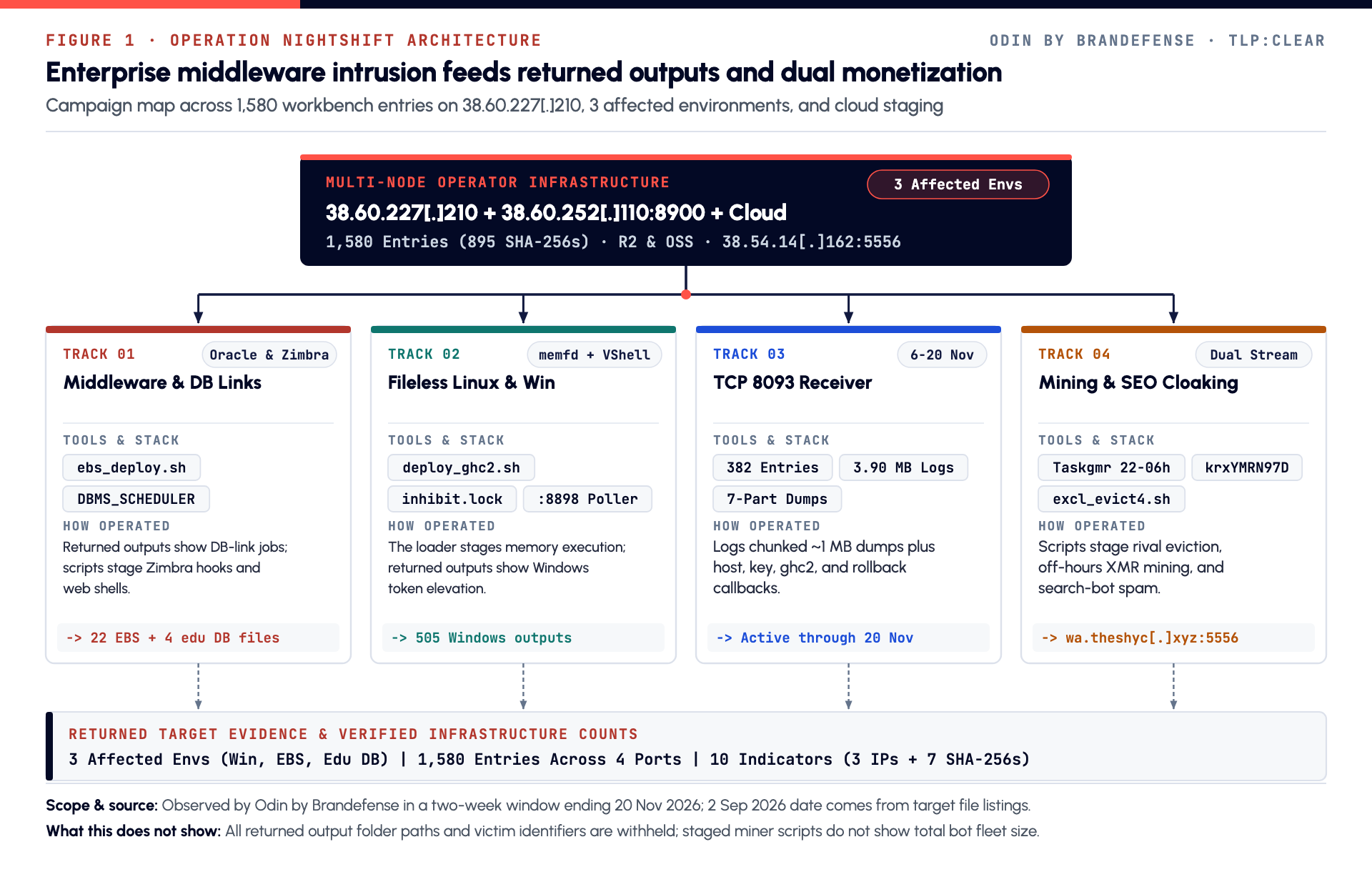
Reconciling the Monograph 03 Snapshot with the Four-Port Inventory
Monograph 03 examined an initial snapshot of 38.60.227[.]210 collected from 13 to 16 November 2026. That snapshot held 1,824 raw rows across five HTTP ports (8000, 8082, 8083, 8093, and 9002). TCP 9002 mirrored TCP 8000 (645 rows then), and 8 paths overlapped across ports. That left 1,171 unique paths alongside 99 retrieved script and config files (94 unique SHA-256 digests).
Continued observation through 20 November 2026 recorded new returned outputs and receiver uploads across the primary ports. Without the 9002 mirror, the four primary ports (8000, 8082, 8083, and 8093) hold 1,580 entries and 1,561 unique paths. Those entries map to 895 unique SHA-256 digests. Within the 1,580 entries, 1,090 sized files total 602,605,284 bytes (602.61 MB), while 490 entries omit byte size.
| Primary TCP port | Total entries | Sized files | Unsized entries | Sized volume (bytes) | Unique SHA-256 | Scripts | Text & logs | Binaries | Archives | Other | Primary operational role |
|---|---|---|---|---|---|---|---|---|---|---|---|
| TCP 8000 (mirrored on 9002) | 952 | 685 | 267 | 202,846,214 | 625 | 198 | 666 | 38 | 2 | 48 | Linux/Windows staging, miners, SEO cloakers, and returned Windows outputs. |
| TCP 8082 | 144 | 144 | 0 | 391,617,257 | 128 | 19 | 26 | 50 | 8 | 41 | Fileless github-c2-agent-dual binaries, Linux LPE archives, and Windows tools. |
| TCP 8083 | 102 | 91 | 11 | 122,152 | 89 | 62 | 4 | 1 | 1 | 34 | Oracle EBS DB-link scripts, Zimbra persistence, and returned DB outputs. |
| TCP 8093 | 382 | 170 | 212 | 8,019,661 | 151 | 0 | 113 | 212 | 57 | 0 | Active chunked upload receiver and transfer logs (6-20 Nov 2026). |
| Combined 4-port total | 1,580 | 1,090 | 490 | 602,605,284 | 895 (cross-port) | 279 | 809 | 301 | 68 | 123 | Full non-mirrored Operation NightShift inventory. |
Figure 5 shows how returned outputs and receiver uploads place 84.4% of all entries (1,334 of 1,580) onto TCP 8000 and TCP 8093. Meanwhile, TCP 8082 holds 65.0% of sized byte volume (391.62 MB) through compiled agents and post-exploitation binaries.
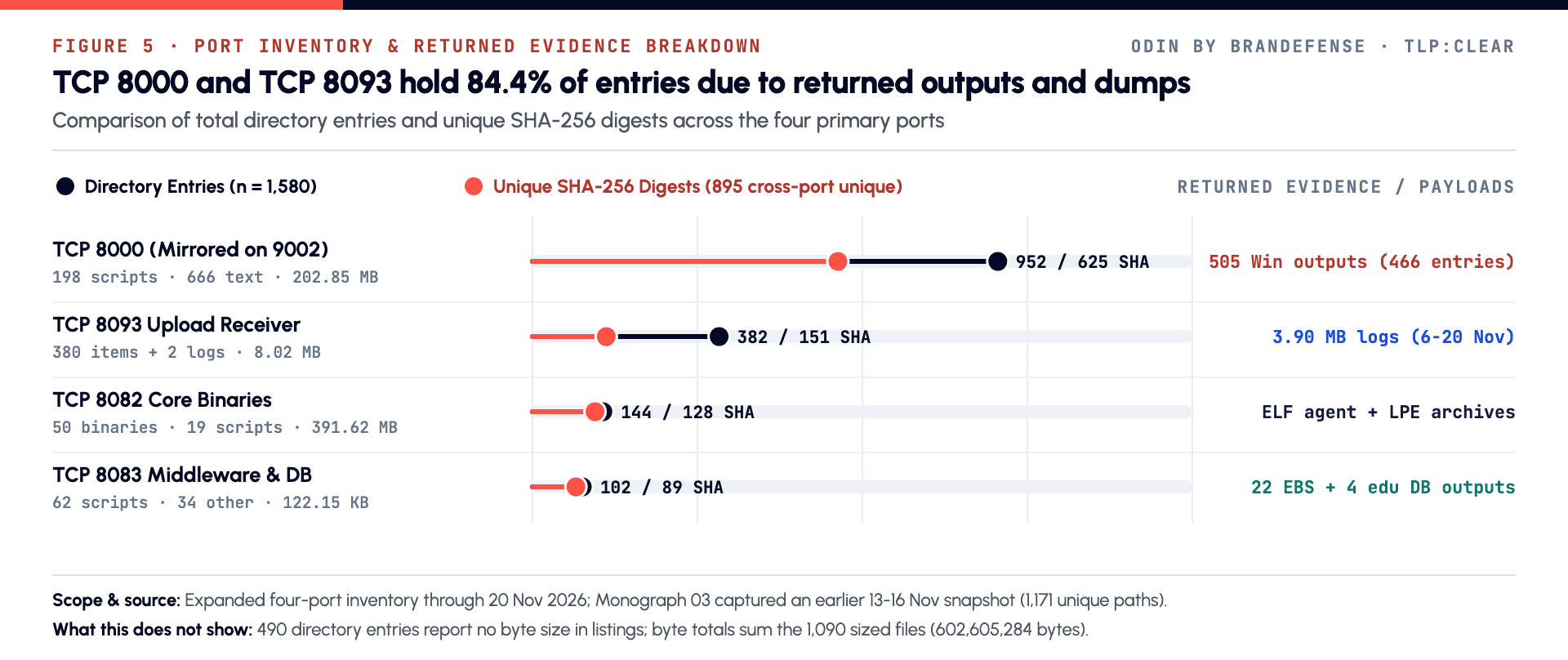
Update on Public Correlation (CVE-2026-104935)
Monograph 03 reported zero hits across five threat-intelligence sources checked on 16 November 2026. Broader web correlation identified a 3 November 2026 post by Etugen Research ([REF-01]). That post studied Ivanti Connect Secure authentication bypass flaw CVE-2026-104935 ([REF-02], CWE-290, CVSS 8.6).
NVD lists affected 25.1.0.0–25.1.1.1, 25.1.2.0–25.1.2.2, and 22.8R2–22.8R2.4. Ivanti lists 25.1.1.2, 25.1.3.0, and 22.8R2.5 as fixes for this CVE; 22.7R2.14 and earlier are unaffected.
Two facts keep that correlation accurate.
- Distinct from
UTA0576. Etugen documented38.60.227[.]210(stagingVShell,Mimikatz, and Garble binaries) as a separate actor distinct fromUTA0576([REF-01]). - Second-stage role. None of the 1,580 directory entries on
38.60.227[.]210holds an Ivanti exploit script. The host serves post-exploitation persistence, lateral movement, and monetization scripts after initial entry.
3. Middleware Pivoting, Fileless Persistence, and Returned Target Outputs
Withheld directories on 38.60.227[.]210 hold returned command outputs, database job logs, and active upload records from affected environments. Because 38.60.227[.]210 is a public indicator, all output folder names and log filenames are withheld. Disk serials, database schemas, and institution names are also withheld under Odin Publication Rules.
| Stream | Anonymized environment / stream | Port | Entries | Sized files | Sized bytes | Captured units | Recorded dates | Observed mechanics |
|---|---|---|---|---|---|---|---|---|
| Environment 1 | Windows and IIS Server Environment | 8000 | 466 | 201 | 326,376 | 505 cmd outputs | Target file dates 2 Sep 2026; observed Nov 2026 | Defender Real-Time Monitoring tamper attempts, CreateProcessAsUser elevation, IIS module staging, and Alibaba OSS pulls. |
| Environment 2 | Enterprise Oracle E-Business Suite Environment | 8083 | 22 | 22 | 2,349 | 22 job outputs | Observed Nov 2026 | DBMS_SCHEDULER OS job outputs returned across Oracle database links (EXEC_DDL_STATEMENT@ / CREATE_JOB@). |
| Environment 3 | Higher-Education Database Environment | 8083 | 4 | 4 | 137 | 4 DB outputs | Observed Nov 2026 | Separate institutional database output files returned to TCP 8083 (22 + 4 = 26 DB outputs, 2,486 B). |
| Receiver Logs | Active Upload Receiver Store | 8093 | 382 | 170 | 8,019,661 | 380 items + 2 logs | 6 Nov to 20 Nov 2026 | Two transfer logs (3,887,512 B + 13,180 B = 3,900,692 B) logging 7-part ~1 MB dumps plus host, key, ghc2, and rollback callbacks. |
Figure 3 separates steps backed by returned outputs and 6-20 November receiver logs (solid arrows) from staged monetization scripts (dashed arrows).
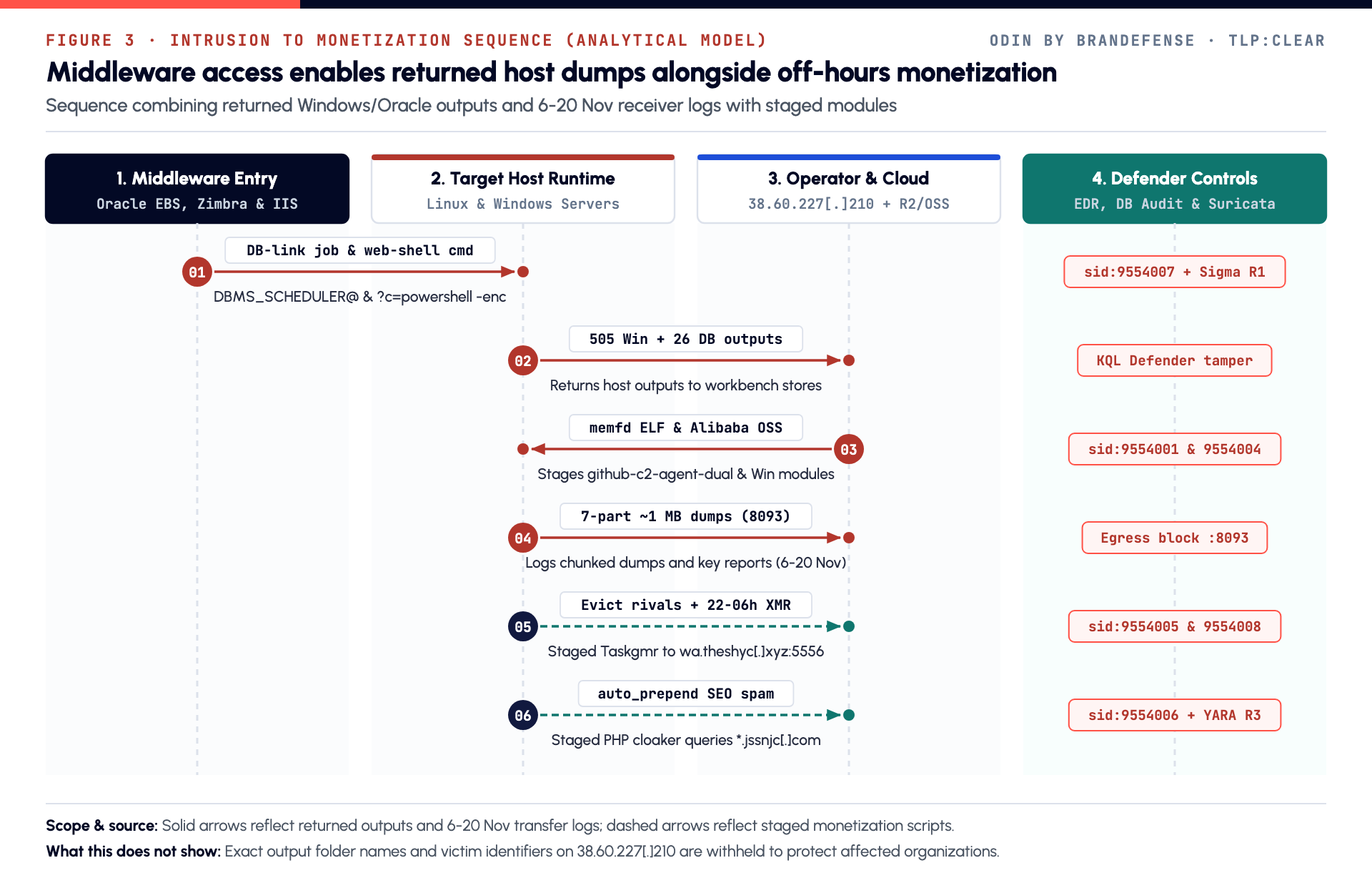
Windows and IIS Post-Exploitation Outputs
A withheld directory on TCP 8000 holds 466 entries (201 sized files totaling 326,376 bytes) from one Windows and IIS environment. A consolidated transcript inside that store holds 505 command outputs. Target directory listings in those outputs carry file dates of 2 September 2026. Those dates reflect either older files on the target or access before November.
Those 505 outputs record four operator steps.
- Defender tamper attempts. PowerShell commands run
Set-MpPreference -DisableRealtimeMonitoring $trueand add path exclusions ([REF-10]). - Token elevation. Privilege escalation via
CreateProcessAsUser()(OKlogged in console output) steps up from IIS worker pools (w3wp.exe) toSYSTEM. - Alibaba OSS payload pulls. Outbound HTTPS fetches download modules from
imagefiles-backup.oss-ap-southeast-7.aliyuncs[.]com. - IIS module deployment. Scripts register native or managed IIS modules alongside encoded PowerShell web-shell requests (
?c=powershell ... -enc).
Oracle Database-Link Pivoting and Zimbra Persistence
On TCP 8083, 62 middleware scripts sit beside a withheld folder holding 26 returned database output files (2,486 bytes). Twenty-two files (2,349 bytes) come from an enterprise Oracle E-Business Suite (EBS) and RAC environment. The other 4 files (137 bytes) come from a higher-education database environment.
The script ebs_deploy.sh (4,199 bytes, 63 lines) crosses internal network boundaries without SSH brute force. Enterprise ERP systems often keep pre-authenticated Oracle database links (DB_LINK) across production, reporting, and standby instances. The script queries link tables and calls DBMS_UTILITY.EXEC_DDL_STATEMENT@ and DBMS_SCHEDULER.CREATE_JOB@ to schedule OS commands on linked database hosts ([REF-06]). Those remote jobs pull loaders from 38.60.227[.]210 and return output to TCP 8083.
Companion scripts target Zimbra Collaboration Suite (CVE-2026-73570, [REF-03], CVSS 8.9, unauthenticated command injection before 10.1.20 when optional zimbra-snmp is installed and SNMP notifications are enabled). Other scripts target Ahsay Backup and Pentaho. For Zimbra servers, staged scripts persist.sh and ops.sh edit .swatchrc under the zimbra account (tagged z_73570_ok). That hook is built to run a 45-second curl poller against 38.60.227[.]210:8898 (/ping/, /c/, and /o/).
Fileless Linux Staging and Active November Receiver Logs
For Linux servers where /tmp may carry noexec, the staged script deploy_ghc2.sh (5,796 bytes, 156 lines) is built to load its payload from memory ([REF-07]).
- Kernel
flockmutex. The script acquires a non-blocking lock on/var/tmp/.systemd/inhibit.lock(with two fallback paths) so cron runs do not start duplicate agents. - Verified
memfd_createloader. It downloadsgithub-c2-agent-dualfrom38.60.227[.]210:8082and checks its exact SHA-256 digest. It then loads the ELF binary into anonymous memory via Python or Perlmemfd_create(/proc/self/fd/N). - Fallback
VShelland LPE archives. Companion scriptvsdeploy.shtests/tmp,$HOME/.cache,/dev/shm, and$HOMEfor executable mounts before dropping aVShellclient (:13574). Archives forCVE-2021-3156(sudobefore1.9.5p2,[REF-04]) andCVE-2021-4034(polkitpkexec,[REF-05]) also sit on TCP 8082.
On TCP 8093, 382 entries (8,019,661 sized bytes) include 380 uploaded items and two transfer logs. Those two logs measure 3,887,512 B and 13,180 B, totaling 3,900,692 B (3.90 MB). They record active callbacks from 6 November (20:32 UTC) through 20 November 2026. Logged callbacks include seven-part dumps (~1 MB) plus host status, network tables, keys, ghc2 checks, rollback notices, and self-checks.
4. Dual Monetization: Night-Shift Mining, Rival Eviction, and Search-Bot Cloaking
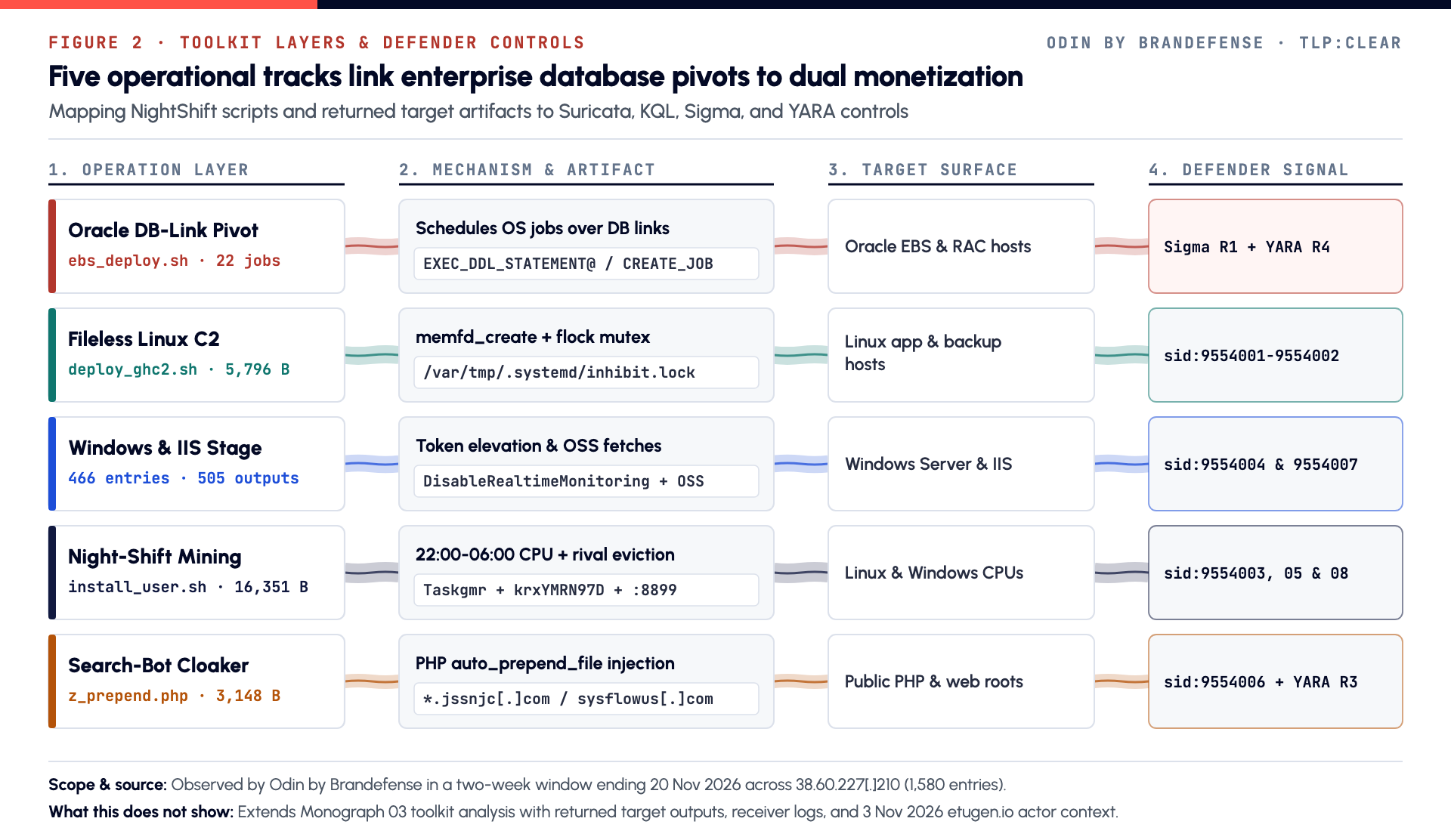
Rather than deploying ransomware that causes immediate outages, Operation NightShift stages two quiet revenue modules for multi-core servers and trusted web domains. Figure 4 shows the four-port server layout. Figure 2 maps all five operational layers to defender controls.
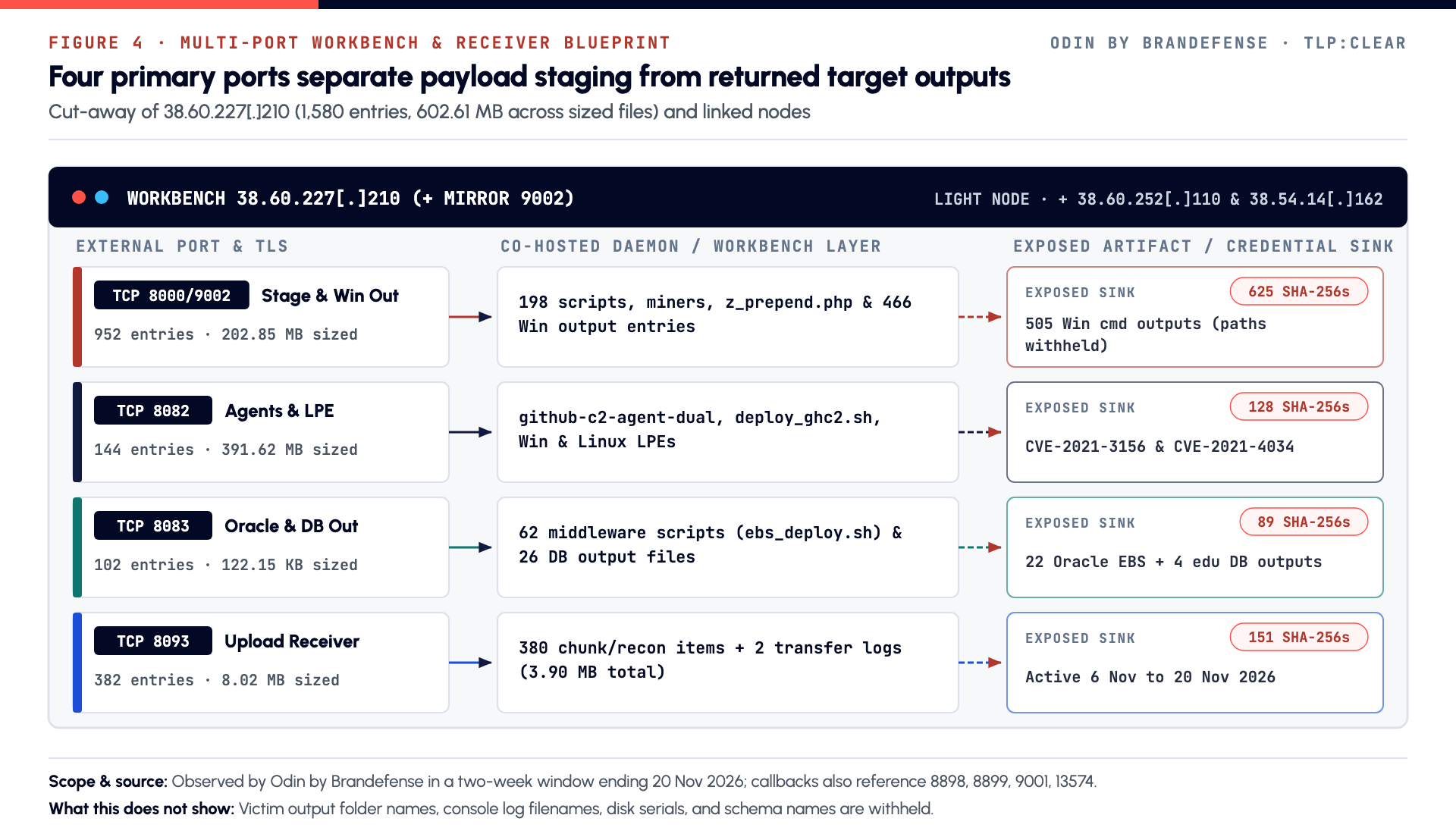
Rival Eviction (excl_evict4.sh) and 22:00-06:00 Mining (install_user.sh)
Exposed middleware servers often draw rival attackers. The operator pairs excl_evict4.sh (7,153 bytes, 131 lines) with install_user.sh (16,351 bytes, 425 lines) to claim off-hours CPU resources ([REF-08]).
- Two-minute rival sweep. The staged script
excl_evict4.shis built to scan/proc,/tmp,/var/tmp,/dev/shm, crontabs, andsystemdunits every 120 seconds. It kills rival miners (xmrig,kinsing, andkdevtmpfsi) while keeping operator markers (.sysjvd,java_update,z_73570,38.60.227[.]210, and :8899). It then posts status reports to38.60.227[.]210:8899. - R2 delivery and night-shift throttling. The installer
install_user.shbeacons to38.60.252[.]110:8900/GEO_TOP_and pulls mining bundles from Cloudflare R2 (pub-307c565a487b43c5bee73d21edc4d83b.r2[.]dev). It stages the miner asTaskgmr(withWinRing0on Windows) under pool prefixkrxYMRN97D. Wrapper rules limit daytime CPU load and ramp threads between 22:00 and 06:00 local time via TLS proxywa.theshyc[.]xyz:5556(38.54.14[.]162:5556). Staged scripts do not show how many hosts mined at once.
Search-Bot Conditional SEO Spam Cloaking (z_prepend.php and wbi_v10.php)
Corporate and university web servers carry strong search-engine trust. Staged scripts z_prepend.php (3,148 bytes, 58 lines) and wbi_v10.php (3,655 bytes, 74 lines) are built to abuse that web reputation without alerting staff.
- Clean pages for human visitors. Loaded via PHP
auto_prepend_filein.htaccess,.user.ini, orphp.ini,z_prepend.phpchecksHTTP_USER_AGENTbefore normal page code runs. If deployed, the script is designed to leave ordinary visitors on the normal site. - Spam feeds for search bots. Visits from
Googlebot,bingbot,Slurp, orYahootrigger a server-side fetch to*.jssnjc[.]comandt1.sysflowus[.]com([REF-09]). It could serve doorway spam to search bots; this evidence does not show that search engines indexed it.
5. Exposure Analysis Across Enterprise Middleware
The returned outputs and 62 middleware scripts point to one clear target profile: stateful enterprise database, mail, backup, and web servers.
| Platform class | Observed evidence | Why this layer attracts hybrid operators | Primary operational risk |
|---|---|---|---|
| Oracle E-Business Suite & RAC | 22 returned job files + ebs_deploy.sh | High core counts, pre-authenticated DB_LINK trust, and frequent EDR exclusions on DB paths. | Cross-subnet OS command scheduling, key dumps (TCP 8093), and nocturnal CPU theft. |
| Windows Server & IIS | 505 command outputs (466 entries) + OSS modules | Combines trusted public web domains with service accounts open to CreateProcessAsUser elevation. | Antivirus tampering, native IIS request hooks, and search-index spam. |
| Higher-Education Databases | 4 returned DB files | High academic domain trust for SEO spam paired with legacy linked database schemas. | Unauthorized SQL/OS jobs and search reputation harm. |
Zimbra (CVE-2026-73570), Ahsay & Pentaho | Staged persistence & web-shell scripts | Internet-facing mail and backup consoles sit directly inside internal server subnets. | Persistent .swatchrc or web-shell callbacks to :8898 and :8093. |
Two operational gaps stand out across these environments. First, database and IIS folders may have file-scan exclusions that reduce visibility into staged files. Monitor process and behavior signals for memfd_create loaders and Defender tamper attempts. Second, database teams, SOC analysts, and web teams rarely compare off-hours CPU spikes with Google Search Console spam alerts ([REF-09]).
6. Alternative Hypotheses
| Hypothesis | Evidence for | Evidence against | Assessment |
|---|---|---|---|
Single integrated operation (Operation NightShift) | Shared hardcoded wiring across 38.60.227[.]210, 38.60.252[.]110:8900, 38.54.14[.]162:5556 (krxYMRN97D), R2, and OSS; shared whitelist tags (z_73570, .sysjvd); active 6-20 Nov receiver logs. | Bundled LPEs (CVE-2021-3156, CVE-2021-4034) and Invoke-SMBExec are public tools. | Supported. Commodity LPEs sit inside one custom-wired operator workflow. |
Same group as UTA0576 | Both appeared in investigations around Ivanti CVE-2026-104935 in early November 2026 ([REF-01]). | Etugen Research separated 38.60.227[.]210 as a distinct actor from UTA0576, with different post-exploitation goals. | Refuted. Treat Operation NightShift as a separate financially driven operator. |
| Multi-thousand-node botnet | install_user.sh uses CDN staging and automated CPU profiling. | Returned stores confirm at least three target environments plus 382 receiver entries; pool worker counts are unseen. | Unverified beyond confirmed floor. State only verified counts. |
7. What Defenders Should Do
Prioritize these five engineering actions:
- Patch Ivanti and Zimbra and inspect post-patch persistence (
0-48 Hours). Upgrade Ivanti Connect Secure (a branch-compatible release addressing the related chain:25.1.1.3,25.1.3.0+, or22.8R2.6+,[REF-02]) and Zimbra (10.1.20+,[REF-03]). Inspect/opt/zimbra/.swatchrc, crontabs, and/proc/*/exememfdlinks right after patching. - Audit and restrict Oracle database links (
Days 1-7). ReviewDBA_DB_LINKSacross Oracle EBS and RAC instances ([REF-06]). Drop unneeded links and revokeCREATE JOBfrom link accounts. Enable Unified Auditing onDBMS_SCHEDULERandEXEC_DDL_STATEMENT. - Enforce Defender Tamper Protection and review web hooks (
Days 1-7). Turn on Microsoft Defender Tamper Protection ([REF-10]) on Windows Server hosts. Inspect IIS<globalModules>and check PHPauto_prepend_filesettings. - Block server-tier cloud bucket and Stratum egress (
Days 7-14). Enforce proxy allowlists on database and middleware VLANs. Compare 22:00-06:00 CPU baselines against daytime load ([REF-08]). - Test public pages with search-bot user agents (
Days 14-30). Request key pages internally with aGooglebotUser-Agentheader. Monitor Google Search Console ([REF-09]) for unauthorized doorway URLs.
8. Detection Rules
The full rules are in the Detection rules tab. All four rule files were tested before release against Suricata 7.0.12 (0 linter warnings), Microsoft Kusto.Language (0 errors), pySigma (3 rules), and YARA-X (4 filesize-bounded rules).
| Rule file | What it catches |
|---|---|
odin_nightshift_middleware_mining_and_cloaking.rules | Suricata 7.x (sid:9554001-9554008): :8898 /ping/ polling, :8900 /GEO_TOP_ check-ins, R2 and OSS bucket TLS SNI, wa.theshyc[.]xyz:5556 proxy TLS SNI, .jssnjc[.]com spam feeds, encoded PowerShell web-shell queries, and plaintext krxYMRN97D Stratum logins. |
sentinel_nightshift_dblink_memfd_and_taskgmr_hunt.kql | Microsoft Sentinel KQL (7-day lookback): Linux memfd_create loaders paired with inhibit.lock or github-c2-agent-dual, Oracle DBMS_SCHEDULER / EXEC_DDL_STATEMENT@ job creation, Windows DisableRealtimeMonitoring or Taskgmr staging, and egress to operator IPs or cloud buckets. |
sigma_nightshift_oracle_dblink_flock_and_taskgmr.yml | Sigma (3 rules): Linux CLI calls to EXEC_DDL_STATEMENT@, DBMS_SCHEDULER.CREATE_JOB@, or ebs_deploy.sh; Linux memfd_create paired with inhibit.lock or github-c2-agent-dual, or zimbra .swatchrc edits; and Windows Taskgmr, pool, or OSS CLI markers, or Defender tamper commands from w3wp.exe or sqlservr.exe. |
odin_nightshift_ghc2_eviction_and_cloaker_artifacts.yar | YARA (4 filesize-bounded rules): deploy_ghc2.sh (< 128 KB), excl_evict4.sh (< 128 KB), z_prepend.php (< 128 KB), and ebs_deploy.sh (< 256 KB). |
How the Suricata and KQL detections work
The eight Suricata rules cover both direct operator callbacks and cloud staging traffic. Rules 9554001 and 9554002 alert on HTTP check-ins to 38.60.227[.]210:8898 (/ping/) and 38.60.252[.]110:8900 (/GEO_TOP_). Rules 9554003 through 9554006 match TLS SNI values for the Cloudflare R2 bucket, the Alibaba OSS bucket, wa.theshyc[.]xyz:5556, and .jssnjc[.]com. Rules 9554007 and 9554008 catch inbound encoded PowerShell URI queries (c=powershell with -enc) and plaintext krxYMRN97D Stratum pool logins.
The Microsoft Sentinel KQL hunt uses a 7-day lookback across DeviceProcessEvents and DeviceNetworkEvents. Before scheduling the query, replace the two placeholder hostnames in ApprovedAdminHosts (dba-jump-01.corp.example and patch-runner-01.corp.example) with your DBA jump-host allowlist. The query groups process and network hits by device and account so analysts can review linked events together.
9. Indicators
The full indicator list is available in the Indicators tab. The public set contains 10 network and file hash indicators (3 operator IPv4 hosts and 7 SHA-256 digests) plus 6 report-only cloud, domain, and host markers. All victim output folder names, transfer log filenames, disk serials, database schema names, and third-party shared mining-pool addresses are withheld.
9.1 Published Network and File Hash Indicators (10 Indicators)
| Type | Defanged value / SHA-256 digest | Port / size | Operational context & action |
|---|---|---|---|
ipv4 | 38.60.227[.]210 | 8082 (8000, 8083, 8093, 9002, 8898, 8899, 9001, 13574) | Primary NightShift workbench and upload receiver (LIGHT NODE) · Block & hunt egress |
ipv4 | 38.60.252[.]110 | 8900 | Secondary /GEO_TOP_ host-profiling listener · Block & hunt egress |
ipv4 | 38.54.14[.]162 | 5556 | Custom TLS mining proxy backing wa.theshyc[.]xyz · Block & inspect SNI |
sha256 | d11b12d628615d5eff982e3e312f4c406fde38373eee76bc056be780a9e2e665 | ELF binary | github-c2-agent-dual enforced digest in deploy_ghc2.sh · Hunt in EDR & /dev/shm |
sha256 | 549d39ceceb57866c0ade97fa02897d29f3141034ff6a02732118324c4ca1ce7 | 5,796 B | deploy_ghc2.sh (156 lines) Linux flock + memfd_create loader · Hunt on Linux hosts |
sha256 | 73fe311d3323b6bbc9f97854e43eaf33ed45d3122b236675f68350b820640b01 | 16,351 B | install_user.sh (425 lines) R2 Taskgmr night-shift miner installer · Hunt on Linux hosts |
sha256 | 2a271c5cbf9bcc000b914c6f1f23cabc168fb98ed1628c555a4e4c416a456cde | 7,153 B | excl_evict4.sh (131 lines) 120-second rival eviction script · Hunt in cron & /tmp |
sha256 | dbf856873b8142dac2d29118d60532f6d7bdafd8eb8763e9e149b9ef46ec832d | 3,148 B | z_prepend.php (58 lines) PHP auto_prepend_file bot cloaker · Hunt in web roots |
sha256 | a7423702c637bd84d96d69d14b1bbefacebb3bfcbecac44b2990c5f59ab4f720 | 3,655 B | wbi_v10.php (74 lines) companion PHP web shell · Hunt in PHP web roots |
sha256 | 9bb5852cb65e3f9eb102f41f04062cc9c8a0d645e48735918208a08d5554eeb0 | 4,199 B | ebs_deploy.sh (63 lines) Oracle EBS DB-link job deployer · Hunt on DB jump hosts |
9.2 Report-Only Cloud, Domain, and Behavioral Markers (6 Markers)
| Marker type | Defanged value / pattern | Hunt surface & note |
|---|---|---|
| Cloud bucket | pub-307c565a487b43c5bee73d21edc4d83b.r2[.]dev | Cloudflare R2 bucket hosting staged mining archives (sid:9554003). |
| Cloud bucket | imagefiles-backup.oss-ap-southeast-7.aliyuncs[.]com | Alibaba Cloud OSS bucket fetched in returned Windows outputs (sid:9554004). |
| TLS proxy host | wa.theshyc[.]xyz (:5556) | Custom TLS Stratum proxy hostname on 38.54.14[.]162:5556 (sid:9554005). |
| Spam feed domains | *.jssnjc[.]com / t1.sysflowus[.]com | Upstream SEO spam servers queried by z_prepend.php (sid:9554006). |
| Pool prefix | krxYMRN97D | Monero/Kryptex pool account prefix in miner configs (sid:9554008). |
| Mutex path | /var/tmp/.systemd/inhibit.lock | Primary flock lock file paired with memfd_create in deploy_ghc2.sh. |
10. Scope and Limits
Odin by Brandefense conducted this analysis during a two-week observation window ending 20 November 2026. Earlier dates in this report come from target file listings (2 September 2026), public research (3 November 2026), and receiver logs (6 November 2026). Returned files confirm at least three affected environments.
Staged miner and cloaker scripts do not show total active miner counts or revenue. All victim paths, filenames, and identifiers are withheld.
11. Sources
[REF-01]Etugen Research, An Ivanti Zero-Day Operation Where the Dead Proxy Was Named in the Operator's Notes (3 November 2026; verified on 22 November 2026): https://etugen.io/blog/ivanti-zero-day-operation/[REF-02]NIST NVD, CVE-2026-104935 - Ivanti Connect Secure Authentication Bypass (verified on 22 November 2026): https://nvd.nist.gov/vuln/detail/cve-2026-104935[REF-03]NIST NVD, CVE-2026-73570 - Zimbra Collaboration Suite zimbra-snmp Command Injection (verified on 22 November 2026): https://nvd.nist.gov/vuln/detail/cve-2026-73570[REF-04]NIST NVD, CVE-2021-3156 - Sudo Heap-Based Buffer Overflow (verified on 22 November 2026): https://nvd.nist.gov/vuln/detail/cve-2021-3156[REF-05]NIST NVD, CVE-2021-4034 - Polkit pkexec Local Privilege Escalation (verified on 22 November 2026): https://nvd.nist.gov/vuln/detail/cve-2021-4034[REF-06]Oracle, Oracle Database 19c Security Guide - Configuring Audit Policies (verified on 22 November 2026): https://docs.oracle.com/en/database/oracle/oracle-database/19/dbseg/configuring-audit-policies.html[REF-07]MITRE ATT&CK, Reflective Code Loading (T1620) (verified on 22 November 2026): https://attack.mitre.org/techniques/T1620/[REF-08]MITRE ATT&CK, Resource Hijacking (T1496) (verified on 22 November 2026): https://attack.mitre.org/techniques/T1496/[REF-09]Google Search Central, Spam Policies for Google Web Search (verified on 22 November 2026): https://developers.google.com/search/docs/essentials/spam-policies[REF-10]Microsoft Learn, Protect Security Settings with Tamper Protection (verified on 22 November 2026): https://learn.microsoft.com/en-us/defender-endpoint/tamper-protection-overview
What is…?
Short explanations of the tools and families named in this study.
What is Zimbra?
Zimbra Collaboration is an email and collaboration suite. Its internet-facing servers are frequent targets of exploitation.
More about ZimbraRemote access implantWhat is VShell?
VShell is a remote access implant and C2 panel that talks over WebSocket and other transports. It is popular with Chinese-speaking operators.
More about VShellFrequently asked questions
How does Operation NightShift expand Monograph 03 and public reporting?
Monograph 03 examined an initial four-day snapshot of 38.60.227[.]210 from 13 to 16 November 2026. That snapshot held 1,824 raw rows across five HTTP ports, including 645 mirrored entries on TCP 9002. Removing the mirror and eight cross-port overlaps left 1,171 unique paths.
What do the returned target outputs and November receiver logs confirm?
Withheld directories on 38.60.227[.]210 hold returned outputs from at least three distinct target environments. Because 38.60.227[.]210 is a public indicator, all output folder paths and log filenames are withheld. Disk serials, database schema names, and institution names are also withheld.
How does the dual-monetization engine stay quiet during business hours?
Once inside multi-core middleware and web servers, the operator stages two parallel revenue modules. The staged mining wrapper limits daytime CPU use, while the cloaker is designed to leave normal pages visible to human visitors.
Why do enterprise database and IIS servers attract this hybrid model?
Enterprise ERP databases and IIS web tiers create two blind spots that these scripts target together. First, database admins often exclude Oracle data paths and IIS worker processes from antivirus scans to protect query speed. File-scan exclusions may hide staged files, while memfd_create loaders and Defender tamper attempts require process and behavior monitoring.