
1. Executive Summary
In short
Operation LedgerSwarm tracks one operator's autonomous agent campaign across 76 target organizations, 10.8 billion input tokens across 39 tasks, and 61 follow-up scripts. Odin by Brandefense analyzed the exposed campaign archive in a two-week observation window ending 18 November 2026. Payments, Web3, banking, and exchange teams must remove front-end secrets, adopt short-lived cloud credentials, lock bucket writes to deployment accounts, and alert on 25-URI scan bursts.
Autonomous offense frameworks place a large language model (LLM) in charge of discovery and vulnerability tools. One operator can queue dozens of organizations and let parallel subagents enumerate subdomains, check JavaScript bundles, and draft summaries continuously.
Operation LedgerSwarm isolates one operator's campaign behind a virtual private server (VPS) in Sweden acting as a relay in front of a second server. Dates before our November window come from the operator's own task records. All target names, domains, task names, archive paths, and both server addresses are withheld.
Payments and Web3 firms make up 53.9% of targets and 85.5% of input tokens.
Across 76 target organizations in 18 verticals, Payments and Fintech (21) and Web3, DeFi, and Stablecoin (20) lead. Within 39 captured task records carrying metadata, those two sectors account for 29 tasks and 9.23 billion of 10.79 billion input tokens.
The operator shifted to strict domain-locked templates before writing 61 custom scripts.
Seven early tasks carry dates from 9 to 12 October 2026, led by one 22-day British fintech run (3.44 billion input tokens). After 23 pre-lock tasks from 4 to 9 November, templates on 9 and 10 November locked workers to whitelisted domains and blocked neighbouring-address scans.
Swarm reports claim 6,124 unverified findings while custom scripts target cloud keys.
Across 141 task IDs plus 85 unassigned entries, the swarm's own summaries record 6,124 claimed findings (941 critical, 2,173 high). None is a confirmed breach. Where automated scans flagged leads, the operator wrote 61 dedicated follow-up scripts, including the Google Cloud Storage playbook in Monograph 30.
Three Decisions for Leaders
- Remove front-end secrets and static workstation cloud keys now. Strip API keys and
.envfiles from web roots, JavaScript bundles, and repositories. Move developers from long-lived service-account JSON keys to short-lived federated tokens. - Restrict object storage writes to named deployment identities. Treat any Cloud Storage, S3, or R2 bucket that feeds a web root or CDN as production code. Disable PHP execution on media mounts and alert on non-CI writes.
- Throttle automated discovery bursts across APIs and subdomains. Pair external attack surface management with per-source API rate limits, bot detection, and disabled production GraphQL introspection. Alert when one source requests 25 or more distinct URIs in five minutes.
The Study in Numbers
| Number | What it is |
|---|---|
| 76 | Anonymized target organizations across 18 verticals in the exposed campaign archive |
| 13,864 / 1,105 | Subdomains enumerated across those 76 targets, narrowed to 1,105 live HTTP or TLS FQDNs |
| 39 | Partially captured task records carrying full timing, sector, country, template, and token metadata |
| 10,794,890,273 | LLM input tokens consumed across the 39 metadata tasks, plus 132,372,680 output tokens |
| 6,124 | Unverified LLM-labeled findings across 141 task IDs plus 85 unassigned (941 critical, 2,173 high) |
| 61 + 174 | Dedicated follow-up scripts (61) plus swarm-tuning files (126) and prompt/skill documents (48) |
| 2 | Published indicators in the Indicators tab: 2 follow-up script SHA-256 hashes and 0 addresses |
How to use this report.
Security leaders can focus on Chapters 1, 5, 6, and 7. Cloud, DevOps, and application teams in payments, Web3, and exchanges should read Chapters 4, 5, and 7. SOC analysts and detection engineers should start with Chapters 3, 8, and 9. Threat intelligence analysts will find architecture, hypotheses, and limits in Chapters 2, 6, and 10.
2. One Campaign Behind a Swedish Relay
In short
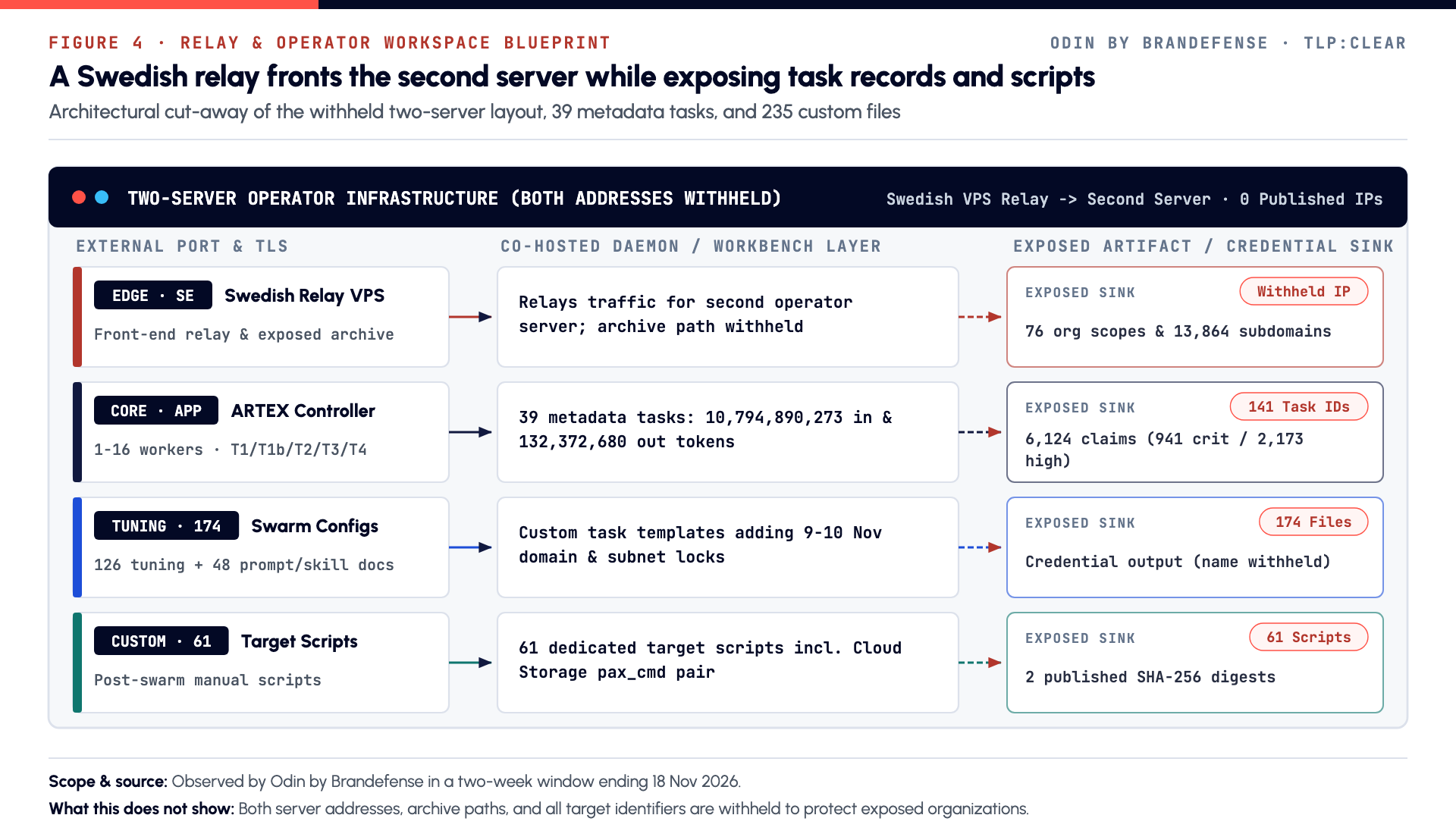
ARTEX is a public autonomous penetration-testing framework used by many unrelated groups. Operation LedgerSwarm examines one operator's campaign behind a Swedish VPS relay fronting a second server, spanning 76 target organizations, 39 metadata tasks, and 235 custom files.
On 13 November 2026, the FBI issued advisory FLASH-20261113-001 warning that threat actors worldwide had weaponized ARTEX. Built in Go with a Next.js console, ARTEX connects external language models to automated discovery and exploitation tools. Earlier in November 2026, Censys documented 1,465 hosts running exposed ARTEX consoles, often on port 8787; defenders can assess such exposure with external attack surface management.
In October 2026, Microsoft Threat Intelligence reported that a China-linked actor (Storm-0940) used ARTEX during cloud supply-chain intrusions. Those public disclosures provide framework context only. ARTEX is a shared tool used by many unrelated operators, and nothing links Storm-0940 or other named groups to Operation LedgerSwarm.
Monograph 11 mapped 4,360 endpoints across five AI offense frameworks (2,121 ARTEX endpoints, 495 confirmed) and introduced the 76-organization archive. Monograph 30 analyzed two Python scripts from that archive written to plant a pax_cmd WordPress gate through Google Cloud Storage. Monograph 53 examines the operation end to end, translating its timeline and token scale into cyber threat intelligence priorities. Figure 1 maps the four task waves and workspace layers.
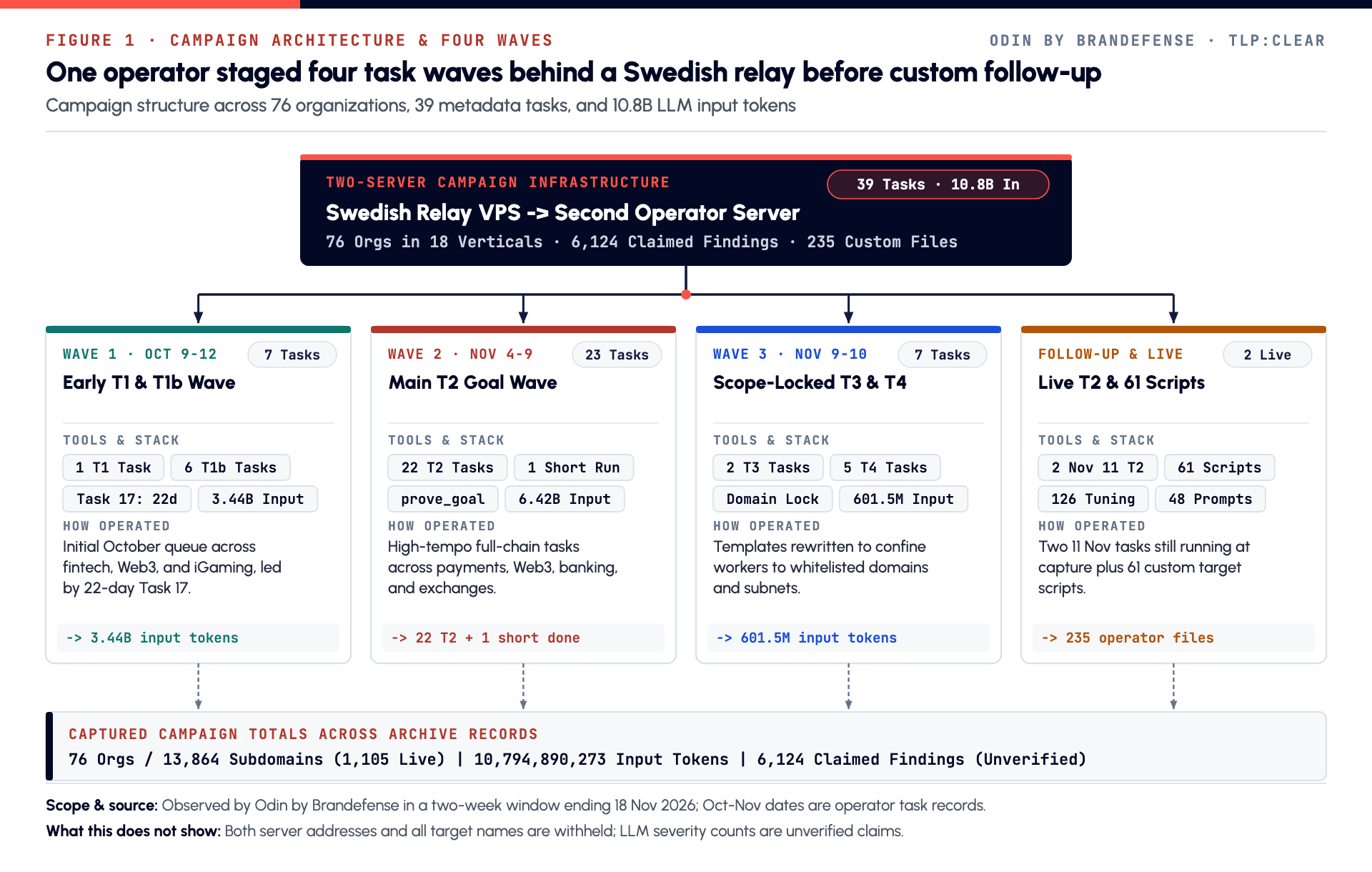
The two-server relay and what is withheld
The operator placed a VPS in Sweden acting as a relay in front of a second server. The Swedish host forwards traffic to the upstream controller and also exposes the campaign archive. Because that archive still holds target data, both server IP addresses and every archive path are withheld.
Every target identity is withheld under the same rule. No target organization name, domain, cloud bucket, WordPress theme, or task name appears in this report, its figures, or its rules. Individual tasks are referenced only by anonymized numeric IDs (8 through 159).
How the archive views fit together
Because the task list was captured partially during our two-week window ending 18 November 2026, the archive provides distinct views of the campaign. Keeping them separate avoids double-counting.
| Archive view | Scope | Key counts | Main limit |
|---|---|---|---|
| Organization roll-up (M11) | External surface | 76 orgs in 18 verticals; 13,864 subdomains (1,105 live); 35 crit/high scopes (17 crit, 18 high) | Unverified LLM scope labels |
| Task metadata slice | Captured task rows | 39 tasks (37 done, 2 running); 10,794,890,273 input & 132,372,680 output tokens | Partial capture (8–19, 125–159) |
| Per-task claimed findings | Per-task counters | 6,124 claims across 141 task IDs (6,039) plus 85 unassigned | Unverified tool and LLM labels |
| Anchor worker runs (M30) | Deep-task effort | 2,178 runs (crypto exchange); 1,231 runs (iGaming) | Effort only; impact unconfirmed |
| Operator workspace | Custom files | 61 follow-up scripts, 126 tuning files, 48 prompt/skill docs (235 total) | Counts only; code & prompts withheld |
3. Campaign Timeline, Token Scale, and the Scope-Lock Shift
In short
Task records inside the 39-task slice carry operator creation dates from 9 October to 11 November 2026 and total 10.79 billion input tokens. On 9 and 10 November, the operator updated templates to lock workers to whitelisted domains and block neighbouring-address scans.
Dates earlier than November 2026 in this chapter are task creation and completion dates from the operator's own controller logs, not Odin monitoring dates. Together, the 39 metadata tasks consumed 10,794,890,273 LLM input tokens and 132,372,680 output tokens (10,927,262,953 tokens combined).
Input tokens outnumber output tokens by 81.5 to 1. Worker pools feed HTTP responses, JavaScript bundles, API schemas, and tool logs into the model on every step while receiving compact JSON calls back. Figure 2 links the four template generations and custom files to defender controls.
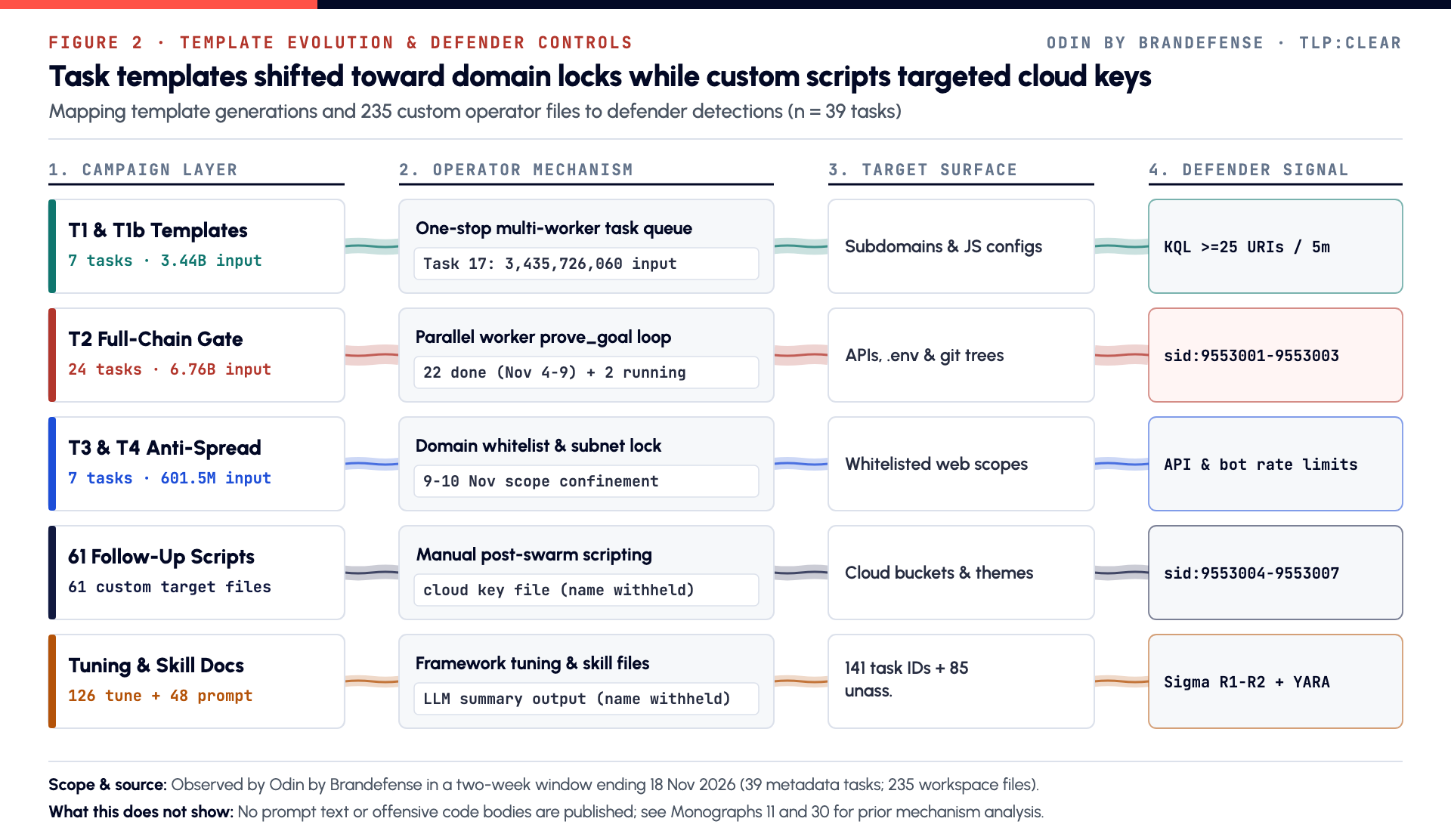
Four waves in the operator's task records
Grouping the 39 metadata tasks by creation date and template generation shows how the campaign progressed.
| Phase and template | Operator record dates | Tasks | Input tokens | Output tokens | Claimed crit / high | Status and goals |
|---|---|---|---|---|---|---|
First wave: T1 (1) and T1b (6), incl. Task 17 | 9 Oct to 3 Nov 2026 | 7 | 3,435,752,673 | 27,095,532 | 149 / 450 | 7 done (2 of 7 goals) |
Main wave: T2 full-chain (prove_goal gate) | 4 to 10 Nov 2026 | 22 | 6,418,031,562 | 91,051,603 | 284 / 434 | 22 done (60 of 60 goals) |
Main wave short run: unnamed template | 5 Nov 2026 | 1 | 46,773 | 1,051 | 0 / 0 | 1 done (0 of 0 goals) |
Scope-restricted wave: T3 hard scope lock | 9 Nov 2026 | 2 | 64,778,721 | 1,013,809 | 7 / 2 | 2 done (5 of 5 goals) |
Scope-restricted wave: T4 v7 subnet lock | 10 Nov 2026 | 5 | 536,674,733 | 8,174,897 | 10 / 39 | 5 done (11 of 11 goals) |
Active at capture: T2 full-chain (prove_goal) | Created 11 Nov 2026 | 2 | 339,605,811 | 5,035,788 | 7 / 20 | 2 running (2 of 2 goals) |
| Total (39-task metadata slice) | 9 Oct to 11 Nov 2026 | 39 | 10,794,890,273 | 132,372,680 | 457 / 945 | 37 done, 2 running (80/85) |
Across the full table, 24 tasks use the T2 template (6,757,637,373 input tokens, 62.6%). Twenty-two completed in the 4 to 9 November wave, and 2 created on 11 November remained running. Adding 1 five-second unnamed run (Task 137 on 5 November) gives 23 pre-lock tasks in that wave. Ten sampled session report dates also cluster between 2 and 9 November (1 on 2 Nov, 3 on 3 Nov, 5 on 5 Nov, 1 on 9 Nov).
Three tasks burned 58.7% of all input tokens
Token spend was concentrated in long multi-day runs. Two early October tasks (Tasks 8 and 13) logged zero tokens in metadata. By contrast, Task 17 (Payments and fintech, United Kingdom) spanned 22 days from 12 October to 3 November 2026. It consumed 3,435,726,060 input tokens (31.8% of the 39-task total) and 27,093,427 output tokens across 566 claimed findings.
Two T2 tasks followed in November. Task 145 (NL payments, 7 to 10 November) used 1,566,410,200 input tokens. Task 133 (US Web3, 5 to 7 November) used 1,335,524,890 input tokens. Together, Tasks 17, 145, and 133 consumed 6,337,661,150 input tokens (58.7%).
Self-graded goals do not confirm breaches
Starting with T2, the operator added a prove_goal check. Across all 31 tasks using T2, T3, or T4, the controller marked 78 of 78 defined goals met (100%). Yet Tasks 128 and 144 both recorded 100% goals met while logging zero critical and zero high findings. A prove_goal flag only marks checklist completion inside the agent loop, not a verified target intrusion.
The 9 and 10 November domain and subnet lock
On 9 November (T3, Tasks 151 and 152) and 10 November (T4 v7, Tasks 153 to 157), the operator rewrote the task template. Both versions confine each task to whitelisted target domains and forbid touching neighbouring addresses.
Average input token use dropped to 32.4 million per task under T3 and 107.3 million under T4, compared with 281.6 million across T2. We separate observation from interpretation:
- Observed fact.
T3andT4confine subagents to whitelisted domains and forbid neighbouring-address scans, before Tasks 158 and 159 returned toT2on 11 November. - Hypotheses. Generating less network noise and hitting fewer unintended third-party hosts on shared subnets are plausible motives, though the archive does not state why the rule was added.
4. From Swarm Sweeps to 61 Custom Follow-Up Scripts
In short
The swarm claimed 6,124 findings across 141 task IDs plus 85 unassigned entries, all written by an LLM. The archive also holds 61 follow-up scripts, 126 tuning files, and 48 prompt and skill documents. Treat the scripts as staged intent until target-side activity is verified.
Operation LedgerSwarm shows how an operator pairs automation with manual scripting. The swarm sweeps dozens of scopes first; the human operator then writes custom scripts for targets that expose keys or cloud paths. See Monograph 11 for ARTEX's four-pool worker architecture, and see Monograph 30 for the Cloud Storage-to-WordPress chain. Figure 3 models that handoff from automated discovery to cloud follow-up.
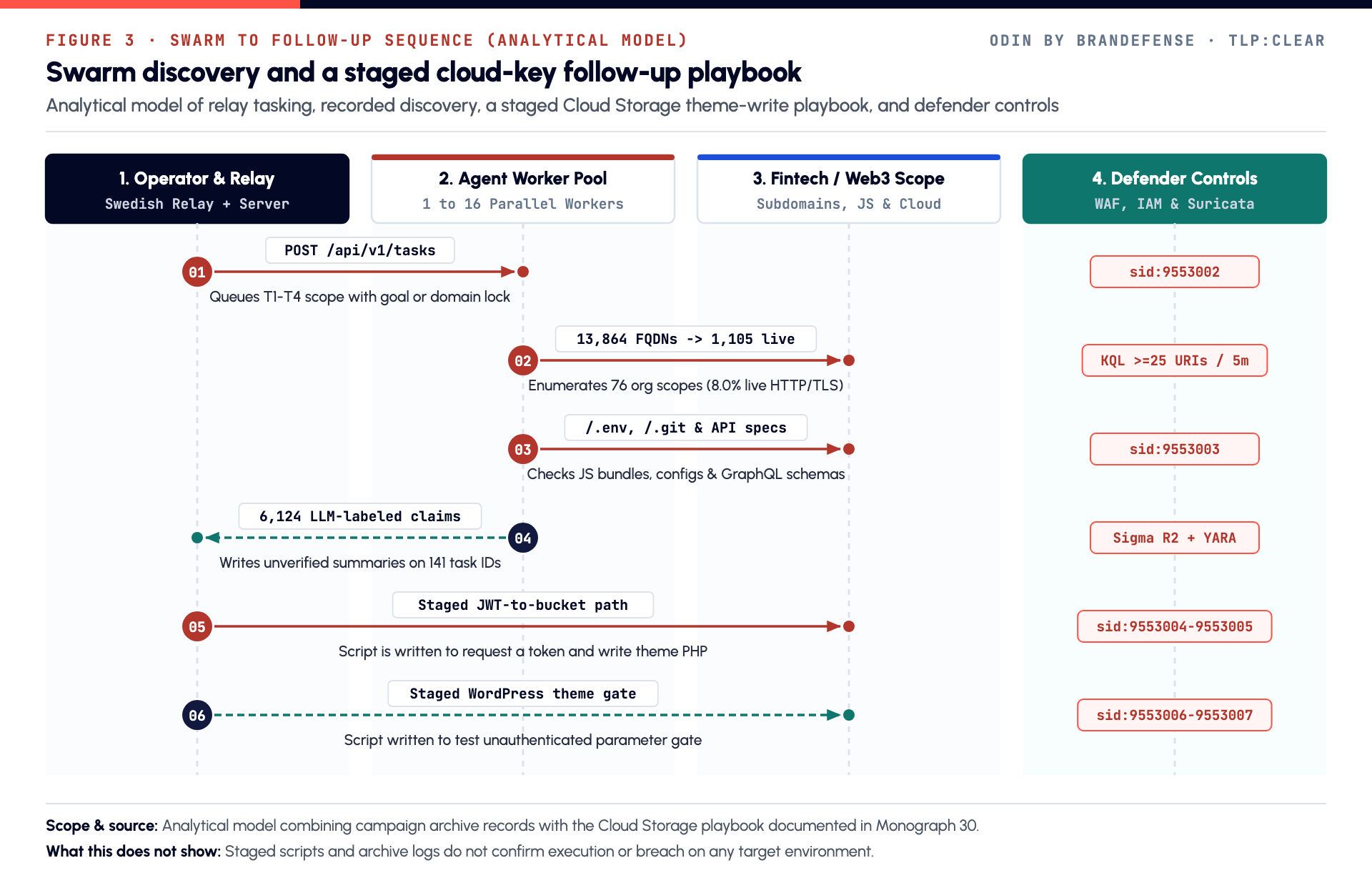
Reading the 6,124 claimed findings
Across the per-task summary table, the swarm logged 6,124 claimed findings: 6,039 across 141 numbered task IDs (8 through 159) plus 85 unassigned entries.
| Claimed severity | Count | Share of 6,124 | How defenders should read it |
|---|---|---|---|
| Critical | 941 | 15.4% | LLM label; often flags .env hits, API docs, or unverified banners |
| High | 2,173 | 35.5% | LLM label; includes open admin panels, GraphQL schemas, and config leaks |
| Medium | 2,161 | 35.3% | Automated header and path findings; unverified on target hosts |
| Low | 837 | 13.7% | Informational banners and minor TLS or cookie settings |
| Informational / other | 12 | 0.2% | Uncategorized items across seven task rows |
| Total | 6,124 | 100.0% | Unverified swarm claims across 141 task IDs + 85 unassigned |
Fifteen task IDs claim 100 or more findings each, led by Task 109 (604), Task 17 (566), and Task 133 (456). Seventy-six task IDs claim at least one critical item. Treat all 6,124 entries strictly as a map of what the swarm checks, never as confirmed breaches.
235 custom operator files
Alongside automated logs, the workspace held 235 operator-authored files. Under Odin publication rules, we publish counts only, with zero prompt text, zero exploit code, and zero target names:
- 61 dedicated follow-up scripts written after the swarm finished for a small set of targets;
- 126 swarm-tuning files modifying worker concurrency, tool wrappers, and task queues;
- 48 prompt and skill documents defining task templates, reporting gates, and scope rules.
Monograph 30 examined two staged follow-up scripts (deploy_gcs_webshell.py, 5,251 bytes, and deploy_gcs_webshell2.py, 5,480 bytes) tied to the archive's iGaming task (1,231 recorded worker runs). Both are written to read a harvested Google Cloud key (filename withheld) and request a one-hour OAuth token with devstorage.full_control scope.
They are written to overwrite a WordPress theme's 404.php and functions.php inside a Cloud Storage bucket with an unauthenticated pax_cmd gate. Separately, the crypto-exchange task (2,178 recorded worker runs) logged unverified claims involving linked-server SQL injection, a NAS webshell, and a workstation cloud key.
5. Why Payments, Web3, and Exchanges Lead
In short
Payments and Fintech (21 organizations) and Web3, DeFi, and Stablecoin (20 organizations) form 53.9% of the 76 archive targets and 85.5% of input tokens in the 39-task slice. Wide API surfaces, public SDK repositories, and cloud buckets make both sectors prime targets.
Payment gateways, fintech APIs, DeFi protocols, stablecoin issuers, and exchanges share three traits that reward automated swarms. First, they expose hundreds of subdomains across partner sandboxes, docs portals, RPC nodes, and regional sites.
Second, web and mobile bundles often leak cloud bucket names, GraphQL endpoints, or API keys. Third, stolen cloud or payment keys grant direct financial access without endpoint malware. Figure 5 compares the 76-organization archive with the 39-task metadata slice.
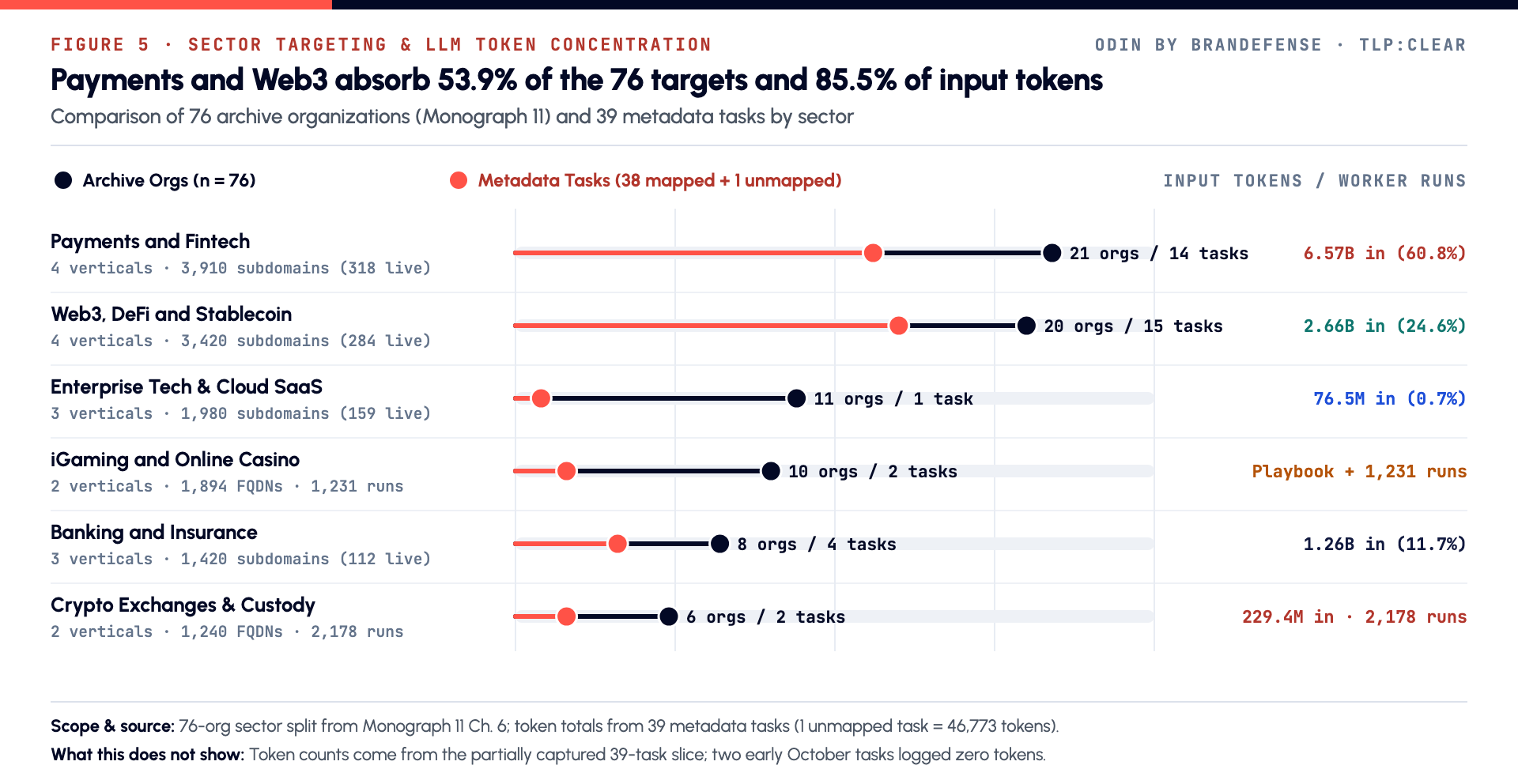
Sector comparison across both archive views
Every number in the 76-organization columns matches Monograph 11 Chapter 6, paired with the 39-task metadata slice.
| Sector | Verticals | Archive orgs (n=76) | Subdomains / live | Labeled crit or high | Metadata tasks (n=39) | Input tokens (39 tasks) |
|---|---|---|---|---|---|---|
| Payments and Fintech | 4 | 21 (27.6%) | 3,910 / 318 | 10 | 14 (35.9%) | 6,566,351,648 (60.8%) |
| Web3, DeFi and Stablecoin | 4 | 20 (26.3%) | 3,420 / 284 | 9 | 15 (38.5%) | 2,660,618,441 (24.6%) |
| Enterprise Tech and Cloud SaaS | 3 | 11 (14.5%) | 1,980 / 159 | 5 | 1 (2.6%) | 76,453,072 (0.7%) |
| iGaming and Online Casino | 2 | 10 (13.2%) | 1,894 / 146 | 5 | 2 (5.1%) | 7,505 (<0.1%) |
| Banking and Insurance | 3 | 8 (10.5%) | 1,420 / 112 | 3 | 4 (10.3%) | 1,261,970,830 (11.7%) |
| Crypto Exchanges and Custody | 2 | 6 (7.9%) | 1,240 / 86 | 3 | 2 (5.1%) | 229,442,004 (2.1%) |
| Not mapped (5-second Task 137) | 0 | 0 (0.0%) | 0 / 0 | 0 | 1 (2.6%) | 46,773 (<0.1%) |
| Total | 18 | 76 (100.0%) | 13,864 / 1,105 | 35 (46.1%) | 39 (100.0%) | 10,794,890,273 (100.0%) |
Adding Banking and Insurance (4 tasks) and Crypto Exchanges (2 tasks) pushes financial and digital-asset targets to 35 of 39 tasks (89.7%) and 99.3% of input tokens. Geographically, the 39 tasks span 15 named countries plus two XX rows and one unmapped row. The United States (10), the United Kingdom (8), and India (3) lead, followed by two tasks each in the United Arab Emirates, Germany, and Lithuania.
What an agent swarm looks like to defenders
From the defender's side, an operation like LedgerSwarm leaves four clear signals:
- Broad subdomain enumeration. Across 76 targets, the swarm enumerated 13,864 subdomains (182.4 each) and focused on 1,105 live FQDNs (8.0%).
- High-rate URI bursts. Subagents sweep
/.env,/.git/config,/graphql, and OpenAPI paths within minutes, tripping distinct-URI thresholds. - Front-end JavaScript and repo harvesting. Workers fetch
.jsbundles and exposed configs for cloud keys, database URIs, and API secrets. - Cloud API call pattern. The staged playbook is written to call
oauth2.googleapis[.]comandstorage.googleapis[.]com; hunt for such calls outside approved CI/CD hosts.
6. Weighing the Authorized Red-Team Hypothesis
In short
Prompt templates in the workspace describe the tasks as authorized penetration testing. Odin found no evidence of authorization, and the staged cloud-key playbook, a hidden Swedish relay across 14+ countries, and cleanup instructions weigh against a legitimate test.
Figure 4 shows the withheld two-server relay layout and the four workspace layers reviewed for intent.
The swarm's prompt files frame its work as authorized penetration testing. Operators of offensive AI tools commonly place "authorized assessment" wording in system prompts so commercial or open-weight models do not refuse exploitation tasks.
Odin found no evidence of authorization. Treating "authorized red team" as an alternative hypothesis, three high-level facts weigh against it:
- Staged stolen-key playbook and unauthenticated gate. Monograph 30 documents a playbook written to use a harvested Google Cloud key to plant an unauthenticated
pax_cmdgate in WordPress templates. Target-side execution is unconfirmed. - Hidden two-tier relay and global targeting. Operating behind a Swedish VPS relay in front of a second server across 76 financial, Web3, and iGaming organizations in 14+ countries does not match a regional consultancy's client list.
- Target-side cleanup paired with open data exposure. Templates include target-side cleanup instructions, while the relay left harvested target records exposed without authentication.
| Hypothesis | For | Against | Conclusion |
|---|---|---|---|
| Unapproved single-operator campaign | 76 scopes in 14+ countries; Swedish relay; stolen key pax_cmd playbook; cleanup rules | Prompt claims "authorized"; T3/T4 domain locks | Most consistent |
| Authorized red team | T1–T4 templates, prove_goal gates, 9–10 Nov locks | Zero auth records; staged unauthenticated pax_cmd gate; exposed data | Weighed against |
| Shared public server | Public ARTEX consoles exist on VPS networks | Cohesive T1–T4 lineage, 85.5% fintech/Web3 tokens, 235 files | Rejected |
7. What Defenders Should Do
Within 24 hours
- Scan public JavaScript bundles, mobile builds, and repos for API keys, RPC tokens, and
.envfiles. Block/.envand/.git/at the WAF and rotate exposed secrets. - Block
pax_cmdin query strings and POST bodies at the WAF, and disable production GraphQL__schemaintrospection. Verify hashes of deployed404.phpandfunctions.phpfiles.
Within 72 hours
- Revoke workstation cloud service-account JSON keys. Enforce
constraints/iam.disableServiceAccountKeyCreationand use short-lived federated OIDC tokens. - Audit every Cloud Storage, S3, or R2 bucket synced into a web root or CDN. Restrict code writes to named CI/CD accounts, turn off PHP on media mounts, and enable
DATA_WRITElogs.
Within 7 to 30 days
- Apply per-IP and per-ASN rate limits plus bot detection on
/api/,/graphql, and login routes. - Alert when one source IP hits 25 distinct URIs in five minutes, or 8 URIs touching
/.env,/.git/config, or/graphql. - Reconcile external DNS zones to retire stale staging subdomains and dangling CNAMEs.
8. Detection Rules
The full rules are in the Detection rules tab, adapted from Monographs 11 and 30.
| Rule file | What it catches |
|---|---|
odin_ledgerswarm_swarm_and_cloud_key_abuse.rules | Suricata 7 (8 SIDs): ARTEX consoles, /api/v1/tasks, .env/.git sweeps, OAuth jwt-bearer, Cloud Storage PHP writes, and pax_cmd gates |
sentinel_ledgerswarm_burst_and_cloud_key_hunt.kql | Sentinel & Defender XDR: 5-minute URI bursts, non-CI Google API calls, and PHP worker shells |
sigma_ledgerswarm_swarm_and_gcs_theme_abuse.yml | Sigma (2 rules): non-CI Cloud Storage PHP writes and container batch tools |
odin_ledgerswarm_artex_and_gcs_playbook_artifacts.yar | YARA (3 rules): ARTEX bundles, Cloud Storage deployers, and pax_cmd gates |
Suricata, KQL, Sigma, and YARA summary
| SID | Signal | Purpose |
|---|---|---|
| 9553001 | HTTP 200 body containing ARTEX plus a title marker or artex-swarm-root | Exposed ARTEX console |
| 9553002 | Outbound POST /api/v1/tasks (target_scope) | Swarm task dispatch |
| 9553003 | Five GET requests in 60s for /.env* or /.git/config | Edge secret sweep |
| 9553004 | Outbound POST to oauth2.googleapis[.]com (jwt-bearer) | Non-CI token mint hunt |
| 9553005 | Outbound POST /upload/storage/v1/b/ (application/x-php) | Cloud Storage PHP write |
| 9553006–9553007 | pax_cmd= in URI (9553006) or POST body (9553007) | Backdoor gate alert; block separately at the WAF |
| 9553008 | Direct request for /wp-content/themes/*/(404|functions).php | Direct template probe |
The 7-day KQL query bins W3CIISLog into 5-minute windows per IP (25 URIs, 10 with tool user agents, or 8 on secret paths). Endpoint branches check DeviceProcessEvents and DeviceNetworkEvents for PHP worker shells, playbook arguments, and non-CI Google API calls using exact allowlists. Sigma covers non-CI Cloud Storage PHP writes and container batch tools, while YARA enforces file-size caps and multi-string matches.
MITRE ATT&CK mapping
| Tactic | Technique | Behavior | Detection |
|---|---|---|---|
| Reconnaissance | T1595.002 Vulnerability Scanning | 13,864 subdomains; .env/.git sweeps | SIDs 9553002–003; KQL; Sigma 2 |
| Defense Evasion | T1078.004 Cloud Accounts | Stolen Google service-account key | SID 9553004; KQL; Sigma 1 |
| Credential Access | T1528 Application Access Token | jwt-bearer (devstorage.full_control) | SID 9553004; YARA |
| Persistence | T1505.003 Web Shell | Theme 404.php / functions.php pax_cmd | SIDs 9553005–008; Sigma 1; YARA |
9. Indicators
The Indicators tab holds 2 published indicators: 2 file hashes (SHA-256) and 0 network addresses. Five behavioral and file-name patterns appear in this chapter only.
| File (in the Indicators tab) | Size (B) | SHA-256 | Use |
|---|---|---|---|
deploy_gcs_webshell.py (v1) | 5,251 | 20745360f904db566a373ce39bb05ea52fee24c5f6a404db756e9c5aecb1981e | Endpoint EDR hunt |
deploy_gcs_webshell2.py (v2) | 5,480 | 17c96f2ab239b6fd5b5454aae51301bee2021f0b8d9726c567c48b8ab167fbdc | Endpoint EDR hunt |
| Pattern (report only) | Type | Use |
|---|---|---|
cd3ebd16437d6d3963592f7365dd3980 | ARTEX /favicon.ico MD5 (15,406 B) | EASM console hunt |
POST /api/v1/tasks | ARTEX task API route | Outbound alert (SID 9553002) |
pax_cmd | Query or POST parameter | WAF block; Suricata alert (SIDs 9553006–007) |
oauth2.googleapis[.]com/token (jwt-bearer) | Cloud API pattern | Watch non-CI callers; never block domain |
devstorage.full_control | OAuth 2.0 scope | Cloud IAM hunt |
Never block oauth2.googleapis[.]com or storage.googleapis[.]com; monitor unusual callers instead. Withheld items include both operator server addresses, archive paths, all 76 target names and domains, task names, credential fragments, target file hashes, and hashes of the remaining 233 operator files.
10. Scope and Limits
- Window and task dates. Findings cover a two-week observation window ending 18 November 2026. Dates between 9 October and 11 November 2026 come from the operator's own task records.
- Claims are not breaches. The 6,124 claimed findings (941 critical, 2,173 high) and 35 critical/high scopes come from automated tools and an LLM writer, not confirmed target breaches.
- Partial task capture. Thirty-nine captured task rows carry full metadata (
10.79 billioninput tokens), while the per-task findings table spans 141 task IDs plus 85 unassigned items. - Staged scripts, not target logs. The 61 follow-up scripts show operator capability and intent, not confirmed execution on any live site.
- Framework vs operator. ARTEX is a public tool used by many unrelated actors, and nothing links Operation LedgerSwarm to
Storm-0940or other named groups. - Rule testing. Every published rule file loaded without errors in Suricata 7.0.12, YARA-X, pySigma, and Microsoft's Kusto.Language analyzer on 22 November 2026. Test and tune them locally before production blocking.
11. Sources
- FBI Cyber Division / IC3. Threat Overview of ARTEX Autonomous Penetration Testing Framework (
FLASH-20261113-001, 13 November 2026). https://www.ic3.gov/csa/2026/261113.pdf (verified on 22 November 2026) - BleepingComputer. FBI warns ARTEX AI hacking tool is powering global cyberattacks. https://www.bleepingcomputer.com/news/security/fbi-warns-artex-ai-hacking-tool-is-powering-global-cyberattacks/ (verified on 22 November 2026)
- Censys ARC (Silas Cutler). ARTEX: Agentic Asbestos (5 November 2026). https://censys.com/blog/artex-agentic-asbestos/ (verified on 22 November 2026)
- Microsoft Threat Intelligence. Storm-0940 uses ARTEX agentic AI (21 October 2026; framework context only). https://www.microsoft.com/en-us/security/blog/2026/10/21/storm-0940-uses-artex-agentic-ai-connectwise-supply-chain-compromise/ (verified on 22 November 2026)
- AhnLab ASEC. Analysis of the infrastructure of ARTEX. https://asec.ahnlab.com/en/95875/ (verified on 22 November 2026)
- Google Cloud. Best practices for managing service account keys. https://docs.cloud.google.com/iam/docs/best-practices-for-managing-service-account-keys (verified on 22 November 2026)
- Google Cloud Storage. JSON API v1, Objects: insert. https://docs.cloud.google.com/storage/docs/json_api/v1/objects/insert (verified on 22 November 2026)
- Google Identity. Using OAuth 2.0 for Server to Server Applications. https://developers.google.com/identity/protocols/oauth2/service-account (verified on 22 November 2026)
- MITRE ATT&CK. T1595.002 Active Scanning: Vulnerability Scanning. https://attack.mitre.org/techniques/T1595/002/ (verified on 22 November 2026)
- OWASP Cheat Sheet Series. Secrets Management Cheat Sheet. https://cheatsheetseries.owasp.org/cheatsheets/Secrets_Management_Cheat_Sheet.html (verified on 22 November 2026)
What is…?
Short explanations of the tools and families named in this study.
What is ARTEX?
ARTEX is an autonomous red-team console that chains AI agents and security tools. Operators fork and rebrand it; its default listener port is 8787.
More about ARTEXBackdoor parameterWhat is pax_cmd?
pax_cmd is the request parameter used by a WordPress theme backdoor described in Monograph 30. Any request carrying it can run commands on the server.
More about pax_cmdFrequently asked questions
How was Operation LedgerSwarm structured, and how does it relate to ARTEX?
On 13 November 2026, the FBI (FLASH-20261113-001) warned that threat actors worldwide had adopted ARTEX, an open-source Go and Next.js autonomous testing framework. Earlier in November, Censys documented 1,465 hosts running exposed ARTEX consoles; external attack surface management helps defenders find such hosts. Microsoft reported in October that Storm-0940 used ARTEX in cloud supply-chain intrusions.
How fast and how large did the campaign grow?
Dates before our November observation window come from task creation and completion records inside the operator's controller. Across 39 partially captured task records carrying full metadata (37 finished and 2 still running), the swarm consumed 10,794,890,273 input tokens and 132,372,680 output tokens. That 81.5-to-1 input-to-output ratio happens because subagents feed raw web responses, JavaScript bundles, and tool logs into the model on every step.
Why did payments, Web3, and exchanges take most of the effort?
Across the 76 target organizations in 18 verticals (Monograph 11 Chapter 6), the swarm enumerated 13,864 subdomains and found 1,105 live FQDNs. Payments and Fintech (21 organizations) and Web3, DeFi, and Stablecoin (20 organizations) represent 53.9% of all targets. Enterprise Tech (11), iGaming (10), Banking and Insurance (8), and Crypto Exchanges (6) account for the rest. The archive records 2,178 worker runs on one crypto-exchange task and 1,231 worker runs on the iGaming task.
Were the 6,124 findings real breaches, or could this be an authorized red team?
Neither assumption holds up. Across 141 task IDs plus 85 unassigned items, the swarm logged 6,124 claimed findings (941 critical, 2,173 high, 2,161 medium, 837 low, 12 info). It also labeled 35 of 76 organization scopes critical (17) or high (18). Those are LLM classifications of tool output, not verified breaches. The archive also holds 61 dedicated target scripts, 126 swarm-tuning files, and 48 prompt and skill documents.