
1. Executive Summary
In short
Odin by Brandefense reviewed 1,421 historical feed records across 1,261 hosts and 942 /24 subnets spanning five upstream feed labels: Gamaredon, PlugX, Gh0stRAT, NDragonRAT, and njRAT. Zero endpoints held up for standalone firewall IP blocking after reviewing the sole feed-confirmed host on a Chinese broadband carrier exposing Remote Desktop. Stop blocking raw feed lists by IP address, restrict direct port 53 traffic to internal DNS forwarders, and alert on non-DNS framing and conserved RAT headers.
Threat intelligence feeds often label virtual servers with espionage or remote access trojan (RAT) names from a single self-signed certificate, TLS server fingerprint, or port banner. Loading raw candidate lists into perimeter firewalls disrupts content delivery networks (CDNs), cuts off broadband customers, and misses rotating proxy relays.
Gamaredon candidates scatter port-443 endpoints across 517 subnets while colliding with Akamai edges.
Across 564 Gamaredon-labelled endpoints, 563 listen on HTTPS port 443 across 517 /24 subnets, 479 of them single-host, led by 361 DigitalOcean servers and 22 self-signed CN=Elastics certificates. Another 106 rows sit on Akamai edge networks and 5 on European telecom carriers.
PlugX-labelled candidates expose TCP port 53 alongside web ports on commercial cloud hosts.
Out of 281 PlugX-labelled endpoints on 158 hosts, 31 hosts expose port 53 and 28 bind HTTP or HTTPS ports at the same time. Five port 53 hosts complete TLS handshakes directly on TCP port 53 instead of DNS-over-TLS port 853.
Gh0stRAT and NDragonRAT clusters concentrate inside Hong Kong and South Korean server subnets.
Gh0stRAT accounts for 552 endpoints, placing 107 on port 14994 and reusing CN=DcRat certificates across 11 endpoints on 9 hosts. Its sole feed-confirmed row sits on Chinanet Remote Desktop port 3389. On 21 November 2026, five new NDragonRAT port 8080 listeners were recorded on Hong Kong provider CTG Server Limited, including four in one /24 subnet.
Three Decisions for Leaders
- Keep uncorroborated espionage and RAT feed lists out of automatic IP block lists. Use cyber threat intelligence to route cloud candidates to network and endpoint hunting while withholding Akamai, Cloudflare, telecom carriers, and Remote Desktop or mail-port collisions from firewall blocks.
- Enforce strict protocol validation on outbound UDP and TCP port 53. Block direct port 53 connections outside internal DNS forwarders, and alert whenever TCP port 53 carries HTTP verbs or TLS handshakes.
- Detect conserved wire framing, self-signed certificate templates, and script HTTPS connections. Alert on Gh0stRAT zlib headers, njRAT pipe-delimited frames, self-signed
CN=ElasticsandCN=DcRatcertificates, and Windows Script Host outbound HTTPS traffic.
The Study in Numbers
| Number | What it is |
|---|---|
| 1,421 / 1,261 | Global feed-labelled sightings and examined endpoints across 1,261 hosts and 942 /24 subnets |
| 0 / 1,421 | Confirmed cloud C2 addresses for standalone IP blocking after withholding a Chinanet port 3389 host |
| 1,251 / 170 | Commercial cloud endpoints kept for hunting (1,251) vs withheld telecom and CDN rows (170) |
| 563 / 564 | Gamaredon-labelled endpoints on HTTPS port 443 across 517 /24 subnets (361 on DigitalOcean) |
| 31 / 281 | PlugX-labelled endpoints on port 53, including 28 multi-port hosts and 5 serving TLS on port 53 |
| 107 / 552 | Gh0stRAT-labelled endpoints on port 14994 (96 in Hong Kong and 8 in Japan) |
| 8 | Published hunt indicators in the Indicators tab: 8 JARM fingerprints (0 IPv4 addresses and 0 hashes) |
How to use this report.
Security leaders can focus on Chapters 1, 6, and 7. Network and Windows architects should read Chapters 3, 4, 5, and 7. SOC analysts and detection engineers should start with Chapters 5, 8, and 9. CTI analysts will find hosting, /24 subnet, and TLS detail in Chapters 2 through 6.
2. Four Infrastructure Groups, One Analytical Model
In short
Zero hosts appear in more than one family across the 1,261 hosts in this study, and only one Hong Kong /24 subnet holds two families. We group the five upstream feed labels into four infrastructure roles as an analytical model for defenders, not as one threat actor. Hunt each role with separate protocol and TLS checks.
Upstream feeds assign labels (aptgamaredon, plugx, gh0strat, ndragonrat, njrat) from TLS certificate fields, JARM fingerprints, or port banners. Those labels show which signature matched a host; they do not establish state sponsorship or operator identity. Eleven endpoints tagged gh0strat serve the default self-signed CN=DcRat certificate across 9 hosts, showing how commodity RAT certificates cross feed rules.
Host comparison confirms zero shared hosts across the five families (564 + 515 + 158 + 18 + 6 = 1,261 hosts). The study spans 942 distinct /24 blocks from 943 family-subnet pairs. One Hong Kong CTG Server Limited /24 holds both a Gh0stRAT and an NDragonRAT port 8080 host. Figure 1 presents the four groups as an analytical model.
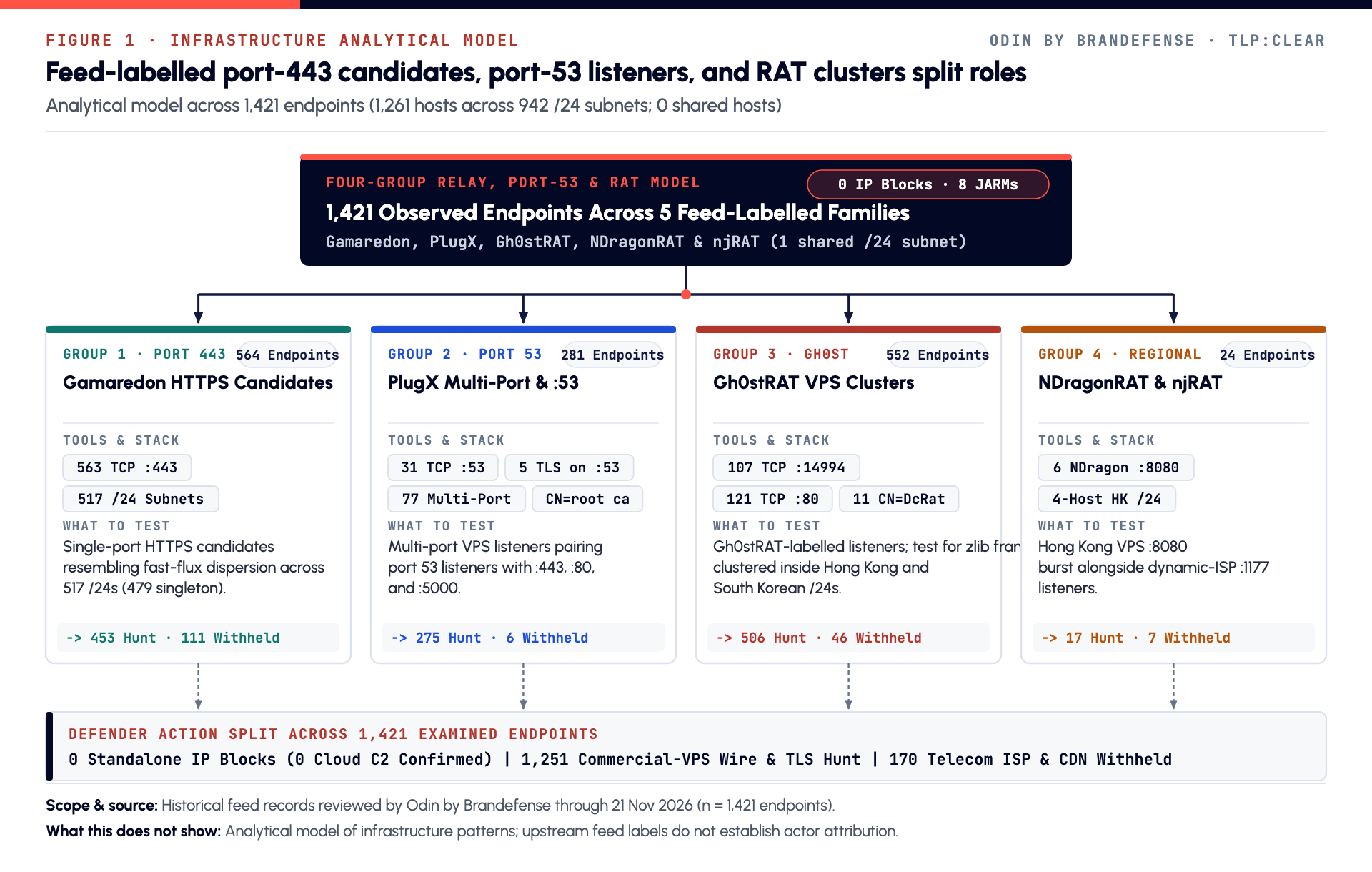
| Group | Feed labels | Endpoints | Hosts | /24s | Defender action |
|---|---|---|---|---|---|
| Port-443 relay candidates | Gamaredon | 564 | 564 | 517 | Hunt CN=Elastics certs and script HTTPS fan-out; withhold 106 Akamai rows |
| Port-53 cloud listeners | PlugX | 281 | 158 | 122 | Block workstation port 53; inspect TCP 53 for HTTP or TLS framing |
| Port-14994 RAT clusters | Gh0stRAT | 552 | 515 | 283 | Hunt Gh0st + zlib |78 9c| and CN=DcRat; withhold 46 telecom rows |
HK /24 burst and port 1177 | NDragonRAT, njRAT | 24 | 24 | 21 | Hunt port 1177 |00|lv frames and HK port 8080 clusters; withhold 7 ISP rows |
Why zero IP addresses are published for blocking
Upstream feeds marked 1,406 endpoints as candidates (98.9%), 14 as suspected (10 PlugX, 4 Gh0stRAT), and 1 as confirmed. Reviewing that sole feed-confirmed record (13 November 2026 under Gh0stRAT) showed that it sits on Chinanet, a Chinese broadband carrier, on TCP port 3389 for Windows Remote Desktop Protocol (RDP).
Broadband hosts exposing RDP are potential victims or third parties rather than cloud C2 servers. That host and 169 other telecom ISP and CDN rows are withheld (170 total, 12.0%). All 1,251 commercial cloud candidates (88.0%) also stay withheld because banner matches alone do not confirm malicious ownership.
Where the endpoints sit
Hong Kong leads across 33 countries, with 393 endpoints (27.7%). The United States has 272 (19.1%), China 141 (9.9%), and Canada and South Korea each have 84 (5.9%). Next are the Netherlands (68), the United Kingdom (59), India (57), Japan (56), Germany (48), Singapore (25), and Taiwan (22).
| Network provider | Role | Endpoints | Family breakdown | Handling |
|---|---|---|---|---|
| DigitalOcean, LLC | Cloud VPS hosting | 361 | Gamaredon (361, 64.0% of family) | Protocol and TLS hunt |
| CTG Server Limited | Commercial VPS (HK, SG) | 137 | Gh0stRAT (129), NDragonRAT (6), PlugX (2) | Protocol and TLS hunt |
| Akamai International and Connected Cloud | Shared CDN edge networks | 106 | Gamaredon (65 + 41) | Withheld (do not block) |
| MOACK[.]Co[.]LTD | Server hosting (KR) | 65 | Gh0stRAT (65, port 80 /24 clusters) | Protocol and TLS hunt |
| BGPNET Global ASN | Commercial VPS (HK, JP) | 52 | PlugX (30, 4 on port 53), Gh0stRAT (22) | Protocol and TLS hunt |
| The Constant Company, LLC | Cloud VPS hosting | 48 | PlugX (30, 5 on port 53), Gamaredon (18) | Protocol and TLS hunt |
| Shenzhen Tencent Computer Systems | Cloud hosting (CN, HK) | 42 | Gh0stRAT (36), PlugX (5), njRAT (1) | Protocol and TLS hunt |
| Naruto | Commercial VPS (HK, JP) | 34 | Gh0stRAT (34, 27 on port 14994) | Protocol and TLS hunt |
| Amazon[.]com, Inc. | Hyperscale cloud | 27 | PlugX (25, 6 on port 53), Gh0stRAT (1), njRAT (1) | Protocol and TLS hunt |
| Chinanet, CHINANET, and CHINA UNICOM | Broadband telecom ISPs | 37 | Gh0stRAT (37 of 46 withheld rows) | Withheld (do not block) |
3. Gamaredon-Labelled HTTPS Candidates and PlugX Port-53 Listeners
In short
Gamaredon candidates (564 endpoints) and PlugX candidates (281 endpoints on 158 hosts) use opposite cloud designs. Gamaredon-labelled records place 563 of 564 endpoints on port 443 across 517 /24 subnets. Of those subnets, 479 hold one host. Nearly half of PlugX-labelled hosts expose two to five ports, including 31 listeners on port 53. Block direct workstation port 53 traffic and inspect allowed port 53 sessions for HTTP or TLS payloads.
CISA and MITRE ATT&CK (G0047) report that Gamaredon uses fast-flux DNS (T1568.001) to rotate domain records across short-lived cloud proxies (T1090.002) polled by VBScript and HTA scripts (T1218.005). PlugX (S0013) side-loads DLLs via signed Windows binaries. It cycles C2 sessions across HTTPS (443), HTTP (80, 8080), 5000, and port 53 (T1571; DNS-protocol use is not established in this sample). Figure 2 maps all five families to their detections.
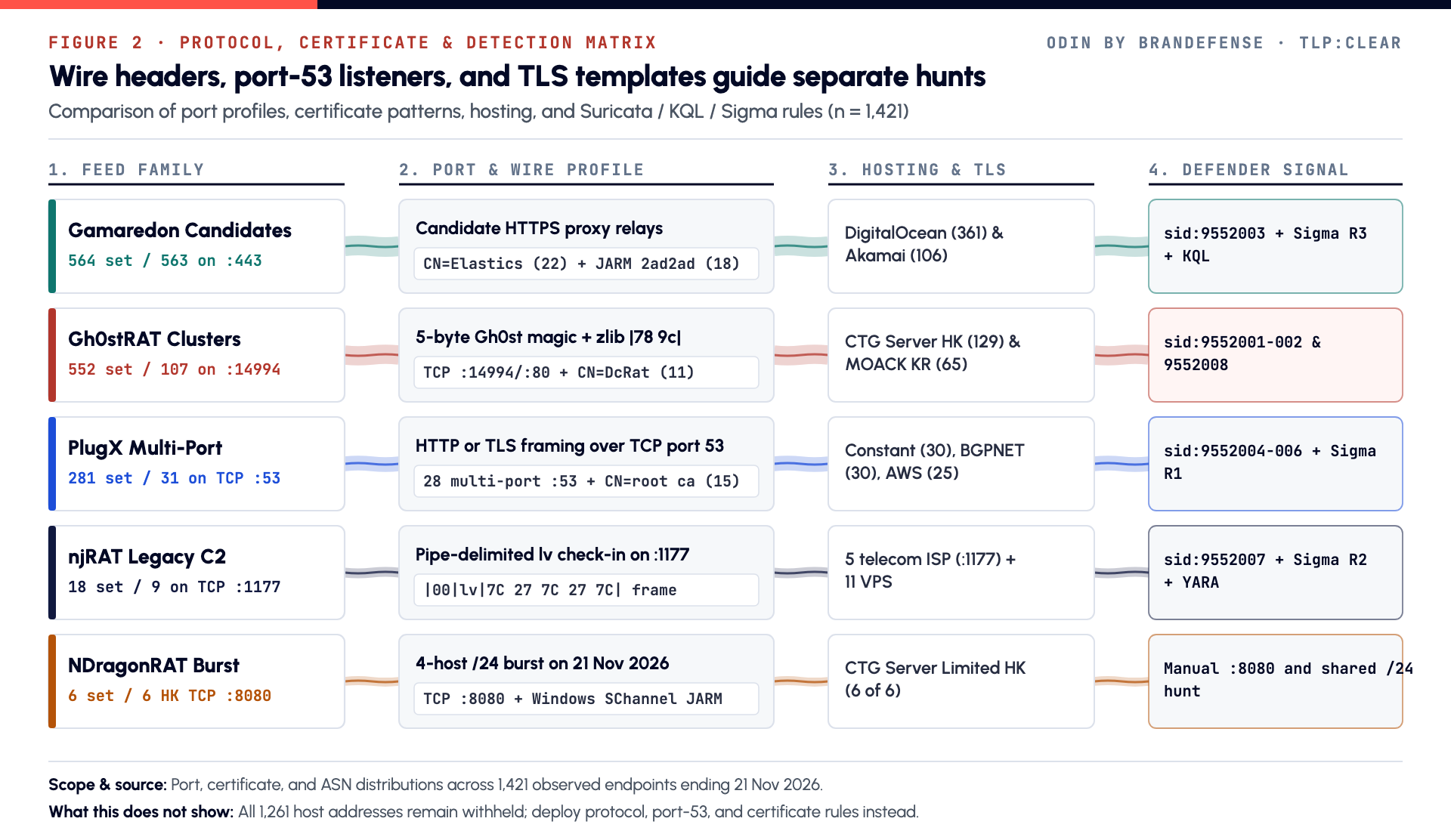
Gamaredon: 99.8% port 443 dispersion and Akamai edge collisions
Upstream feed entries for Gamaredon carry record dates ending on 24 April 2025. Their port and subnet layout resembles published Gamaredon fast-flux patterns, but this sample does not establish DNS rotation or actor attribution:
- Single-port HTTPS focus. Exactly 563 of 564 endpoints (99.8%) listen on TCP 443, with one port 80 host in the Netherlands and zero multi-port hosts.
- Wide
/24spread. The 564 hosts span 517/24subnets: 479 hold 1 host (92.6%), 29 hold 2, 9 hold 3, and zero hold 4 or more. - DigitalOcean droplets vs Akamai edges. DigitalOcean hosts 361 endpoints (64.0%), followed by Constant (18), Unitas Global (18), and BL Networks (17) across the US (191), Canada (83), the Netherlands (59), India (57), the UK (55), and Germany (42). Another 106 rows (18.8%) sit on Akamai International (65) and Akamai Connected Cloud (41) plus 5 European telecom rows, which sit on shared CDN networks and should not be blocked from feed labels alone.
- Self-signed
CN=Elasticscertificates. Alongside 370 entries without a certificate subject and 144 custom-domain certificates, 22 port 443 hosts present self-signedCN=Elastics. Sixteen of those 22 share JARM2ad2ad0002ad2ad22c42d42d0000008a5941c13f67e0c0a2c8a36bfeef6920(18 total), tied with custom-domain candidate JARM27d40d40d00040d00042d43d000000d2e61cae37a985f75ecafb81b33ca523(18).
PlugX: multi-port VPS stacks and port-53 listener verification
Among 281 PlugX endpoints on 158 hosts in 122 /24 subnets, Hong Kong leads with 125 (44.5%). The US has 49 (17.4%), Japan 44 (15.7%), and Singapore 14 (5.0%). Seventy-seven hosts (48.7%) expose two to five ports together, a pattern defenders can review with external attack surface management. These multi-port hosts include 41 two-port, 27 three-port, 8 four-port, and 1 five-port servers.
Port 443 holds 96 endpoints (34.2%), 80 holds 45 (16.0%), port 53 holds 31 hosts (11.0%), 5000 holds 29 (10.3%), and 8080 holds 16 (5.7%). Smaller sets bind 5080 (6), 12345 (6), 8000 (5), 8443 (5), and 21 (5). Fifteen TLS endpoints serve self-signed CN=root ca, with 12 sharing JARM 07d0bd16d21d21d07c07d0bd07d21dd7fc4c7c6ef19b77a4ca0787979cdc13 (XNNET 9, Cogent 3).
Ten PlugX endpoints across nine hosts carried an upstream suspected label between 13 and 19 November 2026. Eight sit on Amazon[.]com, CTG Server Limited, Alibaba, Shenzhen Tencent (8000 and stacked 1033/8254), Hetzner (443, CN=root ca), and Nocix (53). One port 49154 row sits on withheld ISP Korea Telecom.
| Port-53 check | Observed across 31 PlugX port-53 hosts | Defender takeaway |
|---|---|---|
| Cloud VPS hosting | 30 sit on cloud ASNs (Amazon[.]com 6, Constant 5, BGPNET 4, Gigabit 3, PEG TECH 2, Nocix 1) and 1 on Cloudflare London | Separates rented cloud hosts from home lines while keeping Cloudflare withheld |
| TLS directly on TCP 53 | 5 PlugX hosts (US, KR, HK, EE) plus 1 Gh0stRAT host (HK) complete TLS handshakes on TCP 53; 2 share JARM 29d29d00029d29d00042d43d00041dd469afa8cfbe5e42c631eb3fc55d6787 | DNS-over-TLS normally uses TCP 853; TLS on TCP 53 is a non-DNS hunt signal, not proof of a PlugX tunnel (SID 9552006) |
| Multi-port stacking | 28 of 31 hosts (90.3%) co-expose 55 companion ports: 443 (22), 80 (17), 8080 (10), 12345 (2), 21 (2), 8000 (1), 8443 (1) | Matches PlugX builder profiles binding identical listeners across 53, 80, 443, 8080 |
| Resolver overlap | 26 hosts expose plain port 53 without TLS, which web panels running named or dnsmasq can also create | Block workstation port 53 and inspect forwarder TCP 53 for HTTP/1.1 or TLS |
4. Gh0stRAT Port-14994 Clusters and Cross-Family Certificate Reuse
In short
Gh0stRAT accounts for 552 examined endpoints on 515 hosts across 283 /24 subnets, led by Hong Kong (262), China (134), and South Korea (79). Port 14994 holds 107 commercial-VPS endpoints, and 11 endpoints across 9 hosts serve self-signed CN=DcRat certificates. Alert on the 5-byte Gh0st header plus zlib |78 9c| stream and keep broadband RDP and mail ports out of firewall blocks.
Gh0stRAT (S0032) variants keep a conserved binary wire header: a 5-byte ASCII tag (Gh0st), two 4-byte length fields, and a zlib payload (0x78 0x9c) at byte offset 13. Figure 3 models how fast-flux polling, port-53 listeners, and RAT frames cross network layers.
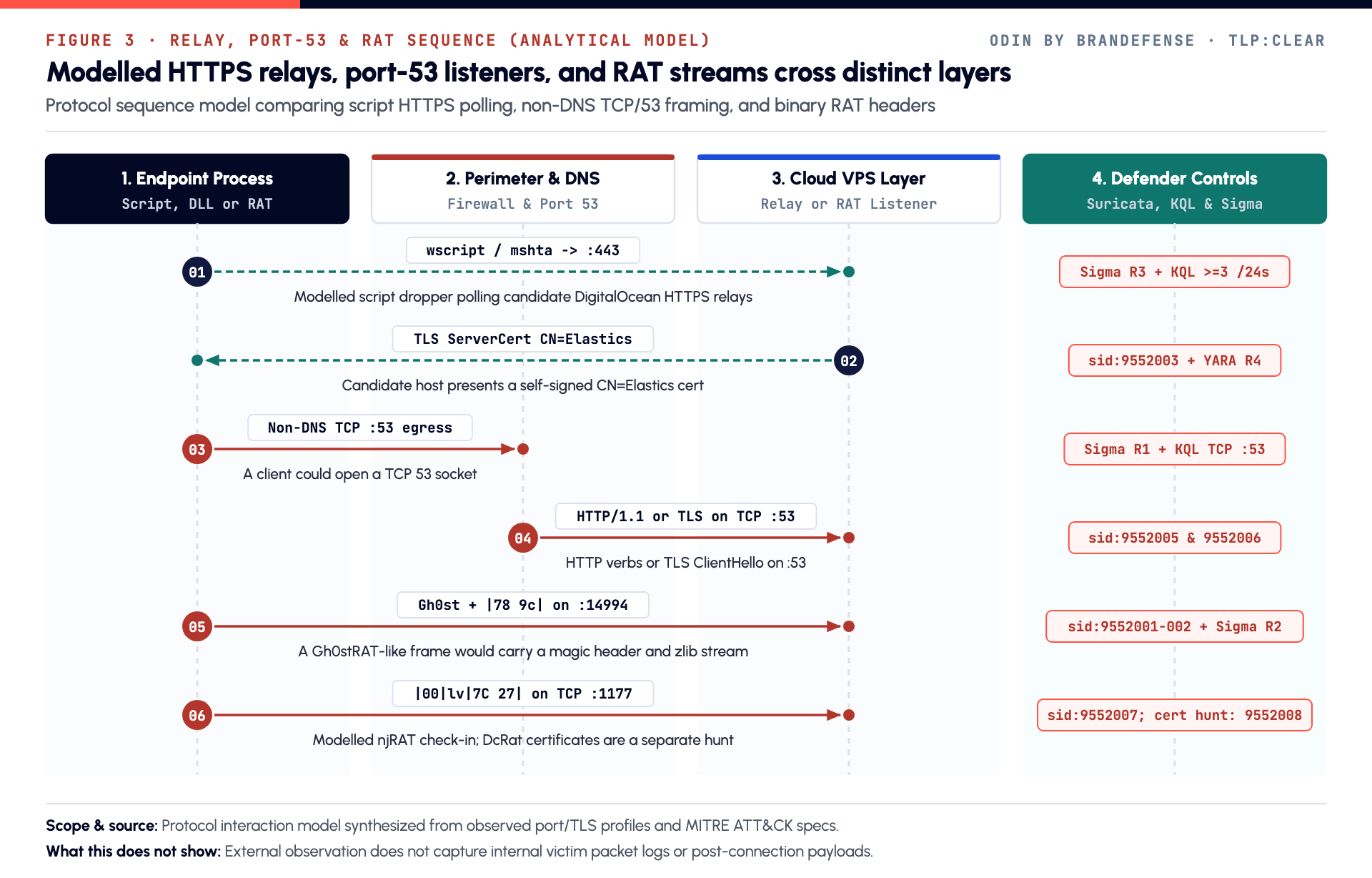
Port 14994 concentration in Hong Kong and Japan
Across 552 Gh0stRAT endpoints on 515 hosts (28 seen in November 2026), four ports hold 364 endpoints (65.9%). These are 80 (121, 21.9%), 14994 (107 hosts, 19.4%), 443 (77, 13.9%), and 8080 (59, 10.7%). Secondary ports include 8000 (29), 3456 (15), 9999 (13), 2100 (11), and 10086 (7).
Hong Kong holds 96 of the 107 port 14994 hosts (89.7%) and Japan holds 8 (7.5%), led by CTG Server Limited (52) and Naruto (27). Twenty-seven port 14994 endpoints match JARM 3fd3fd0003fd3fd21c42d42d000000bdfc58c9a46434368cf60aa440385763 and 25 match Windows SChannel JARM 14d14d16d14d14d08c14d14d14d14dfd9c9d14e4f4f67f94f0359f8b28f532.
| Sub-slice | Endpoints and hosts | Detail | Defender takeaway |
|---|---|---|---|
CN=DcRat reuse | 11 endpoints on 9 hosts (443: 8, 80: 2, 8000: 1) | 7 in one KR/HK /24, 3 in one CTG Server HK /24; 10 share JARM 22b22b00022b22b22b22b22b22b22bd3b67dd3674d9af9dd91c1955a35d0e9 | Alert on CN=DcRat server certificates (SID 9552008) |
| Telecom and RDP | 46 endpoints on 44 hosts | Includes sole feed-confirmed row on Chinanet port 3389 (13 November 2026) and Chunghwa Telecom port 8443 | Withhold broadband carriers and RDP port 3389 from blocks |
| Mail-port host | 3 endpoints on 1 host (465, 993, 995) | Upstream-suspected CTG Server HK host (14 November 2026) serving SMTPS, IMAPS, and POP3S | Require Gh0st wire payload matches before blocking mail ports |
5. Hong Kong Subnet Bursts, Dense /24 Clusters, and njRAT
In short
Commercial VPS resellers in Hong Kong and South Korea pack RAT candidates into single /24 blocks, including 25 /24 clusters (187 endpoints) and a four-host NDragonRAT burst. Legacy njRAT splits instead between scattered VPS hosts and broadband lines on port 1177, so hunt port 1177 delimiters and /24 VPS bursts.
Figure 4 contrasts PlugX multi-port stacks, Gh0stRAT port 14994 clusters, and NDragonRAT's Hong Kong /24 burst with withheld telecom and CDN rows.
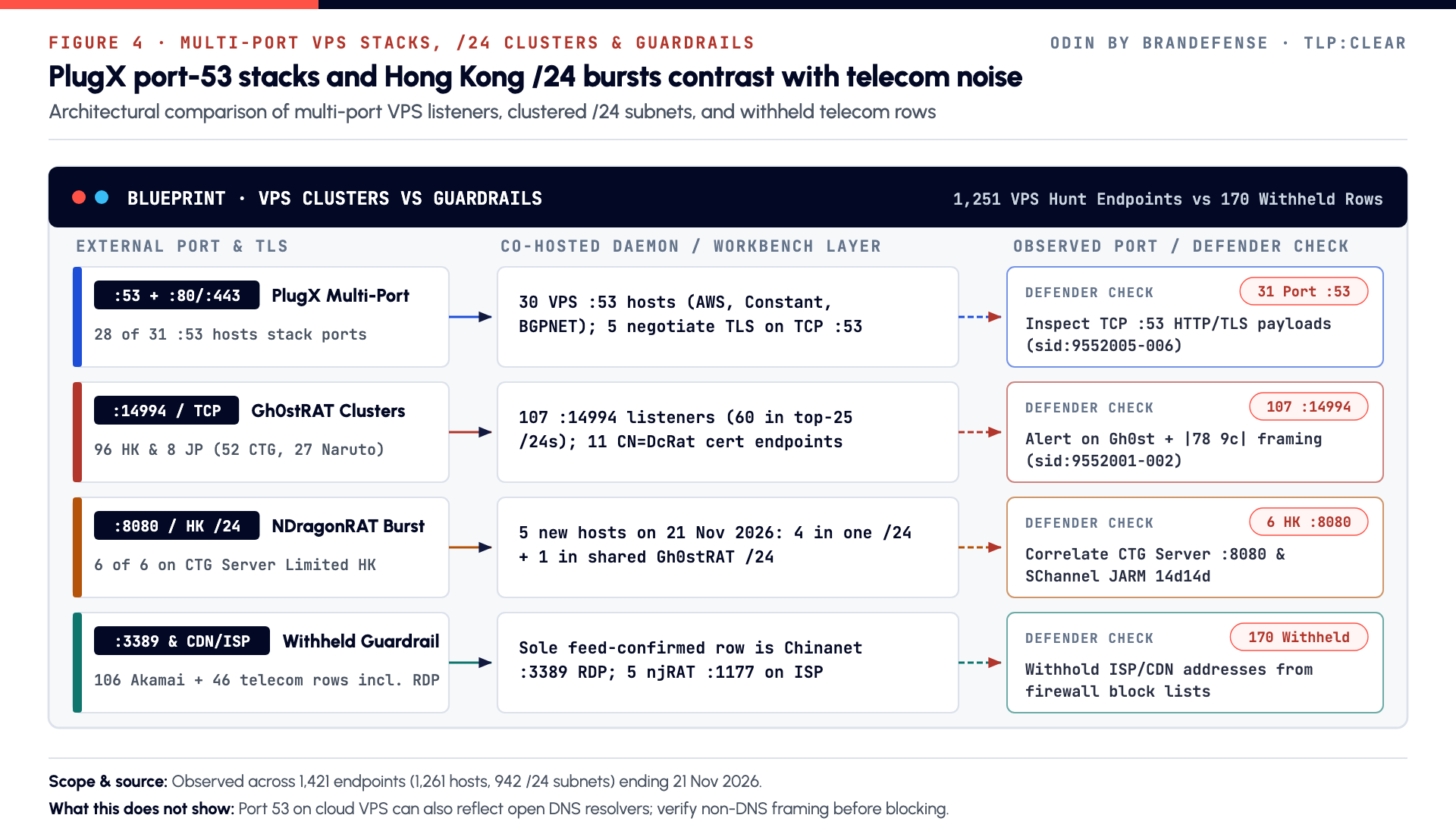
The 21 November 2026 NDragonRAT burst on CTG Server Limited
All 6 NDragonRAT endpoints sit in Hong Kong on CTG Server Limited TCP port 8080. One host was observed from 17 to 20 November 2026 with JARM 21d14d00021d21d00042d43d00000091f9827a8676a9d9f27d421962a09b5d (shared with 9 Gh0stRAT endpoints).
On 21 November 2026, five new port 8080 hosts were recorded on CTG Server Limited. Four sit together inside one /24 subnet, with one serving a default Windows host certificate and SChannel JARM 14d14d16d14d14d08c14d14d14d14dfd9c9d14e4f4f67f94f0359f8b28f532. The fifth sits inside the sole /24 subnet shared with a Gh0stRAT port 8080 candidate.
Top 25 dense /24 clusters vs scattered njRAT port-1177 hosts
Across the study, 29 groups split by family, /24 subnet, port and country hold 4 or more endpoints (203 endpoints, including NDragonRAT's four-host group). The top 25 dense /24 clusters total 187 endpoints (13.2%) across 24 unique /24 subnets:
| Cluster group | /24 clusters | Port(s) | Providers and locations | Endpoints |
|---|---|---|---|---|
| Korean HTTP clusters | 6 (Gh0stRAT) | 80 | MOACK[.]Co[.]LTD KR (16, 11, 7, 7, 6) and BGP Network KR (5) | 52 |
| Asian port-14994 clusters | 7 (Gh0stRAT) | 14994 | CTG Server HK (10, 10, 9, 5), Naruto HK/JP (13, 6), BGPNET HK (7) | 60 |
| HK and KR HTTPS clusters | 6 (Gh0stRAT) | 443 | CTG Server HK (10, 7, 6, 4), BGPNET HK (9), BGP Network KR (7, CN=DcRat) | 43 |
| HK, SG, and CN clusters | 3 (Gh0stRAT) | 80, 9999 | NetLab Global HK (11), Hubei Feixun CN (5), CTG Server SG (4) | 20 |
| HK PlugX HTTPS clusters | 3 (PlugX) | 443 | CNSERVERS LLC HK (4) and Netsec Limited HK (4 and 4) | 12 |
NjRAT (S0385, 18 hosts across 18 /24 subnets in 12 countries, with upstream record dates ending on 21 October 2026) shows zero /24 clustering. Nine endpoints (50.0%) use default port 1177, alongside 8080 (3) and singletons on 6522, 7070, 7077, 22 (SSH on PT Telekomunikasi Indonesia), 443, and 5000.
Five port 1177 hosts sit on dynamic subscriber telecom lines: four on PALTEL and one on Saudi Telecom. One port 6522 host sits on Free SAS, bringing withheld telecom rows to 7. Suricata SID 9552007 catches njRAT's |00|lv|'|'| check-in frame regardless of IP churn.
6. Why Static IP Block Lists Misfire Across All Five Families
In short
Zero endpoints out of 1,421 examined records belong on an automated IP block list. Blocking unverified espionage and RAT feeds disrupts Akamai and Cloudflare edges and broadband subscribers without verifying candidate relays or port-53 listeners. Validate protocol framing before containment.
Figure 5 compares total observed endpoints with the 1,251 commercial-VPS hunt endpoints across all five families.
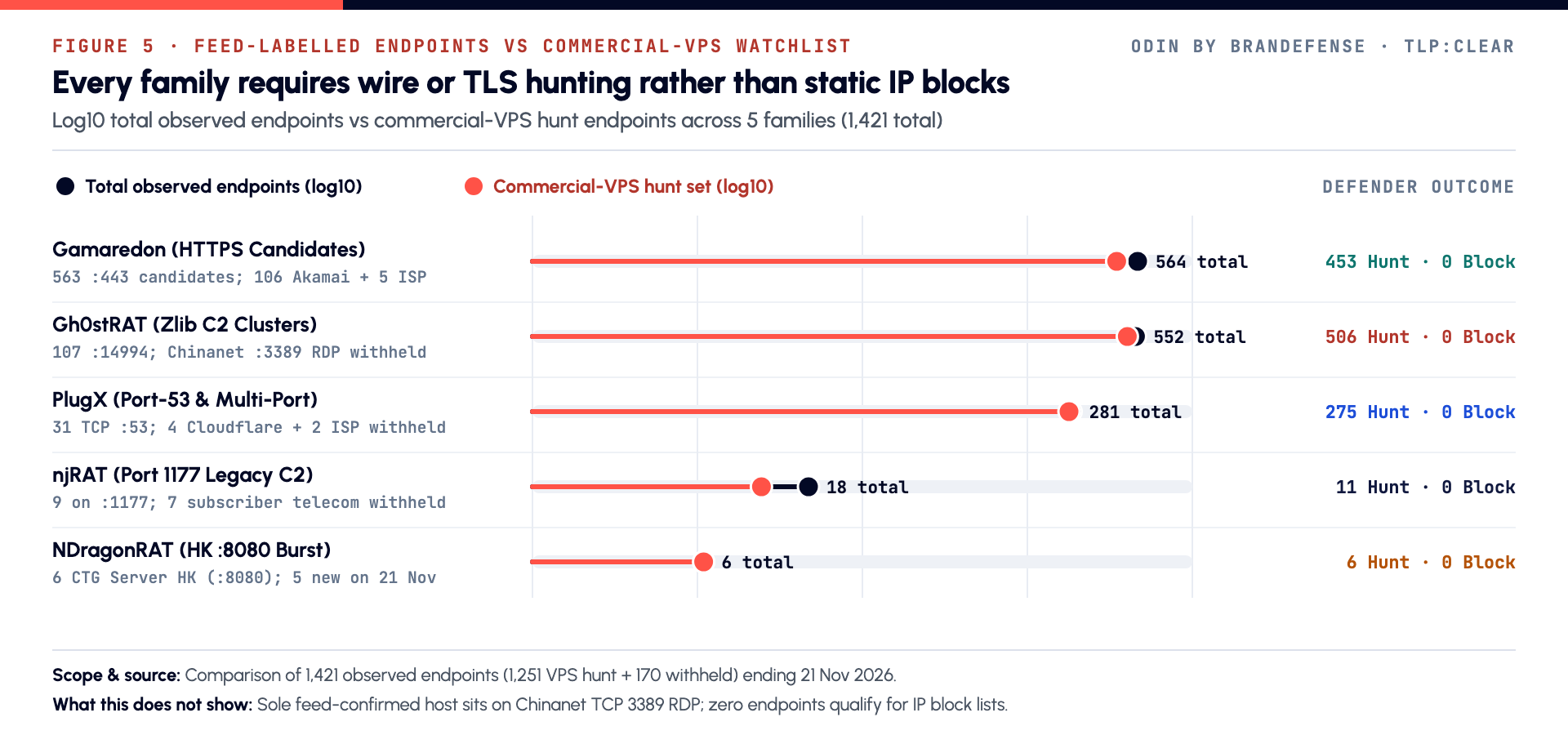
| Family | Observed | Hosts | Block | Commercial-VPS hunt set | Withheld telecom and CDN rows |
|---|---|---|---|---|---|
| Gamaredon | 564 | 564 | 0 | 453 (361 DigitalOcean, 22 CN=Elastics) | 111 (106 Akamai + 5 EU telecom) |
| Gh0stRAT | 552 | 515 | 0 | 506 (107 port 14994, 11 CN=DcRat) | 46 (telecom rows incl. Chinanet port 3389 RDP) |
| PlugX | 281 | 158 | 0 | 275 (30 VPS port 53, 15 CN=root ca) | 6 (4 Cloudflare + 2 telecom ISPs) |
| njRAT | 18 | 18 | 0 | 11 (4 VPS port 1177, 3 port 8080) | 7 (4 PALTEL + Saudi Telecom + Free + Telkom) |
| NDragonRAT | 6 | 6 | 0 | 6 (6 CTG Server HK port 8080) | 0 |
Four reasons raw feed blocking fails here
- Shared CDN edge networks (110 rows). The feed labels 106 Akamai CDN rows as Gamaredon candidates, and 4 PlugX rows point to Cloudflare London.
- Broadband dynamic DNS and RDP collisions (60 rows). Telecom carriers hold 46 Gh0stRAT rows (including Chinanet port 3389 RDP), 7 njRAT rows, 5 Gamaredon rows, and 2 PlugX rows.
- Shared OS TLS stacks across all five families. JARM
14d14d16d14d14d08c14d14d14d14dfd9c9d14e4f4f67f94f0359f8b28f532spans 75 endpoints across all five families (64 Gh0stRAT, 6 Gamaredon, 3 PlugX, 1 NDragonRAT, 1 njRAT), and3fd3fd0003fd3fd21c42d42d000000bdfc58c9a46434368cf60aa440385763spans 89 endpoints across three families, fingerprinting stock Windows SChannel and OpenSSL VPS stacks. - Open DNS resolvers and mail daemons on VPS hosts. Plain port 53 and mail ports (465, 993, 995) require wire payload verification before enforcement.
7. What Defenders Should Do
DNS and perimeter firewall
- Block direct outbound UDP and TCP port 53 traffic from workstations and servers outside internal DNS forwarders (
RFC 1035). - Inspect allowed TCP port 53 trunks with NIDS signatures so HTTP requests or TLS handshakes over port 53 trigger investigation before containment.
Windows endpoints and script hosts
- Block
wscript.exe,cscript.exe, andmshta.exefrom opening direct internet connections on port 443 via host firewall or Attack Surface Reduction rules. - Audit and block unsigned DLL side-loading via
rundll32.exeorregsvr32.exeinC:ProgramDataandC:WindowsTemp.
Network detection and threat intelligence
- Deploy the Suricata, Sentinel KQL, Sigma, and YARA rules in Chapter 8 with exact-hostname allowlists for corporate DNS forwarders and sandboxes.
- Keep Akamai, Cloudflare, telecom ISPs, RDP port 3389, mail ports (465, 993, 995), and JARM-only matches out of automatic firewall block lists.
8. Detection Rules
The full rules are in the Detection rules tab. Suricata 7.0.12 (suricata -T) loaded all eight signatures with 0 errors and lint_suricata.py found 0 problems. Sentinel KQL, Sigma (3 rules), and YARA (4 rules) passed static syntax, modifier, and fixture checks without live engine replay on our build host. Test and tune them locally before automated isolation.
| Rule file | What it catches |
|---|---|
odin_gamaredon_fastflux_plugx_dns_and_rat_c2.rules | Suricata 7: eight signatures for Gh0stRAT zlib headers, CN=Elastics, CN=root ca, and CN=DcRat certs, HTTP or TLS on TCP 53, and njRAT port 1177 frames |
sentinel_fastflux_plugx_dns_and_rat_hunt.kql | Microsoft Sentinel and Defender XDR: non-resolver TCP 53 egress, ports 1177 and 14994, script HTTPS /24 fan-out, and writable-path DLL staging |
sigma_plugx_port53_gamaredon_script_and_rat_ports.yml | Sigma (3 rules): Windows non-DNS outbound TCP 53 connections, ports 14994 or 1177, and wscript/cscript/mshta outbound HTTPS traffic |
odin_gh0strat_plugx_njrat_and_gamaredon_artifacts.yar | YARA (4 rules): Gh0stRAT zlib PE implants, PlugX side-loaded loaders, njRAT .NET clients, and Gamaredon VBS/HTA droppers |
How the Suricata signatures work
| SID | Looks for | Why |
|---|---|---|
| 9552001 | Outbound TCP 14994 stream starting with Gh0st and zlib |78 9c| at offset 13 | Classic Gh0stRAT binary framing on its primary VPS port |
| 9552002 | Outbound Gh0st + zlib header on ports 80, 443, 2100, 3456, 8000, 8080, 9999, 10086 | Catches Gh0stRAT masquerading on web and alternate ports |
| 9552003 | Inbound port 443 server cert with subject and issuer containing the same CN (CN=Elastics) | Flags Gamaredon-labelled CN=Elastics candidate certs (22 rows) |
| 9552004 | Inbound port 443 or 8443 server cert with subject and issuer containing the same CN (CN=root ca) | Hunt signal for PlugX-labelled CN=root ca certs (15 rows; alert-only) |
| 9552005 | Outbound HTTP/1.1 GET, POST, PUT, or HEAD request over TCP 53 | Flags HTTP requests on TCP 53 for non-DNS protocol investigation |
| 9552006 | Outbound TLS ClientHello (|16 03| + |01 00|) over TCP 53 | Flags TLS ClientHello on TCP 53 for non-DNS protocol investigation (5 PlugX, 1 Gh0stRAT) |
| 9552007 | Outbound TCP 1177 stream with |00|lv|7C 27 7C 27 7C| within 16 bytes | Catches njRAT 0.7d pipe-delimited check-in frames |
| 9552008 | Inbound server cert with subject and issuer containing the same CN (CN=DcRat) | Catches DcRat and cross-family cert reuse (11 Gh0stRAT rows) |
How the KQL, Sigma, and YARA rules work
The Sentinel KQL query correlates seven days of DeviceNetworkEvents and DeviceProcessEvents. It flags non-DNS processes opening outbound TCP 53 sockets, connections to ports 1177 or 14994, and wscript.exe, cscript.exe, or mshta.exe reaching three or more /24 subnets over port 443.
It also catches rundll32.exe or regsvr32.exe staging in C:ProgramData or C:WindowsTemp. Exact allowlists cover only CORP-DNS-FWD-01/02, SEC-SANDBOX-WIN-01, SEC-NETLAB-LNX-01, and exact system DNS binary paths.
| Sigma rule | Level | Fires when |
|---|---|---|
| Non-Resolver Process Initiating Outbound TCP Port 53 Connection | High | Windows TCP 53 egress outside exact dns.exe/svchost.exe paths and CORP-DNS-FWD-01/02 |
| Outbound Connection to Characteristic Gh0stRAT Port 14994 or njRAT Port 1177 | High | Windows host outside SEC-SANDBOX-WIN-01 connects to TCP 14994 or 1177 |
| Windows Script Host or MSHTA Initiating Outbound HTTPS Connection | High | Exact System32 or SysWOW64 wscript.exe, cscript.exe, or mshta.exe connects to TCP 443 |
| YARA rule | Fires when |
|---|---|
ODIN_Gh0stRAT_Magic_Zlib_Implant | PE under 5 MB combines Gh0st and zlib 1.1.4 or { 78 9C } with two manager classes |
ODIN_PlugX_Sideloaded_Payload_Loader | PE under 4 MB combines GULP, PLUG, or boot.ldr with RtlDecompressBuffer, VirtualAlloc, and WinInet/DNS APIs |
ODIN_njRAT_DotNet_Port1177_Client | .NET PE under 2 MB combines mscoree.dll and |'|'| with 0.7d or 1177 and firewall strings |
ODIN_Gamaredon_VBS_FastFlux_Relay_Dropper | Script under 1 MB combines WScript.Shell/FileSystemObject, XMLHTTP/WinHttp, ADODB.Stream, and wscript/mshta |
MITRE ATT&CK mapping
| Tactic | Technique | How it shows up | Detection |
|---|---|---|---|
| Resource Development | T1583.003 Virtual Private Server | 361 DigitalOcean droplets, 137 CTG Server HK and 65 MOACK[.]Co[.]LTD rows, 4-host HK /24 burst | SIDs 9552001 to 9552008; 8 JARMs |
| Command and Control | T1568.001 Fast Flux DNS | 563 Gamaredon-labelled port-443 candidates across 517 /24s (479 single-host) and 22 CN=Elastics certs | SID 9552003; KQL; Sigma rule 3 |
| Command and Control | T1571 Non-Standard Port | Gh0stRAT 14994 (107), njRAT 1177 (9), PlugX TCP 53 (31) and 5000 (29) | SIDs 9552001, 9552005 to 9552007 |
| Defense Evasion | T1218.005 Mshta | Gamaredon VBS/HTA HTTPS droppers and PlugX writable-folder DLL side-loading | Sigma rule 3; KQL; YARA rules 2 and 4 |
9. Indicators
The Indicators tab holds 8 published indicators: 0 IPv4 addresses, 0 file hashes, and 8 JARM fingerprints. Eight more wire, certificate, and port-cluster markers appear in this report only. All 1,261 distinct host addresses across the 1,421 examined endpoints are withheld.
| Type | Count | Where to use it |
|---|---|---|
| Network addresses and file hashes (Indicators tab) | 0 | Zero addresses or hashes are published because no cloud host met C2 block criteria |
| TLS JARM fingerprints (Indicators tab) | 8 | TLS hunting only; never block on a JARM fingerprint alone |
| Wire, certificate, and port markers (text only) | 8 | Suricata, Sentinel KQL, Sigma, and YARA hunting |
JARM fingerprints to hunt (in the Indicators tab)
| JARM | Family | Context |
|---|---|---|
2ad2ad0002ad2ad22c42d42d0000008a5941c13f67e0c0a2c8a36bfeef6920 | Gamaredon | Shared by 18 HTTPS endpoints, including 16 of 22 self-signed CN=Elastics candidates |
27d40d40d00040d00042d43d000000d2e61cae37a985f75ecafb81b33ca523 | Gamaredon, Gh0stRAT | TLS fingerprint across 20 feed-labelled endpoints (19 on port 443, one on port 2100) |
07d0bd16d21d21d07c07d0bd07d21dd7fc4c7c6ef19b77a4ca0787979cdc13 | PlugX | Shared by 13 commercial-VPS endpoints, including 12 of 15 CN=root ca listeners |
2ad2ad0002ad2ad22c2ad2ad2ad2ad703dc1bf20eb9604decefea997eabff7 | PlugX | Seen on 11 PlugX-labelled endpoints across six ports, none on port 443 |
29d29d00029d29d00042d43d00041dd469afa8cfbe5e42c631eb3fc55d6787 | PlugX | Shared by 2 of 5 PlugX-labelled hosts serving TLS on TCP 53, plus one port 80 and one port 443 endpoint |
3fd3fd0003fd3fd21c42d42d000000bdfc58c9a46434368cf60aa440385763 | Gh0stRAT, PlugX, Gamaredon | Leading TLS stack across 89 endpoints (86 Gh0stRAT, 27 on port 14994) |
14d14d16d14d14d08c14d14d14d14dfd9c9d14e4f4f67f94f0359f8b28f532 | All 5 families | Windows SChannel TLS stack across 75 endpoints across all five labels |
22b22b00022b22b22b22b22b22b22bd3b67dd3674d9af9dd91c1955a35d0e9 | Gh0stRAT | Shared by 16 endpoints, including 10 of 11 CN=DcRat certificate endpoints |
Other indicators (text only)
| Indicator | Type | Where to hunt |
|---|---|---|
Gh0st + zlib |78 9c| at offset 13 | Binary C2 header | Suricata SIDs 9552001 and 9552002; YARA rule 1 |
CN=Elastics | TLS subject and issuer (22 rows) | Suricata SID 9552003 on inbound TCP 443 |
CN=root ca | TLS subject and issuer (15 rows) | Suricata SID 9552004 (alert-only hunt) |
CN=DcRat | TLS subject and issuer (11 rows) | Suricata SID 9552008 across TLS ports |
HTTP/1.1 or TLS ClientHello on TCP 53 | Non-DNS port-53 investigation signal | Suricata SIDs 9552005 and 9552006; Sigma rule 1; KQL |
|00|lv|7C 27 7C 27 7C| | njRAT check-in frame | Suricata SID 9552007 and YARA rule 3 |
| TCP 14994 | Gh0stRAT VPS port (107 rows) | Suricata SID 9552001; Sigma rule 2; KQL |
| TCP 53 + 80 + 443 + 8080 | Multi-port PlugX stack (28 hosts) | Attack-surface and egress correlation |
Withheld: all 1,261 distinct host addresses across the 1,421 examined endpoints, plus unverified custom certificate domains, workstation hostnames, and brand-lure certificate strings.
10. Scope and Limits
- Window. The records have last-seen dates from 13 June 2023 through 21 November 2026. Upstream feed entries for Gamaredon carry record dates ending on 24 April 2025, and njRAT entries carry record dates ending on 21 October 2026.
- Feed labels are not attribution. Family names come from upstream rules matching certificates, JARM hashes, or port banners and do not establish state sponsorship.
- Analytical model. Zero hosts overlap across the five families, and the single shared Hong Kong
/24subnet sits on a commercial VPS reseller. Figures 1 and 3 show an analytical model, not one actor. - No victim packet logs. External records do not capture victim traffic or confirm whether non-TLS port 53 hosts ran PlugX or open DNS software.
- Rule validation. Suricata
7.0.12loaded all eight rules (suricata -T, 0 errors;lint_suricata.py, 0 problems). Sentinel KQL, Sigma, and YARA passed static checks without live engine replay on our build host.
11. Sources
- MITRE ATT&CK. G0047 Gamaredon Group. https://attack.mitre.org/groups/G0047/ (verified 21 November 2026)
- MITRE ATT&CK. S0013 PlugX. https://attack.mitre.org/software/S0013/ (verified 21 November 2026)
- MITRE ATT&CK. S0032 gh0st RAT. https://attack.mitre.org/software/S0032/ (verified 21 November 2026)
- MITRE ATT&CK. S0385 njRAT. https://attack.mitre.org/software/S0385/ (verified 21 November 2026)
- CISA, NSA, FBI, and International Partners. Advisory AA25-093A: Fast Flux: A National Security Threat. https://www.cisa.gov/news-events/cybersecurity-advisories/aa25-093a (verified 21 November 2026)
- CISA, FBI, and NSA. Advisory AA22-110A: Russian State-Sponsored and Criminal Cyber Threats to Critical Infrastructure. https://www.cisa.gov/news-events/cybersecurity-advisories/aa22-110a (verified 21 November 2026)
- MITRE ATT&CK. T1568.001 Dynamic Resolution: Fast Flux DNS. https://attack.mitre.org/techniques/T1568/001/ (verified 21 November 2026)
- MITRE ATT&CK. T1571 Non-Standard Port. https://attack.mitre.org/techniques/T1571/ (verified 21 November 2026)
- IETF. RFC 1035: Domain Names - Implementation and Specification. https://www.rfc-editor.org/rfc/rfc1035 (verified 21 November 2026)
- Salesforce Engineering. JARM: An Active Transport Layer Security (TLS) Server Fingerprinting Tool. https://github.com/salesforce/jarm (verified 21 November 2026)
What is…?
Short explanations of the tools and families named in this study.
What is Gh0st RAT?
Gh0st RAT is an old remote access trojan whose source code leaked, producing many variants used by criminal and state actors.
More about Gh0st RATRemote access trojanWhat is PlugX?
PlugX is a modular remote access trojan used by several China-nexus groups for over a decade, often loaded through DLL side-loading.
More about PlugXTechniqueWhat is JARM?
JARM is an open TLS server fingerprinting method from Salesforce. It hashes how a server answers a set of crafted TLS handshakes.
More about JARMFrequently asked questions
How do Gamaredon-labelled HTTPS candidates and PlugX port-53 listeners evade static firewall rules?
Gamaredon candidates (564 endpoints, with upstream feed record dates ending on 24 April 2025) and PlugX candidates (281 endpoints across 158 hosts) rely on opposite cloud layouts:
What links Gh0stRAT port-14994 clusters, DcRat certificates, and the Hong Kong /24 burst?
Gh0stRAT accounts for 552 examined endpoints across 515 hosts, led by port 80 (121) and characteristic high port 14994 (107 endpoints: 96 in Hong Kong and 8 in Japan). Two commercial VPS providers, CTG Server Limited (52) and Naruto (27), host 73.8% of all port 14994 listeners. Eleven Gh0stRAT-labelled endpoints across 9 hosts serve self-signed CN=DcRat certificates (10 sharing JARM 22b22b00022b22b22b22b22b22b22bd3b67dd3674d9af9dd91c1955a35d0e9), showing that commodity RAT TLS templates cross feed labels and cannot prove state attribution.