


1. Executive Summary
In short
In a two-week observation window ending 18 November 2026, Odin by Brandefense found 4,360 endpoints running five autonomous AI offense frameworks. Of these, 1,846 are confirmed. Operators rebrand ARTEX consoles for regional markets, stack several frameworks on one server, and run up to 16 parallel workers per target. An exposed swarm archive covers 76 organizations, mostly in payments and Web3. Block the 1,820 confirmed endpoints on stable hosting, hunt the shared ARTEX favicon hash, and alert on 25-URI scan bursts.
Autonomous offense frameworks put a large language model (LLM) in charge of classic scanners such as subfinder, nuclei and sqlmap. The operator gives a target. The model plans the work and hands it to many parallel workers. This report maps where these consoles run, how they are disguised, and what one exposed campaign archive shows about their targets.
Five AI offense frameworks run on 4,360 endpoints across 2,917 hosts.
ARTEX (2,121 endpoints) and CyberStrikeAI (1,720) dominate. PentAGI (340), HexStrikeAI (118) and DeepAudit (61) follow. Of the 4,360 endpoints, 1,846 are confirmed, 117 suspected and 2,397 candidates.
Rebranded ARTEX forks change titles and certificates but keep the favicon.
Two Korean-localized consoles on AWS Seoul serve the same 15,406-byte favicon as upstream ARTEX controllers in China. Separately, 103 hosts carry two or more framework labels. The clearest case, 38.127.244[.]14, runs PentAGI, an ARTEX port and an upload-bypass dropzone side by side.
One swarm archive shows heavy targeting of payments and Web3 firms.
An exposed ARTEX archive lists 76 target organizations and 13,864 enumerated subdomains. Payments and Fintech (21) and Web3, DeFi and Stablecoin (20) make up 53.9% of the scopes. The swarm's own reports label 35 scopes critical or high; these labels are unverified.
Three Decisions for Leaders
- Block confirmed controllers, but keep review lanes. Block the 1,820 confirmed endpoints on stable hosting networks. Put the 30 endpoints on dynamic telecom ISPs, the 3 endpoints under analyst review and all candidates on time-bound watchlists instead.
- Hunt fingerprints that operators do not change. Page titles and logos change with every rebrand. The favicon hash, the TLS certificate subject, the JARM value and the API routes stay the same, so build detection on those.
- Harden upload folders and throttle scan bursts. Disable
.htaccessoverrides on upload directories to stop image-as-PHP polyglots. Alert when one source hits 25 or more distinct URIs in 5 minutes.
The Study in Numbers
| Number | What it is |
|---|---|
| 4,360 | Endpoints running one of five AI offense frameworks, on 2,917 IPv4 hosts in 50 countries and 286 networks |
| 1,846 | Confirmed endpoints (42.3%); 1,820 of them sit on stable hosting and are ready to block |
| 103 | Hosts that carry two or more framework labels |
| 76 | Target organizations in one exposed ARTEX campaign archive, across 18 verticals |
| 13,864 | Subdomains the swarm enumerated for those 76 targets; 1,105 were live |
| 46.1% | Share of the 76 scopes (35) the swarm labeled critical or high, unverified |
| 2,178 | Worker runs the swarm recorded against a single target |
How to use this report.
Security leaders can read Chapter 1, Chapter 6 and Chapter 7. SOC and detection engineers should start with Chapters 7 to 9. CTI analysts will find the fork, co-hosting and infrastructure detail in Chapters 2 to 5.
2. How the Swarms Work
In short
These frameworks split one target into many small jobs and run them in parallel worker pools. The pools hand results forward, from subdomain discovery to template scanning, exploitation checks and an LLM-written report.
From script chains to agent workbenches
Attackers used to glue reconnaissance tools together with their own scripts. The frameworks in this report replace that with a web workbench. The workbench exposes a REST, GraphQL or Model Context Protocol (MCP) API to an LLM planning loop. MCP is an open JSON-RPC protocol that lets a model call external tools.
Each framework takes a slightly different approach. The table below lists the architecture and the default ports.
| Framework | How it is built | Default ports |
|---|---|---|
| ARTEX | Python multi-worker swarm with a pool of 1 to 16 subagents and a SQLite or Postgres task queue | 8787, 443, 80, 7878 |
| CyberStrikeAI | Go and Python platform with role-based agents wrapping 100+ security tools | 5001 to 5003, 8080, 8082, 443, 8899 |
| PentAGI | Go controller with a GraphQL API that starts Docker-in-Docker Kali workers and keeps memory in pgvector | 8443, 8666, 443 |
| HexStrikeAI | Python FastAPI server that exposes nmap, nuclei, sqlmap and ffuf as MCP tools | 5000, 80, 8080, 8000, 8888 |
| DeepAudit | LLM workbench for auditing source code and repositories for vulnerabilities | 8000, 3000, 80 |
PentAGI, CyberStrikeAI and HexStrikeAI are public projects on GitHub. AhnLab ASEC has published an infrastructure analysis of ARTEX, and Team Cymru has tracked CyberStrikeAI infrastructure.
The four worker pools
The exposed ARTEX archive, together with the public PentAGI and HexStrikeAI designs, shows a four-stage pipeline. A controller receives a scope through POST /api/v1/tasks (ARTEX) or a GraphQL createFlow call (PentAGI). It then queues work to four pools.
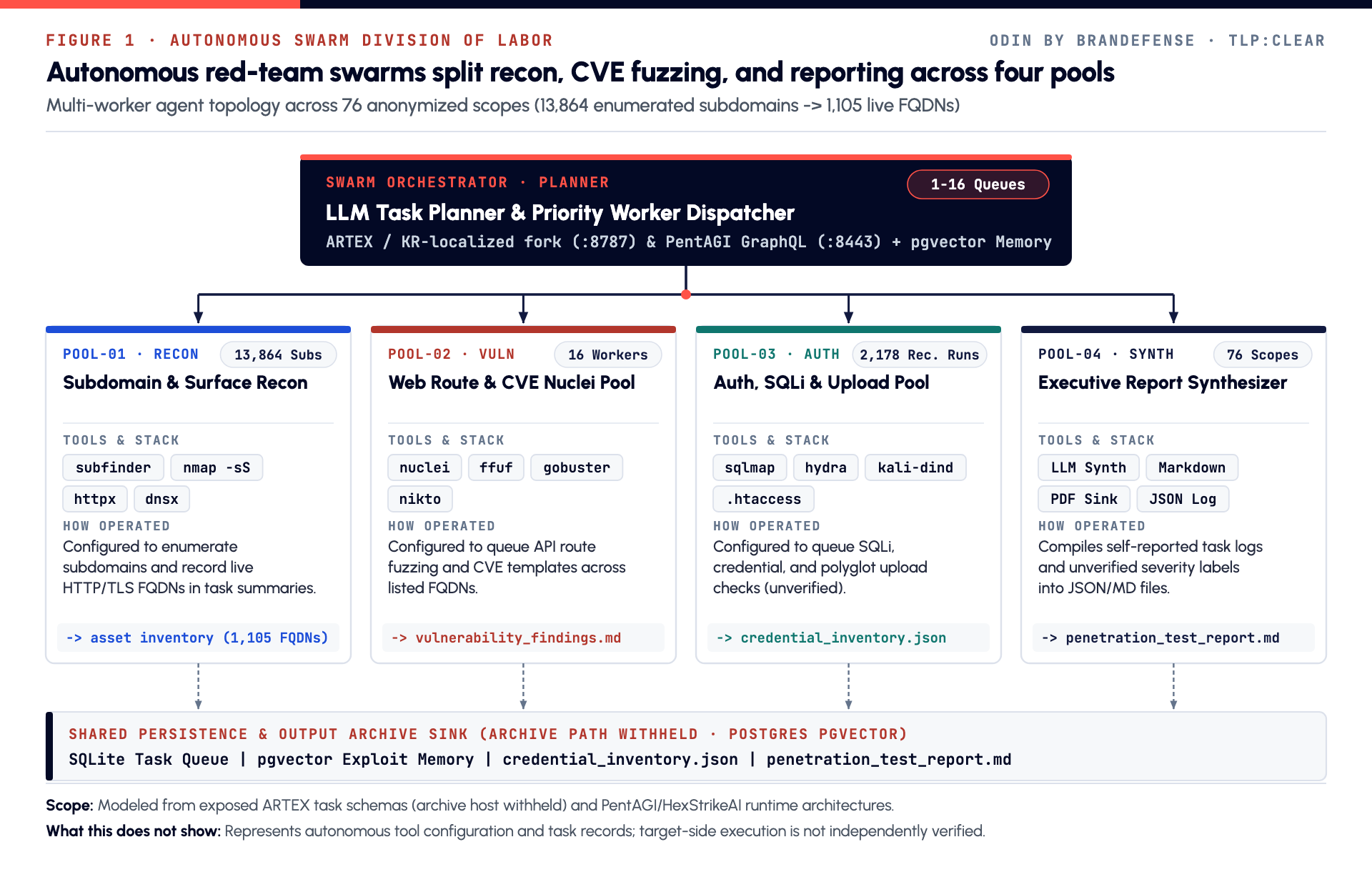
| Pool | Job | Tools | What the archive records |
|---|---|---|---|
| 01 Recon | Expand the attack surface and keep only live hosts | subfinder, naabu, httpx, dnsx | 13,864 subdomains (182.4 per target), narrowed to 1,105 live HTTP or TLS FQDNs (8.0% yield) |
| 02 Vulnerability scan | Run CVE templates and directory fuzzing on live hosts | nuclei, ffuf, gobuster, katana | Sweeps for .env files, .git/config, Swagger or OpenAPI specs, actuator and GraphQL endpoints |
| 03 Exploit checks | Test injectable parameters and upload forms | Kali Docker-in-Docker, sqlmap, MCP tool calls, polyglot uploads | Claimed outputs written to credential_inventory_01.json and findings_summary.json |
| 04 Synthesis | Turn task logs into a report | LLM writer, Markdown, JSON | 35 of 76 scopes labeled critical or high |
Pool 02 workers run with non-interactive batch flags such as -jsonl -silent -rate-limit 150. These flags matter for detection, because they show up in process command lines on the worker host.
In Pool 03, PentAGI starts Kali containers through containerd-shim-runc-v2. HexStrikeAI and CyberStrikeAI instead define MCP tools/call schemas for sqlmap --batch and polyglot upload probes. In both cases, an LLM decides which tool to call next.
How hard the swarm worked
The archive records how many worker runs the swarm spent on single targets. These are the swarm's own counts.
| Sector | Recorded worker runs |
|---|---|
| Crypto exchange | 2,178 |
| Online gaming | 1,231 |
| Not stated | 535 |
| DeFi | 477 |
Read the archive with care
The archive is the attacker's own record, so two limits apply. First, it shows what the tools were configured and logged to do. We did not see these actions on any target system. Second, the severity totals come from an LLM report writer. Such writers often call an unauthenticated banner or an exposed .env hit "critical". Treat the 17 critical and 18 high labels as claims.
The archive server also exposed real target domains and harvested secrets. Its address, port and directory paths are withheld in this report. Sizes of the archive files stay in the Indicators chapter; their hashes are withheld.
3. Fleet Footprint: Where the Consoles Run
In short
The 4,360 endpoints sit mostly on low-cost VPS networks in the United States, Hong Kong and China. One provider, PEG TECH INC, hosts 1,891 of them.
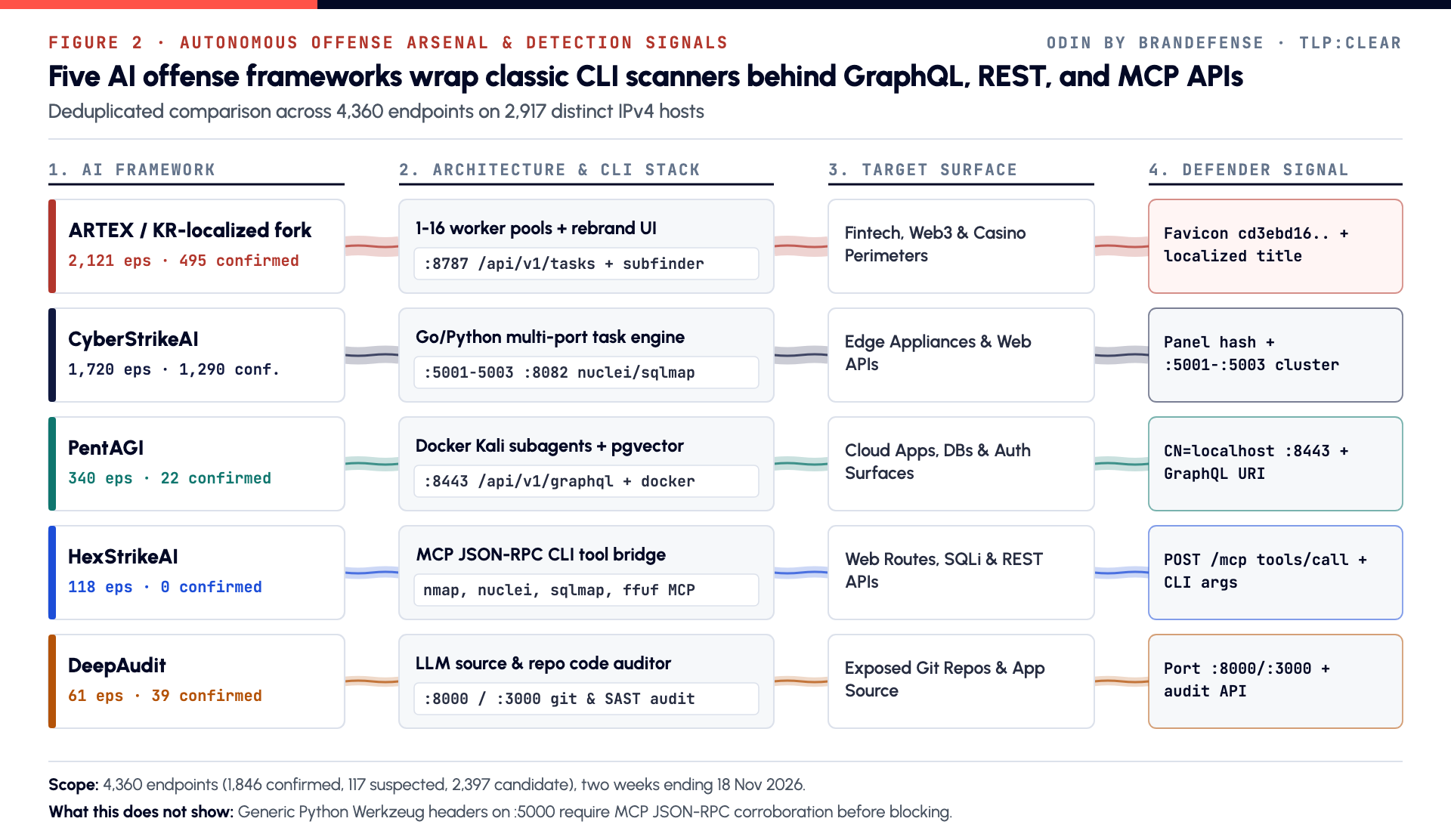
Counts by framework
Each endpoint is an IP, port and framework combination.
| Framework | Endpoints | Hosts | Confirmed | Suspected | Candidate |
|---|---|---|---|---|---|
| ARTEX (incl. Korean fork) | 2,121 | 1,419 | 495 | 14 | 1,612 |
| CyberStrikeAI | 1,720 | 1,142 | 1,290 | 0 | 430 |
| PentAGI | 340 | 333 | 22 | 4 | 314 |
| HexStrikeAI | 118 | 100 | 0 | 99 | 19 |
| DeepAudit | 61 | 26 | 39 | 0 | 22 |
| Total | 4,360 | 2,917 | 1,846 | 117 | 2,397 |
CyberStrikeAI has the highest confirmed share at 75.0%. Its listeners share the JARM value 40d40d...9319. DeepAudit also appears next to HexStrikeAI and ARTEX on the same servers, as on 38.76.218[.]100.
Why PentAGI and HexStrikeAI look small
A responsive panel is not a confirmed deployment. Of the 340 PentAGI endpoints, only 22 are confirmed. The other 314 are candidates. We make no claim that PentAGI deployments grew over time.
HexStrikeAI is harder still. Many installs show only a generic Python Werkzeug or FastAPI page on 5000, 80 or 8080. Nothing else on these pages ties them to the framework. So none of the 118 HexStrikeAI endpoints is confirmed: 99 are suspected and 19 are candidates.
Countries and hosting networks
The fleet spans 50 countries and 286 networks. Six countries lead.
| Country | Endpoints | Share |
|---|---|---|
| United States | 2,586 | 59.31% |
| Hong Kong | 697 | 15.99% |
| China | 444 | 10.18% |
| Japan | 107 | 2.45% |
| Singapore | 95 | 2.18% |
| Germany | 82 | 1.88% |
The top ten hosting networks carry 2,968 of the 4,360 endpoints (68.07%). PEG TECH INC alone hosts 1,891 (43.37%).
| Rank | Hosting network | Countries | Endpoints | Confirmed | Suspected | Candidate | Main frameworks |
|---|---|---|---|---|---|---|---|
| 1 | PEG TECH INC | US, JP, SG | 1,891 | 1,124 | 0 | 767 | CyberStrikeAI, ARTEX, PentAGI |
| 2 | YANCY LIMITED | HK, US | 237 | 237 | 0 | 0 | ARTEX |
| 3 | Shenzhen Tencent Computer Systems | CN, US, JP | 176 | 25 | 12 | 139 | ARTEX, CyberStrikeAI, HexStrikeAI |
| 4 | Hangzhou Alibaba Advertising | CN | 131 | 17 | 10 | 104 | ARTEX, CyberStrikeAI, DeepAudit |
| 5 | AROSSCLOUD INC. | US, HK | 122 | 92 | 0 | 30 | CyberStrikeAI, ARTEX, DeepAudit |
| 6 | DigitalOcean, LLC | US, DE, NL | 116 | 96 | 5 | 15 | CyberStrikeAI, ARTEX, HexStrikeAI |
| 7 | cognetcloud INC | HK, US, IN | 81 | 17 | 4 | 60 | ARTEX, CyberStrikeAI, HexStrikeAI |
| 8 | CTG Server Limited | HK, JP, SG | 79 | 15 | 0 | 64 | ARTEX, CyberStrikeAI, PentAGI |
| 9 | NetLab Global | HK, US, JP | 71 | 6 | 1 | 64 | ARTEX, CyberStrikeAI, PentAGI |
| 10 | HostPapa | US, CA | 64 | 20 | 3 | 41 | ARTEX, CyberStrikeAI, DeepAudit |
What not to block
Some listeners sit on dynamic home or small-business broadband. These include Korea Telecom (AS4766), Chunghwa Telecom (AS3462) and Chinanet (AS4134). Their addresses rotate between unrelated customers. The 30 endpoints in this group (23 confirmed, 7 suspected) belong on watchlists that expire after 24 to 72 hours, not on permanent block lists. Their addresses are not published.
Port 5000 also causes false positives. One suspected HexStrikeAI host turned out to serve a benign replica of a third-party security training portal. It shared only a Werkzeug header with HexStrikeAI. Its favicon did not match, and it is excluded. Generic Python headers on 5000 need an MCP signal before anyone blocks them.
The blocking picture for confirmed endpoints is shown below.
| Group | Endpoints | Action |
|---|---|---|
| Confirmed on stable hosting | 1,820 (41.74%) | Block |
| Confirmed on dynamic telecom ISPs | 23 | Short watchlist |
| Confirmed framework, hostile use not shown | 3 (2 Korean fork nodes, 1 probable authorized tester) | Analyst review |
| Suspected on stable hosting | 110 | Watch, look for a second signal |
| Suspected on dynamic telecom ISPs | 7 | Short watchlist |
| Candidates | 2,397 (15 of them with an open directory) | Hold until corroborated |
By framework, the 1,820 block-ready endpoints are ARTEX 492, CyberStrikeAI 1,272, PentAGI 19 and DeepAudit 37.
4. White-Label Forks: Same Engine, New Paint
In short
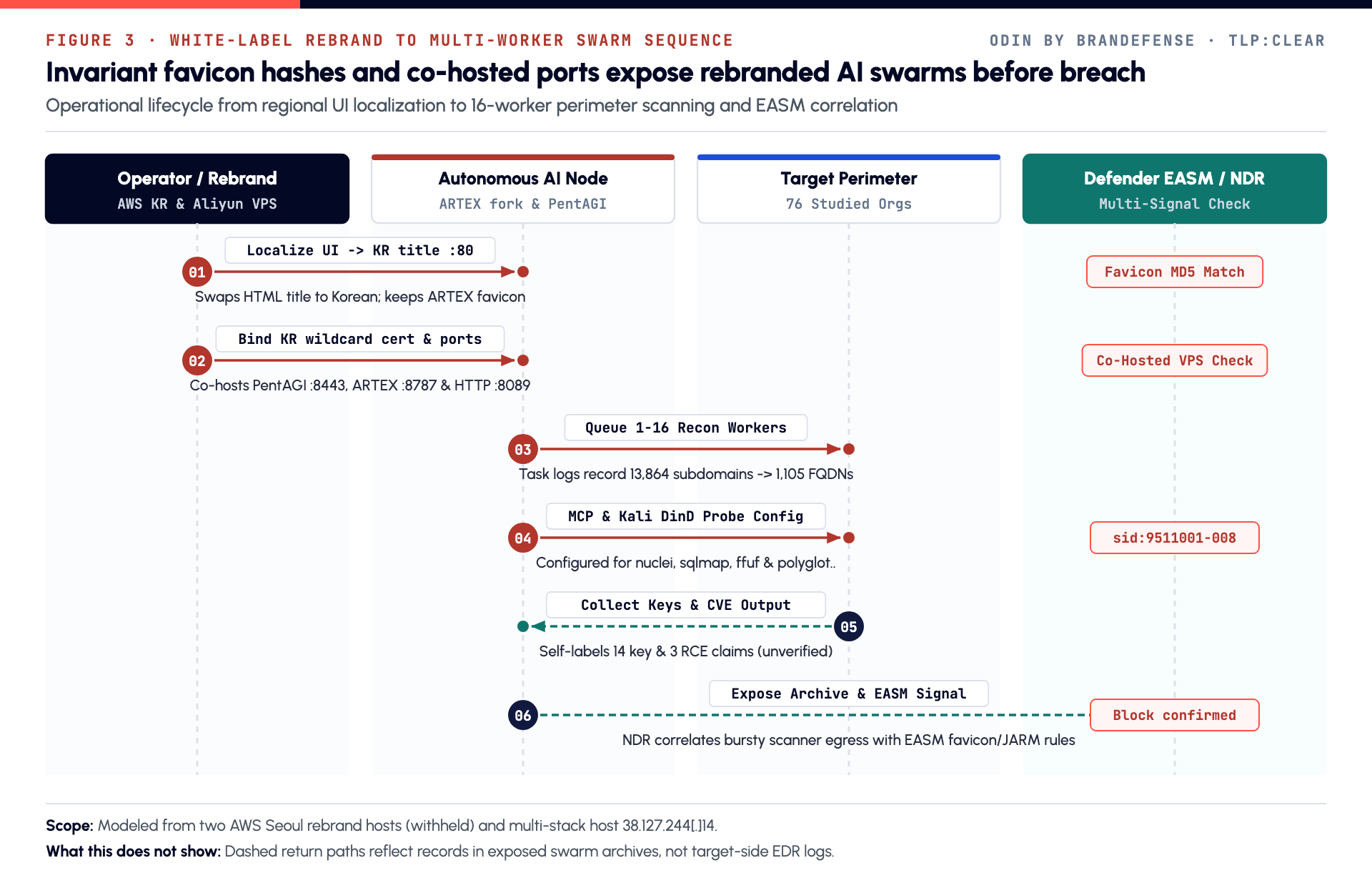
When operators fork an AI offense console, they change the page title, the logo and the TLS certificate. They rarely touch the compiled frontend, the API routes or the favicon file, which is what gives the fork away.
The Korean ARTEX fork
On 17 November 2026, two hosts on Amazon AWS Seoul (ap-northeast-2, AS16509) showed a localized ARTEX console. Their addresses and the Korean brand name are withheld, for reasons explained below.
Node A, on port 80, removed every visible "ARTEX" string from its title. It shows a Korean title ending in 공격·방어 보안 운영 ("Attack and Defense Security Operations"). That subtitle is a word-for-word translation of the Chinese upstream subtitle 攻防安全运营.
Node B, on port 443, kept the English title ARTEX - Autonomous Red-Team Expert. It sits behind a wildcard certificate for a South Korean company domain, with JARM 28d28d28d00028d00042d42d000000831b6af40378e2dd35eeac4e9311926e.
The link to upstream ARTEX
Both Korean nodes serve a 15,406-byte /favicon.ico with MD5 cd3ebd16437d6d3963592f7365dd3980. The same file appears on upstream ARTEX controllers. Both nodes also mount the single-page app in <div id="artex-swarm-root"> and expose /api/v1/tasks.
| Role | Endpoint | Hosting | Page title | TLS subject and JARM |
|---|---|---|---|---|
| Korean fork, node A | Withheld, port 80 | AS16509 AWS Seoul (KR) | Korean title ending 공격·방어 보안 운영 | No TLS |
| Korean fork, node B | Withheld, port 443 | AS16509 AWS Seoul (KR) | ARTEX - Autonomous Red-Team Expert | Korean company wildcard, 28d28d...926e |
| Upstream ARTEX, Chinese | 8.135.3[.]123:80 | AS37963 Alibaba Cloud (CN) | ARTEX - 攻防安全运营 | No TLS |
| Upstream ARTEX, Chinese | 8.135.30[.]162:443 | AS37963 Alibaba Cloud (CN) | ARTEX - 攻防安全运营 | CN=8.135.30[.]162, 15d3fd...e331 |
| Upstream ARTEX, English | 45.156.87[.]185:443 | AS399629 Rodgers Inv. (US) | ARTEX - Autonomous Red-Team Expert | CN=artex.dwwork[.]live, 2ad2ad...f06b |
All five share the favicon hash, the #artex-swarm-root mount point and the /api/v1/tasks route.
Who runs the Korean fork
We weighed three explanations.
| Hypothesis | For | Against | Verdict |
|---|---|---|---|
| H1: A threat actor rebranded ARTEX | Internet-exposed console on default ports; shares the ARTEX fingerprint and JARM | The wildcard certificate belongs to a registered Korean company; no hostile traffic seen from these hosts | Plausible, unproven |
| H2: A Korean security vendor white-labeled ARTEX for clients | Literal translation of the product subtitle; AWS Seoul hosting under a company domain | Leaving the console exposed without mutual TLS is poor practice for a vendor | Plausible |
| H3: Unrelated web app that happens to match | None | Exact 15,406-byte favicon match and identical DOM and API layout | Rejected |
The 76-organization archive in Chapter 2 came from a separate server in Europe. Nothing in it points to the Korean nodes or their domain, so it does not argue against H2.
Because a legitimate vendor (H2) remains plausible, we withhold the brand, the certificate domain and both addresses. Treat this fingerprint as "send to analyst review", not "block", until hostile activity is documented.
A localized portal that does not qualify
Not every localized portal is a fork. A host on Alibaba Cloud (CN), port 8080, shows a Chinese login page titled 用户登录 - 智测工具 ("User Login - Smart Testing Tool"). It is listed as a suspected HexStrikeAI node.
It did not serve the ARTEX favicon, and nothing else ties it to the framework. We treat it as a suspected local testing workbench and withhold its address.
5. One Server, Many Tools: Co-Hosting
In short
Operators often put several AI offense consoles and a payload dropzone on one rented server. Of 2,917 hosts, 103 carry two or more framework labels, and one hub shows the full pattern.
The 103 multi-label hosts
Not every multi-label host is a confirmed multi-framework deployment. The breakdown below separates them by strength of evidence.
| Category | Hosts | Share | Example |
|---|---|---|---|
| Two confirmed frameworks | 1 | 0.97% | 144.172.68[.]197: ARTEX on 80 and CyberStrikeAI on 8443 |
| One confirmed framework plus a weaker companion | 70 | 67.96% | 38.76.218[.]100: DeepAudit on 8000, suspected HexStrikeAI on 5000; 45.144.137[.]148: ARTEX on 80, workbench on 8080 |
| Two or more suspected or candidate frameworks, none confirmed | 31 | 30.10% | VPS clusters on PEG TECH INC and Cloudie Limited (8787 with 8443 or 8666) |
| Flagship hub with confirmed PentAGI, a dropzone and a candidate ARTEX port | 1 | 0.97% | 38.127.244[.]14 |
| Total | 103 | 100.0% |
Together they make up 3.53% of all hosts.
Case study: 38.127.244[.]14
This host sits on Cogent Communications / Tcloudnet in the United States (AS399077). It combines an AI orchestrator with an exploit test dropzone.
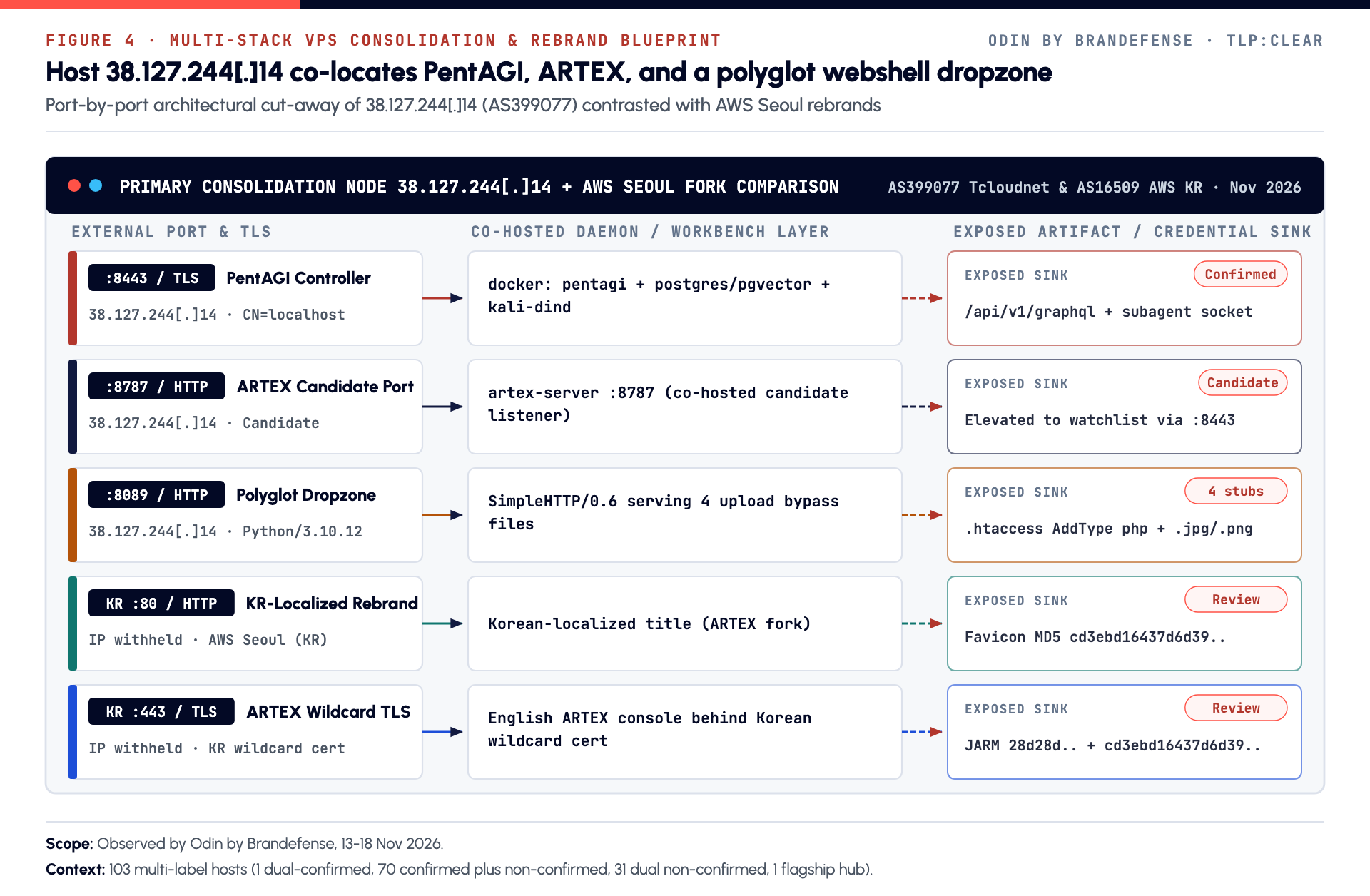
| Port | Service | Fingerprint | Status |
|---|---|---|---|
8443/tcp | PentAGI orchestrator | <title>PentAGI</title>, CN=localhost, JARM 28d28d28d00028d00042d42d000000831b6af40378e2dd35eeac4e9311926e, /api/v1/graphql | Confirmed |
8787/tcp | ARTEX listener | ARTEX default port | Candidate, watched because it shares a host with confirmed PentAGI |
8089/tcp | Open directory dropzone | SimpleHTTP/0.6 Python/3.10.12 | Open directory confirmed |
The PentAGI certificate subject CN=localhost is common across the fleet. It appears on 61 of the 340 PentAGI endpoints (8 confirmed, 53 candidates). Upstream default deployments present CN=pentagi instead.
What the dropzone held
Port 8089 served an unauthenticated directory. It held four small test stubs: .htaccess, test_polyglot.png, avatar_loader.jpg and health.txt. It also held larger staged files from the subagents.
| File | Size (bytes) | SHA-256 | Purpose |
|---|---|---|---|
/.htaccess | 161 | Withheld | Adds AddType application/x-httpd-php .jpg .png .gif, so a permissive Apache server would run uploaded images as PHP (T1505.003) |
/logo_avatar_probe.png | 2,480 | Withheld | Valid PNG header followed by a pentagi_upload_verify marker, used to check whether an upload landed |
| Recon output archive (name withheld) | 184,320 | Withheld | Compressed nuclei JSONL logs and httpx live-host tables from Docker workers |
/graphql_introspection_dump.json | 42,910 | Withheld | GraphQL __schema introspection output from an API recon worker |
/mcp_tools_manifest.json | 8,740 | Withheld | MCP tool descriptor exposing nuclei_scan, sqlmap_audit and ffuf_dir_fuzz to the LLM planner |
These are staged files. Their presence shows intent and tooling. It does not show that any upload worked against a real target.
6. Who the Swarm Targeted
In short
The exposed ARTEX archive covers 76 organizations in 18 verticals. Payment, Web3 and online gambling firms take most of the effort.
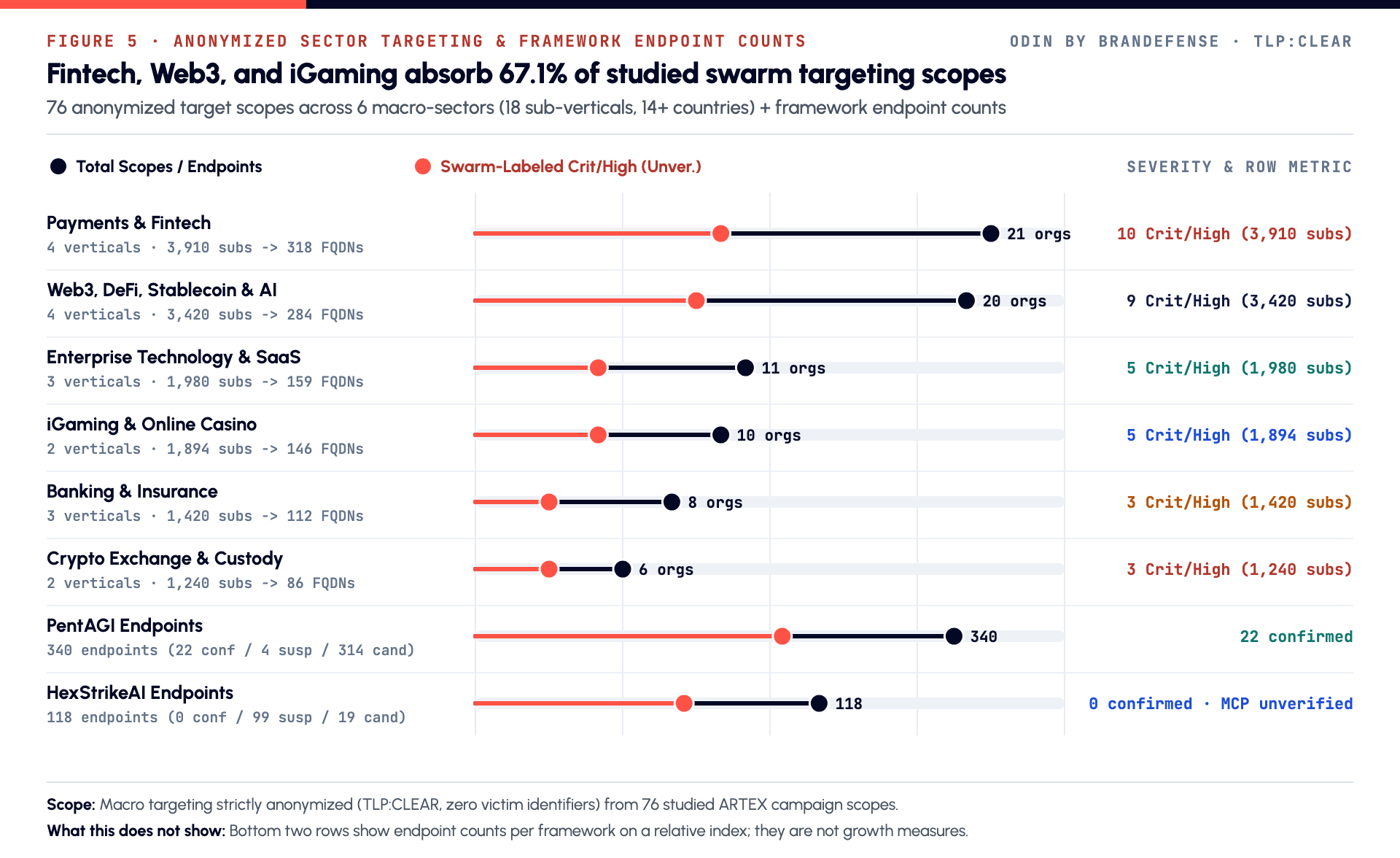
All 76 targets are anonymized. No names, domains or addresses of target organizations appear in this report.
Payments and Fintech (21 organizations, 27.63%) and Web3, DeFi and Stablecoin (20 organizations, 26.32%) together make up 53.95% of the targets. They also account for 52.87% of the enumerated subdomains (7,330 of 13,864).
| Sector | Verticals | Orgs | Share | Subdomains | Live FQDNs | Labeled critical or high | Workers | Claimed finding types |
|---|---|---|---|---|---|---|---|---|
| Payments and Fintech | 4 | 21 | 27.63% | 3,910 | 318 | 10 | 8 to 16 | API auth bypass, exposed .env and payment keys, SQL injection |
| Web3, DeFi and Stablecoin | 4 | 20 | 26.32% | 3,420 | 284 | 9 | 8 to 16 | RPC and GraphQL introspection, cloud secret leaks, exposed admin consoles |
| Enterprise Tech and Cloud SaaS | 3 | 11 | 14.47% | 1,980 | 159 | 5 | 4 to 12 | CI/CD webhook and .git exposure, SSRF, multi-tenant API IDOR |
| iGaming and Online Casino | 2 | 10 | 13.16% | 1,894 | 146 | 5 | 8 to 16 | High-volume sqlmap and nuclei sweeps (1,231 runs on one task) |
| Banking and Insurance | 3 | 8 | 10.53% | 1,420 | 112 | 3 | 4 to 12 | Dangling subdomain candidates, legacy TLS and VPN portal enumeration |
| Crypto Exchanges | 2 | 6 | 7.89% | 1,240 | 86 | 3 | 16 (max 2,178 runs) | Sustained 16-worker sweeps (2,178 runs on one task), key-leak claims |
| Total | 18 | 76 | 100.0% | 13,864 | 1,105 | 35 (46.05%) | 1 to 16 | 17 critical, 18 high |
The swarm's 17 critical labels split into 3 claimed remote code execution or full-access scopes and 14 claimed credential or data exposure scopes. Like the high labels, these are the LLM writer's own classification of scanner output. They are not confirmed breaches.
The finding types still help defenders. They show what a swarm looks for first: .env files, .git folders, GraphQL introspection, open admin consoles and payment API keys.
7. What Defenders Should Do
Within 24 hours
- Block inbound and outbound traffic to the 1,820 confirmed endpoints on stable hosting, starting with the 14 block entries in the Indicators chapter.
- Put the 30 dynamic-ISP endpoints on a watchlist that expires after 24 to 72 hours.
- Send the Korean fork fingerprint and other unattributed forks to analyst review, not to the block list.
Within 72 hours
- Set
AllowOverride Noneon every user-writable upload directory, and turn off script execution there (php_flag engine offorRemoveHandler .php .phtml). - Turn off GraphQL
__schemaintrospection in production. - Rate-limit
/api/and/graphqlroutes.
Within 7 to 30 days
- Add the ARTEX favicon MD5
cd3ebd16437d6d3963592f7365dd3980and the JARM values28d28d...926eand40d40d...9319to external attack surface hunting. - Deploy the scan-burst query at the web edge: alert on 25 or more distinct URIs from one source in 5 minutes.
- Watch container hosts for runtimes that spawn offensive scanners with batch flags.
- Rotate any secret ever exposed in
.envfiles or.gitfolders, since these are the first things a swarm collects.
8. Detection Rules
The full rules are in the Detection rules tab. Each file targets a signal that survives a rebrand.
| Rule file | What it catches |
|---|---|
odin_autonomous_ai_redteam_fleets.rules | Suricata 7: eight signatures for ARTEX, PentAGI, HexStrikeAI and DeepAudit consoles, task APIs and the .htaccess polyglot |
sentinel_autonomous_swarm_scanner_correlation.kql | Microsoft Sentinel and Defender XDR: contact with confirmed controllers, multi-tool container bursts, and web scan bursts |
sigma_docker_subagent_offensive_tool_spawning.yml | Sigma (3 rules): container runtimes spawning scanners, .htaccess or polyglot file creation, and swarm output files |
odin_autonomous_offense_whitelabel_artifacts.yar | YARA (4 rules): ARTEX and fork console bundles, PentAGI configs, HexStrikeAI MCP servers, and polyglot dropzone files |
How the Suricata signatures work
| SID | Looks for | Why |
|---|---|---|
| 9511001 | Korean title bytes 공격·방어 보안 운영 plus artex-swarm-root, /api/v1/tasks or the favicon hash text in an HTTP response | Catches the Korean fork even without the word ARTEX |
| 9511002 | ARTEX with the English or Chinese subtitle in an HTTP response | Catches upstream consoles |
| 9511003 | Outbound POST /api/v1/tasks with subagent_concurrency and target_scope in the body | Catches an internal host dispatching swarm tasks (T1595.002) |
| 9511004 | Outbound POST /api/v1/graphql with subagents and createFlow, subagentLogs, pentagi_worker or spawnSubagent | Catches PentAGI flow creation (T1609) |
| 9511005 | TLS certificate subject CN=pentagi or CN=localhost from ports 8443, 8666 or 8444 | Low-confidence hunt only; pair with SID 9511004 or a JARM match before acting |
| 9511006 | Outbound POST /mcp with jsonrpc, tools/call and a tool name such as nmap, nuclei or sqlmap | Catches an MCP bridge driving offensive tools (T1059.006) |
| 9511007 | DeepAudit with repository_audit, vulnerability_agent or llm_code_scanner from ports 8000 or 3000 | Catches DeepAudit consoles |
| 9511008 | AddType application/x-httpd-php .jpg .png in an HTTP body | Catches the polyglot .htaccess in transit (T1505.003) |
Suricata cannot hash a favicon in transit. SID 9511001 therefore matches the page text, and the favicon MD5 check runs separately in any EASM tool. A simple fetch of /favicon.ico piped to md5sum is enough.
How the other rules work
The KQL query has three branches and a 7-day lookback. It carries the 13 confirmed controller addresses from the Indicators chapter. The first branch flags devices that contact those addresses, or use ports 8787, 8443, 8666, 8000 or 8899 from python3, curl, docker and similar processes. The second flags a container runtime or orchestrator that starts two or more scanners within 10 minutes.
The third branch reads IIS web logs. It counts distinct URIs per source IP in 5-minute bins before filtering. It alerts at 25 or more distinct URIs, or at 10 or more when the user agent names a tool such as nuclei, sqlmap or ffuf. Counting first means rotated user agents do not hide the burst.
The first Sigma rule needs three things together: a parent such as containerd-shim-runc-v2, dockerd or pentagi; a child such as nuclei, sqlmap or naabu; and a batch flag such as -jsonl, --batch or -rate-limit. Authorized breach-simulation runners are the main false positive.
The second Sigma rule flags a Python, PHP, Apache or PentAGI process that creates /.htaccess or /logo_avatar_probe.png. One such event alone is weak. Correlate events in the same directory within 5 minutes, or confirm the file content with YARA. The third Sigma rule flags files ending in _credential_inventory_01.json, _findings_summary.json, /graphql_introspection_dump.json or /mcp_tools_manifest.json.
Each YARA rule needs at least two independent strings, so a single word does not fire it.
| YARA rule | Fires when |
|---|---|
ODIN_ARTEX_Whitelabel_Console | An ARTEX title (English, Chinese or Korean) appears with /api/v1/tasks, artex-swarm-root or the favicon hash text, or the hash appears with either route marker |
ODIN_PentAGI_Subagent_Orchestrator_Artifact | PentAGI appears with two of /api/v1/graphql, pgvector, /var/run/docker.sock, vxcontrol/kali and createFlow |
ODIN_HexStrikeAI_MCP_Offensive_Tool_Server | hexstrike or the Chinese portal title appears with an MCP marker and at least three tool names |
ODIN_Polyglot_Htaccess_PHP_Webshell_Dropzone | AddType with application/x-httpd-php and an image extension, or an image header followed by PHP code |
How to sort a host
The triage logic turns the signals above into an action. It never blocks on uncorroborated evidence. Its routing follows the logic of this report.
| What the host shows | Action |
|---|---|
| Several consoles plus a dropzone on one server | Block |
| A confirmed framework controller on stable hosting | Block |
| A confirmed framework on a dynamic telecom ISP | Watchlist for 24 hours |
| A rebranded fork with no documented hostile activity | Analyst review |
| A localized portal with only a title match | Analyst review |
| A generic Werkzeug header with no favicon or MCP match | Do not block |
| An internal, authorized breach-simulation runner | Allowlist |
9. Indicators
The Indicators tab holds the 14 confirmed controller endpoints. The other 14 records in the selected set appear in this report only, or are withheld.
| Type | Count |
|---|---|
| Confirmed controller endpoints to block (IP and port) | 14 |
| Watchlist or review endpoints | 6 (3 on confirmed hosts listed below, 3 withheld) |
| File hashes (withheld: values not verified against the acquisition record) | 8 |
Supporting fingerprints: one favicon MD5 (cd3ebd16437d6d3963592f7365dd3980), the JARM values named in this report, and the certificate subjects CN=localhost, CN=pentagi, CN=supershell, CN=artex.dwwork[.]live and CN=vps.notelab[.]cc.
Confirmed endpoints to block
| Endpoint | Framework | Country | Key fingerprint | Seen |
|---|---|---|---|---|
| 112.213.123[.]38:80 | ARTEX | HK | artex.112.213.123.38.sslip[.]io, ARTEX favicon | 13 Nov 2026 |
| 45.156.87[.]185:443 | ARTEX | US | CN=artex.dwwork[.]live, JARM 2ad2ad...f06b | 16 Nov 2026 |
| 8.135.3[.]123:80 | ARTEX | CN | Title ARTEX - 攻防安全运营, ARTEX favicon | 17 Nov 2026 |
| 8.135.30[.]162:443 | ARTEX | CN | Title ARTEX - 攻防安全运营, JARM 15d3fd...e331 | 17 Nov 2026 |
| 144.172.118[.]88:443 | CyberStrikeAI | US | Also 8899, open directory | 13 Nov 2026 |
| 38.76.218[.]100:8000 | DeepAudit | HK | Shares host with HexStrikeAI on 5000 | 13 Nov 2026 |
| 205.186.67[.]47:8089 | CyberStrikeAI | MY | CN=supershell, JARM 40d40d...9319 | 13 Nov 2026 |
| 45.144.137[.]148:80 | ARTEX | NL | Open HTTP workbench on 8080 | 17 Nov 2026 |
| 144.172.68[.]197:80 | ARTEX | US | Two confirmed frameworks on one host | 17 Nov 2026 |
| 144.172.68[.]197:8443 | CyberStrikeAI | US | CN=144.172.68[.]197 | 17 Nov 2026 |
| 38.127.244[.]14:8443 | PentAGI | US | <title>PentAGI</title>, CN=localhost, dropzone on 8089 | 17 Nov 2026 |
| 47.120.40[.]104:8000 | DeepAudit | CN | LLM source-code audit workbench | 13 Nov 2026 |
| 82.208.23[.]183:8443 | PentAGI | GB | CN=vps.notelab[.]cc, JARM 40d40d...efa8 | 14 Nov 2026 |
| 134.122.200[.]96:8443 | PentAGI | SG | CN=localhost, JARM 3fd3fd...99fb, GraphQL API | 14 Nov 2026 |
The three published watchlist entries sit on hosts listed above: 38.76.218[.]100:5000 (suspected HexStrikeAI), 38.127.244[.]14:8787 (candidate ARTEX) and 45.144.137[.]148:8080 (open workbench). All eight file hashes from the dropzone and the exposed archive are withheld, because their values could not be checked against the acquisition record.
| File | Size (bytes) | SHA-256 |
|---|---|---|
Credential inventory, part 1 (..._credential_inventory_01.json) | 19,340 | Withheld |
Credential inventory, part 2 (..._credential_inventory_02.json) | 31,280 | Withheld |
Findings summary (..._findings_summary.json) | 54,610 | Withheld |
Withheld: the two Korean fork addresses and their domain, the archive server and its paths, the 30 dynamic-ISP addresses, the benign collision host, and all suspected or candidate addresses on hosts not listed above.
MITRE ATT&CK mapping
| Tactic | Technique | How the fleet uses it | Detection |
|---|---|---|---|
| Resource Development | T1583.006 Acquire Infrastructure: Web Services | 4,360 endpoints on rented hosting; regional ARTEX forks | SID 9511001, 9511002; YARA ARTEX console rule |
| Resource Development | T1587.003 Develop Capabilities: Digital Certificates | Default or self-chosen certificates: CN=localhost, CN=vps.notelab[.]cc, CN=artex.dwwork[.]live, CN=CyberStrikeAI | SID 9511005 (hunt), JARM 28d28d...926e and 3fd3fd...99fb |
| Reconnaissance | T1595.002 Active Scanning: Vulnerability Scanning | 1 to 16 worker pools; 13,864 subdomains and 1,105 live FQDNs | SID 9511003, 9511007; KQL burst branch |
| Execution | T1609 Container Administration Command | PentAGI starts Docker-in-Docker Kali workers through GraphQL createFlow | SID 9511004; YARA PentAGI rule; Sigma rule 1 |
| Execution | T1059.006 Command and Scripting Interpreter: Python | MCP tools/call bridges to nmap, nuclei, sqlmap, gobuster | SID 9511006; YARA HexStrikeAI rule |
| Persistence | T1505.003 Server Software Component: Web Shell | .htaccess MIME override and PNG/PHP polyglot probes staged on 38.127.244[.]14:8089 | SID 9511008; YARA polyglot rule; Sigma rule 2 |
| Collection | T1560.001 Archive Collected Data: Archive via Utility | Recon logs and LLM-written credential inventories packed into JSON and archive files | Sigma rule 3; file names above |
10. Scope and Limits
- Window. The findings cover a two-week observation window ending 18 November 2026. Some records carry earlier first-seen dates from public sources; we do not use those as a tracking start.
- Confirmed is not the same as hostile. A confirmed endpoint runs the framework. For 3 confirmed endpoints, hostile use is not shown, and some operators may be authorized testers.
- Candidates are leads. The 2,397 candidates are hunting leads. Do not block them without corroboration.
- No growth claims. The data supports counts in the window, not trends over time for any framework.
- The archive speaks for the attacker. Worker counts, severity labels and claimed findings come from the swarm's own logs and LLM reports. We did not confirm any of them on a target system.
- One archive, one campaign. The 76 targets come from one exposed ARTEX archive. Nothing links it to the Korean fork, and it may not represent other operators.
- Rule testing. Every published rule file loads without errors in its engine (Suricata 7.0.12, YARA-X, pySigma and Microsoft's Kusto.Language analyzer, checked on 20 November 2026). The rules were not replayed against live traffic, so test and tune them in your own environment before production use.
11. Sources
- VXControl. PentAGI repository. https://github.com/vxcontrol/pentagi (verified 18 November 2026)
- Ed1s0nZ. CyberStrikeAI repository. https://github.com/Ed1s0nZ/CyberStrikeAI (verified 18 November 2026)
- 0x4m4. HexStrikeAI MCP Agents repository. https://github.com/0x4m4/hexstrike-ai (verified 18 November 2026)
- Model Context Protocol. Specification. https://modelcontextprotocol.io/specification/ (verified 18 November 2026)
- MITRE ATT&CK Enterprise Matrix. https://attack.mitre.org/ (verified 18 November 2026)
- Apache HTTP Server 2.4 documentation,
.htaccessfiles. https://httpd.apache.org/docs/2.4/howto/htaccess.html (verified 18 November 2026) - Salesforce. JARM TLS server fingerprinting. https://github.com/salesforce/jarm (verified 18 November 2026)
- AhnLab ASEC. Analysis of the infrastructure of ARTEX, a Chinese AI penetration testing tool. https://asec.ahnlab.com/en/95875 (verified 18 November 2026)
- Team Cymru. Tracking CyberStrikeAI usage. https://www.team-cymru.com/post/tracking-cyberstrikeai-usage (verified 18 November 2026)
What is…?
Short explanations of the tools and families named in this study.
What is ARTEX?
ARTEX is an autonomous red-team console that chains AI agents and security tools. Operators fork and rebrand it; its default listener port is 8787.
More about ARTEXAI offensive toolWhat is PentAGI?
PentAGI is an open-source autonomous penetration testing system that coordinates AI agents and security tools in containers.
More about PentAGIAI offensive toolWhat is CyberStrikeAI?
CyberStrikeAI is a public AI-driven offensive security platform. It spreads its operator interface, API and agent listener across several ports on one host and exposes tools through MCP.
More about CyberStrikeAIAI offensive toolWhat is HexStrike AI?
HexStrikeAI is a public project that exposes many security tools to AI agents through the Model Context Protocol (MCP).
More about HexStrike AITechniqueWhat is JARM?
JARM is an open TLS server fingerprinting method from Salesforce. It hashes how a server answers a set of crafted TLS handshakes.
More about JARMAI security toolWhat is DeepAudit?
DeepAudit is an open-source AI code auditing tool. Application security teams use it to find flaws in source code.
More about DeepAuditFrequently asked questions
What are these frameworks?
All five frameworks put a large language model in charge of classic security tools such as subfinder, nuclei and sqlmap. The operator names a target. The model breaks it into jobs and sends them to worker pools: discovery, vulnerability scanning, exploit checks and a written report.
How do operators disguise them?
Operators fork the ARTEX console and rebrand it. They change the page title, swap the logo and add their own TLS certificate. They rarely change the small icon file the browser shows in the tab.
Why do they share servers?
Operators often stack several tools on one rented server. Of the 2,917 hosts, 103 carry labels for two or more frameworks. Only one has two fully confirmed frameworks, so most of these are leads, not proof.
Who were the targets?
An exposed ARTEX archive on a separate server lists 76 target organizations across 18 industry verticals. We anonymized all of them. The swarm enumerated 13,864 subdomains and found 1,105 of them live.