


Key takeaways
- Odin found 4,360 endpoints running five AI offense frameworks; 1,846 are confirmed.
- Rebranded ARTEX consoles change the title but keep the same favicon file.
- 103 servers host two or more frameworks, sometimes next to an upload-bypass dropzone.
- One exposed swarm archive targeted 76 organizations, mostly payments and Web3 firms.
- Block confirmed controllers, hunt stable fingerprints, and alert on 25-URI scan bursts.
In a two-week observation window ending 18 November 2026, Odin by Brandefense found 4,360 internet-facing endpoints running five autonomous AI offense frameworks. These tools let a language model plan an attack and hand the work to many parallel scanners. Of the 4,360 endpoints, 1,846 are confirmed. Some are rebranded for regional markets, many share servers, and one exposed archive shows who a swarm went after. For defenders, this means faster, wider scanning of their perimeter, run by tools that are easy to rent and easy to disguise.
What are these frameworks?
All five frameworks put a large language model in charge of classic security tools such as subfinder, nuclei and sqlmap. The operator names a target. The model breaks it into jobs and sends them to worker pools: discovery, vulnerability scanning, exploit checks and a written report.
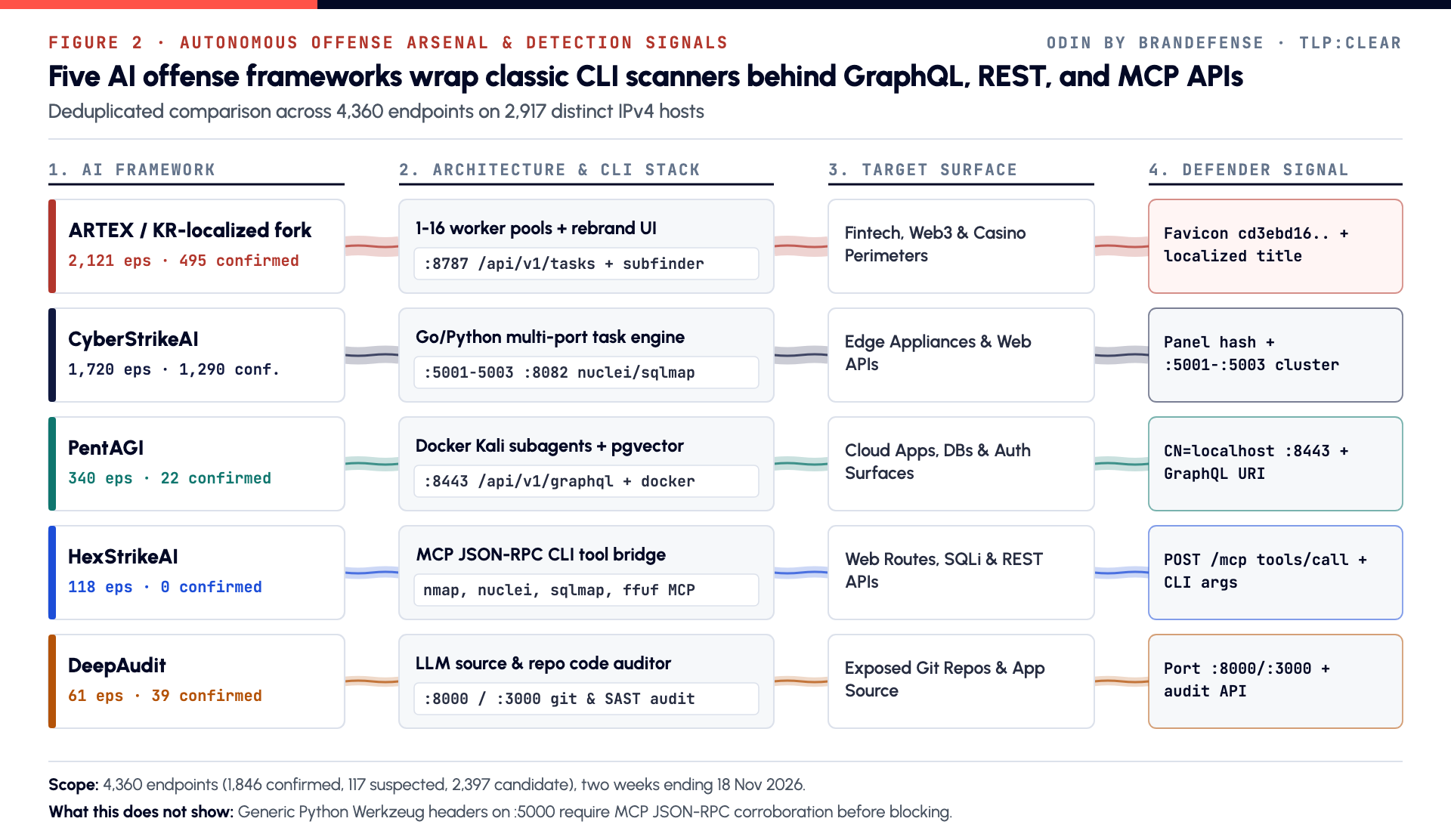
| Framework | Endpoints | Confirmed | How it works |
|---|---|---|---|
| ARTEX | 2,121 | 495 | Python swarm with 1 to 16 parallel workers |
| CyberStrikeAI | 1,720 | 1,290 | Role-based agents wrapping 100+ tools |
| PentAGI | 340 | 22 | GraphQL controller that starts Kali containers |
| HexStrikeAI | 118 | 0 | Exposes scanners to a model through the Model Context Protocol (MCP) |
| DeepAudit | 61 | 39 | LLM workbench for auditing source code |
Confirmed counts for PentAGI and HexStrikeAI are low. Many installs show only a generic login page or a common certificate such as CN=localhost, so most of them stay suspected or candidate.
The fleet runs on 2,917 hosts in 50 countries. The United States hosts 2,586 endpoints, Hong Kong 697 and China 444. One VPS provider, PEG TECH INC, hosts 1,891.
Not every endpoint deserves a block. Thirty sit on dynamic broadband networks (Korea Telecom, Chunghwa Telecom and Chinanet), where addresses change hands often. Another 2,397 are uncorroborated candidates. The 1,820 confirmed endpoints on stable hosting are the ones to block now.
How do operators disguise them?
Operators fork the ARTEX console and rebrand it. They change the page title, swap the logo and add their own TLS certificate. They rarely change the small icon file the browser shows in the tab.
Two hosts on AWS Seoul show this pattern. One has a Korean title that translates the Chinese ARTEX subtitle word for word. The other sits behind a Korean company's wildcard certificate. Both serve the exact same 15,406-byte icon file as upstream ARTEX servers in China.
We do not know who runs the Korean pair. A Korean security vendor offering ARTEX to clients is as plausible as a threat actor. We withhold their names and addresses, and we advise sending such forks to analyst review rather than blocking them outright.
The lesson for defenders is simple. Titles and logos change. The icon file hash, the certificate subject, the TLS fingerprint and the API routes stay the same. Hunt on those.
Why do they share servers?
Operators often stack several tools on one rented server. Of the 2,917 hosts, 103 carry labels for two or more frameworks. Only one has two fully confirmed frameworks, so most of these are leads, not proof.
The clearest case is 38.127.244[.]14 in the United States. It runs a confirmed PentAGI controller, an ARTEX port and an open directory. That directory held an Apache .htaccess file that would make a server run uploaded images as PHP code, plus image files with hidden test markers. It also held a GraphQL schema dump and a list of MCP tools for the model to call. These files were staged, and nothing shows they worked against a real target.
Who were the targets?
An exposed ARTEX archive on a separate server lists 76 target organizations across 18 industry verticals. We anonymized all of them. The swarm enumerated 13,864 subdomains and found 1,105 of them live.
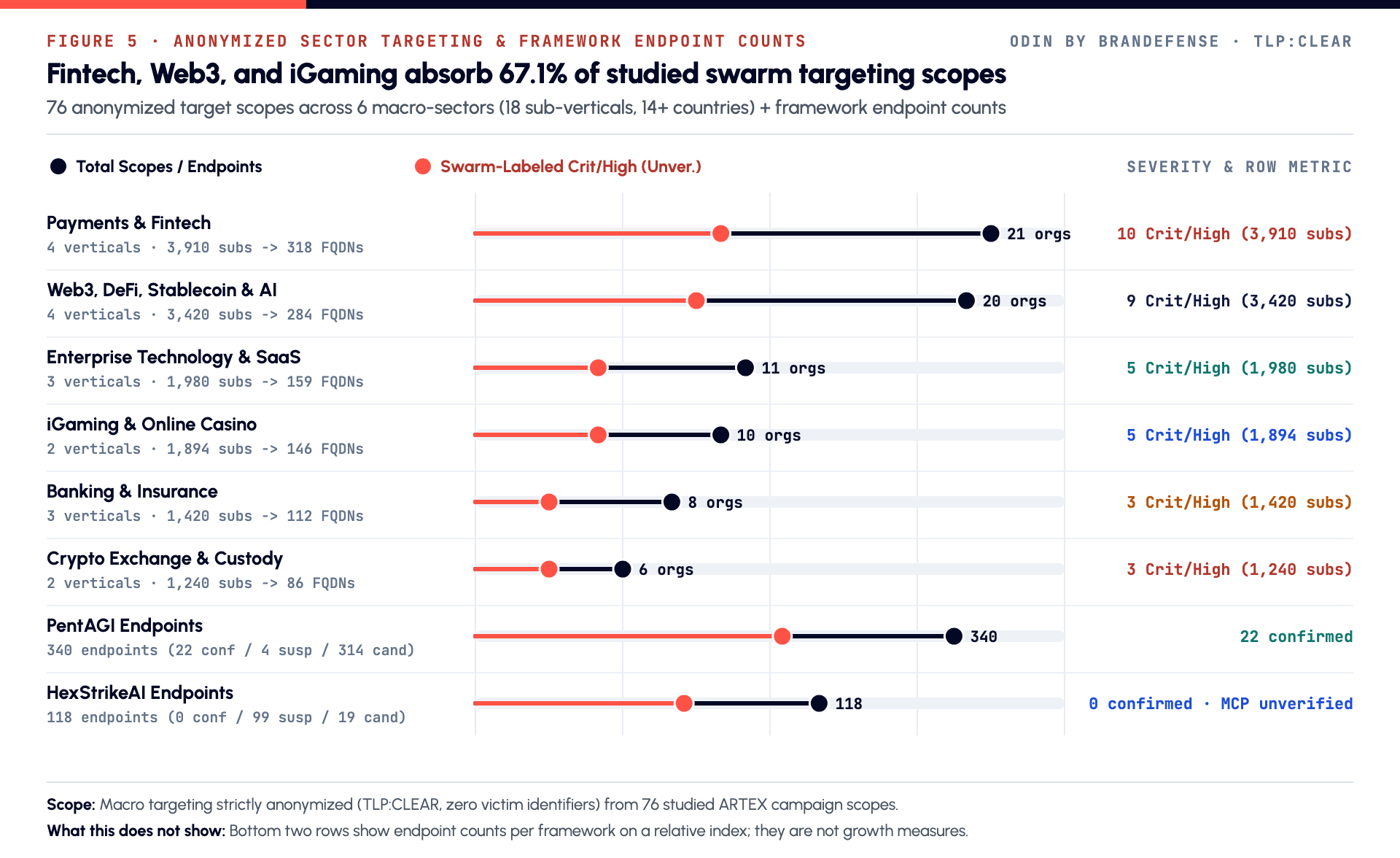
Payments and Fintech (21 organizations) and Web3, DeFi and Stablecoin (20) make up 53.9% of the targets. Online gambling, enterprise SaaS, banking and crypto exchanges follow. The swarm recorded up to 2,178 worker runs against one crypto exchange.
The swarm's own reports label 35 of the 76 targets (46.1%) as critical or high. A language model wrote those labels from scanner output, and we did not confirm them. The finding types are still useful: exposed .env files, .git folders, GraphQL introspection, open admin consoles and payment API keys. These are what a swarm checks first.
What to do now
- Block the 1,820 confirmed endpoints on stable hosting. Put dynamic-ISP addresses on a 24 to 72 hour watchlist, and send unattributed forks to analyst review.
- Hunt stable fingerprints, starting with the ARTEX favicon MD5
cd3ebd16437d6d3963592f7365dd3980, TLS certificate subjects and JARM values in the full report. The full report's Indicators tab lists the 14 confirmed controller endpoints. - Alert on scan bursts: 25 or more distinct URIs from one source in 5 minutes. The full report's Detection rules tab has Suricata, Sentinel KQL, Sigma and YARA rules.
- Lock down upload folders with
AllowOverride Noneand no script execution, and turn off GraphQL introspection in production. - Clean up secrets in
.envfiles and.gitfolders before a swarm finds them.
The full report covers the infrastructure, fingerprints, indicators and rule logic in detail.
What is…?
Short explanations of the tools and families named in this study.
What is ARTEX?
ARTEX is an autonomous red-team console that chains AI agents and security tools. Operators fork and rebrand it; its default listener port is 8787.
More about ARTEXAI offensive toolWhat is PentAGI?
PentAGI is an open-source autonomous penetration testing system that coordinates AI agents and security tools in containers.
More about PentAGIAI offensive toolWhat is CyberStrikeAI?
CyberStrikeAI is a public AI-driven offensive security platform. It spreads its operator interface, API and agent listener across several ports on one host and exposes tools through MCP.
More about CyberStrikeAIAI offensive toolWhat is HexStrike AI?
HexStrikeAI is a public project that exposes many security tools to AI agents through the Model Context Protocol (MCP).
More about HexStrike AITechniqueWhat is JARM?
JARM is an open TLS server fingerprinting method from Salesforce. It hashes how a server answers a set of crafted TLS handshakes.
More about JARMAI security toolWhat is DeepAudit?
DeepAudit is an open-source AI code auditing tool. Application security teams use it to find flaws in source code.
More about DeepAuditFrequently asked questions
What are these frameworks?
All five frameworks put a large language model in charge of classic security tools such as subfinder, nuclei and sqlmap. The operator names a target. The model breaks it into jobs and sends them to worker pools: discovery, vulnerability scanning, exploit checks and a written report.
How do operators disguise them?
Operators fork the ARTEX console and rebrand it. They change the page title, swap the logo and add their own TLS certificate. They rarely change the small icon file the browser shows in the tab.
Why do they share servers?
Operators often stack several tools on one rented server. Of the 2,917 hosts, 103 carry labels for two or more frameworks. Only one has two fully confirmed frameworks, so most of these are leads, not proof.
Who were the targets?
An exposed ARTEX archive on a separate server lists 76 target organizations across 18 industry verticals. We anonymized all of them. The swarm enumerated 13,864 subdomains and found 1,105 of them live.