


1. Executive Summary
In short
In a two-week observation window ending 18 November 2026, Odin by Brandefense studied five dual-use tools that attackers can stage before a payload lands. Of 5,892 endpoints, an estimated 526 deserve attention. Each tool also serves marketers, IT providers or developers, so most hosts stay on watchlists. Three hosts are confirmed adversary infrastructure. Block those three, allowlist your approved remote-management domains, and alert when a browser visit is followed by an installer launch.
The five tools are Keitaro, a commercial traffic direction system (TDS), and TacticalRMM, an open-source remote monitoring and management (RMM) suite. The other three are Hak5 Cloud C2, a controller for Hak5 implant devices, and two tunneling tools, Fast Reverse Proxy (FRP) and ReverseSSH. None of them is malware. Each has legitimate users, and each can also give an attacker a step in an access chain.
An estimated 57 Keitaro gates look like cloaking gates, not marketing.
Only an estimated 57 Keitaro servers fit cloaking-gate patterns; most Keitaro installs serve ordinary marketing. They fall into three clusters: templated CN=SolidityGameServer servers, fresh default-certificate VPS gates, and fake CDN or tracker domains. Their redirects are visible, but not where they lead, so all stay on watchlists.
TacticalRMM on fresh disposable domains offers signed, persistent remote access.
An estimated 338 TacticalRMM servers sit on new .online, .xyz, .top or duckdns[.]org domains. A signed MeshCentral agent gives an operator a shell over HTTPS port 443. Hostile use is not shown, so these stay on watchlists.
Relays hide backends; three hosts are confirmed adversary infrastructure.
We found 114 FRP relays, and 86 of them (75.4%) expose a dashboard on port 7500. Four open directories held relay configs, a key dump and an exploit playbook. Only three hosts pass the bar for blocking: a Hak5 Cloud C2 server next to GoPhish, and two TLS-wrapped ReverseSSH listeners.
Three Decisions for Leaders
- Allowlist remote-management tools by domain. Block unapproved TacticalRMM, MeshCentral and out-of-band SSH management traffic by default. Permit only documented corporate or managed service provider (MSP) subdomains.
- Link browser clicks to installer launches. Join workstation connections to unapproved redirector or disposable domains with Windows Installer, PowerShell or RMM agent launches within five minutes.
- Never block a dual-use banner on its own. Require a second signal, such as a co-hosted phishing kit or an IP-literal reverse-shell certificate. Hold everything else on watchlists, and ignore matches on mail ports.
The Study in Numbers
| Number | What it is |
|---|---|
| 5,892 | Deduplicated endpoints in the study set (an estimate from aggregate summaries) |
| 526 | Estimated priority candidates and relays across the five tools |
| 57 | Keitaro cloaking-gate candidates |
| 338 | TacticalRMM fleet candidates on disposable or self-signed setups |
| 114 | FRP relays; 86 (75.4%) expose the port 7500 dashboard |
| 3 | Hosts confirmed as adversary infrastructure and published for blocking |
How to use this report.
Security leaders can read Chapter 1, Chapter 6 and Chapter 7. SOC and detection engineers should start with Chapters 7 to 9. CTI analysts and infrastructure teams will find the tool detail in Chapters 2 to 6.
2. How the Pieces Can Fit
In short
We measured the five tool populations separately. The four-layer access chain below is an analytical model of how they can combine, not one observed campaign.
An analytical access model
Many initial-access operations split their work across separate servers. One server attracts traffic, another filters it, a third keeps access to the victim, and a fourth relays traffic out of sight. The five tools in this report map onto those roles.
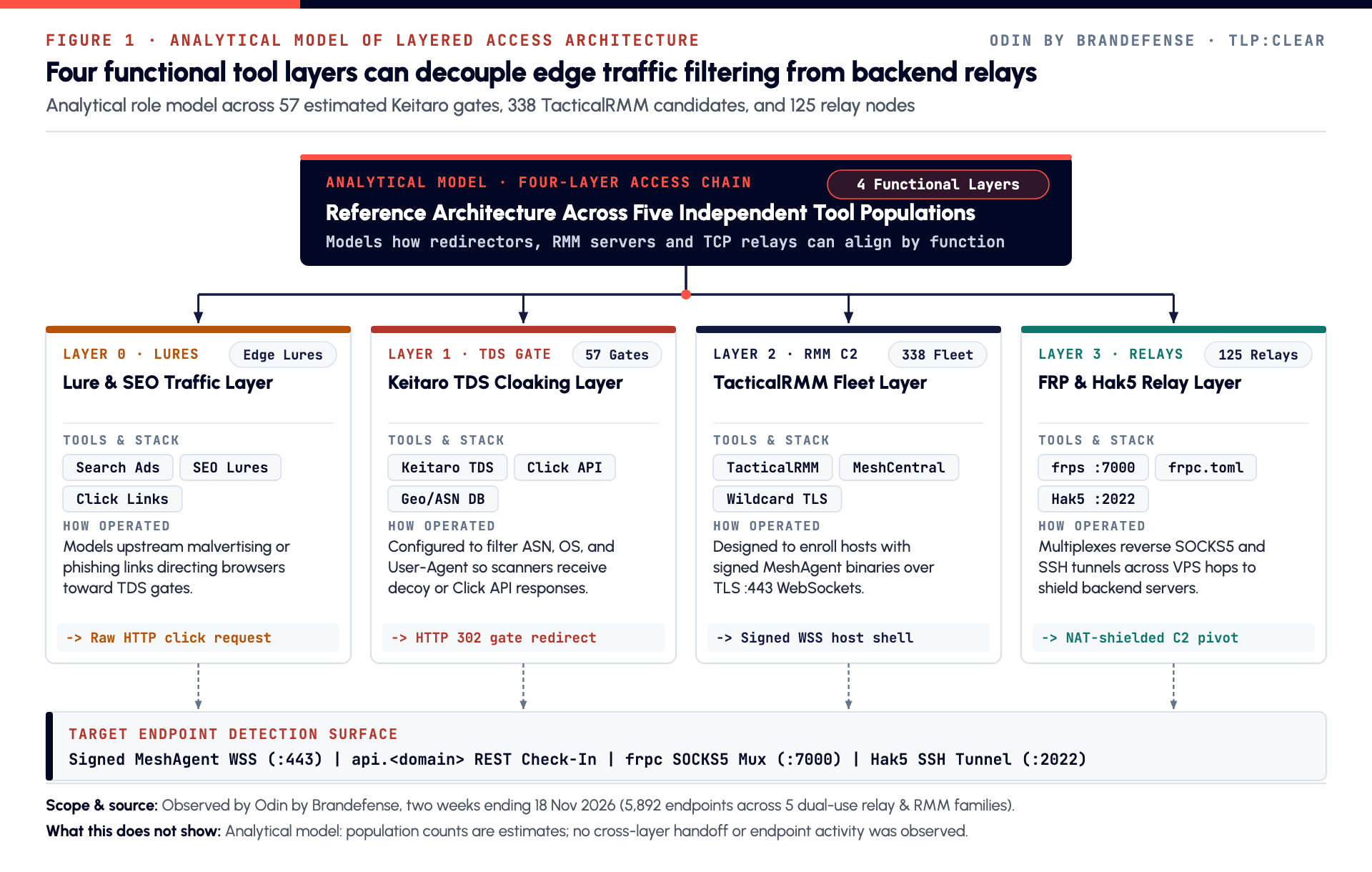
| Layer | Role | Tools | What it gives an operator |
|---|---|---|---|
| 0 Lures | Bring browsers in | Search ads, SEO lures, phishing links | Raw HTTP clicks |
| 1 Traffic gate | Filter visitors and redirect the chosen ones | Keitaro TDS, Click API | HTTP 302 redirects that skip sandboxes |
| 2 Remote management | Keep access to an enrolled host | TacticalRMM, MeshCentral, wildcard TLS | A signed agent with a WebSocket shell on 443 |
| 3 Relays | Hide the backend behind NAT-crossing tunnels | frps on 7000, frpc.toml, Hak5 on 2022, ReverseSSH | SOCKS5 and SSH tunnels across cheap VPS hops |
This is a model. Outside a few shared servers, such as Hak5 Cloud C2 and GoPhish on 146.190.211[.]163, nothing links a specific Keitaro gate to a specific TacticalRMM or FRP server.
Populations and candidates
These tools are popular with legitimate users, so most installs are benign. The table gives each population and its estimated candidates.
| Tool | Layer | Endpoints (hosts) | Estimated candidates | Main ports and hosting |
|---|---|---|---|---|
| Keitaro TDS | Traffic gate | 3,092 (2,368) | 57 | 443, 80; DigitalOcean and Vultr (US, NL, DE) |
| TacticalRMM | Remote management | 2,634 (2,157) | 338 | 443, 1024, 4430; Hetzner and OVH (US, DE, BR) |
FRP (frps) | Relay | 114 (114) | 114 | 7500, 7000; Alibaba and Tencent (CN 70.2%) |
| Hak5 Cloud C2 | Relay and implant control | 22 (16) | 11 | 8080, 9090 plus 2022; AWS and DigitalOcean (US, NL) |
| ReverseSSH | Relay | 30 (23) | 6 | 3232, 8082; 8 POP3S 995 mail collisions removed |
The 5,892 endpoint and 526 candidate totals are estimates from aggregate summaries. Endpoint-level records for these populations are withheld because most hosts are dual-use. Chapter 9 lists a selected set of 28; only its 3 confirmed endpoints are published, and 25 are withheld.
"Software confirmed" names the tool. It does not mean the operator is hostile.
3. Traffic Gates: Keitaro TDS
In short
Keitaro decides in milliseconds which visitor sees which page. An estimated 57 of 3,092 Keitaro endpoints look like cloaking gates, but none shows where its redirect leads, so all stay on watchlists.
How a cloaking gate works
Keitaro was built for affiliate marketing. It reads each visitor's network (ASN), country, operating system and browser, then routes the visitor to one of several weighted campaign streams. An attacker can use the same filters to send sandboxes and security scanners to a harmless page, while real targets get a redirect to an installer.
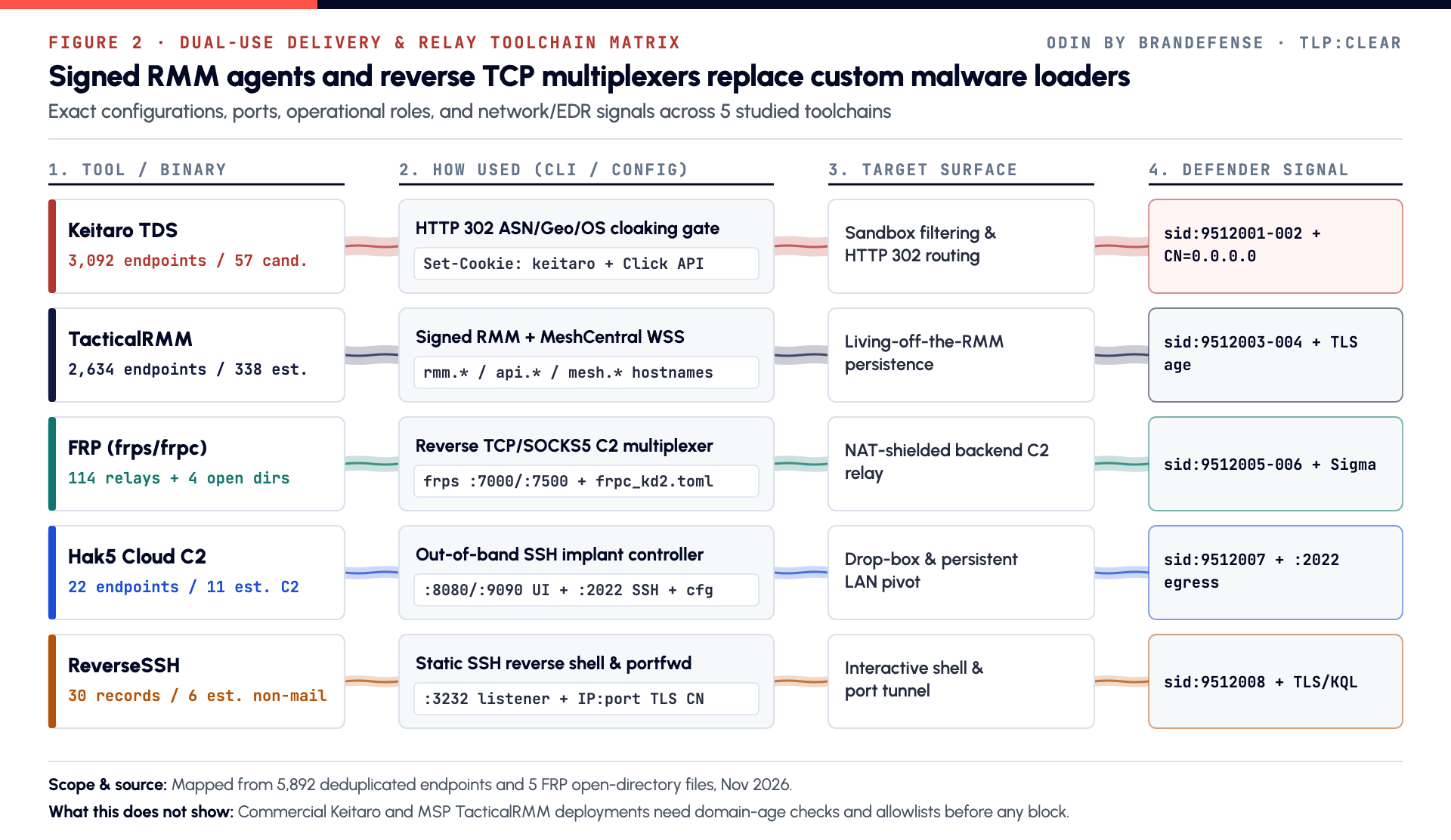
Operators run Keitaro in two ways:
- Direct redirectors answer with HTTP 302 and a
Set-Cookie: keitaroheader. They listen on 443 (1,802 endpoints) and 80 (1,218 endpoints). - Backend Click API v3 engines sit behind WordPress or malvertising landing pages. Those pages call
/click_api/v3and receive anX-KClick-Tokenheader.
The gate sits upstream of the payload. A defender who sees the 302 chain can act before an installer lands.
Three clusters that stand apart from marketing
Commercial agencies usually bind Keitaro to aged brand domains behind Cloudflare (219 such records). The 57 candidates look different. They fall into three clusters.
| Cluster | Certificates seen | Estimated gates | Hosting and fingerprint |
|---|---|---|---|
Default CN=0.0.0.0 TLS | 973 | 21 | Newly issued self-signed certificate, HTTP 302 with X-KClick-Token, JARM prefix 2ad2ad16d2ad2ad00042 |
SolidityGameServer dual-port | 45 | 24 | Paired 8081 and 8082 listeners, mostly on The Constant Company in Germany, JARM prefix 2ad2ad16d00000022c2a |
| CDN and tracker masquerade | Short-lived | 12 | Privacy or offshore hosts such as Privex Inc. and Melbikomas UAB, on domains that mimic ad or CDN services |
The SolidityGameServer gates share certificate names, JARM values and one provider. The sampled ones were first seen on 13 and 14 November 2026. That uniformity suggests templated or automated setup rather than manual work.
Why these gates are not blocked
A gate's visible response shows the 302 and the Click API markers. It does not show the downstream .msi or .ps1 destination. Without that, a gate cannot be told apart from an aggressive ad tracker. All eight sampled Keitaro gates in Chapter 9 are on watchlists, and their addresses are withheld.
4. Persistence: TacticalRMM and Hak5 Cloud C2
In short
Signed remote-management agents get past controls that would stop an unsigned loader. An estimated 338 TacticalRMM servers and 11 Hak5 Cloud C2 controllers fit the pattern, and one Hak5 server shares its host with a phishing kit.
Living off the RMM
Endpoint protection blocks many unsigned commodity loaders. A signed, legitimate RMM installer pointed at an attacker's own server raises fewer alarms. CISA advisory AA23-025A describes this abuse of remote monitoring and management software.
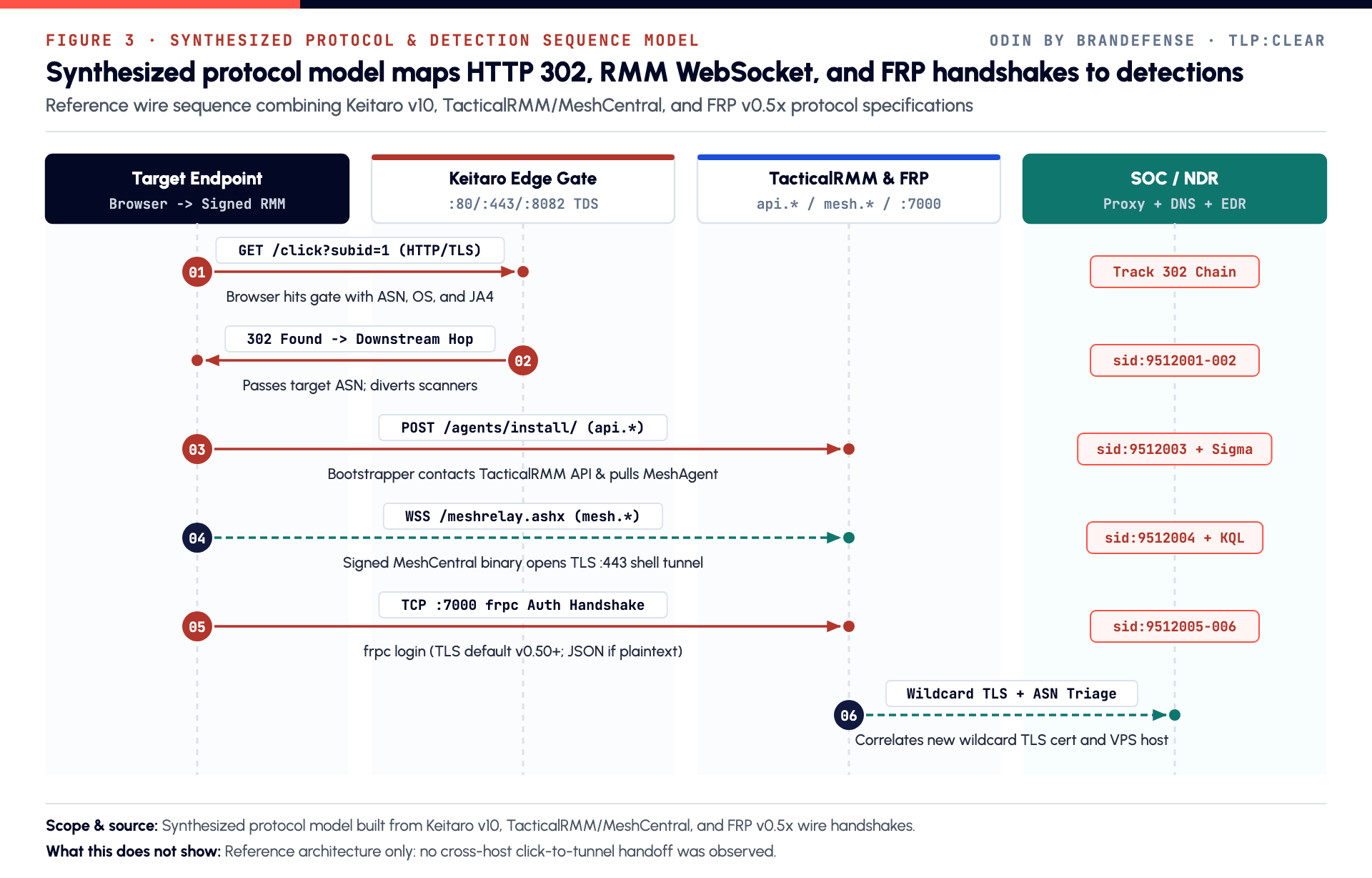
Figure 3 is a protocol model built from the public specifications. It shows where each step appears on the wire and which rule sees it. No single host was seen doing all of these steps.
How a TacticalRMM server is laid out
A standard TacticalRMM install uses three DNS names behind Nginx. The official install covers them with one Let's Encrypt wildcard certificate (*.<domain>), though custom certificates also work.
| Hostname | Service | Common ports | Records |
|---|---|---|---|
rmm.<domain> | Vue operator console | 443 | Not split out |
api.<domain> | Django uWSGI REST backend; agents enroll through POST /agents/install/ | 443 or 1024 | 405 |
mesh.<domain> | MeshCentral relay; remote shells and desktops run through WSS /meshrelay.ashx | 443 or 4430 | 232 |
Once enrolled, the signed MeshAgent.exe opens a WebSocket over port 443. That gives an operator PowerShell and desktop access that looks like normal HTTPS.
Disposable domains versus MSP domains
Legitimate MSPs run TacticalRMM on corporate domains that are years old. The 338 candidates instead sit on newly registered disposable domains and dynamic DNS services.
Eight sampled servers sit on fresh wildcard certificates. Five are shown below, with addresses and domains withheld.
| Certificate pattern | Hosting provider (country) | What stands out |
|---|---|---|
*.<withheld>.online | Rackvolt Cloud (US) | New offensive-themed wildcard certificate; API on 1024 as well as 443 |
*.<withheld>.top | M247 Europe SRL (US) | New .top wildcard on a commercial VPS network |
*.<withheld>.xyz | Sollutium EU (NL) | New .xyz wildcard on a commercial VPS network |
*.<withheld>.duckdns.org | Blatant Tech (SC) | New dynamic DNS wildcard on an offshore VPS |
*.<withheld>.online | Cherry Servers (US) | New wildcard exposing both the 1024 API and the 4430 relay |
The certificates are single wildcards. We did not see an explicit three-name certificate list, and we saw no interaction with a victim. All eight stay on watchlists.
Hak5 Cloud C2 and a phishing neighbor
Hak5 Cloud C2 manages Hak5 hardware implants, such as the LAN Turtle, Packet Squirrel and WiFi Pineapple. It also manages Linux persistence clients (cc-client) set up through /etc/device.config. A controller shows a web console on 8080, 9090, 8088 or 443, plus port 2022 for device SSH tunnels.
Of 22 Hak5 endpoints on 16 IPs, an estimated 11 are controllers. Port 2022 belongs to Hak5 itself, so a console plus 2022 alone is not enough to block. The two standalone controllers in Chapter 9, on Amazon AWS and DigitalOcean, stay on watchlists.
One server is different. 146.190.211[.]163 on DigitalOcean (US) runs Hak5 Cloud C2 on 8088 and 2022. The same host runs a separate GoPhish phishing server on 3333, with the certificate CN=*.maquitacushunfin[.]site. A phishing kit next to an implant controller is a second, independent offensive signal. This host is confirmed and published for blocking.
5. Relays: FRP and ReverseSSH
In short
Reverse proxies let an operator reach inside a network through a cheap cloud relay instead of a core server. We found 114 FRP relays, four open directories with relay files, and two TLS-wrapped ReverseSSH listeners confirmed for blocking.
How FRP shields the backend
FRP has two parts. The server, frps, runs on a cloud VPS. The client, frpc, runs inside the target network and dials out. Traffic then flows back through the relay, so the operator's own machine never faces the target. FRP can carry RDP, SMB and SOCKS5 traffic.
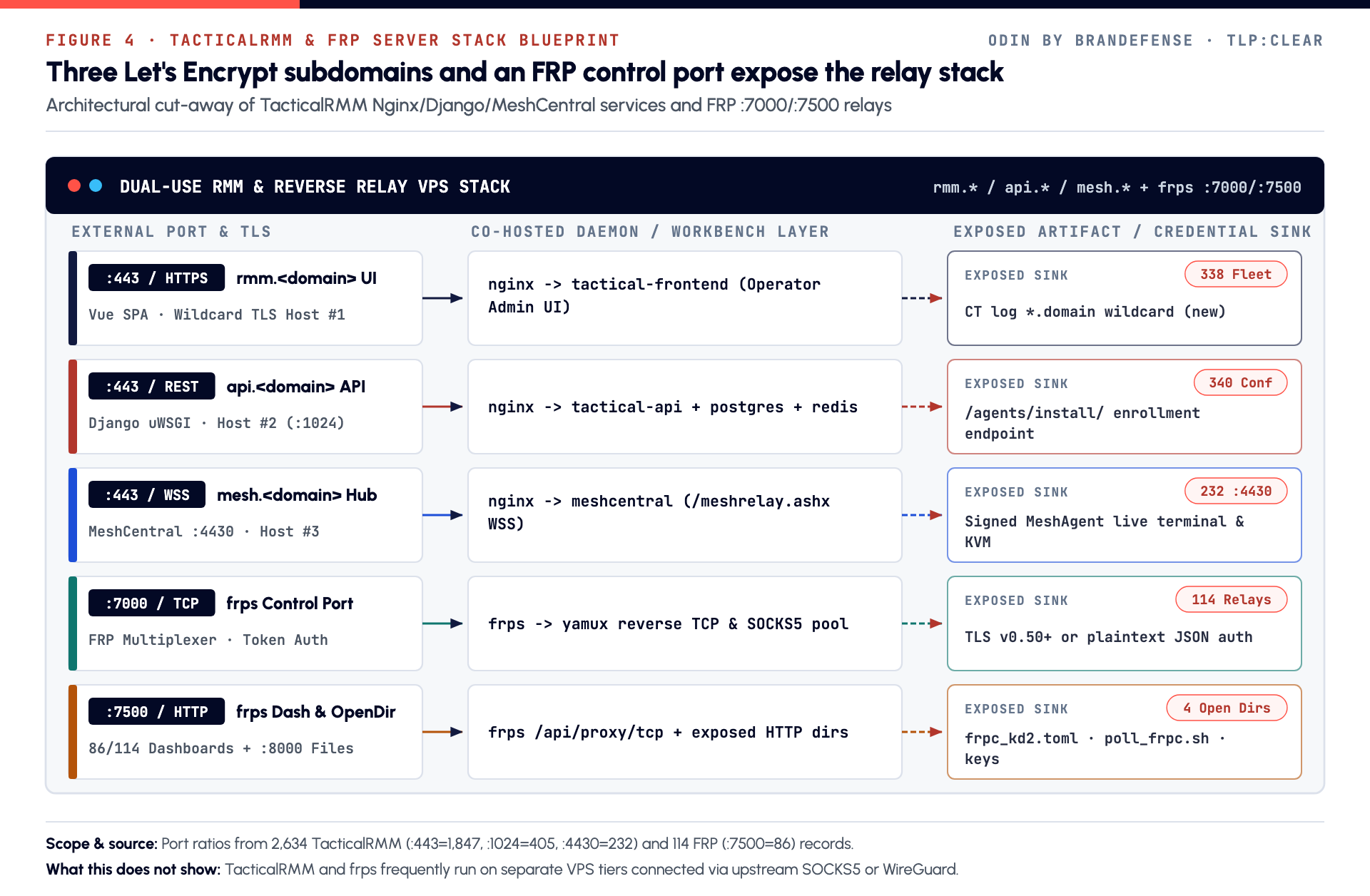
| Port | Service | What a defender sees |
|---|---|---|
| 7000 | frps control port; streams multiplexed with yamux | A JSON login with version, privilege_key, timestamp and run_id, but only when TLS is off |
| 7500 (sometimes 17500) | frps web dashboard, with the /api/proxy/tcp API | An HTTP dashboard listing active tunnels |
The privilege_key is an MD5 digest of the auth.token and a timestamp. From FRP v0.50.0, transport TLS is on by default (transport.tls.enable = true). The plaintext login is visible only on older builds, when TLS is turned off, or behind TLS inspection.
Where the relays run
Of the 114 relays, 86 (75.4%) leave the 7500 dashboard reachable. China hosts 70.2% of them, led by 61 nodes on Alibaba Cloud and 9 on Tencent. Developers also use FRP to expose test services, and ports and providers alone cannot tell the two apart. All 114 relay addresses are withheld and held on watchlists.
What the open directories held
Four open HTTP directories exposed five relay-related files. Some sit next to a 7000 relay. Whether their owners are attackers or lab administrators is unknown, and no separate C2 framework was found on them. All four hosts stay on watchlists.
| Exposed file | Port | Hosting (country) | What it is |
|---|---|---|---|
/frpc_kd2.toml | 8000 | Huawei Cloud (CN) | FRP v0.5x client config with an auth.token (secret withheld) |
/poll_frpc.sh | 18080 | Alibaba Cloud (CN) | Cron watchdog script that restarts frpc tunnels when they drop |
/keydump.txt | 8000 | Oracle Cloud (SG) | Dump of extracted keys, next to a 7000 relay |
/blind-rce-exploit/PLAYBOOK.md | 9999 | Tencent (CN) | Remote code execution playbook next to a 7000 relay (2 records) |
Three of these records were first listed before our window opened. The frpc_kd2.toml record was first seen on 17 November 2026.
ReverseSSH on non-standard ports
ReverseSSH is a static binary that accepts reverse SSH shells and port forwards over firewall-friendly ports. We saw 30 records on 23 IPs. Of these, 11 listen on the default port 3232: 4 as plaintext SSH and 7 behind self-signed CN=:3232 TLS certificates.
Plaintext listeners on 3232, 8082 or 8443 send their SSH banner (SSH-2.0-Go or SSH-2.0-OpenSSH) straight to the client. Suricata SID 9512008 catches that.
The two hosts confirmed for blocking hide the banner inside TLS. Each uses a certificate whose common name is its own IP:port:
| Endpoint | Hosting (country) | Certificate | JARM prefix |
|---|---|---|---|
| 77.111.101[.]84:8082 (also 8443) | Latitude.sh (BR) | CN=77.111.101[.]84:8082 | 3fd3fd0003fd3fd00043 |
| 165.154.199[.]52:443 | Scloud Pte Ltd (SG) | CN=165.154.199[.]52:443 | 3fd3fd0003fd3fd00043 |
TLS hides the inner SSH handshake from wire signatures. Find these hosts through the IP-literal certificate and JARM, egress hunting in KQL, and ssh -R process events in Sigma.
6. Telling Hostile From Legitimate
In short
Blocking every Keitaro or TacticalRMM server would break marketing analytics and outsourced IT support. Four common lookalikes explain why most hosts in this report stay on watchlists.
An exposed TacticalRMM login page shows that the software is present. It does not show intent.
Four lookalikes
| Lookalike | What we saw | How it is handled |
|---|---|---|
| MSPs and marketers | 158 TacticalRMM records on aged MSP domains; Keitaro behind enterprise CDNs | Set aside and logged only, when the domain is old, the certificate is clean and no offensive tool shares the host |
| Mail servers | 8 ReverseSSH records were POP3S mail servers at an Italian hosting provider (ports 995 and 110); 5 Hak5 records sat on mail ports of a Dutch VPS | Matches on mail ports 110, 143, 465, 993 and 995 are ignored |
| Authorized testers | Two suspected Hak5 Cloud C2 instances on Microsoft Azure (IE) and Amazon AWS (DE) present CN=pentest certificates | Analyst review; never auto-blocked or published |
| Home broadband | One TacticalRMM host sits on a dynamic Brazilian subscriber network; 30 TacticalRMM records are on dynamic ISPs | Watchlist entries that expire after 24 hours, so reassigned customer addresses are never blocked for good |
What it takes to block
Everything else in this report needs a second, independent signal before a block. The three confirmed hosts have one each:
- A co-hosted offensive tool. 146.190.211[.]163 pairs Hak5 Cloud C2 with GoPhish.
- An IP-literal reverse-shell certificate. 77.111.101[.]84 and 165.154.199[.]52 wrap SSH in TLS under their own
IP:portnames.
A captured installer redirect from a Keitaro gate would also qualify. None of the sampled gates showed one.
7. What Defenders Should Do
Within 24 hours
- Block the three confirmed hosts: 146.190.211[.]163:8088, 77.111.101[.]84:8082 and 165.154.199[.]52:443.
- Keep watchlist indicators (Keitaro gates, wildcard TacticalRMM servers, standalone Hak5 controllers, FRP open directories,
CN=pentesthosts) out of automatic block feeds. - Exclude mail-port matches (995 POP3S and the other mail ports) from ReverseSSH hunting.
Within 72 hours
- List every approved RMM tool. Allow
rmm.*,api.*andmesh.*traffic, including/meshrelay.ashx, only to documented corporate or MSP names, at DNS and the TLS proxy. - Add WDAC or AppLocker rules that block unapproved
tacticalrmm.exe,MeshAgent.exeandfrpc.exe, even when the files carry a valid Authenticode signature. - Restrict workstation egress on relay ports 2022, 3232, 4430, 7000, 7500 and 17500.
Within 7 to 30 days
- Inspect HTTP 302 chains with
keitarocookies. Correlate browser visits to domains registered in the last 30 days on.xyz,.top,.onlineorduckdns[.]orgwith.msi,.vbsor.ps1launches. - Deploy Suricata SIDs 9512001 to 9512008, the Sentinel KQL hunt and the three Sigma rules.
- Alert on plaintext
SSH-2.0banners from relay ports and on IP-literal TLS certificates. - Rotate any token found in an exposed
frpc.toml.
8. Detection Rules
The full rules are in the Detection rules tab. Each file targets one layer of the model.
| Rule file | What it catches |
|---|---|
odin_keitaro_tacticalrmm_frp.rules | Suricata 7: eight signatures for Keitaro redirects, TacticalRMM enrollment and relay traffic, plaintext FRP logins, Hak5 consoles and ReverseSSH banners |
sentinel_unapproved_rmm_and_tds_redirect_chain.kql | Microsoft Sentinel and Defender for Endpoint: browser-to-installer chains, unapproved RMM or FRP processes, and relay egress |
sigma_tacticalrmm_frpc_unauthorized_execution.yml | Sigma (3 rules): unapproved TacticalRMM or MeshCentral agents, frpc tunnels, and Hak5 or ReverseSSH tunnels |
odin_tds_rmm_frp_staging_configs.yar | YARA (4 rules): Keitaro gate configs, TacticalRMM bootstrap manifests, FRP client configs, and Hak5 or ReverseSSH provisioning files |
How the Suricata signatures work
| SID | Looks for | Tactic |
|---|---|---|
| 9512001 | A server 302 response whose cookie contains keitaro and a subid, _subid or stream marker | Initial Access |
| 9512002 | An internal client requesting /click_api/v3 | Initial Access |
| 9512003 | An internal client calling TacticalRMM enrollment at /agents/install/ | Persistence |
| 9512004 | A WebSocket upgrade to /meshrelay.ashx | Command and Control |
| 9512005 | An outbound plaintext FRP login with privilege_key, version and timestamp or run_id | Command and Control |
| 9512006 | Access to the FRP dashboard API /api/proxy/tcp on 7500, 17500, 8080 or 9527 | Command and Control |
| 9512007 | Hak5 Cloud C2 branding in an HTTP response body (unmodified consoles only) | Command and Control |
| 9512008 | A server response starting SSH-2.0-Go or SSH-2.0-OpenSSH from ports 3232, 8082 or 8443 | Command and Control |
The HTTPS rules (9512001 to 9512004 and 9512007) need TLS inspection or offload. The TCP rules (9512005 and 9512008) belong on perimeter egress. SID 9512005 sees only FRP builds older than v0.50.0 or sessions with TLS turned off. Bypass 9512003 and 9512004 for your documented MSP api. and mesh. names, and exclude sanctioned jump hosts from 9512008.
How the KQL query works
The Sentinel query uses a 14-day lookback and has three branches.
- Browser to installer. It joins a browser connection to a confirmed host, a
click_api/v3URL or a disposable domain with a later process launch. It looks formsiexec.exe, PowerShell, script hosts,tacticalrmm.exeorMeshAgent.exeon the same device within five minutes. - Unapproved RMM or FRP process. It flags
tacticalrmm.exe,MeshAgent.exeorfrpc, or command lines that mentionmeshrelay.ashx,/agents/install/,frpc.toml,frpc.ini,privilege_keyordevice.config. - Relay egress. It flags connections to the three confirmed hosts or to
rmm.,api.ormesh.names on disposable domains. It also flags RMM, FRP or SSH processes that reach relay ports 2022, 3232, 4430, 7000, 7500 or 17500.
Fill the ApprovedMspDomains list before use. Treat the disposable-domain branch as a hunting lead, not an isolation trigger. Endpoint network events do not carry certificate details, so check domain age and certificate names in certificate transparency or passive TLS data first.
How the Sigma and YARA rules work
| Rule | Fires when |
|---|---|
| Sigma: Unapproved TacticalRMM or MeshCentral Agent Execution | tacticalrmm.exe or MeshAgent.exe runs, or a command line names RMM enrollment or relay paths, outside approved MSP names |
| Sigma: FRP Reverse Relay Client Execution or Tunnel Multiplexing | frpc runs, or a command line references frpc.toml or serverPort = 7000; this works even when FRP traffic is encrypted |
| Sigma: Hak5 Cloud C2 or ReverseSSH Outbound Tunnel Invocation | A Linux command references Hak5 /etc/device.config, or ssh -R targets port 2022, 3232, 8082, 8443 or 443 |
YARA: ODIN_Keitaro_TDS_Cloaking_Gate_Config | keitaro appears with X-KClick-Token, click_api/v3 or object=campaigns, plus stream_id= or 302 Found |
YARA: ODIN_TacticalRMM_Agent_Bootstrap_Manifest | Two TacticalRMM markers (/agents/install/, /meshrelay.ashx, tacticalagent) appear with two of the api., mesh. and rmm. prefixes |
YARA: ODIN_FRP_Reverse_Relay_Client_Config | A file has a server address, serverPort = 7000, an auth.token or privilege_key, and a socks5 or [[proxies]] entry |
YARA: ODIN_Hak5_CloudC2_And_ReverseSSH_Provisioning | Two Hak5 markers appear with 2022, or device.config appears with :3232 |
How to sort a host
The triage logic turns these signals into an action. It never blocks on one dual-use signal.
| What the host shows | Action |
|---|---|
| An approved MSP or enterprise asset | Allow |
| A match on a standard mail port | Ignore as a collision |
| An aged domain, a clean business certificate and no co-hosted offensive tool | Log only |
A CN=pentest certificate | Analyst review |
| A dynamic subscriber ISP address | Watchlist for 24 hours |
| A Keitaro gate with no captured installer, a wildcard RMM server on a new disposable domain, a standalone Hak5 controller, or an FRP relay or open directory | Watchlist and analyst review |
| A co-hosted offensive tool, a captured installer redirect, or an IP-literal reverse-shell certificate | Block |
Before you deploy
Only the KQL query carries an allowlist, and it matches exact hostnames. The Sigma, Suricata and YARA rules have none, so suppress sanctioned MSP agents by exact host and agent ID first. Every rule file loads without errors in its engine (Suricata 7.0.12, YARA-X, pySigma, Kusto.Language); the rules were not replayed against live traffic. The YARA rules matched four sample config files and did not fire on two benign controls. Test all rules in your own environment before production use.
9. Indicators
The Indicators tab holds the 3 confirmed endpoints. The other 25 records in the selected set are withheld.
| Type | Count |
|---|---|
| Confirmed adversary endpoints to block (IP and port) | 3 |
| Watchlist endpoints, addresses withheld | 24 |
| Excluded mail-server collision, address withheld | 1 |
Confirmed endpoints to block
| Endpoint | Tool | Hosting (country) | Key fingerprint | First seen |
|---|---|---|---|---|
| 146.190.211[.]163:8088 | Hak5 Cloud C2 | DigitalOcean (US) | Hak5 console on 8088 and 2022; GoPhish on 3333 with CN=*.maquitacushunfin[.]site | 13 Nov 2026 |
| 77.111.101[.]84:8082 | ReverseSSH | Latitude.sh (BR) | TLS-wrapped SSH on 8082 and 8443, CN=77.111.101[.]84:8082, JARM prefix 3fd3fd0003fd3fd00043 | 14 Nov 2026 |
| 165.154.199[.]52:443 | ReverseSSH | Scloud Pte Ltd (SG) | TLS-wrapped SSH, CN=165.154.199[.]52:443, same JARM prefix | 13 Nov 2026 |
Watchlist entries
These 24 entries are for enrichment and analyst triage, not for blocking. Addresses and domains are withheld.
| Group | Entries | Hosting (country) | Fingerprint to hunt |
|---|---|---|---|
| Keitaro gates | 8 | The Constant Company (DE, 3), Ultahost (DE), ROUTE 95 LLC (NL), Privex Inc. (NL), Melbikomas UAB (DE), Mulgin A.S. (UA) | CN=SolidityGameServer on 8081, 8082 and 443; CN=0.0.0.0 with X-KClick-Token; .life, .site and lookalike domains with /click_api/v3 |
| TacticalRMM servers on new wildcards | 8 | Rackvolt Cloud (US), M247 Europe (US), Sollutium EU (NL, 2), Blatant Tech (SC), Ultahost (NL), Amazon AWS (US), Cherry Servers (US) | New wildcards on .online, .top, .xyz, .art, .site and duckdns[.]org; API on 1024; one with /meshrelay.ashx on 443 |
| TacticalRMM on dynamic broadband | 1 | Dynamic telecom network (BR) | 24-hour watchlist only |
| Standalone Hak5 controllers | 2 | Amazon AWS (US), DigitalOcean (US) | Console on 8080 or 9090 plus 2022 |
| FRP open directories | 4 | Tencent (CN), Oracle Cloud (SG), Alibaba Cloud (CN), Huawei Cloud (CN) | The relay files listed in Chapter 5 |
CN=pentest host | 1 | Microsoft Azure (IE) | CN=pentest with 3389 open; the second CN=pentest host (AWS, DE) is outside the selected set |
Most entries were first seen between 13 and 18 November 2026. Three FRP open-directory records were first listed before our window.
Withheld: all 114 FRP relay addresses, the 24 watchlist addresses and domains, the frpc_kd2.toml token, the mail-server collision host, and all other candidate addresses.
ATT&CK tactics
| Tactic | How the tools fit | Detection |
|---|---|---|
| Initial Access | Keitaro gates filter visitors and redirect the chosen ones | SIDs 9512001 and 9512002; KQL branch 1; YARA Keitaro rule |
| Persistence | Signed TacticalRMM and MeshCentral agents enroll and hold access | SID 9512003; KQL branch 2; Sigma rule 1; YARA TacticalRMM rule |
| Command and Control | MeshCentral WebSockets, FRP tunnels, Hak5 SSH and ReverseSSH listeners | SIDs 9512004 to 9512008; KQL branch 3; Sigma rules 2 and 3; YARA FRP and Hak5 rules |
10. Scope and Limits
- Window. The findings cover a two-week observation window ending 18 November 2026. Three FRP directory records were first listed before the window; no dates are given for them.
- Population totals are estimates. The 5,892 endpoints, 526 candidates, 57 gates and 338 TacticalRMM servers come from aggregate summaries. Only 3 confirmed endpoints are published at endpoint level.
- The access chain is a model. The five tools were measured separately. Apart from shared hosts such as the Hak5 and GoPhish server, nothing links one layer to another.
- Software present is not hostile intent. Most hosts run legitimate tools for marketing, IT support or development. Only three hosts are confirmed adversary infrastructure.
- Redirect targets are unseen. No sampled Keitaro gate showed where its redirect leads, and no installer download was seen.
- Open directories show staging, not use. The relay configs, key dump and playbook are staged files. Whether their owners are attackers or lab administrators is unknown.
- Rule testing. Every published rule file loads without errors in its engine (Suricata 7.0.12, YARA-X, pySigma and Microsoft's Kusto.Language analyzer, checked on 20 November 2026). The rules were not replayed against live traffic, so test and tune them in your own environment before production use.
11. Sources
- MITRE ATT&CK Enterprise tactics: Initial Access, Persistence, Command and Control. https://attack.mitre.org/tactics/enterprise/ (verified 18 November 2026)
- CISA. Joint Cybersecurity Advisory AA23-025A, Protecting Against Malicious Use of Remote Monitoring and Management Software. https://www.cisa.gov/news-events/cybersecurity-advisories/aa23-025a (verified 18 November 2026)
- Keitaro TDS documentation: campaign streams, filters, redirects and Click API v3. https://docs.keitaro.io/ (verified 18 November 2026)
- TacticalRMM documentation, How It All Works:
rmm,apiandmeshhostnames, wildcard TLS, Django and MeshCentral. https://docs.tacticalrmm.com/howitallworks/ (verified 18 November 2026) - fatedier. Fast Reverse Proxy (FRP) repository:
frps,frpc.toml, default TLS from v0.50.0, token authentication. https://github.com/fatedier/frp (verified 18 November 2026) - Hak5 Cloud C2 documentation: deployment, ports and
device.config. https://docs.hak5.org/cloud-c2/ (verified 18 November 2026)
What is…?
Short explanations of the tools and families named in this study.
What is FRP?
Fast Reverse Proxy (FRP) is an open-source tool that exposes services behind NAT through a public relay server.
More about FRPRemote managementWhat is TacticalRMM?
TacticalRMM is an open-source remote monitoring and management (RMM) suite built on MeshCentral. MSPs use it, and attackers abuse it for signed, persistent access.
More about TacticalRMMTraffic distributionWhat is Keitaro?
Keitaro is a commercial traffic direction system (TDS) for ad campaigns. Attackers use TDS gates to filter victims and hide malicious pages from scanners.
More about KeitaroTunneling toolWhat is ReverseSSH?
ReverseSSH is an open-source tool that gives an operator an SSH shell through a connection the target opens outward.
More about ReverseSSHDevice controllerWhat is Hak5 Cloud C2?
Hak5 Cloud C2 is a controller for Hak5 implant devices, such as drop boxes, that call home over the internet.
More about Hak5 Cloud C2Remote managementWhat is MeshCentral?
MeshCentral is an open-source web server for remote device management and desktop control.
More about MeshCentralFrequently asked questions
What are these tools, and why do attackers want them?
Each tool fills one step of an access chain. We measured the five populations separately, so the chain below is a model, not one observed campaign. The appeal is simple. Security tools often stop unsigned malware. They are less likely to stop a signed remote-management agent or a marketing redirect.
How many look hostile?
Very few, once legitimate use is set aside. The 57 Keitaro candidates fall into three clusters. Some use a templated certificate named SolidityGameServer on paired ports. Some use fresh default certificates on cheap VPS hosts. Others sit on domains that imitate ad or CDN services. Their redirects are visible, but not where they lead.
Which hosts should be blocked?
Only three hosts carry a second, independent sign of hostile use: Everything else belongs on a watchlist. A Keitaro gate may be an aggressive marketer. A TacticalRMM server may be a small IT provider. An FRP relay may be a developer's test tunnel. Some lookalikes are plainly benign: eight "ReverseSSH" matches were mail servers, and two Hak5 servers carry CN=pentest certificates that suggest authorized testing.
How do defenders catch this without breaking IT?
Start from what your organization approves. If only your MSP's RMM domains are allowed, any other TacticalRMM or MeshCentral traffic stands out at once. Then link events across the chain. A browser visit to a fresh disposable domain, followed within five minutes by msiexec.exe, PowerShell or an RMM agent, is a strong lead. Our Sentinel query does this join.