


1. Executive Summary
In short
In a two-week observation window ending 18 November 2026, Odin by Brandefense found 2,081 cases where a C2 detection rule labelled a benign production server as command-and-control. The hits covered automaker mTLS gateways, AWS load balancers, PHP 8.5 web servers and MySQL databases. Another 135 secret-scanner alerts came from open-source test files. Each rule matched one surface trait. Do not let a threat feed auto-block any address until certificate, protocol and network checks agree.
Many threat feeds label a server as command-and-control (C2) because it matches one trait: a TLS fingerprint, an HTTP status code, a response header or an open port. When a SOC wires such a feed straight into firewall or EDR block lists, every weak rule becomes a way to cut off its own partners. This report shows where that happens, why, and which checks tell a real C2 server from a collision.
Single-trait rules produced 2,081 false C2 hits across four production stacks.
Six automaker mTLS gateways were labelled Emotet, one at a raw score of 97. 356 AWS load balancers were labelled Interactsh and 127 PHP 8.5 web servers ezXSS. Another 1,592 MySQL servers on port 3306 were labelled confirmed Daybreak C2.
A shared AWS TLS fingerprint makes load balancers look like OAST servers.
189 of the 356 load-balancer hits share the exact JARM value seen on AWS-hosted Interactsh servers. Only a certificate issuer check plus an application-layer check separates the two. An Interactsh server is a dual-use testing tool, so even a real one is a hunting lead, not proof of hostile use.
Test fixtures and home broadband create a second wave of bad alerts.
Of 5,576 secret findings in exposed directories, 135 came from unit tests, skill docs and public prompt archives, including 41 rated critical. Separately, 197 C2 hits sat on residential and mobile networks, where addresses change hands. Those need short watchlists, not permanent blocks.
Three Decisions for Leaders
- Stop single-signal auto-blocking. No feed indicator should reach a firewall or EDR block list unless protocol behaviour, certificate issuer and network type all point the same way.
- Give each kind of indicator its own lifetime. Block corroborated C2 on stable hosting for 14 days. Hunt dual-use OAST servers and suspected C2 for 7 days. Watch subscriber ISP addresses for 24 to 72 hours. Keep single-signal candidates for correlation only.
- Read file paths before raising secret alerts. Put live AI agent session folders first. Then filter unit tests, skill reference docs, public prompt archives and known vendor example keys, so analysts see real leaks.
The Study in Numbers
| Number | What it is |
|---|---|
| 25,482 | Deduplicated indicators reviewed: 24,660 C2 endpoints plus 822 open directories |
| 2,081 | C2 rule collisions on benign production servers (8.2%), across 1,958 unique IPv4 hosts |
| 1,592 | MySQL servers on port 3306 labelled confirmed Daybreak C2 |
| 356 | AWS Application Load Balancer endpoints labelled Interactsh OAST servers |
| 135 | Secret-scanner hits from open-source test fixtures, out of 5,576 secret findings |
| 3,916 | Confirmed, separately corroborated C2 indicators fit for a block list (15.4%) |
| 197 | C2 hits on dynamic residential or mobile networks, moved to 24 to 72 hour watchlists |
How to use this report.
Security leaders can read Chapter 1, Chapter 5 and Chapter 6. Detection engineers and SOC analysts should start with Chapters 3, 4 and 7. CTI and feed owners will find the root causes in Chapter 2 and the indicator counts in Chapter 8.
2. Why Single-Signal Rules Collide
In short
Every collision in this study has the same root cause: a rule that matches one surface trait. TLS fingerprints, status codes, headers and port banners describe the server software, not the intent of whoever runs it.
One trait is not an identity
A JARM value describes how a TLS library answers a handshake. An HTTP 400 page describes how a web server rejects a request. An X-Powered-By header names a runtime version. A port banner names a database. Thousands of legitimate servers share each of these traits with some C2 framework.
When a rule matches only one of them, every benign server with the same trait inherits the C2 label. That is the pattern behind all 2,081 C2 collisions and all 135 secret-scanner collisions in this report.
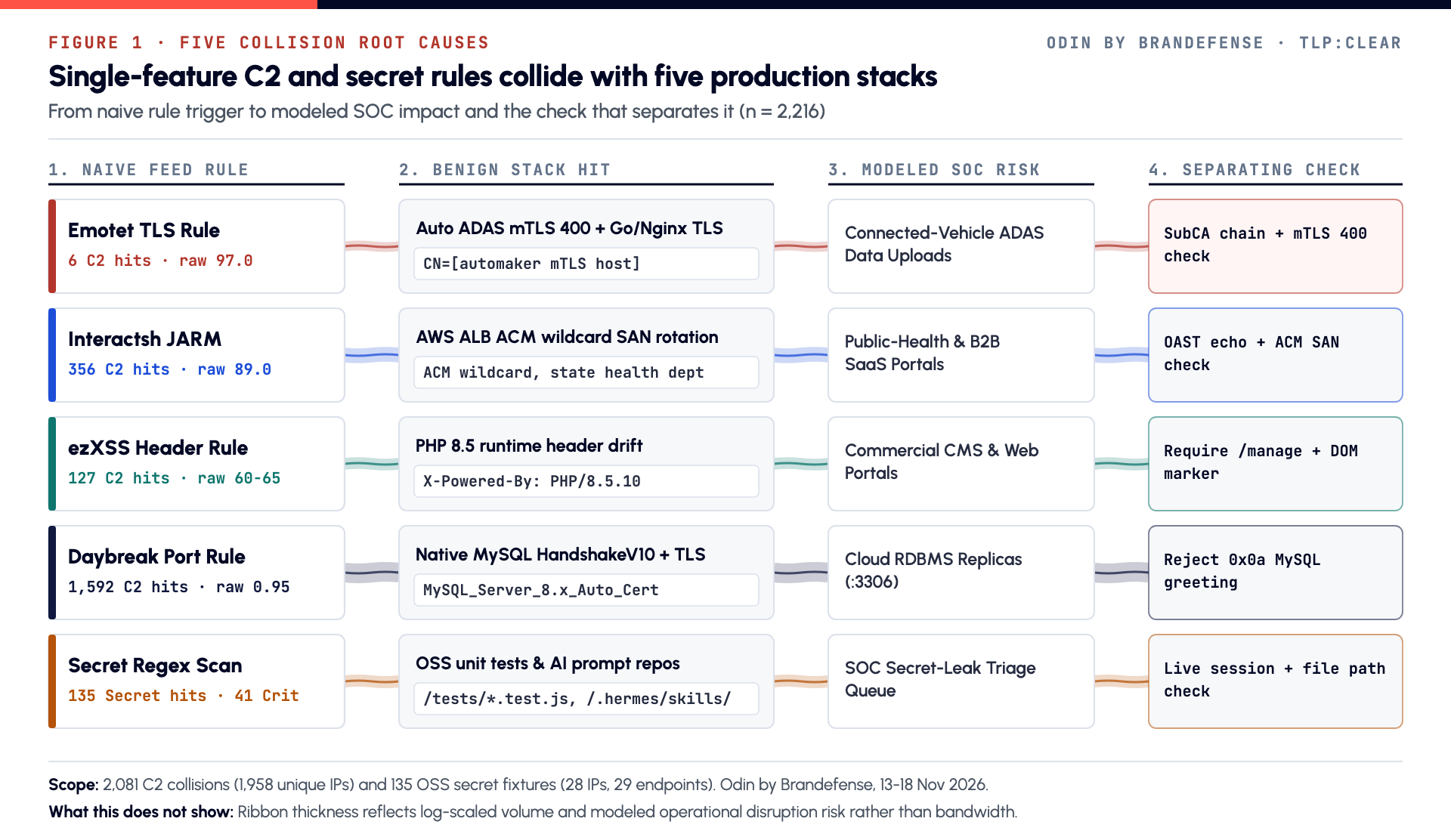
The five collision classes
The 2,081 C2 collisions sit on 1,958 unique IPv4 hosts. The 135 secret-scanner collisions sit on 28 unique IPs across 29 open-directory endpoints. Together they make 2,216 collisions.
| Class | Rule that fired | Rows (unique IPs) | Raw label and score | Benign stack it hit | What separates it from C2 |
|---|---|---|---|---|---|
| 1 | emotet | 6 (5) | 1 confirmed at 97.0, 5 suspected at 80.0 | A Chinese automaker's ADAS and corporate mTLS gateways | Private enterprise sub-CA issuer plus the mTLS "no client certificate" HTTP 400 page |
| 2 | interactsh | 356 (261) | 356 suspected at 89.0 | AWS Application Load Balancers with ACM wildcard certificates | A real Interactsh server reflects test IDs and listens on several ports |
| 3 | ezxss | 127 (101) | 106 suspected at 65.0, 21 at 60.0 | Commercial CMS and portals upgraded to PHP/8.5.10 | No /manage/login panel and no ezxss.js collector script |
| 4 | daybreak | 1,592 (1,592) | 1,592 confirmed at 0.95 | Cloud MySQL 5.7, 8.0, 8.4 and 9.1 on TCP/3306 | MySQL greeting byte 0x0a and an auto-generated MySQL certificate |
| 5 | Secret regex | 135 (28) | 41 critical, 15 high, 79 medium | Unit tests, skill docs, public AI prompt archives | File path context, known example keys, no live session state |
The raw labels and scores are those carried by the detection feed before any checks. One host triggered both the ezXSS and the Daybreak rule, so the class-level host counts add up to 1,959, not 1,958.
The framework names in the "Rule that fired" column are feed labels. They are not attribution of any benign host to any threat actor.
Why this matters for automated blocking
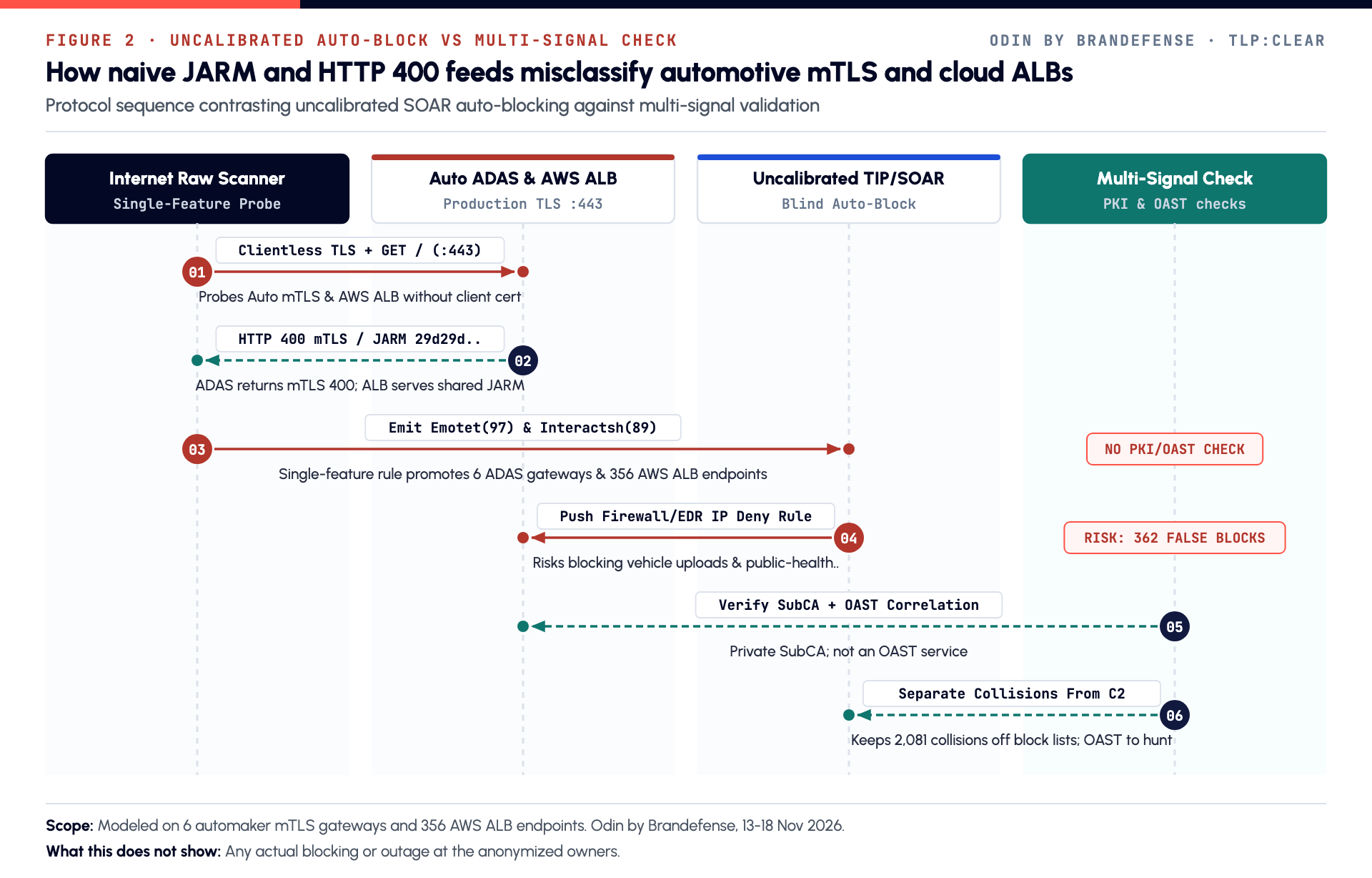
The most dangerous false positives are not low-scoring candidates. They are the high-scoring ones, here 89 to 97, because SOAR playbooks often auto-block anything above a fixed score.
A block on the automaker gateways could cut vehicle data uploads for a supplier or fleet operator. A block on the load balancers could cut a state public-health portal or a logistics SaaS. A block on the MySQL servers could break cloud database replicas. These are modeled risks: we did not observe any actual outage.
3. Automaker mTLS Gateways and Cloud Load Balancers
In short
362 high-scoring collisions came from TLS-layer rules. Six automaker gateways looked like Emotet, and 356 AWS load balancers looked like Interactsh, because their TLS answers matched.
Class 1: automaker mTLS gateways labelled Emotet
On 18 November 2026, an Emotet rule labelled one gateway of a Chinese automaker as confirmed Emotet C2 at a raw score of 97.0. It labelled five more of the automaker's gateways as suspected Emotet at 80.0. One primary and one companion gateway sit on Alibaba Cloud. The other four sit on Huawei Cloud, on ports 443, 8080 and 80.
The automaker's name, domains and addresses are withheld. The gateways are benign and must not enter any block list.
| What the gateway shows | What it means |
|---|---|
| Leaf certificate for an ADAS mTLS host, issued by a private enterprise sub-CA | Issuer and subject differ: this is a corporate PKI, not a self-signed C2 certificate |
| Five companion gateways with a wildcard certificate for the automaker's telematics domain | Same corporate PKI across the fleet |
ssl_verify_client on in Nginx in front of Go services | The gateway demands a client certificate (mutual TLS) |
HTTP 400 Bad Request with "No required SSL certificate was sent" | The normal answer to any scanner that has no client certificate |
ADAS stands for Advanced Driver-Assistance Systems. These gateways carry wireless ADAS and connected-vehicle uploads.
Why the Emotet rule fired.
Emotet Epoch 4 and Epoch 5 used Nginx reverse proxies. They return short HTTP 400 or 404 answers over stock Linux OpenSSL when a POST lacks a valid payload. A rule that matches "Nginx 400 on a cloud network" fires on both.
The rule did not check for the "No required SSL certificate was sent" text. It did not check whether the issuer differs from the subject. Either check would have cleared the gateways.
How real Emotet C2 looked.
The three confirmed Emotet servers in our indicator set use self-signed certificates, where issuer equals subject. Examples are CN=greenedgewealth-zesle, CN=serv-01.nexgeninter[.]net and CN=Callsign. All three sit on DigitalOcean on port 443.
Class 2: AWS load balancers labelled Interactsh
On 17 November 2026, 356 endpoints raised suspected Interactsh alerts at a raw score of 89.0. They sat on 261 unique Amazon IPv4 addresses: 259 rows on port 443 and 97 on port 80.
Interactsh is ProjectDiscovery's out-of-band application security testing (OAST) server. It catches DNS, HTTP and SMTP callbacks from test payloads. Operators often run it on AWS EC2 with a wildcard certificate, so that random correlation subdomains resolve over HTTPS.
The collision behind the 356 rows came from eight anonymized certificate subjects.
| Owner sector (anonymized) | Collision rows |
|---|---|
| Enterprise transportation management SaaS | 116 |
| Commercial analytics and AI SaaS | 109 |
| State public-health agency, non-production cloud | 83 |
| Cloud provider edge routing | 22 |
| Financial payment and accounting integration SaaS | 8 |
| Commercial media web platform | 8 |
| Regional logistics and storage portal | 6 |
| Field-service dispatch SaaS | 4 |
Why the Interactsh rule fired.
189 of the 356 rows return JARM 29d29d00029d29d00041d41d00041dcb3f8752a2d70d1dbf446fc46ab5df96. That is the exact 62-character JARM seen on active AWS-hosted Interactsh servers. The value reflects the AWS TLS stack, not the tenant.
AWS Application Load Balancers (awselb/2.0) scale across short-lived EC2 address pools. They serve Amazon Certificate Manager (ACM) wildcard certificates and a generic default answer to scans that hit a bare IP. A JARM plus wildcard-certificate rule turned eight enterprise domains into 356 false OAST alerts.
What a real Interactsh server shows instead.
It reflects the correlation ID of a test request back to the caller. It listens on several ports at once, typically 53, 80, 443, 465 and 587. It exposes a /register API.
Could a load balancer front a real Interactsh server?
Yes, in principle. ALB listener rules can route one host name or path to a backend container, including an Interactsh container behind an enterprise wildcard certificate.
A load balancer that answers a bare-IP request with its default awselb/2.0 page does none of this. That is why the check that matters is application-layer reflection, not the certificate or the address.
Do not allowlist all of AWS
A tempting fix is to allowlist the whole Amazon network. That would also hide the 523 active Interactsh servers hosted on AWS EC2 in the same dataset. The answer is a structural check per host, not a network-wide exception.
4. PHP 8.5, MySQL 3306 and Test Fixtures
In short
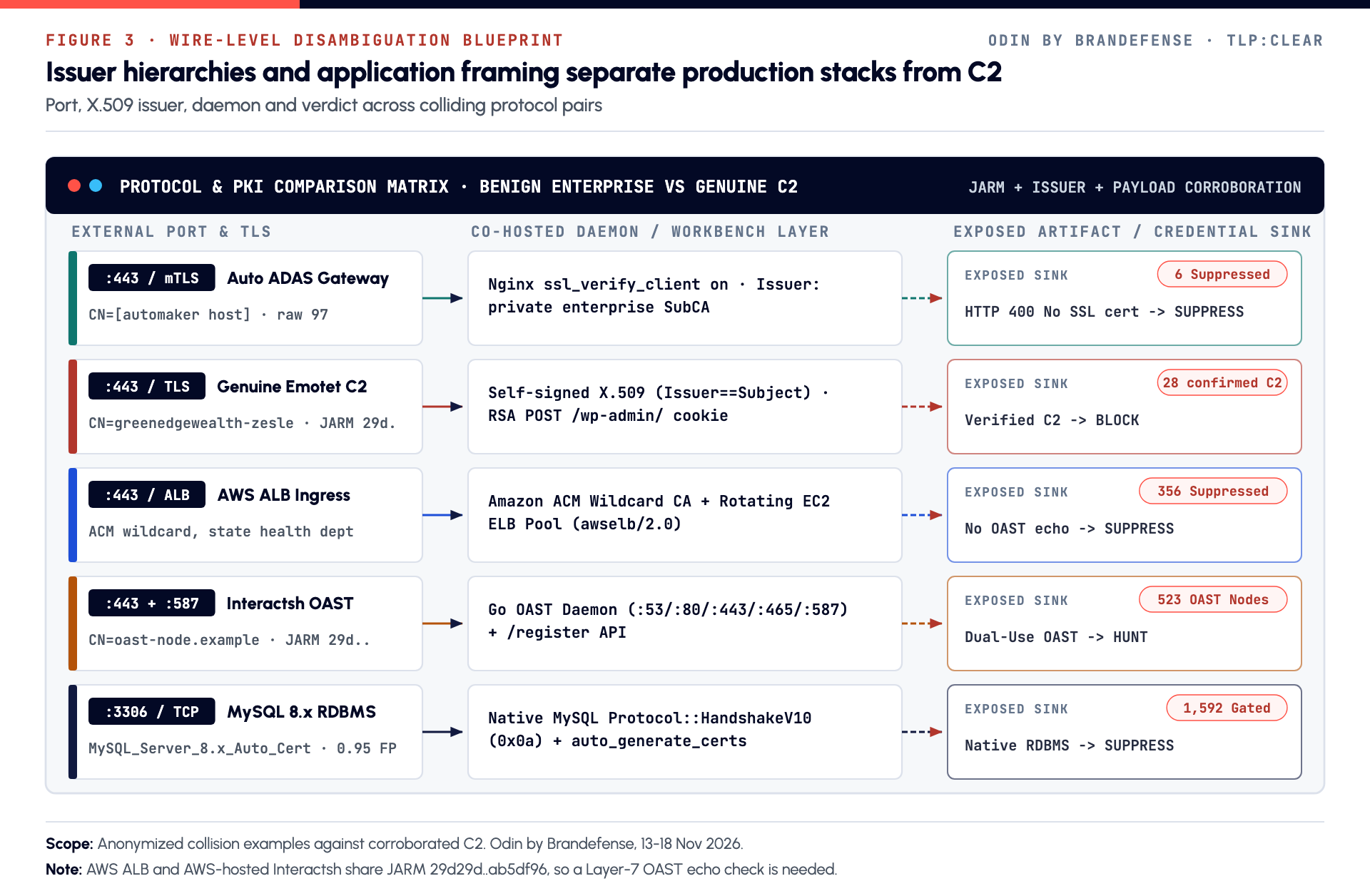
Application-layer checks clear the remaining 1,854 false positives: 127 PHP 8.5.10 websites, 1,592 MySQL servers and 135 test or prompt files. Each one fails a simple check that real C2 passes.
Class 3: PHP 8.5.10 websites labelled ezXSS
A weak ezXSS rule fired on 127 endpoints across 101 unique IPv4 hosts. It scored 106 of them at 65.0 and 21 at 60.0. The hosts were commercial websites, event agencies, regional web portals and newsletter servers.
| Hosting network | Rows |
|---|---|
| Amazon.com, Inc. | 84 |
| Hetzner Online GmbH | 17 |
| Contabo GmbH | 6 |
| Hangzhou Alibaba Advertising | 4 |
| Other cloud providers | 16 |
The rows sit on ports 80, 443 and 8080.
ezXSS is an open-source blind cross-site scripting (XSS) collector. Many Docker deployments run modern PHP-FPM behind Nginx with expose_php = On. They answer with X-Powered-By: PHP/8.x, HTTP/1.1 200 OK, a PHPSESSID cookie and a strict Content-Security-Policy header.
When site owners upgraded ordinary CMS and newsletter servers to PHP/8.5.10, they emitted the same header mix. A header-only rule then labelled each upgraded server as suspected ezXSS. We call this runtime version drift: a legitimate upgrade moves benign servers into a rule's match range.
What a real ezXSS panel shows instead.
The two confirmed ezXSS servers in our indicator set expose fixed application markers:
- the operator login form at
/manage/login - a page title starting with
<title>ezXSS - the collector script
/assets/js/ezxss.js, which harvestsdocument.cookieandlocalStorage
They are 95.156.207[.]122:80 (CN=xss.retr023[.]xyz, M247 Europe) and 201.79.4[.]122:80 (CN=a.fgeio[.]com, DigitalOcean).
Class 4: MySQL servers labelled Daybreak C2
By volume, MySQL on port 3306 was the largest source of feed pollution. It accounts for 1,592 of the 2,081 C2 collisions (76.5%), each on a distinct IPv4 address. Every one of them carried the raw status "confirmed" at a score of 0.95 under the daybreak label.
| Hosting network | MySQL collision hosts |
|---|---|
| Shenzhen Tencent Computer Systems | 391 |
| Hangzhou Alibaba Advertising | 285 |
| DigitalOcean, LLC | 83 |
| POWER LINE (HK) | 63 |
| Huawei Cloud | 53 |
Two traits of a normal MySQL server explain the collision.
Trait one: the server speaks first.
Right after a TCP connection on port 3306, MySQL and MariaDB send Protocol::HandshakeV10. The packet starts with a 3-byte length, sequence byte 0x00 and protocol-version byte 0x0a. A null-terminated version string follows, such as 8.0.45, 5.7.44 or 9.1.0. Then comes an authentication plugin name such as caching_sha2_password or mysql_native_password.
A port-agnostic C2 rule that matches a short, length-prefixed binary greeting plus an optional TLS upgrade will match this handshake.
Trait two: MySQL creates its own certificates.
Modern MySQL runs auto_generate_certs at startup. It creates a self-signed CA and a server certificate signed by that CA, with predictable subjects.
| Auto-generated server certificate subject | Hosts |
|---|---|
MySQL_Server_5.7.44_Auto_Generated_Server_Certificate | 365 |
MySQL_Server_8.0.45_Auto_Generated_Server_Certificate | 148 |
MySQL_Server_8.0.46_Auto_Generated_Server_Certificate | 124 |
A rule that treats any auto-generated certificate over a binary greeting as C2 cannot work. Of 1,684 raw confirmed and suspected Daybreak rows, 1,592 were MySQL. That is a 94.5% false-positive rate among actionable rows, or 95.7% of the raw confirmed rows.
What real Daybreak C2 looked like.
Only 71 endpoints, none on port 3306, held up as confirmed Daybreak C2, plus 17 on dynamic ISP networks. Examples in our indicator set are 188.68.60[.]39:20000 (netcup, also active on 80 and 443), 46.105.117[.]146:443 (OVH, self-signed CN=radeau) and 103.137.250[.]153:1501 (CLODO, CN=keitaro.2 on 1500 and 1501). The name "Daybreak" is the feed's label for this framework.
Class 5: test fixtures flagged as live secrets
Regex-only secret and callback scanners have the same blind spot when they read exposed developer directories. Of 5,576 secret findings, 135 were false positives: 41 critical, 15 high and 79 medium. They sat on 28 unique IPs across 29 open-directory endpoints.
Three patterns drove them.
| Pattern | Example | Why it is not a leak |
|---|---|---|
| AI skill docs and public prompt archives | Mirrored system-prompt collections that document .cursor and .claude prompts; skill reference docs under .hermes/skills/ with a tutorial placeholder password | Path names trigger .cursor, .claude and .hermes rules, but the files hold no live sessionId or OAuth state |
| Unit tests with vendor example keys | *_test.go and .test.js files with AWS's documented example key AKIAIOSFODNN7EXAMPLE, mock Slack xoxb-fake-... tokens and an RFC 1918 test callback http://192.168.1.100:8080/api (60 fixture hits) | Public documentation values and private test addresses |
| Library self-tests | PyCryptodome's Crypto/SelfTest/loader.py (8,518 bytes) in a Python 3.12 virtualenv, tagged as a C2 payload | The unit-test loader calls cipher routines, nothing more |
The same AWS example key also appeared in a Metasploit wordlist file on another host. That is why known example values need their own check, alongside path filtering.
Path filtering must not hide real leaks. A live credential placed under a /tests/ folder is still live. Live session paths should always be checked first.
How the 5,576 secret findings split
| Finding type | Records | Share |
|---|---|---|
| Hard-coded adversary C2 or callback addresses | 2,175 | 39.0% |
| Embedded C2 or callback strings awaiting corroboration | 1,663 | 29.8% |
| Exposed third-party corporate or application secrets | 797 | 14.3% |
| Credentials staged on adversary workbenches | 675 | 12.1% |
| Open-source test fixtures (false positives) | 135 | 2.4% |
Live AI agent session leaks (.claude, .cursor, .codex, .openclaw, .hermes) | 131 | 2.3% |
The bottom two rows are the point. The 135 fixtures slightly outnumber the 131 live AI agent session leaks. Without path context, the fixtures compete with real exposures for analyst time.
5. How Much of a Raw Feed Is Safe to Block
In short
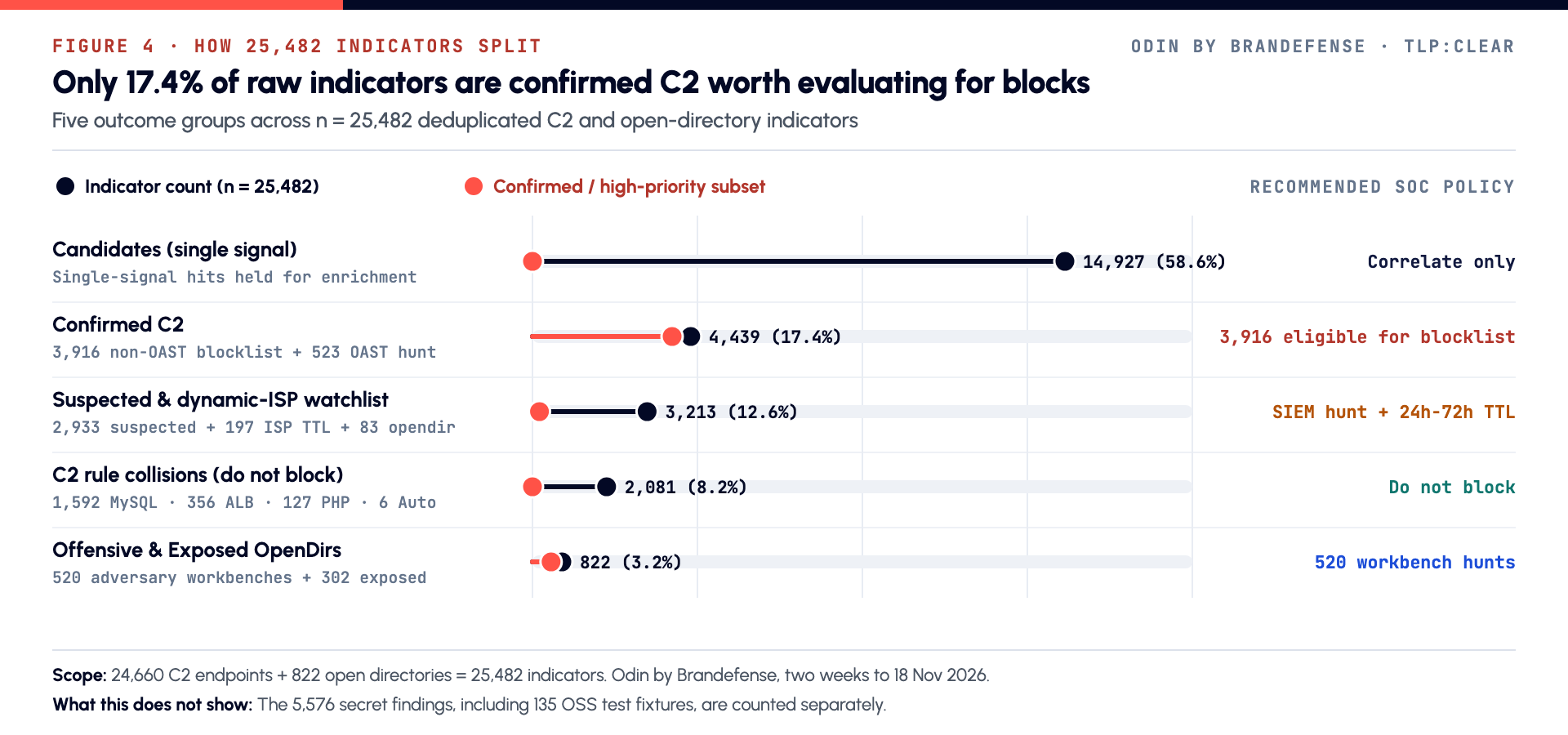
Of 25,482 raw indicators, 17.4% are confirmed C2 and 15.4% are fit for a block list. Before any checks, false-positive rates in four frameworks ran from 9.7% to 94.5%.
Where the 25,482 indicators land
The dataset holds 24,660 C2 endpoints and 822 open directories. Most of it is not safe to block.
| Outcome | Indicators | Share | Recommended handling |
|---|---|---|---|
| Candidates with a single signal | 14,927 | 58.6% | Correlate only; never block |
| Confirmed C2 | 4,439 | 17.4% | 3,916 to block; 523 dual-use Interactsh servers to hunting |
| Suspected C2 and short-life watchlist entries | 3,213 | 12.6% | SIEM watchlist; 24 to 72 hours for subscriber ISPs |
| C2 rule collisions on benign servers | 2,081 | 8.2% | Do not block; keep as regression tests |
| Offensive and exposed open directories | 822 | 3.2% | 520 adversary workbenches to hunt; 302 exposed directories to watch |
The 3,916 block-ready indicators (15.4%) are confirmed C2 that a separate signal corroborates. The 523 Interactsh servers (2.1%) are real OAST servers, but OAST is a dual-use testing tool. They go to hunting unless independent hostile-callback evidence appears.
The 3,213 watchlist entries are 2,933 suspected C2, 197 dynamic ISP hits and 83 candidates that share a host with an open directory.
False-positive rates before any checks
The table below shows how collisions distort four raw framework feeds. "Raw actionable" counts rows labelled confirmed or suspected before any check runs.
| Framework label | Total rows | Raw actionable | Collisions | Actionable false-positive rate | Confirmed C2 after checks |
|---|---|---|---|---|---|
daybreak | 1,686 | 1,684 | 1,592 | 94.5% | 71 |
ezxss | 252 | 177 | 127 | 71.8% | 2 |
interactsh | 1,600 | 994 | 356 | 35.8% | 523 (dual-use, to hunting) |
emotet | 62 | 62 | 6 | 9.7% | 28 |
Two lessons follow. A feed that ships raw Daybreak or Interactsh detections delivers 94.5% MySQL handshakes or 35.8% AWS load balancers. And even after collisions are removed, the 523 Interactsh servers are testing infrastructure, so they belong in hunting rather than on a block list.
Residential and mobile networks need short lifetimes
A permanent IP block also fails when the C2 host sits on a dynamic subscriber pool. In our data, 197 endpoints did: 112 confirmed and 85 suspected, on 161 unique IPs. The frameworks were Mozi, Gh0st RAT, TacticalRMM, Brute Ratel C4 and Daybreak.
The networks were Chinanet, China Unicom, Deutsche Telekom AG, Chunghwa Telecom, Globofiber Telecom and Comcast. Carrier DHCP leases vary, and a subscriber address can pass to a new household without notice.
| Example (address withheld) | Network | Status | Watchlist lifetime |
|---|---|---|---|
| TacticalRMM listener on port 1024 | Globofiber Telecom (BR) | Confirmed | 72 hours |
| Mozi botnet peer on port 443 | Chinanet (CN) | Suspected | 24 hours |
| Gh0st RAT listener on port 8443 | Chunghwa Telecom (TW) | Suspected | 24 hours |
| Brute Ratel C4 on port 8081 | China Unicom (CN) | Suspected | 24 hours |
These addresses are not published, because they may belong to unrelated households by the time a reader sees them.
What separates real C2 from a collision
Every collision in this report fails at least one of the checks below, and every confirmed C2 server passes them. No single check is enough. A server is treated as confirmed C2 only when several independent signals agree.
| Check | Real C2 tends to show | A collision tends to show |
|---|---|---|
| Certificate chain | Self-signed certificate, issuer equals subject | A private enterprise sub-CA or an Amazon ACM chain |
| TLS error behaviour | Short 400 or 404 to a payload-less POST | "No required SSL certificate was sent": a mutual-TLS gateway |
| Application reflection | Interactsh reflects the correlation ID and answers /register on several ports | A default awselb/2.0 answer with no reflection |
| Application markers | ezXSS /manage/login, <title>ezXSS, ezxss.js collector | A plain PHP version header and a session cookie |
| Protocol framing | A C2 check-in on a non-database port | MySQL greeting byte 0x0a and an auth plugin name on 3306 |
| Network type | Stable hosting or VPS network | Residential or mobile subscriber pool: watch briefly, do not block |
| File context | Live session state in an agent folder | Test folders, skill docs, prompt archives, known example keys |
A positive hostile signal always wins. If a server shows a benign stack and also a real C2 beacon, panel or payload, it goes to analyst review rather than being cleared.
6. What Defenders Should Do
Within 24 hours
- Stop SOAR and firewall playbooks from auto-blocking on a single signal or a score alone.
- Remove any port-3306 Daybreak, header-only ezXSS, JARM-only Interactsh and HTTP-400-only Emotet indicators from automated block jobs.
- Block the eight confirmed C2 endpoints listed in Chapter 8.
Within 72 hours
- Restrict auto-blocking to confirmed C2 on stable hosting that carries a second, framework-specific signal.
- Route Interactsh and other OAST servers to a 7-day hunting queue unless hostile callbacks are seen.
- Put C2 hits on residential and mobile networks on watchlists that expire after 24 hours (suspected) or 72 hours (confirmed).
Within 7 to 30 days
- Add certificate issuer checks and mTLS rejection checks to feed ingestion.
- Add MySQL handshake detection and ezXSS panel markers to C2 enrichment.
- In secret scanning, check live
.claude,.cursor,.codex,.openclawand.hermessession paths first. Then filter/tests/, skill docs, prompt archives and known example keys. - Load the six do-not-block placeholder endpoints from the Sentinel rule into staging, plus the three named fixtures in Chapter 8. Confirm that none of them raises a block or an alert.
- Never fix a collision by allowlisting a whole cloud network. Add exact, verified partner PKI domains instead.
7. Detection Rules
The full rules are in the Detection rules tab. Each file pairs a positive C2 signal with an explicit exclusion for the collision classes in this report.
| Rule file | What it catches |
|---|---|
odin_c2_collision_safe.rules | Suricata 7: eight signatures for Emotet, Interactsh, ezXSS and Daybreak, plus a MySQL guardrail that keeps port 3306 handshakes out of C2 alerts |
sentinel_ti_feed_collision_guardrail.kql | Microsoft Sentinel and Defender XDR: filters a threat-intel feed for the collision classes and short ISP lifetimes, then matches it against outbound connections |
sigma_soar_blocklist_enterprise_pki_safeguard.yml | Sigma (3 rules): uncalibrated SOAR auto-block jobs, scripts connecting to confirmed C2, and suspicious reads of live AI agent credential stores |
odin_benign_fixture_vs_live_c2_disambiguator.yar | YARA (4 rules): Emotet, Interactsh, ezXSS and Daybreak C2 content, and live agent transcripts or Sliver operator logs, with fixture exclusions |
How the Suricata signatures work
| SID | Looks for | Why |
|---|---|---|
| 9513001 | The Emotet-associated certificate issuer CN=greenedgewealth-zesle, excluding sub-CA and Amazon RSA issuers | Hunt lead; pair with HTTP or endpoint evidence |
| 9513002 | An Emotet Epoch 4/5 style encoded POST to /wp-admin/ with a PHPSESSID cookie | Hunt lead; confirm with the process that sent it, such as rundll32.exe or regsvr32.exe |
| 9513003 | The Interactsh HTML banner in a 200 response | Finds OAST servers; load balancers do not serve this banner |
| 9513004 | Interactsh /poll?id= requests with an Authorization header | Finds internal hosts polling an OAST server |
| 9513005 | The ezXSS collector script /assets/js/ezxss.js with document.cookie and localStorage | Real ezXSS content, safe against PHP 8.5 header drift |
| 9513006 | <title>ezXSS with /manage/login | The ezXSS operator panel |
| 9513007 | A Daybreak check-in POST to /api/v1/daybreak/ with an X-Daybreak-Node: header | Real Daybreak C2, skipped on flows marked as MySQL |
| 9513008 | A MySQL handshake from port 3306 (byte 0x0a and an auth plugin name) | Sets a flag without alerting, so later rules can skip the flow |
The Interactsh signatures (9513003 and 9513004) find a dual-use tool. Treat their hits as hunting leads. To exclude an authorized internal OAST server, add a local pass rule for its exact /32 address rather than disabling the signature.
How the other rules work
The KQL query reads the ThreatIntelIndicators table over 14 days and keeps only active, non-revoked IPv4 indicators. It then drops the four collision patterns. These are Daybreak on 3306 with a MySQL handshake, low-score ezXSS with a PHP 8.5 header, mTLS rejections from an exact partner hostname, and Interactsh on an AWS load balancer.
Each drop applies only when the feed carries no hostile evidence, and a missing enrichment field never drops a row. The query then enforces a lifetime per indicator type, including 72 hours for confirmed and 24 hours for suspected subscriber ISP hits. Confidence cut-offs are parameters; set them to your feed's own scale. Finally it joins the result to DeviceNetworkEvents over 7 days.
The first Sigma rule fires when a SOAR job pushes a firewall or EDR block for a risky indicator. That covers port-3306 Daybreak, suspected Amazon-hosted hits, candidates, known collisions, dynamic ISP hits and dual-use OAST servers. The second fires when a scripting or system process connects to confirmed C2, with partner mTLS and load-balancer exclusions. The third fires when an archive, transfer or scripting process reads a live AI agent credential store, while ignoring static skill and prompt files.
Each YARA rule needs complete positive C2 or live-session evidence before it fires. Fixture strings such as test paths and example keys act as exclusions, never as triggers.
The triage logic takes one feed record and returns an action. Its routing follows the checks in Chapter 5.
| What the record shows | Action |
|---|---|
| Confirmed C2 with a framework-specific hostile signal, on stable hosting | Block for 14 days |
| Uncorroborated self-signed C2, or a benign stack that also shows a hostile signal | Watchlist for 7 days, analyst review |
| Interactsh or other OAST server without hostile callbacks | Hunt for 7 days |
| C2 hit on a residential or mobile subscriber network | Watchlist for 24 or 72 hours |
| A verified benign stack (mTLS gateway, load balancer, PHP 8.5 header, MySQL handshake) and no hostile signal | Do not block |
| A test fixture or known example key, with no live session state | Do not alert |
The rules map to MITRE ATT&CK T1071.001 (Application Layer Protocol: Web Protocols) and T1583.006 (Acquire Infrastructure: Web Services).
8. Indicators
The Indicators tab lists the eight confirmed C2 endpoints. The other records in this chapter are described but not published.
| Type | Count |
|---|---|
| Confirmed C2 endpoints to block (IP and port) | 8 |
| Exposed Sliver operator workbench, hunt only | 1 (address withheld) |
| Interactsh OAST servers, hunt only | 3 (addresses withheld) |
| Dynamic subscriber ISP examples, short watchlist | 4 (addresses withheld) |
| Secret-finding digests (withheld: they derive from exposed user data) | 3 |
| Do-not-block regression samples | 9 (6 placeholder endpoints in the Sentinel rule, 3 named fixtures) |
Confirmed C2 endpoints to block
| Endpoint | Label | Hosting (country) | Key fingerprint |
|---|---|---|---|
| 64.227.189[.]225:443 | Emotet | DigitalOcean (IN) | Self-signed CN=greenedgewealth-zesle, JARM 29d29d15d..579afa |
| 128.199.131[.]70:443 | Emotet | DigitalOcean (SG) | Self-signed CN=serv-01.nexgeninter[.]net, JARM 29d29d15d..579afa |
| 167.71.229[.]25:443 | Emotet | DigitalOcean (IN) | Self-signed CN=Callsign, JARM 29d29d15d..579afa |
| 95.156.207[.]122:80 | ezXSS | M247 Europe (DE) | CN=xss.retr023[.]xyz, collector panel |
| 201.79.4[.]122:80 | ezXSS | DigitalOcean (DE) | CN=a.fgeio[.]com, collector panel |
| 188.68.60[.]39:20000 | Daybreak | netcup (DE) | Also active on 80 and 443 |
| 46.105.117[.]146:443 | Daybreak | OVH (FR) | Self-signed CN=radeau |
| 103.137.250[.]153:1501 | Daybreak | CLODO (NL) | CN=keitaro.2 on 1500 and 1501 |
Cloud VPS addresses can be reassigned after a takedown. Re-check that the listener is still active before you extend a block past 14 days.
Hunt and regression records
Three secret-finding digests trace a Sliver stager address and two live AI agent credential exposures. They are withheld, because they derive from exposed user data.
The nine do-not-block samples cover all five collision classes. Six are placeholder addresses from the non-routable documentation ranges, one per benign stack, listed as CollisionCanaryIps in the Sentinel rule. Three are known fixtures, named rather than hashed: the AWS documentation example key, a skill-doc placeholder and the PyCryptodome self-test loader. Use them to test that your ingestion filters clear every collision class.
Withheld: the automaker, state agency and cloud customers behind the collisions, all 1,958 benign collision hosts, the Sliver workbench, the three Interactsh servers, the dynamic ISP addresses, and the hosts behind the secret findings.
9. Scope and Limits
- Window. The findings cover a two-week observation window ending 18 November 2026. The collisions were seen between 13 and 18 November 2026.
- External view only. All findings come from handshakes, certificates, HTTP headers and open directories visible from the internet. No customer logs were used.
- Modeled impact. The service risks of a false block are modeled from the protocols and owners involved. We did not see any actual block or outage.
- Feed labels are not attribution. Framework names such as Daybreak and Emotet come from detection feeds. A collision row says nothing about the benign owner's intent.
- Dual-use is not hostile. The 523 Interactsh servers run a legitimate testing tool. Some may belong to authorized testers.
- Counts, not trends. The data supports counts in the window, not growth or decline over time.
- Rule testing. Every published rule file loads without errors in its engine (Suricata 7.0.12, YARA-X, pySigma and Microsoft's Kusto.Language analyzer, checked on 20 November 2026). The rules were not replayed against live traffic, so test and tune them in your own environment before production use.
10. Sources
- Salesforce. JARM active TLS server fingerprinting. https://github.com/salesforce/jarm (verified 18 November 2026)
- ProjectDiscovery. Interactsh OAST server. https://github.com/projectdiscovery/interactsh (verified 18 November 2026)
- Nginx.
ngx_http_ssl_module,ssl_verify_client. https://nginx.org/en/docs/http/ngx_http_ssl_module.html#ssl_verify_client (verified 18 November 2026) - IETF. RFC 8446, The Transport Layer Security (TLS) Protocol Version 1.3. https://datatracker.ietf.org/doc/html/rfc8446 (verified 18 November 2026)
- Amazon Web Services. Create an HTTPS listener for your Application Load Balancer. https://docs.aws.amazon.com/elasticloadbalancing/latest/application/create-https-listener.html (verified 18 November 2026)
- The PHP Group. Core
php.inidirectives,expose_php. https://www.php.net/manual/en/ini.core.php#ini.expose-php (verified 18 November 2026) - Oracle MySQL.
Protocol::HandshakeV10. https://dev.mysql.com/doc/dev/mysql-server/latest/page_protocol_connection_phase_packets_protocol_handshake_v10.html (verified 18 November 2026) - Oracle MySQL. Creating SSL and RSA certificates and keys using MySQL. https://dev.mysql.com/doc/refman/8.4/en/creating-ssl-rsa-files-using-mysql.html (verified 18 November 2026)
- NIST. SP 800-150, Guide to Cyber Threat Information Sharing. https://csrc.nist.gov/pubs/sp/800/150/final (verified 18 November 2026)
- MITRE ATT&CK. T1071.001 Application Layer Protocol: Web Protocols. https://attack.mitre.org/techniques/T1071/001/ (verified 18 November 2026)
- MITRE ATT&CK. T1583.006 Acquire Infrastructure: Web Services. https://attack.mitre.org/techniques/T1583/006/ (verified 18 November 2026)
What is…?
Short explanations of the tools and families named in this study.
What is Interactsh?
Interactsh is ProjectDiscovery's open-source OAST server and client for catching DNS, HTTP and other callbacks.
More about InteractshDetection heuristicWhat is Daybreak?
Daybreak is a public JA4X-based C2 heuristic. On port 3306 it also matches ordinary MySQL servers, which makes it a well-known source of false positives.
More about DaybreakOffensive toolWhat is ezXSS?
ezXSS is an open-source collector for blind cross-site scripting (XSS) payloads. It records pages where a payload fires.
More about ezXSSMalware loaderWhat is Emotet?
Emotet is a long-running modular malware loader and botnet spread by malicious email attachments. It was disrupted by law enforcement in 2021 and later resurfaced.
More about EmotetTechniqueWhat is OAST?
Out-of-band application security testing (OAST) detects blind vulnerabilities by making a target call back to a server the tester controls, usually over DNS or HTTP.
More about OASTTechniqueWhat is JARM?
JARM is an open TLS server fingerprinting method from Salesforce. It hashes how a server answers a set of crafted TLS handshakes.
More about JARMFrequently asked questions
Why do feeds get this wrong?
Each of these rules matched one surface trait. That trait might be a TLS fingerprint, an HTTP status code, a response header or an open port. Those traits describe server software, not intent. Thousands of legitimate servers share each one with some C2 framework.
Which collisions are the most dangerous?
The highest-scoring ones. One automaker gateway was labelled confirmed Emotet at a raw score of 97. The 356 load balancers scored 89. Many SOAR playbooks auto-block anything above a fixed score, so these are the hits most likely to become real blocks.
How much of a raw feed is safe to block?
Less than one in six indicators. Of 25,482 raw indicators, 4,439 (17.4%) are confirmed C2. Of those, 3,916 (15.4%) are fit for a block list. The other 523 are real Interactsh servers, but Interactsh is a dual-use testing tool, so they belong in hunting.
What about secret scanners?
The same problem shows up in secret scanning. Of 5,576 secrets and callback strings found in exposed directories, 135 were false alarms. Of those, 41 were rated critical. They came from unit tests that use AWS's published example key AKIAIOSFODNN7EXAMPLE, from AI skill tutorials with placeholder passwords, and from public prompt archives. One was a standard Python cryptography self-test file.
What separates real C2 from a collision?
Real C2 passes several independent checks at once. A collision fails at least one.