


1. Executive Summary
In short
In a two-week observation window ending 18 November 2026, Odin by Brandefense studied two unlinked attacker workbenches and 2,049 scanner and suspected VShell endpoints. One server held 719 files: hospital portal maps, internal console login tests and VShell implant stagers. The other listed 12 file paths for portal bypass, password-hash edits and split Global Socket relays. No VShell endpoint is confirmed. Block the first workbench, hunt for the second one's file markers, keep dual-use scanners on watchlists, and alert on Global Socket relay lookups and VShell WebSocket traffic.
This report looks at the tools that sit between a first scan and lasting access. It covers internet-wide asset scanners, web portal attack scripts, and two covert access tools: VShell, a WebSocket-based remote access implant, and Global Socket (gsocket), a relay that tunnels shells through public servers. Nothing in the data links the two workbenches or the scanner fleets to one actor.
A 719-file workbench mixes hospital portal mapping, console login tests and VShell stagers.
The server 189.24.105[.]131 exposed an open directory on port 8899. It held port scans, cached maps of hospital web portals and scripts scraped from a hospital information system. Its own access log records two outside hosts downloading a Windows VShell agent.
File names on a second workbench point to portal bypass and relay kits.
On a second server (port 8088, address withheld), 12 file paths and 16 secret and command-and-control matches suggest tools for bypassing content management system (CMS) logins and editing password hashes. Other paths point to a Global Socket binary split into chunks. Script bodies were not available, so these capabilities are inferred.
No VShell endpoint is confirmed, and most scanner consoles are dual-use.
We count 769 VShell endpoints: 282 suspected and 487 candidates. Alongside them sit 425 ARL, 422 Nessus, 397 Acunetix and 36 reNgine consoles. Legitimate security teams use these scanners too, so they belong on watchlists, not block lists.
Three Decisions for Leaders
- Watch for covert relay and WebSocket channels. Alert on outbound WebSocket upgrades to ports 9999, 8084 and 9097, and on DNS lookups for
*.gs.thc[.]org. Tie each alert to the process that made it. - Protect portals against hash edits and split-binary uploads. Audit CMS user tables for unexpected password-hash changes. Remove web file-manager plugins, and alert when a web server process starts shell scripts or
mountover/proc. - Separate active scanning from exposed scanner consoles. Rate-limit inbound ARL, reNgine and Acunetix bursts at the perimeter. Put exposed scanner consoles on watchlists instead of block lists.
The Study in Numbers
| Number | What it is |
|---|---|
| 719 | Files across 25 extensions on workbench 189.24.105[.]131:8899 |
| 12 | File paths on Workbench 2 (port 8088), with 16 secret and command-and-control matches |
| 769 | VShell endpoints on 685 IPs: 0 confirmed, 282 suspected, 487 candidates |
| 425 | ARL (Asset Reconnaissance Lighthouse) endpoints on 413 IPs, led by port 5003 |
| 819 | Exposed Acunetix (397) and Nessus (422) scanner consoles, owners unknown |
| 2,049 | Scanner and VShell endpoints in all, on 1,882 IPv4 addresses |
| 4 | Published indicators: 1 workbench host to block and 3 SHA-256 hashes |
How to use this report.
Security leaders can read Chapter 1, Chapter 6 and Chapter 7. Healthcare IT and portal administrators should read Chapters 4 and 5. SOC and detection engineers should start with Chapters 3, 8 and 9.
2. How the Pieces Fit: A Four-Role Model
In short
The two workbenches and the scanner fleets are separate observations. We group them into four roles, from surface mapping to covert access, to show where defenders can see each step. This grouping is an analytical model, not a known operation.
No shared operator identifier, target domain or network handoff links 189.24.105[.]131, Workbench 2 and the scanner fleets. We place their tools side by side because each covers a different stage of an intrusion. Nothing here shows that any target was breached.
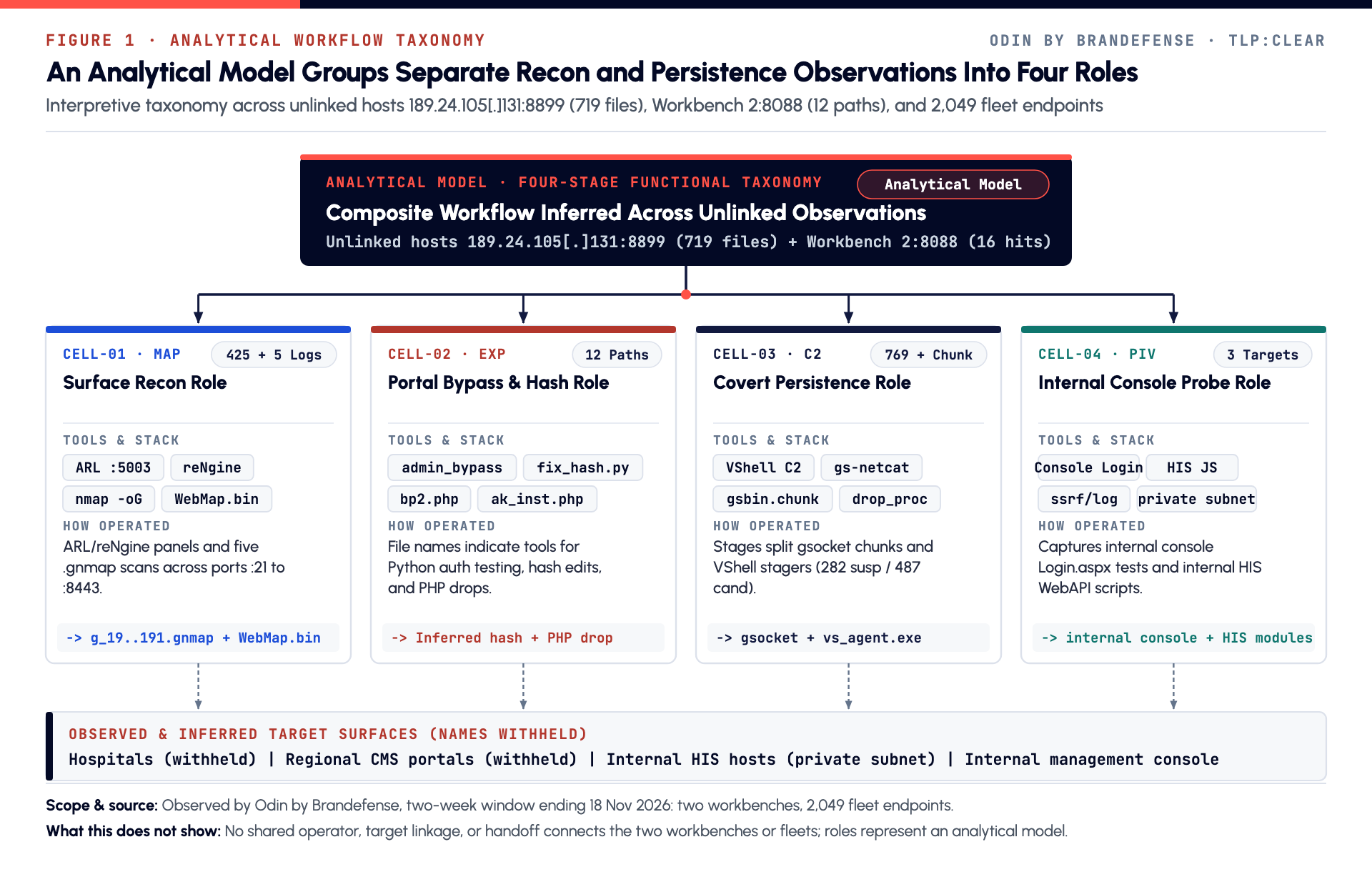
The four roles in the model are listed below.
| Role | What it does | Main evidence |
|---|---|---|
| Surface recon | Finds subdomains, open ports and login pages | Five nmap -oG scan files and hospital web-map caches on port 8899; ARL panels on 5003 and reNgine panels on 8082 |
| Portal bypass and hash edits | Tests CMS logins, edits password hashes, drops PHP files | 12 file paths and 16 matches on port 8088 |
| Covert persistence | Keeps access through relays and implants | Split Global Socket paths on port 8088; VShell agent downloads on port 8899; 769 suspected or candidate VShell endpoints |
| Internal console probing | Tests logins on internal management consoles | Login test captures and scraped hospital system scripts from a private 10.x subnet, stored on port 8899 |
What we studied
| Cluster | Scope | Endpoints or files | Status | Role |
|---|---|---|---|---|
| Workbench 1: hospital recon and VShell | 189.24.105[.]131 port 8899, plus suspected 8082 and 8086 and candidate 8091 and 8093 | 719 files | Block, strong evidence | Port scans, hospital web maps, internal console tests, VShell stagers |
| Workbench 2: portal and Global Socket kit | Port 8088, address withheld | 12 paths | Hunt file markers | CMS bypass, hash edits, PHP drops, Global Socket chunks |
| VShell fleet | 685 IPs | 769 | Hunt and watch | WebSocket listeners on 9999 (227), 8084 (71), 9097 (68) |
| ARL fleet | 413 IPs | 425 | Watchlist | Subdomain, port and web fingerprint discovery, mostly on 5003 (282) |
| Nessus fleet | 394 IPs | 422 | Watchlist | Vulnerability assessment consoles, mostly on 8834 (316) |
| Acunetix fleet | 363 IPs | 397 | Watchlist | Web vulnerability scanners on 3443 (205), 7880 (58), 13443 (27) |
| reNgine fleet | 27 IPs | 36 | Watchlist | Container recon pipelines (nuclei, httpx, subfinder), mostly on 8082 (18) |
How the stages could connect
- Surface mapping. On port 8899, five greppable Nmap scans list hospital portals, VPN gateways on 1723 and admin web ports such as 8080 and 8443. ARL and reNgine automate the same kind of discovery.
- Portal testing. On port 8088, file names point to Python login-bypass and hash-edit scripts (
fix_hash). They sit next to PHP uploaders (bp2.php,ak_inst.php). - Persistent access. Port 8088 also lists a chunked Global Socket binary (
gsbin.chunk.ac). On port 8899, the access log records downloads ofvs_agent.exe, and Linux VShell stagers sit in the same directory.
3. The Toolchain and Where Defenders See It
In short
Five tool families span asset discovery, portal script staging and covert relay delivery. Each leaves file names or network markers that defenders can hunt.
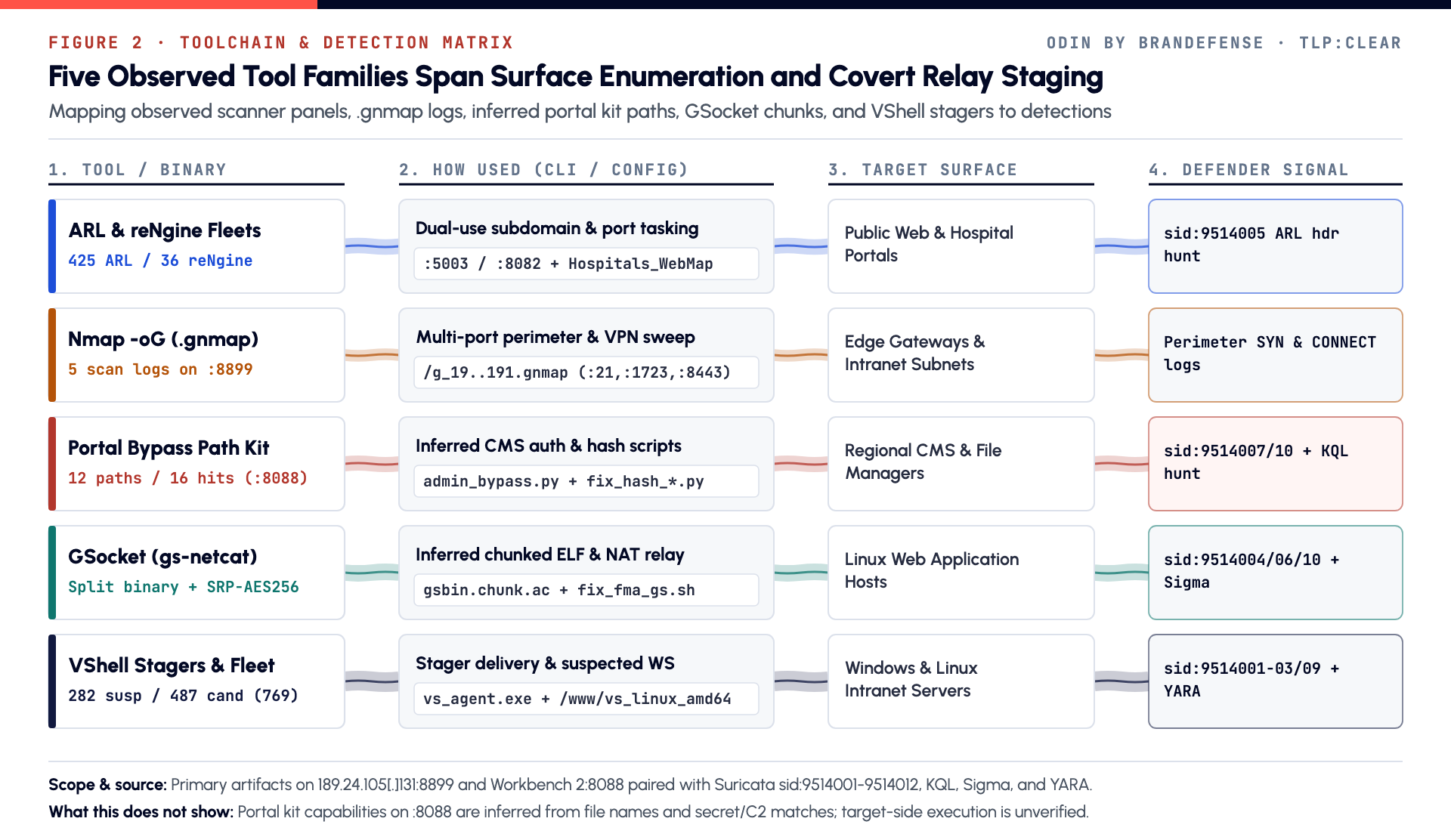
The five tool families
| Tool family | How it is used | Where it shows up | Defender signal |
|---|---|---|---|
| ARL and reNgine | Dual-use subdomain and port discovery | Panels on 5003 and 8082 | ARL HTTP header markers, inbound scan bursts |
| Nmap greppable output | Multi-port sweeps of the perimeter and VPN gateways | Five .gnmap files on port 8899 | Perimeter SYN and CONNECT logs |
| Portal bypass kit | Inferred CMS login and hash scripts | admin_bypass.py, fix_hash_*.py on port 8088 | Script-name fetches, web workers starting shells |
Global Socket (gs-netcat) | Inferred chunked binary and NAT-traversal relay | gsbin.chunk.ac, fix_fma_gs.sh on port 8088 | *.gs.thc[.]org DNS lookups, chunk writes on disk |
| VShell | Stager delivery and suspected WebSocket listeners | vs_agent.exe, /www/vs_linux_amd64 on port 8899 | Stager downloads, WebSocket upgrades on high ports |
ARL is an open-source asset discovery platform. Its console listens on HTTPS port 5003 by default. reNgine is an open-source recon framework that chains tools such as subfinder, httpx and nuclei in containers.
What each stage leaves behind
| Stage | Artifacts on the workbenches | How it works | Why defenders miss it |
|---|---|---|---|
| Surface mapping | /g_19.gnmap, /g_179.gnmap, /g_184.gnmap, /g_187.gnmap, /g_191.gnmap | Greppable sweeps across FTP, SSH, HTTP and HTTPS, PPTP (1723) and alt-HTTPS (8443) | Firewalls log routine SYN noise without linking it to later login probes |
| Sector web caching | /pg_Hospitals_Main_WebMap.bin, /pg_Interactions_HospitalMails.bin, /logon.html | Stored copies of hospital login pages and mail endpoints (112 to 132 KB caches) | Page scraping looks like normal browser GET traffic |
| Portal login and hash scripts | Portal-named _admin_bypass.py and fix_hash_*.py | File names suggest admin bypass and CMS password-hash edits | Endpoint tools rarely watch SQL updates in CMS user tables |
| Split-binary relay kit | /gsbin.chunk.ac, /fix_fma_gs.sh, /drop_proc.sh | File names suggest rebuilding a chunked gs-netcat binary and hiding processes under /proc | Native gs-netcat resolves *.gs.thc[.]org and sends no TLS SNI on port 443 |
| WebSocket stager delivery | /http8899.log, /vs_agent.exe, /www/vs_linux_amd64, /st_5_linux_amd64 | Python http.server hands out a Windows agent and 9,800-byte Linux ELF stagers | A long-lived WebSocket tunnel looks like normal web app streaming |
4. Workbench 2: Portal Bypass and a Split Global Socket Kit
In short
Workbench 2 lists 12 file paths on port 8088 and carries 16 secret and command-and-control matches. The names point to CMS login tests, password-hash edits and a Global Socket relay split into chunks.
All portal names on this server are withheld. Script bodies were not available, so everything in this chapter rests on file paths and the secrets and endpoints found in them. We did not see any script run against a target, and we did not see any database change.
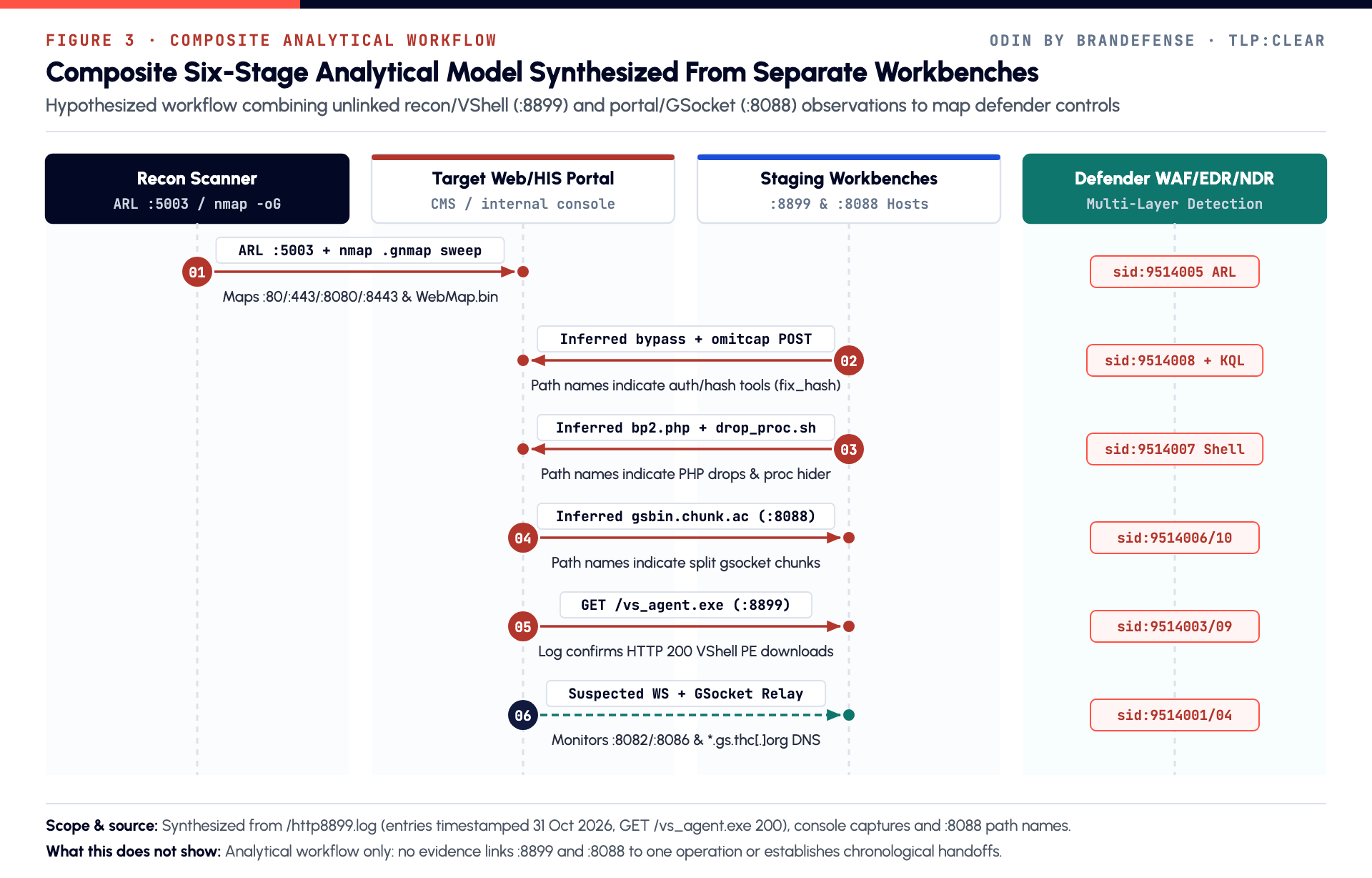
Figure 3 combines both workbenches into one six-stage model. It shows where perimeter and host controls can catch each step. It is a model, not a timeline: nothing links port 8899 and port 8088 to one operation.
What the 16 matches are
The files on port 8088 contain 16 secret and command-and-control matches.
| Match type | Count |
|---|---|
| Command-and-control endpoint references | 9 |
| Generic passwords | 6 |
| Square payment API token | 1 |
The 12 paths in three groups
| Inferred group | Paths (portal names withheld) | What the names suggest |
|---|---|---|
| 1. Portal bypass and hash scripts | Four portal-named Python scripts: an admin-bypass script, a hash-fix script (fix_hash_*.py) and two exploit helpers | Testing portal login flaws and editing or restoring CMS password hashes |
| 2. Webshell and process helpers | /ak_inst.php, /bp2.php, /drop_shells.sh, /drop_proc.sh | Secondary PHP webshell droppers and a Linux process-hiding script |
| 3. Split Global Socket relay kit | A portal-named _gs_deploy.php, /fix_fma_gs.sh, a portal-named gs_*.sh, /gsbin.chunk.ac | A gs-netcat binary split into gsbin.chunk.* parts, and file manager (fma) helpers for an encrypted relay shell |
Six of the file names carry a specific portal's name. Together with the live secrets, this weighs against a generic open-source test fixture. It does not rule out a research lab, a malware sandbox or a decoy server.
Why split the relay binary
Global Socket lets two machines connect through public relay servers, even behind NAT. It encrypts sessions with SRP and AES-256. Normally an attacker installs it with a bootstrap script from gsocket[.]io.
Splitting the gs-netcat binary into small chunks would avoid that download. Small chunks can also slip under CMS file-manager upload limits (upload_max_filesize) and static ELF signature scans. A helper script (fix_fma_gs.sh) would then join the chunks on the server.
Once running, native gs-netcat looks up relay hosts under *.gs.thc[.]org. It starts its encrypted session without a TLS SNI value. Both traits help defenders: the DNS lookup is easy to log, and a missing SNI on port 443 is unusual.
The name drop_proc.sh suggests a process-hiding helper. A common Linux trick binds an empty directory over /proc/<pid> with mount --bind, so tools such as ps no longer list the process.
5. Workbench 1: Hospital Recon and VShell Staging
In short
Workbench 189.24.105[.]131:8899 in Germany exposes 719 files on a Python 3.12 web server. It holds hospital reconnaissance files, login tests against an internal console and VShell implant downloads.
The server sits on NetLab Global (DE). It runs an open Python 3.12 http.server on port 8899. The same address also shows two suspected VShell listeners (8082, 8086) and two candidate ones (8091, 8093).
All hospital names, portal addresses and the addresses of hosts that downloaded files are withheld. How the downloading hosts relate to the hospital targets is unknown.
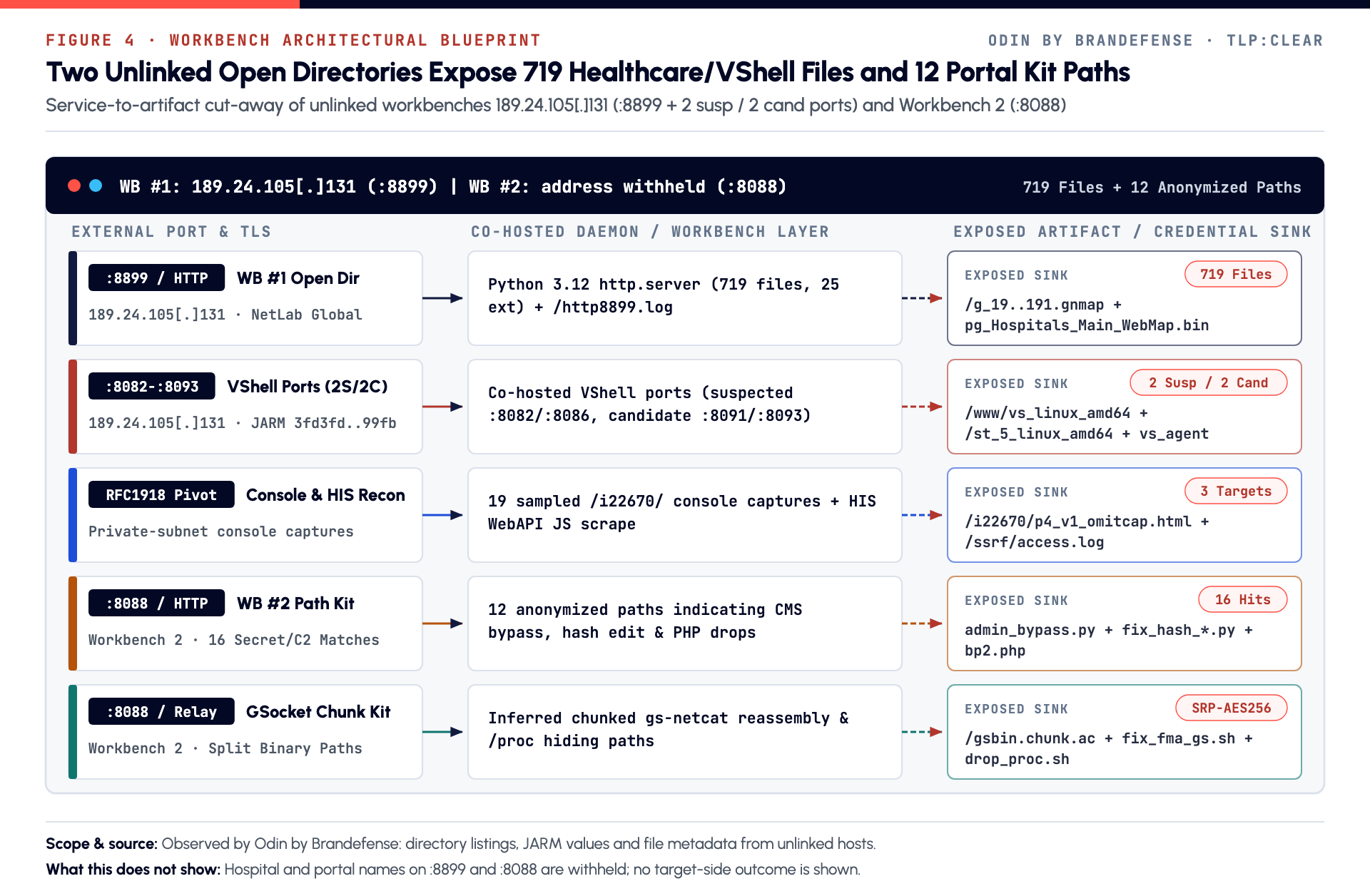
What the 719 files are
The 719 files span 25 extensions. JavaScript scraped from target management interfaces makes up 39.6% of them.
| Extension group | Files | Share | Example | Role |
|---|---|---|---|---|
.js | 285 | 39.6% | Scraped HIS module scripts (names withheld) | Hospital information system and app-management UI modules |
.txt and .out | 102 | 14.2% | /i22670/resp_post_dummy.txt, /i21706_scan.out | Captured HTTP POST responses (58 .txt) and scan outputs (44 .out) |
.py and .sh | 91 | 12.7% | Python recon and replay scripts | Login replay scripts (56 .py) and Unix staging wrappers (35 .sh) |
.html and .body | 53 | 7.4% | /i22670/p4_v1_omitcap.html, /logon.html | Hospital login captures and console CAPTCHA-omission test pages (39 .html, 14 .body) |
.bin and no extension | 68 | 9.5% | /pg_Hospitals_Main_WebMap.bin, /www/vs_linux_amd64 | Hospital web maps (34 .bin) and 9,800-byte Linux ELF stagers (34 without extension) |
.hdr, .http, .https | 39 | 5.4% | HTTP header captures | Raw request templates and response header dumps |
.log, .json, .err | 41 | 5.7% | /http8899.log, /ssrf/access.log, /kharon_deps.log | Delivery logs (15 .log), payload JSON (16) and scan error logs (10) |
.exe, .gnmap and 8 others | 40 | 5.6% | /vs_agent.exe, /g_19.gnmap | 13 Windows PE files, 5 .gnmap scans, 2 .ps1, 2 .pem, plus .tmp, .png and .gz |
Hospital portals and internal systems
The server stores two compiled web-map caches of hospital portals and a copy of one hospital login page (/logon.html). Subfolders /i21931/ and /i22001/ hold scripts scraped from a hospital information system (HIS). They include a password input module and an SSH host management module.
Some of these scripts came from internal web APIs on a private 10.x subnet, on ports 8099 and 8081. That means the operator could reach, or had copies from, systems that should not face the internet.
The folder names, such as /i21931/ and /i22670/, look like engagement or ticket numbers. We do not treat that as proof of an authorized test, for reasons set out in Chapter 6.
Login tests against an internal console
Subfolder /i22670/ holds 19 files from an internal ASP.NET management console. Its login page sits on the same private subnet; the path is withheld.
| File type | Count | Detail |
|---|---|---|
.html login captures | 17 | 16 Login.aspx variants of 89,656 to 89,670 bytes, plus post_dummy_saved.html (88,424 bytes) |
.txt response | 1 | resp_post_dummy.txt |
.body capture | 1 | r_masterjs.body |
The file names p4_v1_omitcap.html, p4_v2_capempty.html and p4_v3_evttarget.html point to three tests. They drop the CAPTCHA field, send it empty, and replay the ASP.NET __EVENTTARGET postback. A server-side request forgery (SSRF) callback log, /ssrf/access.log (60,550 bytes), sits next to them.
What the delivery log records
The file /http8899.log (120,784 bytes) is the server's own access log. It mixes implant downloads with internet proxy noise.
- Windows agent downloads. Five
GET /vs_agent.exe HTTP/1.1entries carry timestamps on 31 October 2026, in server time with no recorded time zone. Two outside hosts received HTTP 200 responses. Their addresses are withheld. - Proxy noise. Four minutes later, opportunistic proxy scanners received HTTP 501
Unsupported method ('CONNECT'). - Linux stagers. Two 9,800-byte Linux AMD64 binaries sit on the server,
/www/vs_linux_amd64and/st_5_linux_amd64. Cross-compilation logs (/mingw_install.log,/kharon_deps.log) sit beside them.
The log shows that files were served. It does not show what the downloading hosts did with them.
The co-hosted VShell ports
| Port | Status | Detail |
|---|---|---|
| 8082 | Suspected VShell | Seen 13 November 2026 |
| 8086 | Suspected VShell | Same host |
| 8091 | Candidate VShell | JARM 3fd3fd00000000000043d43d00043dc3b2afa8a5ec09b510a8559aff7899fb |
| 8093 | Candidate VShell | Same JARM as 8091 |
JARM is a fingerprint of how a server answers TLS handshakes. A shared JARM across two ports suggests the same software stack.
6. Scanner Fleets and the Dual-Use Problem
In short
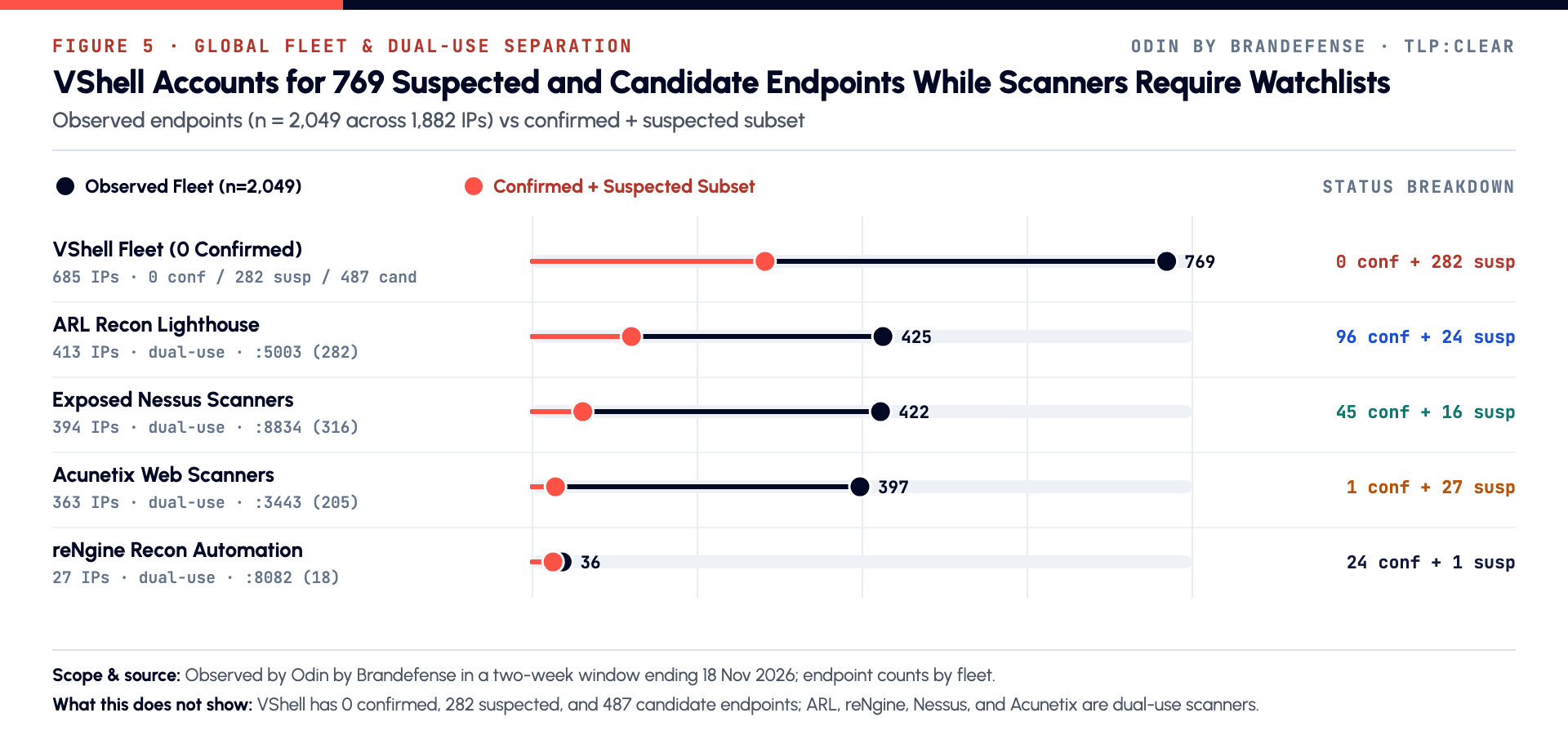
Of 2,049 endpoints on 1,882 IPv4 addresses, 769 are suspected or candidate VShell nodes. The rest are ARL, Nessus, Acunetix and reNgine consoles that legitimate teams also run, so they need watchlists, not blocks.
The five fleets
| Fleet | Endpoints (IPs) | Confirmed / suspected / candidate | Top ports | Top countries |
|---|---|---|---|---|
| VShell | 769 (685) | 0 / 282 / 487 | 9999 (227), 8084 (71), 9097 (68), 80 (21) | HK (270), CN (218), US (187) |
| ARL | 425 (413) | 96 / 24 / 305 | 5003 (282), 443 (95), 3389 (19) | CN (235), US (127), HK (46) |
| Nessus | 422 (394) | 45 / 16 / 361 | 8834 (316), 443 (42), 80 (19), 8000 (17) | US (136), CN (33), DE (31) |
| Acunetix | 397 (363) | 1 / 27 / 369 | 3443 (205), 7880 (58), 13443 (27) | US (83), FR (63), CN (50) |
| reNgine | 36 (27) | 24 / 1 / 11 | 8082 (18), 443 (9), 80 (5) | US (9), DE (8), FR (5) |
For the scanner fleets, "confirmed" means the product is confirmed. It does not mean hostile use. Who runs these consoles, and whether they are authorized, cannot be told from a banner.
Two watchlist samples sit at one hosting provider, SonderCloud Limited: a suspected VShell node on 9999 (HK) and an ARL console on 443 (US). One sample each does not show a regional pattern or a shared operator. Their addresses are withheld.
Could these be legitimate?
We tested four other explanations before recommending any block.
| Explanation | Workbench 1 (port 8899) | Workbench 2 (port 8088) |
|---|---|---|
| Authorized red team | Folder names look like engagement IDs, but the server is unauthenticated and serves implants to outside hosts | No sign of an engagement; portal-specific names and live secrets |
| Honeypot or decoy | Unlikely: real HTTP 200 implant downloads and co-hosted suspected VShell ports | Cannot be ruled out without script bodies or access logs |
| Research lab or sandbox | Unlikely for the same reasons | Cannot be ruled out |
| Open-source test fixture | Does not fit hospital-specific web maps | Six portal-named files weigh against it |
The verdict differs by server. Workbench 1 has strong evidence and belongs on a block list. Workbench 2 rests on file names only, and a research lab or honeypot cannot be ruled out. We withhold its address and recommend hunting for its file markers with the YARA rule. Declaring an active intrusion would need host or portal evidence.
How to tell scanners from implants
- Watch exposed scanner consoles. Nessus (8834), reNgine (8082), ARL (5003) and Acunetix (3443) consoles go on a watchlist. Rate-limit a source only when it also sends an inbound burst of 10 or more requests per second, or shares a host with an implant.
- Allowlist your own scanners narrowly. Exempt the egress addresses of your own attack surface tools and contracted testers, for scanning traffic only. Never let that allowlist hide a contact with a workbench, a split binary, a webshell or a hash edit.
- Do not act on one network signal. A single
*.gs.thc[.]orglookup orgsocket[.]ioconnection calls for a DNS and host investigation, not containment. An inbound scan or postback burst calls for a temporary WAF limit. - Contain a host only on two signals. A single stager file, chunk or
/procbind mount calls for an EDR investigation. A webshell drop calls for quarantine and a web root audit. A confirmed CMS hash change calls for isolating the portal and rotating hashes. Automatic containment needs at least two signals, one of them a file or process on the host.
7. What Defenders Should Do
Within 24 hours
- Block 189.24.105[.]131 (ports 8899, 8082, 8086). Hunt for the Workbench 2 file markers with the YARA rule.
- Alert on DNS lookups for
*.gs.thc[.]organd on TLS connections togsocket[.]io, and tie each to the host process. - Put exposed ARL, reNgine, Nessus and Acunetix consoles on watchlists, not block lists.
Within 72 hours
- Bind CAPTCHA checks to the server-side session on ASP.NET and hospital login pages. A postback with a missing or empty CAPTCHA field must fail.
- Audit CMS user tables for unexpected password-hash changes. Remove web file-manager plugins and mount upload folders
noexec. - Inspect outbound WebSocket upgrades to ports 8082, 8084, 9097 and 9999.
Within 7 to 30 days
- Restrict internal HIS (8081, 8099) and management console interfaces to jump-host VLANs. Block SSRF egress from the web tier to private ranges and cloud metadata.
- Watch Linux web servers for
gsbin.chunk.*files,gs-netcatprocesses and unexpected/proc/<pid>bind mounts (check/proc/mounts). - Deploy the Suricata, KQL, Sigma and YARA rules in Chapter 8 after tuning allowlists.
8. Detection Rules
The full rules are in the Detection rules tab. Each file covers a different layer: network, cloud SIEM, Linux host and files.
| Rule file | What it catches |
|---|---|
odin_vshell_gsocket_arl_recon.rules | Suricata 7: 12 signatures for VShell WebSocket and stager traffic, Global Socket relay DNS, ARL headers, chunk transfers and console postback bursts |
sentinel_gsocket_vshell_and_cms_hash_tamper.kql | Microsoft Sentinel and Defender XDR: host process, file and network events, correlated per device in 1-hour windows |
sigma_linux_gsocket_and_process_hiding_persistence.yml | Sigma (2 rules): Global Socket chunk rebuilds and relays, /proc bind-mount hiding and VShell stagers |
odin_vshell_gsocket_and_portal_staging_kit.yar | YARA (2 rules): VShell delivery logs and portal kit markers |
How the Suricata signatures work
| SID | Looks for | Why |
|---|---|---|
| 9514001 | Outbound Upgrade: websocket with Sec-WebSocket-Key to ports 8082, 8084, 8086, 8091, 8093, 9097 or 9999 | Low-severity hunt; pair with 9514002, 9514011 or 9514012 |
| 9514002 | Outbound URI /ws_agent or /ws_client | VShell WebSocket agent endpoint (T1071) |
| 9514003 | GET for vs_linux_amd64 or st_5_linux_amd64 | Linux VShell stager download |
| 9514004 | DNS query ending .gs.thc[.]org | Global Socket relay pool lookup |
| 9514005 | Inbound X-ARL-Token, ARL-Finger or the ARL product name in headers | Hunt for ARL-marked scanning (TA0043) |
| 9514006 | gsbin.chunk. in a URI | Split Global Socket chunk transfer (T1190) |
| 9514007 | URI ending /drop_shells.sh or /drop_proc.sh | Shell dropper or process-hider fetch |
| 9514008 | Five or more POST requests to a Login.aspx page with __EVENTTARGET from one source in 60 seconds | Console postback replay burst |
| 9514009 | GET URI ending /vs_agent.exe | Windows VShell agent download |
| 9514010 | URI ending /fix_fma_gs.sh | Chunk reassembly helper fetch |
| 9514011 | Outbound URI containing v_ver= | VShell agent version beacon |
| 9514012 | Outbound URI containing vshell | VShell agent identifier |
The inbound portal rules (9514005 to 9514008 and 9514010) need Suricata behind TLS offload to see the HTTP layer. A plain WebSocket handshake carries no VShell banner, so allowlist internal WebSocket services on the hunted ports. Native gs-netcat sends no SNI, while gsocket[.]io serves only HTTPS installer scripts.
How the other rules work
The KQL query looks back 14 days. It collects four kinds of events. The first is host processes such as gs-netcat, VShell stagers or mount binding over /proc. The second is web server workers (php-fpm, apache2, nginx, w3wp.exe and others) running hash-edit, bypass or dropper commands.
The third kind is file writes of stagers, PHP droppers or gsbin.chunk.* parts. The fourth is network connections to the two workbenches, *.gs.thc[.]org, gsocket[.]io, or suspected VShell ports from web workers. The query then groups events per device per hour.
It labels each group by strength of evidence. Host plus network signals, or two or more host signals, should be escalated at once. A single host signal goes to EDR review, and a single network signal goes to perimeter hunting. Do not suppress by host name; exclude only verified container runtimes (runc, containerd-shim).
The first Sigma rule fires on a process named gs-netcat or gsocket, or on command lines with gsbin.chunk., GSOCKET_ARGS=, fix_fma_gs.sh or _gs_deploy.php. The second fires on mount with /proc/ and bind, or on drop_proc.sh, drop_shells.sh and the two VShell stager names. Container runtime start-up is the main false positive.
| YARA rule | Fires when | Status |
|---|---|---|
ODIN_VShell_Staging_Log_And_Agent_Delivery | A Python HTTP log shows a successful vs_agent.exe download, or both Linux stager names appear | Checked against log excerpts |
ODIN_Portal_Hash_Tamper_And_GSocket_Chunk_Kit | A chunk marker appears with a process-hiding or hash-edit marker, or both hash-edit and bypass markers appear | Heuristic; not checked against script bodies |
How to sort an event
The triage logic never blocks on uncorroborated evidence.
| What the event shows | Action |
|---|---|
| Your own documented scanner, with no implant signal | Allowlist |
| An exposed scanner console with no hostile traffic | Watchlist |
| An inbound scan burst or console postback burst | Temporary WAF rate limit and hunt |
| A single relay DNS or SNI signal | DNS and host investigation |
| Contact with a workbench address but no host artifact | Perimeter block and network hunt |
A single stager, chunk or /proc bind-mount signal on a host | EDR investigation |
| A portal webshell drop | Quarantine the file and audit the web root |
| A CMS password-hash change | Isolate the portal and rotate hashes |
| Two or more signals, at least one on the host | Block and contain the host |
9. Indicators
The Indicators tab lists the published set of 4 indicators.
| Type | Count |
|---|---|
| Workbench host to block (189.24.105[.]131, three ports) | 1 |
| File hashes (SHA-256) from workbench 1 | 3 |
| Withheld: Workbench 2 address and three watchlist nodes | 4 |
| Withheld: hashes of scraped hospital, portal and console pages | 11 |
Endpoints to block
| Endpoint | Role | Hosting | Status |
|---|---|---|---|
| 189.24.105[.]131:8899 | Open directory, 719 files, VShell delivery log | NetLab Global (DE) | Block, strong evidence |
| 189.24.105[.]131:8082 | Co-hosted suspected VShell listener, seen 13 November 2026 | NetLab Global (DE) | Block, strong evidence |
| 189.24.105[.]131:8086 | Co-hosted suspected VShell listener | NetLab Global (DE) | Block, strong evidence |
Check current port banners and the JARM value before making a block permanent. The three withheld watchlist nodes are a suspected VShell node on 9999 (SonderCloud, HK), an ARL console on 443 (SonderCloud, US) and a reNgine console on 8082 (Hetzner, DE).
File hashes for hunting
All three published hashes come from workbench 1. None was seen on a target system. The two stager binaries are the ones to hunt on endpoints; the build log describes the staging server itself. The delivery log, the SSRF listener log and the scan output are withheld, because they hold third-party addresses.
| File | Size (bytes) | SHA-256 |
|---|---|---|
/www/vs_linux_amd64 (Linux ELF stager) | 9,800 | 5372c43e83132fad627f4bdab1a98c4a669053252404882afff40ed9cbae1bf4 |
/st_5_linux_amd64 (Linux ELF stager) | 9,800 | 162a74648d48a685c679f8ba5ede4bdd2fb1c690bc8446694a98521d1262add0 |
/kharon_deps.log (implant build log) | 20,919 | e8dfabda9665936e9f21f69d139117c5e65c9db754d9ebf42200fced8afb8cc0 |
Eleven more hashes cover scraped hospital, portal and console pages. They are withheld, because they derive from victim content. Also withheld: the Workbench 2 address, the hospital and portal names, the two hosts that downloaded vs_agent.exe, the three watchlist addresses and all other suspected or candidate addresses.
MITRE ATT&CK mapping
| Tactic | Technique | How it appears here | Detection |
|---|---|---|---|
| Reconnaissance | TA0043 | ARL and reNgine discovery, Nmap sweeps, hospital web maps | SID 9514005; burst check |
| Initial Access | T1190 Exploit Public-Facing Application | Inferred CMS bypass and hash scripts; console CAPTCHA-omission tests | SIDs 9514006 to 9514008, 9514010; KQL web worker branch |
| Command and Control | T1071 Application Layer Protocol | VShell WebSocket agents and Global Socket relays | SIDs 9514001 to 9514004, 9514009, 9514011, 9514012; Sigma rules |
10. Scope and Limits
- Window. The findings cover a two-week observation window ending 18 November 2026. The 31 October 2026 date is a timestamp inside the attacker's own access log, not an observation date.
- Two servers, no link. Nothing ties workbench 1, workbench 2 and the scanner fleets to one actor. The four-role grouping is an analytical model.
- File names are not actions. Workbench 2 capabilities come from file paths and the secrets in them. Script bodies and access logs were not available, and we saw no target-side change.
- Served is not run. The delivery log shows
vs_agent.exewas served to two hosts. It does not show the file ran, or that those hosts belong to the hospital targets. - No confirmed VShell nodes. All 769 VShell endpoints are suspected or candidate. Use them for hunting, not blocking.
- Confirmed scanners are not hostile scanners. A confirmed ARL, reNgine, Nessus or Acunetix console runs that product. Its owner may be an authorized tester.
- Rule testing. Every published rule file loads without errors in its engine (Suricata 7.0.12, YARA-X, pySigma and Microsoft's Kusto.Language analyzer, checked on 20 November 2026). The rules were not replayed against live traffic, so test and tune them in your own environment before production use.
11. Sources
- MITRE ATT&CK. Reconnaissance (TA0043). https://attack.mitre.org/tactics/TA0043/ (verified 18 November 2026)
- MITRE ATT&CK. Exploit Public-Facing Application (T1190). https://attack.mitre.org/techniques/T1190/ (verified 18 November 2026)
- MITRE ATT&CK. Application Layer Protocol (T1071). https://attack.mitre.org/techniques/T1071/ (verified 18 November 2026)
- The Hacker's Choice. Global Socket (gsocket, gs-netcat). https://github.com/hackerschoice/gsocket (verified 18 November 2026)
- Tophant. ARL system installation guide. https://github.com/tophant-ai/ARL-doc/blob/master/docs/system_install.md (verified 19 November 2026)
- reNgine project. yogeshojha/rengine. https://github.com/yogeshojha/rengine (verified 18 November 2026)
- Nmap Project. Greppable output (-oG). https://nmap.org/book/output-formats-grepable-output.html (verified 18 November 2026)
What is…?
Short explanations of the tools and families named in this study.
What is VShell?
VShell is a remote access implant and C2 panel that talks over WebSocket and other transports. It is popular with Chinese-speaking operators.
More about VShellReconnaissance platformWhat is ARL?
ARL (Asset Reconnaissance Lighthouse) is an open-source asset discovery platform, popular with Chinese-speaking testers and attackers.
More about ARLReconnaissance platformWhat is reNgine?
reNgine is an open-source reconnaissance framework that chains tools such as subfinder, httpx and nuclei in containers.
More about reNgineTechniqueWhat is JARM?
JARM is an open TLS server fingerprinting method from Salesforce. It hashes how a server answers a set of crafted TLS handshakes.
More about JARMFrequently asked questions
What did the first server hold?
The server at 189.24.105[.]131 in Germany ran an open web directory on port 8899. Anyone could list its 719 files. All hospital names and the addresses of hosts that downloaded files are withheld in our research.
What did the second server suggest?
A second server on port 8088, whose address we withhold, listed 12 file paths. Their contents were not available, so we can only read the names and the 16 secrets and command-and-control references found in them.
Are the scanner fleets a threat?
Beyond the two servers, we counted 2,049 endpoints on 1,882 IPv4 addresses. The scanners are dual-use. Attackers run them, but so do penetration testers and in-house security teams. A console on the internet does not tell you who owns it or whether they are allowed to scan you. Blocking all of them would catch your own vendors and add little protection.
How do these pieces fit together?
We grouped the findings into four roles: mapping the surface, testing portal logins, keeping covert access, and probing internal consoles. This is an analytical model. It shows where each step can be detected. It does not claim one group ran both servers or that any target was breached.