


Key takeaways
- One open server held 719 files: hospital portal maps, internal console login tests and VShell implant stagers.
- A second, unlinked server listed file names for portal login bypass, password-hash edits and a split relay binary.
- None of the 769 VShell endpoints is confirmed: 282 are suspected and 487 are candidates.
- ARL, reNgine, Nessus and Acunetix consoles are dual-use and belong on watchlists, not block lists.
- Block the two workbenches and alert on Global Socket relay lookups and VShell WebSocket traffic.
In a two-week observation window ending 18 November 2026, Odin by Brandefense studied two unlinked attacker servers and 2,049 internet-facing scanner and suspected implant endpoints. One server mapped hospital web portals, tested logins on an internal management console and handed out VShell implants. The other listed tools for bypassing website logins and hiding a covert relay. For defenders, this shows how quickly cheap scanning tools lead to portal attacks and lasting access, and where each step can be caught.
What did the first server hold?
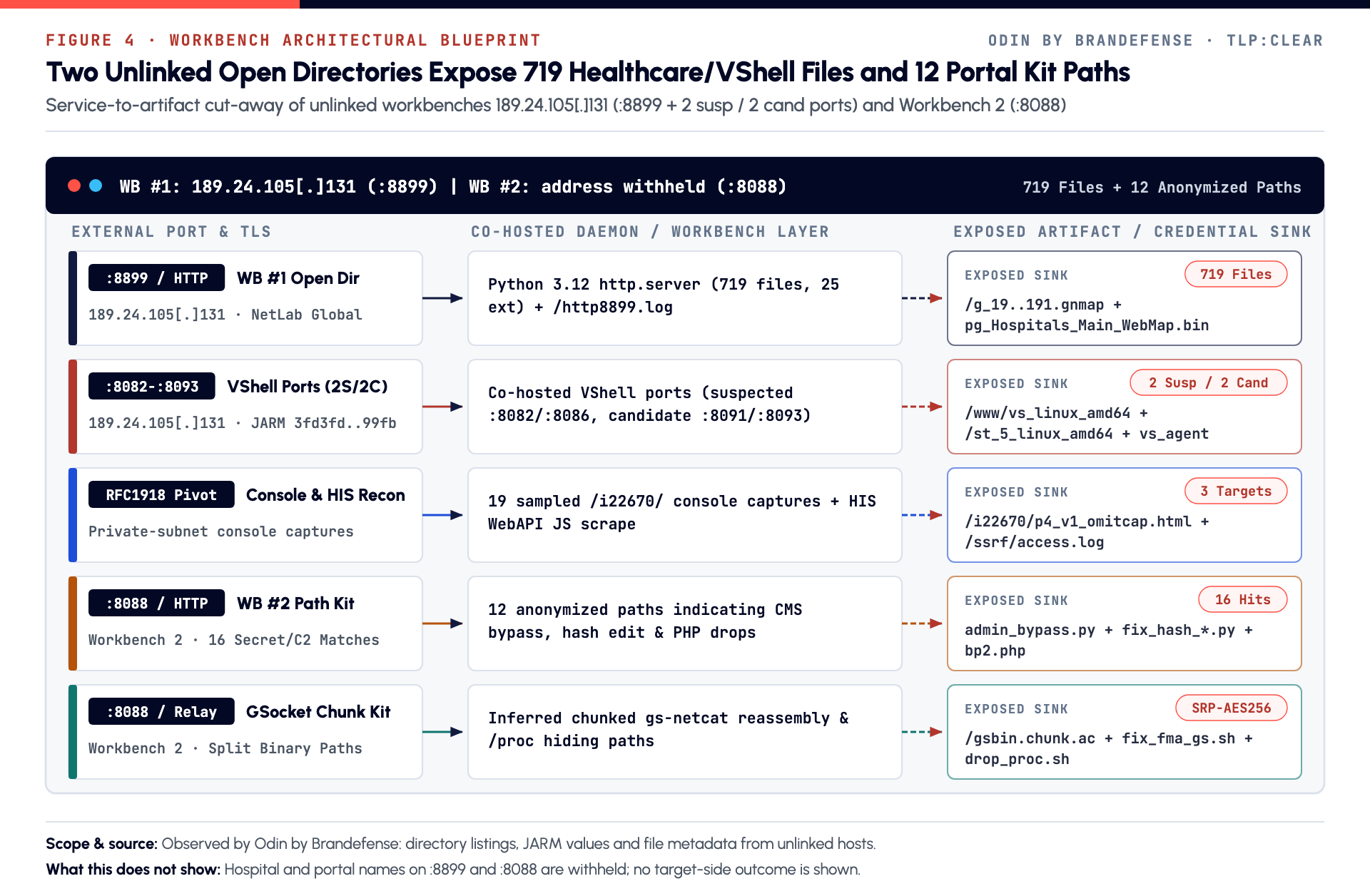
The server at 189.24.105[.]131 in Germany ran an open web directory on port 8899. Anyone could list its 719 files. All hospital names and the addresses of hosts that downloaded files are withheld in our research.
| What we found | Detail |
|---|---|
| Port scans | Five Nmap scan files covering web, VPN and admin ports |
| Hospital web maps | Cached copies of hospital login pages and mail endpoints |
| Scraped hospital system scripts | 285 JavaScript files, some from internal systems on a private network |
| Internal console login tests | 19 files testing whether a login works with the CAPTCHA removed or left empty |
| Implant stagers | A Windows VShell agent and two 9,800-byte Linux stagers |
VShell is a remote access implant that talks to its controller over WebSocket, the same protocol many web apps use for live updates. That makes its traffic easy to mistake for normal browsing.
The server's own access log carries timestamps on 31 October 2026. It records two outside hosts downloading the Windows agent with a successful response. The log shows the file was served. It does not show that it ran, or who the downloading hosts were.
The same address also showed two suspected and two candidate VShell listeners on other ports.
What did the second server suggest?
A second server on port 8088, whose address we withhold, listed 12 file paths. Their contents were not available, so we can only read the names and the 16 secrets and command-and-control references found in them.
The names point to three kinds of tools. Some are Python scripts named after a specific web portal, for login bypass and for editing stored password hashes. Others are PHP upload helpers and a script that may hide Linux processes.
The third group is the most unusual. It points to Global Socket, an open-source tool that lets two machines talk through public relay servers. Here the binary appears split into small chunks. Small pieces can slip past upload size limits and simple file scans, and a helper script would join them again on the server.
We cannot rule out a research lab or a decoy server here. That is why we withhold its address and recommend hunting for its file markers, not a declaration of intrusion. Nothing links this server to the first one.
Are the scanner fleets a threat?
Beyond the two servers, we counted 2,049 endpoints on 1,882 IPv4 addresses.
| Fleet | Endpoints | What it is |
|---|---|---|
| VShell | 769 | Suspected (282) or candidate (487) implant listeners; none confirmed |
| ARL | 425 | Open-source asset discovery console |
| Nessus | 422 | Commercial vulnerability scanner |
| Acunetix | 397 | Commercial web vulnerability scanner |
| reNgine | 36 | Open-source recon automation |
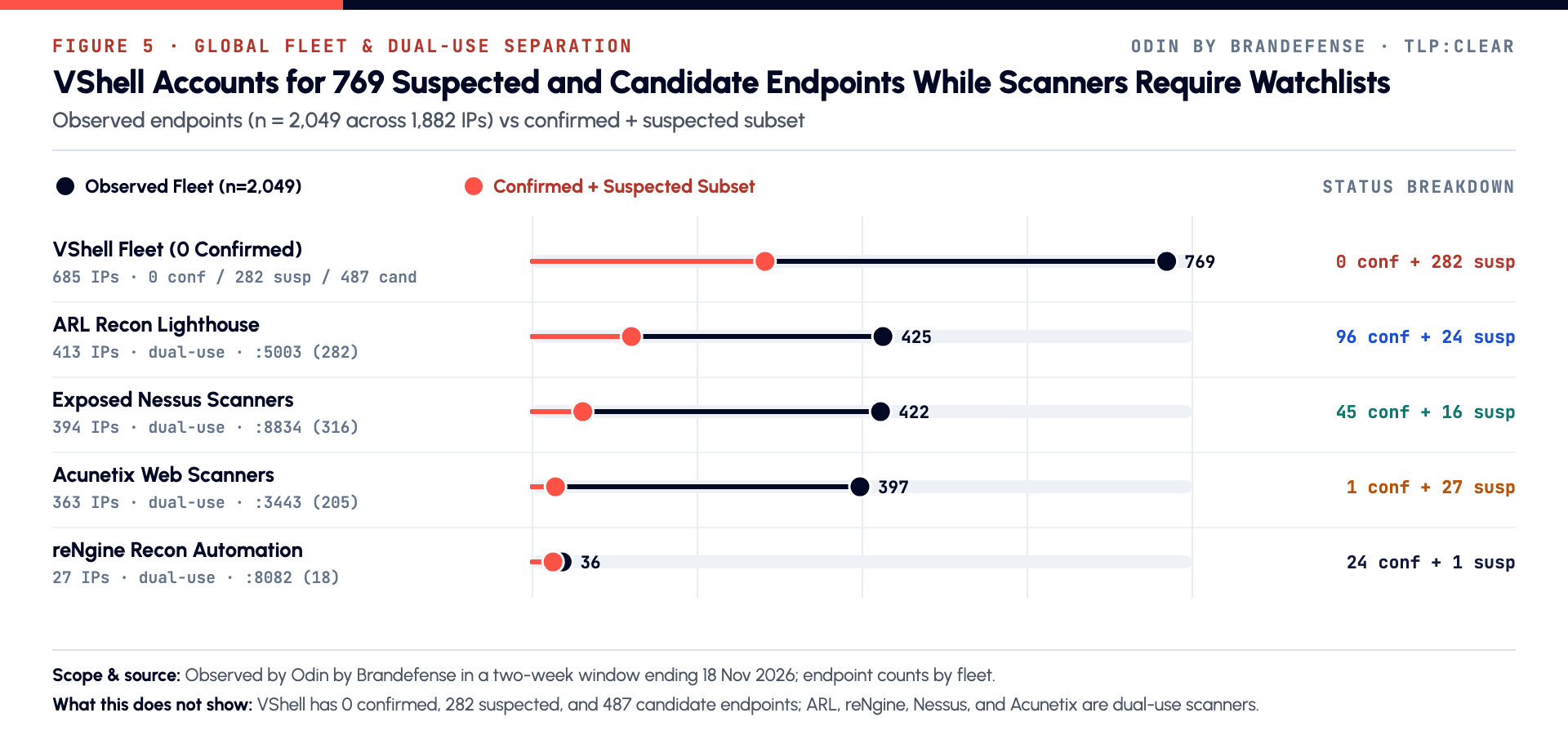
The scanners are dual-use. Attackers run them, but so do penetration testers and in-house security teams. A console on the internet does not tell you who owns it or whether they are allowed to scan you. Blocking all of them would catch your own vendors and add little protection.
The better approach is to watch these consoles and act on behavior. Rate-limit a source when it actually bursts requests at you. Treat suspected VShell listeners as leads for hunting until a second signal confirms them.
How do these pieces fit together?
We grouped the findings into four roles: mapping the surface, testing portal logins, keeping covert access, and probing internal consoles. This is an analytical model. It shows where each step can be detected. It does not claim one group ran both servers or that any target was breached.
The model matters because each role leaves a different trace. Scans show up at the firewall. Portal attacks show up as odd login postbacks and password-hash changes. Covert access shows up as relay DNS lookups, unusual WebSocket traffic and hidden processes on Linux servers.
What to do now
- Block the first workbench at 189.24.105[.]131 and hunt for the second one's file markers with the YARA rule. The full report's Indicators tab lists 4 indicators, including 3 file hashes.
- Alert on covert channels: DNS lookups for
*.gs.thc[.]org, connections togsocket[.]io, and outbound WebSocket upgrades to ports 8084, 9097 and 9999. - Harden portals: make CAPTCHA checks server-side, audit CMS user tables for unexpected password-hash changes, and remove web file-manager plugins.
- Fence off internal systems: keep hospital information systems and management consoles behind jump hosts, and block server-side requests from the web tier to private networks.
- Watch, do not block, scanner consoles: put ARL, reNgine, Nessus and Acunetix consoles on watchlists. The full report's Detection rules tab has Suricata, Sentinel KQL, Sigma and YARA rules.
The full report covers the file inventories, fingerprints, indicators and rule logic in detail.
What is…?
Short explanations of the tools and families named in this study.
What is VShell?
VShell is a remote access implant and C2 panel that talks over WebSocket and other transports. It is popular with Chinese-speaking operators.
More about VShellReconnaissance platformWhat is ARL?
ARL (Asset Reconnaissance Lighthouse) is an open-source asset discovery platform, popular with Chinese-speaking testers and attackers.
More about ARLReconnaissance platformWhat is reNgine?
reNgine is an open-source reconnaissance framework that chains tools such as subfinder, httpx and nuclei in containers.
More about reNgineTechniqueWhat is JARM?
JARM is an open TLS server fingerprinting method from Salesforce. It hashes how a server answers a set of crafted TLS handshakes.
More about JARMFrequently asked questions
What did the first server hold?
The server at 189.24.105[.]131 in Germany ran an open web directory on port 8899. Anyone could list its 719 files. All hospital names and the addresses of hosts that downloaded files are withheld in our research.
What did the second server suggest?
A second server on port 8088, whose address we withhold, listed 12 file paths. Their contents were not available, so we can only read the names and the 16 secrets and command-and-control references found in them.
Are the scanner fleets a threat?
Beyond the two servers, we counted 2,049 endpoints on 1,882 IPv4 addresses. The scanners are dual-use. Attackers run them, but so do penetration testers and in-house security teams. A console on the internet does not tell you who owns it or whether they are allowed to scan you. Blocking all of them would catch your own vendors and add little protection.
How do these pieces fit together?
We grouped the findings into four roles: mapping the surface, testing portal logins, keeping covert access, and probing internal consoles. This is an analytical model. It shows where each step can be detected. It does not claim one group ran both servers or that any target was breached.