


Key takeaways
- Single-signal C2 rules labelled 2,081 benign production servers as command-and-control.
- 1,592 MySQL databases on port 3306 were labelled confirmed Daybreak C2.
- 356 AWS load balancers share a TLS fingerprint with real Interactsh servers.
- 135 secret alerts came from unit tests and prompt archives, not live leaks.
- Only auto-block an indicator when certificate, protocol and network checks agree.
In a two-week observation window ending 18 November 2026, Odin by Brandefense found 2,081 cases where a C2 detection rule labelled a benign production server as command-and-control. The servers included an automaker's mTLS gateways, AWS load balancers, PHP 8.5 websites and MySQL databases. Another 135 secret-scanner alerts came from open-source test files. For a SOC that pushes threat feeds straight into firewall or EDR block lists, each of these is a block that could cut off a partner, a customer or its own cloud services.
Why do feeds get this wrong?
Each of these rules matched one surface trait. That trait might be a TLS fingerprint, an HTTP status code, a response header or an open port. Those traits describe server software, not intent. Thousands of legitimate servers share each one with some C2 framework.
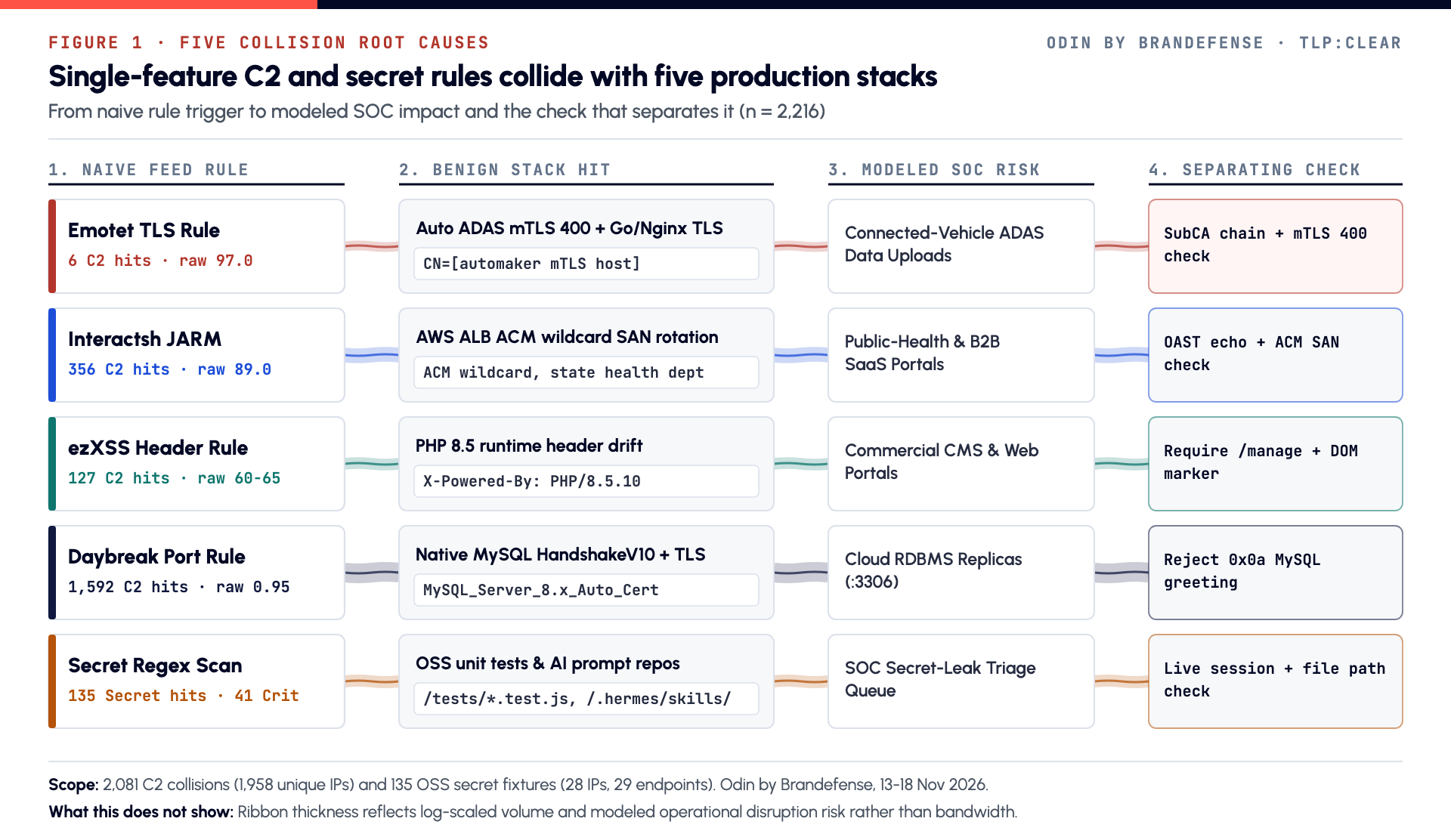
| What was hit | False C2 hits | Rule that fired | The trait it matched |
|---|---|---|---|
| A Chinese automaker's mTLS gateways | 6 | Emotet | An Nginx HTTP 400 page on a cloud network |
| AWS Application Load Balancers | 356 | Interactsh | A JARM fingerprint shared with real Interactsh servers on AWS |
| Websites upgraded to PHP 8.5.10 | 127 | ezXSS | A PHP version header and session cookie |
| MySQL servers on port 3306 | 1,592 | Daybreak | A short binary greeting and a self-signed certificate |
| Unit tests and prompt archives | 135 | Secret regex | Agent folder names and example keys |
The owners are anonymized in this report. None of them is malicious, and none of their addresses should be blocked.
Which collisions are the most dangerous?
The highest-scoring ones. One automaker gateway was labelled confirmed Emotet at a raw score of 97. The 356 load balancers scored 89. Many SOAR playbooks auto-block anything above a fixed score, so these are the hits most likely to become real blocks.
The automaker gateways demand a client certificate before they talk. A scanner without one gets HTTP 400 and the message "No required SSL certificate was sent". Old Emotet servers also returned short 400 pages, so a rule that only looked for "Nginx 400" fired on both.
The load balancers belong to SaaS firms, a cloud provider and a state public-health agency. 189 of them return the exact TLS fingerprint seen on Interactsh testing servers hosted on AWS. The fingerprint alone does not identify an Interactsh server.
Blocking them could stop vehicle data uploads or take a public-health portal offline for anyone behind the block. We did not see such an outage. It is the risk an unchecked feed creates.
How much of a raw feed is safe to block?
Less than one in six indicators. Of 25,482 raw indicators, 4,439 (17.4%) are confirmed C2. Of those, 3,916 (15.4%) are fit for a block list. The other 523 are real Interactsh servers, but Interactsh is a dual-use testing tool, so they belong in hunting.
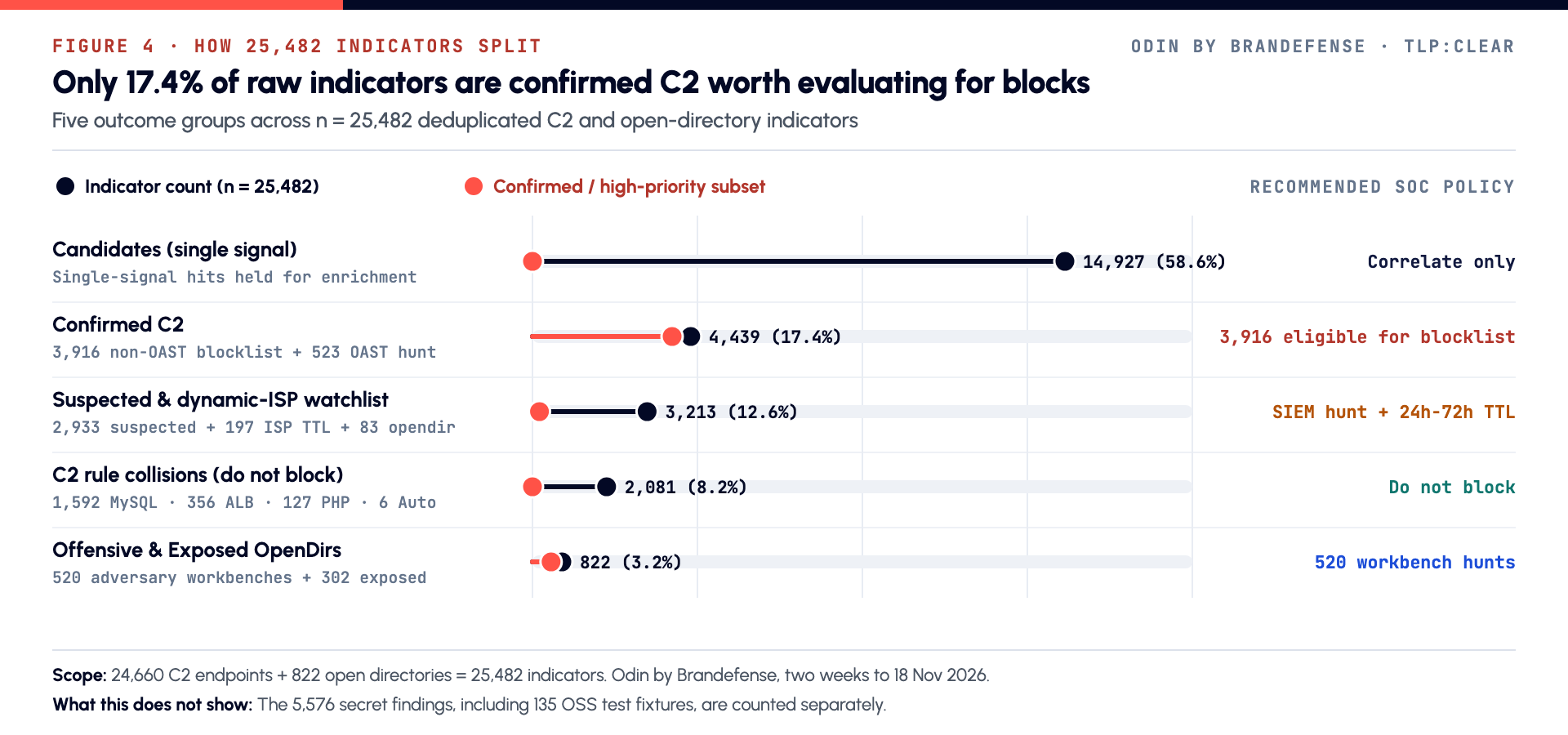
Before any checks, raw feeds for four frameworks carried false-positive rates from 9.7% (Emotet) to 94.5% (Daybreak). In the Daybreak feed, 1,592 of 1,684 actionable rows were plain MySQL servers. A MySQL server speaks first, sends a fixed greeting byte and creates its own certificate at startup. A loose C2 rule mistakes all three for a beacon.
Network type matters too. 197 C2 hits sat on home broadband and mobile networks, such as Chinanet, Chunghwa Telecom and Comcast. Those addresses change hands. A permanent block there may hit the next household, so these hits need watchlists that expire in 24 to 72 hours.
What about secret scanners?
The same problem shows up in secret scanning. Of 5,576 secrets and callback strings found in exposed directories, 135 were false alarms. Of those, 41 were rated critical.
They came from unit tests that use AWS's published example key AKIAIOSFODNN7EXAMPLE, from AI skill tutorials with placeholder passwords, and from public prompt archives. One was a standard Python cryptography self-test file.
The 135 fixtures slightly outnumber the 131 live AI agent session leaks in the same data. Without file-path context, fake secrets compete with real ones for analyst time. Real leaks still come first: a live credential in a test folder is still live.
What separates real C2 from a collision?
Real C2 passes several independent checks at once. A collision fails at least one.
- Certificate chain: real C2 in this study used self-signed certificates. The collisions chain to a corporate sub-CA or to Amazon.
- Application behaviour: a real ezXSS panel shows
/manage/loginand its collector script. A real Interactsh server reflects test IDs. - Protocol framing: a MySQL greeting on port 3306 is a database, not a beacon.
- Network type: subscriber pools get short watchlists, not blocks.
- File context: test folders and known example keys are not leaks.
What to do now
- Stop single-signal auto-blocking. Block only when certificate, protocol and network checks agree.
- Give each indicator type its own lifetime. Block confirmed C2 for 14 days, hunt OAST and suspected C2 for 7 days, and watch subscriber ISP hits for 24 to 72 hours.
- Pull known collisions out of block jobs today, starting with port-3306 Daybreak and header-only ezXSS indicators.
- Never allowlist a whole cloud network. It would also hide the 523 Interactsh servers on AWS.
- Test your filters. The Sentinel rule ships six do-not-block placeholder endpoints, and the full report's Detection rules tab has Suricata, Sentinel KQL, Sigma and YARA rules.
The full report covers each collision class, the rule logic and the confirmed C2 indicators in detail.
What is…?
Short explanations of the tools and families named in this study.
What is Interactsh?
Interactsh is ProjectDiscovery's open-source OAST server and client for catching DNS, HTTP and other callbacks.
More about InteractshDetection heuristicWhat is Daybreak?
Daybreak is a public JA4X-based C2 heuristic. On port 3306 it also matches ordinary MySQL servers, which makes it a well-known source of false positives.
More about DaybreakOffensive toolWhat is ezXSS?
ezXSS is an open-source collector for blind cross-site scripting (XSS) payloads. It records pages where a payload fires.
More about ezXSSMalware loaderWhat is Emotet?
Emotet is a long-running modular malware loader and botnet spread by malicious email attachments. It was disrupted by law enforcement in 2021 and later resurfaced.
More about EmotetTechniqueWhat is OAST?
Out-of-band application security testing (OAST) detects blind vulnerabilities by making a target call back to a server the tester controls, usually over DNS or HTTP.
More about OASTTechniqueWhat is JARM?
JARM is an open TLS server fingerprinting method from Salesforce. It hashes how a server answers a set of crafted TLS handshakes.
More about JARMFrequently asked questions
Why do feeds get this wrong?
Each of these rules matched one surface trait. That trait might be a TLS fingerprint, an HTTP status code, a response header or an open port. Those traits describe server software, not intent. Thousands of legitimate servers share each one with some C2 framework.
Which collisions are the most dangerous?
The highest-scoring ones. One automaker gateway was labelled confirmed Emotet at a raw score of 97. The 356 load balancers scored 89. Many SOAR playbooks auto-block anything above a fixed score, so these are the hits most likely to become real blocks.
How much of a raw feed is safe to block?
Less than one in six indicators. Of 25,482 raw indicators, 4,439 (17.4%) are confirmed C2. Of those, 3,916 (15.4%) are fit for a block list. The other 523 are real Interactsh servers, but Interactsh is a dual-use testing tool, so they belong in hunting.
What about secret scanners?
The same problem shows up in secret scanning. Of 5,576 secrets and callback strings found in exposed directories, 135 were false alarms. Of those, 41 were rated critical. They came from unit tests that use AWS's published example key AKIAIOSFODNN7EXAMPLE, from AI skill tutorials with placeholder passwords, and from public prompt archives. One was a standard Python cryptography self-test file.
What separates real C2 from a collision?
Real C2 passes several independent checks at once. A collision fails at least one.