


Key takeaways
- Five legitimate tools can stage an attack before any malware lands: a traffic gate, an RMM server and three relay tools.
- An estimated 57 Keitaro servers look like cloaking gates rather than marketing.
- An estimated 338 TacticalRMM servers sit on fresh disposable domains, where a signed agent gives remote access.
- Only three hosts are confirmed adversary infrastructure; the rest belong on watchlists, not block lists.
- Allowlist approved RMM domains and alert when a browser visit is followed by an installer launch.
In a two-week observation window ending 18 November 2026, Odin by Brandefense studied five tools that attackers can use before any malware reaches a machine. They are a marketing traffic gate, a remote-management suite, a hardware implant controller and two tunneling tools. None of them is malware, and all have legitimate users. Of 5,892 endpoints running them, an estimated 526 deserve attention, and only three are confirmed adversary infrastructure. For defenders, the lesson is to control these tools by policy, not by blind blocking.
What are these tools, and why do attackers want them?
Each tool fills one step of an access chain. We measured the five populations separately, so the chain below is a model, not one observed campaign.
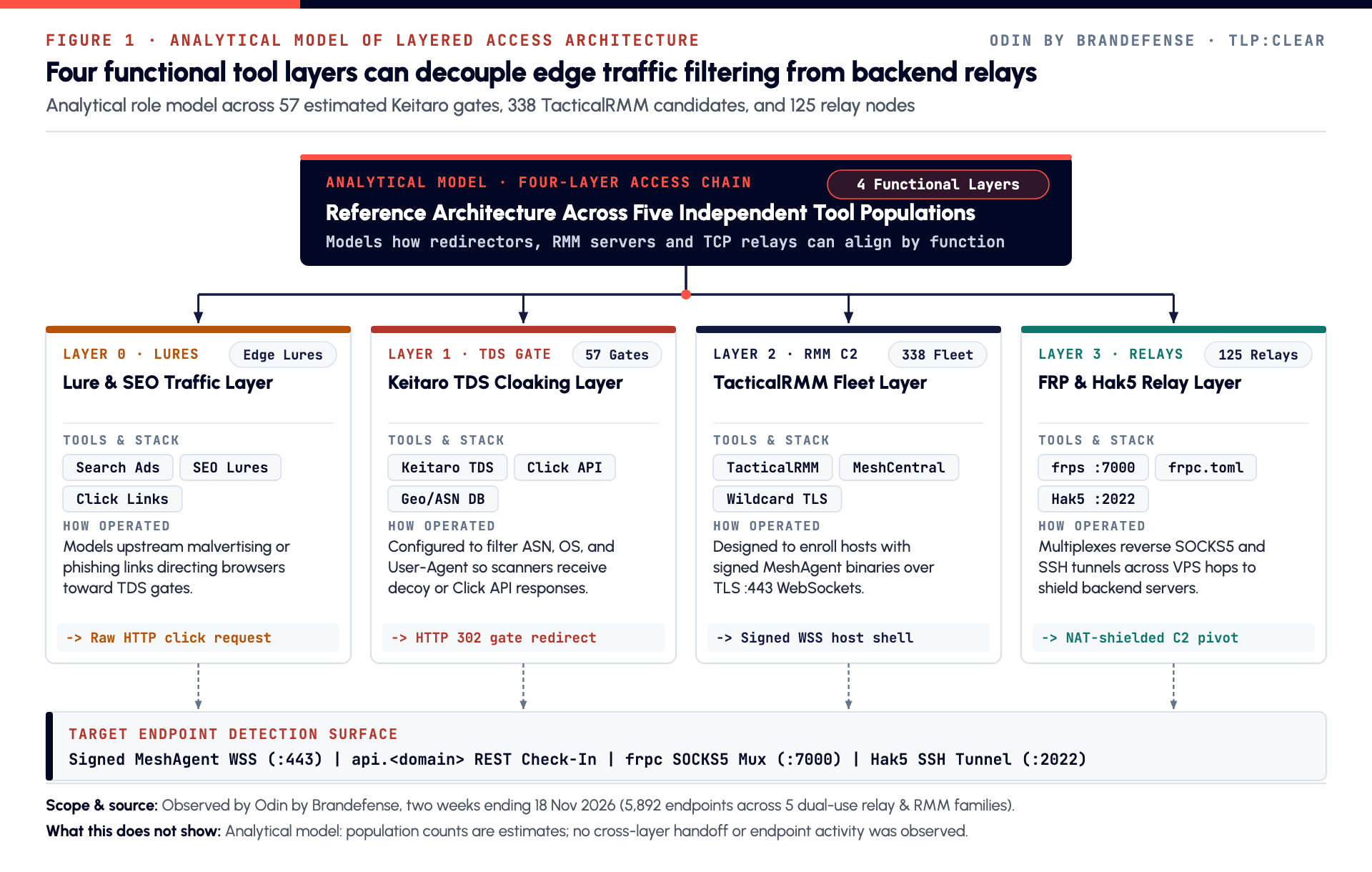
| Tool | What it is built for | What an attacker gets |
|---|---|---|
| Keitaro TDS | Routing ad traffic to campaign pages | A gate that sends sandboxes to a harmless page and real targets to an installer |
| TacticalRMM | Remote IT support for many machines | A signed agent with a remote shell over normal HTTPS |
| Hak5 Cloud C2 | Managing Hak5 test hardware | A controller for implants and SSH tunnels on port 2022 |
| FRP | Exposing internal services through a cloud relay | A tunnel that hides the operator's own server |
| ReverseSSH | ReverseSSH shells on any port | An interactive shell on firewall-friendly ports |
The appeal is simple. Security tools often stop unsigned malware. They are less likely to stop a signed remote-management agent or a marketing redirect.
How many look hostile?
Very few, once legitimate use is set aside.
| Tool | Estimated candidates |
|---|---|
| Keitaro TDS | 57 |
| TacticalRMM | 338 |
| Hak5 Cloud C2 | 11 |
| FRP relays | 114 |
| ReverseSSH | 6 |
The 57 Keitaro candidates fall into three clusters. Some use a templated certificate named SolidityGameServer on paired ports. Some use fresh default certificates on cheap VPS hosts. Others sit on domains that imitate ad or CDN services. Their redirects are visible, but not where they lead.
The 338 TacticalRMM candidates sit on newly registered .online, .xyz, .top or duckdns[.]org domains. Real IT providers run TacticalRMM on domains that are years old. We set aside 158 such servers.
A TacticalRMM server uses three names: rmm. for the console, api. for agent enrollment and mesh. for remote sessions. One wildcard certificate usually covers all three. Once a machine is enrolled, the signed MeshAgent.exe opens a WebSocket on port 443. To a firewall, that looks like ordinary web traffic. This is why the domain behind the connection matters more than the software itself.
Of the 114 FRP relays, 86 (75.4%) leave their admin dashboard open on port 7500. China hosts 70.2% of them. Four open web folders held relay settings, a watchdog script, a key dump and an exploit playbook. Whether their owners are attackers or lab administrators is unknown.
Which hosts should be blocked?
Only three hosts carry a second, independent sign of hostile use:
- 146.190.211[.]163 on DigitalOcean (US) runs Hak5 Cloud C2 next to a GoPhish phishing server.
- 77.111.101[.]84 on Latitude.sh (BR) hides an SSH shell inside TLS, with a certificate named after its own address.
- 165.154.199[.]52 on Scloud (SG) shows the same pattern and the same TLS fingerprint.
Everything else belongs on a watchlist. A Keitaro gate may be an aggressive marketer. A TacticalRMM server may be a small IT provider. An FRP relay may be a developer's test tunnel. Some lookalikes are plainly benign: eight "ReverseSSH" matches were mail servers, and two Hak5 servers carry CN=pentest certificates that suggest authorized testing. One TacticalRMM host sits on home broadband, where addresses change hands, so it gets a watchlist entry that expires after 24 hours.
How do defenders catch this without breaking IT?
Start from what your organization approves. If only your MSP's RMM domains are allowed, any other TacticalRMM or MeshCentral traffic stands out at once.
Then link events across the chain. A browser visit to a fresh disposable domain, followed within five minutes by msiexec.exe, PowerShell or an RMM agent, is a strong lead. Our Sentinel query does this join. Suricata rules watch for Keitaro redirect cookies, TacticalRMM enrollment, MeshCentral WebSocket relays, plaintext FRP logins and ReverseSSH banners. Sigma rules flag unapproved tacticalrmm.exe, MeshAgent.exe and frpc processes even when FRP traffic is encrypted.
Encryption limits what the network can see. Newer FRP versions encrypt their login by default, and the two confirmed ReverseSSH hosts wrap SSH inside TLS. For these, the certificate is the giveaway: a common name made of an IP address and port is a strong second signal.
What to do now
- Block the three confirmed hosts named under "Which hosts should be blocked?", and keep watchlist entries out of automatic block feeds.
- Allowlist approved RMM domains at DNS and the proxy, and block unapproved
tacticalrmm.exe,MeshAgent.exeandfrpc.exewith application control, even when signed. - Alert on browser-to-installer chains within five minutes, starting with fresh
.xyz,.top,.onlineandduckdns[.]orgdomains. - Restrict workstation egress on relay ports 2022, 3232, 4430, 7000, 7500 and 17500.
- Deploy the rules in the full report's Detection rules tab, and take the full indicator list from the full report's Indicators tab.
The full report covers the tool layouts, fingerprints, indicators and rule logic in detail.
What is…?
Short explanations of the tools and families named in this study.
What is FRP?
Fast Reverse Proxy (FRP) is an open-source tool that exposes services behind NAT through a public relay server.
More about FRPRemote managementWhat is TacticalRMM?
TacticalRMM is an open-source remote monitoring and management (RMM) suite built on MeshCentral. MSPs use it, and attackers abuse it for signed, persistent access.
More about TacticalRMMTraffic distributionWhat is Keitaro?
Keitaro is a commercial traffic direction system (TDS) for ad campaigns. Attackers use TDS gates to filter victims and hide malicious pages from scanners.
More about KeitaroTunneling toolWhat is ReverseSSH?
ReverseSSH is an open-source tool that gives an operator an SSH shell through a connection the target opens outward.
More about ReverseSSHDevice controllerWhat is Hak5 Cloud C2?
Hak5 Cloud C2 is a controller for Hak5 implant devices, such as drop boxes, that call home over the internet.
More about Hak5 Cloud C2Remote managementWhat is MeshCentral?
MeshCentral is an open-source web server for remote device management and desktop control.
More about MeshCentralFrequently asked questions
What are these tools, and why do attackers want them?
Each tool fills one step of an access chain. We measured the five populations separately, so the chain below is a model, not one observed campaign. The appeal is simple. Security tools often stop unsigned malware. They are less likely to stop a signed remote-management agent or a marketing redirect.
How many look hostile?
Very few, once legitimate use is set aside. The 57 Keitaro candidates fall into three clusters. Some use a templated certificate named SolidityGameServer on paired ports. Some use fresh default certificates on cheap VPS hosts. Others sit on domains that imitate ad or CDN services. Their redirects are visible, but not where they lead.
Which hosts should be blocked?
Only three hosts carry a second, independent sign of hostile use: Everything else belongs on a watchlist. A Keitaro gate may be an aggressive marketer. A TacticalRMM server may be a small IT provider. An FRP relay may be a developer's test tunnel. Some lookalikes are plainly benign: eight "ReverseSSH" matches were mail servers, and two Hak5 servers carry CN=pentest certificates that suggest authorized testing.
How do defenders catch this without breaking IT?
Start from what your organization approves. If only your MSP's RMM domains are allowed, any other TacticalRMM or MeshCentral traffic stands out at once. Then link events across the chain. A browser visit to a fresh disposable domain, followed within five minutes by msiexec.exe, PowerShell or an RMM agent, is a strong lead. Our Sentinel query does this join.