
Key takeaways
- Operation LedgerSwarm tracks one operator's ARTEX campaign across 76 organizations in 18 verticals, staged behind a Swedish relay VPS fronting a second server.
- Payments and Fintech (21) and Web3, DeFi, and Stablecoin (20) make up 53.9% of targets and 85.5% of the 10.8 billion input tokens across 39 metadata tasks.
- On 9 and 10 November 2026, the operator updated task templates to lock subagents to whitelisted domains and forbid touching neighbouring addresses.
- The swarm's 6,124 claimed findings (941 critical, 2,173 high) are unverified LLM labels; 61 staged follow-up scripts show operator intent, not confirmed target-side execution.
- Remove front-end secrets, replace static cloud keys with short-lived tokens, lock bucket writes to CI/CD accounts, and alert on 25-URI scan bursts.
Operation LedgerSwarm covers one operator's autonomous agent campaign across 76 target organizations, 10.8 billion language model input tokens across 39 tasks, and 61 follow-up scripts. Odin by Brandefense analyzed the exposed archive during a two-week observation window ending 18 November 2026. For payments, Web3, banking, and exchange teams, the campaign shows how AI-assisted intrusions work in practice. Parallel worker pools sweep subdomains and JavaScript bundles first, and a human operator scripts custom follow-ups when cloud keys surface.
How was Operation LedgerSwarm structured, and how does it relate to ARTEX?
On 13 November 2026, the FBI (FLASH-20261113-001) warned that threat actors worldwide had adopted ARTEX, an open-source Go and Next.js autonomous testing framework. Earlier in November, Censys documented 1,465 hosts running exposed ARTEX consoles; external attack surface management helps defenders find such hosts. Microsoft reported in October that Storm-0940 used ARTEX in cloud supply-chain intrusions. Those disclosures describe the public tool, not one group: many unrelated operators use ARTEX, and nothing ties Storm-0940 to Operation LedgerSwarm.
This report isolates one operator's campaign staged behind a VPS in Sweden acting as a relay in front of a second server. Both server addresses, every archive path, and all target names, domains, and task names are withheld because the archive still exposes victim data. Monograph 11 covered ARTEX's four-pool worker design, and Monograph 30 examined the operator's Google Cloud Storage-to-WordPress pax_cmd scripts. Monograph 53 connects the whole campaign for cyber threat intelligence and defense teams.
How fast and how large did the campaign grow?
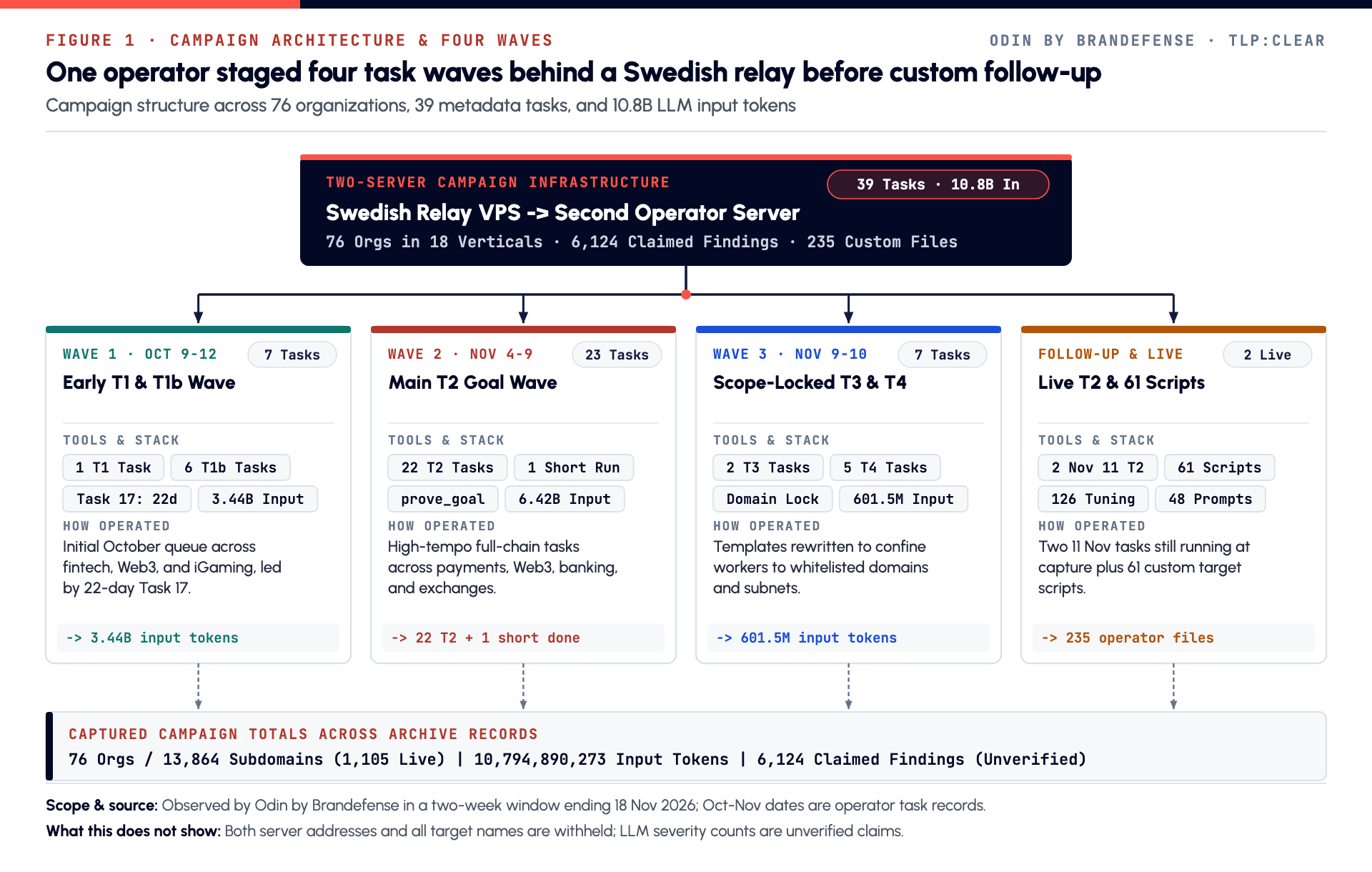
Dates before our November observation window come from task creation and completion records inside the operator's controller. Across 39 partially captured task records carrying full metadata (37 finished and 2 still running), the swarm consumed 10,794,890,273 input tokens and 132,372,680 output tokens. That 81.5-to-1 input-to-output ratio happens because subagents feed raw web responses, JavaScript bundles, and tool logs into the model on every step.
| Campaign wave in operator records | Dates | Tasks | Notes |
|---|---|---|---|
First wave (T1 and T1b templates) | 9 to 12 October 2026 | 7 | Includes the longest task (Task 17, 12 Oct to 3 Nov, 3,435,726,060 input tokens) |
Main wave (T2 prove_goal + 1 short run) | 4 to 9 November 2026 | 23 | 22 completed T2 tasks plus 1 five-second unnamed run (24 T2 tasks overall incl. 11 Nov) |
Scope-restricted wave (T3 and T4) | 9 to 10 November 2026 | 7 | Confines workers to whitelisted target domains and forbids neighbouring addresses |
Still running in the captured list (T2) | Created 11 November 2026 | 2 | One British banking task and one Lithuanian Web3 task active at capture |
Three tasks burned 58.7% of all input tokens: Task 17 (GB payments, 3.44 billion), Task 145 (NL payments, 1.57 billion), and Task 133 (US Web3, 1.34 billion). On 9 and 10 November, the operator rewrote templates (T3 and T4) to lock workers to whitelisted domains and forbid touching neighbouring addresses. Generating less noise and hitting fewer unintended third-party hosts on shared subnets are plausible hypotheses, though the logs state no motive.
Why did payments, Web3, and exchanges take most of the effort?
Across the 76 target organizations in 18 verticals (Monograph 11 Chapter 6), the swarm enumerated 13,864 subdomains and found 1,105 live FQDNs. Payments and Fintech (21 organizations) and Web3, DeFi, and Stablecoin (20 organizations) represent 53.9% of all targets. Enterprise Tech (11), iGaming (10), Banking and Insurance (8), and Crypto Exchanges (6) account for the rest. The archive records 2,178 worker runs on one crypto-exchange task and 1,231 worker runs on the iGaming task.
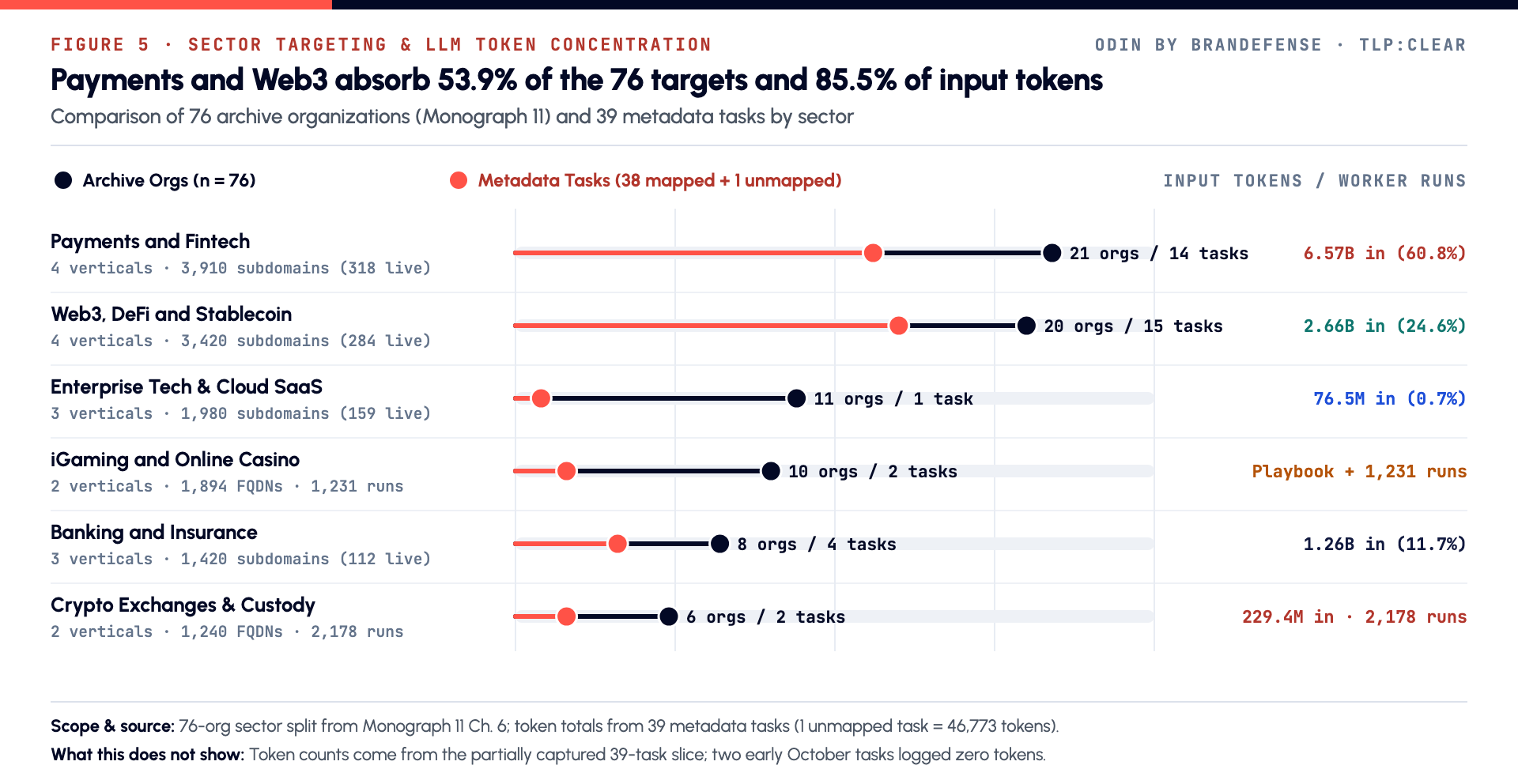
Concentration is even sharper across the 39 metadata tasks. Web3 (15 tasks, 2.66 billion tokens) and Payments (14 tasks, 6.57 billion tokens) represent 29 tasks (74.4%) and 85.5% of input tokens. Add Banking and insurance (4 tasks) and Crypto exchanges and custody (2 tasks), and financial or digital-asset targets absorb 99.3% of input tokens across 12 named countries. Wide API surfaces, public SDK repositories, and exposed .env or JavaScript secrets make these sectors prime targets.
Were the 6,124 findings real breaches, or could this be an authorized red team?
Neither assumption holds up. Across 141 task IDs plus 85 unassigned items, the swarm logged 6,124 claimed findings (941 critical, 2,173 high, 2,161 medium, 837 low, 12 info).
It also labeled 35 of 76 organization scopes critical (17) or high (18). Those are LLM classifications of tool output, not verified breaches. The archive also holds 61 dedicated target scripts, 126 swarm-tuning files, and 48 prompt and skill documents.
Although prompt files describe the work as authorized penetration testing (a standard way to keep LLMs from refusing offensive tasks), Odin found no evidence of authorization. The staged playbook would expose a WordPress site to anyone if its pax_cmd gate were planted with a stolen cloud key. Combined with the Swedish relay across 14+ countries and target-side cleanup instructions, the evidence weighs against an authorized red team.
What to do now
- Remove secrets from front-end code and repositories. Strip API keys, RPC tokens, and
.envor.git/configfiles from web roots and JavaScript bundles, block/.envand/.git/at the WAF, and rotate exposed credentials. - Replace static cloud keys with short-lived credentials. Revoke workstation service-account JSON keys, block new key creation by policy, and move CI/CD jobs to short-lived federated tokens.
- Lock storage buckets that feed web roots. Allow writes to theme and asset buckets only from named deployment identities, disable PHP execution on media mounts, and block
pax_cmdrequests at the WAF. - Throttle APIs and alert on URI bursts. Apply rate limits and bot detection on
/api/and/graphqlroutes, turn off production GraphQL introspection, and alert when one source hits 25 or more distinct URIs in five minutes.
The full report's Indicators tab lists 2 follow-up script SHA-256 hashes (0 network addresses), and the full report's Detection rules tab provides Suricata, Sentinel KQL, Sigma, and YARA rules.
What is…?
Short explanations of the tools and families named in this study.
What is ARTEX?
ARTEX is an autonomous red-team console that chains AI agents and security tools. Operators fork and rebrand it; its default listener port is 8787.
More about ARTEXBackdoor parameterWhat is pax_cmd?
pax_cmd is the request parameter used by a WordPress theme backdoor described in Monograph 30. Any request carrying it can run commands on the server.
More about pax_cmdFrequently asked questions
How was Operation LedgerSwarm structured, and how does it relate to ARTEX?
On 13 November 2026, the FBI (FLASH-20261113-001) warned that threat actors worldwide had adopted ARTEX, an open-source Go and Next.js autonomous testing framework. Earlier in November, Censys documented 1,465 hosts running exposed ARTEX consoles; external attack surface management helps defenders find such hosts. Microsoft reported in October that Storm-0940 used ARTEX in cloud supply-chain intrusions.
How fast and how large did the campaign grow?
Dates before our November observation window come from task creation and completion records inside the operator's controller. Across 39 partially captured task records carrying full metadata (37 finished and 2 still running), the swarm consumed 10,794,890,273 input tokens and 132,372,680 output tokens. That 81.5-to-1 input-to-output ratio happens because subagents feed raw web responses, JavaScript bundles, and tool logs into the model on every step.
Why did payments, Web3, and exchanges take most of the effort?
Across the 76 target organizations in 18 verticals (Monograph 11 Chapter 6), the swarm enumerated 13,864 subdomains and found 1,105 live FQDNs. Payments and Fintech (21 organizations) and Web3, DeFi, and Stablecoin (20 organizations) represent 53.9% of all targets. Enterprise Tech (11), iGaming (10), Banking and Insurance (8), and Crypto Exchanges (6) account for the rest. The archive records 2,178 worker runs on one crypto-exchange task and 1,231 worker runs on the iGaming task.
Were the 6,124 findings real breaches, or could this be an authorized red team?
Neither assumption holds up. Across 141 task IDs plus 85 unassigned items, the swarm logged 6,124 claimed findings (941 critical, 2,173 high, 2,161 medium, 837 low, 12 info). It also labeled 35 of 76 organization scopes critical (17) or high (18). Those are LLM classifications of tool output, not verified breaches. The archive also holds 61 dedicated target scripts, 126 swarm-tuning files, and 48 prompt and skill documents.